Introduction – Evolution and the History of Life
Evolution Class 12 Biology: Introduction and Exam Focus
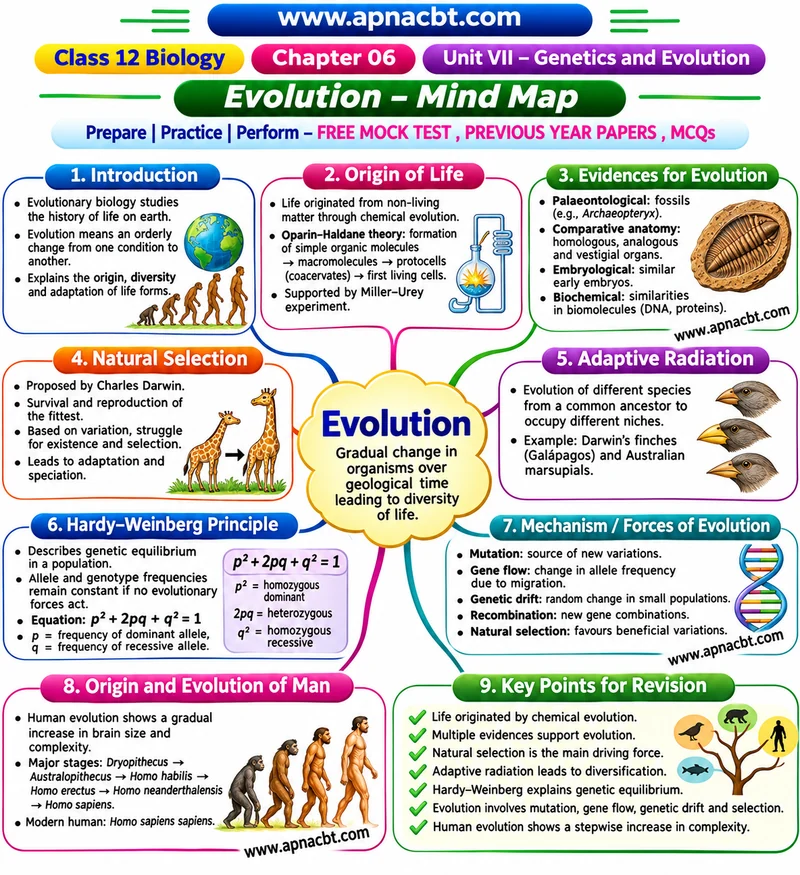
Evolution refers to the orderly change in living organisms over generations and the historical development of life forms on Earth. Evolutionary biology studies how present-day organisms are related to earlier forms, how variations arise and how populations change over long periods. For CBSE Board Exams and NEET preparation, this chapter is especially important for the origin of life, evidences of evolution, adaptive radiation, Darwin’s natural selection, mutation, Hardy-Weinberg equilibrium and the broad sequence of human evolution.
The source material describes evolution as a long history involving the origin of life and the subsequent diversification of living forms. It also connects evolutionary change with variation, reproduction, survival and changes in gene or allele frequencies in populations.
Exam focus: Learn the distinction between homologous and analogous organs, understand fossils and embryological evidence, practise the Hardy-Weinberg equation, remember the factors disturbing genetic equilibrium, and revise the important stages in human evolution.
Origin of Life – From the Early Earth to First Cellular Forms
The universe is described as almost 13.8 billion years old, while Earth formed about 4.5 billion years ago. The Big Bang theory proposes that the universe originated from a huge explosion and subsequently expanded and cooled. Hydrogen and helium formed later, and gravitation led to the formation of galaxies. Earth was initially hot and barren, and conditions later changed sufficiently for life to originate from non-living matter.
Early atmosphere and chemical evolution
The chapter discusses the idea that early Earth lacked free oxygen and had a reducing atmosphere containing gases such as methane, ammonia, hydrogen and water vapour. Oparin and Haldane proposed that life could arise through gradual chemical evolution from non-living molecules. Energy from sources such as lightning and ultraviolet radiation could support chemical reactions that produced organic molecules.
Miller’s experiment
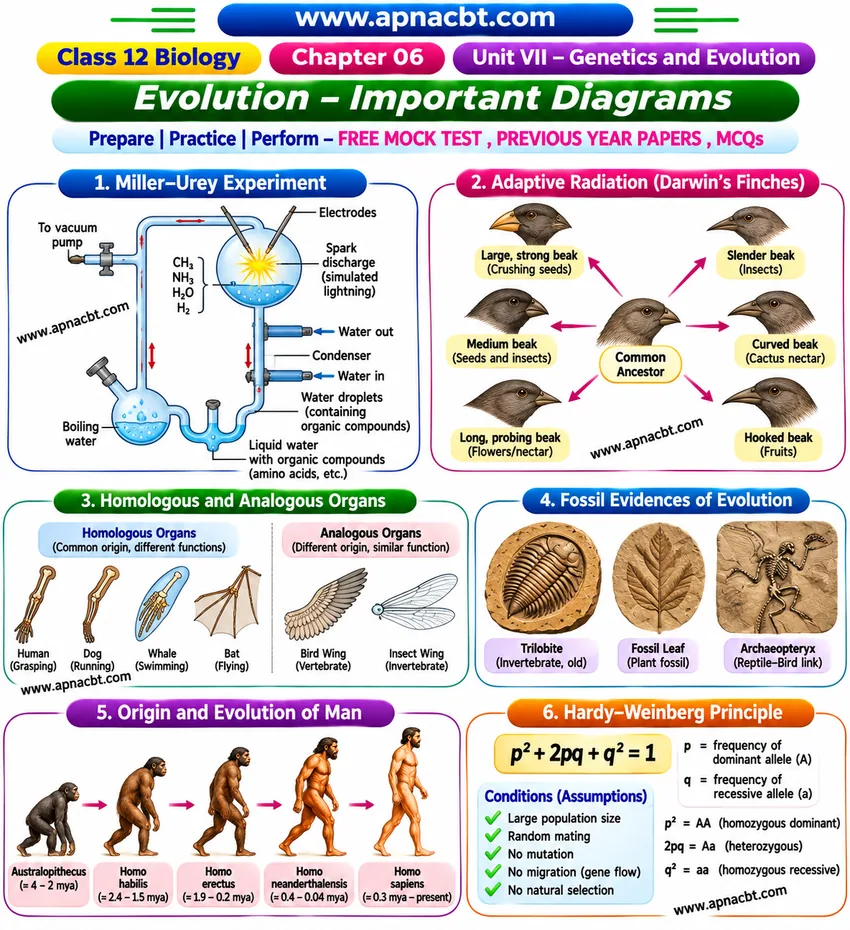
S. L. Miller in 1953 simulated conditions thought to resemble the early Earth in a laboratory apparatus. A mixture containing methane, hydrogen, ammonia and water vapour was exposed to electrical discharges. Amino acids were formed, providing experimental support for the possibility of chemical synthesis of organic molecules under primitive-Earth-like conditions.
From molecules to cells
The source describes the appearance of giant molecules and later the first cellular forms. The exact mechanism by which non-cellular aggregates became cells with membranes is not known. The earliest cellular forms were probably simple single-celled organisms, and some early cells later acquired the ability to release oxygen.
Important theories
- Panspermia: life units were proposed to have reached Earth from elsewhere.
- Biogenesis: life arises from pre-existing life; Pasteur supported this principle.
- Chemical evolution: Oparin-Haldane proposed gradual development from non-living molecules.
Evidences for Evolution – Fossils, Homology and Embryology
Evolution is supported by fossils, comparative anatomy, embryology and molecular evidence, which together reveal historical relationships among organisms.
Palaeontological evidence
Fossils are preserved remains, impressions or traces of organisms from the past. Fossils provide a record of organisms that lived during earlier geological periods and help reconstruct the history of life. The geological record also shows that different groups appeared at different times.
Homologous organs
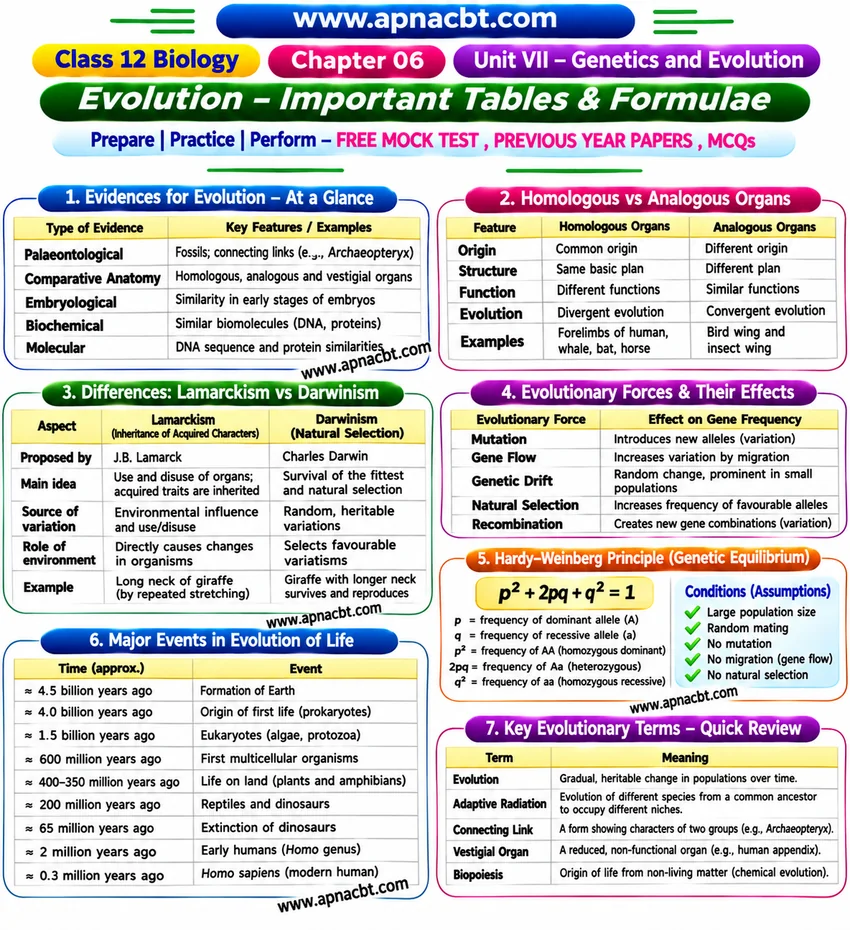
Homologous organs have a common basic structural plan but may perform different functions. The forelimbs of humans, whales, bats and other vertebrates show a common underlying skeletal pattern. Homology indicates common ancestry and is an example of divergent evolution.
Analogous organs
Analogous organs perform similar functions but have different structural origins. Wings of birds and butterflies are a standard example. Such similarities arise independently and illustrate convergent evolution rather than common structural origin.
Embryological and molecular evidence
Similarities in embryonic development can indicate common ancestry. At the molecular level, similarities in DNA and protein sequences can also be used to infer evolutionary relationships. Greater molecular similarity generally indicates closer evolutionary relationship.
Board tip: In comparison questions, remember: homology → common ancestry → divergent evolution, while analogy → similar function with different origin → convergent evolution.
Darwin, Natural Selection and the Mechanism of Evolution
Charles Darwin developed the theory of natural selection after observing variations among organisms and their adaptations. During his voyage on HMS Beagle, Darwin observed the diversity of organisms, including finches on the Galápagos Islands. Alfred Russel Wallace independently reached similar conclusions about natural selection.
Darwin’s central ideas
- Organisms produce more offspring than can survive.
- Individuals show heritable variations.
- Resources are limited, producing a struggle for existence.
- Individuals with advantageous heritable variations are more likely to survive and reproduce.
- Over generations, favourable variations become more common in populations.
Natural selection
Natural selection is differential survival and reproduction of individuals because of heritable variation. It changes the composition of populations over generations. The source explains reproductive fitness in terms of the contribution of individuals to the next generation.
Types of natural selection
| Type | Result |
|---|---|
| Stabilising selection | Individuals near the mean are favoured and extremes are reduced. |
| Directional selection | One extreme phenotype is favoured, shifting the population distribution. |
| Disruptive selection | Both extremes are favoured over the intermediate phenotype. |
Industrial melanism
Industrial melanism in peppered moth populations is an example used to illustrate natural selection. Changes in environmental conditions can alter which colour forms are better camouflaged and therefore more likely to survive and reproduce.
For Evolution Class 12 Biology, natural selection and reproductive fitness are high-value concepts for both board and entrance examinations.
Adaptive Radiation and Convergent Evolution
Adaptive radiation refers to the evolution of different species from a common ancestral form in response to different environmental conditions or ecological opportunities. The resulting species become adapted to different niches.
Darwin’s finches
Darwin’s finches of the Galápagos Islands are a classic example. Different finch populations evolved different beak forms associated with different food resources. They demonstrate diversification from a common ancestral stock.
Australian marsupials
The diversification of Australian marsupials is another example discussed in evolutionary biology. Different marsupials adapted to different ecological roles.
Convergent evolution
Unrelated organisms can independently evolve similar adaptations under similar environmental pressures.
Mutation, Recombination and Sources of Variation
Variation is essential for evolutionary change. Mutations introduce new genetic changes, while recombination creates new combinations of existing genetic material. Gene flow and genetic drift can also alter the genetic composition of populations.
Mutation theory
Hugo de Vries studied mutations in Oenothera lamarckiana and proposed that large mutations, or saltations, could contribute to the formation of new species. In the source, Darwin’s view is contrasted with de Vries: Darwin emphasised gradual change, whereas de Vries gave greater importance to mutation and saltation.
Genetic recombination
Recombination during gamete formation can create new combinations of alleles. Such variation can influence survival and reproductive success when populations experience natural selection.
Genetic drift and founder effect
Genetic drift is a chance change in allele frequency, especially important in small populations. When a small group establishes a new population, the new population may carry only a subset of the original gene pool. This is called the founder effect.
Gene flow
Migration between populations can introduce or remove alleles and change allele frequencies.
Hardy-Weinberg Principle – Genetic Equilibrium and Evolution
The Hardy-Weinberg principle provides a population-genetics model for genetic equilibrium. It states that allele frequencies in a population remain constant from generation to generation when the conditions required for equilibrium are maintained.
Basic equation
For a gene with two alleles, A and a, let the frequencies be p and q. Then:
p + q = 1
The expected genotype frequencies are:
p² + 2pq + q² = 1
- p² = frequency of AA
- 2pq = frequency of Aa
- q² = frequency of aa
Conditions for equilibrium
The idealised equilibrium requires a sufficiently large population, random mating and absence of factors that change allele frequencies. Disturbance of equilibrium indicates evolutionary change in the population.
Five important evolutionary forces
- Gene migration or gene flow
- Genetic drift
- Mutation
- Genetic recombination
- Natural selection
NEET calculation tip: If the recessive phenotype frequency is known, it can represent q² when the recessive phenotype corresponds to homozygous recessive individuals. Take the square root to obtain q, then calculate p = 1 − q and the other genotype frequencies.
For Evolution Class 12 Biology, practise the Hardy-Weinberg equation with simple allele-frequency problems.
A Brief Account of Evolution – Geological History and Major Transitions
The history of life involves a sequence of major biological transitions. The source material describes early cellular life, oxygen release by some cells, the appearance of diverse life forms and the development of major groups through geological time.
Important broad milestones
- Earth formed about 4.5 billion years ago.
- Life originated from non-living matter under early-Earth conditions.
- Early cellular forms appeared later in Earth’s history.
- Some early cells developed the ability to release oxygen, contributing to changes in the atmosphere.
- Major groups diversified over geological time.
- Plants and animals subsequently occupied increasingly diverse ecological niches.
Evolution is branching, not a simple ladder
Evolution should not be interpreted as a straight ladder in which one modern organism necessarily changes directly into another modern organism. Populations branch, diverge and may become extinct. Present-day organisms can share common ancestors while following different evolutionary pathways.
Origin and Evolution of Man – Major Hominin Stages
Human evolution is presented as a branching evolutionary history involving several hominins and related primates. The source material highlights important forms such as Dryopithecus, Ramapithecus, Australopithecus, Homo habilis, Homo erectus, Neanderthal man and Homo sapiens.
Important stages for revision
| Form | Key point for exam revision |
|---|---|
| Dryopithecus | Ape-like primate associated with the evolutionary history of higher primates. |
| Ramapithecus | Early hominid form discussed in the historical sequence of human evolution. |
| Australopithecus | Early hominid; associated with upright posture and early tool use in the chapter’s account. |
| Homo habilis | Associated with early tool-making and increased brain development. |
| Homo erectus | More advanced hominin; associated with larger brain and use of fire in standard NCERT account. |
| Neanderthals | Archaic humans with substantial brain capacity; lived in Eurasia before modern humans became widespread. |
| Homo sapiens | Modern humans; developed advanced cultural and technological capacities. |
The broad sequence used for exam revision is Dryopithecus → Ramapithecus → Australopithecus → Homo habilis → Homo erectus → Neanderthals → Homo sapiens. Human evolution should be understood as a branching process rather than a perfectly linear chain.
For Evolution Class 12 Biology, revise the sequence of major hominins together with their distinguishing features.
Complete Chapter Revision – High-Yield Concepts and Exam Checklist
Evolution Class 12 Biology: Rapid Revision
| Concept | Must-remember point |
|---|---|
| Origin of universe | Big Bang theory; universe expanded and cooled. |
| Origin of life | Chemical evolution explains formation of organic molecules from non-living matter. |
| Miller experiment | Electrical discharge in a primitive-Earth-like gas mixture produced amino acids. |
| Fossils | Provide evidence of organisms from the past. |
| Homology | Similar basic structure; common ancestry; divergent evolution. |
| Analogy | Similar function but different origin; convergent evolution. |
| Natural selection | Heritable advantageous variations increase survival and reproduction. |
| Adaptive radiation | Diversification of one ancestral form into several adapted forms. |
| Hardy-Weinberg | p + q = 1 and p² + 2pq + q² = 1. |
| Evolutionary forces | Gene flow, genetic drift, mutation, recombination and natural selection. |
High-yield sequence: variation → evolutionary forces → changed allele frequencies → evolutionary change.
Authoritative reference: NCERT Textbooks
APNA CBT: APNA CBT – Prepare, Practice and Perform with online exam practice resources.
Practice resource: APNA CBT Biology preparation – use the platform for additional practice and assessment.
Evolution Class 12 Biology revision should connect evidence, selection, population genetics and human evolution rather than treating each topic in isolation.
Short-Answer Questions – 30 Questions with Detailed Answers
30 Important Short Questions
- What is evolution?
Evolution is the orderly change in organisms over generations and the historical development and diversification of life forms.
- What is evolutionary biology?
Evolutionary biology studies the history of life forms, their relationships and the processes responsible for evolutionary change.
- What is the Big Bang theory?
It is the theory that the universe originated from a huge explosion and subsequently expanded and cooled.
- When was Earth formed?
The source material places the formation of Earth at about 4.5 billion years ago.
- What is chemical evolution?
Chemical evolution is the proposed gradual formation of organic molecules and increasingly complex systems from non-living matter under primitive-Earth conditions.
- What did Miller’s experiment demonstrate?
Miller’s experiment showed that amino acids could be formed under laboratory conditions designed to simulate aspects of the primitive Earth.
- What are fossils?
Fossils are preserved remains, impressions or traces of organisms that lived in the past and provide evidence of evolutionary history.
- What are homologous organs?
Homologous organs have a common basic structural plan but may perform different functions; they indicate common ancestry and divergent evolution.
- What are analogous organs?
Analogous organs perform similar functions but have different structural origins and are associated with convergent evolution.
- What is natural selection?
Natural selection is differential survival and reproduction associated with heritable variation, causing favourable variations to become more common over generations.
- Who independently proposed natural selection with Darwin?
Alfred Russel Wallace independently arrived at conclusions about natural selection similar to those of Charles Darwin.
- What is adaptive radiation?
Adaptive radiation is diversification of organisms from a common ancestral form into different forms adapted to different environments or niches.
- What is convergent evolution?
Convergent evolution is the independent development of similar adaptations in unrelated organisms facing similar environmental conditions.
- What is mutation?
A mutation is a change in genetic material that can introduce new genetic variation.
- What is genetic drift?
Genetic drift is a chance change in allele frequencies, particularly significant in small populations.
- What is founder effect?
Founder effect is a form of genetic drift that occurs when a new population is established by a small number of individuals.
- What is gene flow?
Gene flow is the movement of alleles between populations through migration and reproduction.
- State the Hardy-Weinberg principle.
It states that allele frequencies remain constant from generation to generation in an ideal population when evolutionary forces are absent.
- What is the Hardy-Weinberg equation for two alleles?
For allele frequencies p and q, p + q = 1 and genotype frequencies follow p² + 2pq + q² = 1.
- What does p² represent?
p² represents the expected frequency of homozygous dominant genotype AA.
- What does 2pq represent?
2pq represents the expected frequency of heterozygous genotype Aa.
- What does q² represent?
q² represents the expected frequency of homozygous recessive genotype aa.
- Name the five factors that disturb Hardy-Weinberg equilibrium.
Gene flow, genetic drift, mutation, genetic recombination and natural selection.
- What is reproductive fitness?
Reproductive fitness refers to the relative contribution of an individual to the next generation through survival and reproduction.
- What is industrial melanism?
Industrial melanism is a change in the frequency of colour forms in a population associated with environmental conditions and natural selection, classically illustrated by peppered moths.
- What is saltation?
Saltation refers to a large or sudden mutational change; Hugo de Vries used the term in his mutation theory.
- Why are variations important in evolution?
Variations provide differences on which evolutionary forces such as natural selection can act.
- Name two examples of adaptive radiation.
Darwin’s finches and the diversification of Australian marsupials are examples discussed in evolutionary biology.
- What is human evolution?
Human evolution is the branching evolutionary history of humans and their related ancestral forms, leading to modern Homo sapiens.
- Give the broad sequence of major hominins used for revision.
A commonly used revision sequence is Dryopithecus → Ramapithecus → Australopithecus → Homo habilis → Homo erectus → Neanderthals → Homo sapiens.
Long-Answer Questions – 15 Questions with Detailed Answers
15 Important Long Questions
- Explain the origin of life and the role of chemical evolution.
The early Earth was initially hot and barren.
- Describe the major evidences supporting evolution.
Important evidence comes from fossils, comparative anatomy, embryology and molecular similarities. Fossils document organisms from earlier geological periods.
- Explain Darwin’s theory of natural selection.
Darwin observed variation among organisms and recognised that organisms produce more offspring than can survive. Because resources are limited, individuals compete.
- Explain adaptive radiation with suitable examples.
Adaptive radiation is diversification of a common ancestral population into several forms adapted to different ecological niches.
- Differentiate homologous and analogous organs.
Homologous organs share a basic structural plan because of common ancestry, although their functions may differ. Vertebrate forelimbs are a standard example.
- Explain mutation, recombination, gene flow and genetic drift as sources or causes of evolutionary change.
Mutation introduces new genetic changes. Recombination creates new combinations of existing alleles. Gene flow changes allele frequencies when individuals migrate between populations and reproduce.
- State and explain the Hardy-Weinberg principle and equation.
The Hardy-Weinberg principle states that allele frequencies remain constant from generation to generation in an ideal population when evolutionary forces are absent.
- Explain the five factors that disturb Hardy-Weinberg equilibrium.
Gene flow changes allele frequencies when individuals migrate between populations. Genetic drift produces random changes in allele frequency, especially in small populations.
- Describe the broad geological history of life presented in the chapter.
Earth formed about 4.5 billion years ago. Life arose later from non-living matter under early-Earth conditions. Early cellular forms appeared after the development of increasingly complex molecules.
- Explain the origin and evolution of modern humans using the major forms given in the source.
The source discusses a broad sequence involving Dryopithecus, Ramapithecus, Australopithecus, Homo habilis, Homo erectus, Neanderthals and Homo sapiens.
- Compare Darwin’s natural selection with Hugo de Vries’ mutation theory.
Darwin explained evolutionary change mainly through the selection of heritable variations that accumulate over generations.
- Explain stabilising, directional and disruptive selection.
Stabilising selection favours intermediate phenotypes and reduces extremes, maintaining a population around the mean. Directional selection favours one extreme and shifts the population distribution toward that extreme.
- Explain the relationship between variation, natural selection and speciation.
Variation arises through processes such as mutation and recombination and can be redistributed by gene flow or altered by genetic drift.
- Prepare a complete exam-oriented account of Evolution Class 12 Biology.
For CBSE and NEET revision, first learn the origin of life and Miller’s experiment. Next revise fossil, anatomical, embryological and molecular evidence.
- Explain why evolution is described as a branching process rather than a linear ladder.
Evolution is branching because populations sharing a common ancestor can diverge under different environmental pressures, accumulate different variations and follow separate evolutionary pathways.