Chapter 12: Ecosystem – Class 12 Biology | CBSE Board Exams & NEET Preparation
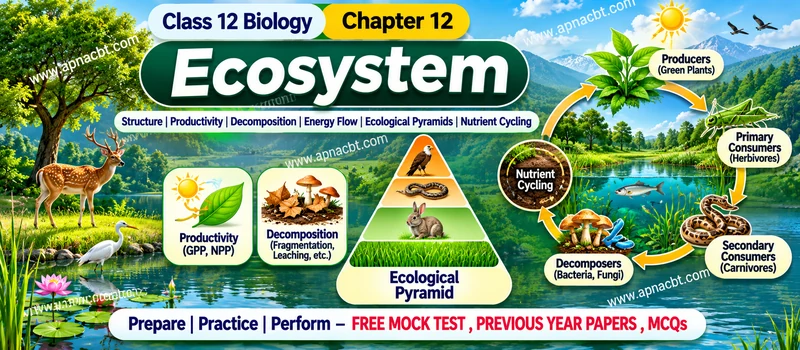
Ecosystem is a structural and functional unit of nature in which living organisms interact with one another and with the physical environment. This lesson covers ecosystem structure and function, productivity, decomposition, energy flow, food chains, ecological pyramids, nutrient cycling and ecosystem services. These concepts are important for Class 12 Biology, CBSE Board Exams and NEET preparation.
1. Ecosystem – Introduction, Types and Basic Features
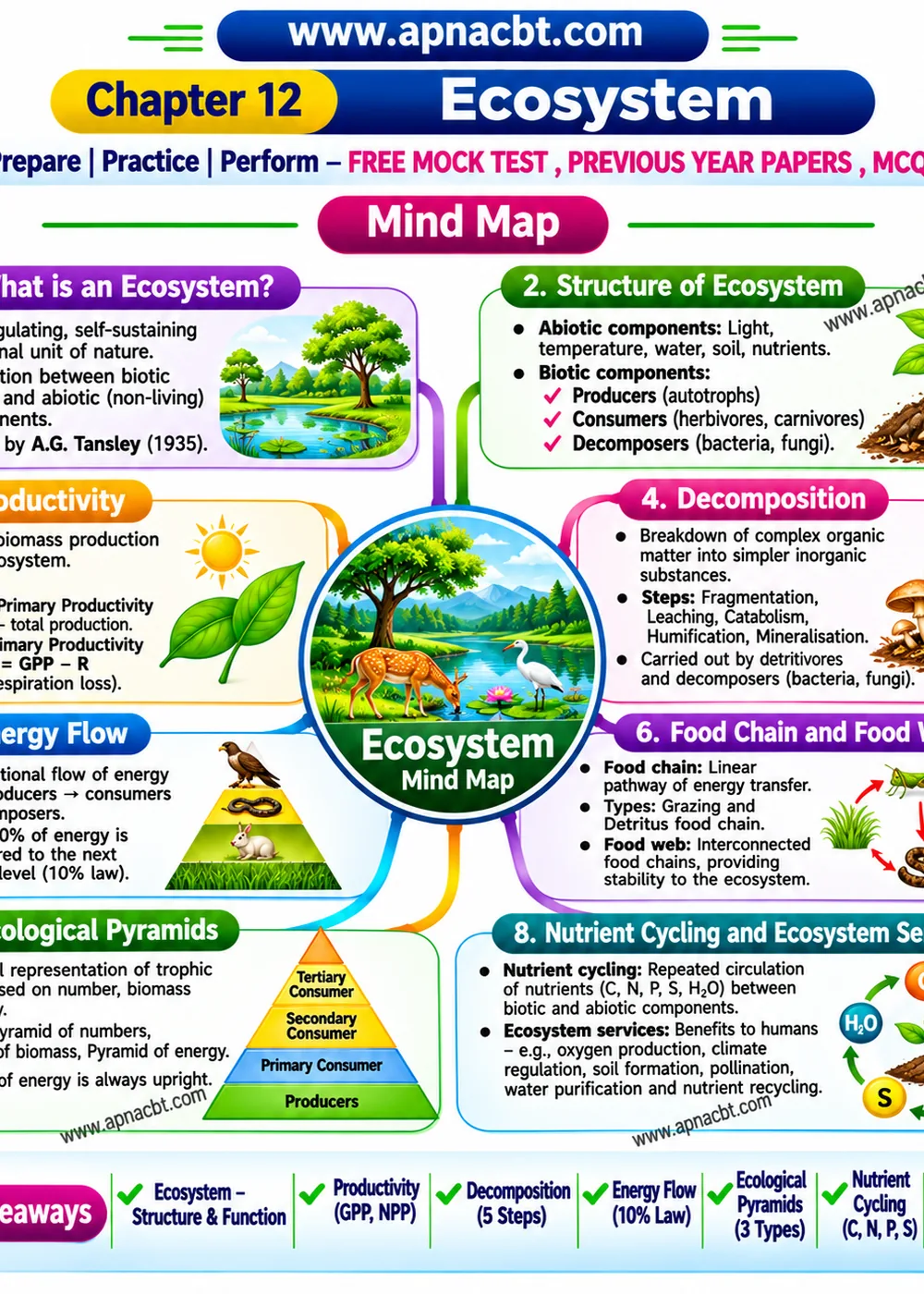
An ecosystem is a self-regulating and self-sustaining structural and functional unit of nature consisting of a community of organisms and its physical environment, interacting and exchanging materials.
Important Points
- The term ecosystem was coined by A.G. Tansley in 1935.
- Ecosystems vary greatly in size, from a small pond to a large forest or sea.
- Natural ecosystems include forests, grasslands, deserts, ponds, lakes, wetlands, rivers and estuaries.
- Man-made ecosystems include crop fields and aquaria.
- An ecosystem is an open system because it receives solar energy and exchanges matter and energy with its surroundings.
Exam Focus
Remember: ecosystem = interaction between biotic community + abiotic environment. Energy flow is unidirectional, whereas matter is cycled.
2. Ecosystem Structure – Abiotic and Biotic Components
The structure of an ecosystem is determined by its physical and biological components and their interactions.
Abiotic Components
- Light
- Temperature
- Water
- Air and gases
- Soil
- Inorganic nutrients and minerals
Biotic Components
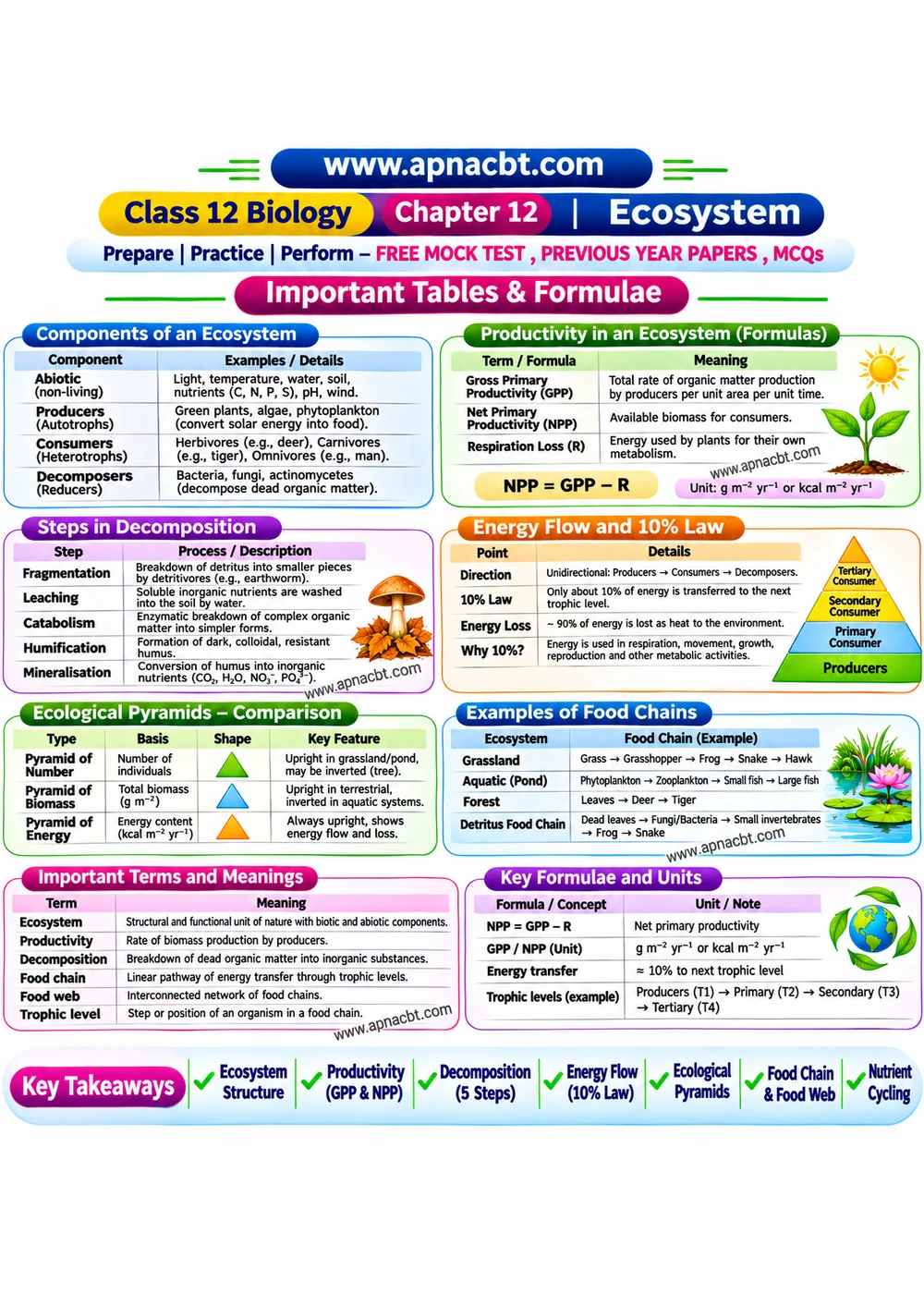
| Component | Role | Examples |
|---|---|---|
| Producers | Prepare organic food mainly by photosynthesis | Green plants, algae |
| Consumers | Obtain food from other organisms | Herbivores, carnivores, omnivores |
| Decomposers | Break down dead organic matter and recycle nutrients | Bacteria, fungi |
Structural Features
Species composition and stratification are important structural features. Stratification refers to the vertical distribution of different species occupying different levels in dense vegetation.
3. Ecosystem Function – Productivity and Its Types
Productivity refers to the rate of production of organic matter or biomass in an ecosystem.
Primary Productivity
Primary productivity is the rate of production of organic matter by producers during photosynthesis.
- Gross Primary Productivity (GPP): total rate of production of organic matter during photosynthesis.
- Net Primary Productivity (NPP): biomass or energy remaining after plant respiration.
- NPP = GPP − Respiration.
- NPP is the biomass available to consumers.
Secondary Productivity
Secondary productivity is the rate of formation of new organic matter by consumers.
Factors Affecting Productivity
Productivity is affected by plant species, photosynthetic capacity, solar radiation, temperature, water availability and nutrient availability. Aquatic productivity may be strongly limited by light penetration.
NEET High-Yield
Do not confuse GPP and NPP. GPP is total photosynthetic production; NPP is GPP minus plant respiration.
4. Decomposition – Processes, Conditions and Importance
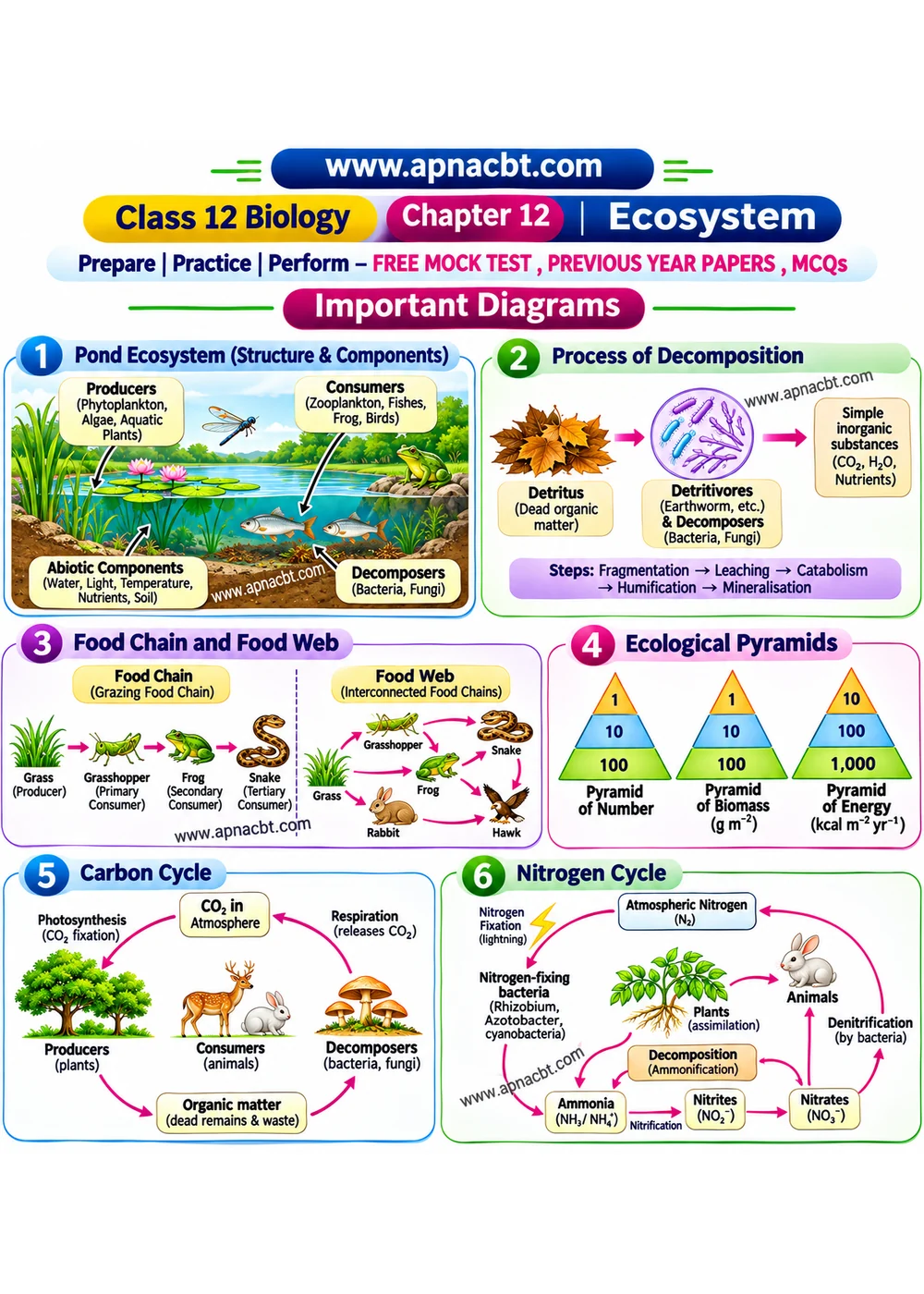
Decomposition is the process by which decomposers break down complex organic matter of detritus into simpler substances and release nutrients.
Major Processes
| Process | Meaning |
|---|---|
| Fragmentation | Detritivores break detritus into smaller particles. |
| Leaching | Water-soluble inorganic nutrients move into deeper soil layers. |
| Catabolism | Microbial enzymes break down complex organic substances. |
| Humification | Formation of a dark, amorphous and resistant organic substance called humus. |
| Mineralisation | Release of inorganic nutrients from organic matter. |
Factors Affecting Decomposition
Decomposition is generally faster under warm and moist conditions with adequate oxygen. It is slower when environmental conditions inhibit microbial activity.
Exam Focus
Know the sequence and distinguish fragmentation, leaching, catabolism, humification and mineralisation.
5. Energy Flow – Trophic Levels and Food Chains
Energy enters most ecosystems as sunlight, is captured by producers and then transferred through different trophic levels.
Unidirectional Flow
Energy flow in an ecosystem is unidirectional. It does not cycle back to the original source. At each trophic transfer, much energy is lost as heat.
Trophic Levels
- First trophic level: producers
- Second trophic level: primary consumers
- Third trophic level: secondary consumers
- Higher trophic levels: tertiary consumers and other higher consumers
Food Chains
A food chain represents the transfer of food and energy from one organism to another.
Grazing food chain (GFC): begins with living green plants.
Detritus food chain (DFC): begins with dead organic matter or detritus.
10% Law
Only about 10% of the energy at one trophic level is transferred to the next trophic level; the remaining energy is mainly dissipated as heat and used in life processes.
6. Food Webs, Ecological Pyramids and Biomass Relationships
Food Web
A food web is a network of interconnected food chains. It provides alternative pathways for energy transfer through an ecosystem.
Ecological Pyramids
Ecological pyramids represent relationships among trophic levels in terms of number, biomass or energy.
| Pyramid | Important Point |
|---|---|
| Pyramid of numbers | Shows number of organisms at each trophic level; shape depends on the ecosystem. |
| Pyramid of biomass | Shows biomass at different trophic levels; may be inverted in aquatic ecosystems. |
| Pyramid of energy | Shows energy at different trophic levels and is always upright. |
NEET High-Yield
- Pyramid of energy is always upright.
- Pyramid of biomass can be inverted in aquatic ecosystems.
- Pyramids generally do not adequately represent decomposers.
7. Nutrient Cycling – Gaseous and Sedimentary Cycles
Nutrient cycling is the movement and storage of nutrient elements through the biotic and abiotic components of an ecosystem.
Types
| Type | Main Reservoir | Example |
|---|---|---|
| Gaseous cycle | Atmosphere or hydrosphere | Carbon, nitrogen |
| Sedimentary cycle | Earth’s crust | Phosphorus |
Carbon Cycle – Key Idea
Carbon moves between atmosphere, producers, consumers, decomposers and the physical environment. Photosynthesis removes carbon dioxide from the atmosphere, while respiration and decomposition return carbon dioxide.
Phosphorus Cycle – Key Idea
Phosphorus is mainly associated with rocks and soil. Weathering releases phosphate into soil and water, where it becomes available to organisms.
8. Ecosystem Services – Benefits Provided by Ecosystems
Ecosystem services are the benefits that human beings obtain from ecosystems.
- Purification of air and water
- Pollination and seed dispersal
- Soil formation and nutrient cycling
- Climate regulation and carbon storage
- Provision of food, fuel, fibre and other resources
- Recreational, cultural and aesthetic benefits
Exam Focus
Forests and other ecosystems perform important services without requiring artificial replacement of every ecological function. Conservation of ecosystems therefore has direct ecological and economic importance.
9. Complete Chapter Revision – Must-Know Facts, Sequences and Comparisons
Rapid Revision Table
| Concept | Must Remember |
|---|---|
| Ecosystem | Biotic community interacting with abiotic environment |
| Tansley | Coined the term ecosystem in 1935 |
| Producers | First trophic level |
| Primary productivity | Rate of organic matter production by producers |
| GPP | Total photosynthetic production |
| NPP | GPP − respiration |
| Secondary productivity | Formation of new organic matter by consumers |
| Decomposition | Breakdown of detritus by decomposers |
| Energy flow | Unidirectional |
| 10% law | Approximately 10% energy transferred to next trophic level |
| Energy pyramid | Always upright |
| Aquatic biomass pyramid | May be inverted |
| Gaseous cycle | Atmosphere/hydrosphere as major reservoir |
| Sedimentary cycle | Earth’s crust as major reservoir |
Important Sequences
Sun → Producers → Primary consumers → Secondary consumers → Higher consumers
Detritus → Fragmentation → Leaching → Catabolism → Humification/Mineralisation
GPP − Respiration = NPP
10. Short-Answer Questions – 30 Questions with Detailed Answers
Questions 1–10
- What is an ecosystem?
Answer: An ecosystem is a structural and functional unit of nature consisting of living organisms and their physical environment interacting with one another. - Who coined the term ecosystem?
Answer: A.G. Tansley coined the term ecosystem in 1935. - What are the two major components of an ecosystem?
Answer: The two major components are abiotic components and biotic components. - What are producers?
Answer: Producers are autotrophic organisms, mainly green plants and algae, that manufacture organic food from inorganic substances using light energy. - What are decomposers?
Answer: Decomposers such as bacteria and fungi break down dead organic matter and help recycle nutrients. - Define primary productivity.
Answer: Primary productivity is the rate at which producers form organic matter or biomass, mainly through photosynthesis. - What is GPP?
Answer: Gross primary productivity is the total rate of organic matter production by producers during photosynthesis. - What is NPP?
Answer: Net primary productivity is the biomass or energy remaining after respiratory loss by producers. NPP = GPP − respiration. - What is secondary productivity?
Answer: It is the rate of formation of new organic matter by consumers. - What is detritus?
Answer: Detritus is dead organic matter such as fallen leaves, dead remains and other organic debris that becomes the substrate for decomposition.
Questions 11–20
- Name the main processes of decomposition.
Answer: Fragmentation, leaching, catabolism, humification and mineralisation are important processes associated with decomposition. - What is fragmentation?
Answer: Fragmentation is the breakdown of detritus into smaller particles by detritivores. - What is leaching?
Answer: Leaching is the movement of water-soluble substances and nutrients into deeper soil layers through water. - What is humification?
Answer: Humification is the formation of dark, amorphous and resistant humus during decomposition. - What is mineralisation?
Answer: Mineralisation is the release of inorganic nutrients from organic matter during microbial decomposition. - Why is energy flow called unidirectional?
Answer: Energy moves from the sun to producers and then through trophic levels. It is not returned to the original source and a significant portion is dissipated as heat. - What is a trophic level?
Answer: A trophic level is a feeding position occupied by organisms in a food chain. - What is a food chain?
Answer: A food chain is a sequence showing transfer of food and energy from one organism to another. - What is a food web?
Answer: A food web is a network of interconnected food chains in an ecosystem. - State the 10% law.
Answer: Approximately 10% of the energy present at one trophic level is transferred to the next trophic level.
Questions 21–30
- Why is the pyramid of energy always upright?
Answer: Energy decreases at successive trophic levels because much energy is lost through respiration and other metabolic activities. Therefore, energy pyramids are always upright. - Can a pyramid of biomass be inverted?
Answer: Yes. In aquatic ecosystems, the biomass of phytoplankton may be lower than the biomass of consumers present at a given time, producing an inverted biomass pyramid. - What is nutrient cycling?
Answer: Nutrient cycling is the movement and recycling of chemical elements between biotic and abiotic components of an ecosystem. - Differentiate gaseous and sedimentary nutrient cycles.
Answer: Gaseous cycles have the atmosphere or hydrosphere as major reservoirs, whereas sedimentary cycles have the Earth’s crust as the major reservoir. - Give one example of a gaseous nutrient cycle.
Answer: The carbon cycle is a gaseous nutrient cycle. - Give one example of a sedimentary nutrient cycle.
Answer: The phosphorus cycle is a sedimentary nutrient cycle. - What are ecosystem services?
Answer: Ecosystem services are useful benefits obtained by humans from ecosystems, such as air purification, pollination, soil formation and climate regulation. - What is stratification?
Answer: Stratification is the vertical distribution of different species occupying different levels in dense vegetation. - Why is NPP important to consumers?
Answer: NPP represents the organic matter remaining after plant respiration and forms the biomass/energy resource available to consumers. - Why are decomposers important in ecosystems?
Answer: Decomposers break down dead organic matter and help return inorganic nutrients to the environment, maintaining nutrient cycling.
11. Long-Answer Questions – 15 Questions with Detailed Answers
Questions 1–5
- Explain the structure and major components of an ecosystem.
Answer: An ecosystem consists of abiotic and biotic components. Abiotic components include light, temperature, water, soil, air and inorganic nutrients. Biotic components include producers, consumers and decomposers. Producers capture solar energy and form organic matter. Consumers obtain food from producers or other consumers. Decomposers break down dead organic matter and recycle nutrients. Interaction between these components gives the ecosystem its characteristic structure and function. - Explain primary productivity and distinguish GPP from NPP.
Answer: Primary productivity is the rate of organic matter production by producers. GPP is the total organic matter produced through photosynthesis. A part of this production is used by plants during respiration. The remaining organic matter is NPP. Therefore, NPP = GPP − respiration. NPP is the biomass available to consumers and is an important measure of ecosystem productivity. - Describe decomposition and its major steps.
Answer: Decomposition is the breakdown of complex organic matter in detritus by decomposers. Fragmentation breaks detritus into smaller particles. Leaching removes soluble substances through water. Catabolism involves enzymatic breakdown of complex organic molecules. Humification produces resistant humus, while mineralisation releases inorganic nutrients. Decomposition recycles nutrients and maintains ecosystem functioning. - Explain energy flow through an ecosystem.
Answer: Solar energy is captured by producers and converted into chemical energy. Energy passes from producers to primary consumers and then to higher trophic levels through food relationships. At each transfer, a large portion is lost as heat and used in metabolic activities. Therefore, energy flow is unidirectional and decreases at successive trophic levels. The 10% law describes the approximate transfer of energy from one trophic level to the next. - Differentiate grazing and detritus food chains.
Answer: A grazing food chain begins with living green plants and proceeds to herbivores and then carnivores. Example: grass → grasshopper → frog → snake. A detritus food chain begins with dead organic matter and proceeds through detritivores and decomposers to higher consumers. Both pathways contribute to energy transfer, but their relative importance differs among ecosystems.
Questions 6–10
- Explain ecological pyramids and their major types.
Answer: Ecological pyramids represent the relationship between trophic levels. The pyramid of numbers represents the number of organisms at each trophic level. The pyramid of biomass represents biomass at each trophic level and may be inverted in aquatic ecosystems. The pyramid of energy represents energy available at each trophic level and is always upright because energy is lost during transfer. - Explain the 10% law and its ecological significance.
Answer: According to the 10% law, approximately 10% of the energy present at one trophic level becomes available to the next trophic level. The rest is lost through respiration, movement, maintenance and heat dissipation. Consequently, energy and biomass generally decrease towards higher trophic levels and food chains cannot normally support an unlimited number of trophic levels. - Explain nutrient cycling and distinguish gaseous and sedimentary cycles.
Answer: Nutrient cycling involves movement of elements between organisms and the physical environment. In gaseous cycles, the atmosphere or hydrosphere serves as the main reservoir, as in carbon and nitrogen cycles. In sedimentary cycles, the Earth’s crust is the main reservoir, as in the phosphorus cycle. Nutrient cycling maintains the availability of essential elements in ecosystems. - Describe the carbon cycle in an ecosystem.
Answer: Carbon dioxide in the atmosphere is fixed by producers through photosynthesis and incorporated into organic compounds. Carbon passes to consumers through feeding. Respiration by plants, animals and microbes returns carbon dioxide to the atmosphere. Decomposition of dead organisms also releases carbon dioxide. Long-term storage occurs in sediments and fossil carbon, while combustion can rapidly return carbon dioxide to the atmosphere. - Explain the phosphorus cycle.
Answer: Phosphorus is mainly stored in rocks and sediments. Weathering releases phosphate into soil and water. Producers absorb phosphate and incorporate it into organic compounds. It passes through food chains to consumers. Decomposition returns phosphorus to the soil or water. Some phosphate becomes incorporated into sediments and rocks again, completing the long-term cycle.
Questions 11–15
- Explain the importance of decomposers in an ecosystem.
Answer: Decomposers such as bacteria and fungi break down dead organisms and organic wastes. Their activities convert complex organic substances into simpler compounds and release inorganic nutrients. This prevents accumulation of dead matter and makes nutrients available again to producers. Decomposers therefore maintain nutrient cycling and ecosystem stability. - Explain food chains and food webs with their significance.
Answer: A food chain is a linear sequence of feeding relationships showing transfer of food and energy. A food web consists of interconnected food chains. Food webs are more realistic representations of natural ecosystems because organisms may have more than one food source or predator. They provide alternative pathways for energy transfer and contribute to ecosystem stability. - Discuss the relationship between productivity, energy flow and trophic levels.
Answer: Producers establish the energy base of an ecosystem through primary productivity. NPP represents the energy or biomass available to consumers. Energy passes through successive trophic levels, but only a small fraction is transferred to the next level. Most energy is lost through metabolic activities and heat. Thus, productivity at the producer level determines the energy available to support higher trophic levels. - Explain ecosystem services and their importance to humans.
Answer: Ecosystems provide many services including purification of air and water, pollination, nutrient cycling, soil formation, climate regulation, carbon storage, food, fuel, fibre and recreational benefits. These services support human survival and economic activities. Protecting ecosystems therefore protects both biodiversity and essential natural resources. - Write a comprehensive note on an ecosystem as a functional unit of nature.
Answer: An ecosystem is a structural and functional unit formed by interactions between a biotic community and its abiotic environment. Producers capture solar energy and manufacture organic matter. Consumers transfer this energy through food chains and food webs, while decomposers recycle nutrients from dead matter. Productivity, decomposition, energy flow and nutrient cycling are closely interconnected. Energy moves unidirectionally, whereas nutrients are repeatedly recycled. Ecological pyramids represent trophic relationships, and ecosystem services provide important benefits to humans. Together, these processes maintain ecosystem organisation and functioning.