Biotechnology: Principles and Processes – Class 12 Biology
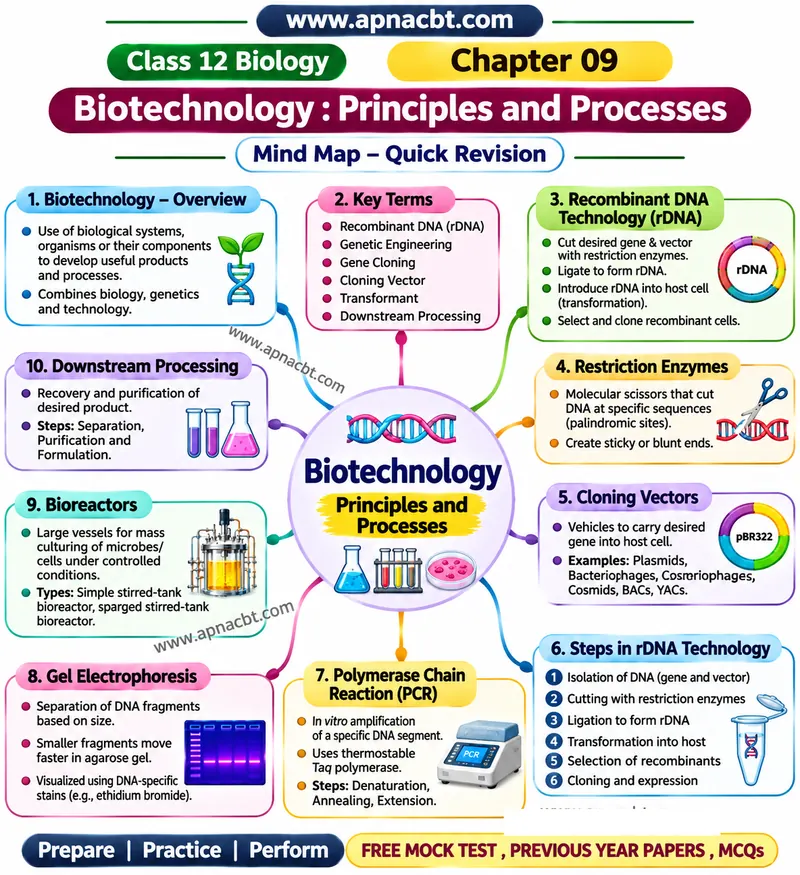
Biotechnology: Principles and Processes is an important Class 12 Biology chapter covering biotechnology, recombinant DNA technology, genetic engineering, restriction enzymes, cloning vectors, PCR, gel electrophoresis, transformation, bioreactors and downstream processing. This Level 01 lesson is designed for CBSE Board Exams and NEET preparation, with focus on NCERT concepts, important terminology, processes, diagrams, comparisons and high-yield questions.
Biotechnology – Introduction and Principles
Biotechnology deals with techniques of using living organisms or enzymes from organisms to produce products and processes useful to humans. In the modern restricted sense, biotechnology includes processes that use genetically modified organisms on a larger scale.
Traditional and Modern Biotechnology
- Making curd, bread and wine through microbe-mediated processes can be considered forms of biotechnology in a broad sense.
- Modern biotechnology includes techniques such as in vitro fertilisation, gene synthesis, DNA vaccine development and correction of defective genes.
- The European Federation of Biotechnology (EFB) definition integrates natural science with organisms, cells, parts thereof and molecular analogues for products and services.
Two Core Techniques of Modern Biotechnology
- Genetic engineering: techniques to alter the chemistry of genetic material (DNA and RNA), introduce these into host organisms and change the phenotype of the host.
- Bioprocess engineering: maintenance of sterile, contamination-free conditions so that only the desired microorganism or eukaryotic cell grows in large quantities for manufacture of products such as antibiotics, vaccines and enzymes.
Basic Steps in Genetic Modification
- Identification of DNA with desirable genes.
- Introduction of the identified DNA into the host.
- Maintenance of the introduced DNA in the host and transfer of the DNA to its progeny.
Exam focus: Modern biotechnology depends on genetic engineering/recombinant DNA technology and controlled bioprocesses for large-scale production.
Tools of Recombinant DNA Technology – Restriction Enzymes
Recombinant DNA technology requires key biological tools including restriction enzymes, polymerases, DNA ligase, vectors and host organisms.
Nucleases
| Enzyme | Action |
|---|---|
| Exonuclease | Removes nucleotides from the terminal ends of DNA. |
| Endonuclease | Makes cuts at specific positions within DNA. |
| Restriction endonuclease | Recognises specific DNA sequences and cuts DNA at particular sites. |
Restriction Endonucleases
The first restriction endonuclease, Hind II, was characterised for its ability to recognise a specific sequence of six base pairs and cut DNA at a particular point. Restriction enzymes are named according to the genus, species, strain and order of isolation of the enzyme.
Type II Restriction Enzymes
Restriction endonucleases are classified into Types I, II and III based on their chemical and physiological properties. Type II restriction endonucleases require Mg2+ and are used in recombinant DNA technology because they cut DNA at specific recognition sites.
EcoRI
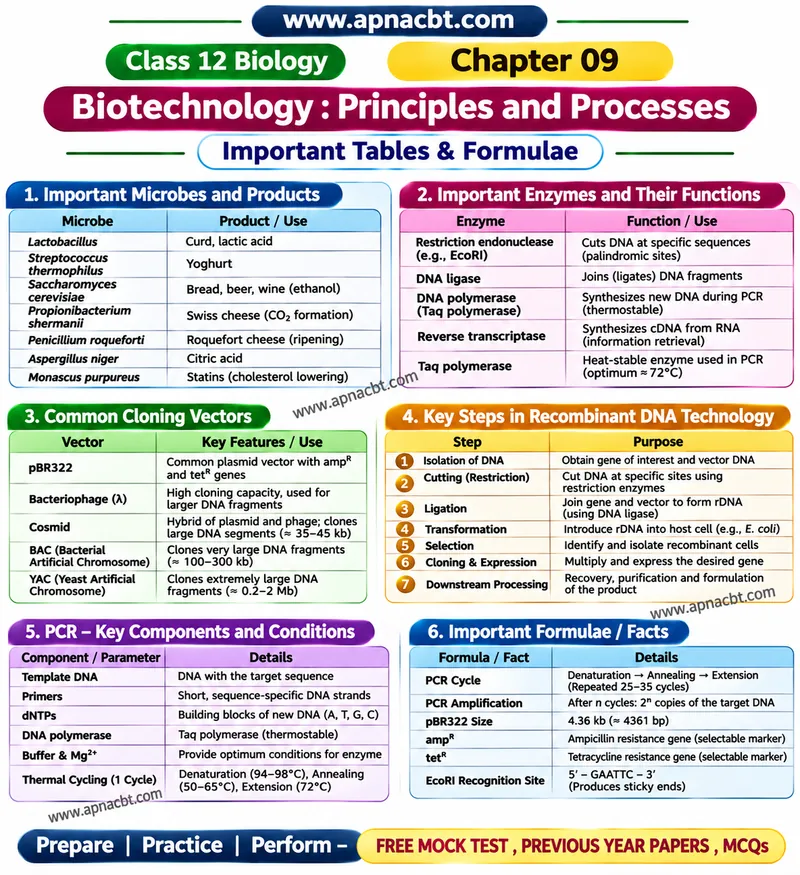
EcoRI is obtained from Escherichia coli strain RY13. The recognition sequence is a palindromic sequence:
5′-GAATTC-3′
3′-CTTAAG-5′
EcoRI cuts between G and A and produces sticky ends. Sticky ends formed by the same restriction enzyme can base-pair with complementary ends of another DNA fragment, facilitating joining by DNA ligase.
Other Important Enzymes
- DNA ligase: seals gaps and joins DNA fragments.
- Reverse transcriptase: synthesises complementary DNA (cDNA) using mRNA as template.
Cloning Vectors – Essential Features and pBR322
A vector is used to carry foreign DNA into a host cell. A good cloning vector should have features that allow replication, selection and insertion of the desired DNA.
Essential Features of a Cloning Vector
| Feature | Importance |
|---|---|
| Origin of replication (ori) | Sequence from which replication begins; controls copy number of linked DNA. |
| Selectable marker | Helps identify and eliminate non-transformants and select transformants. |
| Cloning / recognition site | Unique restriction site where foreign DNA can be inserted. |
pBR322
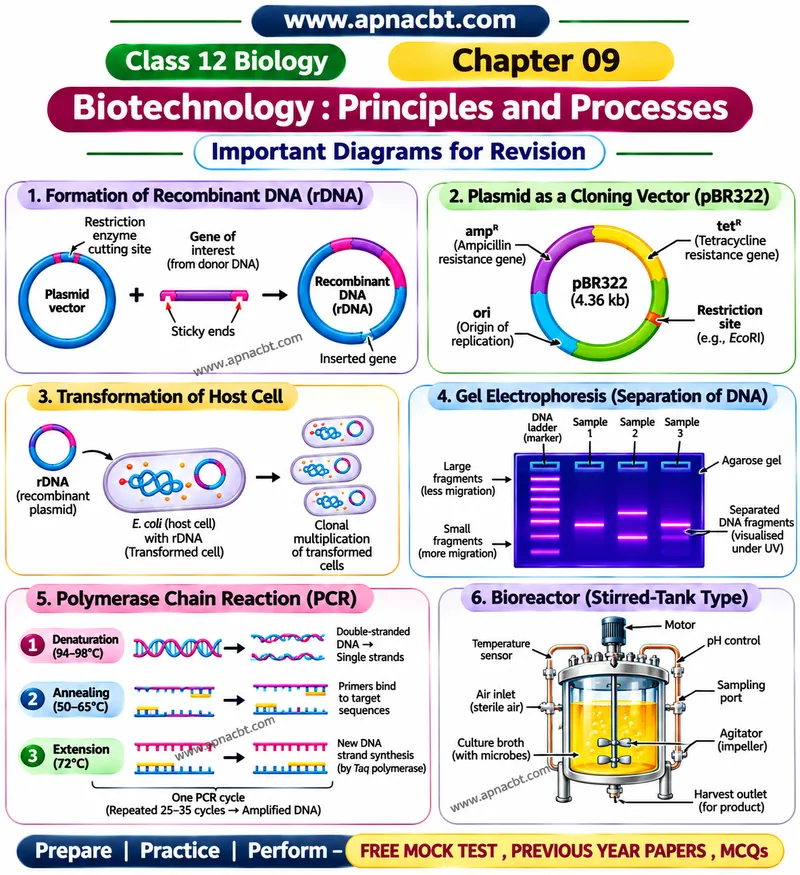
pBR322 is a commonly studied artificial plasmid vector. It contains ori, rop, ampR and tetR and has restriction sites that can be used for cloning.
- ori: controls replication and influences the copy number of linked DNA.
- rop: codes for proteins involved in plasmid replication.
- ampR: ampicillin resistance marker.
- tetR: tetracycline resistance marker.
Polylinker / Multiple Cloning Site
Many vectors contain unique recognition sites for several restriction enzymes in a small DNA region called a polylinker or multiple cloning site (MCS).
NEET focus: Remember ori = replication, selectable marker = selection, and cloning site = insertion of foreign DNA.
Selectable Markers and Insertional Inactivation
Selectable Markers
A vector requires a selectable marker to identify and eliminate non-transformants and selectively permit the growth of transformants. Genes providing resistance to antibiotics such as ampicillin, chloramphenicol, tetracycline or kanamycin can function as selectable markers in suitable bacterial systems.
Insertional Inactivation
Selection of recombinants only by antibiotic inactivation can be cumbersome because it may require simultaneous plating on different antibiotics. Alternative markers can differentiate recombinants from non-recombinants by colour production in the presence of a chromogenic substrate.
In insertional inactivation, recombinant DNA is inserted within the coding sequence of a gene such as the gene for the enzyme β-galactosidase. The insertion inactivates the gene, so recombinant colonies do not produce the characteristic colour, allowing recombinant colonies to be identified.
High-Yield Comparison
| Method | Purpose |
|---|---|
| Antibiotic resistance marker | Selects cells carrying the vector. |
| Insertional inactivation | Differentiates recombinant and non-recombinant colonies. |
| Chromogenic substrate | Allows colour-based identification in suitable reporter systems. |
Vectors for Cloning Genes in Plants and Animals
Agrobacterium tumefaciens
Agrobacterium tumefaciens is a pathogen of several dicot plants. It naturally transfers a piece of DNA called T-DNA into plant cells and can transform normal plant cells. The tumour-inducing plasmid can be modified into a suitable cloning vector by disarming its disease-causing properties.
Retroviral Vectors
Retroviruses can deliver genetic material into animal cells. Disarmed retroviral vectors can be used as vehicles for transferring desirable genes into suitable animal cells.
Important Gene-Transfer Methods
- Micro-injection: recombinant DNA is directly injected into the nucleus of an animal cell.
- Biolistics / gene gun: plant cells are bombarded with high-velocity micro-particles of gold or tungsten coated with DNA.
- Disarmed pathogen vectors: modified pathogens transfer recombinant DNA into host cells.
Exam focus: Agrobacterium is important for plant transformation, while micro-injection and suitable viral vectors are important methods for animal cells.
Competent Host and Introduction of Recombinant DNA
Once recombinant DNA is constructed, it must be introduced into a suitable host cell. Bacterial cells can be made competent so that they can take up recombinant DNA.
Making Bacterial Cells Competent
Since DNA is hydrophilic and cannot normally pass through the bacterial cell membrane, cells can be treated with divalent cations such as calcium ions. Recombinant DNA is then added and the cells are incubated on ice, given a brief heat shock at about 42°C, and returned to ice. This treatment enables bacteria to take up recombinant DNA.
Transformation
Transformation is the procedure through which a piece of DNA is introduced into a host bacterium. Transformed cells can subsequently be selected using suitable markers.
Other Methods
| Method | Application |
|---|---|
| Micro-injection | Direct injection of recombinant DNA into animal-cell nucleus. |
| Biolistics / gene gun | DNA-coated gold or tungsten particles used for plant cells. |
| Disarmed pathogen vector | Modified pathogen transfers recombinant DNA into host cells. |
Processes of Recombinant DNA Technology – Isolation and Cutting of DNA
Recombinant DNA technology follows a sequence of major steps: isolation of DNA, fragmentation by restriction endonucleases, isolation of the desired DNA fragment, ligation into a vector, transfer into the host, large-scale culture and extraction of the desired product.
Isolation of Genetic Material
DNA must be obtained in a pure form before restriction digestion. Cells are broken open to release DNA along with RNA, proteins, polysaccharides and lipids.
| Source | Enzyme |
|---|---|
| Bacteria | Lysozyme |
| Plant cells | Cellulase |
| Fungus | Chitinase |
RNA is removed using ribonuclease, while proteins are removed using protease. Purified DNA can be precipitated by adding chilled ethanol, where it appears as fine threads and can be collected by spooling.
Cutting DNA
Restriction enzymes cut DNA at specific recognition sites. Both the source DNA containing the gene of interest and the vector are cut using the same restriction enzyme so that compatible ends are produced.
Gel Electrophoresis, Separation and Elution of DNA
Restriction digestion produces DNA fragments that can be separated using gel electrophoresis, a technique for separation of charged molecules under an electric field.
Agarose Gel Electrophoresis
- Agarose, obtained from seaweeds, is commonly used as the gel matrix.
- DNA is negatively charged and moves towards the anode (positive electrode).
- DNA fragments separate according to their size through the pores of the gel.
- Smaller DNA fragments move farther than larger fragments.
Visualisation and Elution
DNA fragments are visualised after staining with ethidium bromide and exposure to UV radiation, where they appear as bright orange-coloured bands. The desired DNA band is cut from the gel and the DNA is extracted from the gel piece. This process is called elution.
| Point | Answer |
|---|---|
| DNA charge | Negative |
| Direction | Towards anode |
| Matrix | Agarose |
| Smaller fragments | Move farther |
| Visualisation | Ethidium bromide + UV |
| Recovery | Elution |
Joining DNA Fragments and Formation of Recombinant DNA
The desired DNA fragment and the cut vector are joined using DNA ligase. The complementary sticky ends produced by the same restriction enzyme can base-pair, and DNA ligase seals the sugar-phosphate backbone.
Core Sequence
Source DNA + Vector DNA → Restriction digestion → Compatible ends → Ligation → Recombinant DNA
Role of DNA Ligase
DNA ligase acts on cut DNA molecules and joins their ends. This creates a new combination of circular, autonomously replicating DNA in vitro, called recombinant DNA.
Cloning
When recombinant DNA is transferred into a suitable host such as Escherichia coli, it can replicate using the host’s replication machinery. Multiplication of the introduced DNA is referred to as cloning.
Exam focus: Restriction enzyme cuts; DNA ligase joins; vector carries; host replicates and/or expresses the introduced DNA.
PCR – Amplification of Gene of Interest
Polymerase Chain Reaction (PCR) is used to amplify a selected DNA segment. A small amount of DNA can be amplified to produce very large numbers of copies of the desired sequence.
Requirements for PCR
- DNA template containing the desired sequence.
- Two sets of chemically synthesised oligonucleotide primers complementary to the regions flanking the DNA segment.
- Deoxynucleotide triphosphates (dNTPs).
- Taq DNA polymerase, a thermostable DNA polymerase isolated from Thermus aquaticus.
Three Steps of PCR
- Denaturation: high temperature separates the two strands of DNA.
- Annealing: primers anneal to complementary sequences on the template DNA.
- Extension: Taq polymerase extends the primers and synthesises new DNA strands.
The cycle is repeated many times. Approximately 1 billion copies of the DNA can be made from a starting DNA molecule after about 30 cycles under suitable conditions.
NEET Memory Line
Denaturation → Annealing → Extension = separate → bind → synthesise.
Bioreactors – Large-Scale Production
After cloning and expression, the desired product must be produced on a large scale. Bioreactors are vessels in which biological processes are carried out under controlled conditions for large-scale production.
Stirred-Tank Bioreactor
A commonly used bioreactor is the stirred-tank bioreactor. It is usually cylindrical or has a curved base and is equipped with a stirrer that mixes the contents. It also has provisions for supplying oxygen and maintaining optimum conditions.
Important Components and Functions
| Component / Control | Function |
|---|---|
| Stirrer | Mixing of contents and improvement of aeration. |
| Air supply / sparger | Provides sterile air or oxygen. |
| Temperature control | Maintains optimum growth conditions. |
| pH control | Maintains suitable pH for cells or microbes. |
| Foam control | Controls excessive foam formation. |
| Sampling / monitoring | Allows process conditions and product formation to be monitored. |
Why Large Bioreactors?
Large bioreactors provide controlled conditions for growing cells or microbes and obtaining large quantities of the desired product efficiently.
Downstream Processing and Complete Chapter Revision
Downstream Processing
After completion of the biosynthetic stage, the product is subjected to separation and purification. These processes are collectively called downstream processing.
The product may then be formulated with suitable preservatives. Products such as drugs require thorough clinical trials and strict quality-control testing. Downstream processing and quality-control procedures vary according to the product.
Complete Recombinant DNA Technology Flow
Isolation of DNA → Restriction digestion → Separation of desired fragment → Ligation into vector → Transfer into host → Selection and cloning → Expression of desired gene → Large-scale culture in bioreactor → Product extraction → Downstream processing → Purification → Formulation → Quality control / clinical evaluation where applicable.
CBSE Board Exam Priorities
- Principles of biotechnology and recombinant DNA technology.
- Restriction enzymes and recognition sequences.
- Sticky ends and DNA ligase.
- Cloning vector features and pBR322.
- Selectable markers and insertional inactivation.
- Isolation of DNA and gel electrophoresis.
- PCR and its three steps.
- Bioreactors and downstream processing.
NEET High-Yield Points
- Exonuclease vs endonuclease.
- EcoRI recognition sequence and sticky ends.
- Type II restriction enzymes.
- ori, rop, ampR and tetR of pBR322.
- Lysozyme, cellulase, chitinase, ribonuclease and protease.
- DNA movement towards anode and smaller-fragment migration.
- Taq polymerase source: Thermus aquaticus.
- PCR: denaturation → annealing → extension.
- Transformation, micro-injection, biolistics and disarmed pathogen vectors.
- Bioreactor controls and downstream processing.
Short-Answer Questions – 30 Questions with Detailed Answers
Questions
- What is biotechnology?
- What are the two core techniques of modern biotechnology?
- What is genetic engineering?
- What is bioprocess engineering?
- What is recombinant DNA technology?
- Differentiate exonuclease and endonuclease.
- What is a restriction endonuclease?
- What is a recognition sequence?
- What is a palindromic DNA sequence?
- What are sticky ends?
- Why are sticky ends useful in recombinant DNA technology?
- What is the function of DNA ligase?
- What is the function of reverse transcriptase?
- What is a cloning vector?
- What is the function of ori?
- What is a selectable marker?
- What are ampR and tetR?
- What is insertional inactivation?
- What is a competent bacterial cell?
- How are bacterial cells made competent?
- What is transformation?
- What is biolistics or gene gun method?
- What is gel electrophoresis?
- Why does DNA move towards the anode?
- Why do smaller DNA fragments move farther in agarose gel?
- What is elution?
- What is PCR?
- Why is Taq polymerase used in PCR?
- What is a bioreactor?
- What is downstream processing?
Detailed Answers
- Biotechnology is the use of living organisms, cells, parts of organisms or enzymes to produce useful products and processes.
- The two core techniques are genetic engineering and bioprocess engineering.
- Genetic engineering involves techniques to alter the chemistry of genetic material and introduce it into host organisms to change the host phenotype.
- Bioprocess engineering involves maintaining sterile, contamination-free conditions for growing desired microorganisms or cells in large quantities to manufacture useful products.
- Recombinant DNA technology is the process of constructing recombinant DNA and using it for gene cloning, gene transfer and production of desired products.
- Exonuclease removes nucleotides from DNA ends, whereas endonuclease makes cuts at specific positions within DNA.
- A restriction endonuclease recognises a specific DNA sequence and cuts DNA at a particular position.
- A recognition sequence is the specific nucleotide sequence recognised by a restriction enzyme.
- A palindromic DNA sequence is a sequence that has the same orientation of bases when read in the 5′→3′ direction on the two complementary strands.
- Sticky ends are single-stranded complementary DNA ends produced by staggered restriction-enzyme cutting.
- Sticky ends can base-pair with complementary ends on another DNA fragment, making joining by DNA ligase easier.
- DNA ligase seals gaps in the sugar-phosphate backbone and joins DNA fragments.
- Reverse transcriptase synthesises complementary DNA (cDNA) using mRNA as a template.
- A cloning vector is a DNA molecule used to carry foreign DNA into a host cell and support its replication.
- ori is the origin of replication. It is the site from which replication begins and also influences the copy number of linked DNA.
- A selectable marker helps identify and select cells that have received the vector.
- ampR provides ampicillin resistance and tetR provides tetracycline resistance in pBR322.
- Insertional inactivation is the inactivation of a gene when foreign DNA is inserted within its coding sequence.
- A competent bacterial cell is a cell treated so that it can take up recombinant DNA.
- Bacterial cells can be treated with calcium ions, incubated with recombinant DNA on ice, briefly heat-shocked at about 42°C and returned to ice.
- Transformation is the introduction of a piece of DNA into a host bacterium.
- Biolistics introduces DNA into plant cells using high-velocity gold or tungsten micro-particles coated with DNA.
- Gel electrophoresis separates charged molecules such as DNA fragments under an electric field through a gel.
- DNA is negatively charged, so it migrates towards the positive electrode, the anode.
- Smaller DNA fragments pass more easily through agarose pores and therefore travel farther than larger fragments.
- Elution is the recovery of a desired DNA fragment from the gel after the appropriate band has been cut out.
- PCR is Polymerase Chain Reaction, a technique used to amplify a selected DNA segment.
- Taq polymerase is thermostable and remains active during the high-temperature steps of repeated PCR cycles. It is obtained from Thermus aquaticus.
- A bioreactor is a vessel in which biological processes are carried out under controlled conditions for large-scale production.
- Downstream processing includes separation and purification of the product after the biosynthetic stage, followed by suitable formulation and quality-control procedures.
Long-Answer Questions – 15 Questions with Detailed Answers
Questions
- Explain the principles of modern biotechnology and the three basic steps involved in genetically modifying an organism.
- Describe restriction endonucleases, recognition sequences and sticky-end formation with reference to EcoRI.
- Explain the essential features of a cloning vector and describe the important components of pBR322.
- Explain selectable markers and insertional inactivation in recombinant DNA technology.
- Describe the major vectors and methods used for introducing recombinant DNA into plant and animal cells.
- Explain how bacterial cells are made competent for transformation.
- Describe the complete process of isolation and purification of DNA for recombinant DNA technology.
- Explain gel electrophoresis, visualisation of DNA and elution of the desired DNA fragment.
- Describe the process of joining a desired DNA fragment with a vector to form recombinant DNA.
- Explain PCR, including its requirements and the three major steps involved.
- Describe the complete sequence of recombinant DNA technology from isolation of DNA to introduction into the host.
- Explain the structure, working and advantages of a stirred-tank bioreactor.
- What is downstream processing? Explain the steps involved after the biosynthetic stage.
- Differentiate the roles of restriction enzymes, DNA ligase, cloning vectors, host cells and PCR in recombinant DNA technology.
- Explain the complete recombinant DNA technology process and highlight the important points for CBSE Board Exams and NEET.
Detailed Answers
- Principles of modern biotechnology: Biotechnology uses organisms, cells or enzymes for useful products and processes. Modern biotechnology is based mainly on genetic engineering and bioprocess engineering. Genetic engineering alters genetic material and introduces desirable genes into hosts, while bioprocess engineering maintains sterile conditions for large-scale growth of desired cells. The three basic genetic-modification steps are identification of DNA with desirable genes, introduction of the identified DNA into the host, and maintenance of the introduced DNA in the host with transfer to progeny.
- Restriction enzymes and EcoRI: Restriction endonucleases recognise specific nucleotide sequences and cut DNA at particular positions. Recognition sequences may be palindromic. EcoRI from Escherichia coli RY13 recognises 5′-GAATTC-3′ and cuts between G and A on the respective strands, producing sticky ends. These complementary ends can base-pair with DNA fragments cut by the same enzyme and can subsequently be joined by DNA ligase.
- Cloning vector and pBR322: A cloning vector needs an origin of replication, selectable marker and cloning/recognition site. The ori permits replication and influences copy number. Selectable markers identify transformants. A unique restriction site permits insertion of foreign DNA. pBR322 contains ori, rop, ampR and tetR, along with restriction sites used in cloning.
- Selectable markers and insertional inactivation: Selectable markers such as antibiotic-resistance genes allow cells carrying the vector to be selected. Insertional inactivation provides an alternative way of distinguishing recombinants. When foreign DNA is inserted into the coding sequence of a reporter gene such as β-galactosidase, the gene is inactivated. Recombinant colonies therefore fail to produce the characteristic colour in a suitable chromogenic system and can be distinguished from non-recombinants.
- Vectors and gene transfer: Agrobacterium tumefaciens naturally transfers T-DNA to plant cells and can be modified as a plant cloning vector. Disarmed retroviral vectors can deliver desirable genes into animal cells. Micro-injection directly introduces recombinant DNA into an animal-cell nucleus. Biolistics or gene gun introduces DNA-coated gold or tungsten particles into plant cells. Disarmed pathogen vectors can also transfer recombinant DNA into host cells.
- Competent bacterial cells: DNA is hydrophilic and cannot readily pass through the bacterial cell membrane. Cells are therefore treated with divalent cations such as calcium ions. Recombinant DNA is added, followed by incubation on ice, a brief heat shock at about 42°C and cooling on ice. This treatment enables the bacteria to take up recombinant DNA. The transformed cells can then be selected using appropriate markers.
- DNA isolation: Cells are broken open to release DNA along with RNA, proteins and other macromolecules. Lysozyme is used for bacterial cells, cellulase for plant cells and chitinase for fungi. RNA is removed with ribonuclease and proteins with protease. Purified DNA is precipitated using chilled ethanol and appears as fine threads that can be collected by spooling.
- Gel electrophoresis: DNA fragments generated by restriction digestion are separated using agarose gel electrophoresis. DNA is negatively charged and moves towards the anode. Fragments separate according to size, with smaller fragments moving farther through the gel. DNA bands are visualised after staining with ethidium bromide and exposure to UV radiation. The desired band is cut out and DNA is recovered from it by elution.
- Formation of recombinant DNA: The desired gene fragment and vector are cut using the same restriction enzyme to generate compatible ends. The fragments are mixed so complementary sticky ends can pair. DNA ligase then seals the sugar-phosphate backbone. The resulting DNA molecule containing DNA from different sources is recombinant DNA. When introduced into a suitable host, it can be replicated and/or expressed.
- PCR: PCR amplifies a selected DNA segment. It requires template DNA, two oligonucleotide primers, dNTPs and Taq DNA polymerase from Thermus aquaticus. During denaturation, the DNA strands separate. During annealing, primers bind to complementary sequences. During extension, Taq polymerase synthesises new DNA strands. Repeated cycles amplify the target DNA enormously.
- Complete recombinant DNA sequence: The process begins with isolation of pure DNA. The DNA is cut with restriction endonucleases, the desired fragment is separated and ligated into a vector. The recombinant DNA is introduced into a suitable host and transformants are selected. The host is cultured and the desired gene is cloned and/or expressed. Large-scale production is performed in a bioreactor, followed by extraction and downstream processing.
- Stirred-tank bioreactor: It is a commonly used bioreactor for large-scale biological production. A stirrer mixes the contents and improves aeration. Sterile air can be introduced through a sparger. Temperature, pH, oxygen supply, mixing and foam are controlled to maintain optimum conditions for growth and product formation. Monitoring and sampling facilities help control the process.
- Downstream processing: After biosynthesis, the desired product must be separated and purified. These operations are collectively called downstream processing. The product may then be formulated with suitable preservatives. In the case of drugs, formulation undergoes clinical trials and strict quality-control testing. The exact downstream steps depend on the product.
- Roles of major tools: Restriction enzymes cut DNA at specific sites; DNA ligase joins DNA fragments; vectors carry foreign DNA and permit its replication in hosts; host cells provide the biological system for replication and expression; PCR amplifies the selected DNA sequence before or during cloning workflows.
- Complete exam-oriented process: Biotechnology uses living systems for useful products. Modern recombinant DNA technology begins with identification and isolation of desirable DNA, restriction digestion, separation of the desired fragment, ligation into a vector, transformation into a competent host, selection of transformants, cloning/expression and large-scale production. PCR is used for amplification, gel electrophoresis for DNA separation, bioreactors for controlled large-scale production and downstream processing for separation, purification and formulation. For CBSE and NEET, special attention should be given to restriction enzymes, EcoRI, sticky ends, pBR322, ori, selectable markers, insertional inactivation, competent cells, PCR, gel electrophoresis, bioreactors and downstream processing.