1. Nucleic Acids, DNA and RNA – Basic Concepts
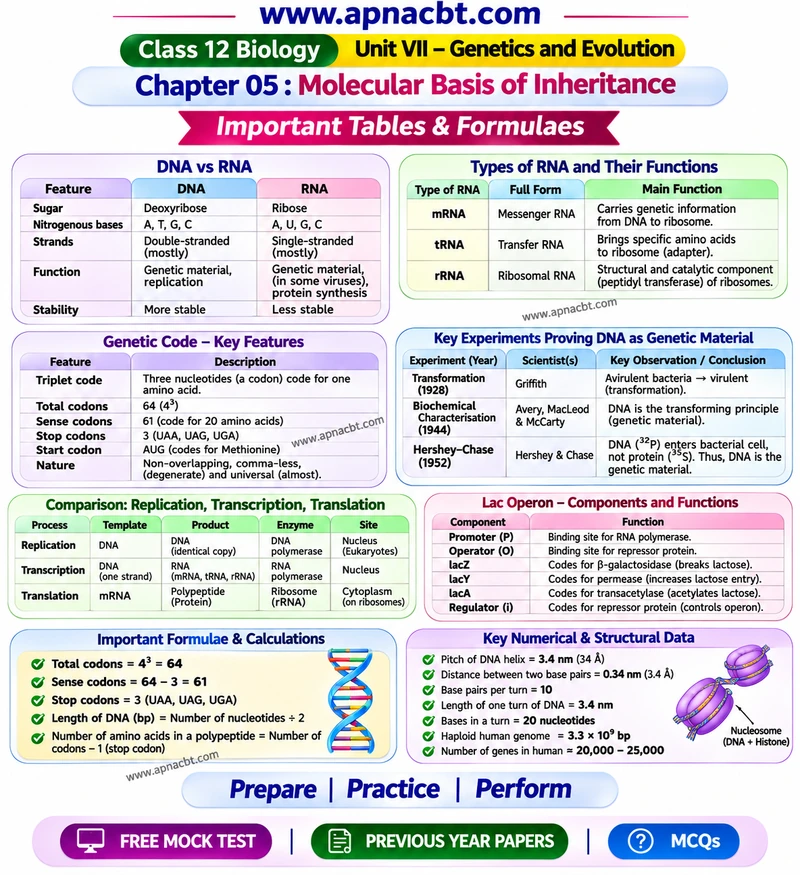
Nucleic acids are polymers of nucleotides and include DNA and RNA. DNA acts as the genetic material in most organisms, whereas RNA acts as the genetic material in some viruses and also performs messenger, adaptor, structural and catalytic roles.
Nucleotide and Nucleoside
- Nucleotide: nitrogenous base + pentose sugar + phosphate group.
- Nucleoside: nitrogenous base + pentose sugar, without phosphate.
- DNA contains the sugar 2-deoxyribose; RNA contains ribose.
- DNA bases are adenine (A), guanine (G), cytosine (C) and thymine (T).
- RNA generally contains uracil (U) in place of thymine.
Purines and Pyrimidines
| Category | Bases | Key point |
|---|---|---|
| Purines | Adenine, Guanine | Two-ring nitrogenous bases |
| Pyrimidines | Cytosine, Thymine, Uracil | Single-ring nitrogenous bases |
DNA versus RNA
- DNA is generally more chemically and structurally stable than RNA.
- The 2′-OH group makes RNA more reactive and comparatively labile.
- DNA uses thymine, whereas RNA uses uracil.
- RNA can function as a genetic material in some viruses and can also act as a catalytic molecule.
Exam focus: Know the differences between nucleotide and nucleoside, purines and pyrimidines, DNA and RNA, and the components of a nucleotide.
2. DNA Structure, Base Pairing and Packaging
DNA is a long polymer of deoxyribonucleotides. In the classical double-helical model, the two polynucleotide strands are antiparallel and complementary.
Watson–Crick Model of DNA
- The two strands run in opposite directions: one 5′→3′ and the other 3′→5′.
- The sugar-phosphate backbone lies towards the outside, while nitrogenous bases project inward.
- Adenine pairs with thymine through two hydrogen bonds.
- Guanine pairs with cytosine through three hydrogen bonds.
- Base pairing provides complementarity and helps DNA replicate accurately.
- The DNA helix has approximately 3.4 nm pitch per complete turn in the classical B-DNA description, with about 10 base pairs per turn.
Chargaff’s Rule
In double-stranded DNA, the amount of adenine equals thymine and the amount of guanine equals cytosine. Therefore, total purines equal total pyrimidines:
A = T, G = C and A + G = T + C.
DNA Packaging
Long DNA molecules are compacted by association with proteins. In eukaryotes, DNA is wrapped around histone proteins to form nucleosomes. Nucleosomes and linker DNA form higher levels of chromatin organisation.
High-yield sequence: DNA → nucleosome → chromatin → higher-order chromosome organisation.
Exam focus: Antiparallel strands, complementary base pairing, hydrogen bonds, Chargaff’s rule, nucleosome and chromatin packaging are frequently tested concepts.
3. Search for Genetic Material – Major Experiments
The identification of DNA as genetic material was established through a series of important experiments.
Griffith’s Transformation Experiment
Frederick Griffith worked with Streptococcus pneumoniae. The smooth (S) strain was virulent, while the rough (R) strain was non-virulent. Heat-killed S bacteria could transform living R bacteria into virulent forms when mixed with them.
Griffith proposed that a transforming principle had transferred information from the dead S bacteria to the living R bacteria.
Avery, MacLeod and McCarty
They investigated the transforming principle and demonstrated that DNA was the substance responsible for transformation. Destruction of DNA prevented transformation, whereas destruction of protein or RNA did not produce the same effect.
Hershey–Chase Experiment
Hershey and Chase used bacteriophages to determine whether DNA or protein entered bacterial cells during infection. DNA was labelled with radioactive phosphorus (32P), while protein was labelled with radioactive sulphur (35S). The radioactive DNA entered the bacteria and directed production of new phage particles, supporting DNA as the genetic material.
RNA as Genetic Material
Although DNA is the genetic material in most organisms, RNA serves this role in some viruses. RNA’s ability to store information, replicate in suitable systems and undergo mutation supports its role as genetic material in those organisms.
Exam sequence: Griffith → Avery, MacLeod & McCarty → Hershey & Chase.
4. DNA Replication – Mechanism and Semiconservative Model
DNA replication is the process by which DNA produces a copy of itself. Complementary base pairing provides the basis for accurate duplication.
Meselson and Stahl Experiment
Matthew Meselson and Franklin Stahl used 15N and 14N in E. coli to demonstrate that DNA replication is semiconservative. After transfer from heavy nitrogen to normal nitrogen, DNA molecules showed the predicted intermediate and light bands across successive generations.
Replication Fork and Enzymes
- Helicase: separates the two DNA strands.
- Primase: synthesises RNA primers.
- DNA polymerase: adds nucleotides to the growing DNA strand in the 5′→3′ direction.
- DNA ligase: joins DNA fragments, especially on the lagging strand.
- Topoisomerase: helps relieve torsional stress generated during DNA unwinding.
Leading and Lagging Strands
Because DNA polymerase synthesises DNA only in the 5′→3′ direction, the two new strands are produced differently.
- Leading strand: synthesised continuously towards the replication fork.
- Lagging strand: synthesised discontinuously away from the fork as short Okazaki fragments, which are later joined by DNA ligase.
High-yield sequence: DNA unwinding → primer formation → nucleotide addition → primer removal/replacement → joining of fragments.
Exam focus: semiconservative replication, direction of synthesis, leading/lagging strands, Okazaki fragments and the roles of replication enzymes.
5. Transcription – DNA to RNA
Transcription is the process of copying genetic information from one DNA strand into an RNA molecule. The RNA sequence is complementary to the template DNA strand, except that uracil replaces thymine.
Transcription Unit
A transcription unit contains three major regions:
- Promoter: site where RNA polymerase recognises and initiates transcription.
- Structural gene: region that is transcribed.
- Terminator: sequence that signals termination of transcription.
Template and Coding Strands
The template strand is read by RNA polymerase in the 3′→5′ direction so that RNA is synthesised 5′→3′. The coding strand has the same base sequence as the RNA, except that DNA has T where RNA has U.
Transcription in Prokaryotes
A single RNA polymerase produces the major RNA types. Transcription and translation can be coupled because there is no nuclear membrane separating the processes.
Transcription in Eukaryotes
- RNA polymerase I transcribes major rRNAs.
- RNA polymerase II transcribes precursor mRNA (hnRNA) and some other RNAs.
- RNA polymerase III transcribes tRNA, 5S rRNA and some small RNAs.
Exam focus: promoter–structural gene–terminator, template versus coding strand, direction of transcription and functions of RNA polymerases.
6. RNA Processing, Genetic Code and Translation
RNA Processing in Eukaryotes
The primary transcript or hnRNA is processed before mature mRNA is transported to the cytoplasm.
- Capping: a modified guanosine nucleotide is added at the 5′ end.
- Tailing: a poly-A tail is added at the 3′ end.
- Splicing: introns are removed and exons are joined.
Genetic Code
- The code is triplet: three nucleotides form one codon.
- There are 64 codons: 61 code for amino acids and 3 are stop codons.
- UAA, UAG and UGA are stop codons.
- AUG acts as the start codon and codes for methionine.
- The code is degenerate because most amino acids are represented by more than one codon.
- It is generally unambiguous: a particular codon specifies only one amino acid.
- It is read continuously and is nearly universal.
Translation
Translation converts the nucleotide sequence of mRNA into the amino-acid sequence of a polypeptide.
- tRNA acts as an adaptor molecule and carries a specific amino acid.
- The anticodon of tRNA pairs with the codon of mRNA.
- Ribosomes provide the platform for translation.
- Translation includes initiation, elongation and termination.
- Peptide bonds are formed as amino acids are added to the growing chain.
High-yield flow: DNA → RNA → protein.
7. Regulation of Gene Expression – Lac Operon
Gene expression is regulated so that cells produce proteins when they are needed. The lac operon of E. coli, described by Jacob and Monod, is a classic example of gene regulation.
Components of Lac Operon
- Regulator gene (i): produces the repressor protein.
- Promoter: binding site for RNA polymerase.
- Operator: regulatory region to which the repressor can bind.
- Structural genes: lacZ, lacY and lacA code for proteins involved in lactose utilisation.
When Lactose is Absent
The repressor binds to the operator and prevents RNA polymerase from effectively transcribing the structural genes. Therefore, the enzymes needed for lactose utilisation are not produced in significant amounts.
When Lactose is Present
Lactose-derived inducer interacts with the repressor, preventing it from blocking the operator. RNA polymerase can then transcribe the structural genes, allowing production of enzymes required for lactose metabolism.
Exam focus: Identify the regulator gene, promoter, operator, structural genes and repressor, and understand the difference between the operon in the presence and absence of inducer.
8. Human Genome Project – Goals, Findings and Applications
The Human Genome Project (HGP) was an international scientific effort to determine the sequence of human DNA and identify genes.
Major Goals
- Identify all human genes.
- Determine the sequence of the approximately 3.2 billion base pairs in the human genome.
- Store the information in databases.
- Improve data analysis tools.
- Study ethical, legal and social issues associated with genomic information.
Important Findings
- The human genome contains approximately 3.2 billion nucleotide base pairs.
- Only a small fraction of the genome codes for proteins.
- A large proportion consists of non-coding and repetitive sequences.
- Human individuals are highly similar at the DNA sequence level but differ at many specific positions.
- Single nucleotide polymorphisms (SNPs) are important sources of genetic variation.
Applications
Genome information supports research into disease-associated genes, diagnosis, biotechnology, evolutionary studies and personalised approaches to medicine.
Exam focus: objectives, sequencing strategy, major findings, coding versus non-coding DNA and applications of genome information.
9. DNA Fingerprinting – Principle, Steps and Applications
DNA fingerprinting is a technique used to identify individuals on the basis of differences in repetitive DNA sequences. Alec Jeffreys developed the technique using highly polymorphic repetitive DNA sequences.
Basis of DNA Fingerprinting
Regions containing variable number tandem repeats (VNTRs) can differ among individuals. These variations generate characteristic DNA fragment patterns.
Major Steps
- Isolation of DNA from the biological sample.
- Amplification of DNA when required.
- Cutting DNA into fragments using restriction enzymes or preparation of target regions.
- Separation of DNA fragments according to size by electrophoresis.
- Transfer and hybridisation steps in classical Southern blot-based approaches.
- Detection of bands to obtain a characteristic pattern.
Applications
- Forensic identification.
- Paternity and kinship analysis.
- Identification of individuals from biological samples.
- Population and evolutionary studies.
Exam sequence: DNA isolation → fragmentation/amplification → electrophoresis → blotting/hybridisation or modern profiling workflow → band/profile detection → comparison.
10. Mutations, Central Dogma and High-Yield Revision
Central Dogma
The central flow of genetic information is commonly represented as DNA → RNA → Protein. DNA can replicate itself, DNA can be transcribed into RNA, and RNA can be translated into protein. Reverse transcription occurs in certain biological systems such as retroviruses.
Mutations and Genetic Code
A point mutation is a change involving a single base pair. A classic example is the mutation in the beta-globin gene associated with sickle-cell anaemia, where a change in codon alters the encoded amino acid.
Insertion or deletion of one or two bases can alter the reading frame from the point of mutation. Such mutations are called frameshift mutations.
High-Yield Sequences
- DNA structure: nucleotide → polynucleotide → double helix → chromatin.
- Replication: unwinding → primer → 5′→3′ synthesis → Okazaki fragments → ligation.
- Transcription: promoter recognition → initiation → elongation → termination.
- Eukaryotic RNA processing: capping → splicing → polyadenylation → mature mRNA.
- Translation: initiation → elongation → termination.
- DNA fingerprinting: DNA sample → separation/profile generation → comparison.
Must-Remember Facts
| Concept | Key fact |
|---|---|
| DNA replication | Semiconservative; synthesis occurs 5′→3′ |
| A–T pairing | Two hydrogen bonds |
| G–C pairing | Three hydrogen bonds |
| Start codon | AUG |
| Stop codons | UAA, UAG, UGA |
| Template strand | Read 3′→5′ during transcription |
| RNA processing | Capping, splicing and polyadenylation |
| Lac operon | Classic model of inducible gene regulation |
| DNA fingerprinting | Based on polymorphic repetitive DNA profiles |
Board + NEET strategy: Practise labelled diagrams of DNA structure, replication fork, transcription unit, RNA processing, lac operon, DNA fingerprinting and important experimental setups. Learn sequences, enzyme functions, strand directions and scientist–experiment associations precisely.
11. Short-Answer Questions – 30 Questions with Detailed Answers
Important Short-Answer Questions
- What are nucleic acids?
- Differentiate between a nucleotide and a nucleoside.
- Name the purines and pyrimidines found in nucleic acids.
- State Chargaff’s rule for double-stranded DNA.
- Why is DNA more stable than RNA?
- What is meant by antiparallel DNA strands?
- How are adenine and thymine paired in DNA?
- How are guanine and cytosine paired in DNA?
- What is a nucleosome?
- What did Griffith demonstrate?
- What was the conclusion of the Avery, MacLeod and McCarty experiment?
- How did Hershey and Chase prove that DNA is genetic material?
- What is semiconservative replication?
- What was demonstrated by Meselson and Stahl?
- In which direction does DNA polymerase synthesise DNA?
- What are Okazaki fragments?
- What is transcription?
- What are promoter, structural gene and terminator?
- Differentiate between template and coding strands.
- What is RNA capping?
- What is RNA splicing?
- What is a codon?
- Why is the genetic code called degenerate?
- What is the start codon?
- Name the stop codons.
- What is the role of tRNA in translation?
- What is the lac operon?
- What is a point mutation?
- What is DNA fingerprinting?
- What are VNTRs and where are they useful?
Detailed Answers
- What are nucleic acids?
Nucleic acids are polymers of nucleotides. DNA and RNA are the two major types. DNA stores genetic information in most organisms, while RNA has genetic, messenger, adaptor, structural or catalytic roles depending on the system.
- Differentiate between a nucleotide and a nucleoside.
A nucleotide contains a nitrogenous base, pentose sugar and phosphate group. A nucleoside contains only the nitrogenous base and pentose sugar.
- Name the purines and pyrimidines found in nucleic acids.
Adenine and guanine are purines. Cytosine, thymine and uracil are pyrimidines.
- State Chargaff’s rule for double-stranded DNA.
In double-stranded DNA, A equals T and G equals C. Consequently, total purines equal total pyrimidines.
- Why is DNA more stable than RNA?
DNA lacks the reactive 2′-OH group present in RNA and contains thymine instead of uracil. Its double-stranded structure and complementary pairing also contribute to stability.
- What is meant by antiparallel DNA strands?
The two DNA strands run in opposite directions. If one strand runs 5′→3′, the complementary strand runs 3′→5′.
- How are adenine and thymine paired in DNA?
Adenine pairs with thymine through two hydrogen bonds.
- How are guanine and cytosine paired in DNA?
Guanine pairs with cytosine through three hydrogen bonds.
- What is a nucleosome?
A nucleosome is a unit of eukaryotic chromatin in which DNA is wrapped around a histone protein core, helping compact the long DNA molecule.
- What did Griffith demonstrate?
Griffith demonstrated transformation in bacteria: material from heat-killed virulent S bacteria could transform living non-virulent R bacteria into virulent forms.
- What was the conclusion of the Avery, MacLeod and McCarty experiment?
They showed that DNA was the transforming principle responsible for the observed bacterial transformation.
- How did Hershey and Chase prove that DNA is genetic material?
They separately labelled phage DNA with 32P and protein with 35S. DNA entered bacterial cells and directed production of progeny phages, whereas most labelled protein remained outside, supporting DNA as genetic material.
- What is semiconservative replication?
It means each daughter DNA molecule contains one parental strand and one newly synthesised strand.
- What was demonstrated by Meselson and Stahl?
Their isotope-labelling experiment demonstrated that DNA replication in E. coli is semiconservative.
- In which direction does DNA polymerase synthesise DNA?
DNA polymerase adds nucleotides in the 5′→3′ direction.
- What are Okazaki fragments?
They are short DNA segments formed discontinuously on the lagging strand during replication and later joined by DNA ligase.
- What is transcription?
Transcription is the synthesis of RNA using one DNA strand as a template.
- What are promoter, structural gene and terminator?
The promoter is the RNA polymerase recognition/initiation region, the structural gene is transcribed, and the terminator signals the end of transcription.
- Differentiate between template and coding strands.
The template strand is read by RNA polymerase and is complementary to the RNA. The coding strand has the same sequence as the RNA except that DNA contains thymine instead of uracil.
- What is RNA capping?
A modified guanosine nucleotide is added to the 5′ end of eukaryotic precursor mRNA during processing.
- What is RNA splicing?
Splicing removes introns from the primary RNA transcript and joins the exons to produce mature mRNA.
- What is a codon?
A codon is a sequence of three nucleotides in mRNA that specifies an amino acid or a termination signal.
- Why is the genetic code called degenerate?
Because most amino acids are specified by more than one codon.
- What is the start codon?
AUG is the usual start codon and also codes for methionine.
- Name the stop codons.
UAA, UAG and UGA are stop codons.
- What is the role of tRNA in translation?
tRNA acts as an adaptor. Its anticodon recognises the complementary codon on mRNA and it carries the corresponding amino acid.
- What is the lac operon?
The lac operon is an inducible gene-regulatory system in E. coli that controls genes involved in lactose utilisation.
- What is a point mutation?
A point mutation is a change involving a single nucleotide or base pair. Depending on the altered codon, it may change an amino acid or have another effect.
- What is DNA fingerprinting?
DNA fingerprinting is a method of identifying individuals by analysing polymorphic DNA regions, traditionally including VNTRs, to obtain a characteristic banding or profile pattern.
- What are VNTRs and where are they useful?
VNTRs are variable number tandem repeats. Their variation among individuals makes them useful in forensic identification, paternity analysis and population studies.
12. Long-Answer Questions – 15 Questions with Detailed Answers
Important Long-Answer Questions
- Explain the structure of DNA according to the Watson–Crick model.
- Describe the major experiments that established DNA as the genetic material.
- Explain the semiconservative replication of DNA and the Meselson–Stahl experiment.
- Describe the mechanism of DNA replication, including leading and lagging strand synthesis.
- Explain transcription and the organisation of a transcription unit.
- Compare transcription in prokaryotes and eukaryotes.
- Explain eukaryotic RNA processing and the role of capping, splicing and polyadenylation.
- Describe the genetic code and explain its important properties.
- Explain translation, including initiation, elongation and termination.
- Explain the lac operon model of regulation of gene expression.
- Describe the Human Genome Project and its major findings.
- Explain the principle, steps and applications of DNA fingerprinting.
- Explain the central dogma and important exceptions such as reverse transcription.
- Explain point mutation and frameshift mutation with suitable examples.
- Discuss the most important CBSE and NEET revision points from Molecular Basis of Inheritance.
Detailed Answers
- Explain the structure of DNA according to the Watson–Crick model.
DNA consists of two long polynucleotide strands arranged as a double helix. The strands are antiparallel and complementary. The sugar-phosphate backbone is on the outside and the nitrogenous bases project inward. Adenine pairs with thymine through two hydrogen bonds and guanine pairs with cytosine through three hydrogen bonds. Complementary base pairing gives DNA a reliable mechanism for information storage and copying. The classical helix has a regular pitch and approximately ten base pairs per turn. DNA is further compacted in cells through association with proteins, including histones in eukaryotes.
- Describe the major experiments that established DNA as the genetic material.
Griffith demonstrated bacterial transformation using virulent S and non-virulent R strains of S. pneumoniae. Avery, MacLeod and McCarty subsequently showed that DNA was the transforming principle. Hershey and Chase used bacteriophages with radioactively labelled DNA and protein; DNA entered bacterial cells and directed production of progeny phages. Together, these experiments provided strong evidence that DNA is the genetic material in most organisms.
- Explain the semiconservative replication of DNA and the Meselson–Stahl experiment.
During semiconservative replication, the two parental strands separate and each acts as a template for synthesis of a complementary new strand. Thus every daughter DNA molecule contains one old strand and one new strand. Meselson and Stahl first grew E. coli in 15N-containing medium and then transferred the cells to 14N medium. DNA collected after successive generations showed the predicted intermediate and light density patterns, proving the semiconservative model.
- Describe the mechanism of DNA replication, including leading and lagging strand synthesis.
Helicase unwinds the DNA double helix, producing replication forks. Primase provides RNA primers. DNA polymerase extends the new strand only in the 5′→3′ direction. Because the template strands are antiparallel, one new strand is produced continuously as the leading strand, while the other is produced discontinuously as Okazaki fragments on the lagging strand. RNA primers are removed or replaced with DNA, and DNA ligase joins adjacent DNA fragments. Topoisomerases help reduce torsional strain caused by unwinding.
- Explain transcription and the organisation of a transcription unit.
Transcription is RNA synthesis using a DNA template. A transcription unit contains a promoter, structural gene and terminator. RNA polymerase recognises the promoter, locally unwinds DNA and begins RNA synthesis. The template strand is read 3′→5′, while RNA grows 5′→3′. Complementary RNA nucleotides are added until a termination signal is reached. The resulting RNA may be processed before it functions as mature RNA, especially in eukaryotes.
- Compare transcription in prokaryotes and eukaryotes.
In prokaryotes, a single major RNA polymerase transcribes the principal RNA classes, and transcription and translation may be coupled in the cytoplasm. In eukaryotes, transcription occurs in the nucleus and different RNA polymerases have specialised roles. RNA polymerase I produces major rRNAs, RNA polymerase II produces precursor mRNA and some other RNAs, and RNA polymerase III produces tRNA, 5S rRNA and certain small RNAs. Eukaryotic precursor mRNA undergoes processing before leaving the nucleus.
- Explain eukaryotic RNA processing and the role of capping, splicing and polyadenylation.
The primary transcript, or hnRNA, contains coding exons and non-coding introns. A modified guanosine cap is added at the 5′ end, a poly-A tail is added at the 3′ end, and introns are removed by splicing while exons are joined. These processing events produce mature mRNA that can be transported to the cytoplasm for translation. They also help protect the RNA and assist in its recognition and processing by the cellular machinery.
- Describe the genetic code and explain its important properties.
The genetic code is triplet because three nucleotides form one codon. There are 64 possible codons; 61 specify amino acids and three are stop codons. AUG acts as the usual start codon and codes for methionine. The code is degenerate because several codons can specify the same amino acid, but it is generally unambiguous because each codon has one meaning. The code is read continuously without commas and is nearly universal across organisms. These properties allow nucleotide information to be translated into a precise amino-acid sequence.
- Explain translation, including initiation, elongation and termination.
Translation occurs on ribosomes. During initiation, the ribosome assembles on mRNA and identifies the start codon, usually AUG, with the appropriate initiator tRNA. During elongation, tRNAs bring amino acids according to the mRNA codons and peptide bonds are formed as the polypeptide chain grows. During termination, a stop codon enters the relevant ribosomal site and release factors promote release of the completed polypeptide. The ribosome then dissociates and can participate in another translation cycle.
- Explain the lac operon model of regulation of gene expression.
The lac operon contains a regulator gene, promoter, operator and structural genes. In the absence of inducer, the repressor protein binds the operator and prevents effective transcription of the structural genes. When lactose is available, an inducer derived from lactose interacts with the repressor so that it cannot block the operator. RNA polymerase can then transcribe the structural genes, allowing synthesis of enzymes involved in lactose utilisation. The model demonstrates inducible regulation of gene expression.
- Describe the Human Genome Project and its major findings.
The Human Genome Project was an international effort to determine the sequence of human DNA and identify genes. Its goals included sequencing the genome, identifying genes, storing and analysing sequence information and considering ethical, legal and social implications. The human genome contains about 3.2 billion base pairs, but only a small proportion directly codes for proteins. Large portions are non-coding or repetitive. Sequence variation among individuals includes SNPs and other polymorphisms. Genome information has applications in disease research, diagnostics, biotechnology, evolutionary studies and personalised medicine.
- Explain the principle, steps and applications of DNA fingerprinting.
DNA fingerprinting relies on differences in polymorphic DNA regions, traditionally including VNTRs. DNA is isolated from a biological sample and target sequences are analysed to produce a characteristic profile. Classical workflows may involve restriction digestion, electrophoresis, Southern blotting, hybridisation with a probe and detection of bands; modern profiling often uses PCR-based methods and capillary electrophoresis. Profiles can be compared between samples. Applications include forensic identification, paternity and kinship analysis, identification of unknown individuals and population or evolutionary studies.
- Explain the central dogma and important exceptions such as reverse transcription.
The central dogma describes the principal flow of genetic information from DNA to RNA to protein. DNA replication copies DNA, transcription produces RNA from DNA, and translation converts RNA information into protein. Some biological systems also use reverse transcription, in which RNA serves as a template for DNA synthesis, as seen in retroviruses. The central dogma therefore represents the major information flow but does not mean that every biological system follows only the simple DNA→RNA→protein pathway.
- Explain point mutation and frameshift mutation with suitable examples.
A point mutation involves a change in a single base or base pair. If the changed codon specifies a different amino acid, the resulting protein can have an altered structure or function. A classic example is the beta-globin mutation associated with sickle-cell anaemia. Frameshift mutations occur when bases are inserted or deleted in numbers that are not multiples of three. This shifts the reading frame and can change every codon downstream of the mutation, often producing a severely altered protein.
- Discuss the most important CBSE and NEET revision points from Molecular Basis of Inheritance.
For DNA structure, remember antiparallel strands, A–T and G–C pairing, hydrogen bonds and Chargaff’s rule. For genetic-material experiments, remember the scientist–experiment–conclusion sequence. For replication, remember semiconservative replication, 5′→3′ synthesis, leading and lagging strands and Okazaki fragments. For transcription, learn promoter, template strand, coding strand, terminator and RNA polymerases. For RNA processing, remember capping, splicing and poly-A tail. For translation, learn codons, anticodons, start and stop codons and ribosomal functions. For regulation, master the lac operon. For HGP and DNA fingerprinting, learn objectives, major findings, VNTR principle, workflow and applications. Practise diagrams and sequence-based MCQs because these concepts frequently require precise recall.
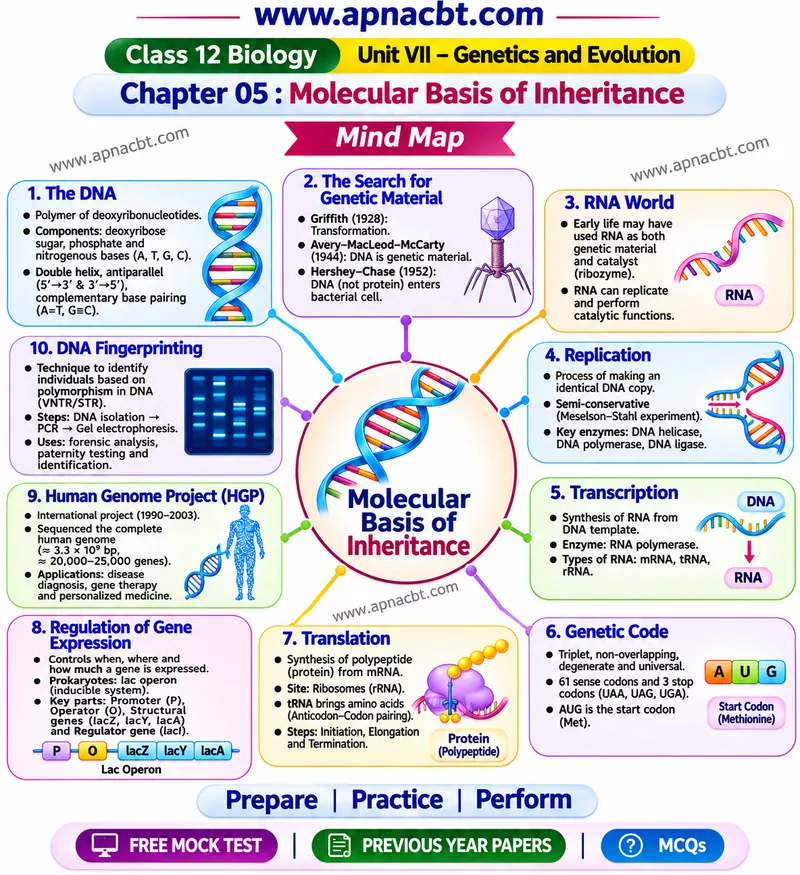
Important Mindmaps From Lesson
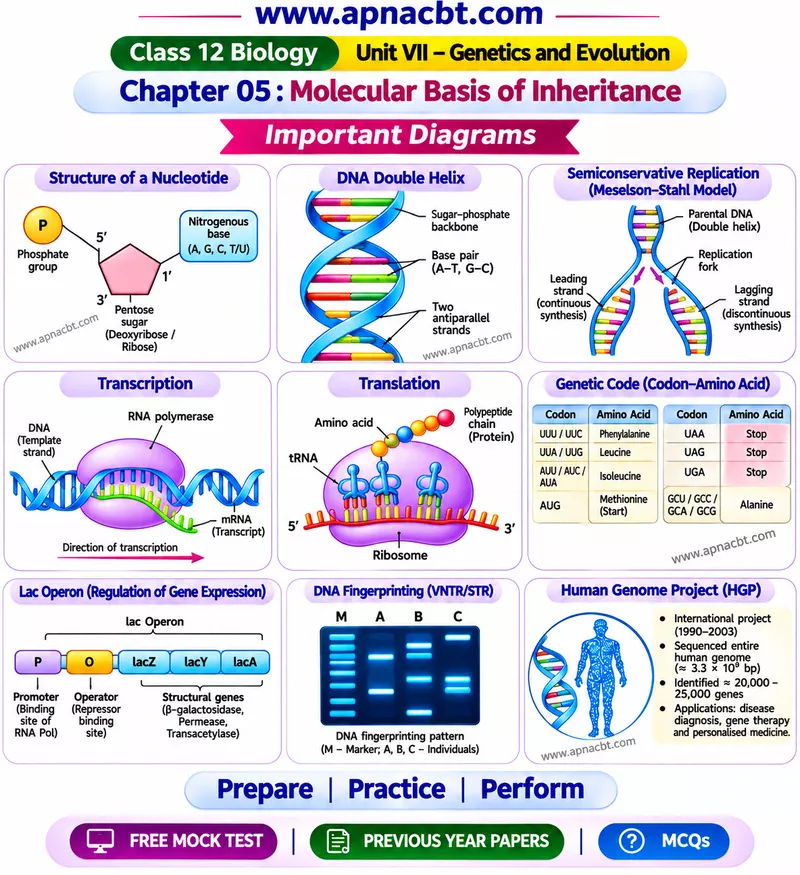
Important Diagrams From Lesson
Important tables and formulae from Lesson