Biodiversity and Conservation Class 12 Biology
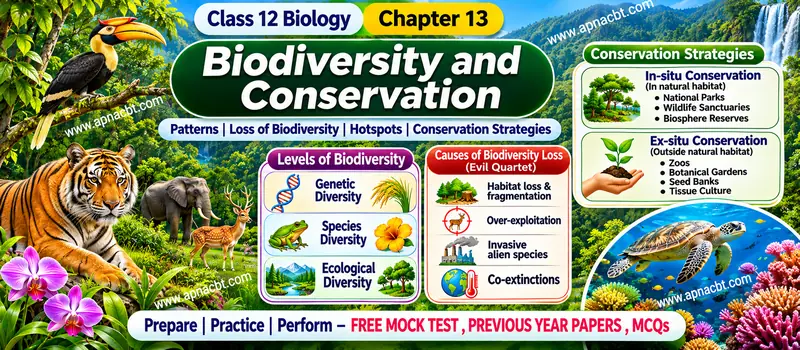
Biodiversity and Conservation Class 12 Biology explains the variety of life at genetic, species and ecosystem levels, patterns of biodiversity, causes of biodiversity loss, biodiversity hotspots and conservation strategies. This lesson is designed for CBSE Board Exams and NEET preparation.
Chapter focus: This lesson is designed for Class 12 Biology, CBSE Board Exams and NEET preparation. Learn the important concepts from Biodiversity and Conservation in a structured, exam-oriented sequence with definitions, comparisons, examples, high-yield facts, revision points and practice questions.
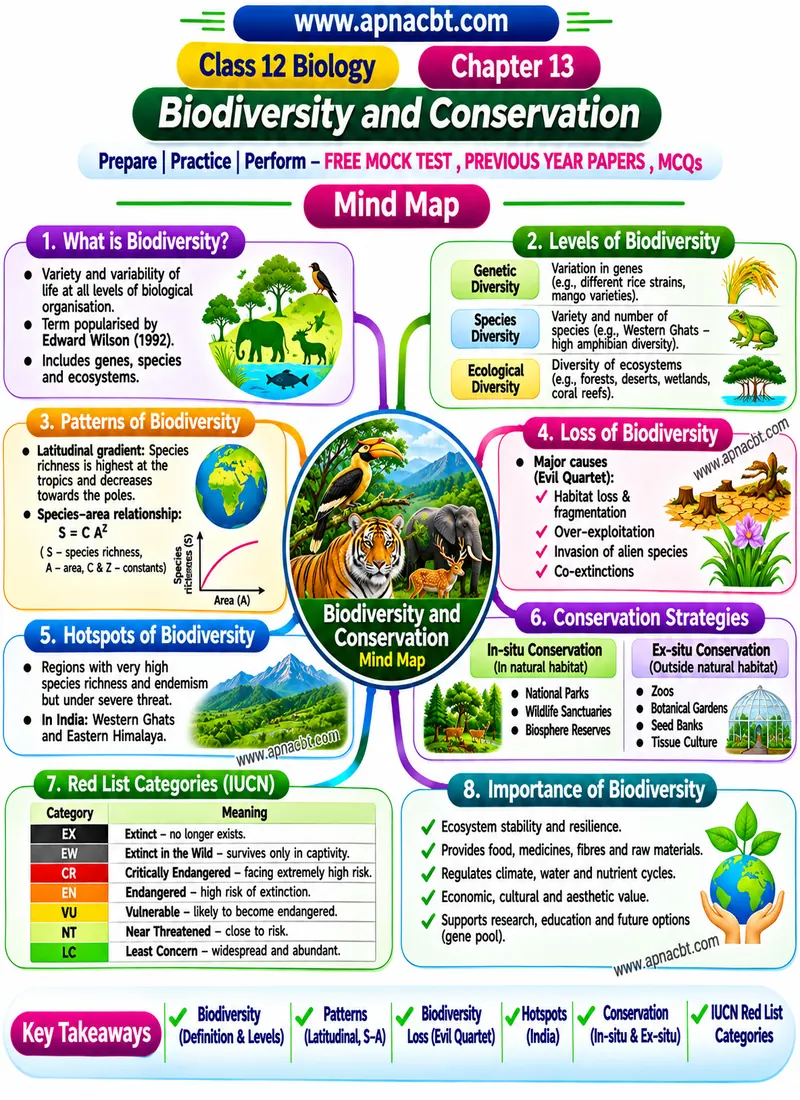
1. Biodiversity – Meaning, Levels and Importance
Biodiversity or biological diversity refers to the variety of living organisms and the diversity present at different levels of biological organisation.
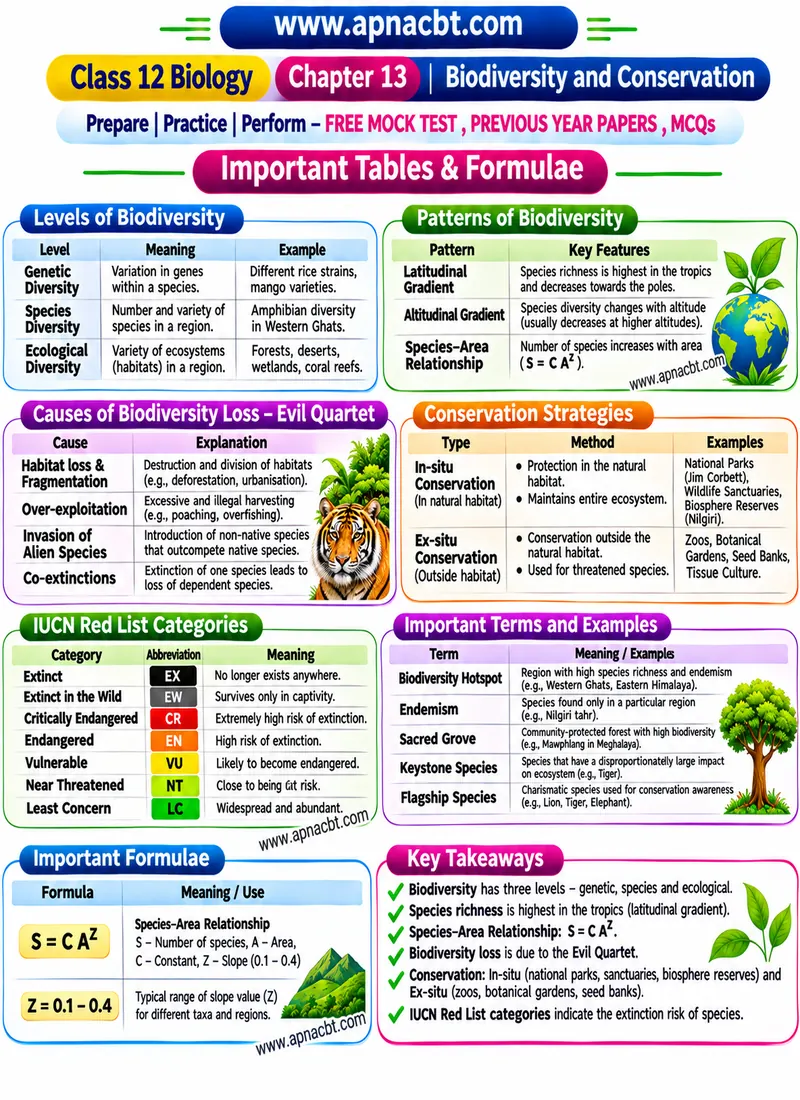
Three Important Levels of Biodiversity
- Genetic diversity: Variation in genes within a species. It enables a species to adapt to changing environmental conditions.
- Species diversity: Variety and relative abundance of different species in a region.
- Ecosystem diversity: Variety of ecosystems, habitats and ecological processes in a geographical area.
The term biodiversity was coined by Walter G. Rosen in 1985 and was popularised by Edward Wilson.
Why Biodiversity Matters
- Maintains ecological stability and ecosystem functioning.
- Provides food, fibres, fuel, medicines and other biological resources.
- Supports pollination, nutrient cycling, climate regulation and other ecosystem services.
- Provides genetic resources for crop and livestock improvement.
- Has aesthetic, cultural, ethical and educational value.
Exam focus: Remember the sequence genetic diversity → species diversity → ecosystem diversity.
2. Biodiversity Patterns – Species Richness and Latitudinal Gradient
Biodiversity is not uniformly distributed across Earth. Species richness generally varies with latitude, climate and area.
Latitudinal Gradient
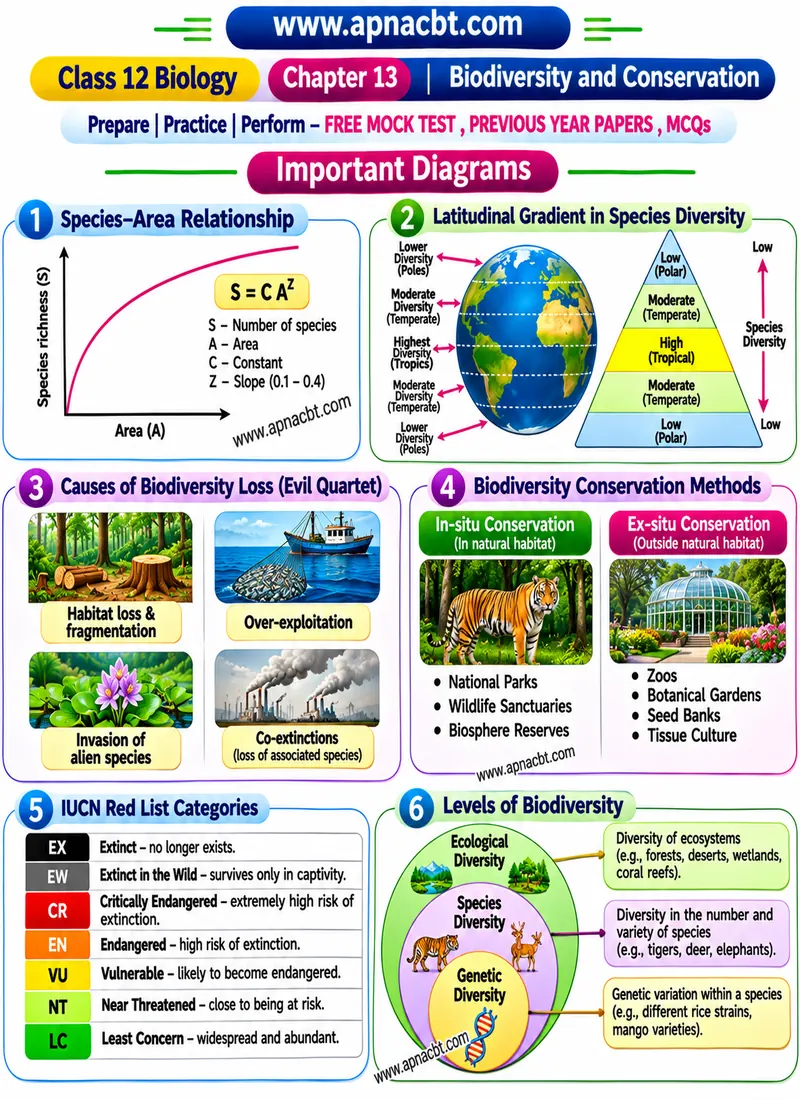
Species diversity generally increases from the poles towards the equator. Tropical regions usually contain greater species richness than temperate and polar regions.
Why Are Tropics Rich in Species?
- Tropical regions have remained relatively undisturbed for longer evolutionary periods.
- They generally have a relatively constant environment.
- Greater solar energy contributes to higher productivity.
- Stable environmental conditions may promote niche specialisation and diversification.
High-yield point: Species richness is generally highest in tropical regions and decreases towards the poles.
3. Species–Area Relationship and Biodiversity Measurement
Species richness is also related to the area of a region. Larger areas generally support more species than smaller areas, although the increase is not unlimited.
Species–Area Relationship
For many taxonomic groups, the relationship between species richness and area is represented by a rectangular hyperbolic curve. On a logarithmic scale it becomes approximately linear.
Equation: S = C AZ
- S = species richness
- A = area
- C = constant
- Z = regression coefficient or slope
For small areas, the value of Z is relatively low. For very large areas, such as continents, the slope can be much steeper.
NEET focus: Know the equation and identify what S, C, A and Z represent.
4. Biodiversity and Ecosystem Stability
Ecologists have studied whether communities with greater diversity are more stable and productive. Diverse communities may show greater resistance to environmental disturbances and biological invasions.
David Tilman’s Long-term Grassland Experiments
Long-term ecological experiments have provided evidence that greater plant diversity can contribute to higher productivity and greater resistance to invasion and environmental fluctuations.
Rivet-Popper Hypothesis
Paul Ehrlich compared species in an ecosystem with rivets in an aeroplane. Removal of a few species may initially have little visible effect, but continued species loss can eventually weaken ecosystem functioning and cause serious consequences.
Exam focus: Biodiversity is not simply a count of species; it is linked with ecosystem functioning, productivity, stability and resilience.
5. Biodiversity Loss and Extinction
Extinction is the permanent disappearance of a species from Earth. Earth has experienced natural extinction events in its geological history, but current extinction rates are strongly associated with human activities.
Background Extinction and Mass Extinction
- Background extinction: Normal, gradual disappearance of species over geological time.
- Mass extinction: Rapid loss of a large number of species over a relatively short geological period.
The present rate of extinction has been estimated in the source material to be much higher than pre-human background rates. Habitat destruction, over-exploitation, invasive species and co-extinction are major drivers.
Examples
- Dodo: Classic example of a species driven to extinction.
- Passenger pigeon: Extinction associated with over-exploitation.
- Dinosaurs: Associated with the Cretaceous–Tertiary mass extinction event in standard NCERT discussion.
6. The Evil Quartet – Major Causes of Biodiversity Loss
The major causes of biodiversity loss are often remembered as the Evil Quartet.
1. Habitat Loss and Fragmentation
Destruction and fragmentation of natural habitats is one of the most important causes of biodiversity loss. Wetlands may be filled, forests cleared, grasslands converted and habitats divided by roads, dams and other development projects.
2. Over-exploitation
When biological resources are harvested at rates higher than their natural replacement, populations decline and species may become endangered or extinct.
3. Alien Species Invasions
Introduced species can become invasive and compete with, prey upon or otherwise adversely affect native species.
- Lantana camara has replaced native vegetation in several regions.
- Parthenium hysterophorus has displaced several herbs and shrubs.
- African catfish Clarias gariepinus has threatened native catfish populations.
- Nile perch introduced into Lake Victoria contributed to the decline and extinction of many native cichlid fishes.
4. Co-extinction
When one species becomes extinct, another species that depends exclusively on it may also disappear. Examples include highly specialised host-parasite relationships and obligate mutualisms.
NEET memory: Habitat loss + Over-exploitation + Alien invasions + Co-extinction = Evil Quartet.
7. Other Threats – Pollution, Disturbance and Degradation
Besides the Evil Quartet, pollution and environmental degradation can reduce biodiversity.
Pollution
- Excessive pesticides can contaminate water and enter food chains.
- Biomagnification can increase concentrations of persistent pollutants at higher trophic levels.
- Air pollutants can damage sensitive plants.
- Oil spills can kill marine organisms and birds.
- Heavy metals may cause toxicity and mortality in aquatic organisms.
Disturbance and Habitat Degradation
Natural disturbances include forest fires, tree falls, pest outbreaks and insect attacks. Human disturbances such as deforestation, excessive resource extraction and habitat modification can intensify biodiversity loss.
Exam focus: Differentiate direct habitat destruction from broader pollution and degradation effects.
8. Why Conserve Biodiversity? – Three Major Arguments
Conservation of biodiversity is essential for ecological, economic, social and ethical reasons.
Narrowly Utilitarian Argument
Humans directly depend on biological resources for food, fuel, fibres, medicines, construction materials and other useful products.
Broadly Utilitarian Argument
Nature provides ecosystem services that support human life, including pollination, oxygen production, climate moderation, flood control, pest control, nutrient cycling and soil formation.
Ethical Argument
Every species has intrinsic value. Humans have a moral responsibility to protect other organisms and pass Earth’s biological heritage to future generations.
CBSE focus: Be able to explain all three arguments with examples rather than merely listing them.
9. Biodiversity Hotspots and Red List Categories
Biodiversity Hotspots
Hotspots are regions with very high species richness and endemism that are also subject to substantial habitat loss and threat.
The source material identifies 34 biodiversity hotspots worldwide. The Indian region is represented in hotspot areas including the Western Ghats–Sri Lanka, Indo-Burma and Himalaya; the supplied study material also discusses Sundaland in the broader hotspot list.
Endemism
An endemic species is naturally restricted to a particular geographical region and is not found elsewhere in the wild.
IUCN Red List Categories in the Source
| Category | Meaning / example |
|---|---|
| Extinct | Taxon has been completely eliminated or died out; Dodo is a classic example. |
| Critically Endangered | Very high risk of extinction in the wild in the immediate future. |
| Endangered | High risk of extinction in the wild in the near future. |
| Vulnerable | Population is declining and faces extinction risk in the medium term. |
| Extinct in the Wild | Absent from natural or expected habitats in the wild. |
| Lower Risk | Threatened species with comparatively lower extinction risk. |
| Data Deficient | Insufficient information to assess extinction risk directly or indirectly. |
| Rare | Species with naturally small, localised or scattered populations. |
| Not Evaluated | Taxon has not yet been evaluated for extinction risk. |
| Indeterminate | Species is in danger but the reason for the danger is not known. |
Exam focus: Learn the distinction between endangered, vulnerable, critically endangered, extinct in the wild and data deficient.
10. In-situ Conservation – Hotspots, Protected Areas and Sacred Groves
In-situ conservation means conserving organisms in their natural habitat. Protecting the entire ecosystem can protect biodiversity at genetic, species and ecosystem levels.
Biodiversity Hotspots
Hotspots are selected for intensive conservation because they combine high biodiversity and endemism with significant habitat loss.
Protected Areas
- National Parks: Areas managed primarily for protection of wildlife and natural ecosystems with strict legal protection.
- Wildlife Sanctuaries: Protected areas where wildlife and habitats receive legal protection; certain regulated human activities may be permitted depending on the area.
- Biosphere Reserves: Large areas intended to conserve biodiversity while allowing appropriate research, education and sustainable activities in designated zones.
Sacred Groves
Sacred groves are forest patches protected through traditional religious and cultural practices. The source material mentions sacred groves in the Khasi and Jaintia Hills of Meghalaya, Aravalli Hills of Rajasthan, Western Ghats of Karnataka and Maharashtra, and parts of Madhya Pradesh.
NEET memory: In-situ = on-site = natural habitat.
11. Biosphere Reserves – Zones and Conservation Strategy
Biosphere reserves combine biodiversity conservation with appropriate human activities and research. They are associated with the UNESCO Man and the Biosphere (MAB) programme.
Common Zonation
| Zone | Main feature |
|---|---|
| Core zone | Strictly protected area where conservation has the highest priority. |
| Buffer zone | Surrounds the core; research, education and compatible activities may be allowed. |
| Transition zone | Outer region where regulated human activities such as agriculture, forestry and recreation may occur. |
Exam focus: The core zone has the strictest protection, while the transition zone permits the greatest level of regulated human activity.
12. Ex-situ Conservation – Off-site Protection and Genetic Resources
Ex-situ conservation means conserving threatened organisms outside their natural habitats in controlled or specially managed settings.
Major Methods
- Zoological parks: Maintain threatened animals under protected conditions.
- Botanical gardens: Maintain living collections of plants.
- Wildlife safari parks: Provide managed environments for wildlife.
- Seed banks: Preserve seeds and genetic strains of important plants.
- Cryopreservation: Preserves viable biological material at very low temperatures.
- In-vitro fertilisation: Can assist conservation of threatened genetic material.
- Tissue culture: Enables rapid propagation and maintenance of selected plant material.
- Gene banks: Preserve genetic resources for future use.
In-situ vs Ex-situ: In-situ protects species within their natural ecosystem; ex-situ protects them outside their natural habitat.
13. Biodiversity Conservation in India
India is one of the world’s megadiverse countries and contains substantial plant, animal and ecosystem diversity.
Important Indian Conservation Efforts
- Protected areas such as biosphere reserves, national parks and wildlife sanctuaries.
- Sacred groves maintained through traditional cultural practices.
- Conservation of crop genetic resources and germplasm.
- Ex-situ conservation through botanical and zoological facilities, seed banks and related methods.
- Institutions and programmes supporting conservation and sustainable use of biological resources.
ICRISAT
The source material refers to the International Crops Research Institute for the Semi-Arid Tropics (ICRISAT) in Hyderabad and its role in conserving germplasm of crops such as groundnut, pigeon pea, chickpea, pearl millet and sorghum.
Exam focus: Link India → megadiversity → hotspots → protected areas → sacred groves → genetic resource conservation.
14. International Efforts – Earth Summit, CBD, CITES and Sustainable Use
Earth Summit – Rio de Janeiro, 1992
The historic Earth Summit at Rio de Janeiro in 1992 led to the Convention on Biological Diversity (CBD) and emphasised biodiversity conservation and sustainable utilisation of biological resources.
World Summit on Sustainable Development – Johannesburg, 2002
The source material notes that 190 countries participated and pledged to reduce the rate of biodiversity loss.
IUCN
The International Union for Conservation of Nature provides scientific and technical leadership for conservation and maintains the framework associated with the Red List.
WWF
The World Wide Fund for Nature is an international conservation organisation working on biodiversity and environmental protection.
CITES
The Convention on International Trade in Endangered Species of Wild Fauna and Flora helps regulate international trade in threatened wildlife and plant species.
Key idea: Biodiversity conservation requires cooperation among countries because biological diversity does not follow political boundaries.
15. Complete Chapter Revision – Must-Know Facts, Comparisons and NEET Triggers
Rapid Revision Table
| Concept | Must-remember point |
|---|---|
| Biodiversity | Diversity of life at genetic, species and ecosystem levels. |
| Genetic diversity | Variation within a species. |
| Species diversity | Variety and relative abundance of species. |
| Ecosystem diversity | Variety of ecosystems and habitats. |
| Latitudinal gradient | Species richness generally increases towards the tropics. |
| Species–area relationship | S = C AZ. |
| Evil Quartet | Habitat loss, over-exploitation, alien invasions and co-extinction. |
| Hotspot | High species richness/endemism plus major habitat threat. |
| In-situ | Conservation in natural habitat. |
| Ex-situ | Conservation outside natural habitat. |
| Core zone | Strictest protection in a biosphere reserve. |
| Seed bank | Ex-situ conservation of seeds/genetic resources. |
| Cryopreservation | Long-term preservation of viable biological material at very low temperature. |
| Sacred groves | Traditional community-protected forest patches. |
| CBD | International biodiversity conservation and sustainable-use framework associated with Rio 1992. |
| CITES | Regulates international trade in endangered wildlife and plants. |
High-Probability NEET Triggers
- Three levels of biodiversity.
- Tropical species richness and latitudinal gradient.
- Species-area equation and meaning of Z.
- Evil Quartet and examples of alien species.
- Co-extinction examples.
- Narrowly utilitarian, broadly utilitarian and ethical arguments.
- Hotspot definition and Indian hotspot regions.
- In-situ versus ex-situ conservation.
- Biosphere reserve zones.
- Sacred groves and their conservation value.
- Seed banks, tissue culture and cryopreservation.
- CBD, IUCN, WWF and CITES.
Board exam strategy: For long answers, define the concept first, organise the answer under subheadings, add examples and finish with the conservation or ecological significance.
16. Short-Answer Questions – 30 Questions with Detailed Answers
1. What is biodiversity?
Answer: Biodiversity is the variety of living organisms and biological variation occurring at genetic, species and ecosystem levels.
2. Name the three important levels of biodiversity.
Answer: Genetic diversity, species diversity and ecosystem diversity.
3. What is genetic diversity?
Answer: Genetic diversity is variation in genes among individuals or populations of the same species. It helps populations adapt to environmental changes.
4. What is species diversity?
Answer: Species diversity refers to the variety and relative abundance of different species in a particular region.
5. What is ecosystem diversity?
Answer: Ecosystem diversity is the variety of ecosystems, habitats and ecological processes found in a geographical area.
6. What is the latitudinal gradient in biodiversity?
Answer: Species richness generally increases from the poles towards the equator, with tropical regions showing greater biodiversity.
7. Why are tropical regions rich in species?
Answer: Tropics have had greater evolutionary time, relatively stable environments and high solar energy and productivity, which favour diversification.
8. State the species-area relationship.
Answer: Species richness is related to area according to S = C AZ, where S is species richness, A is area, C is a constant and Z is the regression coefficient.
9. What is an endemic species?
Answer: An endemic species is naturally restricted to a particular geographical region and is not naturally found elsewhere.
10. What is extinction?
Answer: Extinction is the permanent disappearance of a species from Earth.
11. What is the Evil Quartet?
Answer: The Evil Quartet consists of habitat loss and fragmentation, over-exploitation, alien species invasions and co-extinctions.
12. Why is habitat loss a major cause of biodiversity loss?
Answer: It destroys living space, reduces food and shelter, fragments populations and increases vulnerability to predation and local extinction.
13. What is over-exploitation?
Answer: Over-exploitation occurs when organisms or biological resources are harvested faster than their populations can naturally recover.
14. What is an alien species invasion?
Answer: It occurs when a species introduced outside its natural range becomes invasive and negatively affects native species or ecosystems.
15. Give two examples of invasive alien species mentioned in the chapter.
Answer: Lantana camara and Parthenium hysterophorus are examples. African catfish and Nile perch are also discussed as problematic introductions.
16. What is co-extinction?
Answer: Co-extinction is the extinction of one species following the extinction of another species on which it depends, such as an obligate parasite or mutualist.
17. What are biodiversity hotspots?
Answer: Biodiversity hotspots are regions with high species richness and endemism that are also under significant threat from habitat loss and other pressures.
18. Name important hotspot regions associated with India.
Answer: Western Ghats–Sri Lanka, Indo-Burma and Himalaya are major hotspot regions associated with India. The broader hotspot list also includes Sundaland.
19. What is in-situ conservation?
Answer: In-situ conservation protects species within their natural habitats, thereby conserving organisms along with their ecological relationships and ecosystems.
20. What is ex-situ conservation?
Answer: Ex-situ conservation protects threatened organisms outside their natural habitats in facilities such as zoological parks, botanical gardens, seed banks and controlled conservation centres.
21. Give two examples of ex-situ conservation.
Answer: Seed banks and zoological parks are examples. Botanical gardens, cryopreservation and tissue culture are also ex-situ methods.
22. What are sacred groves?
Answer: Sacred groves are forest patches traditionally protected by local communities because of religious or cultural beliefs. They can conserve rare and endemic species.
23. Name the three common zones of a biosphere reserve.
Answer: Core zone, buffer zone and transition zone.
24. Which biosphere-reserve zone has the strictest protection?
Answer: The core zone has the strictest protection and prioritises biodiversity conservation.
25. What is cryopreservation?
Answer: Cryopreservation is the preservation of viable biological material at very low temperatures for long-term conservation.
26. What are the three arguments for conserving biodiversity?
Answer: They are narrowly utilitarian, broadly utilitarian and ethical arguments.
27. What is the broadly utilitarian argument?
Answer: It emphasises ecosystem services provided by biodiversity, such as pollination, oxygen production, climate regulation, pest control and flood control.
28. What is the Convention on Biological Diversity?
Answer: The Convention on Biological Diversity is an international framework associated with the 1992 Rio Earth Summit that promotes biodiversity conservation and sustainable use of biological resources.
29. What is CITES?
Answer: CITES is the Convention on International Trade in Endangered Species of Wild Fauna and Flora. It helps regulate international trade in threatened species.
30. What is the purpose of the IUCN Red List?
Answer: The Red List provides information about the conservation status and extinction risk of species and helps identify conservation priorities.
17. Long-Answer Questions – 15 Questions with Detailed Answers
1. Explain biodiversity and its three levels.
Answer: Biodiversity is the variety of life and biological variation at different levels. At the genetic level, it refers to variation within a species. At the species level, it refers to the variety and relative abundance of species. At the ecosystem level, it refers to the variety of habitats, ecosystems and ecological processes. These levels are interconnected and together contribute to the biological richness and functioning of Earth.
2. Explain the latitudinal pattern of biodiversity and why tropics are species-rich.
Answer: Species richness generally increases from the poles towards the equator. Tropical regions have experienced long periods of evolutionary diversification, generally have more stable climatic conditions and receive greater solar energy. Higher productivity and greater habitat opportunities support a large variety of organisms. Therefore, tropical regions generally contain more species than temperate or polar regions.
3. Explain the species-area relationship.
Answer: Species richness generally increases with the area sampled. The relationship can be represented as S = C AZ, where S is species richness, A is area, C is a constant and Z is the regression coefficient. When plotted on ordinary coordinates, the relationship is generally represented by a rectangular hyperbola; logarithmic transformation gives an approximately linear relationship. The concept is important in understanding habitat size and conservation planning.
4. Explain the major causes of biodiversity loss known as the Evil Quartet.
Answer: The Evil Quartet consists of four major causes. Habitat loss and fragmentation destroy and divide natural habitats. Over-exploitation removes organisms faster than populations can recover. Alien species invasions introduce species that may become invasive and suppress native species. Co-extinction occurs when the disappearance of one species causes the extinction of another species that depends on it. Together these factors contribute strongly to present-day biodiversity loss.
5. Explain habitat loss and fragmentation as causes of extinction.
Answer: Habitat destruction removes food, shelter and breeding sites. Wetland filling, deforestation, conversion of grasslands and large development projects can eliminate natural habitats. Fragmentation divides a continuous habitat into small isolated patches. Small isolated populations are more vulnerable to demographic fluctuations, inbreeding, predation and environmental disturbances. Therefore, habitat loss and fragmentation can ultimately lead to local or global extinction.
6. Explain alien species invasion with examples.
Answer: Alien species are organisms introduced outside their natural geographical range. Some become invasive and rapidly spread because native ecosystems may lack effective controls against them. Lantana camara has replaced native vegetation in some forests, while Parthenium hysterophorus has displaced native herbs and shrubs. African catfish has threatened native catfish populations, and Nile perch introduced into Lake Victoria contributed to severe losses of native cichlid fish diversity.
7. Explain the three major arguments for biodiversity conservation.
Answer: The narrowly utilitarian argument focuses on direct benefits such as food, fuel, fibres and medicines. The broadly utilitarian argument focuses on ecosystem services such as pollination, climate regulation, pest control, oxygen production and flood control. The ethical argument states that every species has intrinsic value and humans have a moral responsibility to protect biodiversity for present and future generations.
8. What are biodiversity hotspots? Explain their significance.
Answer: Biodiversity hotspots are regions with high species richness and high endemism that are also experiencing accelerated habitat loss and other threats. They are important because conservation resources are limited and protecting highly threatened, biodiversity-rich regions can protect a large number of species. Hotspot identification therefore helps prioritise conservation efforts. Western Ghats–Sri Lanka, Indo-Burma and Himalaya are major hotspot regions associated with India.
9. Explain in-situ conservation with examples.
Answer: In-situ conservation means protecting organisms in their natural habitats. It protects not only individual species but also ecological interactions and the ecosystem as a whole. Biodiversity hotspots, national parks, wildlife sanctuaries, biosphere reserves and sacred groves are important examples. The core idea is to conserve biodiversity where it naturally occurs.
10. Explain ex-situ conservation and list its major methods.
Answer: Ex-situ conservation involves taking threatened organisms out of their natural habitats and maintaining them under controlled or specially managed conditions. Major methods include zoological parks, botanical gardens, wildlife safari parks, seed banks, gene banks, tissue culture, in-vitro fertilisation and cryopreservation. Ex-situ methods are especially useful when populations are critically threatened in their natural habitats.
11. Differentiate between in-situ and ex-situ conservation.
Answer: In-situ conservation occurs in the natural habitat and protects organisms along with their ecological relationships. Examples include national parks, sanctuaries, biosphere reserves and sacred groves. Ex-situ conservation occurs outside the natural habitat and provides controlled protection through zoos, botanical gardens, seed banks, gene banks, tissue culture and cryopreservation. In-situ is ecosystem-oriented, whereas ex-situ focuses on maintaining threatened genetic and biological material under managed conditions.
12. Explain biosphere reserves and their zonation.
Answer: Biosphere reserves are large conservation landscapes designed to protect biodiversity while allowing appropriate research, education and sustainable human activities. They commonly contain a core zone, buffer zone and transition zone. The core zone has strict protection. The buffer zone surrounds the core and permits compatible research, education and conservation activities. The transition zone is the outer area where regulated activities such as agriculture, forestry and recreation may occur.
13. Write an account of biodiversity conservation in India.
Answer: India is a megadiverse country with substantial genetic, species and ecosystem diversity. Conservation includes biosphere reserves, national parks, wildlife sanctuaries, sacred groves and genetic-resource conservation. Crop germplasm is maintained through specialised institutions and seed banks. ICRISAT at Hyderabad is associated with conservation of germplasm of crops such as groundnut, pigeon pea, chickpea, pearl millet and sorghum. Traditional sacred groves also provide important protection to rare and endemic organisms.
14. Explain international efforts for biodiversity conservation.
Answer: Biodiversity conservation requires international cooperation because species and ecosystems are not confined by political boundaries. The 1992 Rio Earth Summit led to the Convention on Biological Diversity, which promotes conservation and sustainable use. The 2002 Johannesburg World Summit continued international commitments to reduce biodiversity loss. IUCN provides conservation leadership and maintains the Red List framework. WWF works globally for nature conservation, while CITES regulates international trade in endangered wildlife and plants.
15. Explain the importance of biodiversity conservation for human survival.
Answer: Biodiversity supports human survival through direct resources such as food, fibres, fuel and medicines and through ecosystem services such as pollination, oxygen production, climate regulation, flood control, pest control and nutrient cycling. Biodiversity also provides genetic resources for crop and livestock improvement and contributes cultural, aesthetic and ethical benefits. Because ecosystems depend on complex interactions among organisms, continued biodiversity loss can reduce ecosystem resilience and threaten long-term human well-being. Conservation is therefore an ecological, economic and ethical necessity.