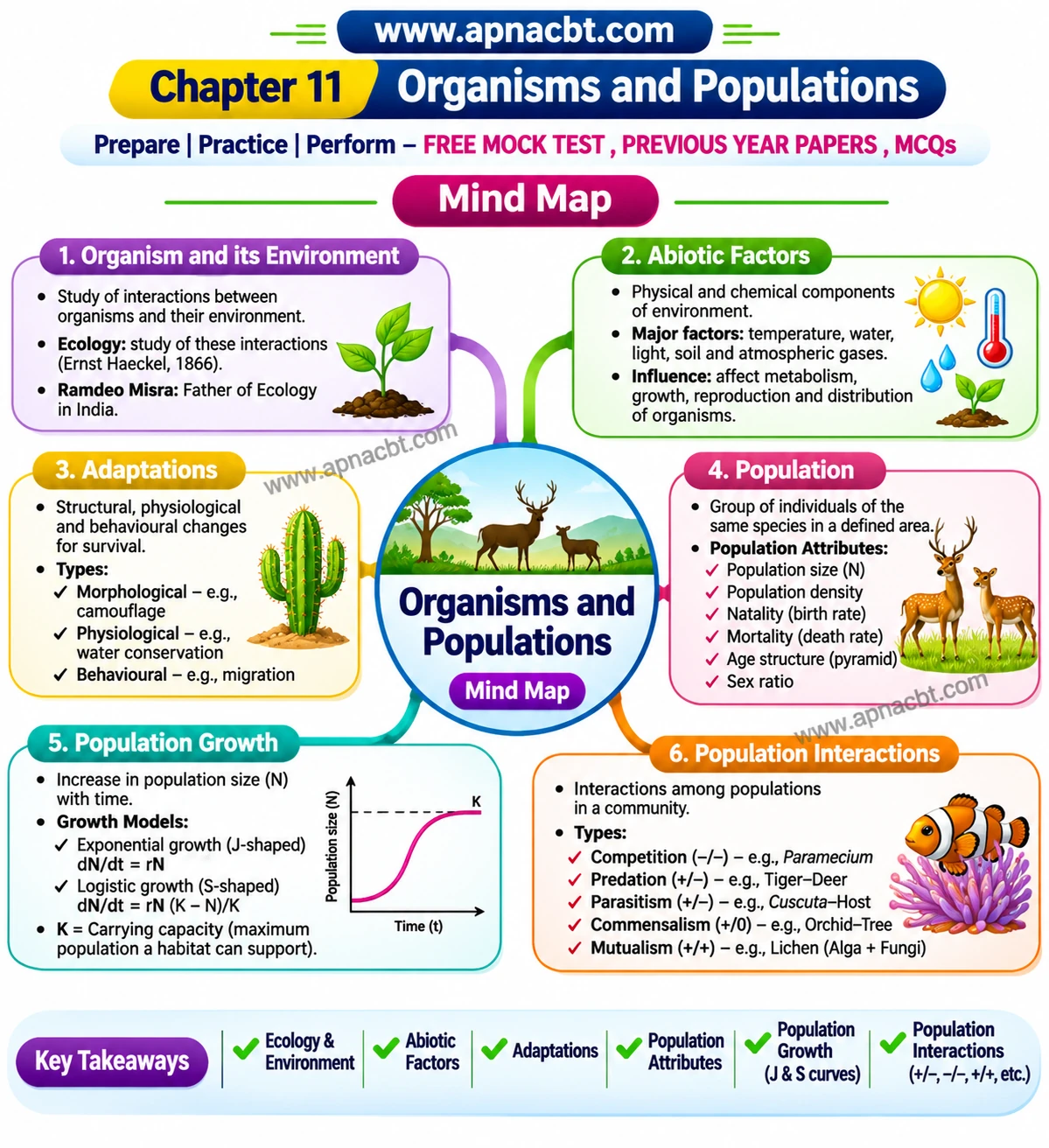
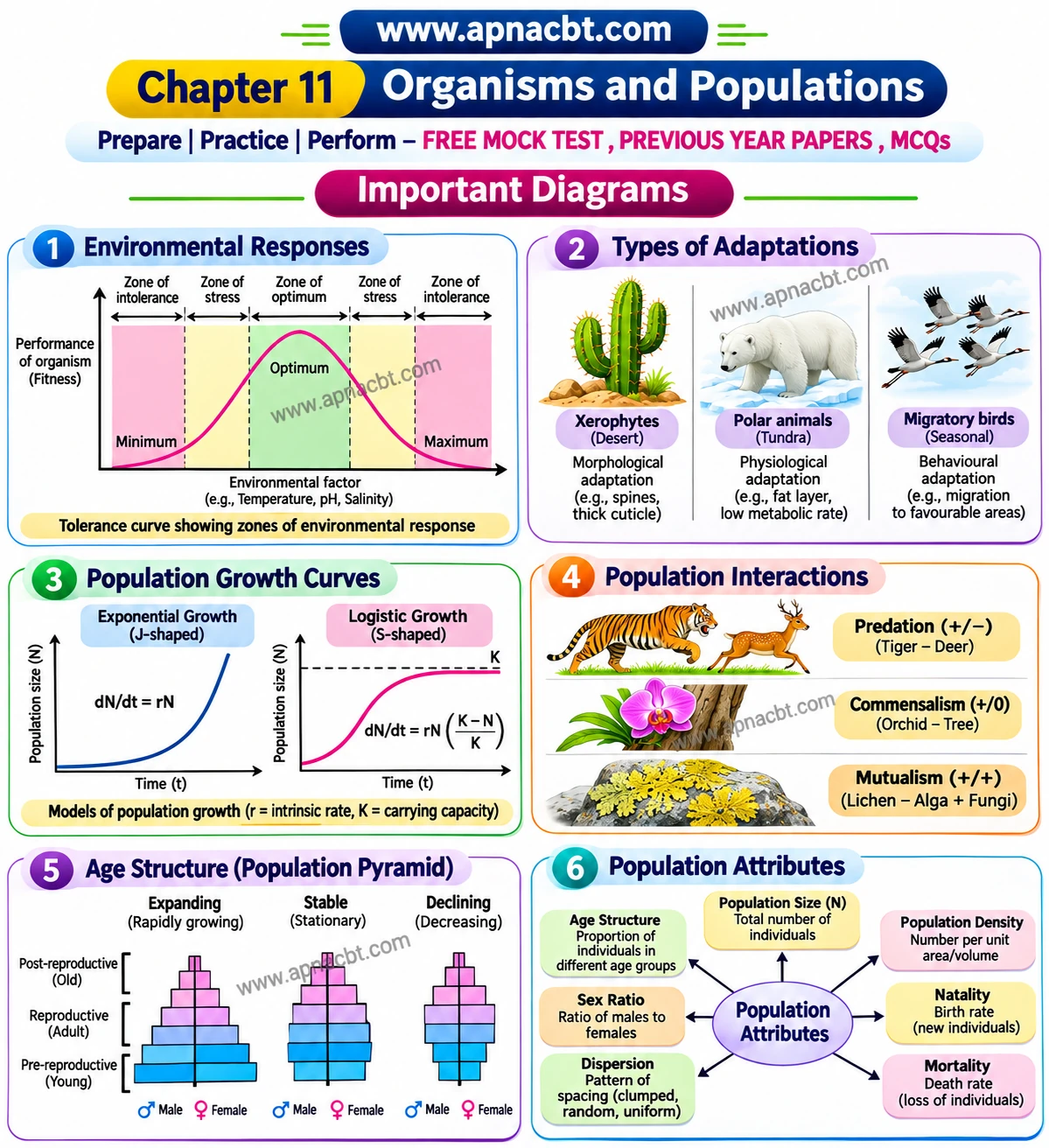
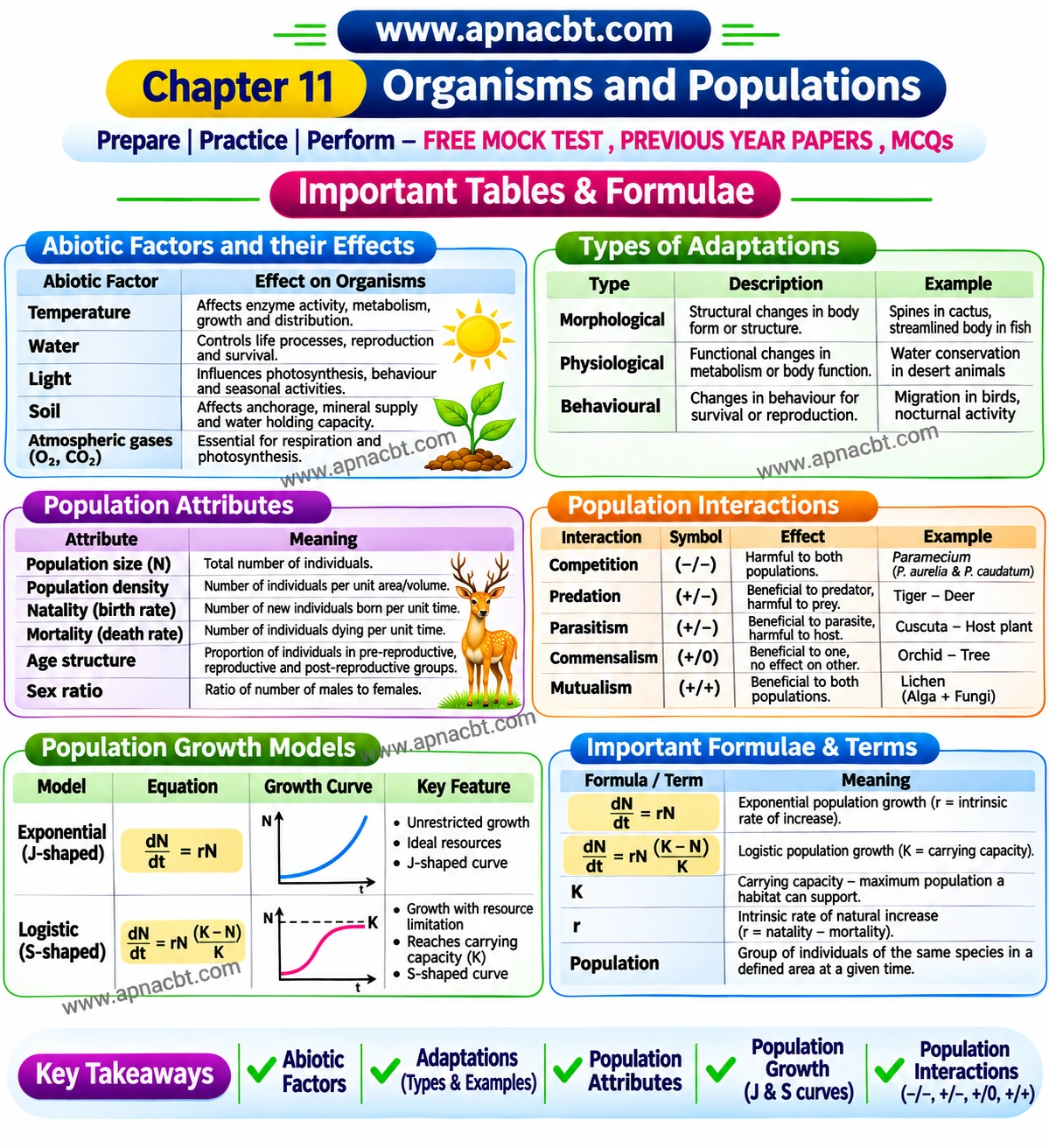
Organisms and Populations is an important Class 12 Biology ecology chapter covering organism–environment relationships, abiotic factors, adaptations, population attributes, population growth and interactions. This Level 01 lesson is designed for CBSE Board Exams, Class 12 Biology and NEET preparation, with focus on temperature, water, light, soil, homeostasis, regulators and conformers, population density, exponential and logistic growth, carrying capacity, and ecological interactions.
1. Organism and Its Environment – Ecology and Habitat
Ecology studies the relationships of living organisms with their abiotic and biotic components of the environment. The major levels of biological organisation considered in ecology are organisms, populations, communities and biomes.
At the organismic level, ecology mainly asks how organisms are adapted to their environments for survival and reproduction. Variations in temperature and precipitation contribute to the formation of major biomes such as deserts, rain forests and tundra.
Habitat
A habitat includes the physical and chemical conditions as well as the biotic components with which an organism interacts. Important abiotic factors include temperature, water, light and soil. Biotic components include pathogens, parasites, predators and competitors.
Niche
The niche of an organism includes its range of tolerance, the resources it uses and its functional role in the ecosystem.
Exam focus: Distinguish habitat from niche, and remember the four major abiotic factors: temperature, water, light and soil.
2. Major Abiotic Factors – Temperature, Water, Light and Soil
Temperature
Temperature is one of the most important ecologically relevant environmental factors. It influences enzyme activity, metabolism, reproduction and other physiological processes. Organisms living in different habitats show adaptations to their characteristic temperature ranges.
Microbes such as archaebacteria can live in very high-temperature environments such as hot springs and deep-sea hydrothermal vents. Many organisms have a narrow temperature tolerance, whereas some show a wider range.
Water
Water is essential for life. Availability of water strongly influences the distribution and productivity of organisms. Aquatic organisms are also affected by salinity. Organisms that tolerate a wide range of salinity are called euryhaline, whereas those with a narrow salinity tolerance are called stenohaline.
Light
Light is essential for photosynthesis and therefore affects plants and the organisms dependent on them. In aquatic ecosystems, light availability changes with depth. Different groups of algae occupy different depths according to their light requirements and photosynthetic pigments.
Soil
Soil characteristics depend on climate, weathering, origin and development. Soil composition, grain size, aggregation, pH, mineral composition and topography influence water-holding capacity, vegetation and the animals that can be supported.
CBSE/NEET focus: Learn temperature tolerance, euryhaline versus stenohaline organisms, the importance of light in aquatic habitats and the role of soil characteristics.
3. Responses to Abiotic Factors – Regulators, Conformers and Other Strategies
Organisms cope with environmental variation through several strategies. Maintaining a relatively constant internal environment is called homeostasis.
Regulators
Regulators maintain a relatively constant internal environment despite changes in the external environment. Birds and mammals are examples of animals capable of maintaining thermal and osmotic balance through physiological mechanisms.
Conformers
Conformers cannot maintain a constant internal environment when external conditions change. Their internal conditions tend to change with the environment. Most animals and nearly all plants fall largely into this category.
Partial Regulators
Some organisms can regulate their internal conditions only within a limited range. Beyond that range, they behave as conformers.
Migrate
Some organisms temporarily move away from an unfavourable habitat to a more favourable area and return when conditions improve. Seasonal migration of birds is a familiar example.
Suspend
Organisms may avoid stressful periods by reducing activity or entering dormant stages. Examples include hibernation in winter, aestivation during hot and dry periods and diapause, a stage of suspended development in many zooplankton.
Memory point: Regulate = maintain internal conditions; Conform = internal conditions follow external conditions; Migrate = escape in space; Suspend = escape in time.
4. Adaptations – Morphological, Physiological and Behavioural
Adaptation is an attribute of an organism that enables it to survive and reproduce in its habitat. Adaptations may be morphological, physiological or behavioural and many have evolved over long periods through natural selection.
Desert Adaptations
- Kangaroo rat obtains much of its water through metabolic processes and produces highly concentrated urine.
- Many desert plants have a thick cuticle that reduces water loss.
- Sunken stomata reduce transpiration.
- CAM plants keep stomata closed during the day and open them at night.
- In Opuntia, leaves are reduced to spines and the flattened stem performs photosynthesis.
Temperature-related Adaptations
- Mammals in colder climates generally have shorter ears and limbs, reducing heat loss; this is associated with Allen’s Rule.
- Seals and other aquatic mammals in polar regions have a thick layer of insulating fat called blubber.
- High-altitude acclimatisation involves increased red blood cell production, changes in haemoglobin binding and increased breathing rate.
Exam focus: Learn the examples of desert plant adaptations, kangaroo rat, Allen’s Rule, blubber and high-altitude acclimatisation.
5. Population and Its Attributes
A population is a group of individuals of a species living in a defined geographical area and sharing or competing for similar resources. Populations may also arise from asexual reproduction for ecological study.
Population Attributes
| Attribute | Meaning |
|---|---|
| Birth rate / Natality | Rate of addition of new individuals through reproduction. |
| Death rate / Mortality | Rate of loss of individuals through death. |
| Sex ratio | Proportion of males and females in a population. |
| Age distribution | Proportion of individuals in different age groups. |
| Population density | Number or equivalent measure of individuals in a defined area or volume at a given time. |
An individual organism has a sex and an age, but a population has a sex ratio and an age structure. Age pyramids represent the distribution of individuals among age groups and can indicate whether a population is growing, stable or declining.
Important: Birth and death rates are usually expressed as per-capita rates.
6. Population Density and Factors Affecting Population Size
Population density can be expressed as the number of individuals per unit area or volume at a particular time. Depending on the organism, density may also be expressed through biomass, percentage cover or other appropriate measures.
Population Density Equation
Nt+1 = Nt + [(B + I) − (D + E)]
| Symbol | Meaning |
|---|---|
| Nt | Population density at time t |
| B | Births |
| I | Immigration |
| D | Deaths |
| E | Emigration |
Population density increases when B + I > D + E and decreases when D + E > B + I.
When direct counting is difficult, population size may be estimated indirectly. For example, tiger populations may be estimated using evidence such as pug marks and faecal pellets.
NEET focus: Remember the four processes affecting population density: births, deaths, immigration and emigration.
7. Population Growth – Exponential and Logistic Models
Exponential Growth
When resources such as food and space are unlimited, a population can grow exponentially. The population increases rapidly and produces a J-shaped growth curve.
Equation: dN/dt = (b − d)N = rN
Here, N is population density, b is birth rate, d is death rate and r is the intrinsic rate of natural increase.
The intrinsic rate of natural increase represents the inherent capacity of a population to increase under given conditions.
Logistic Growth
Natural habitats have limited resources. As population density increases, competition for resources increases and environmental resistance limits further growth.
The maximum population size that a habitat can support is its carrying capacity (K).
Equation: dN/dt = rN[(K − N)/K]
Logistic growth generally shows a sigmoid (S-shaped) curve with lag, acceleration, deceleration and an asymptotic phase approaching carrying capacity.
| Exponential Growth | Logistic Growth |
|---|---|
| Resources assumed unlimited | Resources are limited |
| J-shaped curve | S-shaped curve |
| Rapid unrestricted increase | Growth slows as K is approached |
| Equation: dN/dt = rN | Equation: dN/dt = rN[(K−N)/K] |
8. Life History Variation and Reproductive Strategies
Populations evolve life-history traits that maximise reproductive fitness under the conditions of their habitat. This is also called Darwinian fitness.
- Some organisms breed only once in their lifetime, such as Pacific salmon and bamboo.
- Other organisms breed many times during their lifetime, including many birds and mammals.
- Some organisms produce a large number of small-sized offspring, such as oysters and pelagic fishes.
- Others produce a small number of large-sized offspring, such as birds and mammals.
These reproductive strategies reflect constraints imposed by abiotic and biotic components of the habitat.
Exam focus: Compare organisms producing many small offspring with organisms producing fewer large offspring, and remember the examples given above.
9. Population Interactions – Predation, Competition, Parasitism and Mutualism
Interactions between individuals of the same species are intraspecific, whereas interactions between different species are interspecific.
| Interaction | Effect | Meaning |
|---|---|---|
| Mutualism | + / + | Both species benefit. |
| Competition | − / − | Both species are adversely affected. |
| Predation | + / − | Predator benefits; prey is harmed. |
| Parasitism | + / − | Parasite benefits; host is harmed. |
| Commensalism | + / 0 | One benefits; the other is unaffected. |
| Amensalism | − / 0 | One is harmed; the other is unaffected. |
Predation
Predation transfers energy from lower to higher trophic levels and helps regulate prey populations. Predators can maintain species diversity by reducing competition among prey species. Prey organisms show defences such as camouflage and chemical protection.
Competition
Closely related species competing for the same limiting resources may not coexist indefinitely. Gause’s Competitive Exclusion Principle describes the elimination of the competitively inferior species under limiting-resource conditions. Coexistence can occur through resource partitioning, as shown by MacArthur’s observations on warblers.
Parasitism
Parasites obtain resources from hosts and often show specialised adaptations such as attachment organs, reduced unnecessary structures and high reproductive capacity. Parasites and hosts may co-evolve.
Mutualism
Both interacting species benefit. Examples include lichens and plant-pollinator relationships. Fig and fig-wasp interactions show a close association in which pollination benefits the plant and the wasp obtains resources for its developing larvae. Ophrys orchid uses sexual deceit to attract a bee pollinator, illustrating co-evolution.
Commensalism and Amensalism
In commensalism, one species benefits while the other is unaffected. Examples include epiphytes growing on trees and cattle egrets associated with grazing cattle. In amensalism, one species is harmed while the other is unaffected.
10. Complete Chapter Revision – Must-Know Facts, Equations and Comparisons
Rapid Revision Table
| Concept | Must-Remember Point |
|---|---|
| Ecology | Study of relationships of organisms with abiotic and biotic components. |
| Major abiotic factors | Temperature, water, light and soil. |
| Niche | Range of tolerance, resources used and functional role. |
| Homeostasis | Maintenance of a relatively constant internal environment. |
| Regulators | Maintain internal conditions despite external changes. |
| Conformers | Internal conditions change with external conditions. |
| Migration | Escape from stress in space. |
| Hibernation | Winter dormancy. |
| Aestivation | Summer dormancy. |
| Diapause | Suspended development, common in zooplankton. |
| Population density | Population size expressed per area, volume or suitable measure. |
| Exponential growth | Unlimited-resource model; J-shaped curve. |
| Logistic growth | Limited-resource model; S-shaped curve; carrying capacity K. |
| Competitive exclusion | Closely related species competing for the same limiting resources cannot coexist indefinitely under the stated conditions. |
| Resource partitioning | Differences in resource use can reduce competition and permit coexistence. |
Important Equations
- Population density change: Nt+1 = Nt + [(B + I) − (D + E)]
- Exponential growth: dN/dt = rN = (b − d)N
- Logistic growth: dN/dt = rN[(K − N)/K]
CBSE strategy: Practise definitions, comparisons, explanations, equations and diagrams such as age pyramids and growth curves.
NEET strategy: Memorise interaction signs, examples, formulas, population attributes, regulator/conformer concepts and exact examples of adaptations.
11. Short-Answer Questions – 30 Questions with Detailed Answers
Questions
- What is ecology?
- Name the four levels of biological organisation mainly considered in ecology.
- What is a habitat?
- What is a niche?
- Name four major abiotic factors.
- Why is temperature an important ecological factor?
- Differentiate euryhaline and stenohaline organisms.
- Why is light important in aquatic ecosystems?
- How does soil affect vegetation?
- What is homeostasis?
- Who are regulators?
- Who are conformers?
- What are partial regulators?
- What is migration as a response to environmental stress?
- Differentiate hibernation, aestivation and diapause.
- Define adaptation.
- Give two adaptations of desert plants.
- What is a population?
- Name four important population attributes.
- What is population density?
- Write the equation for change in population density.
- What is intrinsic rate of natural increase?
- What is exponential population growth?
- What is carrying capacity?
- What is logistic population growth?
- Differentiate J-shaped and S-shaped growth curves.
- What is competitive exclusion?
- What is resource partitioning?
- Differentiate mutualism and commensalism.
- What is predation and why is it ecologically important?
Detailed Answers
- Ecology: Ecology is the study of relationships of living organisms with the abiotic and biotic components of their environment.
- Levels: The major levels are organisms, populations, communities and biomes.
- Habitat: A habitat is the environment in which an organism lives, including relevant abiotic conditions and biotic interactions.
- Niche: A niche includes the range of conditions tolerated by an organism, the resources it uses and its functional role in the ecosystem.
- Abiotic factors: Temperature, water, light and soil are the major abiotic factors emphasised in the chapter.
- Temperature: It affects enzyme activity, metabolism and physiological processes and therefore strongly influences the distribution and survival of organisms.
- Euryhaline vs stenohaline: Euryhaline organisms tolerate a wide range of salinity, whereas stenohaline organisms tolerate only a narrow salinity range.
- Light: Light supports photosynthesis and its availability changes with depth, influencing the distribution of aquatic plants and algae.
- Soil: Soil composition, grain size, aggregation, pH, minerals and topography affect water retention and the vegetation that can grow in an area.
- Homeostasis: It is the maintenance of a relatively constant internal environment despite changes in external conditions.
- Regulators: Regulators maintain relatively constant internal conditions through physiological mechanisms despite external variation.
- Conformers: Conformers cannot maintain constant internal conditions; their internal state changes with the external environment.
- Partial regulators: They can regulate internal conditions only over a limited range and become conformers beyond that range.
- Migration: Migration is temporary movement from a stressful habitat to a more favourable location, followed by return when conditions improve.
- Hibernation, aestivation and diapause: Hibernation is winter dormancy, aestivation is summer dormancy and diapause is a stage of suspended development seen in many zooplankton.
- Adaptation: An adaptation is a morphological, physiological or behavioural attribute that enables an organism to survive and reproduce in its habitat.
- Desert plant adaptations: Examples include thick cuticle, sunken stomata, CAM photosynthesis and leaves reduced to spines in plants such as Opuntia.
- Population: A population is a group of individuals of a species living in a defined geographical area and sharing or competing for resources.
- Attributes: Important population attributes include birth rate, death rate, sex ratio, age distribution and population density.
- Population density: It is the population size expressed as number per unit area or volume, or by another suitable measure such as biomass or percentage cover.
- Equation: Nt+1 = Nt + [(B + I) − (D + E)], where B and D are births and deaths and I and E are immigration and emigration.
- Intrinsic rate: The intrinsic rate of natural increase, r, represents the inherent potential of a population to increase under given conditions.
- Exponential growth: It occurs when resources are effectively unlimited and population growth follows dN/dt = rN, producing a J-shaped curve.
- Carrying capacity: K is the maximum population size that a habitat can support under its prevailing conditions.
- Logistic growth: It occurs when resources are limited and growth slows as population density approaches carrying capacity.
- J-shaped vs S-shaped: Exponential growth produces a J-shaped curve, whereas logistic growth produces a sigmoid or S-shaped curve.
- Competitive exclusion: Gause’s principle states that closely related species competing for the same limiting resources cannot coexist indefinitely under the stated conditions; the inferior competitor may be eliminated.
- Resource partitioning: Competing species may use resources differently, such as feeding at different times or in different ways, reducing competition and permitting coexistence.
- Mutualism vs commensalism: In mutualism both species benefit (+/+), whereas in commensalism one benefits and the other is unaffected (+/0).
- Predation: Predation is an interaction in which the predator benefits and the prey is harmed. It transfers energy between trophic levels and helps regulate prey populations and maintain community diversity.
12. Long-Answer Questions – 15 Questions with Detailed Answers
Questions
- Explain the major abiotic factors that influence organisms and their habitats.
- Explain how organisms respond to changes in abiotic conditions through regulation, conformity, migration and suspension.
- Define adaptation and explain important adaptations of desert organisms.
- Explain the concept of population and describe its major attributes.
- Explain population density and the factors responsible for changes in population density.
- Derive or explain the exponential population growth equation and describe its J-shaped curve.
- Explain logistic population growth, carrying capacity and the sigmoid curve.
- Compare exponential and logistic population growth.
- Explain life-history variation with suitable examples.
- Classify population interactions and explain their effects using +, − and 0 signs.
- Explain predation and discuss its ecological significance and prey adaptations.
- Explain competition, competitive exclusion and resource partitioning with examples.
- Explain parasitism and the adaptations commonly found in parasites.
- Explain mutualism with suitable examples including plant-pollinator interactions.
- Write a comprehensive note on the important concepts of Organisms and Populations for CBSE and NEET revision.
Detailed Answers
- Major abiotic factors: Temperature, water, light and soil are major physical factors. Temperature influences metabolic and physiological processes. Water availability and salinity influence distribution, particularly in aquatic habitats. Light determines photosynthesis and affects the distribution of plants and algae. Soil characteristics such as composition, grain size, pH, minerals, water-holding capacity and topography influence vegetation and the animals supported by it.
- Responses to abiotic conditions: Organisms may regulate their internal environment, conform to external conditions, partially regulate within a limited range, migrate temporarily to favourable areas or suspend activity. Regulators maintain homeostasis, while conformers allow internal conditions to change with the environment. Migration is escape in space. Hibernation, aestivation and diapause represent forms of avoiding stress by suspension in time.
- Adaptations: Adaptation is a morphological, physiological or behavioural attribute that improves survival and reproduction. Desert organisms conserve water through structural and physiological adaptations. Kangaroo rats obtain water through metabolic processes and concentrate urine. Desert plants have thick cuticles and sunken stomata. CAM plants close stomata during the day. Opuntia has leaves modified into spines and uses its flattened stem for photosynthesis. Animals may also show behavioural adaptations such as seeking shade or burrowing.
- Population and attributes: A population is a group of individuals of the same species occupying a defined geographical area and sharing or competing for resources. Important attributes include birth rate, death rate, sex ratio, age distribution and population density. Individuals have births and deaths, but population ecology expresses these as rates. Age pyramids represent the distribution of males and females across age groups and indicate whether a population is growing, stable or declining.
- Population density: Population density expresses the size of a population in relation to area, volume or another appropriate measure. Population size changes through births, deaths, immigration and emigration. The relationship is Nt+1 = Nt + [(B + I) − (D + E)]. Births and immigration increase population density, while deaths and emigration decrease it. Direct counting is not always possible, so relative density may be estimated using suitable evidence.
- Exponential growth: When food and space are effectively unlimited, a population can realise its innate growth potential. The growth rate is expressed as dN/dt = rN = (b − d)N. Here N is population density and r is the intrinsic rate of natural increase. The population rises rapidly and the graph of population density against time is J-shaped. Such growth cannot continue indefinitely in natural conditions because resources become limiting.
- Logistic growth: Natural habitats have finite resources. As population density increases, competition and environmental resistance increase. A habitat can support a maximum population size called carrying capacity, K. Logistic growth is represented by dN/dt = rN[(K − N)/K]. The population initially shows a lag phase, followed by acceleration and deceleration, and finally approaches an asymptote at carrying capacity, producing an S-shaped curve. It is considered more realistic for many natural populations.
- Comparison of growth models: Exponential growth assumes unlimited resources, produces a J-shaped curve and follows dN/dt = rN. Logistic growth incorporates limited resources, carrying capacity and environmental resistance and produces an S-shaped curve. Logistic growth slows as N approaches K, whereas exponential growth can rise rapidly when resources are assumed unlimited.
- Life-history variation: Populations evolve reproductive strategies that maximise fitness under habitat constraints. Some organisms reproduce only once, such as Pacific salmon and bamboo, while many birds and mammals reproduce repeatedly. Oysters and pelagic fishes may produce many small offspring, whereas birds and mammals may produce fewer, larger offspring. These strategies reflect the interaction of abiotic and biotic constraints with reproductive success.
- Population interactions: Mutualism is +/+, competition is −/−, predation and parasitism are +/−, commensalism is +/0 and amensalism is −/0. The signs indicate whether each participant benefits, suffers or remains unaffected. These interactions influence population sizes, resource use, energy transfer and community structure.
- Predation: Predation is an interaction in which the predator obtains food from the prey. It transfers energy to higher trophic levels and prevents prey populations from becoming excessively large. Predators can also maintain species diversity by reducing competition among prey species. Prey have evolved defences such as camouflage and chemical protection. Biological control of pests also uses natural predator–prey relationships.
- Competition: Competition occurs when organisms require the same limiting resources. Gause’s Competitive Exclusion Principle proposes that closely related species competing for the same resources cannot coexist indefinitely under limiting conditions. However, species may evolve resource partitioning, using resources at different times or in different ways. MacArthur’s study of warblers is an example of coexistence through behavioural differences in foraging.
- Parasitism: In parasitism the parasite benefits while the host is harmed. Parasites often become host-specific and may co-evolve with hosts. They can show adaptations such as adhesive organs or suckers, loss of unnecessary structures, reduced digestive systems and high reproductive capacity. Some parasites have complex life cycles involving intermediate hosts or vectors.
- Mutualism: Mutualism benefits both interacting species. Lichens represent a mutual association, and plant-pollinator relationships are important examples. In the fig–fig-wasp association, the wasp pollinates the fig while obtaining resources for its developing larvae. Ophrys uses sexual deceit to attract a male bee; pseudocopulation results in pollen transfer. Such interactions demonstrate co-evolution between partners.
- Comprehensive revision: The chapter connects organism-level ecology with population-level ecology. Key abiotic factors are temperature, water, light and soil. Organisms cope through regulation, conformity, partial regulation, migration and suspension. Adaptations enable survival and reproduction. Populations possess attributes such as birth rate, death rate, sex ratio, age distribution and density. Population growth may be exponential or logistic, with carrying capacity limiting natural populations. Interspecific interactions include mutualism, competition, predation, parasitism, commensalism and amensalism. For CBSE, focus on explanations, equations and diagrams; for NEET, focus on exact definitions, examples, interaction signs, formulae and comparison-based questions.