Biotechnology and its Applications – Class 12 Biology
Biotechnology and its Applications is an important Class 12 Biology lesson covering biotechnological applications in agriculture, genetically modified organisms (GMOs), Bt crops, RNA interference (RNAi), genetically engineered insulin, gene therapy, molecular diagnosis, transgenic animals, bioethics, biopiracy and patents. This Level 01 lesson is designed for CBSE Board Exams, school board examinations and NEET preparation, with emphasis on NCERT concepts, mechanisms, examples, comparisons and high-yield questions.
Biotechnology and its Applications – Introduction
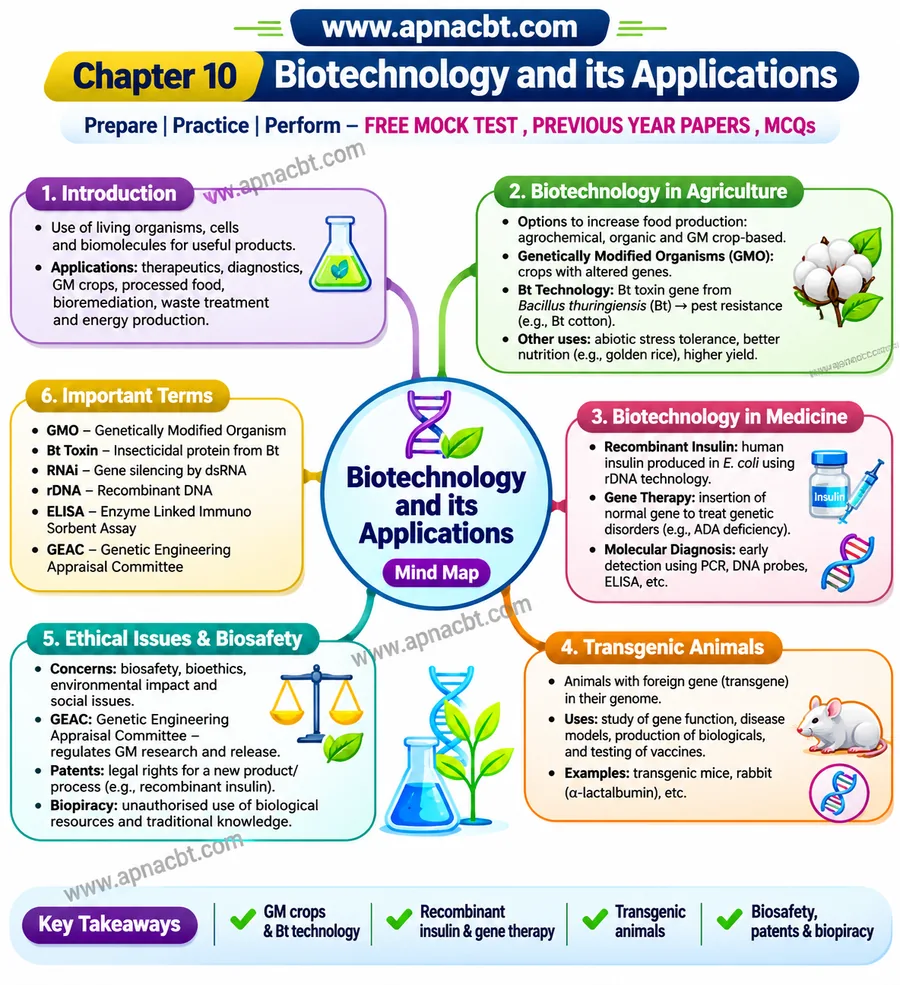
Biotechnology deals with the industrial-scale production of useful products and biologicals using genetically modified microbes, fungi, plants and animals. Applications include therapeutics, diagnostics, genetically modified crops, processed food, bioremediation, waste treatment and energy production.
Three Critical Research Areas
- Providing the best catalyst, usually an improved organism or pure enzyme.
- Creating optimal conditions through engineering for the catalyst to act.
- Using downstream processing technologies to purify the required protein or organic compound.
Exam focus: Biotechnology connects genetic engineering with large-scale production and purification of useful biological products.
Biotechnological Applications in Agriculture – GM Crops
Three broad approaches for increasing food production are agro-chemical based agriculture, organic agriculture and genetically engineered crop-based agriculture. Genetic modification provides an alternative when conventional breeding and increased agrochemical use have limitations.
Genetically Modified Organisms
Plants, bacteria, fungi and animals whose genes have been altered by manipulation are called Genetically Modified Organisms (GMOs).
Major Benefits of GM Plants
- Greater tolerance to abiotic stresses such as cold, drought, salt and heat.
- Reduced reliance on chemical pesticides.
- Reduced post-harvest losses.
- Improved mineral-use efficiency.
- Enhanced nutritional value, e.g. Golden Rice.
- Tailor-made plants supplying starches, fuels and pharmaceuticals.
Board focus: Learn the definition of GMO and the major advantages of GM crops given in NCERT.
Bt Crops and Bt Cotton – Pest Resistance
Bacillus thuringiensis (Bt) produces insecticidal proteins. Bt toxin genes have been introduced into crop plants to provide resistance against specific insect pests and reduce the need for chemical insecticides.
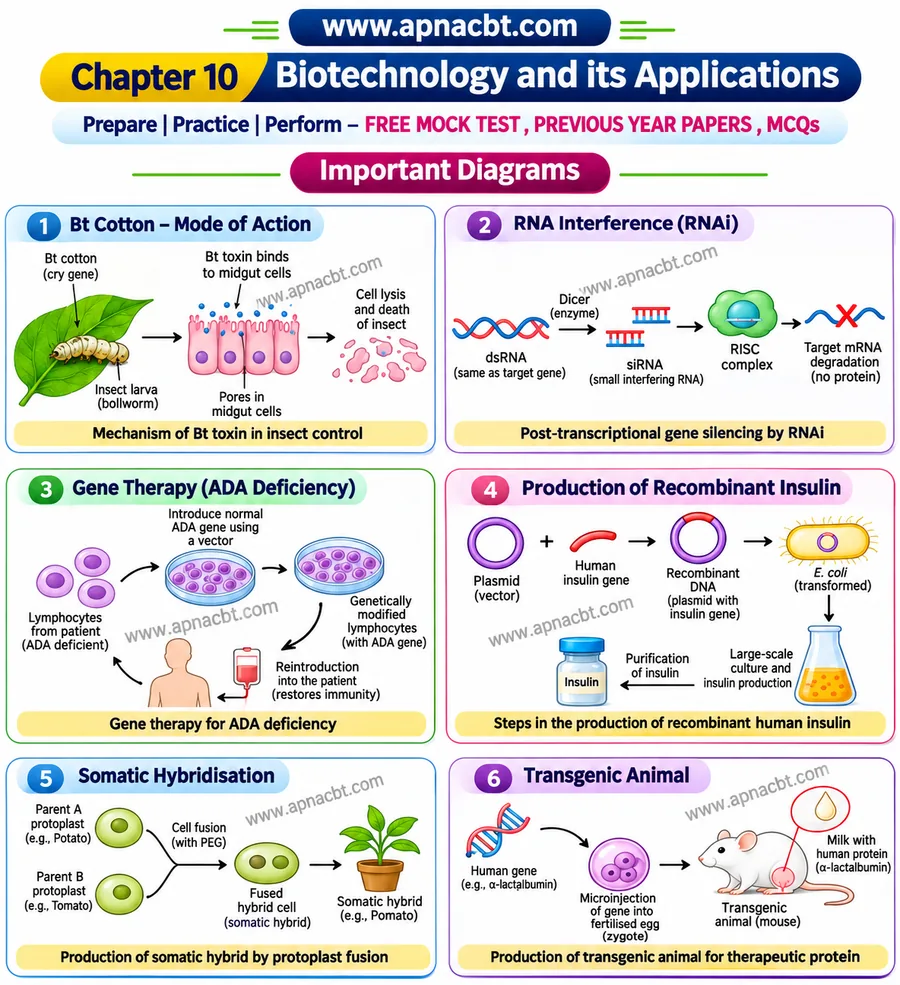
Bt Toxin – Mechanism of Action
- Bt forms protein crystals containing inactive protoxin.
- A susceptible insect ingests the inactive toxin.
- The alkaline gut solubilises the crystal.
- The protoxin becomes an active toxin.
- The active toxin binds to midgut epithelial cells.
- Pores form in the cells, causing swelling and lysis.
- The insect eventually dies.
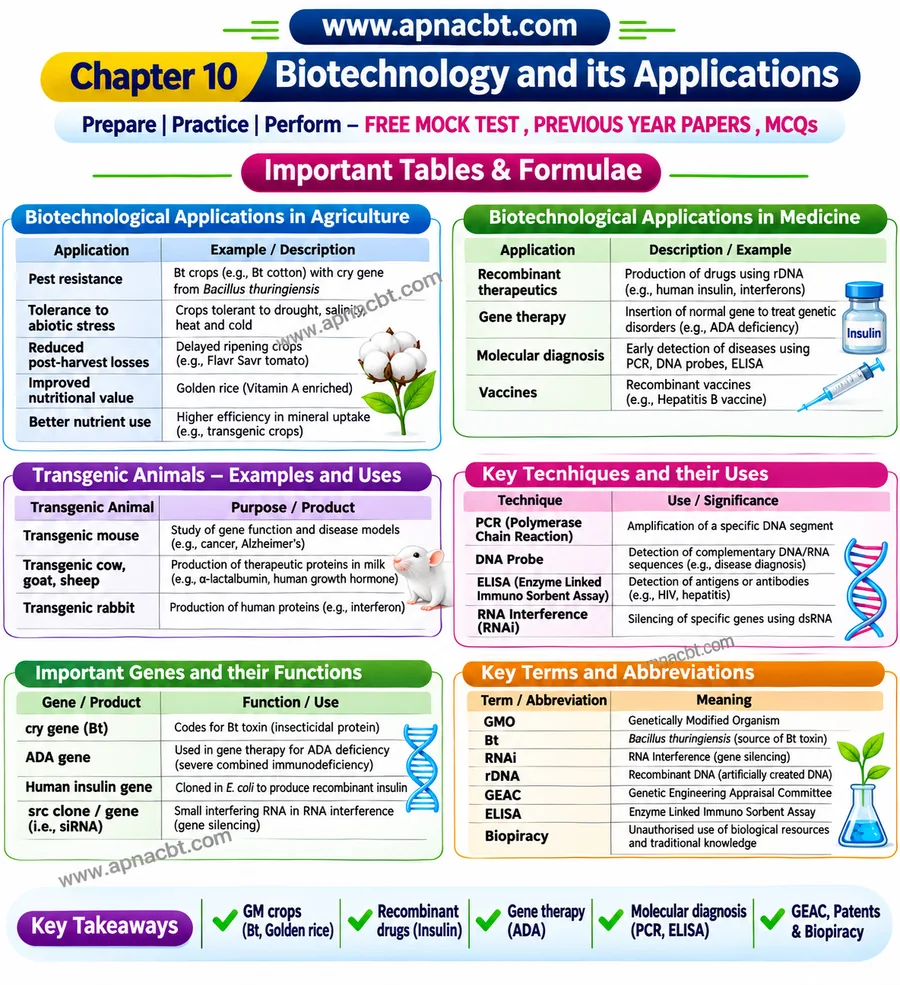
| Gene | Major target |
|---|---|
| cryIAc | Cotton bollworms |
| cryIIAb | Cotton bollworms |
| cryIAb | Corn borer |
NCERT examples of Bt crops include Bt cotton, Bt corn, Bt rice, Bt tomato, Bt potato and Bt soybean.
Pest Resistant Plants – RNA Interference
RNA interference (RNAi) is a cellular defence mechanism in eukaryotic organisms. A complementary double-stranded RNA molecule silences a specific mRNA and prevents its translation.
NCERT Example – Nematode Resistance
The nematode Meloidogyne incognita infects tobacco roots and reduces yield.
- Nematode-specific genes are introduced into the host using Agrobacterium vectors.
- The DNA produces sense and antisense RNA.
- The complementary RNAs form dsRNA.
- dsRNA initiates RNAi and silences the specific mRNA.
- The nematode cannot survive in the transgenic host.
- The tobacco plant is protected from infestation.
NEET focus: Agrobacterium vector → sense + antisense RNA → dsRNA → RNAi → mRNA silencing → nematode protection.
Biotechnological Applications in Medicine
Recombinant DNA technology has made a major impact on healthcare by enabling mass production of safer and more effective therapeutic drugs. Recombinant therapeutics can avoid unwanted immunological responses associated with some products isolated from non-human sources.
Major Medical Applications
- Genetically engineered insulin
- Gene therapy
- Molecular diagnosis
Genetically Engineered Insulin
Insulin used for diabetes was earlier extracted from the pancreas of slaughtered cattle and pigs. Animal insulin could cause allergic or other reactions in some patients.
Structure and Maturation
- Mature insulin has Chain A and Chain B.
- The chains are linked by disulphide bridges.
- Insulin is synthesised as a pro-hormone.
- Pro-insulin contains an extra C-peptide.
- C-peptide is removed during maturation and is absent from mature insulin.
Recombinant Production
In 1983, Eli Lilly prepared DNA sequences corresponding to the A and B chains of human insulin and introduced them separately into plasmids of Escherichia coli. The chains were produced separately, extracted and combined by creating disulphide bonds to form human insulin.
Gene Therapy – ADA Deficiency
Gene therapy is a collection of methods used to correct a gene defect by introducing a normal functional gene into affected cells or tissues.
ADA Deficiency
The first clinical gene therapy was given in 1990 to a four-year-old girl with adenosine deaminase (ADA) deficiency. ADA is important for immune-system function.
- Lymphocytes are isolated from the patient’s blood.
- They are grown in culture outside the body.
- Functional ADA cDNA is introduced using a retroviral vector.
- The genetically engineered lymphocytes are returned to the patient.
- Because the cells are not immortal, periodic infusion may be required.
ADA deficiency may also be treated by bone marrow transplantation or enzyme replacement therapy. Introduction of the functional ADA gene into early embryonic cells could potentially provide a permanent cure.
Molecular Diagnosis – PCR, DNA Probes and ELISA
Early diagnosis is essential for effective treatment. Molecular techniques such as PCR, DNA/RNA probes and ELISA help detect disease at an early stage.
PCR
Polymerase Chain Reaction (PCR) amplifies very small amounts of nucleic acid. It can detect pathogens before symptoms become visible and is used for HIV detection, mutation detection in suspected cancer patients and identification of genetic disorders.
DNA/RNA Probe
A labelled single-stranded DNA or RNA probe hybridises with its complementary DNA sequence. Detection can be performed using autoradiography.
ELISA
ELISA is based on antigen-antibody interaction. Infection can be detected by identifying pathogen antigens or antibodies produced against the pathogen.
Transgenic Animals – Uses and Examples
Transgenic animals are animals whose DNA has been manipulated to possess and express an extra foreign gene. Transgenic rats, rabbits, pigs, sheep, cows and fish have been produced; NCERT notes that more than 95% of existing transgenic animals are mice.
| Use | Purpose / Example |
|---|---|
| Normal physiology and development | Study gene regulation and factors such as insulin-like growth factor. |
| Study of disease | Models for cancer, cystic fibrosis, rheumatoid arthritis and Alzheimer’s. |
| Biological products | Production of proteins such as human α-1-antitrypsin. |
| Vaccine safety | Testing vaccine safety, including polio vaccine. |
| Chemical safety testing | Testing toxicity of drugs and other chemicals. |
Rosie
In 1997, the first transgenic cow, Rosie, produced human protein-enriched milk containing human alpha-lactalbumin. NCERT states that the milk contained about 2.4 grams per litre of this human protein.
Ethical Issues, GEAC, Patents and Biopiracy
Genetic modification can have unpredictable consequences when modified organisms are introduced into ecosystems. Ethical standards and regulatory oversight are therefore important.
GEAC
The Indian Government established organisations such as the Genetic Engineering Approval Committee (GEAC) to consider the validity of GM research and the safety of introducing GM organisms for public services, as described in NCERT.
Patents and Traditional Knowledge
Concerns arise when companies seek patents on products and technologies based on biological resources and traditional knowledge developed and used by farmers and indigenous communities.
Basmati and Biopiracy
NCERT discusses the controversy surrounding an American company’s patent on Basmati rice in 1997. It also mentions attempts involving traditional products such as turmeric and neem.
Biopiracy means the use of bio-resources by multinational companies or other organisations without proper authorisation from the countries and people concerned and without compensatory payment.
Complete Chapter Revision – High-Yield Facts
- Bt toxin: inactive protoxin → alkaline insect gut → active toxin → midgut pore formation → cell lysis → insect death.
- RNAi: dsRNA → specific mRNA silencing → inhibition of translation.
- Insulin: A chain + B chain → disulphide bridges; pro-insulin contains C-peptide, which is removed.
- Gene therapy: functional gene/cDNA introduced into cells to compensate for a defective gene.
- PCR: amplification of nucleic acid for early molecular diagnosis.
- ELISA: antigen-antibody interaction.
- Transgenic animals: disease models, biological products, vaccine safety and toxicity testing.
- GEAC: evaluates GM research and safety in the Indian context described in NCERT.
- Biopiracy: unauthorised use of bio-resources/traditional knowledge without proper authorisation and compensation.
| Term | Key point |
|---|---|
| GMO | Organism whose genes have been altered by manipulation. |
| Bt toxin | Insecticidal protein produced by Bacillus thuringiensis. |
| RNAi | Gene silencing through complementary dsRNA. |
| Pro-insulin | Precursor containing an extra C-peptide. |
| Gene therapy | Correction of a gene defect by introducing functional genetic material. |
| ELISA | Diagnostic technique based on antigen-antibody interaction. |
| Transgenic animal | Animal expressing an extra foreign gene. |
| Biopiracy | Unauthorised exploitation of bio-resources/traditional knowledge. |
Short-Answer Questions – 30 Questions with Detailed Answers
- What is biotechnology?
Answer: Biotechnology uses living organisms, cells, parts of organisms or enzymes to produce useful products and processes. Modern biotechnology particularly involves genetic engineering and controlled bioprocesses. - What are GMOs?
Answer: Genetically Modified Organisms are organisms whose genes have been altered by genetic manipulation. - State two advantages of GM crops.
Answer: They can tolerate abiotic stresses and reduce reliance on chemical pesticides. They may also reduce post-harvest losses and improve nutritional value. - What is Bt toxin?
Answer: It is an insecticidal protein produced by certain strains of Bacillus thuringiensis and used to provide crop resistance against specific insects. - Why does Bt toxin not kill Bacillus?
Answer: It is produced as an inactive protoxin/crystal and becomes active only after ingestion by a susceptible insect and solubilisation in its alkaline gut. - What happens to Bt toxin in an insect gut?
Answer: The crystal is solubilised, the protoxin is activated, the toxin binds to midgut cells, pores form, cells lyse and the insect dies. - Name two Cry genes and their targets.
Answer: cryIAc and cryIIAb control cotton bollworms; cryIAb controls corn borer. - What is RNA interference?
Answer: RNAi is gene silencing in which complementary dsRNA prevents translation of a specific mRNA. - Which nematode is used in the NCERT RNAi example?
Answer: Meloidogyne incognita. - Which vector is used to introduce nematode-specific genes into tobacco?
Answer: Agrobacterium vectors. - What are recombinant therapeutics?
Answer: Therapeutic biological products produced using recombinant DNA technology on a large scale. - What are the two chains of mature insulin?
Answer: Chain A and Chain B. - What is C-peptide?
Answer: It is the extra stretch present in pro-insulin that is removed during maturation and absent from mature insulin. - Which bacterium was used for recombinant human insulin production?
Answer: Escherichia coli. - What is gene therapy?
Answer: A method of treating disease by introducing functional genetic material to compensate for a defective gene. - What is ADA deficiency?
Answer: A hereditary disorder involving loss or dysfunction of the adenosine deaminase gene, affecting immune-system function. - When was the first clinical gene therapy given?
Answer: In 1990, to a four-year-old girl with ADA deficiency. - What is PCR used for in diagnosis?
Answer: PCR amplifies very small amounts of nucleic acid, allowing early detection of pathogens, mutations and some genetic disorders. - What is a molecular probe?
Answer: A labelled single-stranded DNA or RNA molecule that hybridises with its complementary sequence for detection. - What is ELISA based on?
Answer: Antigen-antibody interaction. - Define transgenic animals.
Answer: Animals whose DNA has been manipulated to possess and express an extra foreign gene. - Name four transgenic animals mentioned in NCERT.
Answer: Rats, rabbits, pigs, sheep, cows, fish and mice are examples. - How are transgenic animals useful in disease studies?
Answer: They serve as models for human diseases and help researchers study disease development and treatments. - How are transgenic animals used in vaccine safety?
Answer: Transgenic mice can be used to test vaccine safety before human use. - What is GEAC?
Answer: Genetic Engineering Approval Committee, referred to by NCERT in connection with GM research validity and safety. - What is biopiracy?
Answer: Unauthorised use of bio-resources by organisations without proper authorisation and compensatory payment. - Why is traditional knowledge important?
Answer: It can guide modern applications and reduce time, effort and expenditure during commercialisation. - What is Golden Rice?
Answer: A genetically modified rice described by NCERT as having enhanced nutritional value through vitamin A enrichment. - What is downstream processing?
Answer: Technologies used to purify the required protein or organic compound after biological production. - Differentiate gene therapy and molecular diagnosis.
Answer: Gene therapy treats a genetic defect by introducing functional genetic material, whereas molecular diagnosis detects pathogens, mutations or disease-related molecules.
Long-Answer Questions – 15 Questions with Detailed Answers
- Explain the major applications of genetically modified crops.
Answer: GM crops can tolerate drought, salt, heat and cold; reduce chemical pesticide use; reduce post-harvest losses; improve mineral-use efficiency; and enhance nutritional value. Golden Rice is an NCERT example of nutritional improvement. GM technology can also produce plants supplying starches, fuels and pharmaceuticals. - Explain the mechanism of Bt toxin in insects.
Answer: Bacillus thuringiensis forms protein crystals containing inactive protoxin. A susceptible insect ingests the toxin; its alkaline gut solubilises the crystal and activates the toxin. The active toxin binds to midgut epithelial cells, forms pores, causes swelling and lysis, and kills the insect. - Explain RNA interference in pest-resistant plants.
Answer: Nematode-specific genes are introduced into tobacco using Agrobacterium vectors. Sense and antisense RNAs form dsRNA, which triggers RNAi and silences the specific nematode mRNA. Translation is prevented, the nematode cannot survive and the transgenic plant is protected. - Describe the structure and recombinant production of human insulin.
Answer: Mature insulin contains A and B chains linked by disulphide bridges. Pro-insulin contains an extra C-peptide that is removed during maturation. Eli Lilly prepared DNA sequences for A and B chains and introduced them separately into E. coli plasmids. The chains were produced, extracted and combined through disulphide bonds to form human insulin. - What is gene therapy? Explain the ADA example.
Answer: Gene therapy corrects a genetic defect by introducing a functional gene. In ADA deficiency, lymphocytes are isolated and cultured, functional ADA cDNA is introduced using a retroviral vector, and the modified cells are returned to the patient. Because these cells are not immortal, repeated infusion may be required. - Explain PCR in molecular diagnosis.
Answer: PCR amplifies very small amounts of nucleic acid. It can detect pathogens before symptoms appear and is used for HIV detection, mutation detection in suspected cancer patients and identification of genetic disorders. - Explain DNA/RNA probes and ELISA.
Answer: A labelled single-stranded probe hybridises with its complementary nucleic acid sequence and permits detection. ELISA is based on antigen-antibody interaction and can detect pathogen antigens or antibodies produced against the pathogen. - Describe the major uses of transgenic animals.
Answer: They are used to study normal physiology and development, model human diseases, produce useful biological products, test vaccine safety and perform chemical toxicity testing. - Explain the use of transgenic animals for biological products.
Answer: Animals can be engineered to express genes for useful human proteins. NCERT gives human α-1-antitrypsin as an example. Rosie, the first transgenic cow mentioned, produced human protein-enriched milk containing human alpha-lactalbumin. - Discuss ethical issues in biotechnology.
Answer: Genetic modification may have unpredictable ecosystem effects. Ethical concerns also involve regulation, patents, ownership of biological resources, traditional knowledge and fair benefit sharing. GEAC is cited in NCERT in relation to GM research and safety. - What is biopiracy? Explain its relationship with traditional knowledge.
Answer: Biopiracy is unauthorised exploitation of bio-resources without proper authorisation and compensation. Traditional knowledge can make commercial development faster and cheaper, so communities and countries have raised concerns about unfair exploitation. NCERT discusses Basmati, turmeric and neem in this context. - Compare Bt technology and RNA interference.
Answer: Bt technology uses insecticidal proteins from Bacillus thuringiensis that become active in the insect gut and damage midgut cells. RNAi uses complementary dsRNA to silence a specific mRNA and prevent translation. Thus Bt acts through a toxin, whereas RNAi acts through sequence-specific gene silencing. - Explain the three critical research areas of biotechnology.
Answer: They are obtaining an efficient biological catalyst, creating optimal engineering conditions for the catalyst and using downstream processing to purify the desired protein or organic compound. - Explain the contribution of biotechnology to healthcare.
Answer: Recombinant DNA technology enables production of therapeutic proteins such as human insulin. Gene therapy provides approaches for correcting hereditary defects such as ADA deficiency. PCR, probes and ELISA aid early diagnosis. Thus biotechnology contributes to treatment, therapeutic production and diagnosis. - Write an integrated account of the major applications covered in the chapter.
Answer: In agriculture, biotechnology provides GM crops with stress tolerance, pest resistance, improved mineral use, reduced post-harvest losses and enhanced nutrition. Bt crops and RNAi provide pest-control strategies. In medicine, recombinant DNA technology enables human insulin production; gene therapy addresses genetic defects; PCR, probes and ELISA aid diagnosis. Transgenic animals are used in physiology, disease modelling, biological-product production, vaccine safety and toxicity testing. These applications also require ethical and regulatory consideration because of ecological, patent and biopiracy concerns.