Introduction – Principles of Inheritance and Variation
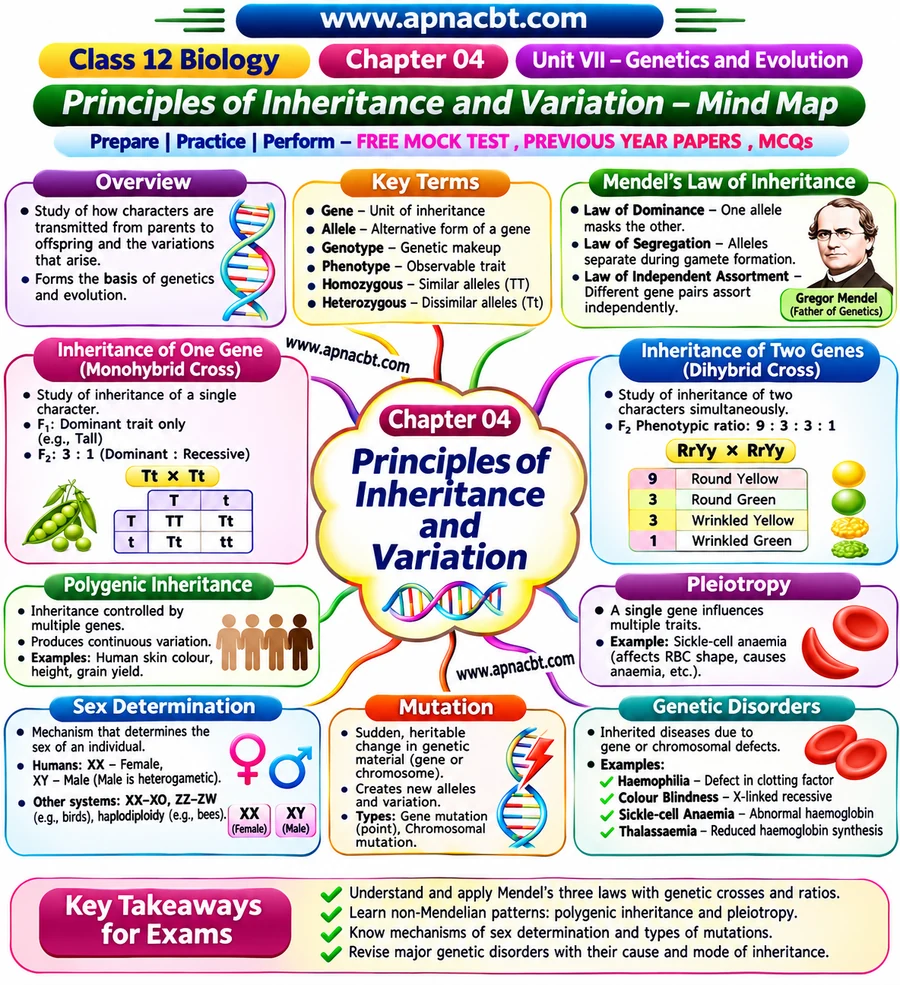
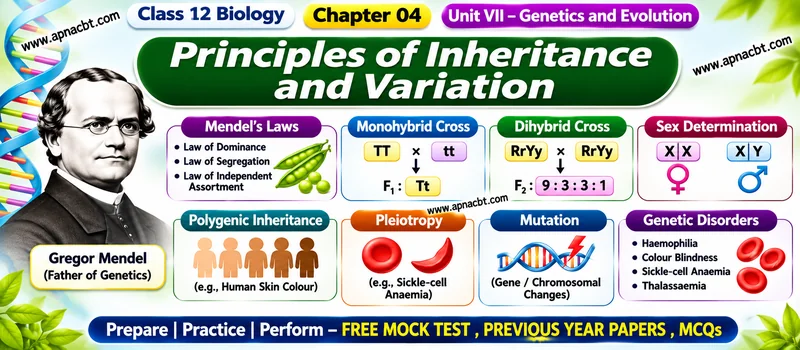
Principles of Inheritance and Variation Class 12 Biology is an important chapter for CBSE Board Exams and NEET preparation, covering Mendel’s laws, monohybrid and dihybrid inheritance, genetic crosses, linkage and recombination, sex determination, mutation and genetic disorders.
Principles of Inheritance and Variation deals with the inheritance of characters from parents to offspring and the variation observed among progeny. Inheritance forms the basis of heredity, while variation explains the differences between parents and offspring and among individuals. The chapter develops the genetic principles established through Mendel’s experiments and extends them to chromosome behaviour, linkage, recombination, sex determination, mutation and human genetic disorders.
Exam focus: Principles of Inheritance and Variation is especially important for Mendelian ratios, Punnett squares, test crosses, incomplete dominance, codominance, ABO blood groups, multiple alleles, polygenic inheritance, pleiotropy, linkage and recombination, sex determination, pedigree concepts, mutations and chromosomal disorders in CBSE and NEET.
Mendel’s Experiments and Laws of Inheritance – Principles of Inheritance and Variation
Gregor Johann Mendel systematically studied inheritance using garden pea, Pisum sativum. Pea was suitable because it has several clear contrasting traits, a relatively short generation time, many offspring and the ability to undergo self-pollination as well as controlled cross-pollination.
Contrasting traits studied by Mendel
- Stem height – tall / dwarf
- Flower colour – violet / white
- Flower position – axial / terminal
- Pod shape – inflated / constricted
- Pod colour – green / yellow
- Seed shape – round / wrinkled
- Seed colour – yellow / green
Important terminology
- Gene: Functional unit controlling a character.
- Alleles: Alternative forms of a gene.
- Genotype: Genetic constitution of an organism.
- Phenotype: Observable expression of a character.
- Homozygous: Both alleles are identical.
- Heterozygous: The two alleles are different.
- Dominant allele: Expressed in a heterozygous condition.
- Recessive allele: Expressed when present in the appropriate homozygous condition.
Law of Dominance
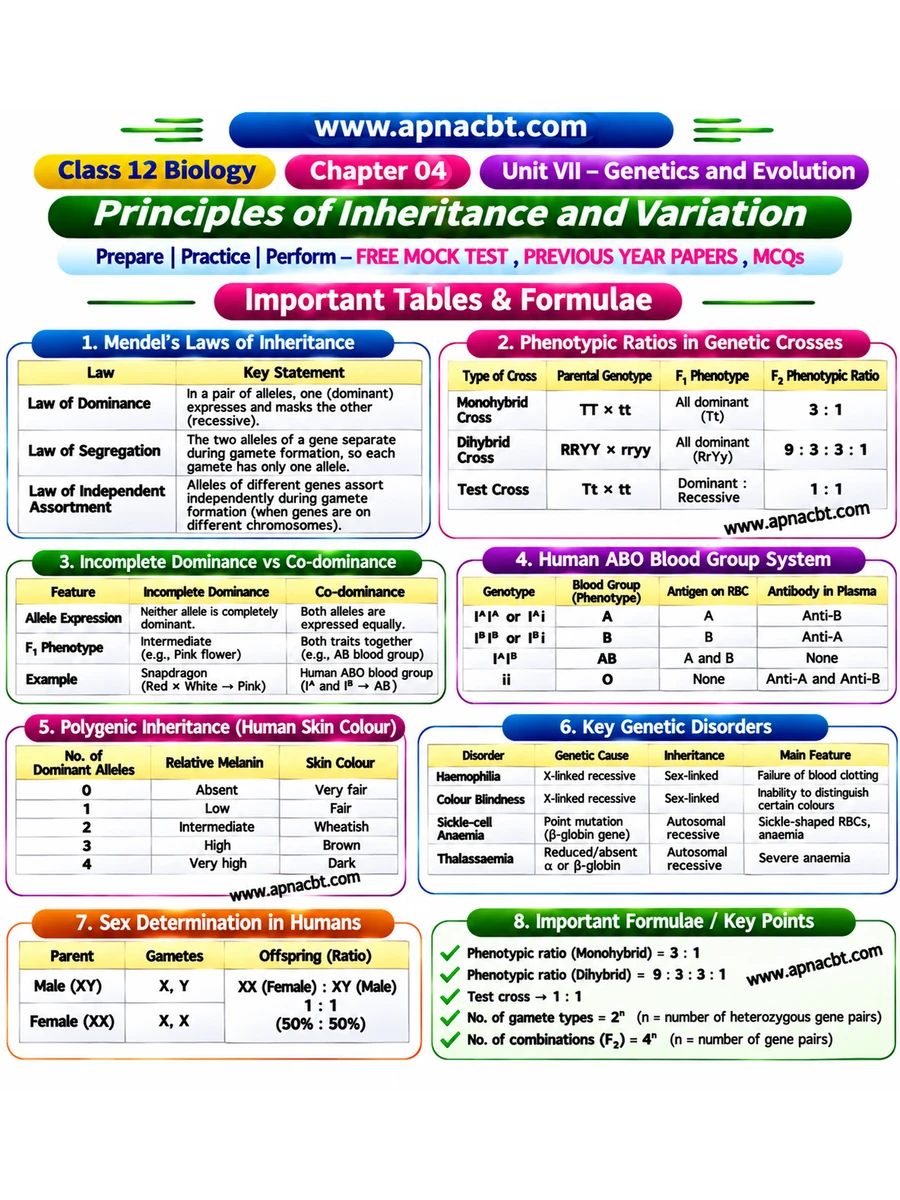
When two contrasting alleles occur together in a heterozygote, one may express itself while the other remains unexpressed. The expressed allele is called dominant and the unexpressed allele is recessive.
Law of Segregation
The two alleles of a gene pair separate during gamete formation so that each gamete receives only one allele. Alleles do not blend. A heterozygote therefore produces two types of gametes in equal proportions when segregation is normal.
Law of Independent Assortment
During gamete formation, alleles of different gene pairs assort independently when the genes are independently inherited. This principle is demonstrated by the classical dihybrid cross.
Inheritance of One Gene – Monohybrid Cross and Test Cross
A monohybrid cross follows the inheritance of one pair of contrasting characters. In Mendel’s classic cross, a true-breeding tall plant (TT) was crossed with a true-breeding dwarf plant (tt).
Monohybrid cross
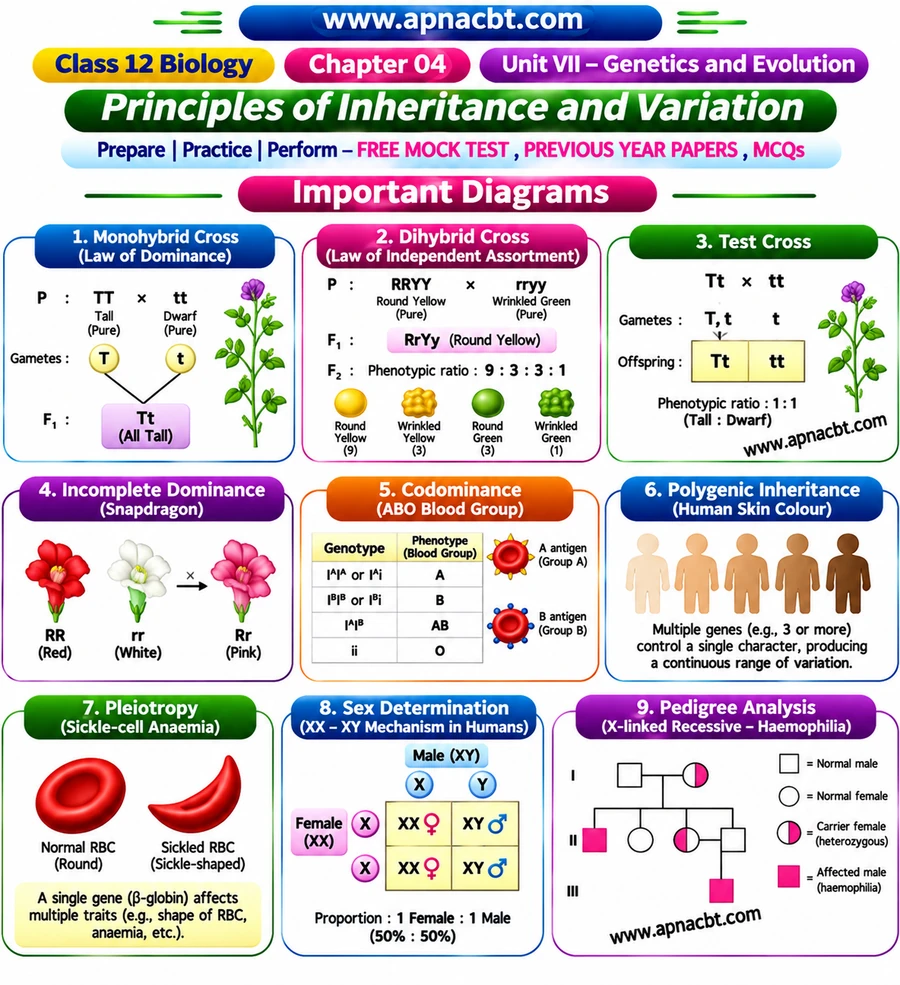
P: TT × tt → F1: all Tt (tall)
Selfing of F1: Tt × Tt
F2 genotypic ratio: 1 TT : 2 Tt : 1 tt
F2 phenotypic ratio: 3 tall : 1 dwarf
Test cross
A test cross is performed between an individual showing a dominant phenotype and a homozygous recessive individual to determine whether the dominant individual is homozygous or heterozygous.
- TT × tt → all offspring Tt and dominant phenotype.
- Tt × tt → 1 Tt : 1 tt, giving a 1 : 1 phenotypic ratio.
Key exam point
A Punnett square is a graphical method for predicting possible combinations of gametes and their expected genotypes. It represents probability, not a guarantee for every individual family or cross.
Deviations from Simple Mendelian Inheritance
Incomplete dominance
In incomplete dominance, neither allele completely dominates the other. The heterozygote shows an intermediate phenotype. In the snapdragon example, red flower × white flower produces pink F1 flowers, and the F2 phenotypic and genotypic ratio is 1 red : 2 pink : 1 white.
Codominance
In codominance, both alleles express themselves in the heterozygote. The ABO blood group system provides a classic example. The IA and IB alleles are codominant, while i is recessive.
- Group A: IAIA or IAi
- Group B: IBIB or IBi
- Group AB: IAIB
- Group O: ii
Multiple alleles
A gene may have more than two alternative forms in a population, although an individual diploid organism carries only two alleles at a locus. The ABO blood group gene has three alleles: IA, IB and i.
Polygenic inheritance
Polygenic traits are controlled by multiple genes and often show continuous variation. Human skin colour is a classical example. The phenotype reflects the cumulative contribution of several alleles and can also be influenced by environmental factors.
Pleiotropy
A single gene can influence more than one phenotypic character. Phenylketonuria is a classic example in which mutation of a single gene affects a metabolic pathway and produces multiple phenotypic effects.
Inheritance of Two Genes – Dihybrid Cross
A dihybrid cross follows two pairs of contrasting characters simultaneously. Mendel used seed shape and seed colour to study independent inheritance.
Parental cross: RRYY × rryy
F1: all RrYy, showing the dominant phenotypes.
Selfing of F1 gives: RrYy × RrYy
Classical F2 phenotypic ratio: 9 round yellow : 3 round green : 3 wrinkled yellow : 1 wrinkled green.
Dihybrid test cross
RrYy × rryy produces four possible offspring classes when the genes assort independently:
Phenotypic ratio: 1 : 1 : 1 : 1
Important probability results
- Number of different gamete types from a genotype with n heterozygous gene pairs = 2n.
- For a classical dihybrid heterozygote RrYy, possible gametes are RY, Ry, rY and ry.
- The 9 : 3 : 3 : 1 ratio is associated with independent assortment under the classical Mendelian assumptions.
Chromosomal Theory, Linkage and Recombination
Sutton and Boveri proposed the chromosomal theory of inheritance by relating the behaviour of chromosomes during meiosis to Mendel’s principles. Genes are located on chromosomes, and chromosome segregation provides a physical basis for segregation of alleles.
Morgan’s contribution
Thomas Hunt Morgan and his colleagues used Drosophila melanogaster to experimentally study inheritance. Drosophila is suitable because it can be cultured easily, has a short life cycle, produces many offspring and has readily distinguishable male and female forms.
Linkage
Genes located on the same chromosome tend to be inherited together. This physical association is called linkage. Closely located genes show stronger linkage and lower recombination frequency.
Recombination
Recombination produces new combinations of alleles. Crossing over between homologous chromosomes during meiosis contributes to recombination.
Recombination frequency (%) = (Number of recombinant offspring / Total offspring) × 100
Sturtevant used recombination frequency as a measure of relative distance between genes and constructed genetic maps. One map unit or centimorgan corresponds approximately to 1% recombination.
Sex Determination and Sex-Linked Inheritance
Chromosomal basis of sex determination
This chapter also explains how sex determination varies among organisms. In humans, females are XX and males are XY. Females produce ova carrying 22 autosomes plus X, whereas males produce two types of sperm: 22 autosomes plus X and 22 autosomes plus Y. Therefore, the sperm determines the sex of the child.
Other systems
- XO type: Found in some insects; females XX and males XO.
- ZW type: Found in birds; males ZZ and females ZW.
- Haplodiploidy: Seen in honeybees; males develop from unfertilised eggs and females from fertilised eggs.
Sex-linked inheritance
Genes located on sex chromosomes are sex-linked. X-linked recessive disorders such as haemophilia and red-green colour blindness show characteristic inheritance patterns because males have only one X chromosome.
A carrier female can transmit an X-linked recessive allele to sons. Father-to-son transmission does not occur for X-linked traits because a father gives his Y chromosome to his sons.
Mutation and Genetic Variation
A mutation is a change in genetic material. Mutations may occur spontaneously or may be induced by mutagens such as certain chemicals and radiation. Mutations are important sources of genetic variation.
Point mutation
A point mutation involves a change in a single base pair of DNA. The classic example discussed in the chapter is sickle-cell anaemia, which results from a point mutation in the gene coding for the beta chain of haemoglobin.
Sickle-cell anaemia
The mutant haemoglobin forms sickle-shaped red blood cells under low-oxygen conditions. The disorder is inherited as an autosomal recessive condition. Individuals homozygous for the mutant allele show the disease, while heterozygotes carry the allele and may show resistance to severe malaria in certain populations.
Importance of mutation
- Creates new alleles.
- Contributes to genetic variation.
- Provides raw material on which natural selection can act.
- May be harmful, beneficial or neutral depending on circumstances.
Human Genetic Disorders and Pedigree Analysis
This chapter also covers human genetic disorders, which can broadly be classified into Mendelian disorders and chromosomal disorders. Pedigree analysis is used to trace the inheritance of a trait through generations of a family.
Important Mendelian disorders
- Haemophilia: X-linked recessive blood-clotting disorder.
- Colour blindness: Usually an X-linked recessive disorder affecting red-green colour discrimination.
- Phenylketonuria: Autosomal recessive metabolic disorder involving deficiency of phenylalanine hydroxylase.
- Thalassemia: Inherited disorder involving reduced synthesis of globin chains.
- Cystic fibrosis: Autosomal recessive disorder caused by mutation affecting a chloride ion channel.
- Sickle-cell anaemia: Autosomal recessive disorder caused by a point mutation in the beta-globin gene.
Chromosomal disorders
- Down syndrome: Trisomy of chromosome 21.
- Klinefelter syndrome: Usually XXY; affected males have an additional X chromosome.
- Turner syndrome: Usually XO; affected females have only one X chromosome.
Pedigree analysis
Pedigree charts use standard symbols to represent individuals and relationships. They help identify whether a trait is dominant, recessive, autosomal or sex-linked by examining its transmission through generations.
Complete Chapter Revision – Must-Know Concepts, Ratios and Formulas
Must-remember ratios
- Monohybrid F2 phenotype: 3 : 1
- Monohybrid F2 genotype: 1 : 2 : 1
- Incomplete dominance F2 phenotype: 1 : 2 : 1
- Dihybrid F2 phenotype: 9 : 3 : 3 : 1
- Monohybrid test cross: 1 : 1 for a heterozygote
- Dihybrid test cross: 1 : 1 : 1 : 1 under independent assortment
High-yield distinctions
- Dominance: one allele masks the other in a heterozygote.
- Incomplete dominance: heterozygote shows an intermediate phenotype.
- Codominance: both alleles are expressed in the heterozygote.
- Polygenic inheritance: several genes contribute to one trait.
- Pleiotropy: one gene affects multiple phenotypic traits.
- Linkage: genes on the same chromosome tend to be inherited together.
- Recombination: formation of new allele combinations.
NEET calculation points
For n heterozygous gene pairs, the number of possible gamete types is 2n. Recombination frequency is expressed as the percentage of recombinant offspring among total offspring.
Board-exam diagrams to practise: monohybrid Punnett square, dihybrid Punnett square, test cross, incomplete dominance cross, ABO blood-group inheritance, sex determination in humans, linkage and recombination, pedigree symbols and chromosomal disorders. These diagrams support revision of Principles of Inheritance and Variation.
Short-Answer Questions – 30 Questions with Detailed Answers
Questions
These questions revise the core genetics concepts for CBSE and NEET.
- What is genetics?
- Define inheritance and variation.
- Why did Mendel select pea plants?
- What is an allele?
- Differentiate genotype and phenotype.
- What is a homozygous condition?
- What is a heterozygous condition?
- State the Law of Dominance.
- State the Law of Segregation.
- What is a monohybrid cross?
- What is the F2 phenotypic ratio of a typical monohybrid cross?
- What is a test cross?
- What is incomplete dominance?
- What is codominance?
- Why is the ABO blood group system an example of multiple allelism?
- What is a polygenic trait?
- What is pleiotropy?
- What is a dihybrid cross?
- State the classical F2 phenotypic ratio of a dihybrid cross.
- What is the purpose of a Punnett square?
- What is the chromosomal theory of inheritance?
- Define linkage.
- Define recombination frequency.
- What is a sex-linked gene?
- Why does the father determine the sex of a child in humans?
- What is a mutation?
- What is a point mutation?
- What is Down syndrome?
- What are Klinefelter and Turner syndromes?
- What is pedigree analysis?
Detailed Answers
The detailed answers reinforce the most important inheritance and variation concepts.
- Genetics is the branch of biology that deals with inheritance and variation of characters.
- Inheritance is transmission of characters from parents to offspring. Variation is the degree of difference observed among offspring and between offspring and parents.
- Mendel selected pea because it has clear contrasting traits, a short generation time, many offspring, and permits both self-pollination and controlled cross-pollination.
- An allele is an alternative form of a gene occupying the same locus on homologous chromosomes.
- Genotype is the genetic constitution, whereas phenotype is the observable expression of characters.
- A homozygous individual has two identical alleles for a gene, such as TT or tt.
- A heterozygous individual has two different alleles, such as Tt.
- The Law of Dominance states that in a heterozygote, one of a pair of contrasting alleles may express itself as dominant while the other remains unexpressed as recessive.
- The Law of Segregation states that the two alleles of a gene pair separate during gamete formation, so each gamete receives only one allele.
- A monohybrid cross studies inheritance of one pair of contrasting characters.
- The typical F2 phenotypic ratio is 3 dominant : 1 recessive.
- A test cross is a cross between an individual showing a dominant phenotype and a homozygous recessive individual.
- Incomplete dominance occurs when neither allele completely dominates the other and the heterozygote shows an intermediate phenotype.
- Codominance occurs when both alleles are expressed simultaneously in the heterozygote, as in AB blood group.
- The ABO system has three alleles, IA, IB and i, in the population. Thus it demonstrates multiple allelism; IA and IB are codominant.
- A polygenic trait is controlled by multiple genes and usually shows continuous variation, such as human skin colour.
- Pleiotropy is the phenomenon in which one gene influences multiple phenotypic traits.
- A dihybrid cross studies inheritance of two pairs of contrasting characters simultaneously.
- The classical F2 phenotypic ratio is 9 : 3 : 3 : 1.
- A Punnett square is used to represent possible gametic combinations and predict expected offspring genotypes and phenotypes.
- The chromosomal theory states that genes are located on chromosomes and that chromosome behaviour during meiosis provides a physical basis for Mendelian inheritance.
- Linkage is the tendency of genes located on the same chromosome to be inherited together.
- Recombination frequency is the percentage of recombinant offspring among total offspring: (recombinants / total) × 100.
- A sex-linked gene is a gene located on a sex chromosome.
- Human males produce X-bearing and Y-bearing sperm, while all normal ova carry X. X sperm produces XX females and Y sperm produces XY males.
- A mutation is a change in genetic material that can generate a new allele or genetic variation.
- A point mutation is a change involving a single base pair of DNA.
- Down syndrome is a chromosomal disorder caused by an additional copy of chromosome 21, producing trisomy 21.
- Klinefelter syndrome is usually XXY and occurs in males. Turner syndrome is usually XO and occurs in females.
- Pedigree analysis is the study of inheritance of a trait through generations of a family using a standard diagrammatic representation.
Long-Answer Questions – 15 Questions with Detailed Answers
Questions
- Explain Mendel’s monohybrid experiment and derive the F2 genotypic and phenotypic ratios.
- Explain Mendel’s Laws of Dominance and Segregation with suitable examples.
- Describe a test cross and explain how it helps determine an unknown genotype.
- Explain incomplete dominance and codominance with suitable examples.
- Describe the ABO blood group system in humans and explain multiple allelism and codominance.
- Explain Mendel’s dihybrid cross and the Law of Independent Assortment.
- Describe the chromosomal theory of inheritance and the contribution of Sutton, Boveri and Morgan.
- Explain linkage and recombination and describe how recombination frequency is used in gene mapping.
- Explain sex determination in humans and compare it with XO, ZW and haplodiploid systems.
- Explain X-linked inheritance using haemophilia or colour blindness as an example.
- What is mutation? Explain point mutation with reference to sickle-cell anaemia.
- Explain polygenic inheritance and pleiotropy with suitable examples.
- Describe Mendelian disorders and explain the inheritance of haemophilia, colour blindness, thalassemia and phenylketonuria.
- Describe chromosomal disorders Down syndrome, Klinefelter syndrome and Turner syndrome.
- Explain the major concepts of inheritance and variation that are important for CBSE and NEET preparation.
Detailed Answers
- Monohybrid experiment: Mendel crossed true-breeding tall TT with dwarf tt plants. All F1 plants were Tt and tall. Selfing F1 produced TT, Tt, Tt and tt in the F2 generation. Therefore, the genotypic ratio was 1 : 2 : 1 and the phenotypic ratio was 3 tall : 1 dwarf. This experiment demonstrated segregation of alleles and dominance of the tall allele under the classical conditions.
- Laws: The Law of Dominance explains expression of one allele in a heterozygote. The Law of Segregation states that paired alleles separate during gamete formation. In Tt, the alleles T and t segregate so that half the gametes carry T and half carry t.
- Test cross: A dominant-phenotype individual is crossed with homozygous recessive. If the unknown is TT, all offspring are dominant. If it is Tt, offspring occur in approximately 1 dominant : 1 recessive ratio. Thus the test cross reveals whether the unknown genotype is homozygous or heterozygous.
- Incomplete dominance and codominance: In incomplete dominance, the heterozygote is intermediate, as in red × white snapdragon producing pink flowers. In codominance, both alleles are expressed, as in IAIB individuals with AB blood group. The F2 ratio in incomplete dominance is typically 1 : 2 : 1.
- ABO blood groups: The system is controlled by three alleles IA, IB and i. IA and IB are codominant, while i is recessive. IAIA and IAi give A; IBIB and IBi give B; IAIB gives AB; ii gives O. It demonstrates both multiple allelism and codominance.
- Dihybrid cross: In RRYY × rryy, F1 are RrYy. Selfing F1 produces four gamete types RY, Ry, rY and ry. Under independent assortment, the F2 phenotypic ratio is 9 round yellow : 3 round green : 3 wrinkled yellow : 1 wrinkled green. This supports the Law of Independent Assortment for independently inherited gene pairs.
- Chromosomal theory: Sutton and Boveri related chromosome behaviour to Mendelian factors and proposed that genes are carried on chromosomes. Morgan experimentally verified the relationship using Drosophila and demonstrated linkage and recombination, showing that genes on the same chromosome may not assort independently.
- Linkage and recombination: Linked genes are located on the same chromosome and tend to be inherited together. Crossing over can generate recombinant combinations. Recombination frequency = recombinant offspring ÷ total offspring × 100. Higher recombination generally indicates greater distance between genes; 1% recombination is approximately one map unit or centimorgan.
- Sex determination: Human females are XX and males XY. All ova carry X, while sperm carry either X or Y. XX produces a female and XY a male. In XO systems, males are XO; in ZW systems, females are ZW and males ZZ; in haplodiploidy, males develop from unfertilised eggs and females from fertilised eggs.
- X-linked inheritance: Haemophilia and red-green colour blindness are classic X-linked recessive disorders. Males are hemizygous for X-linked genes because they possess only one X chromosome. A carrier female can transmit the recessive allele to sons. A father does not transmit an X-linked allele directly to his sons because sons receive his Y chromosome.
- Mutation and sickle-cell anaemia: Mutation is a change in genetic material. A point mutation in the beta-globin gene changes one base and alters the amino acid sequence of beta-globin. The resulting haemoglobin can cause red blood cells to assume a sickle shape under low oxygen conditions. The condition is inherited as an autosomal recessive disorder.
- Polygenic inheritance and pleiotropy: Polygenic inheritance involves several genes contributing to one trait and commonly produces continuous variation. Human skin colour is a classical example. Pleiotropy occurs when one gene affects several traits; phenylketonuria illustrates how a single gene mutation affecting a metabolic enzyme can produce multiple phenotypic effects.
- Mendelian disorders: These usually result from mutation in a single gene and can be traced using pedigree analysis. Haemophilia and colour blindness are X-linked recessive disorders. Phenylketonuria is an autosomal recessive metabolic disorder. Thalassemia involves defective globin-chain synthesis. Sickle-cell anaemia is an autosomal recessive disorder caused by a point mutation.
- Chromosomal disorders: Down syndrome results from trisomy 21. Klinefelter syndrome usually has XXY and affects males. Turner syndrome usually has XO and affects females. These disorders generally arise from abnormalities in chromosome number, often associated with failure of proper chromosome segregation.
- Chapter-wide exam approach: For CBSE, practise definitions, laws, crosses, ratios, diagrams, explanations and comparisons. For NEET, focus strongly on monohybrid and dihybrid probability, test crosses, ABO inheritance, incomplete dominance, codominance, linkage and recombination, sex-linked inheritance, mutation and chromosomal disorders. Memorise the major ratios and practise solving genetic-cross questions rather than only reading them.
- Final revision tip: Revise the chapter by connecting each law with a genetic cross, ratio, chromosome behaviour or inheritance pattern. This makes the chapter easier to apply in CBSE descriptive questions and NEET multiple-choice problems.
Continue Your Biology Preparation
Continue your preparation with APNA CBT learning resources and explore the Class 12 Biology resources available on the website.
Reference: For textbook-based study, refer to the official NCERT website.