


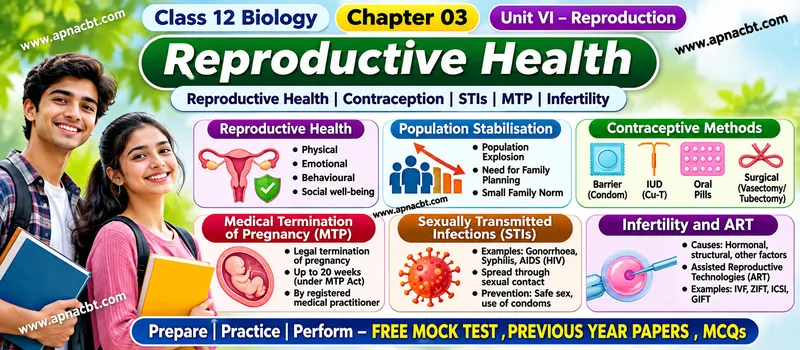
Reproductive Health Class 12 Biology is an important chapter for CBSE Board Exams and NEET preparation, covering reproductive health problems and strategies, population stabilisation, contraception, medical termination of pregnancy, sexually transmitted infections and infertility with important concepts and exam-focused questions.
Reproductive Health – Meaning, Importance and Major Problems
Reproductive health refers to total well-being in all aspects of reproduction. According to WHO, it includes physical, emotional, behavioural and social well-being related to reproduction. A reproductively healthy person has normally functioning reproductive organs and healthy emotional and behavioural interactions in sex-related matters.
Reproductive health is broader than simply being free from reproductive diseases. It includes awareness, appropriate medical care, safe and hygienic practices, responsible behaviour, family planning and access to professional assistance when reproductive problems arise.
Major reproductive-health concerns
- Unwanted pregnancy and lack of awareness about contraception.
- Population explosion and associated social and health problems.
- Sexually transmitted infections.
- Infertility and problems related to conception.
- Menstrual and pregnancy-related problems.
- Sex abuse and sex-related crimes.
- Unsafe abortion and lack of proper medical care.
Reproductive and Child Health Care programmes
India initiated national-level programmes to attain reproductive health as a social goal. Family-planning programmes began in 1951 and later became part of broader Reproductive and Child Health Care programmes. These programmes focus on awareness, medical facilities, maternal and child care, contraception, prevention of sexually transmitted infections and assistance for reproductive problems.
Exam focus
Remember the WHO definition, the broad meaning of reproductive health and the major components of RCH programmes. These are common conceptual areas in CBSE and NEET questions.
Strategies for Improving Reproductive Health
Improving reproductive health requires awareness, education, medical facilities, counselling and responsible social behaviour. Governmental and non-governmental agencies use audio-visual and print media to spread correct information.
Important strategies
- Introduce and encourage sex education in schools to provide scientifically correct information.
- Dispel myths and misconceptions about reproductive organs, adolescence and sexual health.
- Promote safe and hygienic sexual practices.
- Create awareness about sexually transmitted infections including AIDS.
- Educate couples about available contraceptive methods and responsible family planning.
- Provide care during pregnancy, delivery and the postnatal period.
- Promote breastfeeding and equal opportunities for male and female children.
- Prevent sex abuse and sex-related crimes through awareness and social responsibility.
- Provide professional medical assistance for menstrual problems, infertility, pregnancy, contraception and STIs.
- Use improved techniques and new strategies to provide better reproductive healthcare.
Amniocentesis
Amniocentesis involves analysis of amniotic fluid and fetal cells to detect certain genetic disorders. It can help identify conditions such as Down syndrome, haemophilia and sickle-cell anaemia. Its misuse for prenatal sex determination has been legally restricted to prevent female foeticide.
Population Explosion – Causes and Population Stabilisation
Population explosion refers to a rapid increase in population over a relatively short period. Improved health facilities and better living conditions reduced death rates, infant mortality and maternal mortality, contributing to rapid population growth.
Major causes
- Rapid decline in death rate.
- Decline in infant mortality rate.
- Decline in maternal mortality rate.
- Increase in the number of people in the reproductive age group.
- Improved health and living conditions.
Population-control measures
- Promotion of contraception and family planning.
- Awareness about small-family norms.
- Statutory increase in the minimum marriageable age.
- Government incentives for couples with small families.
- Education and awareness about reproductive health.
The objective is not simply to reduce population but to achieve population stabilisation while maintaining reproductive health and responsible family planning.
NEET focus
Questions frequently test the link between improved healthcare, reduced mortality and population explosion. Learn the distinction between population growth and population stabilisation.
Contraception – Principles and Ideal Features
Contraception is the deliberate prevention of pregnancy. Birth control can be achieved by preventing the meeting of sperm and ovum, preventing ovulation, or preventing implantation of the early embryo.
Ideal contraceptive
An ideal contraceptive should be user-friendly, easily available, highly effective, reversible, have little or no side effects and should not interfere with sexual drive, desire or the sexual act.
Major groups of contraceptive methods
| Group | Examples | Main principle |
|---|---|---|
| Natural methods | Periodic abstinence, withdrawal, lactational amenorrhea | Avoid meeting of sperm and ovum |
| Barrier methods | Condoms, diaphragms, cervical caps, vaults | Prevent physical meeting of sperm and ovum |
| IUDs | Lippes loop, CuT, Cu7, Multiload 375, hormone-releasing IUDs | Prevent fertilisation and/or implantation |
| Hormonal methods | Oral pills, injectables, implants | Inhibit ovulation, implantation and alter cervical mucus |
| Surgical methods | Vasectomy, tubectomy | Block gamete transport |
Natural and Barrier Methods of Birth Control
Natural methods
- Periodic abstinence: Couples avoid coitus during the fertile period, traditionally around days 10–17 of the menstrual cycle. Its effectiveness is limited because ovulation is not always predictable and menstrual cycles may vary.
- Coitus interruptus: Withdrawal of the penis from the vagina before ejaculation. It has limited effectiveness because pre-ejaculatory fluid may contain sperm.
- Lactational amenorrhea: During intense lactation after childbirth, ovulation and menstruation may be absent. It is considered effective only for a limited period, generally up to six months after parturition when the required conditions are met.
Barrier methods
Barrier methods prevent physical contact between sperm and ovum.
- Male condom and female condom prevent semen from entering the female reproductive tract.
- Diaphragms, cervical caps and vaults are placed over the cervix to prevent sperm entry.
- Spermicidal preparations may be used with barrier devices to improve effectiveness.
Condoms also provide protection against several sexually transmitted infections, making them particularly important in reproductive and sexual health.
Intrauterine Devices – Types and Mechanism
Intrauterine devices are inserted into the uterus by trained healthcare professionals. They are widely accepted contraceptive options and may be non-medicated, copper-releasing or hormone-releasing.
Types
- Non-medicated IUD: Lippes loop.
- Copper-releasing IUDs: CuT, Cu7 and Multiload 375.
- Hormone-releasing IUDs: Progestasert and LNG-20.
Mechanism
IUDs increase phagocytosis of sperms within the uterus. Copper ions released by copper IUDs reduce sperm motility and fertilising capacity. Hormone-releasing IUDs make the uterus unsuitable for implantation and alter cervical mucus, reducing sperm entry.
High-yield comparison
| IUD type | Examples | Key action |
|---|---|---|
| Non-medicated | Lippes loop | Creates conditions unfavourable for fertilisation |
| Copper-releasing | CuT, Cu7, Multiload 375 | Reduces sperm motility and fertilising capacity |
| Hormone-releasing | Progestasert, LNG-20 | Prevents implantation and alters cervical mucus |
Oral Pills, Injectables, Implants and Emergency Contraception
Oral pills
Oral contraceptive pills contain progestogens or combinations of progestogen and oestrogen. They prevent pregnancy mainly by inhibiting ovulation and implantation and by changing cervical mucus.
Saheli is a non-steroidal oral contraceptive developed at the Central Drug Research Institute (CDRI), Lucknow. It is taken once a week.
Emergency contraception
Emergency contraceptive pills may be used within a short period after unprotected intercourse, as directed medically. They are intended for emergency use and not as a regular contraceptive method.
Injectables and implants
Hormonal injections and subcutaneous implants release hormones over an extended period. Implants are highly effective and long-acting. They act mainly by suppressing ovulation and producing changes that reduce the probability of fertilisation and implantation.
Exam focus
Remember the distinction between regular oral pills, emergency contraception and long-acting implants. Also remember that Saheli is non-steroidal and was developed by CDRI, Lucknow.
Surgical Methods – Vasectomy and Tubectomy
Surgical methods are permanent methods of contraception and are generally chosen by couples who have completed their desired family size.
Vasectomy
In males, a small part of each vas deferens is cut and tied through an incision in the scrotal region. This prevents sperm transport through the vas deferens.
Tubectomy
In females, a small part of each fallopian tube is cut and tied through an abdominal or vaginal incision. This prevents transport of sperm and ovum and therefore prevents their meeting.
| Method | Sex | Structure interrupted | Result |
|---|---|---|---|
| Vasectomy | Male | Vas deferens | Sperm transport blocked |
| Tubectomy | Female | Fallopian tubes | Gamete transport/meeting prevented |
These methods should not be confused with temporary contraceptive methods. They are intended to be permanent and require appropriate counselling.
Medical Termination of Pregnancy – MTP
Medical termination of pregnancy is the intentional termination of pregnancy before full term under appropriate medical conditions. In India, MTP was legalised in 1971 under the applicable law, with subsequent amendments to the legal framework.
Situations in which MTP may be considered
- Unwanted pregnancy, including pregnancy resulting from rape.
- Pregnancy in which continuation may pose a serious risk to the mother.
- Cases involving severe fetal abnormalities where legally permitted.
MTP is considered relatively safer during the early part of pregnancy, and it should be performed only by qualified medical professionals under legally permitted conditions.
Important distinction
MTP is different from contraception. Contraception prevents conception, whereas MTP terminates an established pregnancy.
Exam focus
Learn the meaning of MTP, its purpose, legalisation in India and the importance of medically supervised procedures. Avoid confusing MTP with amniocentesis or contraceptive methods.
Sexually Transmitted Infections – Types, Symptoms and Prevention
Sexually transmitted infections (STIs), also called venereal diseases in older terminology, are infections transmitted mainly through sexual contact. Some can also spread through infected blood, shared needles or from mother to child.
Important STIs
- Gonorrhoea
- Syphilis
- Genital herpes
- Chlamydiasis
- Genital warts
- Trichomoniasis
- Hepatitis-B
- HIV infection/AIDS
Common symptoms
Symptoms may include abnormal genital discharge, itching, pain, sores, burning sensation during urination and other reproductive-tract symptoms. Some infections may remain asymptomatic, making testing and medical consultation important.
Complications
Untreated STIs can lead to pelvic inflammatory disease, infertility, complications during pregnancy and other serious health problems. HIV infection can progress to AIDS if untreated.
Prevention
- Avoid sexual contact with unknown or multiple partners.
- Use condoms correctly and consistently.
- Do not share needles or syringes.
- Seek early medical diagnosis and treatment.
- Do not self-medicate or ignore symptoms.
Infertility and Assisted Reproductive Technologies
Infertility refers to the inability to conceive or produce children despite prolonged unprotected sexual cohabitation. Causes may occur in either the male or female partner and can be physical, congenital, disease-related, drug-related, immunological or psychological.
Assisted Reproductive Technologies (ART)
- IVF – In Vitro Fertilisation: Fertilisation takes place outside the body and the resulting embryo is transferred into the female reproductive tract.
- ZIFT – Zygote Intra-Fallopian Transfer: A zygote or early embryo up to 8 blastomeres is transferred into the fallopian tube.
- IUT – Intra-Uterine Transfer: Embryos with more than 8 blastomeres are transferred into the uterus.
- GIFT – Gamete Intra-Fallopian Transfer: Ovum from a donor female is introduced into the fallopian tube along with sperm under suitable conditions.
- ICSI – Intra-Cytoplasmic Sperm Injection: A sperm is directly injected into the ovum.
- AI/IUI – Artificial Insemination/Intra-Uterine Insemination: Semen from the husband or a donor is introduced into the female reproductive tract; IUI may be used in selected cases such as low sperm count.
Adoption
Adoption is also an important option for couples who cannot conceive naturally and wish to build a family.
High-yield ART sequence
IVF → fertilisation outside the body → embryo/zygote transfer. ZIFT is associated with early embryos in the fallopian tube, whereas IUT involves transfer into the uterus.
Chapter Revision – Must-Know Facts and Comparisons
Must-remember facts
- WHO definition of reproductive health includes physical, emotional, behavioural and social well-being.
- Family-planning programmes in India began in 1951.
- RCH programmes aim at reproductive and child healthcare and awareness.
- Population explosion is associated with reduced mortality and improved living conditions.
- Periodic abstinence traditionally avoids coitus during the fertile period.
- Lactational amenorrhea works during intense lactation for a limited period after childbirth.
- Condoms are barrier contraceptives and also help reduce transmission of several STIs.
- CuT is a copper-releasing IUD.
- Saheli is a non-steroidal oral contraceptive developed by CDRI, Lucknow.
- Vasectomy blocks the vas deferens; tubectomy blocks the fallopian tubes.
- MTP means medical termination of pregnancy.
- Amniocentesis can detect certain fetal genetic abnormalities but prenatal sex determination is legally restricted.
- STIs can cause infertility and other reproductive complications if untreated.
- IVF involves fertilisation outside the body.
- ZIFT transfers a zygote/early embryo into the fallopian tube.
- IUT transfers embryos into the uterus.
- ICSI involves direct injection of sperm into the ovum.
NEET comparison table
| Concept | Key point |
|---|---|
| Periodic abstinence | Avoid intercourse during fertile period |
| Withdrawal | Penis withdrawn before ejaculation |
| Lactational amenorrhea | Ovulation suppressed during intense lactation for a limited period |
| Condom | Barrier; also helps protect against STIs |
| CuT | Copper-releasing IUD |
| Saheli | Non-steroidal weekly oral contraceptive |
| Vasectomy | Vas deferens cut and tied |
| Tubectomy | Fallopian tubes cut and tied |
| ZIFT | Early embryo/zygote to fallopian tube |
| IUT | Embryo with more than 8 blastomeres to uterus |
| ICSI | Sperm directly injected into ovum |
Short-Answer Questions – 30 Questions with Detailed Answers
1. What is reproductive health?
Answer: Reproductive health means total well-being in all aspects of reproduction, including physical, emotional, behavioural and social well-being. It includes normal functioning of reproductive organs, healthy relationships and access to appropriate reproductive healthcare.
2. What is meant by reproductive and child health care?
Answer: Reproductive and Child Health Care (RCH) programmes are healthcare and awareness programmes designed to promote reproductive health, maternal and child health, family planning, contraception, prevention of STIs and medical assistance for reproductive problems.
3. When were family-planning programmes initiated in India?
Answer: India initiated family-planning programmes at the national level in 1951. These programmes were subsequently expanded into broader reproductive and child healthcare initiatives.
4. Mention two strategies for improving reproductive health.
Answer: Two important strategies are providing sex education based on scientific information and creating awareness about safe sexual practices and sexually transmitted infections. Medical facilities and counselling are also essential.
5. What is population explosion?
Answer: Population explosion is a rapid increase in population over a relatively short period. Improved health facilities, reduced death rates and better living conditions are important contributors.
6. Mention two causes of population explosion.
Answer: Rapid decline in death rate and infant mortality rate are important causes. A rise in the number of people in the reproductive age group also contributes.
7. What is contraception?
Answer: Contraception is the deliberate prevention of pregnancy. It may act by preventing the meeting of sperm and ovum, inhibiting ovulation or preventing implantation.
8. State two features of an ideal contraceptive.
Answer: An ideal contraceptive should be highly effective and reversible. It should also be easily available, user-friendly and have little or no side effects.
9. What is periodic abstinence?
Answer: Periodic abstinence is a natural contraceptive method in which couples avoid coitus during the fertile period of the menstrual cycle, traditionally around days 10–17. Its effectiveness is limited because ovulation is not always predictable.
10. What is lactational amenorrhea?
Answer: Lactational amenorrhea is a natural method based on suppression of ovulation and menstruation during intense lactation after childbirth. Its effectiveness is limited to a short postpartum period.
11. What are barrier contraceptives?
Answer: Barrier contraceptives prevent physical contact between sperm and ovum. Examples include condoms, diaphragms, cervical caps and vaults.
12. Name three types of IUDs.
Answer: IUDs are non-medicated, copper-releasing and hormone-releasing. Examples include Lippes loop, CuT and LNG-20 respectively.
13. What is the function of copper in Cu-releasing IUDs?
Answer: Copper ions reduce sperm motility and fertilising capacity and contribute to the contraceptive effect of copper IUDs.
14. What is Saheli?
Answer: Saheli is a non-steroidal oral contraceptive developed at CDRI, Lucknow. It is notable as a once-a-week oral contraceptive.
15. What is vasectomy?
Answer: Vasectomy is a permanent male contraceptive method in which a small portion of each vas deferens is cut and tied, blocking sperm transport.
16. What is tubectomy?
Answer: Tubectomy is a permanent female contraceptive method in which a small portion of each fallopian tube is cut and tied, preventing the meeting of sperm and ovum.
17. What is MTP?
Answer: MTP stands for Medical Termination of Pregnancy. It is the intentional termination of an established pregnancy under medically and legally permitted conditions.
18. Why is MTP considered safer during early pregnancy?
Answer: Medical termination is generally considered relatively safer during the early part of pregnancy than later stages. It must be performed by qualified professionals under appropriate legal and medical conditions.
19. What is amniocentesis?
Answer: Amniocentesis is a prenatal diagnostic procedure in which amniotic fluid is examined to detect certain fetal genetic abnormalities. Its misuse for prenatal sex determination is legally restricted.
20. Name four sexually transmitted infections.
Answer: Gonorrhoea, syphilis, genital herpes and chlamydiasis are examples. Other important STIs include genital warts, trichomoniasis, hepatitis-B and HIV infection.
21. How can STIs be prevented?
Answer: Prevention includes avoiding sexual contact with unknown or multiple partners, using condoms correctly, avoiding shared needles and seeking early diagnosis and treatment.
22. Mention two complications of untreated STIs.
Answer: Untreated STIs may cause pelvic inflammatory disease and infertility. They may also produce complications during pregnancy and other serious health problems.
23. What is infertility?
Answer: Infertility is the inability to conceive or produce children despite prolonged unprotected sexual cohabitation. Causes may be associated with either partner.
24. What is IVF?
Answer: IVF means In Vitro Fertilisation. In this technique fertilisation takes place outside the body, after which the resulting embryo is transferred into the female reproductive tract.
25. What is ZIFT?
Answer: ZIFT means Zygote Intra-Fallopian Transfer. A zygote or early embryo up to 8 blastomeres is transferred into the fallopian tube.
26. What is IUT?
Answer: IUT means Intra-Uterine Transfer. Embryos with more than 8 blastomeres are transferred into the uterus.
27. What is ICSI?
Answer: ICSI means Intra-Cytoplasmic Sperm Injection. A sperm is directly injected into the ovum to facilitate fertilisation.
28. What is GIFT?
Answer: GIFT means Gamete Intra-Fallopian Transfer. Gametes, including an ovum from a donor in suitable cases, are introduced into the fallopian tube for fertilisation within the female reproductive tract.
29. Why are condoms considered especially useful?
Answer: Condoms act as barrier contraceptives and prevent sperm from entering the female reproductive tract. They also reduce the risk of transmission of several sexually transmitted infections.
30. Differentiate contraception and MTP.
Answer: Contraception prevents conception or pregnancy from occurring, whereas MTP terminates an established pregnancy under medically and legally permitted conditions. Therefore, contraception is preventive while MTP is a termination procedure.
Long-Answer Questions – 15 Questions with Detailed Answers
1. Define reproductive health and explain strategies to achieve a reproductively healthy society.
Answer: Reproductive health is total well-being in physical, emotional, behavioural and social aspects of reproduction. A reproductively healthy society requires scientific sex education, awareness about reproductive organs and adolescence, safe and hygienic sexual practices, STI prevention, family planning, access to contraceptive methods, maternal and child healthcare, postnatal care, breastfeeding awareness, prevention of sex abuse and professional treatment for menstrual problems, infertility, pregnancy-related problems and STIs. Strong infrastructure, trained professionals and continued improvement of healthcare strategies are also required.
2. Explain the causes of population explosion and measures for population stabilisation.
Answer: Population explosion results from rapid growth of population over a short period. Major factors include declining death rate, infant mortality rate and maternal mortality rate, along with improved healthcare, better living conditions and an increase in the reproductive-age population. Population stabilisation can be promoted through family planning, contraceptive use, awareness programmes, education, delayed marriage, small-family norms and government measures encouraging responsible family size.
3. Explain the different natural methods of contraception.
Answer: Natural methods avoid the meeting of sperm and ovum without using drugs or devices. Periodic abstinence involves avoiding intercourse during the fertile period, traditionally days 10–17. Coitus interruptus involves withdrawal before ejaculation, but it has limited reliability because pre-ejaculatory fluid may contain sperm. Lactational amenorrhea relies on the absence of ovulation during intense lactation after childbirth and is effective only for a limited period. Natural methods generally have no drug-related side effects but have higher failure rates than some modern methods.
4. Explain barrier methods of contraception.
Answer: Barrier methods prevent sperm from physically meeting the ovum. Male and female condoms prevent semen from entering the female reproductive tract. Diaphragms, cervical caps and vaults cover the cervix and prevent sperm entry. Spermicidal preparations may be used with some barrier methods. Condoms are particularly valuable because, in addition to contraception, they reduce the risk of transmission of several STIs.
5. Describe IUDs and explain their types and mechanisms.
Answer: Intrauterine devices are inserted into the uterus by trained healthcare professionals. Non-medicated IUDs include Lippes loop. Copper-releasing IUDs include CuT, Cu7 and Multiload 375; copper ions reduce sperm motility and fertilising capacity. Hormone-releasing IUDs such as Progestasert and LNG-20 make the uterus less suitable for implantation and alter cervical mucus. IUDs are effective long-term contraceptive options.
6. Explain hormonal methods of contraception.
Answer: Hormonal contraceptives include oral pills, injectables and implants. Oral pills may contain progestogens alone or combinations of progestogen and oestrogen and act mainly by inhibiting ovulation, preventing implantation and altering cervical mucus. Saheli is a non-steroidal weekly oral contraceptive developed at CDRI, Lucknow. Hormonal injections and subcutaneous implants provide longer-lasting contraception by sustained hormone release and suppression of ovulation and related reproductive processes.
7. Explain surgical methods of contraception.
Answer: Surgical methods are generally permanent methods. In vasectomy, a small portion of each vas deferens is cut and tied, preventing sperm transport. In tubectomy, a small portion of each fallopian tube is cut and tied, preventing the meeting of sperm and ovum. These methods are intended for couples who have completed their desired family size and require appropriate counselling.
8. What is MTP? Explain its importance and precautions.
Answer: Medical Termination of Pregnancy is the intentional termination of pregnancy under appropriate medical and legal conditions. It may be considered for unwanted pregnancies, pregnancies resulting from rape, serious risks to the mother or certain severe fetal abnormalities where legally permitted. MTP is generally safer in early pregnancy than later stages. It should be performed only by qualified medical professionals and should not be confused with contraception, which prevents conception.
9. Explain sexually transmitted infections, their complications and prevention.
Answer: STIs are infections transmitted mainly through sexual contact. Important examples include gonorrhoea, syphilis, genital herpes, chlamydiasis, genital warts, trichomoniasis, hepatitis-B and HIV infection. They may cause genital symptoms, pelvic inflammatory disease, infertility and pregnancy-related complications. Prevention includes avoiding sexual contact with unknown or multiple partners, correct condom use, avoiding shared needles, early diagnosis and appropriate treatment. Some STIs can remain asymptomatic, so awareness and medical testing are important.
10. Explain infertility and its major causes.
Answer: Infertility is inability to conceive or produce children despite prolonged unprotected sexual cohabitation. Causes may be physical, congenital, disease-related, drug-related, immunological or psychological. Problems may occur in the male, female or both partners. Modern reproductive medicine can diagnose and manage many causes and can assist selected couples through ART procedures.
11. Describe IVF, ZIFT and IUT.
Answer: IVF is in vitro fertilisation in which sperm and ovum are brought together outside the body and fertilisation occurs in laboratory conditions. In ZIFT, the resulting zygote or early embryo up to 8 blastomeres is transferred into the fallopian tube. In IUT, embryos with more than 8 blastomeres are transferred into the uterus. These techniques help selected infertile couples achieve pregnancy.
12. Explain GIFT, ICSI and artificial insemination.
Answer: GIFT is Gamete Intra-Fallopian Transfer, in which gametes are introduced into the fallopian tube so fertilisation can occur within the female reproductive tract. ICSI involves direct injection of a sperm into the ovum and is particularly useful in selected male-factor infertility cases. Artificial insemination involves introducing semen from the husband or a donor into the female reproductive tract; IUI places the semen directly into the uterus in suitable cases.
13. Compare the major contraceptive methods on the basis of principle and examples.
Answer: Natural methods avoid intercourse during the fertile period or use withdrawal/lactational amenorrhea. Barrier methods such as condoms and diaphragms physically block sperm. IUDs act within the uterus and may be non-medicated, copper-releasing or hormone-releasing. Hormonal methods such as pills, injectables and implants suppress ovulation and produce other reproductive changes. Surgical methods such as vasectomy and tubectomy permanently block gamete transport. The choice depends on effectiveness, reversibility, health status and reproductive goals.
14. Explain how reproductive health education helps society.
Answer: Scientific reproductive health education dispels myths and misconceptions, provides correct information about reproductive organs and adolescence, promotes safe sexual practices and increases awareness about STIs and AIDS. It helps individuals understand contraception, pregnancy care, breastfeeding and postnatal care. Education also helps prevent sex abuse, sex-related crimes, unwanted pregnancies and harmful practices. Therefore, education is an essential component of a reproductively healthy society.
15. Prepare an integrated revision of Reproductive Health for CBSE and NEET.
Answer: The chapter should be revised around five major themes: reproductive-health problems and strategies, population explosion and birth control, MTP, STIs and infertility. Memorise the WHO definition, RCH programmes, causes of population explosion, ideal contraceptive features and classifications of contraceptive methods. Learn the mechanism and examples of natural methods, barriers, IUDs, pills, implants and surgical methods. Understand MTP and amniocentesis as distinct concepts. Memorise common STIs and prevention. Finally, learn ART abbreviations and embryo-transfer sites: ZIFT to fallopian tube, IUT to uterus and ICSI as direct sperm injection into the ovum. These concepts form a strong foundation for CBSE short/long answers and NEET objective questions.
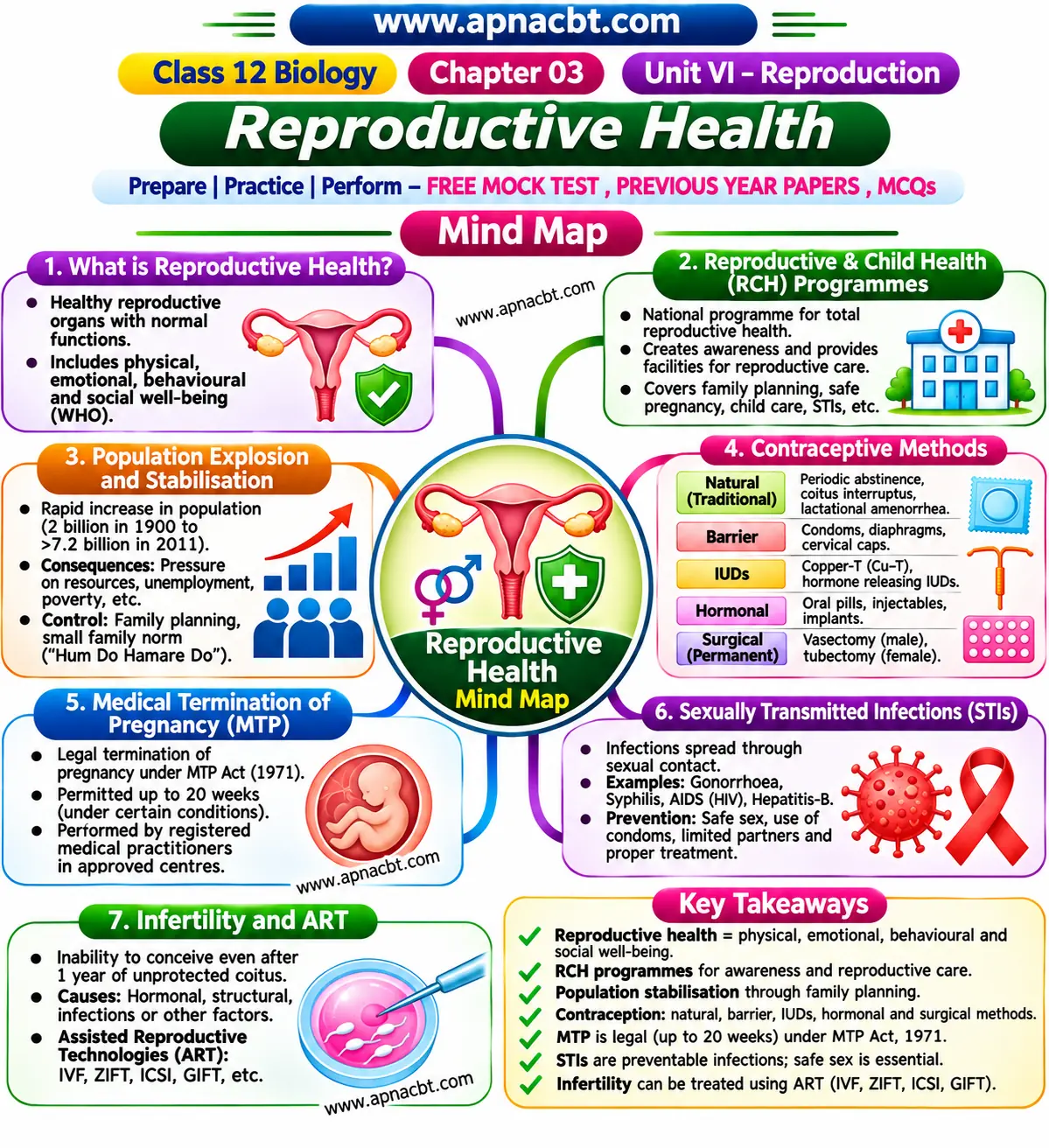
Class 12 Biology Chapter 3 Reproductive Health is one of the most scoring chapters for CBSE Board exams and NEET UG. This page gives you a quick mind map, the most important diagrams and the key tables so you can revise the whole chapter in minutes.
Class 12 Biology Chapter 3 Reproductive Health Mind Map
The mind map covers reproductive health problems, birth control methods, medical termination of pregnancy (MTP), sexually transmitted infections (STIs) and infertility treatments such as IVF, ZIFT and GIFT. Revise it first to see how all the topics connect.
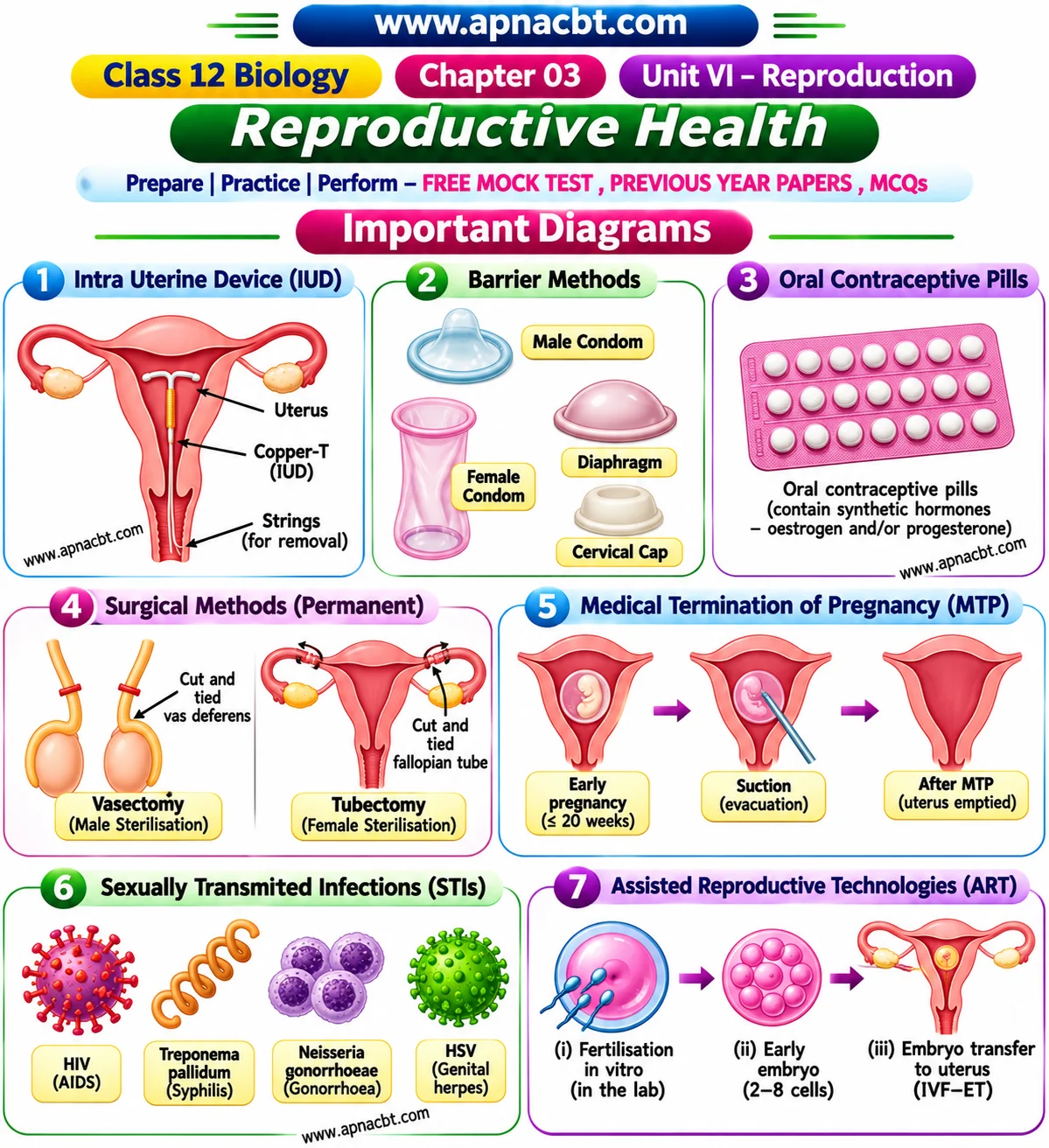
Important Diagrams for Reproductive Health
Diagrams such as the Copper-T, the IUD types and the assisted reproductive techniques are frequently asked in exams. Practise labelling them by hand, because NEET often tests the position and function of each part.
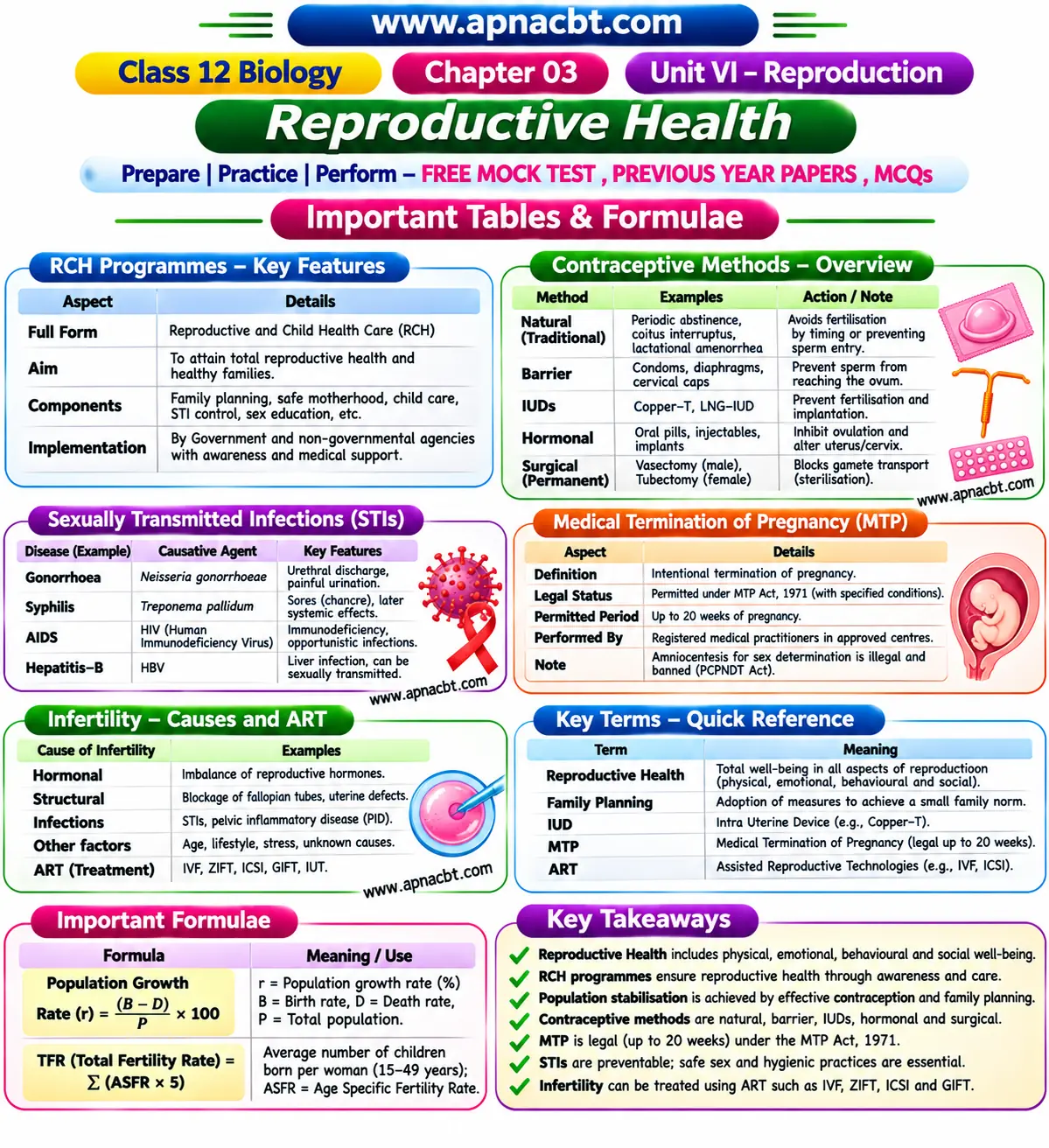
Important Tables for Quick Revision
These tables compare contraceptive methods, STIs and their causative organisms, and assisted reproductive technologies. Tables like these are a common source of match-the-following and statement-based questions in Class 12 Biology Chapter 3 Reproductive Health.
How to Prepare Reproductive Health for Exams
Read the chapter once from the official NCERT textbooks, then revise with the mind map and tables above. For NEET aspirants, check the latest syllabus and notices on the NTA NEET website.
After revision, test yourself with our free online mock tests and build speed with online exam practice for NEET UG, JEE Main and CBSE. You can also explore more resources on online exam preparation with Apna CBT.
Bookmark this page and revise Class 12 Biology Chapter 3 Reproductive Health again a day before your exam.

