Chapter 01: Solutions – Class 12 Chemistry
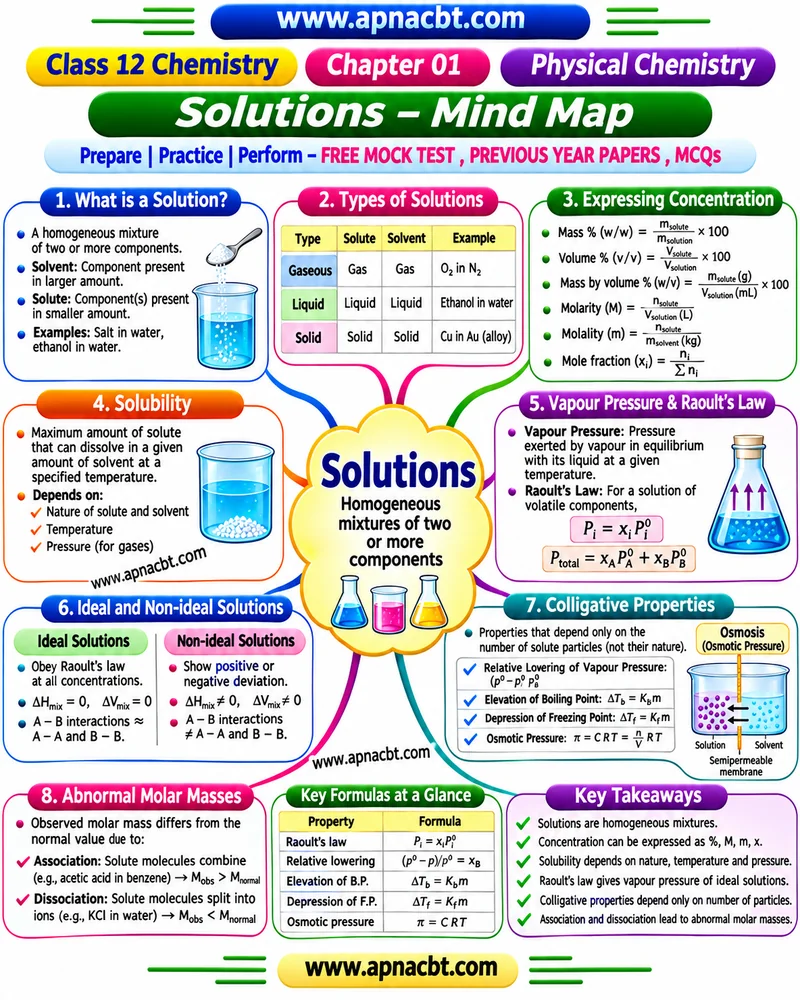
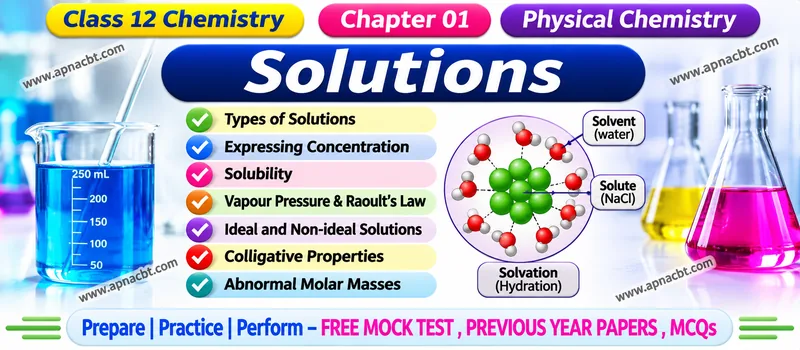
Solutions Class 12 Chemistry is a Level 01 preparation lesson for CBSE Board Exams, Class 12 Chemistry revision and NEET. It covers solution types, concentration terms, solubility, Henry’s law, vapour pressure, Raoult’s law, ideal and non-ideal solutions, colligative properties, osmotic pressure and abnormal molar masses.
Table of Contents
- 1. Introduction to Solutions and Types of Solutions
- 2. Methods of Expressing Concentration of Solutions
- 3. Solubility of Solids and Gases in Liquids
- 4. Vapour Pressure of Liquid Solutions and Raoult’s Law
- 5. Ideal and Non-Ideal Solutions, Deviations and Azeotropes
- 6. Colligative Properties and Relative Lowering of Vapour Pressure
- 7. Elevation of Boiling Point and Depression of Freezing Point
- 8. Osmosis, Osmotic Pressure and Reverse Osmosis
- 9. Abnormal Molar Masses and van’t Hoff Factor
- 10. Formula Sheet, Graphs and Numerical Problem Strategy
- 11. Complete Chapter Revision – CBSE, Board and NEET Focus
- 12. Short-Answer Questions – 30
- 13. Long-Answer Questions – 15
1. Introduction to Solutions and Types of Solutions
Solutions Class 12 Chemistry – Introduction and Exam Importance
Solutions Class 12 Chemistry explains homogeneous mixtures and the factors that determine their measurable properties. It is important for CBSE Board examinations because the chapter combines definitions, laws, graphs, formulae and numerical problems. It is also useful for NEET because concentration terms, vapour pressure, colligative properties and abnormal molar masses are repeatedly tested.
A solution is a homogeneous mixture of two or more components. The component present in larger amount is generally called the solvent and the component present in smaller amount is called the solute. Solutions may be gaseous, liquid or solid.
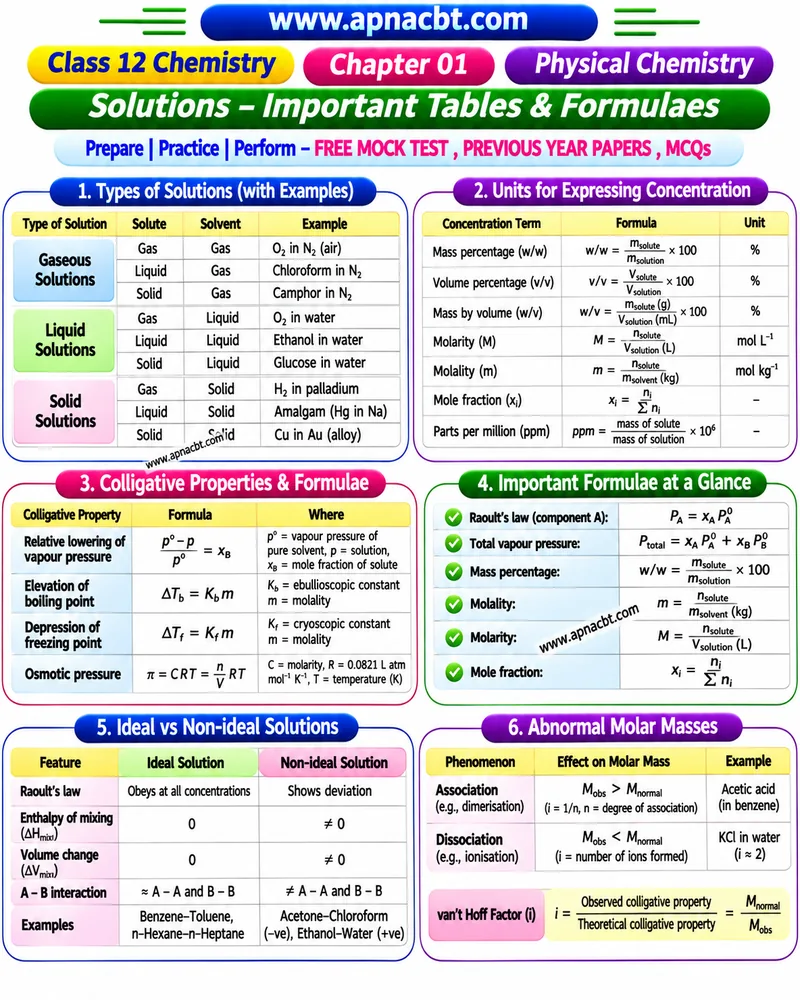
| Type | Example |
|---|---|
| Gas in gas | Air |
| Gas in liquid | Carbon dioxide in water |
| Liquid in liquid | Ethanol in water |
| Solid in liquid | Glucose in water |
| Solid in solid | Brass |
Board focus: define solution, solute and solvent and give examples. NEET focus: identify the physical state of the solvent and select the correct concentration expression.
2. Methods of Expressing Concentration of Solutions
Solution composition can be expressed by mass percentage, volume percentage, mass by volume percentage, parts per million, mole fraction, molarity and molality.
Mass and Volume Based Terms
Mass percentage = mass of component / total mass of solution × 100. Volume percentage = volume of component / total volume of solution × 100. Mass by volume percentage gives grams of solute present in 100 mL of solution. Parts per million is useful for very dilute concentrations.
Mole Fraction, Molarity and Molality
Mole fraction of component i is xi = ni/Σn. For a binary solution, xA + xB = 1.
Molarity (M) is moles of solute per litre of solution. Because it uses volume, it is temperature dependent. Molality (m) is moles of solute per kilogram of solvent. Because it uses mass, it is temperature independent.
Common mistake: molarity uses volume of solution, whereas molality uses mass of solvent. This distinction is essential in numerical questions.
3. Solubility of Solids and Gases in Liquids
Solubility is the maximum amount of a solute that can dissolve in a specified amount of solvent at a given temperature and pressure to form a saturated solution.
Solubility of Solids
Solubility depends on the nature of solute and solvent and on temperature. Many solids become more soluble when dissolution is endothermic and temperature rises, whereas an exothermic dissolution may show the opposite trend.
Solubility of Gases
Gas solubility in liquids generally decreases as temperature increases and increases as pressure increases.
Henry’s Law
At constant temperature, the solubility of a gas in a liquid is proportional to its partial pressure above the liquid. A common expression is p = KHx. Henry’s law explains why carbonated drinks are bottled under pressure and why pressure changes influence gases dissolved in biological systems.
NEET memory: higher pressure generally increases gas solubility; higher temperature generally decreases gas solubility.
4. Vapour Pressure of Liquid Solutions and Raoult’s Law
When a liquid is kept in a closed container, molecules escape into the vapour phase. At equilibrium, the vapour exerts a pressure called vapour pressure.
Raoult’s Law
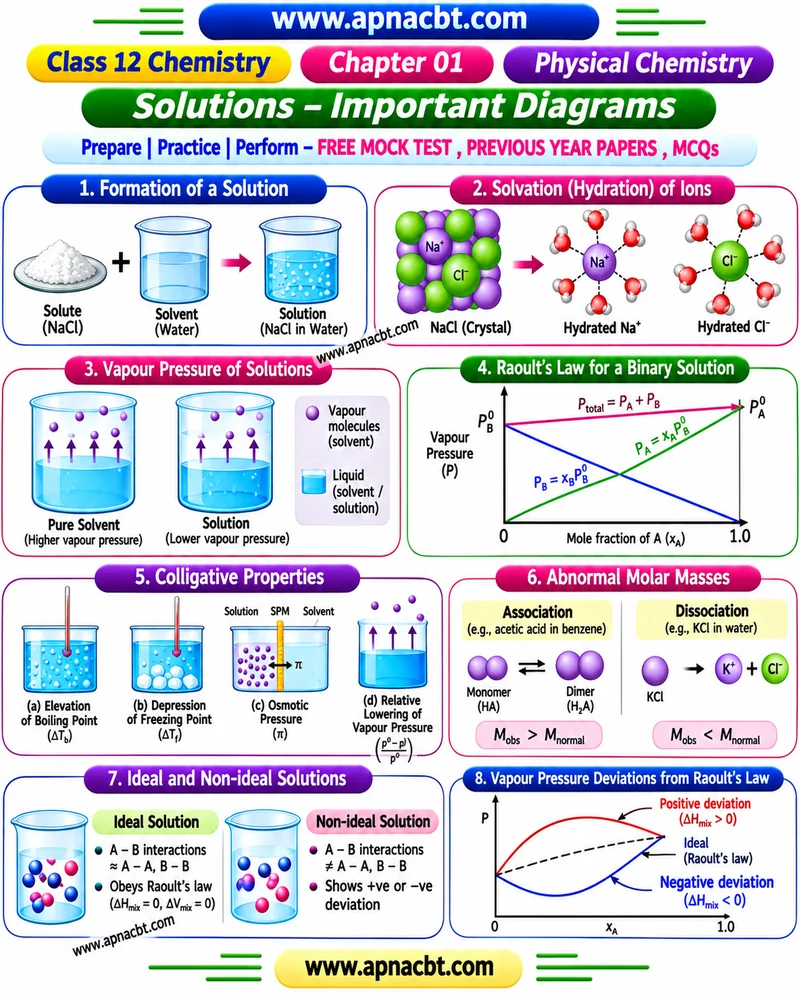
For an ideal solution of volatile liquids A and B, pA = xAp°A and pB = xBp°B. The total vapour pressure is the sum of the partial pressures.
Non-Volatile Solute
When a non-volatile solute is added to a volatile solvent, the mole fraction and escaping tendency of the solvent decrease. The solution therefore has a lower vapour pressure. For a dilute solution, relative lowering of vapour pressure is related to the mole fraction of solute.
Ideal Solution
An ideal solution obeys Raoult’s law throughout the composition range. A–B interactions are approximately comparable with A–A and B–B interactions, with negligible heat and volume changes on mixing.
5. Ideal and Non-Ideal Solutions, Deviations and Azeotropes
Solutions Class 12 Chemistry – Ideal and Non-Ideal Behaviour
In an ideal solution, unlike-molecule interactions are approximately equal to like-molecule interactions. Therefore Raoult’s law is followed over the complete composition range.
Positive Deviation
Positive deviation occurs when A–B attractions are weaker. Molecules escape more easily and the vapour pressure is higher than the ideal value. Suitable systems can form minimum-boiling azeotropes.
Negative Deviation
Negative deviation occurs when A–B attractions are stronger. Escaping tendency and vapour pressure are reduced. Suitable systems can form maximum-boiling azeotropes.
Azeotropes
An azeotrope is a constant-boiling mixture in which liquid and vapour have the same composition. Ordinary fractional distillation cannot completely separate its components.
| Feature | Positive deviation | Negative deviation |
|---|---|---|
| A–B interaction | Weaker | Stronger |
| Vapour pressure | Higher | Lower |
| Azeotrope | Minimum boiling | Maximum boiling |
6. Colligative Properties and Relative Lowering of Vapour Pressure
Colligative properties depend primarily on the number of dissolved solute particles relative to solvent particles, not on their chemical identity.
Four Colligative Properties
- Relative lowering of vapour pressure.
- Elevation of boiling point.
- Depression of freezing point.
- Osmotic pressure.
Relative lowering of vapour pressure is especially useful for determining molar mass. For a non-volatile solute in a dilute solution, the relative lowering is connected with the mole fraction of the solute.
In numerical questions, first identify whether the solute is volatile or non-volatile. Convert masses to moles, calculate mole fractions where required, and use the appropriate form of Raoult’s law.
7. Elevation of Boiling Point and Depression of Freezing Point
Elevation of Boiling Point
A non-volatile solute lowers vapour pressure, so a higher temperature is required for the solution to boil. The elevation is ΔTb = Tb − T°b. For a dilute normal solution, ΔTb = Kbm; with particle-number correction, ΔTb = iKbm.
Depression of Freezing Point
A solution freezes at a lower temperature than the pure solvent. The depression is ΔTf = T°f − Tf. For a dilute normal solution, ΔTf = Kfm; with particle-number correction, ΔTf = iKfm.
| Property | Equation | Effect |
|---|---|---|
| Boiling point | ΔTb = iKbm | Increases |
| Freezing point | ΔTf = iKfm | Decreases |
Board focus: define the property, write the equation and explain every symbol. NEET focus: distinguish Kb from Kf and use molality correctly.
8. Osmosis, Osmotic Pressure and Reverse Osmosis
Osmosis is the spontaneous movement of solvent through a semipermeable membrane from pure solvent or a dilute solution toward a more concentrated solution.
Osmotic Pressure
Osmotic pressure is the excess pressure required to stop osmosis. For a dilute solution, π = CRT = nRT/V. When association or dissociation occurs, π = iCRT.
Isotonic, Hypotonic and Hypertonic Solutions
Two solutions with equal osmotic pressure at a given temperature are isotonic. A solution with lower osmotic pressure is hypotonic relative to a more concentrated solution, which is hypertonic.
Biological Importance
Water movement across cell membranes can cause swelling or shrinking. Excess water entry can cause haemolysis in suitable animal-cell conditions, while water loss can cause crenation or plasmolysis.
Reverse Osmosis
When pressure greater than osmotic pressure is applied on the solution side, solvent is forced through the membrane in the reverse direction. Reverse osmosis is used for desalination and water purification.
9. Abnormal Molar Masses and van’t Hoff Factor
Solutions Class 12 Chemistry – Abnormal Molar Mass and van’t Hoff Factor
Colligative-property equations normally assume that the solute particles do not associate or dissociate. If particles combine or split, the number of particles changes and the molar mass calculated from a colligative property becomes abnormal.
van’t Hoff Factor
The van’t Hoff factor, i, corrects for changes in particle number. It may be written as observed colligative property divided by calculated colligative property, or calculated molar mass divided by observed molar mass.
- ΔTb = iKbm
- ΔTf = iKfm
- π = iCRT
Association decreases the number of particles, so i is generally less than one. Dissociation increases the number of particles, so i is generally greater than one.
For AxBy dissociating into n particles with degree of dissociation α, i = 1 + (n − 1)α.
10. Formula Sheet, Graphs and Numerical Problem Strategy
High-Yield Formulae
| Concept | Formula |
|---|---|
| Molarity | M = moles of solute / volume of solution in L |
| Molality | m = moles of solute / mass of solvent in kg |
| Mole fraction | xi = ni/Σn |
| Raoult’s law | pi = xip°i |
| Boiling point | ΔTb = iKbm |
| Freezing point | ΔTf = iKfm |
| Osmotic pressure | π = iCRT |
Numerical Strategy
- Write the data and units.
- Convert mass to moles.
- Select molarity, molality or mole fraction as required.
- Check for association or dissociation.
- Introduce i when particle number changes.
- Substitute values and check units.
Common Errors
- Using mass of solution instead of solvent for molality.
- Using volume of solvent instead of solution for molarity.
- Forgetting temperature dependence of molarity.
- Confusing boiling-point elevation with freezing-point depression.
- Ignoring abnormal particle behaviour.
11. Complete Chapter Revision – CBSE, Board and NEET Focus
Rapid Revision of Solutions Class 12 Chemistry
For CBSE Board examinations, learn definitions, laws, graphs, comparisons, derivations and numerical steps. For NEET, prioritise formula application, concentration conversion, particle counting and interpretation of ideal and non-ideal behaviour.
| Concept | Must-remember point |
|---|---|
| Solution | Homogeneous mixture of two or more components. |
| Molarity | Moles per litre of solution; temperature dependent. |
| Molality | Moles per kilogram of solvent; temperature independent. |
| Henry’s law | Gas solubility is proportional to partial pressure at constant temperature. |
| Raoult’s law | Partial vapour pressure equals mole fraction × pure-component vapour pressure. |
| Positive deviation | Weaker A–B interactions; higher vapour pressure. |
| Negative deviation | Stronger A–B interactions; lower vapour pressure. |
| Colligative properties | Depend mainly on number of solute particles. |
| Osmotic pressure | π = iCRT for dilute solutions. |
| van’t Hoff factor | Corrects for association or dissociation. |
Revision sequence: classify the solution → choose concentration term → study solubility → apply Henry’s law for gases → apply Raoult’s law → identify ideal or non-ideal behaviour → apply colligative properties → use osmotic pressure → correct abnormal molar mass with i.
Continue preparation through the APNA CBT home page, Class XII Level 01 section and online exam practice.
Authoritative reference: NCERT Textbooks.
12. Short-Answer Questions – 30 Questions with Detailed Answers
Important Short-Answer Questions for CBSE and NEET
Use these questions for rapid revision of definitions, laws, formulae and key distinctions. Each answer appears immediately below its question.
- 1. What is a solution?
Answer: A solution is a homogeneous mixture of two or more components with uniform composition and properties.
- 2. Define solute and solvent.
Answer: The solute is generally the smaller component; the solvent is generally the larger component.
- 3. What is molarity?
Answer: Molarity is moles of solute per litre of solution. It is temperature dependent.
- 4. What is molality?
Answer: Molality is moles of solute per kilogram of solvent. It is temperature independent.
- 5. What is mole fraction?
Answer: It is the ratio of moles of a component to the total moles of all components.
- 6. Why is molarity temperature dependent?
Answer: It uses solution volume, and volume can change with temperature.
- 7. Why is molality temperature independent?
Answer: It uses mass of solvent, and mass does not change with temperature.
- 8. State Henry’s law.
Answer: At constant temperature, gas solubility is proportional to its partial pressure above the liquid.
- 9. How does temperature affect gas solubility?
Answer: Gas solubility generally decreases as temperature increases.
- 10. How does pressure affect gas solubility?
Answer: Increasing gas partial pressure generally increases its solubility.
- 11. State Raoult’s law.
Answer: For an ideal volatile component, p_i = x_i p°_i.
- 12. What happens to vapour pressure when a non-volatile solute is added?
Answer: The solvent vapour pressure decreases.
- 13. What is an ideal solution?
Answer: A solution that obeys Raoult’s law throughout its composition range.
- 14. What is positive deviation?
Answer: Vapour pressure is higher than the Raoult-law prediction, usually because A–B interactions are weaker.
- 15. What is negative deviation?
Answer: Vapour pressure is lower than predicted because A–B interactions are stronger.
- 16. What is an azeotrope?
Answer: A constant-boiling mixture with the same composition in liquid and vapour phases.
- 17. Name four colligative properties.
Answer: Relative lowering of vapour pressure, boiling-point elevation, freezing-point depression and osmotic pressure.
- 18. What are colligative properties?
Answer: Properties depending primarily on the number of dissolved particles.
- 19. Why does boiling point rise after adding a non-volatile solute?
Answer: The solute lowers vapour pressure, so a higher temperature is needed to boil.
- 20. Why does freezing point fall after adding a non-volatile solute?
Answer: The dissolved particles lower the freezing temperature of the solvent.
- 21. Write the boiling-point equation.
Answer: For a dilute solution, ΔT_b = iK_bm.
- 22. Write the freezing-point equation.
Answer: For a dilute solution, ΔT_f = iK_fm.
- 23. Define osmotic pressure.
Answer: It is the pressure required to prevent net solvent flow through a semipermeable membrane.
- 24. What is an isotonic solution?
Answer: Two solutions are isotonic when they have equal osmotic pressure at the same temperature.
- 25. What is reverse osmosis?
Answer: It is solvent flow forced through a semipermeable membrane by applying pressure greater than osmotic pressure.
- 26. What is van’t Hoff factor?
Answer: It corrects colligative-property equations for changes in particle number.
- 27. What is i for association?
Answer: It is generally less than one because particles combine.
- 28. What is i for dissociation?
Answer: It is generally greater than one because particles split into more particles.
- 29. Why can colligative properties determine molar mass?
Answer: The property change depends on the number of solute particles, which is related to moles of solute.
- 30. Give one distinction between molarity and molality.
Answer: Molarity uses volume of solution; molality uses mass of solvent.
13. Long-Answer Questions – 15 Questions with Detailed Answers
Important Long-Answer Questions for Board Exams
Write board answers in a clear sequence: definition or principle, explanation, equation or example, and conclusion. These questions also strengthen conceptual preparation for competitive examinations.
- 1. Explain solutions and classify them.
Detailed Answer: A solution is a homogeneous mixture of two or more components. The solvent is normally the major component and the solute the minor component. Solutions may be gas in gas such as air, gas in liquid such as carbon dioxide in water, liquid in liquid such as ethanol in water, solid in liquid such as glucose in water, and solid in solid such as alloys.
- 2. Explain concentration terms.
Detailed Answer: Mass percentage, volume percentage and mass-by-volume percentage express composition using masses and volumes. Mole fraction is moles of a component divided by total moles. Molarity is moles of solute per litre of solution and is temperature dependent. Molality is moles per kilogram of solvent and is temperature independent.
- 3. Explain solubility of gases and Henry’s law.
Detailed Answer: Gas solubility generally decreases with temperature and increases with pressure. At constant temperature, Henry’s law states that the partial pressure of a gas is proportional to its mole fraction in solution, p = K_Hx. This explains pressure effects in carbonated beverages and dissolved gases in biological systems.
- 4. Explain Raoult’s law.
Detailed Answer: For an ideal binary solution, p_A = x_Ap°_A and p_B = x_Bp°_B. Total pressure equals the sum of partial pressures. The law follows from the proportional contribution of each component to the vapour phase. It is obeyed throughout the composition range by an ideal solution.
- 5. Differentiate ideal and non-ideal solutions.
Detailed Answer: Ideal solutions obey Raoult’s law and have approximately equal A–A, B–B and A–B interactions, with negligible heat and volume change on mixing. Non-ideal solutions deviate positively or negatively because unlike-molecule interactions differ from like-molecule interactions.
- 6. Explain positive and negative deviations.
Detailed Answer: Positive deviation results from weaker A–B interactions, producing higher vapour pressure than predicted. Negative deviation results from stronger A–B interactions, producing lower vapour pressure. Suitable positive-deviation systems may form minimum-boiling azeotropes; negative-deviation systems may form maximum-boiling azeotropes.
- 7. Explain azeotropes.
Detailed Answer: An azeotrope is a constant-boiling mixture whose liquid and vapour compositions are the same. Because the vapour does not become progressively enriched in one component, ordinary fractional distillation cannot completely separate the mixture. Minimum-boiling azeotropes are linked with positive deviation and maximum-boiling azeotropes with negative deviation.
- 8. Explain the four colligative properties.
Detailed Answer: The four properties are relative lowering of vapour pressure, elevation of boiling point, depression of freezing point and osmotic pressure. They depend primarily on the number of solute particles. For dilute solutions, ΔT_b = iK_bm, ΔT_f = iK_fm and π = iCRT.
- 9. Explain elevation of boiling point.
Detailed Answer: A non-volatile solute lowers vapour pressure, so the solution needs a higher temperature to reach external pressure. The increase is ΔT_b = T_b − T°_b. For a dilute normal solution ΔT_b = K_bm; if particle number changes, ΔT_b = iK_bm.
- 10. Explain depression of freezing point.
Detailed Answer: A solution containing a non-volatile solute freezes below the pure solvent temperature. The decrease is ΔT_f = T°_f − T_f. For a normal dilute solution ΔT_f = K_fm, while association or dissociation requires the factor i.
- 11. Explain osmosis and osmotic pressure.
Detailed Answer: Osmosis is solvent movement through a semipermeable membrane toward the more concentrated side. Osmotic pressure is the pressure required to stop that movement. For dilute solutions π = CRT, or π = iCRT when particle number changes. The principle has major biological importance.
- 12. Explain reverse osmosis.
Detailed Answer: When pressure greater than osmotic pressure is applied to the solution side, solvent is forced through the membrane toward the pure-solvent side. The process is reverse osmosis and is used for desalination and water purification.
- 13. Explain abnormal molar mass and van’t Hoff factor.
Detailed Answer: Association or dissociation changes the number of solute particles, so the experimentally determined molar mass differs from the normal molar mass. The van’t Hoff factor i is the observed colligative property divided by the calculated value, or calculated molar mass divided by observed molar mass. Association gives i < 1 and dissociation gives i > 1.
- 14. Derive the expression for i for dissociation.
Detailed Answer: If one formula unit dissociates into n particles and the degree of dissociation is α, the undissociated fraction contributes 1 − α particles and the dissociated fraction contributes nα. Total particles = 1 − α + nα = 1 + (n − 1)α. Therefore i = 1 + (n − 1)α.
- 15. Describe a systematic method for numerical problems.
Detailed Answer: Write the given data and units, convert masses to moles, identify the required concentration term, check whether association or dissociation occurs, introduce i when necessary, substitute into the appropriate equation and verify the unit and magnitude of the final result.
Exam Writing and Numerical Checklist
For numerical questions, show the formula before substitution. Convert grams to moles, millilitres to litres when required, and kilograms to grams only when the selected equation demands it. Keep the distinction between solvent and solution clear. For theory questions, define the term first and then state the law or equation. In graph questions, label the axes and identify whether the curve represents ideal behaviour or a deviation.
For CBSE, practise derivations and explanations of Raoult’s law, colligative properties, osmotic pressure and abnormal molar mass. For NEET, practise quick calculations involving mole fraction, molality, boiling-point elevation, freezing-point depression, osmotic pressure and van’t Hoff factor. Always check whether an electrolyte produces more particles through dissociation or fewer particles through association.