Table of Contents
- Introduction and Structure of amine compounds
- Classification and Nomenclature of amine compounds
- Preparation of amine compounds
- Physical Properties and Basic Character of amine compounds
- Chemical Reactions of amine compounds
- Tests, Separation and Important Distinctions
- Aromatic amine compounds and Electrophilic Substitution
- Diazonium Salts: Preparation, Stability and Reactions
- High-Yield Revision: Named Reactions, Applications and Exam Strategy
- Short-Answer Questions – 30 Questions with Detailed Answers
- Long-Answer Questions – 15 Questions with Detailed Answers
1. Introduction and Structure of Amines
Introduction to Amines for Class 12 Chemistry
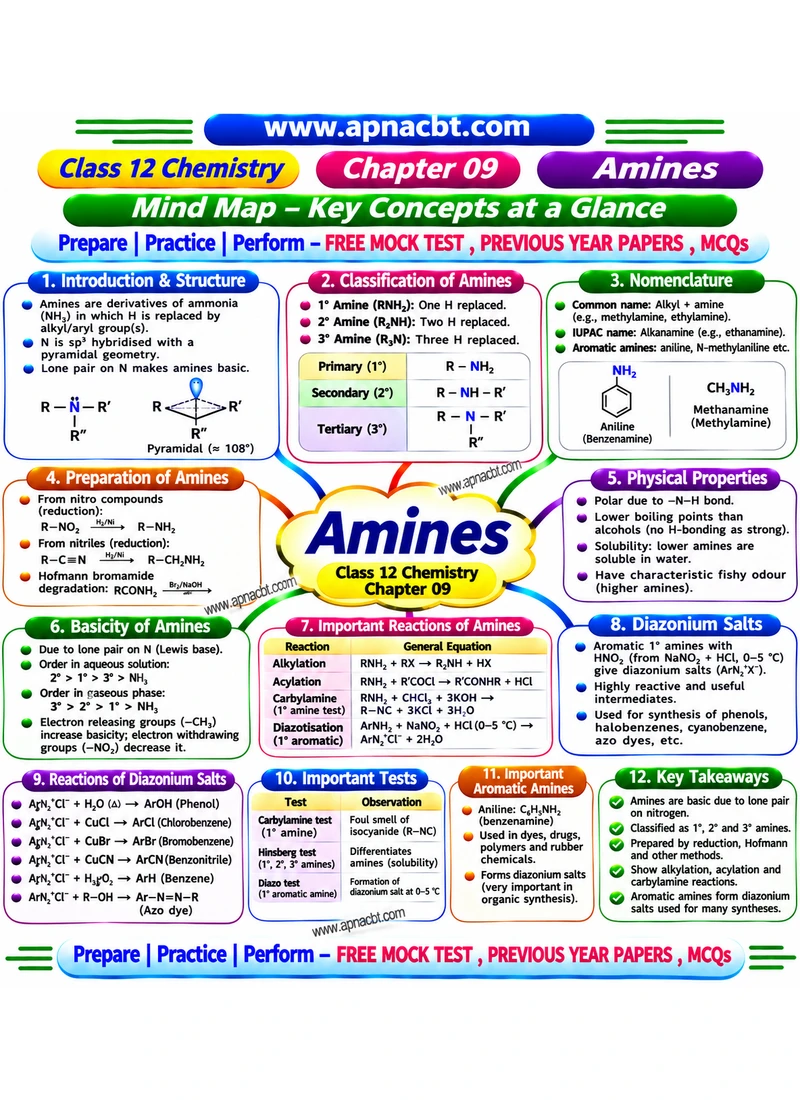
amine compounds are an important group of nitrogen-containing organic compounds in Class 12 Chemistry and are highly relevant for CBSE Board Exams, school examinations, concept revision and NEET preparation. They are derived conceptually from ammonia by replacement of one or more hydrogen atoms by alkyl or aryl groups. The chapter develops the structure, classification, nomenclature, preparation, physical properties, basic character, chemical reactions and important reactions of aromatic amine compounds and diazonium salts. These ideas connect structure with reactivity and provide a strong foundation for solving organic chemistry questions.
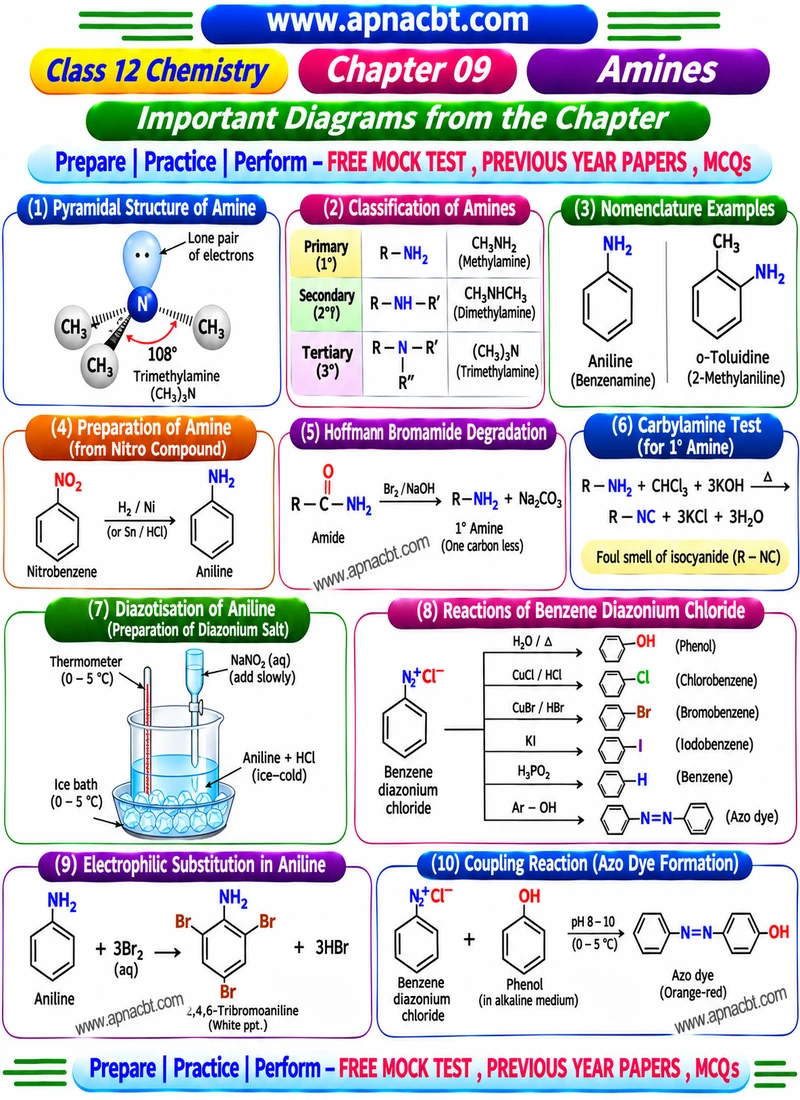
In simple amine compounds, nitrogen is generally sp3 hybridised and has a pyramidal geometry because one orbital contains an unshared electron pair. The lone pair makes amine compounds nucleophilic and basic. The extent of basicity is influenced by alkyl groups, resonance, inductive effects and solvation. Aromatic amine compounds such as aniline require special attention because the nitrogen lone pair is delocalised into the benzene ring.
2. Classification and Nomenclature of amine compounds
Classification and Nomenclature of Amines
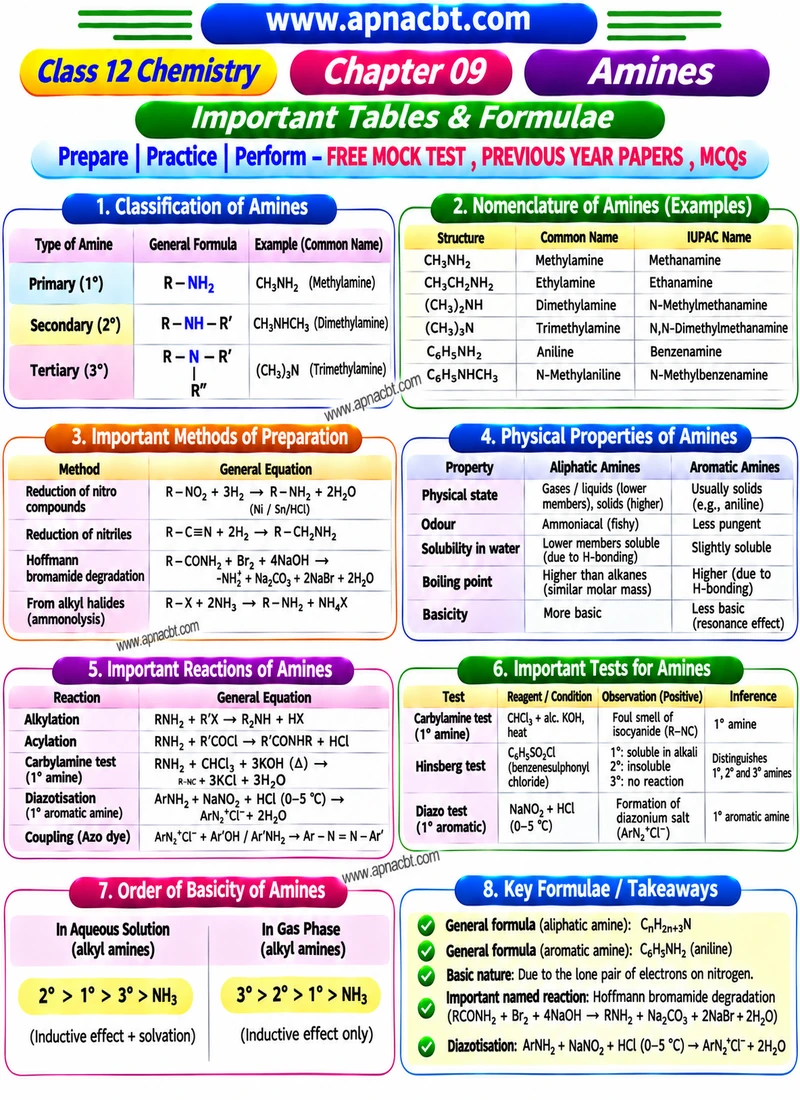
amine compounds are classified according to the number of alkyl or aryl groups directly attached to nitrogen. A primary (1°) amine has one carbon group, a secondary (2°) amine has two and a tertiary (3°) amine has three. Quaternary ammonium compounds have four carbon groups attached to positively charged nitrogen and are salts rather than neutral amine compounds.
| Class | General formula | Example |
|---|---|---|
| Primary | RNH2 | CH3NH2 – methanamine |
| Secondary | R2NH | (CH3)2NH – dimethylamine |
| Tertiary | R3N | (CH3)3N – trimethylamine |
| Quaternary ammonium salt | R4N+X− | tetramethylammonium chloride |
In the IUPAC system, primary aliphatic amine compounds are named as alkanamine compounds, such as methanamine and ethanamine. For secondary and tertiary amine compounds, N-locants identify substituents attached to nitrogen. Aniline is retained as a widely used common name, while its systematic name is benzenamine.
3. Preparation of amine compounds
Preparation Methods of amine compounds
Several methods are important for board and entrance examinations. In Hoffmann ammonolysis, an alkyl halide reacts with alcoholic ammonia. The reaction initially gives an ammonium salt and, after treatment with a strong base, the free amine is obtained. Because the amine compounds formed can themselves react with alkyl halides, a mixture of products may result. Using a large excess of ammonia favours the primary amine.
Reduction of nitriles gives primary amine compounds: R–CN can be reduced with LiAlH4 or by catalytic hydrogenation to R–CH2NH2. This route is useful because it increases the carbon chain by one carbon compared with the alkyl halide used to prepare the nitrile. Reduction of nitriles with sodium amalgam in ethanol is known as the Mendius reduction.
Reduction of amides with LiAlH4 gives primary amine compounds. A particularly important chain-shortening method is Hoffmann bromamide degradation, in which a primary amide reacts with bromine and alkali to produce a primary amine containing one carbon atom fewer than the starting amide.
Gabriel phthalimide synthesis is useful for primary aliphatic amine compounds. Potassium phthalimide undergoes alkylation with an appropriate alkyl halide, and subsequent hydrolysis releases the primary amine. It is not suitable for preparing arylamine compounds by ordinary SN2 alkylation of aryl halides.
For aromatic primary amine compounds, reduction of nitro compounds is an important route. Nitrobenzene, for example, can be reduced using reagents such as Sn/HCl or Fe/HCl to produce aniline.
4. Physical Properties and Basic Character of amine compounds
Physical Properties and Basic Character of amine compounds
Lower aliphatic amine compounds are commonly gases or volatile liquids with characteristic odours. As molecular mass increases, boiling points generally rise. Primary and secondary amine compounds can form intermolecular hydrogen bonds because they contain N–H bonds. Tertiary amine compounds cannot donate hydrogen bonds, although their nitrogen lone pair can accept hydrogen bonds.
Lower amine compounds are appreciably soluble in water because the amino group can hydrogen-bond with water and because amine compounds can be protonated in aqueous medium. Solubility generally decreases as the hydrophobic carbon portion becomes larger.
The basic nature of amine compounds is explained by the availability of the nitrogen lone pair. Alkyl groups exert a positive inductive effect and tend to increase electron density on nitrogen. In aromatic amine compounds, resonance delocalisation of the lone pair into the ring decreases its availability for protonation. The observed basicity in water also depends on how effectively the protonated amine is solvated.
High-yield comparison
| Factor | Effect on amine basicity |
|---|---|
| Electron-donating alkyl group | Generally increases electron density at nitrogen. |
| Resonance delocalisation in aniline | Reduces availability of the nitrogen lone pair. |
| Strong electron-withdrawing group | Generally lowers basicity. |
| Solvation of protonated amine | Can substantially affect the basicity order in water. |
5. Chemical Reactions of amine compounds
Important Chemical Reactions of Amines
amine compounds show reactions characteristic of a nucleophilic nitrogen atom. With mineral acids they form ammonium salts. For example, RNH2 + HCl → RNH3+Cl−. Alkylation with alkyl halides can progressively replace N–H hydrogen atoms and may ultimately form quaternary ammonium salts.
Acylation of primary and secondary amine compounds with acid chlorides or anhydrides gives amides. This reaction is also important in controlling the strong activating effect of an –NH2 group on an aromatic ring.
The carbylamine reaction is a diagnostic test for primary amine compounds. A primary amine is heated with chloroform and alcoholic KOH to produce an isocyanide with a very unpleasant smell. Secondary and tertiary amine compounds do not give this reaction.
With nitrous acid, primary aliphatic amine compounds form unstable diazonium intermediates and release nitrogen as they decompose. Primary aromatic amine compounds form comparatively stable arenediazonium salts at 273–278 K. Secondary amine compounds form N-nitrosoamine compounds, while tertiary amine compounds show different salt-forming or substitution behaviour depending on their structure.
Must-remember equations
- RNH2 + HCl → RNH3+Cl−
- RNH2 + CHCl3 + 3KOH → RNC + 3KCl + 3H2O
- C6H5NH2 + NaNO2 + HCl, 273–278 K → C6H5N2+Cl− + 2H2O
6. Tests, Separation and Important Distinctions
Important Tests for amine compounds
The Hinsberg method uses benzenesulphonyl chloride to distinguish primary, secondary and tertiary amine compounds on the basis of sulphonamide formation and solubility in alkali. A primary amine forms a sulphonamide containing an acidic N–H proton and can therefore form a soluble salt in alkaline medium. A secondary amine forms an N,N-disubstituted sulphonamide that is insoluble in alkali. A tertiary amine does not form a sulphonamide under the test conditions but can dissolve in dilute acid through salt formation.
The carbylamine test is specific for primary amine compounds. It is especially useful when the question asks for a reagent that distinguishes primary amine compounds from secondary and tertiary amine compounds.
The azo dye test identifies primary aromatic amine compounds. The amine is first diazotised at low temperature and the diazonium salt is then coupled with an activated aromatic compound to give a strongly coloured azo dye.
| Test | Primary amine | Secondary amine | Tertiary amine |
|---|---|---|---|
| Carbylamine | Positive | Negative | Negative |
| Hinsberg | Alkaline-soluble sulphonamide | Alkaline-insoluble sulphonamide | No sulphonamide; forms salt with acid |
| Diazotisation/azo dye | Aromatic primary amine compounds give azo coupling after diazotisation | Does not form the same diazonium intermediate | Does not give the primary aromatic amine azo-dye test |
7. Aromatic amine compounds and Electrophilic Substitution
Aromatic amine compounds and Electrophilic Substitution
Aniline is the most important aromatic amine in this chapter. The –NH2 group donates electron density into the benzene ring by resonance and therefore strongly activates the ring towards electrophilic substitution. The group is ortho-para directing.
Direct bromination of aniline in aqueous bromine can produce 2,4,6-tribromoaniline. The high activation of the ring explains why substitution can occur readily. For controlled monosubstitution, the amino group can be protected by acylation, reducing its activating effect and allowing better control of the reaction.
Aniline also undergoes nitration and sulphonation under suitable conditions. In strongly acidic medium, the amino group can be protonated to form the anilinium ion, which is much less activating and behaves as a meta-directing group. Therefore, the reaction conditions must always be considered when predicting orientation.
NEET/Board concept
Aniline is less basic because the lone pair is delocalised, but the ring is strongly activated because resonance donation increases electron density at ortho and para positions.
8. Diazonium Salts: Preparation, Stability and Reactions
Diazonium Salts: Preparation and Reactions of Amines
Primary aromatic amine compounds react with nitrous acid at low temperature to form arenediazonium salts. For aniline, sodium nitrite and hydrochloric acid are used at 273–278 K. The reaction is called diazotisation and gives benzenediazonium chloride.
Arenediazonium salts are more stable than alkyldiazonium salts because the aromatic ring helps disperse the positive charge. Even so, they are generally used soon after preparation and are not treated as indefinitely stable compounds.
Reactions involving replacement of the diazonium group
| Reagent/condition | Product | Named reaction or description |
|---|---|---|
| CuCl/HCl | Chlorobenzene | Sandmeyer reaction |
| CuBr/HBr | Bromobenzene | Sandmeyer reaction |
| CuCN/KCN | Benzonitrile | Sandmeyer reaction |
| KI | Iodobenzene | Replacement by iodine |
| HBF4, heat | Fluorobenzene | Balz–Schiemann reaction |
| Water, warming | Phenol | Hydrolysis |
| H3PO2 | Benzene | Reduction and removal of diazo group |
Diazonium salts also undergo azo coupling with phenols and aromatic amine compounds. The products contain the –N=N– group and are often intensely coloured. This reaction is important in the manufacture of azo dyes and in qualitative identification of primary aromatic amine compounds.
9. High-Yield Revision: Named Reactions, Applications and Exam Strategy
amine compounds: Final Revision and Exam Strategy
For fast revision, connect each reagent with the functional-group change it produces. Amines reward this reaction-based approach because the same functional groups recur across many questions.
| High-yield topic | What to remember |
|---|---|
| Structure | sp3 nitrogen, pyramidal geometry, lone pair |
| Preparation | Ammonolysis, nitrile/amide reduction, Gabriel, Hoffmann bromamide |
| Basicity | Inductive effect, resonance and solvation |
| Tests | Carbylamine, Hinsberg and azo dye test |
| Aniline | Less basic than alkylamine compounds; ortho-para directing and strongly activating |
| Diazonium salts | Diazotisation at 273–278 K; Sandmeyer, Gattermann, Balz–Schiemann and coupling |
Exam-writing strategy
- Identify the amine class and starting functional group.
- Write the reagent, essential temperature/medium and major product.
- For comparison questions, give the structural reason, not only an order.
Useful APNA CBT resources can be accessed from the APNA CBT home page. For the authoritative textbook framework, refer to the official NCERT textbook portal. The chapter source emphasises structure, classification, preparation, physical properties and chemical reactions of amine compounds and the important diazonium chemistry used in exam questions.
10. Short-Answer Questions – 30 Questions with Detailed Answers
Short-Answer Questions – 30 Questions with Detailed Answers
These questions are designed for CBSE, Board Exams, NEET revision and rapid practice.
What are amine compounds?
Answer: amine compounds are organic compounds derived conceptually from ammonia by replacing one or more hydrogen atoms with alkyl or aryl groups. They are classified as primary, secondary or tertiary amine compounds according to the number of carbon groups attached to nitrogen.
Why are amine compounds basic?
Answer: amine compounds contain a lone pair of electrons on nitrogen. This electron pair can accept a proton, so amine compounds behave as Lewis bases and, in suitable media, as Brønsted bases.
What is the hybridisation of nitrogen in simple amine compounds?
Answer: The nitrogen atom in simple amine compounds is generally sp³ hybridised. The geometry is pyramidal because three sigma bonds and one lone pair are arranged around nitrogen.
Why is the bond angle in trimethylamine less than 109.5°?
Answer: The lone pair occupies more space than a bonding pair and repels the bonding electron pairs more strongly. Therefore the C–N–C bond angle is compressed from the ideal tetrahedral angle.
How are amine compounds classified?
Answer: A primary amine has one alkyl or aryl group attached to nitrogen, a secondary amine has two, and a tertiary amine has three. Quaternary ammonium salts contain four carbon groups attached to positively charged nitrogen.
Give the IUPAC name of CH3NH2.
Answer: CH3NH2 is methanamine. Its common name is methylamine.
What is aniline?
Answer: Aniline is benzenamine, C6H5NH2. It is a primary aromatic amine in which the amino group is directly attached to a benzene ring.
What is ammonolysis of an alkyl halide?
Answer: Ammonolysis is the nucleophilic substitution of an alkyl halide by ammonia to form an amine. The initial ammonium salt can be treated with a strong base to liberate the free amine.
Why does ammonolysis often give a mixture?
Answer: The amine initially formed is also nucleophilic and can react further with the alkyl halide. Consequently, secondary and tertiary amine compounds and quaternary ammonium salts may form.
How can primary amine compounds be prepared from nitriles?
Answer: Nitriles can be reduced to primary amine compounds using lithium aluminium hydride or by catalytic hydrogenation. The carbon of the nitrile group becomes the carbon attached to the amino group.
What is Gabriel phthalimide synthesis?
Answer: It is a method for preparing primary aliphatic amine compounds. Potassium phthalimide reacts with an alkyl halide to form an N-alkylphthalimide, which on hydrolysis gives the corresponding primary amine.
What is Gabriel phthalimide synthesis used for?
Answer: It is used mainly for preparing primary aliphatic amine compounds. Potassium phthalimide reacts with an alkyl halide and the resulting N-alkylphthalimide is hydrolysed to give the primary amine.
What is Hoffmann bromamide degradation?
Answer: A primary amide reacts with bromine and alkali to form a primary amine containing one carbon atom fewer than the original amide. It is therefore useful for shortening the carbon chain.
Why does aniline have lower basicity than alkylamine compounds?
Answer: In aniline, the nitrogen lone pair is delocalised into the benzene ring by resonance. Its availability for protonation is therefore reduced compared with a typical alkylamine.
What is the basicity order in aqueous solution among common alkylamine compounds?
Answer: The exact order depends on solvation and the structure of the amine compounds. For simple methylamine compounds in aqueous solution, secondary amine compounds are commonly more basic than primary amine compounds, while tertiary amine compounds are affected by poorer solvation of the protonated ion.
What happens when a primary amine reacts with nitrous acid?
Answer: A primary aliphatic amine forms an unstable alkyldiazonium intermediate that decomposes with evolution of nitrogen and formation of products such as alcohols. A primary aromatic amine forms a relatively stable arenediazonium salt at low temperature.
What is the carbylamine test?
Answer: Primary amine compounds, both aliphatic and aromatic, react with chloroform and alcoholic potassium hydroxide on heating to form foul-smelling isocyanides. Secondary and tertiary amine compounds do not give this test.
Which amine compounds give the carbylamine test?
Answer: Only primary amine compounds give the carbylamine test because formation of the isocyanide requires the primary amino group.
How are primary, secondary and tertiary amine compounds separated using benzenesulphonyl chloride?
Answer: With benzenesulphonyl chloride in alkaline medium, primary and secondary amine compounds form sulphonamides with different solubility behaviour, while tertiary amine compounds do not form sulphonamides under these conditions. This is the basis of the Hinsberg method.
What is the azo dye test?
Answer: A primary aromatic amine is diazotised and the resulting diazonium salt is coupled with an activated aromatic compound such as phenol in suitable medium to form a brightly coloured azo compound.
Why are arylamine compounds activating and ortho-para directing?
Answer: The amino group donates electron density to the benzene ring through resonance. This increases electron density particularly at the ortho and para positions, making electrophilic substitution easier at these sites.
What is diazotisation?
Answer: Diazotisation is the conversion of a primary aromatic amine into an arenediazonium salt using nitrous acid, usually generated in situ from sodium nitrite and hydrochloric acid, at about 273–278 K.
Why are arenediazonium salts more stable than alkyldiazonium salts?
Answer: In arenediazonium salts, the positive charge is stabilised by delocalisation involving the aromatic ring. Alkyldiazonium salts lack this stabilisation and readily lose nitrogen.
What is Sandmeyer reaction?
Answer: In the Sandmeyer reaction, an arenediazonium salt is treated with a cuprous salt such as CuCl, CuBr or CuCN to replace the diazonium group by chlorine, bromine or cyano group.
What is Gattermann reaction?
Answer: In the Gattermann reaction, an arenediazonium salt is treated with copper powder and the corresponding hydrogen halide to replace the diazonium group by a halogen.
What is Balz–Schiemann reaction?
Answer: Arenediazonium tetrafluoroborate on heating decomposes to give the corresponding aryl fluoride. This reaction provides a useful route to aromatic fluorides.
How is phenol prepared from benzenediazonium chloride?
Answer: Benzenediazonium chloride reacts with water on warming to form phenol with evolution of nitrogen gas.
How is iodobenzene prepared from an arenediazonium salt?
Answer: The diazonium group can be replaced by iodine using potassium iodide, giving iodobenzene and releasing nitrogen.
What is coupling reaction of diazonium salts?
Answer: Arenediazonium salts couple with activated aromatic compounds such as phenols or aromatic amine compounds to form azo compounds containing the –N=N– linkage. The products are often intensely coloured.
Why is diazonium chemistry important?
Answer: The diazonium group can be replaced by several different groups and can also participate in coupling reactions. Thus diazonium salts provide a versatile route for preparing substituted aromatic compounds and azo dyes.
11. Long-Answer Questions – 15 Questions with Detailed Answers
Long-Answer Questions – 15 Questions with Detailed Answers
Write equations where appropriate and include essential reaction conditions.
Explain the structure, classification and basic nature of amine compounds.
Answer: amine compounds are derivatives of ammonia in which one or more H atoms are replaced by alkyl or aryl groups. Nitrogen is generally sp³ hybridised and pyramidal because of its lone pair. Primary, secondary and tertiary amine compounds contain one, two and three carbon groups on nitrogen. Their basicity arises from lone-pair availability and is affected by inductive effects, resonance and solvation.
Describe the important methods of preparation of primary amine compounds.
Answer: Primary amine compounds are prepared by ammonolysis of alkyl halides, reduction of nitriles and amides, Gabriel phthalimide synthesis and Hoffmann bromamide degradation. Nitrile reduction gives RCH₂NH₂, while Hoffmann bromamide degradation gives a primary amine with one carbon fewer than the starting amide. Reduction of nitro compounds is especially important for aromatic primary amine compounds such as aniline.
Explain the physical properties and basicity of amine compounds.
Answer: Lower aliphatic amine compounds are volatile and have characteristic odours. Primary and secondary amine compounds form intermolecular hydrogen bonds, whereas tertiary amine compounds cannot donate hydrogen bonds. Lower members are appreciably water soluble. Basicity depends on lone-pair availability, electron-donating or withdrawing groups, resonance and solvation. Alkyl groups generally increase electron density, while resonance in aniline decreases the availability of nitrogen’s lone pair.
Explain the chemical reactions of amine compounds with suitable equations.
Answer: amine compounds form ammonium salts with acids and undergo alkylation and acylation. Primary amine compounds give the carbylamine test with CHCl₃ and alcoholic KOH. With nitrous acid, primary aliphatic amine products evolve nitrogen, while primary aromatic amine compounds form arenediazonium salts at low temperature. Aromatic amine compounds also undergo electrophilic substitution because the –NH₂ group activates the ring and directs substitution mainly to ortho and para positions.
Explain the Hinsberg method for distinguishing primary, secondary and tertiary amine compounds.
Answer: In the Hinsberg method, benzenesulphonyl chloride reacts with amine in alkaline medium. A primary amine forms a sulphonamide that contains an N–H proton and becomes soluble in alkali as its salt. A secondary amine forms an alkali-insoluble sulphonamide. A tertiary amine does not form a sulphonamide under these conditions but dissolves in dilute acid by forming an ammonium salt.
Describe the preparation of benzenediazonium chloride from aniline.
Answer: Aniline is treated with sodium nitrite and hydrochloric acid at 273–278 K. Nitrous acid is generated in situ and converts the –NH₂ group into the diazonium group, producing benzenediazonium chloride. Low temperature is essential because the diazonium salt is stable only for a limited period and decomposes more readily on warming. The product is then used for substitution and coupling reactions.
Explain the important substitution reactions of benzenediazonium chloride.
Answer: Benzenediazonium chloride is a versatile aromatic intermediate. CuCl/HCl gives chlorobenzene, CuBr/HBr gives bromobenzene and CuCN/KCN gives benzonitrile. KI gives iodobenzene, while warming with water gives phenol. Diazotisation followed by HBF₄ and heating provides aryl fluoride through the Balz–Schiemann reaction. Reduction can replace the diazonium group by hydrogen.
Explain the coupling reactions of diazonium salts and the formation of azo dyes.
Answer: Arenediazonium salts act as electrophiles and couple with activated aromatic compounds such as phenol or aniline. Coupling usually occurs at an activated position and forms an azo compound containing –N=N–. The extended conjugation gives intense colour, making these compounds useful as azo dyes. The reaction also forms the basis of the azo dye test for primary aromatic amine compounds.
Compare aniline with aliphatic amine compounds in terms of basicity and electrophilic substitution.
Answer: Aniline is less basic than typical aliphatic amine compounds because its nitrogen lone pair is delocalised into the benzene ring. Yet the same resonance donation makes the ring strongly activated towards electrophilic substitution and directs attack mainly to ortho and para positions. Bromine water can therefore give 2,4,6-tribromoaniline. Acyl protection of –NH₂ can be used when controlled substitution is required.
Write an exam-focused summary of the chapter amine compounds.
Answer: For revision, connect the chapter through five blocks: structure and classification; preparation by ammonolysis, reductions, Gabriel synthesis and Hoffmann degradation; basicity and its electronic and solvation factors; diagnostic tests and reactions; and aromatic amine/diazonium chemistry. Memorise the key conditions for diazotisation, Sandmeyer, Gattermann, Balz–Schiemann and azo coupling, and always identify the amine class before predicting a product.
Explain the preparation of amine compounds from alkyl halides, nitriles and amides.
Answer: Alkyl halides undergo ammonolysis with alcoholic ammonia to form amine compounds after basification. Nitriles are reduced with LiAlH₄ or catalytic hydrogenation to primary amine compounds, RCN → RCH₂NH₂. Primary amides are reduced with LiAlH₄ to primary amine compounds. Nitrile reduction retains the nitrile carbon, whereas Hoffmann bromamide degradation of an amide shortens the carbon chain by one carbon.
Discuss the basicity of aniline and alkylamine compounds using electronic effects.
Answer: Basicity depends on the availability of the nitrogen lone pair. Alkyl groups generally donate electron density by the +I effect and can increase basicity. In aniline, resonance delocalises the lone pair into the benzene ring, reducing its availability for protonation. Electron-withdrawing substituents lower basicity, while electron-donating substituents can increase it. In water, solvation of the protonated species also influences the observed order.
Describe the preparation and reactions of benzenediazonium chloride.
Answer: Aniline reacts with NaNO₂ and HCl at 273–278 K to form benzenediazonium chloride. The diazonium group can then be replaced by Cl, Br, CN or I using suitable reagents; water gives phenol, while HBF₄ followed by heating gives aryl fluoride. Reduction can replace the diazonium group by hydrogen. The salt also undergoes azo coupling with activated aromatic compounds.
Explain why aniline is ortho-para directing and describe its bromination.
Answer: The –NH₂ group donates electron density to the benzene ring through resonance, increasing electron density at ortho and para positions. Hence aniline is strongly activating and ortho-para directing. Bromine water can produce 2,4,6-tribromoaniline. Because the ring is highly activated, controlled monosubstitution may require protection of the amino group by acylation.
Give a comprehensive comparison of the major diagnostic tests for amine compounds.
Answer: The carbylamine test is positive only for primary amine compounds and produces foul-smelling isocyanides. The Hinsberg method uses benzenesulphonyl chloride to distinguish primary, secondary and tertiary amine compounds by sulphonamide formation and solubility. The azo dye test is characteristic of primary aromatic amine compounds: diazotisation is followed by coupling with an activated aromatic compound to form a coloured azo dye.