Table of Contents
- Introduction and Carbonyl Functional Group
- Nomenclature and Structure of Aldehydes and Ketones
- Preparation of Aldehydes and Ketones
- Physical Properties and Nucleophilic Addition
- Important Reactions of Aldehydes and Ketones
- Aldol, Cannizzaro and Other Named Reactions
- Carboxylic Acids: Nomenclature, Structure and Properties
- Preparation and Chemical Reactions of Carboxylic Acids
- Distinction Tests, Uses and High-Yield Revision
- Short-Answer Questions – 30 Questions with Detailed Answers
- Long-Answer Questions – 15 Questions with Detailed Answers
1. Introduction and Carbonyl Functional Group
Introduction to Aldehydes, Ketones and Carboxylic Acids for Class 12 Chemistry
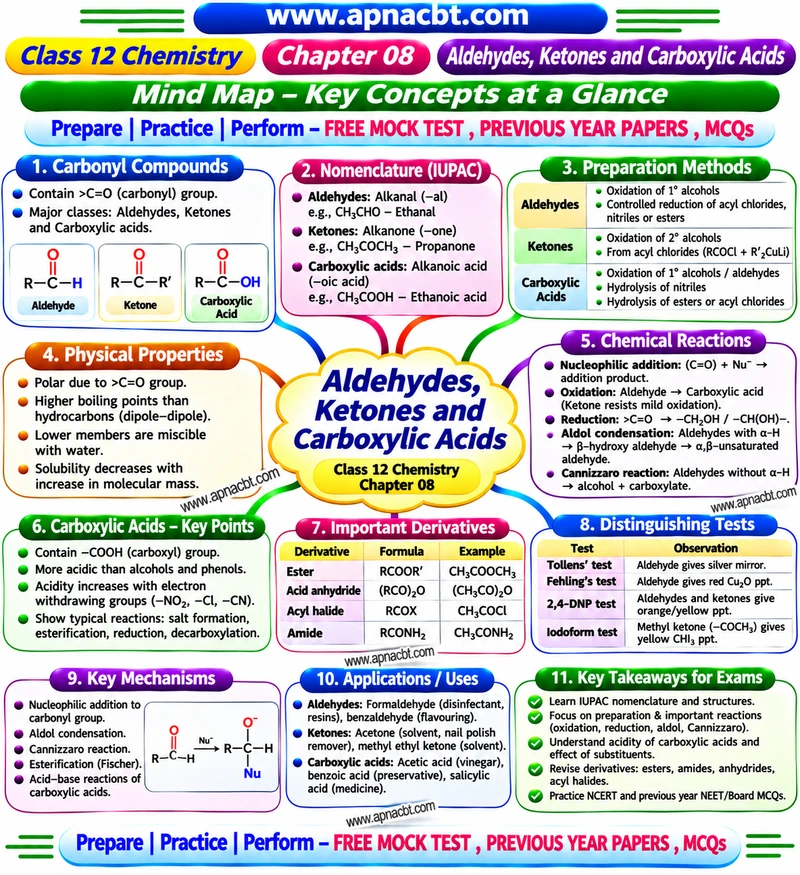
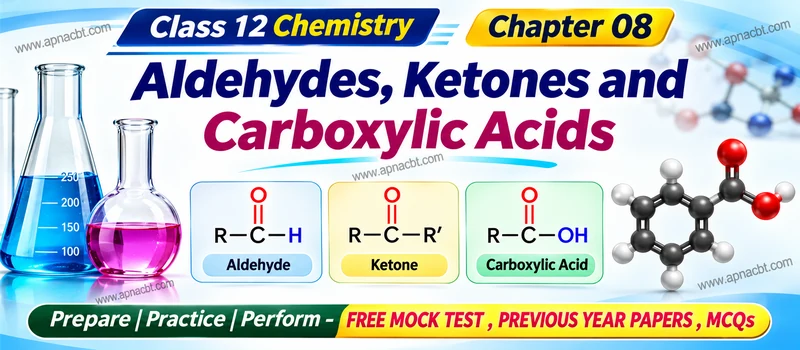
Aldehydes, Ketones and Carboxylic Acids are important carbonyl compounds in Class 12 Chemistry and form a major part of organic chemistry for CBSE Board Exams, school examinations, concept revision and NEET preparation. The common structural feature is the carbonyl group, >C=O. In aldehydes the carbonyl carbon is bonded to hydrogen and a carbon group, whereas in ketones it is bonded to two carbon groups. Carboxylic acids contain the carboxyl group, –COOH. The NCERT chapter develops nomenclature, structure, preparation, physical properties, chemical reactions, mechanisms, acidity and applications of these compounds. fileciteturn108file6
Carbonyl compounds are important because the C=O bond is strongly polar. Oxygen attracts electron density, leaving the carbonyl carbon electrophilic. This explains many nucleophilic addition reactions of aldehydes and ketones. The chapter also connects structure with reactivity, oxidation-reduction behaviour and named reactions such as aldol condensation and Cannizzaro reaction.
Exam focus
- Identify and name aldehydes, ketones and carboxylic acids correctly.
- Understand preparation methods and the conditions required for selective products.
- Remember oxidation, reduction and nucleophilic addition reactions.
- Differentiate aldol condensation from Cannizzaro reaction.
- Explain acidity of carboxylic acids using resonance and inductive effects.
2. Nomenclature and Structure of Aldehydes and Ketones
Nomenclature of Carbonyl Compounds and Acids
Aldehydes are named by replacing the ending ‘-e’ of the corresponding alkane with ‘-al’. The carbon of the aldehyde group is assigned number 1. Ketones use the suffix ‘-one’, and the position of the carbonyl group is indicated by a locant. Common names such as formaldehyde, acetaldehyde, acetone and benzaldehyde are also frequently encountered in board and entrance questions.
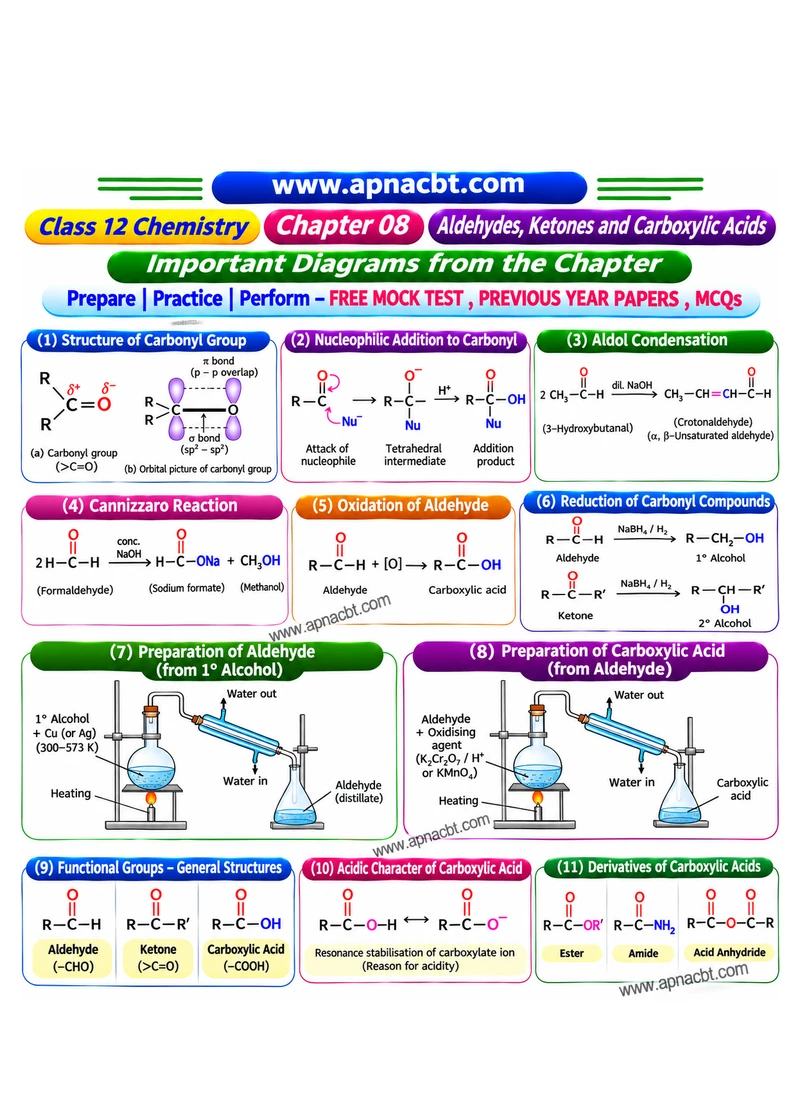
The carbonyl carbon is approximately sp2-hybridised. The three groups around it lie in a trigonal planar arrangement. The C=O bond consists of a sigma and a pi component and is polar. Resonance representations help explain the electrophilic nature of the carbonyl carbon.
High-yield structural points
- Aldehyde: R–CHO.
- Ketone: R–CO–R′.
- Aldehydes have a hydrogen directly attached to the carbonyl carbon.
- Ketones have two carbon substituents attached to the carbonyl carbon.
- Aromatic aldehydes and ketones retain the carbonyl group’s electronic influence on the aromatic ring.
3. Preparation of Aldehydes and Ketones
Important Preparation Methods
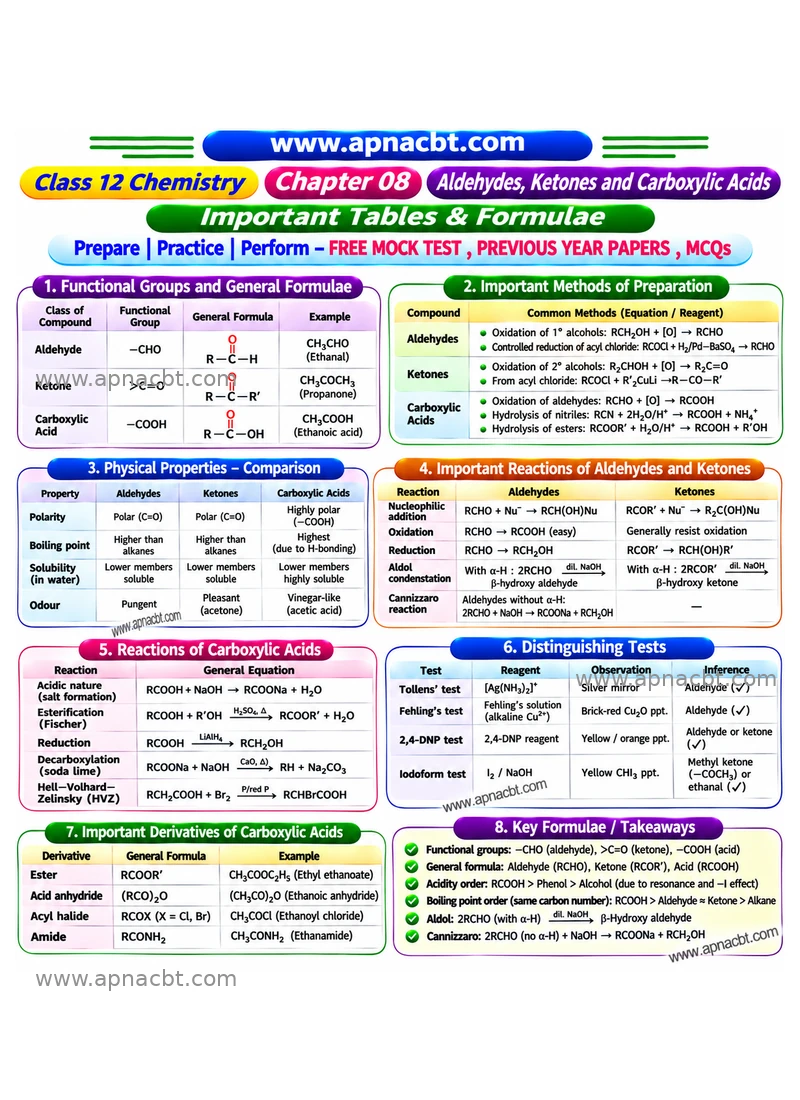
Primary alcohols can be oxidised carefully to aldehydes, while secondary alcohols give ketones. Dehydrogenation over heated copper is another useful laboratory method. Ozonolysis of alkenes can give aldehydes or ketones depending on the structure of the alkene. Acid chlorides can be reduced selectively to aldehydes by Rosenmund reduction.
Key reactions to revise
- Primary alcohol → aldehyde under controlled oxidation.
- Secondary alcohol → ketone on oxidation.
- Acid chloride → aldehyde by Rosenmund reduction.
- Alkene ozonolysis → aldehydes and/or ketones after suitable work-up.
- Suitable alkynes can give carbonyl compounds by hydration under appropriate catalytic conditions.
For examination questions, do not memorise reagents in isolation. Link each reagent to the functional-group transformation and the required product. This is particularly useful in multi-step conversion questions.
4. Physical Properties and Nucleophilic Addition
Nucleophilic Addition in Aldehydes, Ketones and Carboxylic Acids
Lower aldehydes and ketones are appreciably soluble in water because the carbonyl oxygen can participate in hydrogen bonding with water. Solubility generally decreases as the hydrocarbon portion increases. Boiling points are influenced by molecular mass and polarity; aldehydes and ketones generally have lower boiling points than comparable alcohols because they cannot form intermolecular hydrogen bonds in the same way.
The most important reaction pattern of aldehydes and ketones is nucleophilic addition. A nucleophile attacks the electrophilic carbonyl carbon. The pi bond is temporarily broken to give a tetrahedral intermediate, followed by proton transfer or another stabilising step.
Important nucleophilic additions
- HCN gives cyanohydrins.
- NaHSO3 gives bisulfite addition products.
- Alcohols can form hemiacetals and acetals under acid catalysis.
- Grignard reagents add to the carbonyl group and give alcohols after hydrolysis.
- Derivatives of ammonia such as hydroxylamine and hydrazine form characteristic condensation products.
5. Important Reactions of Aldehydes and Ketones
Reaction Revision for Carbonyl Compounds
Aldehydes are readily oxidised to carboxylic acids. They respond to mild oxidising tests such as Tollens’ and Fehling’s reagents in appropriate cases. Ketones generally do not undergo oxidation with mild oxidising agents; strong oxidising conditions can cause cleavage of carbon–carbon bonds.
Reduction of aldehydes produces primary alcohols, whereas reduction of ketones produces secondary alcohols. NaBH4 is a comparatively mild reducing agent, while LiAlH4 is more powerful and reduces a wider range of functional groups. Clemmensen and Wolff–Kishner reductions convert carbonyl compounds to hydrocarbons.
Electrophilic substitution in aromatic carbonyl compounds
In aromatic aldehydes and ketones, the carbonyl group deactivates the aromatic ring and directs electrophilic substitution predominantly to the meta position. This electronic effect is a frequent conceptual question.
6. Aldol, Cannizzaro and Other Named Reactions
High-Yield Named Reactions
Aldol condensation: Aldehydes or ketones containing at least one alpha-hydrogen undergo base-catalysed condensation. The initial product is a beta-hydroxy carbonyl compound and dehydration can give an alpha,beta-unsaturated product. The alpha-hydrogen requirement is the key condition.
Cannizzaro reaction: Aldehydes lacking an alpha-hydrogen undergo self oxidation-reduction in concentrated alkali. One molecule is oxidised to a carboxylate salt while another is reduced to an alcohol. Benzaldehyde and formaldehyde are important examples.
Cross-Cannizzaro reaction: Two different aldehydes may participate when suitable structures are chosen. Formaldehyde is often preferentially oxidised while another aldehyde is reduced to its alcohol.
Fast comparison
- Alpha-hydrogen present → think aldol condensation.
- Alpha-hydrogen absent in aldehyde → think Cannizzaro reaction.
- Aldehyde oxidation → carboxylic acid.
- Aldehyde reduction → primary alcohol.
- Ketone reduction → secondary alcohol.
7. Carboxylic Acids: Nomenclature, Structure and Properties
Carboxylic Acids and Their Structure
Carboxylic acids contain the –COOH group. In IUPAC nomenclature, the carbon of the carboxyl group is carbon 1 and the suffix ‘-oic acid’ is used. For two or more carboxyl groups, suffixes such as ‘-dioic acid’ are used. Common names such as formic acid, acetic acid, oxalic acid, malonic acid, succinic acid and benzoic acid are also important.
The carboxyl carbon is approximately sp2-hybridised and the atoms around it are planar. Resonance in the carboxylate ion is particularly important because the negative charge is delocalised over two oxygen atoms. This explains why carboxylic acids are substantially more acidic than alcohols.
Factors affecting acidity
- Electron-withdrawing groups increase acidity.
- Electron-donating alkyl groups decrease acidity.
- Inductive effects are stronger when the substituent is closer to –COOH.
- Resonance stabilisation of the carboxylate ion favours ionisation.
Lower carboxylic acids are soluble in water because of hydrogen bonding. Their solubility decreases as the hydrocarbon chain becomes longer. Boiling points are relatively high because carboxylic acids form strong hydrogen-bonded associations.
8. Preparation and Chemical Reactions of Carboxylic Acids
Reactions of Carboxylic Acids
Carboxylic acids can be prepared by oxidation of primary alcohols and aldehydes, hydrolysis of nitriles and suitable derivatives, and other standard transformations. Their characteristic reactions include salt formation, esterification, reduction, decarboxylation and alpha-halogenation.
Important reactions
- With active metals: formation of carboxylate salts with liberation of hydrogen.
- With NaOH: neutralisation to form carboxylate salts.
- With NaHCO3: brisk evolution of CO2, a useful distinction test.
- With alcohols: esterification in the presence of an acid catalyst.
- With soda lime: decarboxylation of suitable salts to hydrocarbons.
- Kolbe electrolysis: decarboxylative coupling of carboxylate ions.
- Hell–Volhard–Zelinsky reaction: alpha-halogenation of acids having an alpha-hydrogen.
Aromatic carboxylic acids undergo electrophilic substitution on the ring, with the –COOH group acting as a deactivating meta-directing group. These transformations should be learned with both the structural reason and the expected product.
9. Distinction Tests, Uses and High-Yield Revision
Final Revision of Carbonyl Compounds and Acids
For rapid revision, remember the diagnostic behaviour of the three classes. Aldehydes are readily oxidised and give positive Tollens’ and, for suitable aliphatic aldehydes, Fehling’s tests. Ketones generally do not give these mild oxidation tests. Carboxylic acids react with sodium bicarbonate with brisk effervescence of carbon dioxide, whereas phenols do not show the same bicarbonate reaction.
Must-remember comparisons
| Compound class | Functional group | Typical oxidation | Key identification point |
|---|---|---|---|
| Aldehyde | –CHO | To carboxylic acid | Tollens’ silver mirror; Fehling’s positive for many aliphatic aldehydes |
| Ketone | >C=O | Usually resistant to mild oxidation | Generally negative to Tollens’ test |
| Carboxylic acid | –COOH | Further oxidation depends on structure | CO2 with NaHCO3 |
Authoritative reference: For the prescribed NCERT Chemistry textbook and official textbook resources, use the NCERT Textbooks portal. For additional APNA CBT practice, students can use the APNA CBT learning platform.
10. Short-Answer Questions – 30 Questions with Detailed Answers
These questions are designed for Class 12 Board Exams, CBSE-style revision and NEET concept checks.
What is a carbonyl group?
Answer: A carbonyl group is the functional group containing a carbon atom doubly bonded to oxygen, represented as >C=O. It is the characteristic group of aldehydes and ketones and also occurs in carboxylic acids and their derivatives.
How do aldehydes differ structurally from ketones?
Answer: In an aldehyde, the carbonyl carbon is bonded to at least one hydrogen atom, giving the general structure R–CHO. In a ketone, the carbonyl carbon is bonded to two carbon groups, giving R–CO–R′.
What is the IUPAC suffix for an aldehyde?
Answer: The suffix is ‘-al’. The aldehydic carbon is assigned carbon number 1. For example, CH3CHO is ethanal.
What is the IUPAC suffix for a ketone?
Answer: The suffix is ‘-one’. The position of the carbonyl group is indicated by a locant, for example propan-2-one.
Why are aldehydes generally more reactive than ketones toward nucleophilic addition?
Answer: Aldehydes have one alkyl group and one hydrogen attached to the carbonyl carbon, whereas ketones have two alkyl groups. Aldehydes therefore have less steric hindrance and a greater positive character at the carbonyl carbon.
What is nucleophilic addition?
Answer: It is a reaction in which a nucleophile attacks the electrophilic carbonyl carbon, followed by protonation or another suitable step. Aldehydes and ketones commonly undergo this reaction.
What is formed when an aldehyde is oxidised?
Answer: An aldehyde is generally oxidised to the corresponding carboxylic acid having the same carbon skeleton. R–CHO gives R–COOH.
Why do ketones resist mild oxidation?
Answer: Ketones do not contain a hydrogen atom attached directly to the carbonyl carbon. Oxidation therefore usually requires strong oxidising conditions and often involves cleavage of carbon–carbon bonds.
What is Tollens’ reagent used for?
Answer: Tollens’ reagent is used mainly to distinguish aldehydes from ketones. Aldehydes reduce the reagent to metallic silver, producing the characteristic silver mirror, whereas ordinary ketones do not.
What is Fehling’s solution used for?
Answer: Fehling’s solution is used as an oxidation test for many aliphatic aldehydes. A positive test gives a brick-red precipitate of cuprous oxide.
What is the Schiff test?
Answer: Schiff’s reagent generally gives a pink or magenta colour with aldehydes, while ketones do not normally produce the same colour change under the test conditions.
What is aldol condensation?
Answer: Aldol condensation occurs with aldehydes or ketones having at least one alpha-hydrogen. They undergo base-catalysed condensation to form a beta-hydroxy carbonyl compound, which may dehydrate to an alpha,beta-unsaturated carbonyl compound.
What is Cannizzaro reaction?
Answer: Aldehydes without an alpha-hydrogen undergo self oxidation-reduction in concentrated alkali. One molecule is oxidised to a carboxylate salt while another is reduced to an alcohol.
What is cross-Cannizzaro reaction?
Answer: It is a Cannizzaro reaction between two different aldehydes, commonly involving one aldehyde without alpha-hydrogen and formaldehyde. The products include the alcohol and carboxylate corresponding to the reacting aldehydes.
What is a carboxyl group?
Answer: The carboxyl group is –COOH. It combines a carbonyl group and a hydroxyl group on the same carbon and is the characteristic functional group of carboxylic acids.
What is the IUPAC suffix for carboxylic acids?
Answer: The suffix is ‘-oic acid’ for monocarboxylic acids. The carboxyl carbon is assigned number 1; for multiple carboxyl groups, terms such as dioic acid are used.
Why are carboxylic acids acidic?
Answer: The O–H bond can ionise to form a carboxylate ion. The carboxylate ion is stabilised by resonance, which makes loss of the proton comparatively favourable.
Why is the carboxylate ion resonance stabilised?
Answer: The negative charge is delocalised over the two oxygen atoms of the carboxylate group. This delocalisation lowers the energy of the conjugate base.
How does an electron-withdrawing group affect acidity?
Answer: An electron-withdrawing group stabilises the carboxylate ion through the inductive effect and generally increases acidity, especially when it is close to the carboxyl group.
What is esterification?
Answer: Carboxylic acids react with alcohols in the presence of a strong acid catalyst to form esters and water. This reversible reaction is called esterification.
What is decarboxylation?
Answer: Decarboxylation is the removal of carbon dioxide from a carboxylic acid or its salt under suitable conditions. Sodium salts of carboxylic acids give hydrocarbons on heating with soda lime.
What is Kolbe electrolysis?
Answer: Electrolysis of concentrated aqueous solutions of sodium or potassium carboxylates produces hydrocarbons by decarboxylative coupling at the anode. The process is called Kolbe electrolysis.
What is Hell–Volhard–Zelinsky reaction?
Answer: Carboxylic acids containing an alpha-hydrogen undergo alpha-halogenation in the presence of halogen and phosphorus, giving alpha-halo carboxylic acids.
How are aromatic aldehydes and ketones affected by the carbonyl group during ring substitution?
Answer: The carbonyl group is deactivating and meta-directing. Electrophilic substitution therefore occurs preferentially at the meta position in suitable aromatic aldehydes and ketones.
Why are lower carboxylic acids soluble in water?
Answer: Lower members form hydrogen bonds with water and have relatively small hydrocarbon portions. Solubility decreases as the hydrocarbon chain becomes longer.
What is the product of reduction of an aldehyde?
Answer: Reduction of an aldehyde gives a primary alcohol. For example, ethanal is reduced to ethanol.
What is the product of reduction of a ketone?
Answer: Reduction of a ketone gives a secondary alcohol. For example, propanone is reduced to propan-2-ol.
Which is generally stronger: LiAlH4 or NaBH4 as a reducing agent?
Answer: LiAlH4 is the stronger reducing agent. It reduces aldehydes and ketones and also reacts with many other carbonyl derivatives and functional groups. NaBH4 is milder and is commonly used for aldehydes and ketones.
Why does formic acid show unusual behaviour among carboxylic acids?
Answer: Formic acid has no alkyl group and has a hydrogen directly attached to the carboxyl carbon. Its structure gives it distinctive oxidation and reduction behaviour compared with ordinary alkyl-substituted carboxylic acids.
Why is the carbonyl carbon electrophilic?
Answer: The carbon–oxygen double bond is polar because oxygen attracts electron density more strongly than carbon. The carbon therefore carries a partial positive charge and can be attacked by nucleophiles, which explains the characteristic addition reactions of aldehydes and ketones.
11. Long-Answer Questions – 15 Questions with Detailed Answers
Write equations wherever appropriate and explain the structural reason behind the reaction. The following questions cover the most important chapter-level concepts.
Explain the structure, nomenclature and important features of aldehydes and ketones.
Answer: Aldehydes and ketones contain the carbonyl group, >C=O. In aldehydes, the carbonyl carbon is bonded to hydrogen and an alkyl or aryl group; in ketones it is bonded to two carbon groups. Aldehydes use the suffix -al and ketones use -one. The carbonyl carbon is sp2 hybridised and the group is planar around that carbon. The C=O bond is polar because oxygen is more electronegative, making the carbonyl carbon electrophilic. Aldehydes generally undergo nucleophilic addition more readily than ketones because they have lower steric hindrance and less electron donation from alkyl groups.
Describe the important methods of preparation of aldehydes and ketones.
Answer: Aldehydes can be prepared by controlled oxidation or dehydrogenation of primary alcohols, ozonolysis of suitable alkenes and reduction of acid chlorides by Rosenmund reduction. Ketones are commonly prepared by oxidation or dehydrogenation of secondary alcohols, ozonolysis of suitable alkenes and hydration of alkynes under appropriate conditions. The choice of method depends on the required carbon skeleton and functional-group compatibility.
Explain nucleophilic addition reactions of aldehydes and ketones with examples.
Answer: The polar carbonyl bond makes the carbonyl carbon electrophilic. A nucleophile attacks this carbon, producing a tetrahedral intermediate, followed by proton transfer where required. Important examples include addition of HCN to form cyanohydrins, sodium bisulfite to form addition products, alcohols to form hemiacetals and acetals under suitable conditions, and Grignard reagents to form alcohols after hydrolysis. Aldehydes are usually more reactive than ketones because of lower steric and electronic effects.
Explain the oxidation and reduction reactions of aldehydes and ketones.
Answer: Aldehydes are readily oxidised to carboxylic acids, even by mild oxidising agents such as Tollens’ and Fehling’s reagents in appropriate cases. Ketones generally require stronger oxidation and undergo carbon–carbon bond cleavage. Reduction of aldehydes gives primary alcohols, while reduction of ketones gives secondary alcohols. Sodium borohydride and lithium aluminium hydride are important reducing agents. Clemmensen reduction and Wolff–Kishner reduction convert carbonyl compounds to hydrocarbons under different conditions.
Explain aldol condensation and state the condition required for it.
Answer: Aldol condensation is shown by aldehydes or ketones containing at least one alpha-hydrogen. In dilute base, the alpha-hydrogen is removed to form an enolate-type species, which attacks the carbonyl carbon of another molecule. A beta-hydroxy aldehyde or ketone, called an aldol, is formed. On heating, dehydration can occur to give an alpha,beta-unsaturated carbonyl compound. The presence of an alpha-hydrogen is the essential structural requirement.
Explain Cannizzaro reaction with a suitable example.
Answer: Aldehydes lacking an alpha-hydrogen undergo disproportionation in concentrated alkali. One aldehyde molecule is oxidised to a carboxylate salt and another is reduced to an alcohol. Benzaldehyde is a typical example: two molecules react with concentrated NaOH to give benzyl alcohol and sodium benzoate. The reaction is different from aldol condensation because the reacting aldehyde does not possess an alpha-hydrogen.
Explain the nomenclature and structure of carboxylic acids.
Answer: Carboxylic acids contain the –COOH group. In IUPAC nomenclature, the parent chain containing the carboxyl carbon is selected and the suffix ‘-oic acid’ is used; the carboxyl carbon is carbon 1. Dicarboxylic and tricarboxylic acids are named using suitable multiplicative suffixes. The carboxyl carbon is approximately sp2 hybridised, and the bonds around it are planar. Resonance contributes to the character of the carboxyl group and stabilises the conjugate base formed on ionisation.
Explain the acidity of carboxylic acids and factors affecting it.
Answer: Carboxylic acids donate a proton to form carboxylate ions. The carboxylate ion is resonance stabilised because its negative charge is delocalised over two oxygen atoms. Electron-withdrawing groups such as halogens increase acidity by stabilising the negative charge through the inductive effect. Electron-donating alkyl groups generally decrease acidity. The effect is stronger when the substituent is closer to the carboxyl group and decreases with distance.
Describe important chemical reactions of carboxylic acids.
Answer: Carboxylic acids react with active metals and bases to form salts, with carbonates and bicarbonates to release carbon dioxide, and with alcohols in the presence of acid to form esters. They can form acid chlorides and other derivatives through suitable reactions. Reduction gives primary alcohols under strong reducing conditions. Sodium salts undergo decarboxylation with soda lime, while Kolbe electrolysis gives hydrocarbons through decarboxylative coupling. Aromatic carboxylic acids undergo electrophilic substitution with the carboxyl group acting as a deactivating meta-directing group.
Compare aldehydes, ketones and carboxylic acids on the basis of functional group and major reactions.
Answer: Aldehydes contain –CHO, ketones contain >C=O between carbon groups, and carboxylic acids contain –COOH. Aldehydes readily undergo nucleophilic addition and oxidation to acids. Ketones also undergo nucleophilic addition but are generally less reactive and resist mild oxidation. Carboxylic acids show acidic behaviour, esterification, decarboxylation and substitution reactions involving the carboxyl group. These differences arise from the substituents attached to the carbonyl carbon and from resonance and inductive effects.
Explain the important distinction tests for aldehydes and ketones.
Answer: Tollens’ reagent gives a silver mirror with aldehydes, while ordinary ketones generally do not. Fehling’s solution gives a brick-red cuprous oxide precipitate with many aliphatic aldehydes. Schiff’s reagent develops a pink or magenta colour with aldehydes. These tests are based mainly on the ease with which aldehydes are oxidised. Appropriate experimental conditions and the nature of the substrate must be considered when interpreting the tests.
Explain why aldehydes are more reactive than ketones towards nucleophilic addition.
Answer: Two factors are important. First, the carbonyl carbon of an aldehyde is attached to only one carbon group and one hydrogen, so there is less steric hindrance to nucleophile attack. Second, alkyl groups donate electron density toward the carbonyl carbon, reducing its electrophilic character. Ketones have two alkyl groups and therefore show greater steric hindrance and greater electron donation. Hence aldehydes generally react faster.
Describe the reduction methods that convert aldehydes and ketones into hydrocarbons.
Answer: Carbonyl compounds can be converted into hydrocarbons by Clemmensen reduction using zinc amalgam and hydrochloric acid, or by Wolff–Kishner reduction using hydrazine under strongly basic conditions with heat. Both methods remove the carbonyl oxygen and produce a methylene group at the former carbonyl position, but their reaction conditions are different and therefore useful for different substrates.
Write a board-style integrated answer on the importance and applications of aldehydes, ketones and carboxylic acids.
Answer: These carbonyl compounds are important in organic synthesis and industry. Aldehydes are used in resins, plastics, perfumes, flavouring materials and pharmaceuticals; formaldehyde and benzaldehyde are common examples of industrially important aldehydes. Ketones are useful as solvents and intermediates in manufacture. Carboxylic acids occur widely in natural and industrial materials and are used to prepare esters, polymers, pharmaceuticals and other organic compounds. Their characteristic reactions also make them valuable synthetic building blocks.
Explain the preparation and major reactions of carboxylic acids in an integrated sequence.
Answer: Carboxylic acids can be obtained by oxidation of suitable primary alcohols and aldehydes and by hydrolysis of nitriles and related derivatives. Once formed, they show characteristic acid reactions with bases and carbonates, esterification with alcohols, reduction to primary alcohols under strong reducing conditions, decarboxylation of suitable salts and alpha-halogenation by the Hell–Volhard–Zelinsky reaction. Their aromatic derivatives undergo electrophilic substitution with the carboxyl group acting as a deactivating meta director. These reactions demonstrate how the –COOH group controls both acidity and organic reactivity.