Electrochemistry Class 12 Chemistry – Complete Chapter Preparation
Electrochemistry Class 12 Chemistry is an important Class 12 Chemistry chapter for CBSE Board Exams and NEET preparation. This Level 01 lesson covers electrochemical cells, galvanic and electrolytic cells, electrode potential, the Nernst equation, Gibbs energy, conductance, molar conductivity, Kohlrausch law, electrolysis, batteries, fuel cells and corrosion. Use the topic tabs below for focused concept preparation and revision.
1. Electrochemical Cells – Galvanic and Electrolytic Cells
Introduction to Electrochemistry
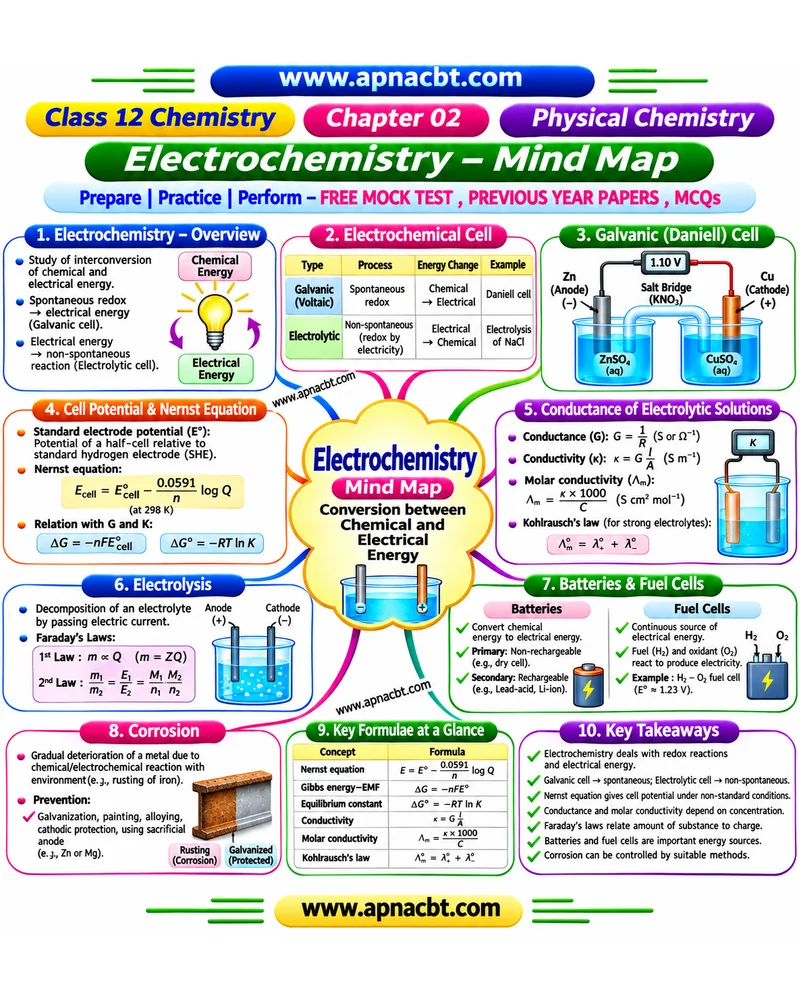
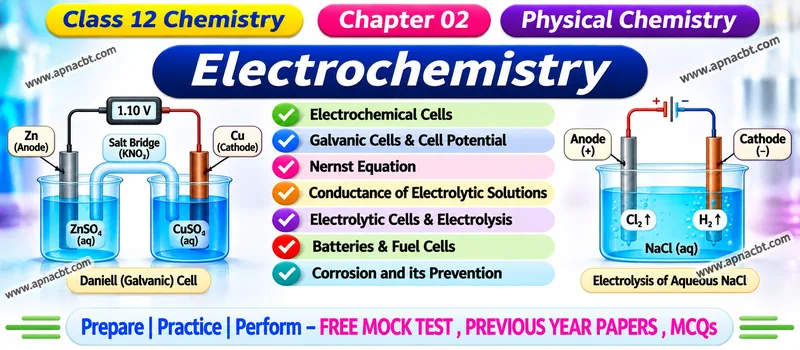
Electrochemistry Class 12 Chemistry connects chemical reactions with electrical energy. Electrochemical cells convert chemical energy into electrical work, while electrolytic cells use electrical energy to drive non-spontaneous chemical reactions. The NCERT chapter begins with the Daniell cell and develops the ideas of oxidation, reduction, electrode potential, cell emf and electrolysis.
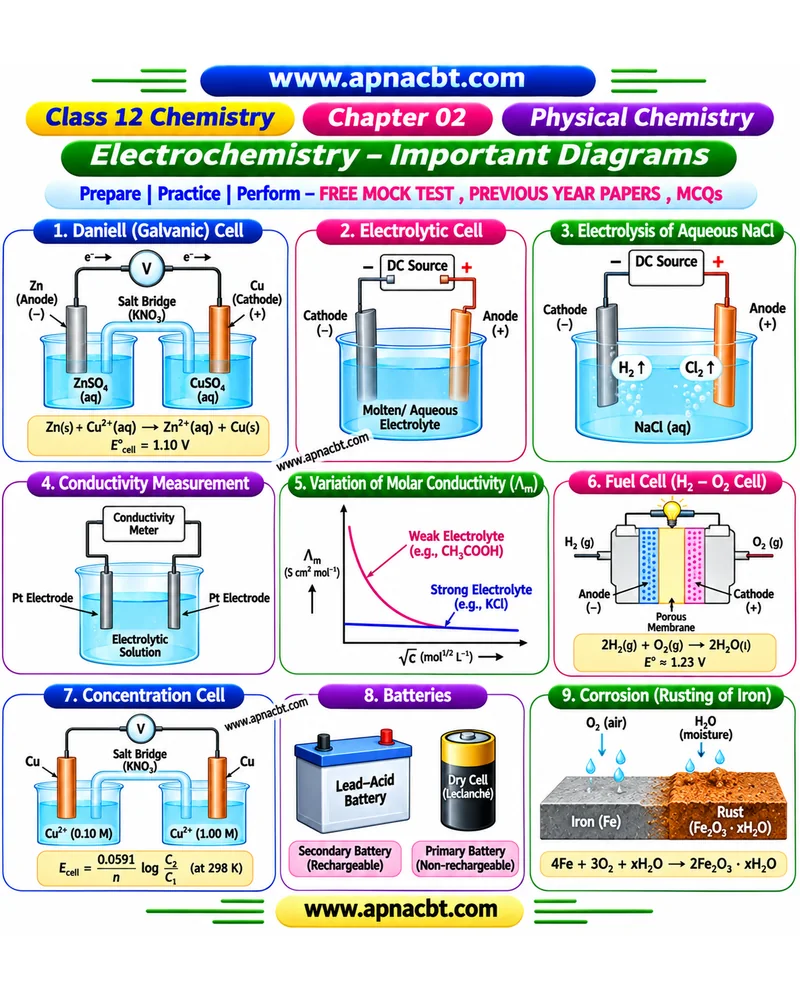
A galvanic or voltaic cell operates through a spontaneous redox reaction. In a Daniell cell, zinc is oxidised at the anode and copper(II) ions are reduced at the cathode:
Zn(s) + Cu2+(aq) → Zn2+(aq) + Cu(s)
Oxidation always occurs at the anode and reduction always occurs at the cathode. In a galvanic cell, the anode is negative and the cathode is positive. Electrons move through the external circuit from anode to cathode.
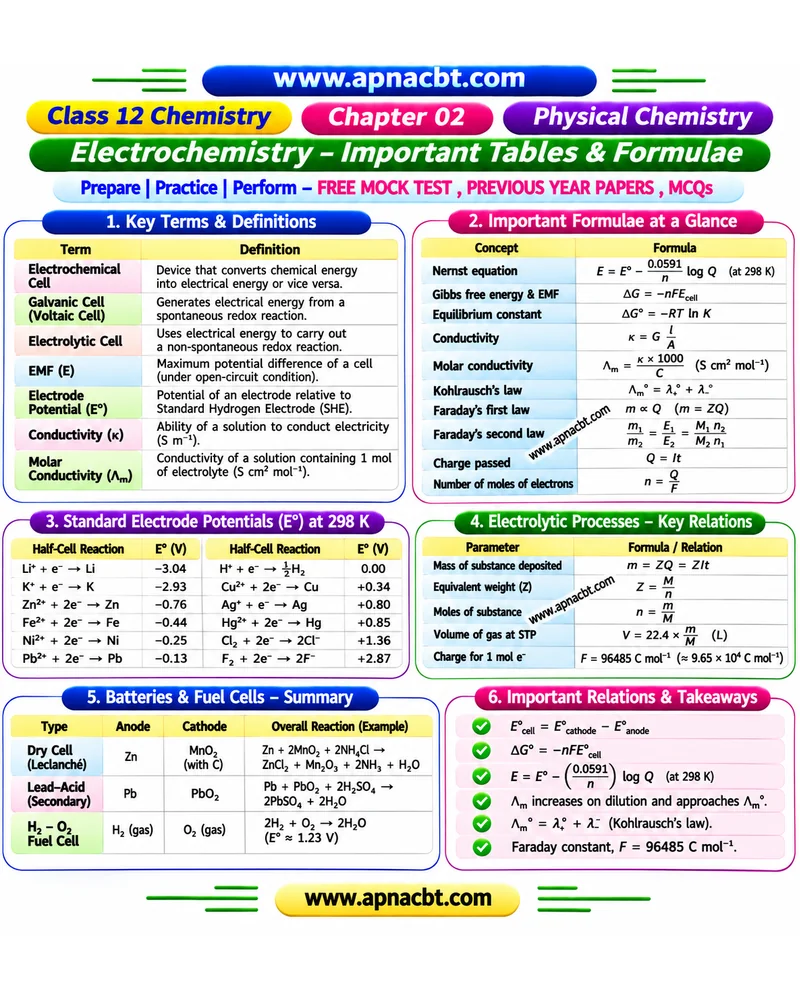
Galvanic versus Electrolytic Cell
| Feature | Galvanic cell | Electrolytic cell |
|---|---|---|
| Energy conversion | Chemical → electrical | Electrical → chemical |
| Reaction | Spontaneous | Non-spontaneous |
| Anode | Negative | Positive |
| Cathode | Positive | Negative |
| Oxidation | At anode | At anode |
| Reduction | At cathode | At cathode |
Exam focus: The signs of electrodes change between galvanic and electrolytic cells, but the locations of oxidation and reduction do not.
2. Galvanic Cells, Salt Bridge and Cell Representation
A galvanic cell contains two half-cells connected externally by a conducting wire and internally by an electrolyte connection such as a salt bridge. Each half-cell contains an electrode and an electrolyte. The salt bridge completes the internal circuit and helps maintain electrical neutrality.
Functions of the Salt Bridge
- Completes the electrical circuit between the two half-cells.
- Maintains electrical neutrality by migration of ions.
- Minimises direct mixing of the two electrolytes.
- Helps reduce liquid junction potential.
The conventional cell representation keeps the anode on the left and cathode on the right. A single vertical line represents the electrode–electrolyte interface, while a double vertical line represents the salt bridge:
Zn(s) | Zn2+(aq) || Cu2+(aq) | Cu(s)
For a galvanic cell, the cell potential is calculated from reduction potentials:
Ecell = Ecathode − Eanode
When no current is drawn, the cell potential is called the emf of the cell. A positive Ecell indicates a thermodynamically feasible spontaneous cell reaction under the stated conditions.
3. Electrode Potential and Standard Hydrogen Electrode
When a metal is dipped in a solution containing its ions, a potential difference develops at the metal–solution interface. This is called the electrode potential. Absolute electrode potential cannot be measured directly; only a difference between two half-cell potentials can be measured.
Standard Hydrogen Electrode
The standard hydrogen electrode (SHE) is the reference electrode assigned a standard potential of 0.00 V. It consists of platinum in contact with hydrogen gas at about 1 bar and hydrogen ions at unit activity under standard conditions. The reference half-reaction is:
2H+(aq) + 2e− → H2(g)
By coupling an unknown half-cell with the SHE, its standard reduction potential can be determined. A positive standard reduction potential means the oxidised species has a greater tendency to accept electrons relative to the H+/H2 reference couple.
Using Standard Electrode Potentials
A more positive reduction potential generally corresponds to a stronger oxidising tendency of the oxidised form. A more negative reduction potential generally corresponds to a stronger reducing tendency of the reduced form. These values help predict cell emf, feasibility of redox reactions and relative oxidising or reducing strength.
4. Nernst Equation and Cell Potential
Electrochemistry Class 12 Chemistry – Nernst Equation Focus
Standard electrode potentials apply under standard conditions. When concentrations or pressures differ from standard conditions, the electrode potential changes. The Nernst equation expresses this concentration dependence.
For a general cell reaction involving reaction quotient Q:
Ecell = E°cell − (RT/nF) ln Q
At 298 K, the equation is commonly written as:
Ecell = E°cell − (0.0591/n) log Q
Here, n is the number of electrons transferred in the balanced redox reaction, R is the gas constant, T is temperature in kelvin and F is the Faraday constant.
Daniell Cell Example
For Zn(s) + Cu2+(aq) → Zn2+(aq) + Cu(s), the reaction quotient is:
Q = [Zn2+]/[Cu2+]
Therefore:
Ecell = E°cell − (0.0591/2) log([Zn2+]/[Cu2+])
Solids do not appear in Q because their activities are taken as unity. This is a frequent numerical and conceptual point for CBSE and NEET.
5. Electrochemistry Class 12 Chemistry – Gibbs Energy and Equilibrium
The electrical work obtainable from a galvanic cell is related to the Gibbs energy change of the cell reaction. For a reversible cell:
ΔrG = −nFEcell
Under standard conditions:
ΔrG° = −nFE°cell
Thus, a positive E°cell corresponds to a negative ΔG° and indicates spontaneity under standard conditions.
Relation with Equilibrium Constant
Thermodynamics also gives:
ΔG° = −RT ln K
Combining the two relations gives:
E°cell = (RT/nF) ln K
At 298 K:
E°cell = (0.0591/n) log K
At equilibrium, Ecell becomes zero and the reaction quotient becomes the equilibrium constant K. These relationships allow equilibrium constants to be calculated from electrochemical measurements.
6. Conductance, Resistance, Resistivity and Conductivity
Electrolytic solutions conduct electricity through the movement of ions. The resistance R of a conductor depends on its length and cross-sectional area:
R = ρl/A
Here, ρ is resistivity. The inverse of resistance is conductance:
G = 1/R
The inverse of resistivity is conductivity, represented by κ:
κ = 1/ρ = l/(RA)
The conductivity of an electrolyte depends on the nature of electrolyte, solvent, concentration, temperature and ionic mobility. Ionic conductance differs from metallic conductance because ions move through the solution while electrons are the charge carriers in metals.
Cell Constant
The ratio l/A is called the cell constant. Hence:
κ = cell constant / R
Conductivity is commonly expressed in S cm−1 or S m−1. Unit conversions must be handled carefully in numerical problems.
7. Molar Conductivity and Variation with Concentration
Molar conductivity, Λm, is the conductance of the volume of solution containing one mole of electrolyte placed between electrodes of suitable dimensions. It is related to conductivity and concentration by:
Λm = κ × 1000/c
when κ is expressed in S cm−1 and c in mol L−1. The unit is S cm2 mol−1.
Effect of Dilution
Conductivity generally decreases on dilution because the number of ions per unit volume decreases. In contrast, molar conductivity increases because ions experience less interionic interaction and ionic mobility increases.
For strong electrolytes, molar conductivity increases gradually with dilution and approaches a limiting value at infinite dilution, Λ°m. For weak electrolytes, the increase is much sharper because dilution increases ionisation substantially.
For a strong electrolyte, the limiting behaviour is commonly represented by:
Λm = Λ°m − K√c
8. Kohlrausch Law and Its Applications
Kohlrausch’s law of independent migration of ions states that at infinite dilution each ion contributes independently to the total molar conductivity of an electrolyte.
Λ°m = ν+λ°+ + ν−λ°−
Here ν values are the stoichiometric numbers of cations and anions, and λ° values are the limiting ionic conductivities.
Important Applications
- Calculation of Λ°m for weak electrolytes using data from strong electrolytes.
- Determination of degree of dissociation of weak electrolytes.
- Estimation of dissociation constants when concentration and limiting conductivity are known.
- Calculation of the limiting ionic conductivity of individual ions when suitable data are available.
For a weak electrolyte, an approximate degree of dissociation can be obtained from:
α = Λm/Λ°m
For a weak acid HA of concentration c:
Ka = cα2/(1 − α)
9. Electrolytic Cells, Faraday’s Laws and Electrolysis
In an electrolytic cell, an external electrical source drives a non-spontaneous reaction. Oxidation occurs at the anode and reduction occurs at the cathode. In an electrolytic cell, the anode is connected to the positive terminal and the cathode to the negative terminal.
Faraday’s Laws
First law: The amount of chemical change at an electrode is proportional to the quantity of electricity passed.
Second law: When the same quantity of electricity passes through different electrolytes, the masses of substances liberated are proportional to their chemical equivalent masses.
The charge passed is:
Q = It
One Faraday is approximately 96500 C mol−1 and corresponds to the charge carried by one mole of electrons.
Useful Mass Relation
For deposition of a species requiring n electrons:
m = (MIt)/(nF)
where M is molar mass. In numerical problems, first write the balanced electrode reaction and determine n before substituting values.
10. Products of Electrolysis and Industrial Applications
The products of electrolysis depend on the ions present, their relative discharge tendencies, electrode material, concentration and overpotential. Inert electrodes such as platinum mainly provide a surface for electron transfer, whereas reactive electrodes can participate in the reaction.
Aqueous versus Molten Electrolysis
Molten NaCl contains Na+ and Cl−, so electrolysis gives sodium at the cathode and chlorine at the anode. Aqueous NaCl also contains water, so competing electrode reactions must be considered. In the chlor-alkali process, aqueous sodium chloride can produce sodium hydroxide, hydrogen and chlorine.
Electrorefining
In copper electrorefining, impure copper is used as the anode and pure copper is deposited at the cathode. The process uses electrochemical oxidation and reduction to obtain high-purity copper.
NEET approach: identify all possible oxidising and reducing species, compare their electrode potentials, and remember that kinetic factors such as overpotential can influence the actual products.
11. Batteries – Primary and Secondary Cells
Batteries are practical sources of electrical energy based on galvanic cell reactions. A useful battery should be reasonably light and compact and should provide a suitable voltage with reliable operation.
Primary Cells
Primary cells are not designed for repeated recharging. The dry cell, or Leclanché cell, uses a zinc container as anode, a carbon rod as cathode and a paste containing ammonium chloride and zinc chloride as electrolyte. A mercury cell uses zinc–mercury amalgam and mercury(II) oxide with alkaline electrolyte.
Secondary Cells
Secondary cells can be recharged by passing current in the reverse direction. The lead storage battery is a major example. It contains lead, lead dioxide and sulfuric acid. During discharge:
Pb + PbO2 + 2H2SO4 → 2PbSO4 + 2H2O
On charging, the overall reaction is reversed. Nickel–cadmium is another rechargeable cell discussed in the NCERT chapter.
12. Fuel Cells, Corrosion and Hydrogen Economy
Fuel Cells
Fuel cells convert the chemical energy of continuously supplied fuels directly into electrical energy. The hydrogen–oxygen fuel cell uses hydrogen and oxygen and produces water:
2H2(g) + O2(g) → 2H2O(l)
The NCERT description gives an alkaline hydrogen–oxygen cell with porous carbon electrodes and a concentrated sodium hydroxide electrolyte. Fuel cells can operate continuously as long as reactants are supplied.
Corrosion
Corrosion is an electrochemical process in which a metal is oxidised. In rusting of iron, anodic regions produce Fe2+, while cathodic regions reduce oxygen in the presence of water and hydrogen ions. Further oxidation and hydration produce rust.
Corrosion can be reduced by barrier coatings, protective metallic coatings and sacrificial protection. Zinc or magnesium can act as sacrificial metals because they oxidise preferentially and protect the iron surface.
Hydrogen Economy
Hydrogen is discussed in the chapter as a potential renewable and non-polluting energy carrier when produced using renewable energy. Electrolysis of water and hydrogen fuel cells are both based on electrochemical principles.
13. Complete Chapter Revision – Formulae, Comparisons and Exam Strategy
Essential Formula Sheet
| Concept | Formula / Key point |
|---|---|
| Cell potential | Ecell = Ecathode − Eanode |
| Gibbs energy | ΔG = −nFE |
| Equilibrium | ΔG° = −RT ln K |
| Standard cell relation | E° = (0.0591/n) log K at 298 K |
| Nernst equation | E = E° − (0.0591/n) log Q at 298 K |
| Resistance | R = ρl/A |
| Conductance | G = 1/R |
| Conductivity | κ = 1/ρ = l/(RA) |
| Molar conductivity | Λm = κ × 1000/c |
| Charge | Q = It |
| Electrolysis | m = MIt/(nF) |
| Faraday constant | F ≈ 96500 C mol−1 |
High-Yield Comparisons
- Anode: oxidation in both galvanic and electrolytic cells.
- Cathode: reduction in both types of cells.
- Conductivity: generally decreases on dilution.
- Molar conductivity: increases on dilution.
- Primary battery: not designed for recharging.
- Secondary battery: rechargeable.
For Electrochemistry Class 12 Chemistry, CBSE preparation should emphasise definitions, derivations, equations, cell diagrams and explanations, while NEET preparation should add rapid formula recall, electrode-potential comparisons and numerical practice.
For further APNA CBT learning resources, visit APNA CBT and use the site’s available chemistry practice resources. You can also return to the APNA CBT home page to access current exam practice content.
Authoritative reference: For the prescribed NCERT chemistry text, refer to the NCERT Textbooks portal.
14. Short-Answer Questions – 30 Questions with Detailed Answers
30 Short Questions with Detailed Answers
- What is electrochemistry?
Answer: Electrochemistry is the study of the relationship between chemical reactions and electrical energy, including the production of electricity by spontaneous redox reactions and the use of electricity to drive non-spontaneous reactions.
- What is a galvanic cell?
Answer: A galvanic or voltaic cell converts the chemical energy of a spontaneous redox reaction into electrical energy.
- What is an electrolytic cell?
Answer: An electrolytic cell uses electrical energy from an external source to drive a non-spontaneous chemical reaction.
- Where does oxidation occur?
Answer: Oxidation occurs at the anode in both galvanic and electrolytic cells.
- Where does reduction occur?
Answer: Reduction occurs at the cathode in both galvanic and electrolytic cells.
- What is the sign of the anode in a galvanic cell?
Answer: The anode is negative in a galvanic cell because oxidation releases electrons there.
- What is the function of a salt bridge?
Answer: A salt bridge completes the internal circuit, maintains electrical neutrality and helps minimise direct mixing and liquid junction potential.
- What is electrode potential?
Answer: Electrode potential is the potential difference developed between an electrode and the electrolyte when they are in contact.
- What is the standard hydrogen electrode?
Answer: The standard hydrogen electrode is a reference half-cell assigned a standard electrode potential of 0.00 V under standard conditions.
- Write the expression for cell potential.
Answer: For reduction potentials, Ecell = Ecathode − Eanode.
- What is emf of a cell?
Answer: The cell potential measured when no current is drawn from the cell is called the electromotive force or emf.
- What is the Nernst equation at 298 K?
Answer: Ecell = E°cell − (0.0591/n) log Q.
- What is the reaction quotient?
Answer: Q is the ratio of activities or concentrations of products to reactants, each raised to its stoichiometric coefficient; pure solids and liquids are omitted.
- State the Gibbs energy relation for a cell.
Answer: For a reversible cell, ΔG = −nFEcell.
- What is the relation between E° and K at 298 K?
Answer: E°cell = (0.0591/n) log K.
- Define conductance.
Answer: Conductance is the reciprocal of resistance: G = 1/R, and its SI unit is siemens.
- Define resistivity.
Answer: Resistivity is the proportionality constant in R = ρl/A and is a measure of the resistance of a material of unit length and unit cross-sectional area.
- Define conductivity.
Answer: Conductivity is the reciprocal of resistivity and represents the conductance of a material of unit length and unit cross-sectional area.
- What is cell constant?
Answer: Cell constant is the ratio l/A for a conductivity cell.
- Define molar conductivity.
Answer: Molar conductivity is the conductance of the volume of solution containing one mole of electrolyte, expressed by Λm = κ × 1000/c when suitable units are used.
- How does conductivity change on dilution?
Answer: Conductivity generally decreases on dilution because the number of ions per unit volume decreases.
- How does molar conductivity change on dilution?
Answer: Molar conductivity increases on dilution because ionic mobility increases and interionic interactions decrease.
- State Kohlrausch’s law.
Answer: At infinite dilution, each ion contributes independently to the total molar conductivity of an electrolyte.
- State Faraday’s first law.
Answer: The mass of substance liberated at an electrode is directly proportional to the quantity of electricity passed through the electrolyte.
- What is one Faraday?
Answer: One Faraday is approximately 96500 coulombs, corresponding to the charge on one mole of electrons.
- What is a primary battery?
Answer: A primary battery is designed for use without repeated recharging because its cell reaction is effectively irreversible under normal use.
- What is a secondary battery?
Answer: A secondary battery can be recharged by passing current in the reverse direction, restoring the reactants.
- What is a fuel cell?
Answer: A fuel cell is a galvanic cell in which fuel and oxidant are supplied continuously and their chemical energy is converted directly into electrical energy.
- What is corrosion?
Answer: Corrosion is the gradual deterioration of a metal through chemical or electrochemical reactions with its environment.
- How can corrosion be prevented?
Answer: Corrosion can be reduced by barrier coatings, protective metallic coatings and sacrificial protection using a more easily oxidised metal.
15. Long-Answer Questions – 15 Questions with Detailed Answers
15 Long Questions with Detailed Answers
- Explain the construction and working of a Daniell cell.
Answer: A Daniell cell consists of a zinc electrode immersed in ZnSO4 solution and a copper electrode immersed in CuSO4 solution. The half-cells are connected externally and internally through a salt bridge. Zinc undergoes oxidation at the anode: Zn → Zn2+ + 2e−. Copper ions undergo reduction at the cathode: Cu2+ + 2e− → Cu. Electrons flow through the external circuit from zinc to copper. The overall reaction is Zn + Cu2+ → Zn2+ + Cu. The cell converts chemical energy into electrical energy.
- Differentiate between galvanic and electrolytic cells.
Answer: A galvanic cell produces electrical energy from a spontaneous redox reaction, whereas an electrolytic cell consumes electrical energy to drive a non-spontaneous reaction. The galvanic anode is negative and cathode positive; in an electrolytic cell the anode is positive and cathode negative. Oxidation nevertheless occurs at the anode and reduction at the cathode in both.
- Explain electrode potential and the standard hydrogen electrode.
Answer: When an electrode contacts an electrolyte, a potential difference develops at the interface because of competing tendencies of ions to leave or enter the electrode. This is electrode potential. Since an absolute half-cell potential cannot be measured, a reference electrode is required. The standard hydrogen electrode is assigned zero potential and consists of platinum, hydrogen gas at standard pressure and hydrogen ions under standard conditions. Coupling an unknown half-cell to the SHE permits determination of its standard reduction potential.
- Derive the relation between standard Gibbs energy and cell emf.
Answer: For a reversible electrochemical cell, the maximum electrical work is nFE. The Gibbs energy change equals the negative of maximum non-expansion work. Therefore ΔG = −nFE. Under standard conditions, ΔG° = −nFE°. A positive E° therefore corresponds to a negative ΔG° and a spontaneous cell reaction under standard conditions.
- Derive the relation between E°cell and equilibrium constant.
Answer: Thermodynamics gives ΔG° = −RT ln K, while electrochemistry gives ΔG° = −nFE°. Equating these expressions gives nFE° = RT ln K, so E° = (RT/nF) ln K. At 298 K, E° = (0.0591/n) log K. This relation shows that a large positive standard cell potential corresponds to a large equilibrium constant.
- Explain the Nernst equation and its significance.
Answer: The Nernst equation describes how electrode or cell potential changes with composition. For a cell reaction with reaction quotient Q, Ecell = E°cell − (RT/nF) ln Q. At 298 K, Ecell = E°cell − (0.0591/n) log Q. It is used to calculate cell emf under non-standard conditions, determine ion concentrations and understand the approach to equilibrium.
- Define resistance, conductance, resistivity and conductivity and relate them.
Answer: Resistance is the opposition to current flow and follows R = ρl/A. Conductance is its reciprocal, G = 1/R. Resistivity ρ is the reciprocal of conductivity. Conductivity κ is given by κ = 1/ρ = l/(RA). Conductance is measured in siemens, resistivity in ohm metre and conductivity in siemens per metre in SI units.
- Explain the variation of conductivity and molar conductivity with dilution.
Answer: On dilution, the number of ions per unit volume decreases, so conductivity generally decreases. Molar conductivity, however, increases because the volume containing one mole becomes larger and ionic mobility increases as interionic interactions decrease. Strong electrolytes show a gradual increase in molar conductivity, whereas weak electrolytes show a much sharper increase because dilution increases their ionisation.
- State Kohlrausch’s law and explain two applications.
Answer: Kohlrausch’s law states that at infinite dilution, each ion migrates independently and contributes a definite amount to molar conductivity. Thus Λ°m is the sum of ionic contributions. The law is used to calculate limiting molar conductivity of weak electrolytes from strong-electrolyte data and to determine degree of dissociation and dissociation constants of weak electrolytes.
- State and explain Faraday’s laws of electrolysis.
Answer: Faraday’s first law states that the mass of substance liberated is proportional to the quantity of electricity passed. Faraday’s second law states that, for the same quantity of electricity, masses of different substances liberated are proportional to their equivalent masses. Since Q = It, the deposited mass can be calculated from m = MIt/(nF).
- Explain the factors affecting products of electrolysis.
Answer: Products depend on the ions present, their electrode potentials, concentration, electrode nature and kinetic factors such as overpotential. Inert electrodes do not normally participate, while reactive electrodes can be oxidised or reduced. In aqueous solutions, water may compete with dissolved ions. Therefore the most thermodynamically favourable reaction is not always the only factor controlling the observed product.
- Describe the construction and working of a lead storage battery.
Answer: The lead storage battery is a rechargeable secondary cell. It has lead as the negative electrode, lead dioxide packed on a lead grid as the positive electrode and sulfuric acid as electrolyte. During discharge, Pb is oxidised to PbSO4 and PbO2 is reduced to PbSO4. The overall reaction is Pb + PbO2 + 2H2SO4 → 2PbSO4 + 2H2O. Charging reverses the reaction and regenerates Pb and PbO2.
- Explain the hydrogen–oxygen fuel cell.
Answer: In the alkaline hydrogen–oxygen fuel cell, hydrogen and oxygen are supplied continuously to porous electrodes in alkaline electrolyte. Hydrogen is oxidised at the anode and oxygen is reduced at the cathode. The overall reaction is 2H2 + O2 → 2H2O. Because reactants are continuously supplied, the cell can operate continuously and produces water as the overall product.
- Explain corrosion of iron as an electrochemical process and give prevention methods.
Answer: At anodic regions of iron, Fe is oxidised to Fe2+ and releases electrons. These electrons travel through the metal to cathodic regions where oxygen is reduced in the presence of water and hydrogen ions. Further oxidation and hydration produce rust. Corrosion can be reduced by painting or other barrier coatings, coating with protective metals and using sacrificial anodes such as zinc or magnesium.
- Write a comprehensive exam strategy for Electrochemistry.
Answer: For CBSE, learn definitions, derivations, cell notation, standard electrode potentials, Nernst equation, conductance relations, Kohlrausch law, Faraday laws and battery reactions. For NEET, practise quick identification of anode/cathode, signs, oxidation/reduction, Nernst numericals, E°–K–ΔG relations, conductivity calculations and electrolysis stoichiometry. Always balance the redox reaction before deciding n, and check units before numerical substitution.