Chapter 09: Ray Optics and Optical Instruments
Ray Optics and Optical Instruments is an important Class 12 Physics chapter for CBSE Board Exams and NEET preparation. Learn reflection, refraction, mirrors, lenses, prism, total internal reflection and optical instruments.
This NCERT-based Level 01 lesson builds the concepts required before chapter-wise practice, previous year questions and mock tests. The lesson emphasises definitions, sign conventions, formulae, ray diagrams, derivations, numerical applications and high-frequency exam concepts.
Table of Contents
- Ray Optics and Optical Instruments – Introduction and Exam Focus
- Reflection of Light by Spherical Mirrors
- Cartesian Sign Convention and Mirror Image Formation
- Refraction of Light and Snell’s Law
- Total Internal Reflection, Critical Angle and Optical Fibre
- Refraction at Spherical Surfaces and Lenses
- Combination of Lenses and Power
- Refraction Through a Prism and Minimum Deviation
- Dispersion of Light and Atmospheric Refraction
- Optical Instruments – Human Eye and Simple Microscope
- Compound Microscope and Astronomical Telescope
- Quick Revision – Formulae, Comparisons and Common Mistakes
- 30 Short Questions – Ray Optics and Optical Instruments
- 15 Long Questions – Ray Optics and Optical Instruments
Related APNA CBT resources: APNA CBT Physics Preparation | Class 12 Physics Practice | APNA CBT Mock Tests
Official resources: NCERT Physics – Ray Optics and Optical Instruments | CBSE Academic
Ray Optics and Optical Instruments – Introduction and Exam Focus
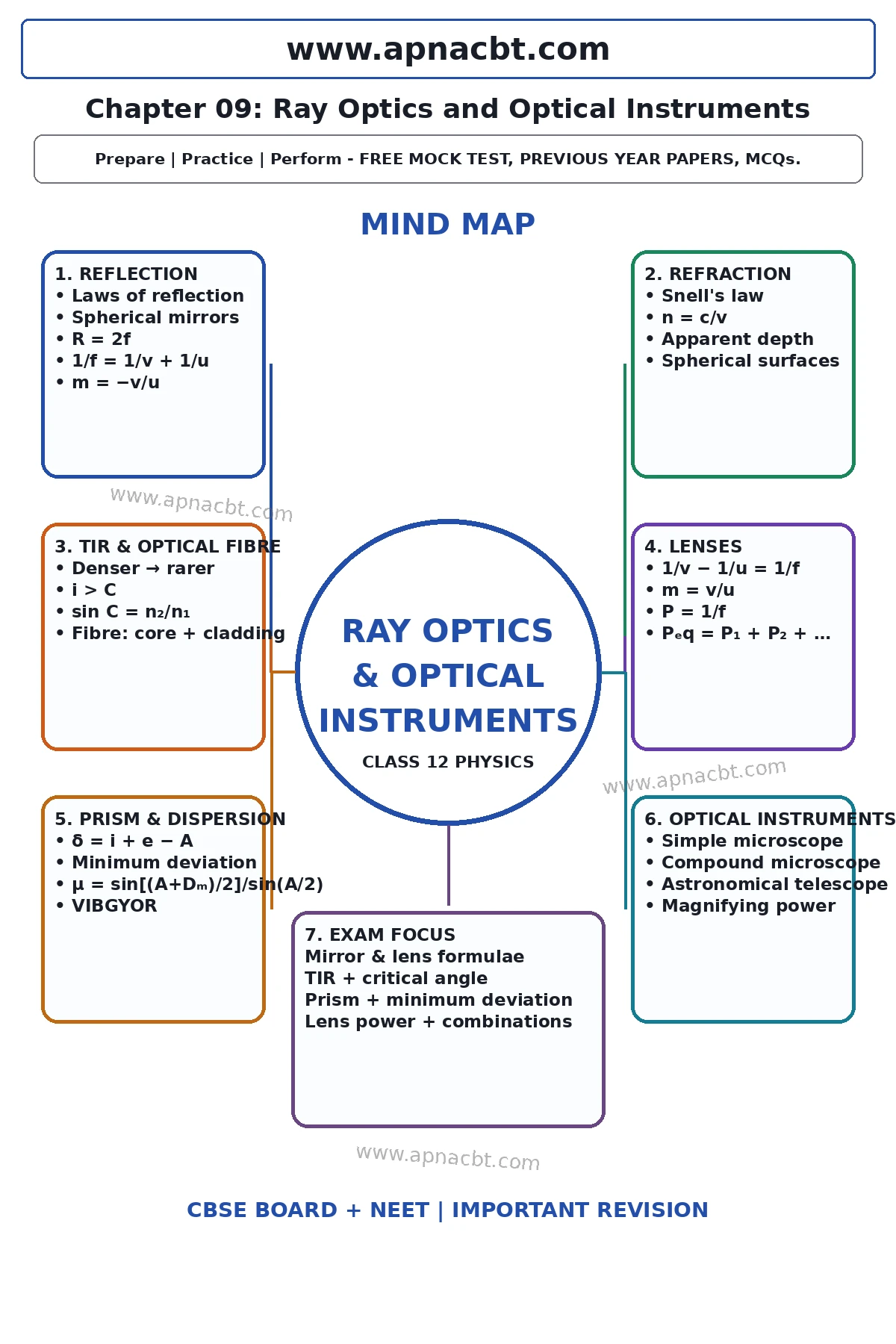
Ray Optics and Optical Instruments is a high-value Class 12 Physics chapter covering reflection, refraction, image formation, total internal reflection, lenses, prisms, dispersion and optical instruments. NCERT develops the chapter using the ray picture of light and applies the laws of reflection and refraction to mirrors, spherical surfaces and lenses.
For CBSE Board Exams, focus on sign conventions, mirror and lens formulae, derivations, ray diagrams, total internal reflection, prism relations, optical instruments and standard numerical problems. For NEET, prioritise direct formula applications, image nature, magnification, refractive index, critical angle, lens combinations and instrument magnifying power.
Use this Level 01 lesson as the preparation stage before chapter-wise MCQs, previous year questions and mock tests. Keep the formulae and ray diagrams together during revision.
Reflection of Light by Spherical Mirrors
Reflection is the return of light into the same medium after it strikes a reflecting surface. The angle of incidence equals the angle of reflection, and the incident ray, reflected ray and normal at the point of incidence lie in the same plane.
A spherical mirror is a part of a hollow sphere. A concave mirror has its reflecting surface on the inner side, while a convex mirror has its reflecting surface on the outer side. Important terms are pole, centre of curvature, radius of curvature, principal axis, principal focus and focal length.
For paraxial rays, the focal length f of a spherical mirror is related to the radius of curvature R by R = 2f. The mirror formula is 1/v + 1/u = 1/f, using the Cartesian sign convention. Lateral magnification is m = h_i/h_o = -v/u.
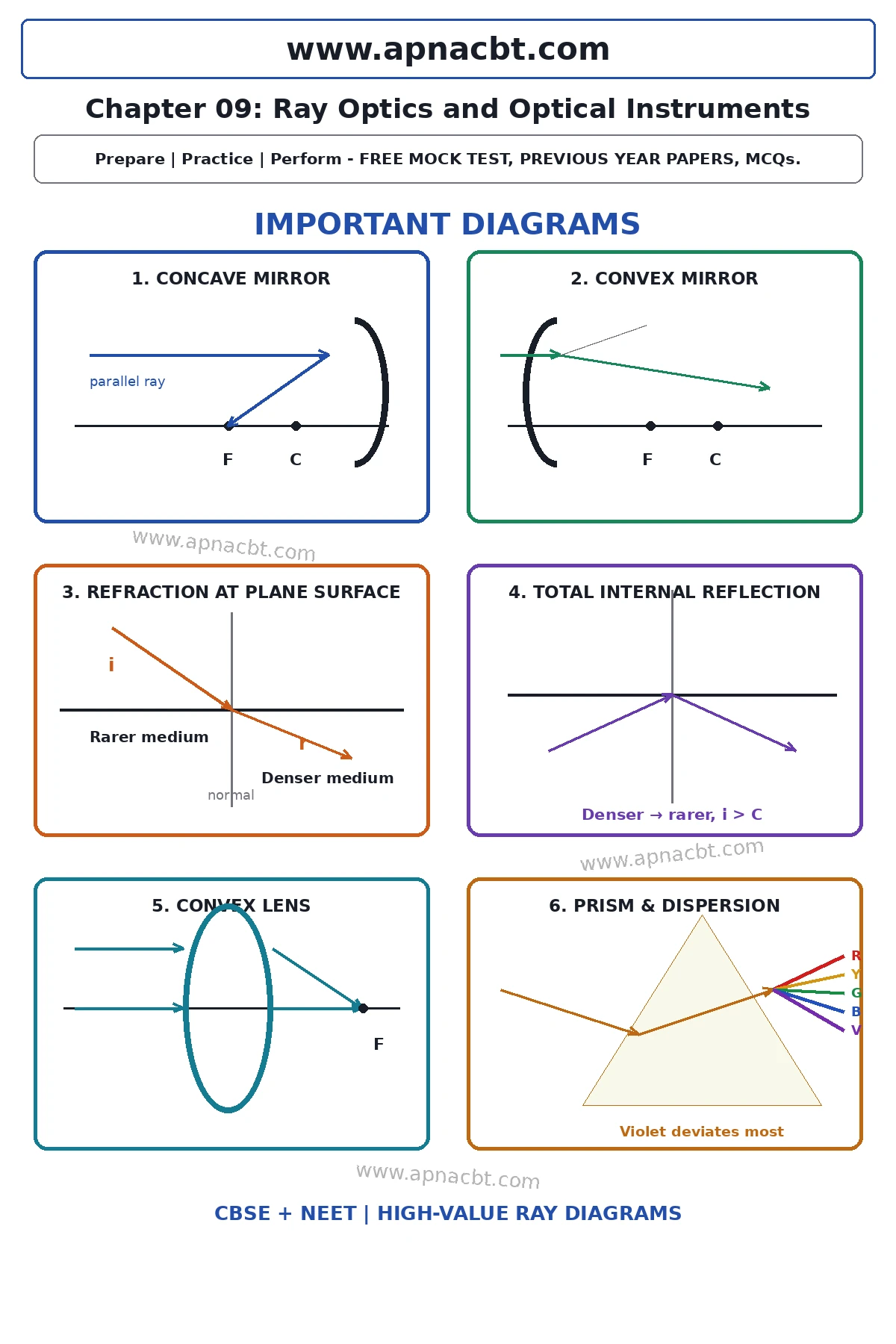
Ray-diagram rules are essential: a ray parallel to the principal axis passes through the focus after reflection from a concave mirror; a ray through the centre of curvature retraces its path; and a ray through the focus emerges parallel to the principal axis. These rules help locate real and virtual images quickly.
Cartesian Sign Convention and Mirror Image Formation
In the Cartesian sign convention used by NCERT, distances are measured from the pole of a mirror or optical centre of a lens. Distances measured in the direction of incident light are positive and those opposite to it are negative. Heights above the principal axis are positive and heights below it are negative.
A concave mirror can form real, inverted and magnified images when the object is between the focus and centre of curvature, while an object beyond the centre of curvature gives a diminished real image. When the object lies between the pole and focus, the image is virtual, erect and magnified.
A convex mirror always forms a virtual, erect and diminished image for a real object. This is why convex mirrors are useful as rear-view mirrors: they provide an erect image with a wider field of view.
Refraction of Light and Snell’s Law
Refraction is the change in direction of light when it passes obliquely from one transparent medium to another because its speed changes. The incident ray, refracted ray and normal lie in the same plane. Snell's law states sin i / sin r = n21, where n21 is the refractive index of the second medium relative to the first.
When light travels from an optically rarer medium to a denser medium, it bends towards the normal. When it travels from a denser medium to a rarer medium, it bends away from the normal. At normal incidence, the direction does not change even though the speed and wavelength can change.
The absolute refractive index of a medium is n = c/v, where c is the speed of light in vacuum and v is its speed in the medium. Refractive index also depends on wavelength, which becomes important in dispersion.
Total Internal Reflection, Critical Angle and Optical Fibre
Total internal reflection occurs when light travels from an optically denser medium to a rarer medium and the angle of incidence is greater than the critical angle. At the critical angle, the refracted ray grazes the interface and the angle of refraction is 90°.
For a denser medium of refractive index n1 and a rarer medium of refractive index n2, sin C = n2/n1 when the rarer medium is air-like with the appropriate reference. The two necessary conditions are propagation from denser to rarer medium and an angle of incidence greater than the critical angle.
Optical fibres use repeated total internal reflection to guide light through a thin transparent core. They are used in communication, medical endoscopy and other applications where light must be transmitted over long paths with low loss.
Refraction at Spherical Surfaces and Lenses
Refraction at a spherical surface is the extension of plane-interface refraction to a curved boundary. For refraction from medium 1 to medium 2, NCERT gives the spherical-surface relation n2/v − n1/u = (n2 − n1)/R, with the adopted sign convention.
A thin lens is a transparent optical medium bounded by two surfaces, at least one of which is spherical. A convex lens is converging for the usual surrounding medium, while a concave lens is diverging. The thin-lens formula is 1/v − 1/u = 1/f.
The lens maker's formula is 1/f = (n2 − n1)/n1 (1/R1 − 1/R2). Lens magnification is m = h_i/h_o = v/u. The power of a lens is P = 1/f when f is measured in metres, and the SI unit is dioptre (D).
Combination of Lenses and Power
For thin lenses in contact, the effective focal length is given by 1/f = 1/f1 + 1/f2 + 1/f3 + … . The corresponding powers add algebraically: P = P1 + P2 + P3 + … .
A positive focal length corresponds to a converging lens in the usual convention, while a negative focal length corresponds to a diverging lens. When several lenses are separated, the image formed by one lens acts as the object for the next lens, so image formation is handled sequentially.
Combination-of-lenses problems are important in Ray Optics and Optical Instruments for both CBSE numericals and NEET. Always maintain the Cartesian sign convention and carefully identify whether the intermediate image is real or virtual for the next lens.
Refraction Through a Prism and Minimum Deviation
A prism is a transparent refracting medium bounded by two plane surfaces inclined to each other. The angle between the two refracting surfaces is the prism angle A. The angle through which the emergent ray is deviated from its original direction is called the angle of deviation δ.
At minimum deviation, the path of the ray through a prism is symmetrical, so the angle of incidence equals the angle of emergence and the two internal refraction angles are equal. For a prism of refractive index n in air, n = sin[(A + Dm)/2] / sin(A/2), where Dm is the minimum deviation.
For a thin prism, the deviation is approximately δ = (n − 1)A. These relations are frequently used in board derivations and numerical questions.
Dispersion of Light and Atmospheric Refraction
Dispersion is the splitting of white light into its constituent colours when it passes through a prism. The refractive index of a material depends on wavelength, so different colours deviate by different amounts. In normal dispersion, shorter wavelengths generally have larger refractive indices and are deviated more strongly.
Violet is deviated more than red in a glass prism. The familiar sequence of colours is remembered as VIBGYOR. Dispersion explains the formation of spectra and contributes to natural phenomena such as the rainbow.
Atmospheric refraction occurs because the atmosphere consists of layers with gradually varying optical properties. It explains effects such as the apparent advance of sunrise and delay of sunset and the reddish appearance of the Sun near the horizon.
Optical Instruments – Human Eye and Simple Microscope
Optical instruments use reflection and refraction to form enlarged or otherwise useful images. The human eye is a natural optical instrument. The eye lens forms a real, inverted image on the retina, and accommodation allows the eye to focus objects at different distances.
The least distance of distinct vision for a normal eye is taken as D = 25 cm. A simple microscope or magnifying glass is a converging lens of short focal length. When the final image is at the least distance of distinct vision, magnifying power is M = 1 + D/f. For the final image at infinity, M = D/f.
These expressions make Ray Optics and Optical Instruments especially important for NEET and CBSE numerical problems. The final image is virtual and enlarged in the normal magnifier arrangements described in the chapter.
Compound Microscope and Astronomical Telescope
A compound microscope uses two convex lenses: an objective of short focal length and an eyepiece that provides further angular magnification. The objective forms a real, inverted and enlarged intermediate image, which acts as the object for the eyepiece.
For a compound microscope, the approximate magnifying power is M ≈ (L/f_o)(D/f_e) when the final image is at the least distance of distinct vision, where L is the tube length and f_o and f_e are the focal lengths of the objective and eyepiece.
An astronomical telescope uses an objective of large focal length and an eyepiece of shorter focal length. For normal adjustment, its magnifying power in magnitude is M = f_o/f_e and the final image is at infinity. The objective forms a real, inverted image of the distant object, which is then viewed through the eyepiece.
Quick Revision – Formulae, Comparisons and Common Mistakes
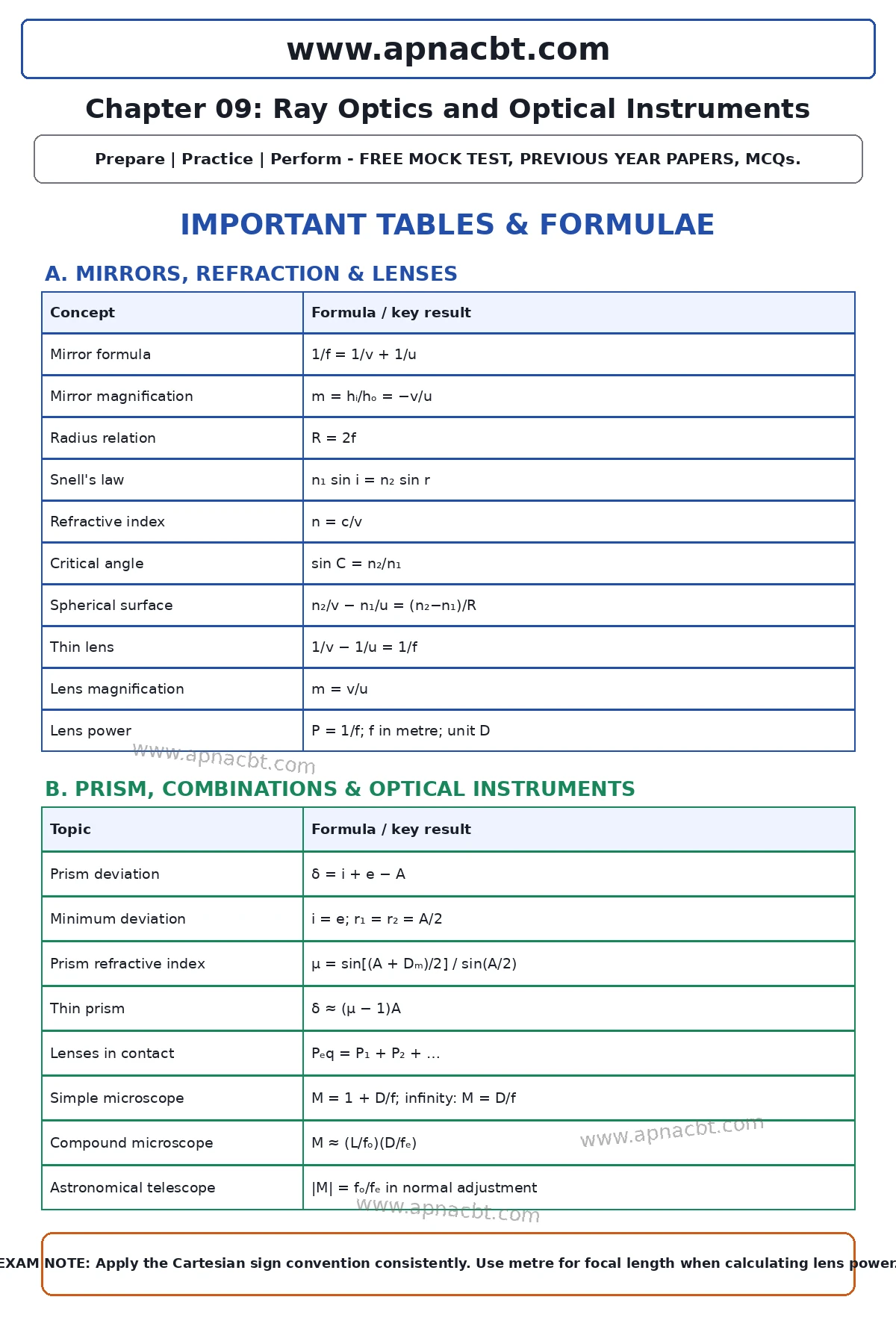
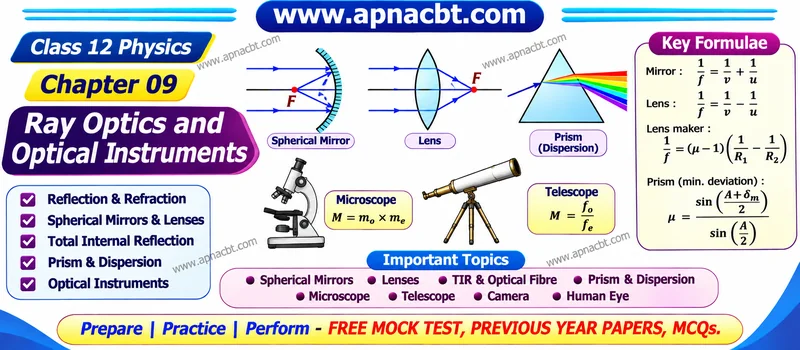
For Ray Optics and Optical Instruments, the most important relations are R = 2f, 1/v + 1/u = 1/f for spherical mirrors, m = -v/u for mirror magnification, sin i/sin r = n21, n = c/v, sin C = n2/n1, n2/v − n1/u = (n2 − n1)/R, 1/v − 1/u = 1/f for a thin lens, m = v/u, P = 1/f, 1/f = 1/f1 + 1/f2 + …, P = P1 + P2 + …, n = sin[(A + Dm)/2]/sin(A/2), and δ ≈ (n − 1)A for a thin prism.
For optical instruments, remember M = 1 + D/f and M = D/f for a simple microscope, M ≈ (L/f_o)(D/f_e) for a compound microscope in the standard near-point case, and M = f_o/f_e in magnitude for an astronomical telescope in normal adjustment.
Common mistakes include mixing mirror and lens sign conventions, using the wrong focal-length sign, forgetting that frequency does not change at refraction, applying total internal reflection when light travels from rarer to denser medium, and confusing magnifying power with linear magnification.
30 Short Questions – Ray Optics and Optical Instruments
These 30 questions revise the definitions, laws, formulae, image formation, total internal reflection, prism and optical instruments for CBSE and NEET preparation.
1. What is a ray of light?
Answer: A ray is the idealised straight-line path along which light travels in the ray picture of optics.
2. State the two laws of reflection.
Answer: The angle of incidence equals the angle of reflection, and the incident ray, reflected ray and normal lie in the same plane.
3. What is a spherical mirror?
Answer: It is a reflecting surface forming part of a hollow sphere.
4. What is the relation between radius of curvature and focal length of a spherical mirror?
Answer: For paraxial rays, R = 2f.
5. Write the mirror formula.
Answer: 1/v + 1/u = 1/f.
6. Write the magnification formula for a spherical mirror.
Answer: m = h_i/h_o = -v/u.
7. What is refraction?
Answer: Refraction is the change in direction of light when it passes between transparent media because its speed changes.
8. State Snell's law.
Answer: sin i/sin r is constant for a given pair of media and equals the relative refractive index.
9. Define absolute refractive index.
Answer: The absolute refractive index is n = c/v, where c is the speed in vacuum and v is the speed in the medium.
10. What is total internal reflection?
Answer: It is complete reflection of light back into a denser medium when it travels toward a rarer medium with incidence angle greater than the critical angle.
11. State the two conditions for total internal reflection.
Answer: Light must travel from denser to rarer medium, and the angle of incidence must exceed the critical angle.
12. Define critical angle.
Answer: It is the angle of incidence in the denser medium for which the angle of refraction in the rarer medium is 90°.
13. What is an optical fibre based on?
Answer: Optical fibres are based on total internal reflection.
14. Write the spherical refraction formula.
Answer: n2/v − n1/u = (n2 − n1)/R.
15. Write the thin lens formula.
Answer: 1/v − 1/u = 1/f.
16. Write the lens maker's formula.
Answer: 1/f = (n2 − n1)/n1 (1/R1 − 1/R2).
17. What is the power of a lens?
Answer: Power is P = 1/f when focal length is measured in metres; its SI unit is dioptre.
18. What is the power of lenses in contact?
Answer: The total power is P = P1 + P2 + P3 + … .
19. What is a prism?
Answer: A prism is a transparent refracting medium bounded by two plane surfaces inclined to each other.
20. What is angle of deviation?
Answer: It is the angle between the original direction of the incident ray and the direction of the emergent ray.
21. Write the prism formula at minimum deviation.
Answer: n = sin[(A + Dm)/2]/sin(A/2), for a prism in air.
22. What is dispersion?
Answer: Dispersion is the splitting of white light into its constituent colours because refractive index depends on wavelength.
23. Which colour deviates most in a glass prism?
Answer: Violet deviates most.
24. Which colour deviates least in a glass prism?
Answer: Red deviates least.
25. What is atmospheric refraction?
Answer: It is refraction caused by gradual changes in the optical properties of the atmosphere along the path of light.
26. What is the least distance of distinct vision for a normal eye?
Answer: It is conventionally taken as 25 cm.
27. Write the magnifying power of a simple microscope for final image at the near point.
Answer: M = 1 + D/f.
28. Write the magnifying power of a simple microscope for final image at infinity.
Answer: M = D/f.
29. What is the magnifying power of an astronomical telescope in normal adjustment?
Answer: Its magnitude is M = f_o/f_e.
30. What is the role of the objective in a compound microscope?
Answer: It forms a real, inverted and magnified intermediate image of the object.
15 Long Questions – Ray Optics and Optical Instruments
These 15 questions focus on derivations, explanations, ray diagrams, formula applications and high-value concepts for board examinations and entrance-test preparation.
1. Explain the laws of reflection and the important terms of a spherical mirror.
Detailed Answer: The angle of incidence equals the angle of reflection, and the incident ray, reflected ray and normal lie in one plane. For a spherical mirror, the pole is the geometric centre of the reflecting surface, the centre of curvature is the centre of the sphere, the radius of curvature is the distance from pole to centre of curvature, the principal axis joins the pole and centre of curvature, and the principal focus is the point where paraxial parallel rays meet or appear to diverge from. For paraxial rays, R = 2f.
2. Derive and explain the mirror formula and magnification.
Detailed Answer: Using standard paraxial ray geometry and similar triangles for a spherical mirror, the image and object distances are related by 1/v + 1/u = 1/f. The lateral magnification is the ratio of image height to object height and, with the Cartesian convention, is m = h_i/h_o = -v/u. The sign of m indicates image orientation, while its magnitude indicates the size ratio.
3. Describe image formation by a concave mirror for different object positions.
Detailed Answer: When the object is beyond C, the image is real, inverted and diminished between C and F. At C, the image is real, inverted and of the same size at C. Between C and F, the image is real, inverted and enlarged beyond C. At F, reflected rays are parallel and the image is effectively at infinity. Between F and P, the image is virtual, erect and enlarged behind the mirror.
4. Explain the image formed by a convex mirror and its applications.
Detailed Answer: A convex mirror causes reflected rays to diverge and their backward extensions meet behind the mirror. For a real object, the image is always virtual, erect and diminished and lies between the pole and focus. The wide field of view makes convex mirrors useful as rear-view and security mirrors.
5. Explain refraction and derive the relation between refractive index and speed.
Detailed Answer: Refraction occurs because the speed of light changes when it enters a different transparent medium. Snell's law gives sin i/sin r = n21. The absolute refractive index is n = c/v, so a larger refractive index corresponds to lower speed of light in the medium. At normal incidence there is no change in direction, although speed and wavelength change.
6. Explain total internal reflection and its applications.
Detailed Answer: Total internal reflection occurs only when light travels from an optically denser medium to a rarer medium and the incidence angle is greater than the critical angle. At critical incidence, the refracted angle is 90°. For the appropriate pair of media, sin C = n2/n1. Optical fibres use repeated total internal reflection to transmit light efficiently and are used in communication and endoscopy.
7. Explain refraction at a spherical surface.
Detailed Answer: For a spherical interface separating media of refractive indices n1 and n2, the paraxial relation is n2/v − n1/u = (n2 − n1)/R. The sign convention is essential for assigning u, v and R. This relation is the starting point for deriving the lens maker's formula and thin-lens formula by applying refraction successively at the two surfaces of a thin lens.
8. Derive the lens maker's formula and state the thin-lens formula.
Detailed Answer: Applying the spherical-surface refraction relation to both surfaces of a thin lens and adding the two relations gives 1/f = (n2 − n1)/n1 (1/R1 − 1/R2). For a thin lens in air or the appropriate surrounding medium, the image relation is 1/v − 1/u = 1/f. Magnification is m = v/u under the Cartesian convention.
9. Explain power and combination of thin lenses in contact.
Detailed Answer: The power of a thin lens is P = 1/f when f is in metres, and the unit is dioptre. For several thin lenses in contact, reciprocal focal lengths add: 1/f = 1/f1 + 1/f2 + … . Equivalently, powers add algebraically: P = P1 + P2 + … . The signs of focal lengths or powers must be retained.
10. Explain refraction through a prism and minimum deviation.
Detailed Answer: A prism deviates a ray because refraction occurs at its two inclined faces. The angle of deviation is the angle between the incident direction and emergent direction. At minimum deviation, the path is symmetric, so i = e and r1 = r2 = A/2. For a prism in air, n = sin[(A + Dm)/2]/sin(A/2). For a thin prism, δ ≈ (n − 1)A.
11. Explain dispersion of white light through a prism.
Detailed Answer: The refractive index of the prism material depends on wavelength. Therefore different colours in white light travel with different speeds in the prism and emerge with different deviations. Violet is deviated more and red less in normal dispersion through glass. The separated colours form a spectrum. Dispersion is also involved in the formation of natural phenomena such as rainbows.
12. Explain the construction and working of a simple microscope.
Detailed Answer: A simple microscope is a convex lens of short focal length. The object is placed within the focal length so that the lens forms a virtual, erect and magnified image. If the final image is at the least distance of distinct vision D, magnifying power is M = 1 + D/f. If the final image is at infinity, M = D/f. The near-point value for a normal eye is D = 25 cm.
13. Explain the principle and magnifying power of a compound microscope.
Detailed Answer: A compound microscope uses an objective and eyepiece. The object is placed close to the objective's focal region. The objective forms a real, inverted and enlarged intermediate image, which acts as the object for the eyepiece. For the final image at the near point, the approximate magnifying power is M ≈ (L/f_o)(D/f_e).
14. Explain the construction and working of an astronomical telescope.
Detailed Answer: An astronomical telescope uses a large-focal-length objective and a short-focal-length eyepiece. The objective forms a real, inverted image of a distant object near its focal plane. In normal adjustment the intermediate image is placed at the focal plane of the eyepiece, so the final image is at infinity. The magnitude of angular magnifying power is M = f_o/f_e.
15. Write a complete exam-oriented formula sheet for the chapter.
Detailed Answer: Important formulae are R = 2f; 1/v + 1/u = 1/f and m = -v/u for mirrors; n = c/v and sin i/sin r = n21; sin C = n2/n1 for the critical-angle relation; n2/v − n1/u = (n2 − n1)/R for spherical refraction; 1/v − 1/u = 1/f, m = v/u, P = 1/f, 1/f = 1/f1 + 1/f2 + … and P = P1 + P2 + … for lenses; n = sin[(A + Dm)/2]/sin(A/2) for a prism; δ ≈ (n − 1)A for a thin prism; M = 1 + D/f and D/f for a simple microscope; M ≈ (L/f_o)(D/f_e) for a compound microscope near-point case; and M = f_o/f_e in magnitude for an astronomical telescope in normal adjustment.