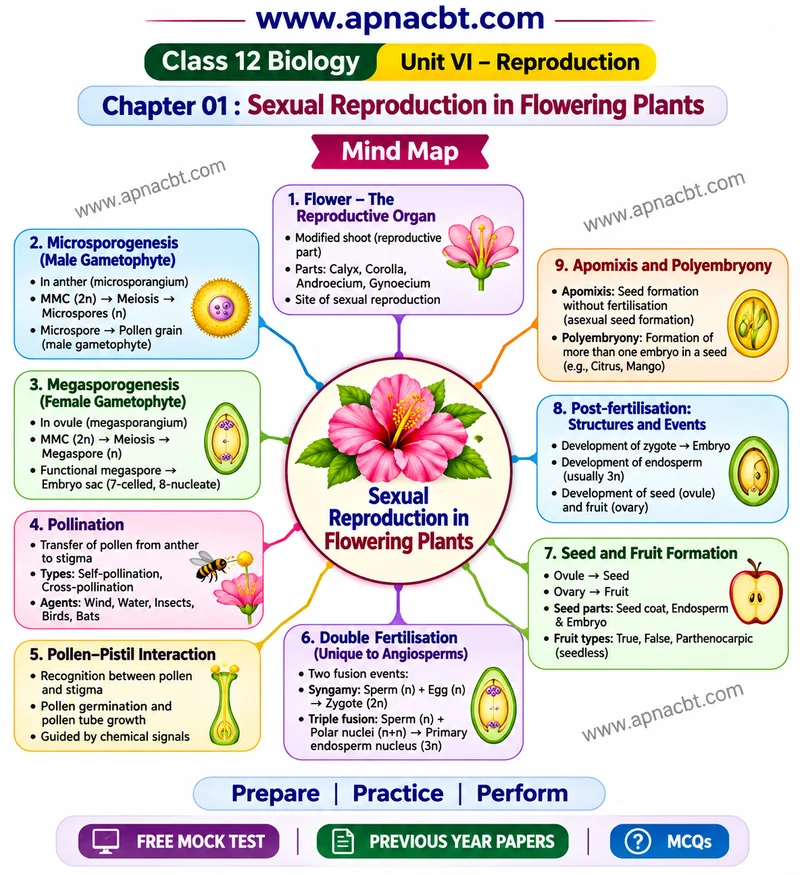
1. Flower – The Site of Sexual Reproduction in Angiosperms
Sexual reproduction in flowering plants takes place through highly specialised reproductive structures present in the flower. The two principal reproductive organs are the androecium (male reproductive organ) and gynoecium (female reproductive organ).
Parts of a typical flower
- Androecium: consists of stamens; each stamen has a filament and anther.
- Gynoecium: consists of one or more carpels/pistils; each pistil has stigma, style and ovary.
- Stigma: receives pollen grains.
- Style: connects stigma with ovary and provides the path for pollen-tube growth.
- Ovary: contains ovules attached to the placenta.
Key reproductive structures
The anther is the site of pollen formation, while the ovule is the site in which the female gametophyte develops. Pollen grains represent the male gametophytic generation and the embryo sac represents the female gametophyte.
CBSE/Board focus: Draw and label a typical flower and identify androecium, gynoecium, anther, stigma, style, ovary and ovule.
NEET focus: Remember the site of male gametophyte development = pollen grain; female gametophyte development = embryo sac inside ovule.
High-yield facts
- Flower is the seat of sexual reproduction in angiosperms.
- Stamen = filament + anther.
- Pistil = stigma + style + ovary.
- Ovules arise from the placenta inside the ovary.
2. Stamen, Microsporangium and Microsporogenesis
A typical stamen has a long slender filament and a terminal anther. A typical angiosperm anther is bilobed, dithecous and tetrasporangiate. Each anther lobe contains two microsporangia, giving four microsporangia in a transverse section.
Wall layers of microsporangium
- Epidermis – outer protective layer.
- Endothecium – helps in anther dehiscence.
- Middle layers – temporary layers involved in protection/nourishment during development.
- Tapetum – innermost layer; nourishes developing pollen grains and contributes to pollen-wall formation.
In the young microsporangium, the centre contains compact sporogenous tissue. Its cells give rise to pollen mother cells (PMCs).
Microsporogenesis
The formation of microspores from pollen mother cells through meiosis is called microsporogenesis. A diploid PMC undergoes meiosis and produces a tetrad of four haploid microspores.
Sequence: Sporogenous tissue → pollen mother cell → meiosis → microspore tetrad → individual microspores → pollen grains.
CBSE/Board focus: Explain the four wall layers of a microsporangium and the sequence of microsporogenesis.
NEET focus: PMC = diploid (2n); microspores = haploid (n); meiosis occurs in the PMC.
Important diagram
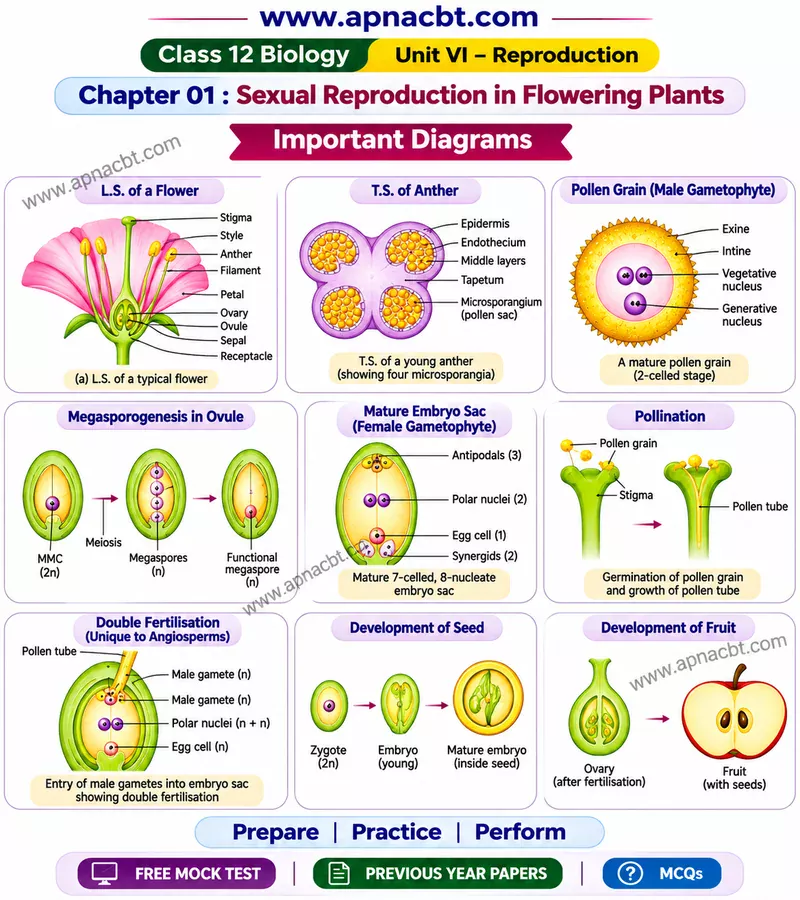
The NCERT figure of a transverse section of a young anther shows the four microsporangia and the wall layers of one microsporangium. This is a high-priority labelling diagram for board examinations.
3. Pollen Grain – Structure, Development and Viability
Pollen grains are the male gametophytes of flowering plants. They are generally spherical and commonly measure about 25–50 μm in diameter, although size and shape vary among species.
Pollen wall
- Exine: outer wall, made of highly resistant sporopollenin.
- Germ pores: regions where sporopollenin is absent; pollen tube emerges through a germ pore.
- Intine: inner thin wall made mainly of cellulose and pectin.
Sporopollenin is extremely resistant to degradation and is responsible for excellent preservation of pollen grains as fossils.
Two-celled and three-celled pollen
- Vegetative cell: larger, contains abundant food reserve and a large irregular nucleus.
- Generative cell: smaller and spindle-shaped; it divides mitotically to form two male gametes.
- In more than 60% of angiosperms, pollen grains are shed at the two-celled stage.
- In some species, pollen is shed at the three-celled stage, containing the vegetative cell and two male gametes.
Pollen viability and storage
Pollen viability depends on species, temperature and humidity. In some cereals such as rice and wheat, pollen loses viability rapidly, whereas pollen of some members of Rosaceae, Leguminosae and Solanaceae may remain viable for months. Pollen can be stored in liquid nitrogen at −196°C in pollen banks for crop-breeding programmes.
CBSE/Board focus: Draw/label pollen grain and explain exine, intine, germ pore, vegetative cell and generative cell.
NEET focus: Exine = sporopollenin; intine = cellulose + pectin; pollen grain = male gametophyte.
4. Pistil, Ovule, Megasporogenesis and Embryo Sac
The gynoecium is the female reproductive part. A pistil consists of stigma, style and ovary. Ovules arise from the placenta inside the ovary.
Structure of a typical anatropous ovule
- Funicle: stalk attaching the ovule to the placenta.
- Hilum: junction between ovule and funicle.
- Integuments: protective envelopes surrounding the nucellus, except at the micropyle.
- Micropyle: small opening at the micropylar end.
- Chalaza: basal region opposite the micropyle.
- Nucellus: tissue enclosed by integuments; contains the embryo sac.
- Embryo sac: female gametophyte.
Megasporogenesis
A diploid megaspore mother cell (MMC) undergoes meiosis to form four haploid megaspores. In the common monosporic type, only one megaspore remains functional and the other three degenerate.
Female gametophyte – the mature embryo sac
The functional megaspore undergoes three successive mitotic divisions, producing an 8-nucleate embryo sac. After cellular organisation, the mature embryo sac is 7-celled and 8-nucleate.
- Micropylar end: egg apparatus – 1 egg + 2 synergids.
- Chalazal end: 3 antipodals.
- Central cell: contains 2 polar nuclei.
- Synergids: possess a filiform apparatus at the micropylar end and help guide the pollen tube.
CBSE/Board focus: The 7-celled, 8-nucleate embryo sac is one of the most important diagrams of the chapter.
NEET focus: MMC is diploid; four megaspores are haploid; only one functional megaspore generally forms the embryo sac; mature embryo sac = 7 cells + 8 nuclei.
5. Pollination – Types and Basic Mechanism
Pollination is the transfer of pollen grains from the anther to the stigma of a pistil. Because the male and female gametes are non-motile, pollination brings the pollen to the female reproductive structure.
Types based on source of pollen
- Autogamy: transfer of pollen from anther to stigma of the same flower.
- Geitonogamy: transfer of pollen from anther to stigma of another flower of the same plant. Functionally it involves a pollinating agent, but genetically it is similar to self-pollination.
- Xenogamy: transfer of pollen from anther of one plant to stigma of a different plant. It is the type that introduces genetically different pollen.
Cleistogamy
Cleistogamous flowers do not open. Their anthers and stigma remain close, making autogamy assured. Examples include Viola, Oxalis and Commelina. Such flowers ensure seed set even without pollinators.
CBSE/Board focus: Differentiate autogamy, geitonogamy and xenogamy with examples.
NEET focus: Geitonogamy is genetically similar to autogamy but functionally involves a pollinating agent; xenogamy brings genetically different pollen.
6. Agents of Pollination and Floral Adaptations
Abiotic agents
- Wind: pollen grains are generally light and non-sticky; stamens are often exposed and stigma may be large and feathery. Wind pollination is common in grasses.
- Water: relatively rare in flowering plants. Examples include Vallisneria, Hydrilla and Zostera. Water-pollinated flowers often have adaptations that protect pollen from wetting.
Biotic agents
Animals are the dominant biotic pollinating agents. Common pollinators include bees, butterflies, flies, beetles, wasps, moths, birds and bats. Insects, particularly bees, are major pollinating agents.
Animal-pollinated flowers are commonly large, colourful, fragrant and rich in nectar. Pollen may be sticky so that it adheres to the animal body.
Special plant-pollinator relationships
The NCERT text highlights the relationship between Yucca and its moth pollinator, where both species depend on each other for completion of their life cycles.
CBSE/Board focus: Explain adaptations of wind-, water- and animal-pollinated flowers.
NEET focus: Wind = light/non-sticky pollen and exposed stamens; water pollination is rare; insect-pollinated flowers often have nectar and sticky pollen.
7. Outbreeding Devices and Pollen–Pistil Interaction
Continued self-pollination may result in inbreeding depression. Flowering plants have evolved several mechanisms to discourage self-pollination and promote cross-pollination.
Major outbreeding devices
- Dichogamy: pollen release and stigma receptivity do not occur at the same time.
- Herkogamy: anther and stigma are positioned at different places, reducing self-pollination.
- Self-incompatibility: a genetic mechanism prevents self-pollen from germinating or prevents pollen-tube growth.
- Unisexual flowers: in monoecious plants such as castor and maize, autogamy is prevented but geitonogamy can occur.
- Dioecy: male and female flowers occur on different plants, as in papaya; both autogamy and geitonogamy are prevented.
Pollen–pistil interaction
The pistil recognises whether pollen is compatible or incompatible. Compatible pollen germinates on the stigma and forms a pollen tube that grows through the style toward the ovule. Incompatible pollen is rejected by the pistil.
Bagging and artificial hybridisation
In plant breeding, the desired female parent may be protected from unwanted pollen by bagging the flower after emasculation and controlled pollination. This helps ensure that pollen from the selected male parent reaches the stigma.
CBSE/Board focus: Explain self-incompatibility, emasculation and bagging in artificial hybridisation.
NEET focus: Monoecious prevents autogamy but not geitonogamy; dioecy prevents both autogamy and geitonogamy.
8. Pollen Tube Growth and Entry into the Ovule
After compatible pollination, the pollen grain germinates on the stigma. The pollen tube grows through the style, enters the ovary and reaches an ovule.
Path of pollen tube
- Pollen grain lands on a compatible stigma.
- Pollen grain germinates and produces a pollen tube.
- The pollen tube grows through the style.
- It enters the ovary and reaches the ovule.
- The pollen tube generally enters the ovule through the micropyle.
- It enters one of the synergids and releases the two male gametes.
The synergids contain a filiform apparatus at the micropylar end, which plays an important role in guiding the pollen tube.
CBSE/Board focus: Draw the pollen tube pathway from stigma to embryo sac and explain entry into the synergid.
NEET focus: Pollen tube enters through the micropyle and ultimately releases two male gametes into a synergid.
9. Double Fertilisation – Syngamy and Triple Fusion
Double fertilisation is a characteristic feature of flowering plants. Two fusion events occur in the embryo sac.
Syngamy
One male gamete fuses with the egg cell to form a diploid zygote (2n). This fusion is called syngamy.
Triple fusion
The second male gamete fuses with the two polar nuclei in the central cell. The three haploid nuclei fuse to form a triploid primary endosperm nucleus (PEN, 3n). This fusion is called triple fusion.
Double fertilisation
Because syngamy and triple fusion occur in the same embryo sac, the phenomenon is called double fertilisation. It is unique to flowering plants.
| Fusion | Participating nuclei | Product | Ploidy |
|---|---|---|---|
| Syngamy | Male gamete + egg | Zygote | 2n |
| Triple fusion | Male gamete + two polar nuclei | Primary endosperm nucleus | 3n |
CBSE/Board focus: Explain double fertilisation with a labelled diagram and differentiate syngamy from triple fusion.
NEET focus: 1 male gamete + egg = 2n zygote; 1 male gamete + 2 polar nuclei = 3n PEN.
10. Post-fertilisation: Endosperm and Embryo Development
Following double fertilisation, the primary endosperm cell, zygote, ovule and ovary undergo coordinated development. Endosperm development precedes embryo development and provides nourishment to the developing embryo.
Endosperm
The primary endosperm cell develops into triploid endosperm tissue rich in reserve food. In the common type, the primary endosperm nucleus undergoes repeated nuclear divisions before cell-wall formation, producing a free-nuclear endosperm. Tender coconut water is an example of free-nuclear endosperm, while the white kernel represents cellular endosperm.
Embryo development
The zygote develops into the embryo. In dicots, embryogeny includes stages such as proembryo, globular stage, heart-shaped stage and mature embryo.
Dicot embryo
- Two cotyledons.
- Embryonal axis.
- Epicotyl above cotyledons, ending in plumule.
- Hypocotyl below cotyledons, ending in radicle.
- Radicle is protected by a root cap.
Monocot embryo
In grasses, the single cotyledon is called the scutellum. The radicle and root cap are enclosed by the coleorrhiza, while the plumule is protected by the coleoptile.
CBSE/Board focus: Compare dicot and monocot embryos and explain why endosperm formation precedes embryo development.
NEET focus: Endosperm is generally triploid; dicot = two cotyledons; grass monocot = one cotyledon called scutellum.
11. Seed, Fruit, Parthenocarpy and Seed Dormancy
A seed is commonly described as a mature/fertilised ovule. A typical seed contains seed coat(s), cotyledon(s) and embryo axis.
Types of seeds based on endosperm
- Non-albuminous/ex-albuminous seeds: endosperm is consumed during embryo development. Examples: pea, groundnut and beans.
- Albuminous seeds: some endosperm persists in the mature seed. Examples: wheat, maize, barley and castor.
- Perisperm: persistent nucellus, seen in seeds such as black pepper and beet.
Seed coat and micropyle
Integuments harden to form protective seed coats. The micropyle remains as a small pore and facilitates entry of water and oxygen during germination.
Fruit formation
After fertilisation, the ovary develops into the fruit and the ovules develop into seeds. The ovary wall becomes the pericarp.
- True fruit: develops mainly from the ovary.
- False fruit: other floral parts also contribute; apple, strawberry and cashew are examples.
- Parthenocarpic fruit: develops without fertilisation; banana is a common example. Such fruits are generally seedless.
Seed dormancy
Mature seeds have reduced water content and metabolic activity. Under unfavourable conditions the embryo may remain dormant. Under favourable conditions of moisture, oxygen and temperature, germination begins.
CBSE/Board focus: Differentiate albuminous and non-albuminous seeds, true and false fruits, and explain parthenocarpy.
NEET focus: Ovule → seed; ovary → fruit; ovary wall → pericarp; banana → parthenocarpic fruit.
12. Apomixis and Polyembryony
Apomixis is the production of seeds without fertilisation. It is a form of asexual reproduction that mimics sexual reproduction because the product is a seed.
Examples and mechanisms
Some species of Asteraceae and grasses show apomixis. In one mechanism, a diploid egg develops without reduction division and without fertilisation. In another, seen in some Citrus and Mango varieties, nucellar cells surrounding the embryo sac develop into embryos.
Polyembryony
The occurrence of more than one embryo in a seed is called polyembryony. Nucellar embryony in Citrus and Mango can result in multiple embryos in one ovule/seed.
Agricultural importance of apomixis
Hybrid varieties may lose desirable combinations because sexual reproduction causes segregation in their progeny. If apomixis can be introduced into hybrids, the hybrid characters could be maintained generation after generation, reducing the need to purchase hybrid seed every year. This is why apomixis is important in hybrid-seed technology.
CBSE/Board focus: Define apomixis and polyembryony and explain the agricultural importance of apomixis.
NEET focus: Apomixis = seed formation without fertilisation; polyembryony = more than one embryo per seed.
13. Complete Chapter Revision – Must-Know Facts, Sequences and Diagrams
Must-remember sequences
- Male side: Sporogenous tissue → PMC → meiosis → microspore tetrad → pollen grain → male gametes.
- Female side: MMC → meiosis → four megaspores → one functional megaspore → 2-, 4-, 8-nucleate stages → 7-celled, 8-nucleate embryo sac.
- Fertilisation: Pollination → pollen germination → pollen tube growth → entry into synergid → release of two male gametes → syngamy + triple fusion.
- Post-fertilisation: PEN → endosperm; zygote → embryo; ovule → seed; ovary → fruit.
High-priority diagrams for CBSE/Board
- Typical flower.
- Structure of anther and transverse section of microsporangium.
- Pollen grain.
- Typical anatropous ovule.
- Development and mature structure of embryo sac.
- Types of pollination.
- Pollen tube growth and entry into embryo sac.
- Double fertilisation.
- Dicot and monocot embryo.
- Structure of seed.
NEET rapid facts
| Concept | Fact |
|---|---|
| Microspore mother cell | Diploid; undergoes meiosis |
| Microspore | Haploid; develops into pollen grain |
| MMC | Diploid; meiosis produces four megaspores |
| Functional megaspore | Usually one of four; forms embryo sac |
| Mature embryo sac | 7-celled, 8-nucleate |
| Zygote | Diploid |
| Primary endosperm nucleus | Triploid |
| Double fertilisation | Syngamy + triple fusion |
| Apomixis | Seed formation without fertilisation |
| Polyembryony | More than one embryo in a seed |
Board strategy: For 5-mark answers, use a definition, sequence/process, labelled diagram where appropriate, and a concluding statement. For NEET, focus on ploidy, sequence, examples, terminology and exceptions.
14. Short-Answer Questions – 30 Questions with Detailed Answers
Important Short-Answer Questions
- What are the two main reproductive organs of a flower?
- What is a typical angiosperm anther?
- Name the four wall layers of a microsporangium.
- What is microsporogenesis?
- What is the function of tapetum?
- What is the ploidy of a microspore?
- What is sporopollenin and where is it found?
- Differentiate between exine and intine.
- What are the two cells of a two-celled pollen grain?
- What is pollen viability?
- Name the three parts of a pistil.
- What is a micropyle?
- What is megasporogenesis?
- What is monosporic development?
- Why is the mature embryo sac called 7-celled and 8-nucleate?
- What is autogamy?
- Differentiate between geitonogamy and xenogamy.
- What are cleistogamous flowers? Give examples.
- Name two abiotic agents of pollination.
- What is self-incompatibility?
- What is pollen–pistil interaction?
- What is syngamy?
- What is triple fusion?
- Why is double fertilisation called double fertilisation?
- Why does endosperm development generally precede embryo development?
- What is a non-albuminous seed? Give one example.
- Differentiate between true fruit and false fruit.
- What is parthenocarpy? Give one example.
- What is apomixis?
- What is polyembryony?
Detailed Answers
- What are the two main reproductive organs of a flower?
The androecium is the male reproductive organ and consists of stamens. The gynoecium is the female reproductive organ and consists of one or more carpels/pistils.
- What is a typical angiosperm anther?
A typical angiosperm anther is bilobed and dithecous. Each lobe contains two microsporangia, so a transverse section normally shows four microsporangia.
- Name the four wall layers of a microsporangium.
From outside to inside they are epidermis, endothecium, middle layers and tapetum.
- What is microsporogenesis?
Microsporogenesis is the formation of microspores from pollen mother cells through meiosis. A diploid PMC produces a tetrad of four haploid microspores.
- What is the function of tapetum?
Tapetum is the innermost wall layer of the microsporangium. It nourishes developing pollen grains and contributes materials required for pollen-wall development.
- What is the ploidy of a microspore?
A microspore is haploid (n), because it is produced by meiosis of a diploid pollen mother cell.
- What is sporopollenin and where is it found?
Sporopollenin is an extremely resistant organic material forming the exine of pollen grains. Its resistance allows pollen grains to be preserved as fossils.
- Differentiate between exine and intine.
Exine is the hard outer pollen wall made of sporopollenin and contains germ pores. Intine is the inner thin wall mainly composed of cellulose and pectin.
- What are the two cells of a two-celled pollen grain?
They are a large vegetative cell and a smaller generative cell. The generative cell later divides mitotically to form two male gametes.
- What is pollen viability?
Pollen viability is the period during which a shed pollen grain remains capable of germinating and effecting fertilisation. It varies with species and environmental conditions.
- Name the three parts of a pistil.
The three parts are stigma, style and ovary.
- What is a micropyle?
The micropyle is the small opening in the integuments of an ovule. It is generally the route through which the pollen tube enters the ovule and also remains as a pore in the mature seed coat.
- What is megasporogenesis?
It is the formation of megaspores from the diploid megaspore mother cell through meiosis.
- What is monosporic development?
It is embryo-sac development from a single functional megaspore. In the common pattern, three of the four megaspores degenerate and only one develops further.
- Why is the mature embryo sac called 7-celled and 8-nucleate?
It contains three antipodals, two synergids, one egg cell and one large central cell, making seven cells. The central cell contains two polar nuclei, so the total number of nuclei is eight.
- What is autogamy?
Autogamy is transfer of pollen from the anther to the stigma of the same flower.
- Differentiate between geitonogamy and xenogamy.
Geitonogamy transfers pollen between two flowers of the same plant. Xenogamy transfers pollen from one plant to a different plant and therefore brings genetically different pollen.
- What are cleistogamous flowers? Give examples.
Cleistogamous flowers remain closed and self-pollinate because their anthers and stigma are close together. Viola, Oxalis and Commelina are examples.
- Name two abiotic agents of pollination.
Wind and water are the two abiotic agents.
- What is self-incompatibility?
Self-incompatibility is a genetically controlled mechanism in which the pistil rejects self-pollen by preventing pollen germination or pollen-tube growth.
- What is pollen–pistil interaction?
It includes the events from pollen landing on the stigma through recognition, acceptance and pollen-tube growth, or rejection of incompatible pollen.
- What is syngamy?
Syngamy is fusion of one male gamete with the egg cell to form a diploid zygote.
- What is triple fusion?
Triple fusion is fusion of the second male gamete with the two polar nuclei in the central cell. It produces the triploid primary endosperm nucleus.
- Why is double fertilisation called double fertilisation?
Two fusion events occur in the same embryo sac: syngamy and triple fusion. Their products are the zygote and primary endosperm nucleus respectively.
- Why does endosperm development generally precede embryo development?
The developing embryo requires nutrition. Endosperm forms a reserve-food-rich tissue that provides nourishment to the developing embryo, so its development generally begins first.
- What is a non-albuminous seed? Give one example.
A non-albuminous seed has no residual endosperm at maturity because it has been consumed during embryo development. Pea and groundnut are examples.
- Differentiate between true fruit and false fruit.
A true fruit develops mainly from the ovary. A false fruit also involves other floral parts such as the thalamus; apple and strawberry are examples.
- What is parthenocarpy? Give one example.
Parthenocarpy is fruit development without fertilisation. Banana is a common example and the resulting fruits are generally seedless.
- What is apomixis?
Apomixis is formation of seeds without fertilisation. It is a form of asexual reproduction that mimics sexual reproduction.
- What is polyembryony?
Polyembryony is the occurrence of more than one embryo in a single seed. Nucellar embryony in Citrus and Mango can produce multiple embryos.
15. Long-Answer Questions – 15 Questions with Detailed Answers
Important Long-Answer Questions
- Describe the structure of a typical angiosperm anther and explain microsporogenesis.
- Describe the structure of a pollen grain and explain its development from a microspore.
- Describe the structure of a typical anatropous ovule.
- Explain megasporogenesis and the development of a typical 7-celled, 8-nucleate embryo sac.
- Define pollination and differentiate autogamy, geitonogamy and xenogamy.
- Explain the major agents of pollination and the adaptations of wind- and animal-pollinated flowers.
- Explain the outbreeding devices developed by flowering plants to prevent self-pollination.
- Describe pollen–pistil interaction and the growth of a pollen tube up to the embryo sac.
- Explain double fertilisation in flowering plants with syngamy and triple fusion.
- Describe post-fertilisation events with reference to endosperm and embryo development.
- Compare the structure of dicot and monocot embryos.
- Explain seed formation, types of seeds based on endosperm and fruit development.
- Explain parthenocarpy and distinguish true fruits, false fruits and seedless fruits.
- Explain apomixis and polyembryony and discuss the agricultural importance of apomixis.
- Prepare an integrated account of sexual reproduction in flowering plants from pollen formation to seed and fruit formation.
Detailed Answers
- Describe the structure of a typical angiosperm anther and explain microsporogenesis.
A typical angiosperm anther is bilobed and dithecous. Each lobe contains two microsporangia, giving four microsporangia in total. Each microsporangium has four wall layers: epidermis, endothecium, middle layers and tapetum. The centre contains sporogenous tissue. Sporogenous cells differentiate into pollen mother cells. Each pollen mother cell undergoes meiosis and forms a tetrad of four haploid microspores. The microspores separate and mature into pollen grains. Thus, microsporogenesis connects the diploid sporophytic tissue with the haploid male gametophytic generation.
- Describe the structure of a pollen grain and explain its development from a microspore.
A pollen grain is the male gametophyte. It has a hard outer exine made of sporopollenin and an inner intine made mainly of cellulose and pectin. Germ pores occur where sporopollenin is absent. A mature pollen grain may be two-celled, containing a vegetative cell and generative cell, or three-celled, containing the vegetative cell and two male gametes. The generative cell divides mitotically to form the two male gametes. The vegetative cell produces the pollen tube during germination.
- Describe the structure of a typical anatropous ovule.
An anatropous ovule is attached to the placenta by a funicle. The junction of the ovule body and funicle is the hilum. The ovule is surrounded by one or two integuments except at the micropyle. The basal region opposite the micropyle is the chalaza. Inside the integuments lies the nucellus, which contains the embryo sac. The micropyle is important because the pollen tube usually enters the ovule through this opening. The mature embryo sac is the female gametophyte within the ovule.
- Explain megasporogenesis and the development of a typical 7-celled, 8-nucleate embryo sac.
A diploid megaspore mother cell develops in the nucellus and undergoes meiosis to form four haploid megaspores. Usually, three degenerate and one remains functional. The functional megaspore undergoes three successive mitotic nuclear divisions, producing two, four and finally eight nuclei. The nuclei become organised into cells: three antipodals at the chalazal end, an egg apparatus consisting of one egg and two synergids at the micropylar end, and a large central cell containing two polar nuclei. Thus the mature embryo sac contains seven cells but eight nuclei.
- Define pollination and differentiate autogamy, geitonogamy and xenogamy.
Pollination is transfer of pollen grains from anther to stigma. Autogamy occurs within the same flower. Geitonogamy occurs between different flowers of the same plant; it is functionally cross-pollination but genetically resembles self-pollination. Xenogamy occurs between flowers of different plants and introduces genetically different pollen. Cleistogamous flowers ensure autogamy because they remain closed and the anther and stigma are close together.
- Explain the major agents of pollination and the adaptations of wind- and animal-pollinated flowers.
Pollinating agents are abiotic and biotic. Wind-pollinated flowers generally produce light, non-sticky pollen, have exposed stamens and often possess large or feathery stigmas. Wind pollination is common in grasses. Water pollination is rare and occurs in plants such as Vallisneria and Zostera. Animal-pollinated flowers are often colourful, fragrant and rich in nectar. Their pollen may be sticky so it adheres to visiting animals. Bees, butterflies, flies, beetles, moths, birds and bats can act as pollinators.
- Explain the outbreeding devices developed by flowering plants to prevent self-pollination.
Plants discourage self-pollination through several mechanisms. Dichogamy separates pollen release and stigma receptivity in time. Herkogamy separates the anther and stigma spatially. Self-incompatibility prevents self-pollen from germinating or prevents pollen-tube growth. Monoecious unisexual flowers such as those of castor and maize prevent autogamy but allow geitonogamy. Dioecy, as in papaya, places male and female flowers on different plants and prevents both autogamy and geitonogamy.
- Describe pollen–pistil interaction and the growth of a pollen tube up to the embryo sac.
After pollen lands on the stigma, the pistil recognises whether it is compatible. Compatible pollen germinates and produces a pollen tube. The tube grows through the style and reaches the ovary. It enters an ovule, usually through the micropyle, and grows into a synergid. The filiform apparatus of the synergid helps guide the pollen tube. The pollen tube releases two male gametes into the synergid, allowing the two fertilisation events to occur.
- Explain double fertilisation in flowering plants with syngamy and triple fusion.
After the pollen tube releases two male gametes, one male gamete fuses with the egg to form the diploid zygote. This is syngamy. The other male gamete fuses with the two polar nuclei in the central cell to form the triploid primary endosperm nucleus. This is triple fusion because three haploid nuclei participate. The occurrence of syngamy and triple fusion in the same embryo sac is called double fertilisation and is a characteristic feature of angiosperms.
- Describe post-fertilisation events with reference to endosperm and embryo development.
The primary endosperm cell develops into triploid endosperm tissue, which stores reserve food and nourishes the developing embryo. In the common free-nuclear type, repeated nuclear divisions occur before cell-wall formation. The zygote develops into the embryo, passing through stages such as proembryo, globular and heart-shaped stages in dicots. Endosperm development generally precedes embryo development, ensuring a nutritional supply for the young embryo.
- Compare the structure of dicot and monocot embryos.
A typical dicot embryo has two cotyledons and an embryonal axis. The part above the cotyledons is the epicotyl and ends in the plumule; the part below is the hypocotyl and ends in the radicle. A monocot embryo has one cotyledon. In grasses this cotyledon is called the scutellum. The radicle and root cap are enclosed in the coleorrhiza, while the shoot apex and leaf primordia are enclosed in the coleoptile.
- Explain seed formation, types of seeds based on endosperm and fruit development.
The ovule develops into a seed after fertilisation. The integuments become the seed coat, while the embryo develops from the zygote. Non-albuminous seeds such as pea and groundnut have little or no residual endosperm at maturity. Albuminous seeds such as wheat, maize, barley and castor retain endosperm. As the ovule becomes a seed, the ovary develops into a fruit and its wall becomes the pericarp. In some fruits other floral parts also contribute, producing false fruits.
- Explain parthenocarpy and distinguish true fruits, false fruits and seedless fruits.
A true fruit develops mainly from the ovary. A false fruit develops from the ovary along with other floral parts; apple and strawberry are examples. Parthenocarpic fruits develop without fertilisation and are generally seedless; banana is a common example. Parthenocarpy can also be induced by application of growth substances. Thus, fruit formation does not always require fertilisation.
- Explain apomixis and polyembryony and discuss the agricultural importance of apomixis.
Apomixis is formation of seeds without fertilisation and therefore mimics sexual reproduction through seed production without the usual fusion of gametes. Polyembryony means the presence of more than one embryo in a seed. In some Citrus and Mango varieties, nucellar cells can develop into embryos. Apomixis is agriculturally important because hybrid progeny normally segregates and loses desirable combinations. If hybrid varieties could reproduce through apomixis, their useful characters could be maintained generation after generation and the cost of repeatedly producing hybrid seed could be reduced.
- Prepare an integrated account of sexual reproduction in flowering plants from pollen formation to seed and fruit formation.
Sexual reproduction begins with differentiation of androecium and gynoecium. In the anther, sporogenous tissue gives rise to pollen mother cells, which undergo meiosis to form haploid microspores and subsequently pollen grains. In the ovule, the megaspore mother cell undergoes meiosis and usually one functional megaspore forms the 7-celled, 8-nucleate embryo sac. Pollination transfers pollen to the stigma. Compatible pollen germinates and the pollen tube grows through the style into the ovule. One male gamete fuses with the egg to form the zygote, while the other fuses with two polar nuclei to form the triploid primary endosperm nucleus. This double fertilisation is followed by endosperm and embryo development. The ovule becomes the seed and the ovary becomes the fruit. Some plants may additionally show parthenocarpy, apomixis or polyembryony.
Important Diagrams From Lesson
Mind Map From Lesson