1. Classification of Hydrocarbons
Hydrocarbons are organic compounds containing only carbon and hydrogen. They are important fuels and raw materials. Petrol, diesel and kerosene are obtained from petroleum; LPG, CNG and LNG are important gaseous fuels.
Major classes
- Saturated hydrocarbons: contain only C–C single bonds. Open-chain members are alkanes; ring compounds are cycloalkanes.
- Unsaturated hydrocarbons: contain at least one C=C or C≡C bond. They include alkenes and alkynes.
- Aromatic hydrocarbons: cyclic, conjugated systems with special stability, such as benzene and its derivatives.
| Class | Characteristic bond | General formula (acyclic, one multiple bond) | Example |
|---|---|---|---|
| Alkane | C–C | CnH2n+2 | Ethane, C2H6 |
| Alkene | C=C | CnH2n | Ethene, C2H4 |
| Alkyne | C≡C | CnH2n−2 | Ethyne, C2H2 |
Exam point: These formulae apply to open-chain hydrocarbons containing one indicated type of unsaturation. Rings and additional multiple bonds change the hydrogen count.
2. Alkanes: Structure, Nomenclature and Isomerism
Alkanes are saturated open-chain hydrocarbons with formula CnH2n+2. Each carbon is approximately tetrahedral and sp3-hybridised; C–C and C–H bonds are sigma bonds.
IUPAC naming essentials
- Select the longest continuous carbon chain as the parent.
- Number it from the end that gives the substituents the lowest possible set of locants.
- Name each alkyl substituent and show its position.
- Use di-, tri-, tetra- for repeated substituents; alphabetise different substituent names (ignore multiplicative prefixes for alphabetising).
- Write numbers separated by commas and numbers from words by hyphens.
Examples: CH3CH(CH3)CH3 is 2-methylpropane; CH3CH(CH3)CH2CH3 is 2-methylbutane.
Chain isomerism
Compounds with the same molecular formula but different carbon skeletons are chain isomers. Butane has n-butane and 2-methylpropane. Pentane has three chain isomers: pentane, 2-methylbutane and 2,2-dimethylpropane.
Branching trend: For isomeric alkanes, increased branching generally lowers boiling point because the molecule has a smaller surface area of contact and weaker London dispersion forces.
3. Preparation and Chemical Properties of Alkanes
Important preparations
- Hydrogenation: alkenes/alkynes + H2 in presence of Ni, Pd or Pt give alkanes. Example: CH2=CH2 + H2 → CH3CH3.
- Reduction of alkyl halides: R–X gives R–H using suitable reducing conditions.
- Wurtz reaction: 2R–X + 2Na → R–R + 2NaX (dry ether). It is most useful for symmetrical alkanes with an even number of carbon atoms; different halides give mixtures.
- Decarboxylation: RCOONa + NaOH (soda lime, heat) → RH + Na2CO3. The alkane has one carbon less than the carboxylate salt.
Physical properties
Alkanes are non-polar, practically insoluble in water and soluble in non-polar organic solvents. Their boiling points generally increase with molecular mass; branching lowers boiling point among isomers.
Chemical properties
- Combustion: complete combustion gives CO2 and H2O with heat. In limited oxygen, CO and/or carbon may form.
- Halogenation: substitution with Cl2 or Br2 in light/heat proceeds by a free-radical chain mechanism: initiation, propagation and termination.
- Pyrolysis/cracking: larger alkanes break into smaller alkanes and alkenes on strong heating, often with a catalyst.
- Aromatisation: suitable higher alkanes can cyclise and dehydrogenate over catalysts at high temperature.
For methane chlorination: CH4 + Cl2 → CH3Cl + HCl (sunlight/UV); further substitution can form CH2Cl2, CHCl3 and CCl4.
4. Conformations of Ethane
Rotation about the C–C sigma bond in ethane produces different spatial arrangements called conformations. They are represented using sawhorse and Newman projections.
- Staggered conformation: C–H bonds on the rear carbon lie between those on the front carbon; dihedral angle is 60°. It has minimum torsional strain and is more stable.
- Eclipsed conformation: rear C–H bonds align with front C–H bonds; dihedral angle is 0°. It has maximum torsional strain and is less stable.
The energy difference is small (approximately 12 kJ mol−1 in the textbook treatment), so rotation is rapid at ordinary temperatures and the conformers cannot normally be isolated. The staggered form is the energy minimum and eclipsed form the maximum during rotation.
5. Alkenes: Structure, Nomenclature and Isomerism
Alkenes are unsaturated hydrocarbons containing at least one C=C bond. Acyclic alkenes with one double bond have formula CnH2n. Each double-bonded carbon is sp2-hybridised and approximately trigonal planar.
A C=C bond contains one sigma bond (head-on overlap) and one pi bond (sideways overlap of unhybridised p orbitals). Restricted rotation about the double bond allows geometrical isomerism.
Nomenclature
Select the longest chain containing the double bond, number from the end nearest the double bond, and indicate its locant using the suffix -ene. Examples: CH2=CH2, ethene; CH3CH=CH2, prop-1-ene (propene); CH3CH=CHCH3, but-2-ene.
Geometrical isomerism
When each double-bond carbon has two different substituents, cis/trans (or more generally E/Z) forms may exist. In cis-but-2-ene the two methyl groups are on the same side; in trans-but-2-ene they are on opposite sides. The trans isomer is usually more stable due to lower steric repulsion. Geometrical isomers may differ in boiling point, melting point and dipole moment.
6. Preparation and Reactions of Alkenes
Preparation
- Dehydration of alcohols: removal of water using concentrated H2SO4 or heated alumina gives an alkene.
- Dehydrohalogenation: heating an alkyl halide with alcoholic KOH removes HX and forms an alkene.
- Dehalogenation: vicinal dihalides react with Zn to form alkenes.
Addition reactions
- H2/Ni, Pt or Pd gives an alkane.
- Br2 adds across the double bond; bromine solution is decolourised, a common test for unsaturation.
- HX adds to unsymmetrical alkenes generally according to Markovnikov’s rule: hydrogen attaches to the carbon already bearing more hydrogen atoms, and X to the more substituted carbon.
- In the presence of peroxide, HBr adds by the anti-Markovnikov radical pathway (peroxide effect). This effect is characteristic of HBr, not generally HCl or HI.
- Cold dilute alkaline KMnO4 oxidises alkenes to vicinal diols (Baeyer’s test).
- Ozonolysis cleaves C=C and forms carbonyl compounds; products help locate the double bond.
Polymerisation: many alkene molecules join to form polymers, e.g. nCH2=CH2 → (–CH2–CH2–)n (polyethene).
7. Alkynes: Structure, Nomenclature and Isomerism
Alkynes contain at least one carbon-carbon triple bond. Acyclic alkynes with one triple bond have formula CnH2n−2. The two triple-bonded carbon atoms are sp-hybridised and the arrangement around the triple bond is linear (180°).
A C≡C bond consists of one sigma bond and two mutually perpendicular pi bonds. The first member is ethyne (acetylene), HC≡CH.
For naming, select the longest chain containing the triple bond, number from the nearest end, and use the suffix -yne: HC≡CH, ethyne; CH3C≡CH, prop-1-yne; CH3C≡CCH3, but-2-yne. Position isomers arise when the triple bond occupies different positions.
Terminal alkynes have an acidic hydrogen because the C–H bond is attached to an sp carbon with 50% s-character. They react with strong bases/active metals to form acetylide salts. Internal alkynes do not possess this terminal acidic hydrogen.
8. Preparation and Reactions of Alkynes
Preparation
- Double dehydrohalogenation: vicinal or geminal dihalides undergo two eliminations of HX with a strong base to form an alkyne.
- Calcium carbide hydrolysis: CaC2 + 2H2O → C2H2 + Ca(OH)2.
Reactions
- Hydrogenation can give an alkene or alkane depending on catalyst and conditions; poisoned catalysts can stop at the cis-alkene.
- Halogens and hydrogen halides add across the triple bond; excess reagent can produce di-addition products.
- Hydration in the presence of HgSO4/dilute H2SO4 gives an enol that tautomerises to a carbonyl compound. Ethyne gives ethanal; higher terminal alkynes generally give methyl ketones under these conditions.
- Ozonolysis/oxidative cleavage breaks the triple bond and forms carboxylic acids; terminal carbon may be oxidised to CO2.
For unsymmetrical addition reactions, regiochemistry depends on the reagent and reaction mechanism; apply the stated conditions rather than assuming one rule for every addition.
9. Aromatic Hydrocarbons and Benzene Structure
Aromatic hydrocarbons (arenes) contain one or more aromatic rings. Benzene, C6H6, is a planar hexagonal molecule. Each carbon is sp2-hybridised; the sigma framework is in the plane and the unhybridised p orbitals overlap around the ring to form a delocalised pi system.
Benzene is often represented by two Kekulé structures or a hexagon with a circle. All six C–C bonds are equivalent and have lengths intermediate between typical single and double bonds. Benzene is more stable than a hypothetical localised cyclohexatriene due to resonance/delocalisation.
Aromaticity conditions (Hückel rule)
- cyclic system;
- planar or nearly planar structure;
- continuous conjugation (a p orbital at every ring atom);
- (4n + 2) pi electrons, where n = 0, 1, 2, …
Benzene has six pi electrons (n = 1) and is aromatic. A cyclic, planar, fully conjugated system with 4n pi electrons is antiaromatic; systems that fail planarity or continuous conjugation are non-aromatic.
10. Nomenclature and Isomerism of Aromatic Compounds
Monosubstituted benzene compounds are named as derivatives of benzene, e.g. chlorobenzene, nitrobenzene, ethylbenzene and methylbenzene (toluene). All six positions in benzene are equivalent, so only one monosubstituted product is possible for a given substituent.
For disubstituted benzene, relative positions are described as ortho (o-; 1,2), meta (m-; 1,3) and para (p-; 1,4). Numbering gives the lowest set of locants; use the retained parent name where appropriate (e.g. toluene, phenol, aniline).
Examples: 1,2-dimethylbenzene (o-xylene), 1,3-dimethylbenzene (m-xylene), and 1,4-dimethylbenzene (p-xylene). For three or more substituents, use numerical locants and list substituents alphabetically where required.
11. Preparation and Physical Properties of Benzene
Preparation
- Trimerisation of ethyne: 3HC≡CH → C6H6 by passing ethyne through a red-hot tube under suitable conditions.
- Decarboxylation: sodium benzoate with soda lime on heating gives benzene.
- Dehydrogenation/aromatisation: suitable cycloalkanes or straight-chain hydrocarbons can form benzene over catalysts at high temperature.
Physical properties
Benzene is a colourless, volatile liquid with a characteristic odour. It is non-polar, insoluble in water and miscible with many organic solvents. It burns with a sooty flame due to its relatively high carbon content. Benzene is toxic and should not be inhaled or handled without appropriate controls.
12. Chemical Properties of Benzene: Electrophilic Substitution
Benzene generally undergoes electrophilic substitution rather than addition because substitution preserves the aromatic pi system. The general stages are: (1) generation of an electrophile, (2) attack of the electrophile on the ring to form a resonance-stabilised sigma complex, and (3) loss of H+ to restore aromaticity.
- Nitration: concentrated HNO3/H2SO4 gives nitrobenzene; electrophile is NO2+.
- Halogenation: Cl2/FeCl3 or Br2/FeBr3 gives haloarene.
- Sulphonation: fuming H2SO4 gives benzenesulphonic acid.
- Friedel–Crafts alkylation: RCl/anhydrous AlCl3 gives alkylbenzene; rearrangement and polyalkylation may occur.
- Friedel–Crafts acylation: acyl halide/anhydrous AlCl3 gives an aryl ketone; rearrangement is generally not encountered.
Benzene can undergo addition only under vigorous conditions, for example catalytic hydrogenation to cyclohexane.
13. Directive Influence of Substituents in Benzene
A substituent already attached to benzene influences both the rate and position of a second electrophilic substitution.
Ortho/para directors
Electron-donating groups such as –OH, –OR, –NH2, –NHR, –R generally increase ring electron density and direct incoming electrophiles mainly to ortho and para positions. Halogens are an important exception: they deactivate the ring by their –I effect but direct ortho/para through lone-pair resonance donation.
Meta directors
Strong electron-withdrawing groups such as –NO2, –CHO, –COR, –COOH, –COOR, –CN and –SO3H generally deactivate the ring and direct incoming electrophiles to the meta position.
Exam method: identify the first substituent, classify it as activating/deactivating and ortho/para/meta directing, then draw the permitted positions. When two substituents are already present, consider their combined directing effects and steric effects.
14. Carcinogenicity, Toxicity and Environmental Importance
Benzene and certain polynuclear aromatic hydrocarbons (PAHs), especially compounds with fused rings, are toxic; some are carcinogenic. PAHs may form during incomplete combustion of coal, petroleum, tobacco and other organic materials. Exposure can occur through polluted air, smoke and contaminated materials.
Benzene exposure is associated with serious health effects, including damage to bone marrow and increased risk of leukaemia. Avoid inhalation and skin contact; use appropriate ventilation and safety procedures in laboratories and industry. Never use benzene as a household cleaning solvent.
Hydrocarbons are valuable fuels and feedstocks, but combustion releases pollutants and carbon dioxide. Cleaner fuel use, emission control and safe handling are important.
14. Short-Answer Questions – 30 Questions with Answers
Important Short-Answer Questions
- Define hydrocarbons.
- Classify hydrocarbons based on carbon-carbon bonds.
- Write the general formula of an open-chain alkane.
- Write the general formulae of an acyclic monoalkene and monoalkyne.
- What is the hybridisation of carbon in alkanes, alkenes and alkynes?
- What bonds constitute a carbon-carbon double bond?
- Why is rotation restricted around a C=C bond?
- Define chain isomerism with an example.
- What is the Wurtz reaction?
- What is decarboxylation of a sodium carboxylate?
- Why does branching lower the boiling point of an alkane isomer?
- What are staggered and eclipsed conformations of ethane?
- State Markovnikov’s rule.
- What is the peroxide effect?
- What is ozonolysis used for?
- Why are terminal alkynes weakly acidic?
- Describe the geometry of ethyne.
- What is the structure of the benzene pi system?
- State Hückel’s rule.
- What are ortho, meta and para positions?
- Why does benzene prefer electrophilic substitution?
- Name the electrophile in benzene nitration.
- Give two examples of ortho/para-directing groups.
- Give two examples of meta-directing groups.
- Why are halogens deactivating but ortho/para directing?
- What is Friedel–Crafts alkylation?
- What is Friedel–Crafts acylation?
- Name one method of preparing benzene from ethyne.
- What are polynuclear aromatic hydrocarbons?
- Why is benzene hazardous?
Detailed Answers
- Define hydrocarbons.
Hydrocarbons are organic compounds made up only of carbon and hydrogen atoms.
- Classify hydrocarbons based on carbon-carbon bonds.
They are saturated (only C–C single bonds), unsaturated (C=C or C≡C bonds) and aromatic (special cyclic conjugated systems).
- Write the general formula of an open-chain alkane.
For an acyclic saturated alkane containing n carbon atoms, the formula is CnH2n+2.
- Write the general formulae of an acyclic monoalkene and monoalkyne.
A monoalkene has CnH2n and a monoalkyne has CnH2n−2.
- What is the hybridisation of carbon in alkanes, alkenes and alkynes?
The relevant carbon atoms are sp3 in alkanes, sp2 at a C=C bond and sp at a C≡C bond.
- What bonds constitute a carbon-carbon double bond?
One sigma bond formed by head-on overlap and one pi bond formed by sideways overlap of p orbitals.
- Why is rotation restricted around a C=C bond?
Rotation would disrupt the sideways overlap that forms the pi bond, requiring substantial energy.
- Define chain isomerism with an example.
Chain isomers have the same molecular formula but different carbon skeletons; n-butane and 2-methylpropane are examples.
- What is the Wurtz reaction?
Alkyl halides react with sodium in dry ether to couple alkyl groups: 2R–X + 2Na → R–R + 2NaX.
- What is decarboxylation of a sodium carboxylate?
Heating RCOONa with soda lime removes the carboxylate carbon and produces RH and Na2CO3.
- Why does branching lower the boiling point of an alkane isomer?
Branching reduces molecular surface contact, weakening London dispersion forces and generally lowering boiling point.
- What are staggered and eclipsed conformations of ethane?
Staggered has a 60° dihedral angle and minimum torsional strain; eclipsed has 0° and maximum torsional strain.
- State Markovnikov’s rule.
In addition of HX to an unsymmetrical alkene, H generally attaches to the carbon already bearing more hydrogen atoms, while X attaches to the more substituted carbon.
- What is the peroxide effect?
In the presence of peroxide, HBr adds to an unsymmetrical alkene by a radical pathway, usually giving the anti-Markovnikov product.
- What is ozonolysis used for?
Ozonolysis cleaves a C=C bond into carbonyl compounds; identifying the products helps locate the original double bond.
- Why are terminal alkynes weakly acidic?
Their acidic hydrogen is attached to an sp-hybridised carbon with high s-character, which stabilises the conjugate acetylide ion.
- Describe the geometry of ethyne.
Ethyne is linear around each sp-hybridised carbon, with a bond angle of 180°.
- What is the structure of the benzene pi system?
Six parallel p orbitals overlap around the planar ring to form a delocalised pi-electron system above and below the sigma framework.
- State Hückel’s rule.
A planar, cyclic, fully conjugated system is aromatic when it contains (4n + 2) pi electrons, where n is a non-negative integer.
- What are ortho, meta and para positions?
In disubstituted benzene, ortho is 1,2; meta is 1,3; para is 1,4 substitution.
- Why does benzene prefer electrophilic substitution?
Substitution restores and preserves aromaticity after the electrophile replaces hydrogen; addition would destroy the aromatic stabilisation.
- Name the electrophile in benzene nitration.
The nitronium ion, NO2+, is the electrophile generated by concentrated nitric and sulfuric acids.
- Give two examples of ortho/para-directing groups.
–OH and –CH3 are examples. –NH2 and halogens also direct ortho/para, although halogens deactivate the ring.
- Give two examples of meta-directing groups.
–NO2 and –COOH are common meta-directing, deactivating groups.
- Why are halogens deactivating but ortho/para directing?
Their strong –I effect withdraws electron density and deactivates the ring, while lone-pair resonance donation favours ortho/para substitution.
- What is Friedel–Crafts alkylation?
It is electrophilic substitution of benzene with an alkyl halide in the presence of a Lewis acid such as anhydrous AlCl3.
- What is Friedel–Crafts acylation?
Benzene reacts with an acyl halide in the presence of a Lewis acid to form an aryl ketone.
- Name one method of preparing benzene from ethyne.
Passing ethyne through a red-hot tube under suitable conditions causes trimerisation: 3C2H2 → C6H6.
- What are polynuclear aromatic hydrocarbons?
They are aromatic compounds containing two or more fused aromatic rings; some are toxic and carcinogenic.
- Why is benzene hazardous?
Benzene is toxic; prolonged exposure can damage bone marrow and increase the risk of blood cancers, including leukaemia.
15. Long-Answer Questions – 15 Questions with Detailed Answers
Important Long-Answer Questions
- Classify hydrocarbons and compare alkanes, alkenes and alkynes.
- Explain IUPAC nomenclature of branched alkanes with an example.
- Describe the important methods of preparation of alkanes.
- Explain free-radical chlorination of methane.
- Compare staggered and eclipsed conformations of ethane.
- Explain the structure and bonding in ethene.
- Explain Markovnikov addition and the peroxide effect with propene.
- Describe the important chemical reactions of alkenes.
- Explain the structure, bonding and acidity of alkynes.
- Describe the structure of benzene and explain its unusual stability.
- State the conditions for aromaticity and apply Hückel’s rule.
- Explain electrophilic substitution of benzene with nitration as an example.
- Discuss the directive influence of substituents in monosubstituted benzene.
- Describe the preparation and important reactions of benzene.
- Explain carcinogenicity and toxicity associated with hydrocarbons.
Detailed Answers
- Classify hydrocarbons and compare alkanes, alkenes and alkynes.
Hydrocarbons contain only C and H. Saturated open-chain alkanes contain C–C single bonds and have formula CnH2n+2. Alkenes contain at least one C=C bond; an acyclic monoalkene has formula CnH2n. Alkynes contain at least one C≡C bond; an acyclic monoalkyne has formula CnH2n−2. Aromatic hydrocarbons contain special conjugated cyclic systems such as benzene. Alkanes mainly undergo substitution, whereas alkenes and alkynes commonly undergo addition because of their pi bonds.
- Explain IUPAC nomenclature of branched alkanes with an example.
Choose the longest continuous carbon chain as parent and name it using the appropriate alkane stem. Number from the end nearest the first substituent to obtain the lowest set of locants. Identify and name each alkyl substituent, use di-/tri- for repetition, and alphabetise different substituents. For CH3–CH(CH3)–CH2–CH3, the longest chain has four carbons (butane); the methyl group is at carbon 2, so the name is 2-methylbutane. Use commas between numbers and hyphens between numbers and words.
- Describe the important methods of preparation of alkanes.
Alkanes may be prepared by catalytic hydrogenation of alkenes/alkynes; reduction of alkyl halides; Wurtz coupling of alkyl halides with sodium in dry ether; and decarboxylation of sodium carboxylates with soda lime. Hydrogenation adds H2 across a multiple bond. Wurtz reaction couples two alkyl groups and is best for symmetrical even-carbon alkanes; using two different halides gives a mixture. Decarboxylation produces an alkane with one carbon fewer than the carboxylate salt.
- Explain free-radical chlorination of methane.
The reaction CH4 + Cl2 → CH3Cl + HCl occurs in light/UV through a chain mechanism. Initiation: Cl2 undergoes homolytic cleavage to form two Cl· radicals. Propagation: Cl· abstracts H from methane to form HCl and CH3·; CH3· reacts with Cl2 to form CH3Cl and regenerate Cl·. Termination occurs when radicals combine, for example Cl· + Cl· → Cl2 or CH3· + Cl· → CH3Cl. Further substitution can produce CH2Cl2, CHCl3 and CCl4.
- Compare staggered and eclipsed conformations of ethane.
Conformations arise by rotation about the C–C sigma bond. In the staggered form, rear C–H bonds lie between front C–H bonds; the dihedral angle is 60°, repulsion/torsional strain is minimum and the form is more stable. In the eclipsed form, bonds align with a 0° dihedral angle, producing maximum torsional strain and higher energy. The energy barrier is small enough that rotation is rapid at room temperature; individual conformers are not normally isolated.
- Explain the structure and bonding in ethene.
Each carbon in ethene is sp2-hybridised. Three sp2 orbitals lie in one plane at approximately 120° and form sigma bonds; the unhybridised p orbital on each carbon overlaps sideways to form one pi bond. Thus C=C consists of one sigma and one pi bond. The molecule is planar around the double bond. Rotation is restricted because it would break the p-orbital overlap, allowing geometrical isomerism when each carbon has two different substituents.
- Explain Markovnikov addition and the peroxide effect with propene.
For addition of HBr to propene under ordinary ionic conditions, H attaches to the terminal carbon (which has more H atoms) and Br attaches to the more substituted carbon, giving 2-bromopropane. In the presence of peroxide, HBr adds through a radical chain pathway and gives anti-Markovnikov addition, forming 1-bromopropane. The peroxide effect is characteristic of HBr; it should not be generalised to HCl and HI.
- Describe the important chemical reactions of alkenes.
Alkenes undergo hydrogenation to alkanes; halogen addition to vicinal dihalides; addition of HX according to regioselective mechanisms; hydration to alcohols under suitable acid-catalysed conditions; oxidation with cold dilute alkaline KMnO4 to vicinal diols; ozonolysis to carbonyl compounds; and addition polymerisation. Decolourisation of bromine solution and Baeyer’s reagent are common tests for unsaturation. Ozonolysis products can be used to determine the position of the original double bond.
- Explain the structure, bonding and acidity of alkynes.
The carbon atoms of a triple bond are sp-hybridised and linear. A C≡C bond consists of one sigma bond formed by head-on overlap and two pi bonds formed by sideways overlap of two mutually perpendicular p-orbital pairs. Terminal alkynes contain a hydrogen attached to sp carbon. The high s-character stabilises the acetylide conjugate base, making terminal alkynes more acidic than alkenes and alkanes. Internal alkynes lack this terminal acidic hydrogen.
- Describe the structure of benzene and explain its unusual stability.
Benzene is a planar hexagonal molecule with six sp2-hybridised carbon atoms. Each carbon forms sigma bonds to two neighbouring carbons and one hydrogen. The six unhybridised p orbitals overlap continuously around the ring, producing a delocalised pi system containing six pi electrons. Two Kekulé structures represent resonance contributors; the actual molecule has equivalent C–C bonds of intermediate length. Delocalisation lowers the energy, giving aromatic stabilisation. Benzene therefore favours electrophilic substitution, which restores aromaticity, rather than addition.
- State the conditions for aromaticity and apply Hückel’s rule.
A compound must be cyclic, planar (or sufficiently planar), fully conjugated with a p orbital at each ring atom, and contain (4n+2) pi electrons for n = 0, 1, 2, etc. Benzene has six pi electrons and satisfies the rule with n=1, so it is aromatic. A planar, cyclic, fully conjugated system with 4n pi electrons is antiaromatic. If planarity or continuous conjugation is absent, the system is non-aromatic rather than antiaromatic.
- Explain electrophilic substitution of benzene with nitration as an example.
In nitration, concentrated HNO3 and H2SO4 generate the nitronium ion NO2+. The pi electrons of benzene attack NO2+ to form a sigma complex (arenium ion), in which aromaticity is temporarily lost but the positive charge is delocalised by resonance. A base removes H+ from the carbon bearing NO2, restoring the aromatic pi system and forming nitrobenzene. The three key stages are electrophile generation, sigma-complex formation and deprotonation/aromaticity restoration.
- Discuss the directive influence of substituents in monosubstituted benzene.
Electron-donating groups such as –OH, –OR, –NH2 and alkyl groups generally activate the ring and direct a new electrophile to ortho and para positions. Strong electron-withdrawing groups such as –NO2, –CHO, –COOH, –CN and –SO3H deactivate the ring and generally direct meta substitution. Halogens deactivate by their –I effect but direct ortho/para because lone-pair resonance donation stabilises the corresponding intermediates. The directing effect is explained by relative stability of sigma-complex intermediates and electron-density distribution.
- Describe the preparation and important reactions of benzene.
Benzene can be prepared by trimerisation of ethyne, decarboxylation of sodium benzoate with soda lime, and dehydrogenation/aromatisation of suitable hydrocarbons. Its characteristic reactions are electrophilic substitution: nitration, halogenation, sulphonation, Friedel–Crafts alkylation and acylation. These reactions preserve the aromatic ring. Under vigorous catalytic conditions benzene can undergo hydrogenation to cyclohexane, but addition is less favoured under ordinary conditions because it destroys aromatic stabilisation.
- Explain carcinogenicity and toxicity associated with hydrocarbons.
Benzene is a toxic volatile hydrocarbon; chronic exposure can damage bone marrow and increase the risk of leukaemia. Certain polynuclear aromatic hydrocarbons with fused rings are also carcinogenic. They can be generated during incomplete combustion of tobacco, coal, petroleum and other organic materials. Exposure may occur through smoke and polluted air. Prevention includes avoiding inhalation and skin contact, using effective ventilation and suitable protective procedures, and controlling combustion emissions. Benzene must not be used as a household solvent.
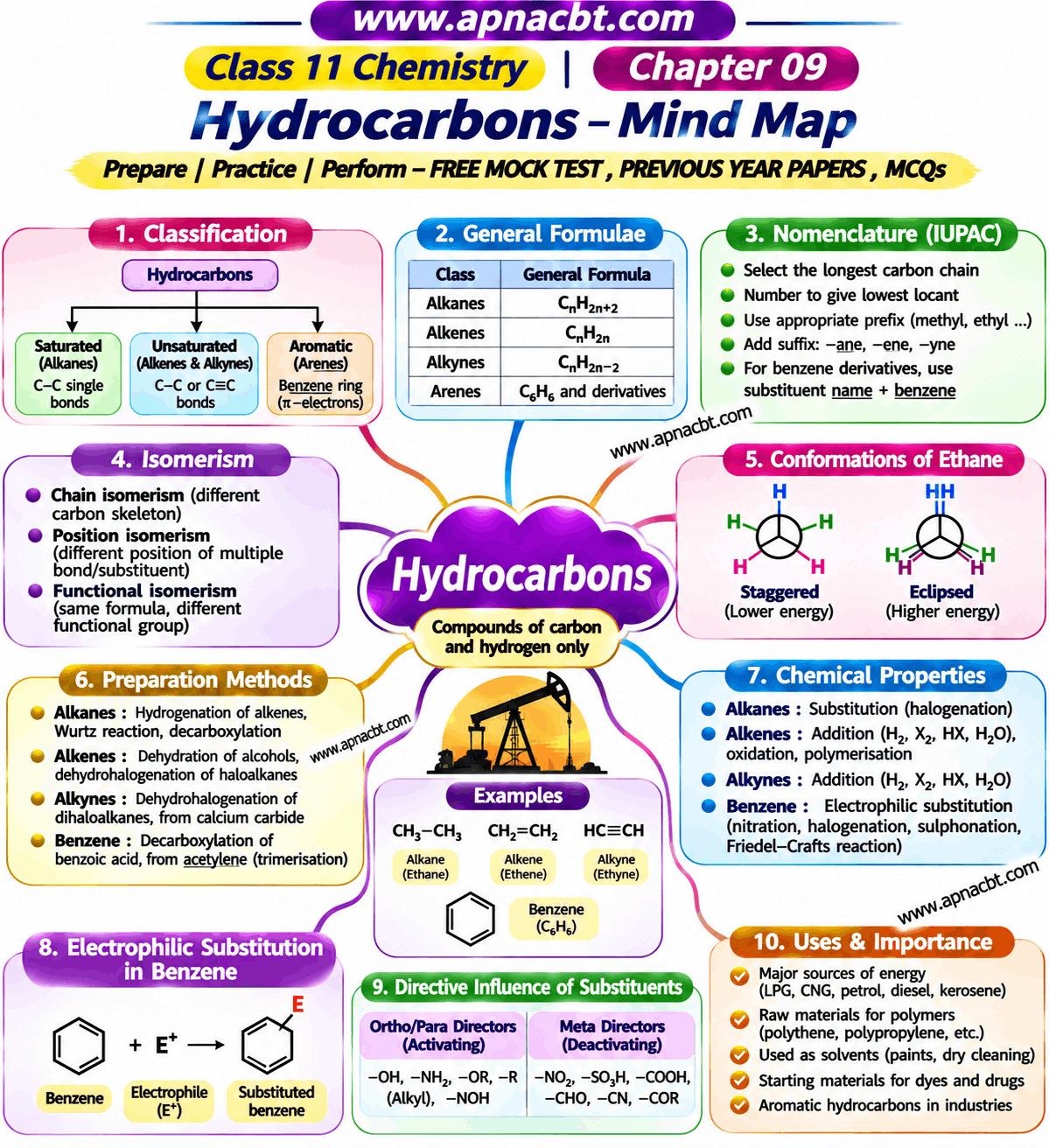
Hydrocarbons Class 11 Chemistry – Chapter 09 Mind Map
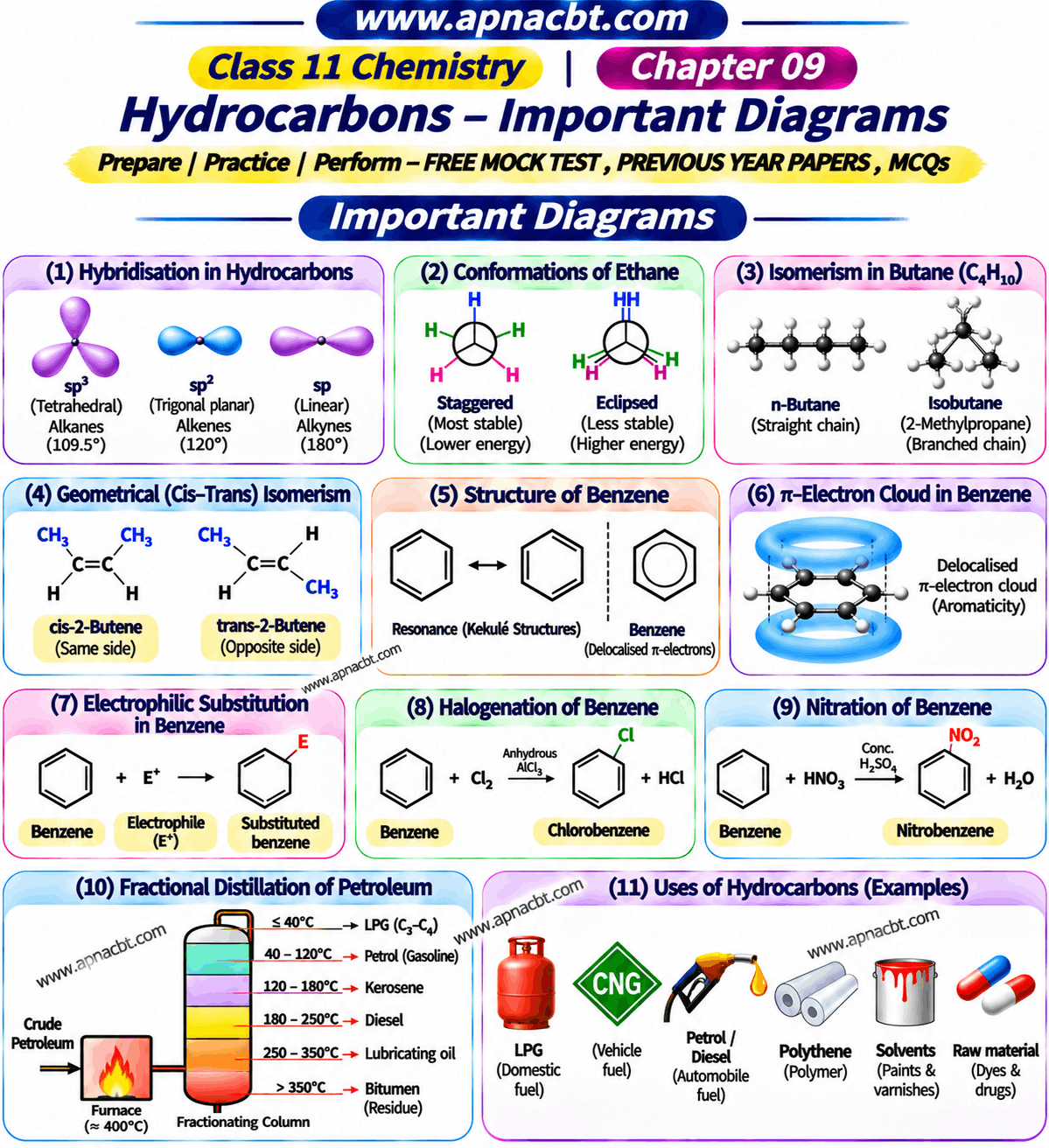
Hydrocarbons Class 11 Chemistry – Important Diagrams
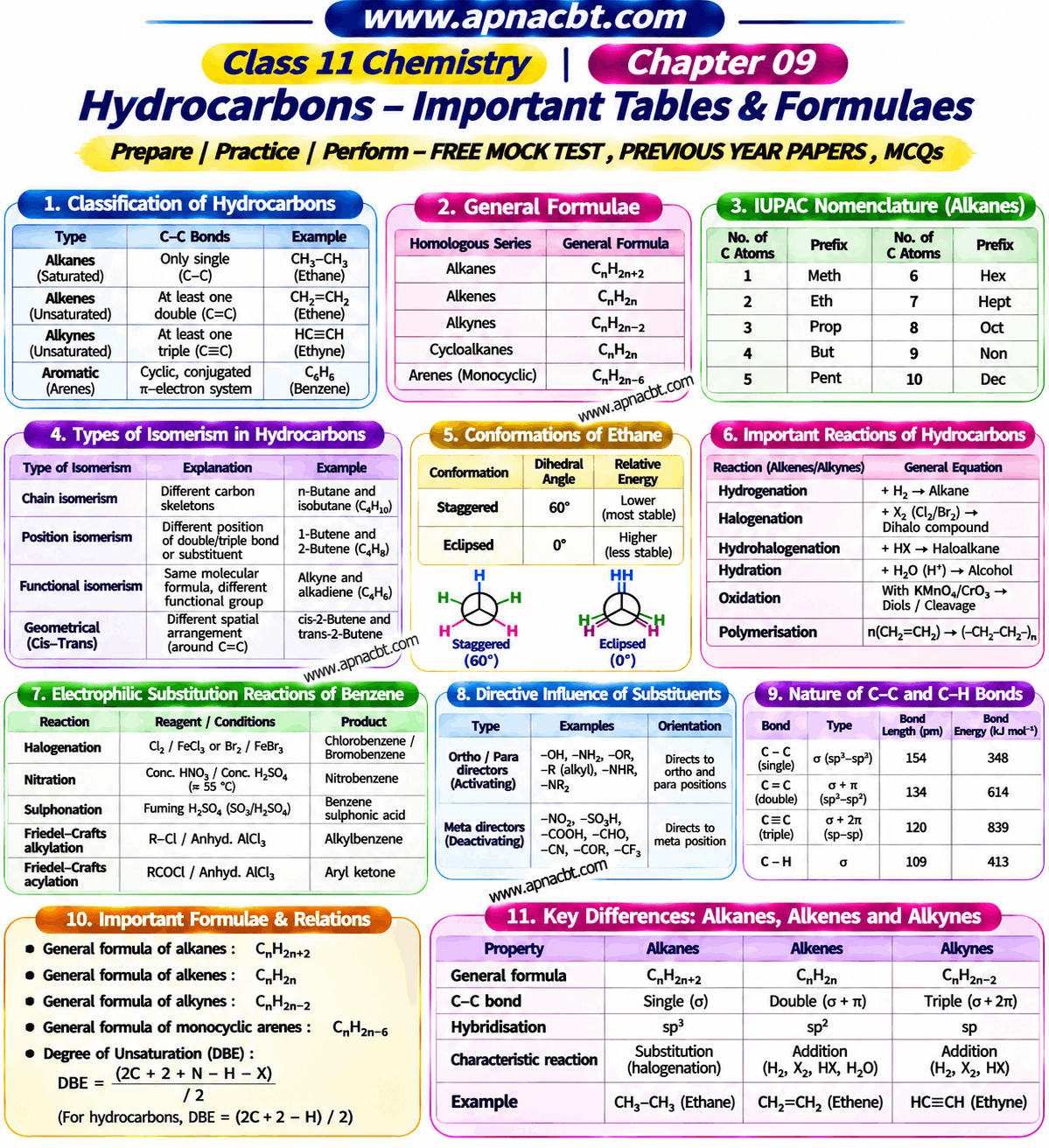
Hydrocarbons Class 11 Chemistry – Important Tables & Formulae