Electric Charges and Fields is a core Class 12 Physics chapter for CBSE, board exams and NEET preparation. This NCERT-based lesson covers electric charge, conductors and insulators, charging by induction, basic properties of charge, Coulomb’s law, superposition, electric field, field lines, electric flux, electric dipole, torque on a dipole, continuous charge distribution and Gauss’s law with its important applications.
Prepare | Practice | Perform – Use the concepts and formulas below for NCERT revision, CBSE board-answer writing and NEET problem solving. The uploaded NCERT-at-your-Fingertips analysis identifies Gauss’s law, electric dipole, Coulomb’s law and electric-field concepts as recurring high-value areas for competitive exams. The NCERT chapter also emphasises quantisation, conservation and additivity of charge, superposition and symmetry-based use of Gauss’s law.
1. Chapter Overview – Electric Charges and Fields
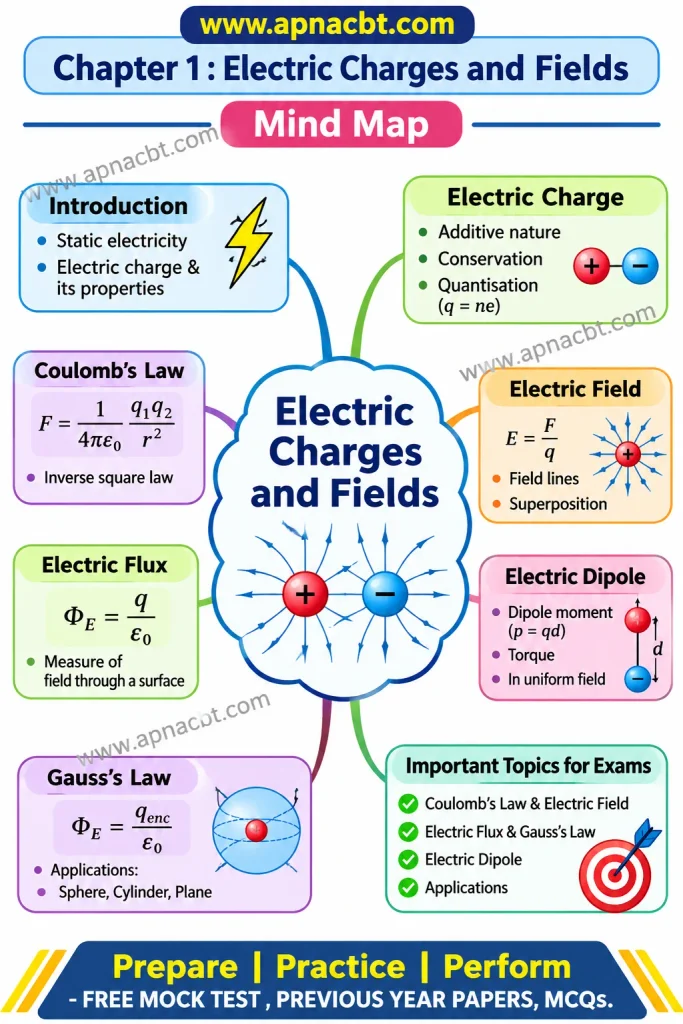
Electric Charges and Fields introduces electrostatics: the study of forces and fields produced by charges at rest. The chapter develops the subject from simple charging experiments to Coulomb’s law, electric field, electric flux and Gauss’s law.
- Charge may be positive or negative; like charges repel and unlike charges attract.
- Charge is additive, conserved and quantised: q = ne.
- Conductors permit comparatively free movement of charge; insulators strongly restrict it.
- Electrostatic force follows Coulomb’s inverse-square law.
- Electric field is a vector quantity and obeys the superposition principle.
- Electric flux measures the electric field passing through a surface.
- Gauss’s law relates net electric flux through a closed surface to enclosed charge.
2. Electric Charge, Conductors, Insulators and Charging
Electric charge
Electric charge is a basic property of matter responsible for electrical interaction. There are two types: positive and negative. Charging generally involves transfer of electrons; charge is not created merely by rubbing two bodies.
Conductors and insulators
Metals, the human body and Earth are conductors because charge carriers can move comparatively freely. Glass, plastic, nylon and many other non-metals are insulators. In a conductor, excess charge can redistribute over its surface.
Charging by induction
Charging by induction uses electrostatic separation of charges in a conductor without direct contact with the charging body. A charged rod brought near a conductor causes redistribution of mobile charges. With grounding and correct separation steps, the conductor can acquire a net charge while the inducing rod retains its charge.
3. Basic Properties of Electric Charge
Additivity
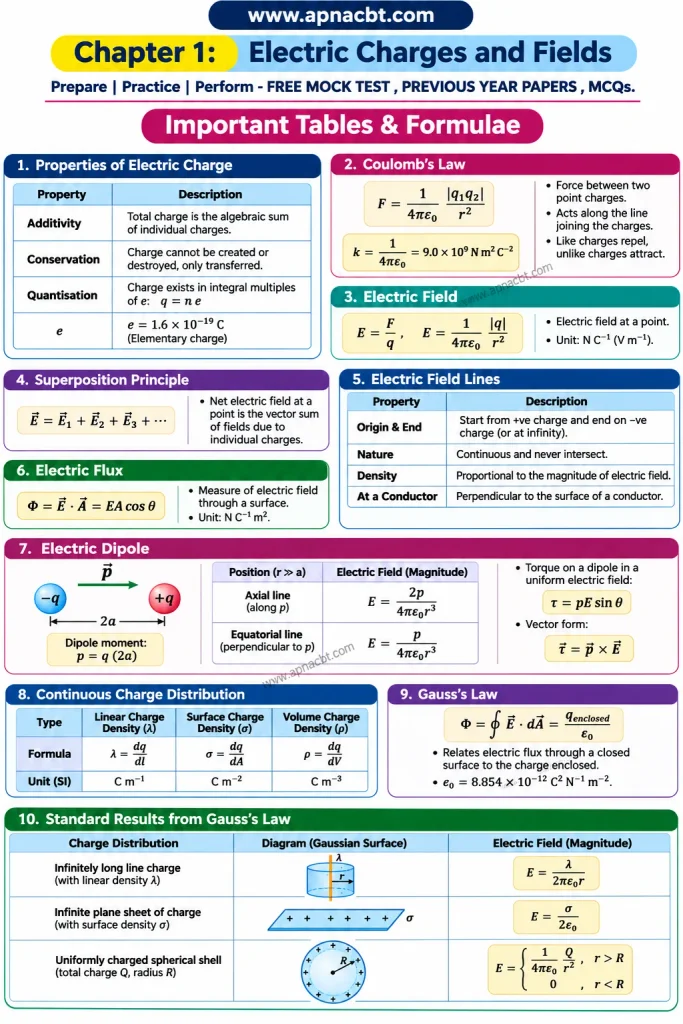
Total charge is the algebraic sum of individual charges: Q = q₁ + q₂ + … + qₙ. Signs must be included.
Conservation
The total charge of an isolated system remains constant. During rubbing, electrons transfer from one body to another; charge is not created or destroyed.
Quantisation
Free charge occurs in integral multiples of the elementary charge: q = ne, where n = 0, ±1, ±2, … and e = 1.6 × 10⁻¹⁹ C.
4. Coulomb’s Law and Superposition Principle
For two point charges q₁ and q₂ separated by distance r in vacuum, the magnitude of electrostatic force is
F = (1/4πε₀) |q₁q₂|/r² = k|q₁q₂|/r²
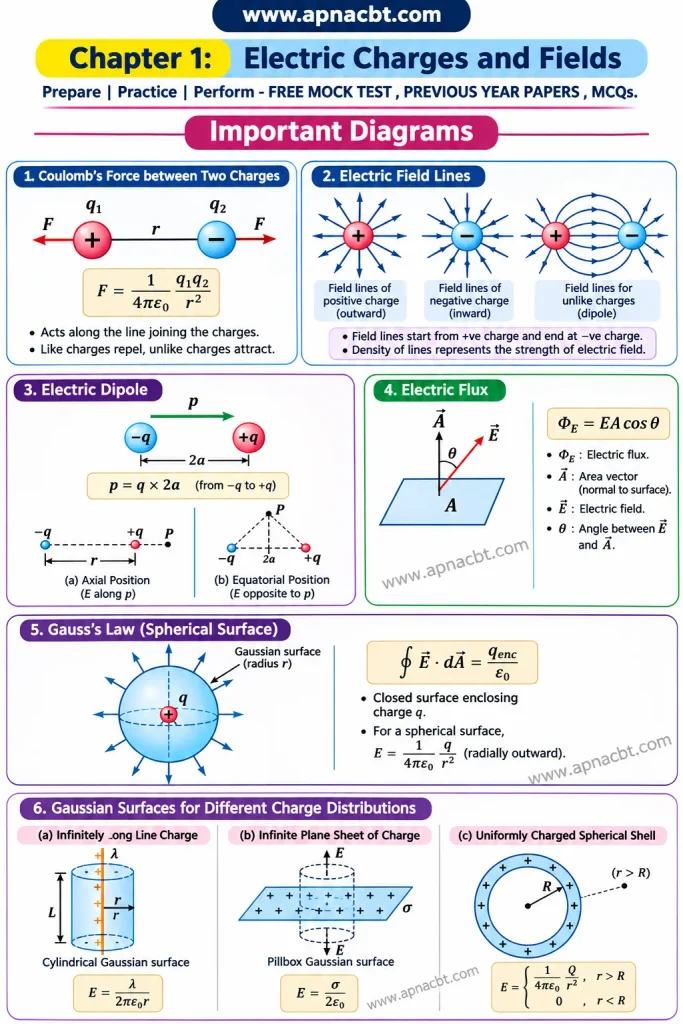
where k ≈ 9 × 10⁹ N m² C⁻². The force is repulsive for like charges and attractive for unlike charges.
Superposition principle
For several charges, the net force is the vector sum of the individual Coulomb forces. Each pairwise force is calculated independently and then added vectorially.
5. Electric Field and Electric Field Lines
The electric field at a point is the force experienced by a unit positive test charge placed at that point. For a point charge Q:
E = (1/4πε₀) Q/r²
and the force on a charge q placed in the field is F = qE.
Field-line properties
- The tangent to a field line gives the field direction.
- Field lines start from positive charge and end on negative charge or infinity.
- Two electrostatic field lines never intersect.
- Greater line density represents a stronger field.
- Electrostatic field lines do not form closed loops.
6. Electric Flux
Electric flux through a small area element is the dot product of electric field and vector area. For a uniform field through a plane surface:
Φ = EA cos θ
where θ is the angle between the electric field and the area vector (normal to the surface). Flux is maximum when θ = 0° and zero when θ = 90°.
The SI unit is N m² C⁻¹. Electric flux is a scalar quantity.
7. Electric Dipole and Dipole Field
An electric dipole consists of equal and opposite charges +q and −q separated by distance 2a. Its dipole moment is
p = q(2a)
and its direction is from the negative charge to the positive charge.
Far-field results
- On the axial line: E = 2p/(4πε₀r³), for r ≫ a.
- On the equatorial line: E = p/(4πε₀r³) in magnitude, directed opposite to p.
- At large distance, dipole field varies as 1/r³, faster than the 1/r² field of a point charge.
8. Dipole in a Uniform External Electric Field
In a uniform electric field, the +q and −q charges of a dipole experience equal and opposite forces. Hence the net force is zero, but the two forces form a couple and produce torque.
τ = pE sin θ and vectorially τ⃗ = p⃗ × E⃗.
- At θ = 0° or 180°, torque is zero.
- At θ = 90°, torque is maximum: τmax = pE.
- The torque tends to align the dipole moment with the electric field.
In a non-uniform field, a dipole can experience a net force as well as torque.
9. Continuous Charge Distribution
When charge is distributed continuously, the charge can be described using density rather than separate point charges.
| Distribution | Symbol | Definition | SI Unit |
|---|---|---|---|
| Linear | λ | dq/dl | C m⁻¹ |
| Surface | σ | dq/dA | C m⁻² |
| Volume | ρ | dq/dV | C m⁻³ |
The electric field of a continuous distribution is obtained by summing the contributions of small charge elements using the superposition principle.
10. Gauss’s Law and Its Applications
Gauss’s law states that the total electric flux through any closed surface is equal to the enclosed charge divided by ε₀:
Φ = qenclosed/ε₀
The law is especially useful when the charge distribution has suitable symmetry. Charges outside a Gaussian surface can contribute to the electric field at the surface, but they do not contribute to qenclosed.
Standard results
| Charge distribution | Electric field |
|---|---|
| Infinite line charge | E = λ/(2πε₀r) |
| Infinite plane sheet | E = σ/(2ε₀) |
| Uniform spherical shell, outside | E = kQ/r² |
| Uniform spherical shell, inside | E = 0 |
12. Short Questions – 30 with Answers
- What is electrostatics?
Answer: Electrostatics is the study of forces, fields and related phenomena produced by charges at rest. - What are the two types of electric charge?
Answer: Positive and negative charges. Like charges repel and unlike charges attract. - State quantisation of charge.
Answer: Charge on a body is an integral multiple of elementary charge: q = ne, where n is an integer. - What is the SI unit of charge?
Answer: Coulomb (C). - What is conservation of charge?
Answer: The total charge of an isolated system remains constant; charging transfers charge rather than creating or destroying net charge. - What is a conductor?
Answer: A material in which electric charges can move comparatively freely, such as a metal. - What is an insulator?
Answer: A material that strongly restricts the movement of electric charge, such as glass or plastic. - What is charging by induction?
Answer: It is charging a conductor through charge redistribution caused by a nearby charged body, followed by suitable grounding and separation. - State Coulomb’s law.
Answer: The electrostatic force between two point charges is proportional to the product of their charges and inversely proportional to the square of their separation. - What is the value of k in vacuum?
Answer: k = 1/(4πε₀) ≈ 9 × 10⁹ N m² C⁻². - What is the principle of superposition?
Answer: The net force or field due to many charges is the vector sum of the individual forces or fields. - Define electric field.
Answer: Electric field at a point is force per unit positive test charge: E = F/q. - What is the SI unit of electric field?
Answer: N/C, equivalently V/m. - What is the direction of field due to a positive point charge?
Answer: Radially outward from the positive charge. - What is the direction of field due to a negative point charge?
Answer: Radially inward toward the negative charge. - Why do field lines not intersect?
Answer: Their tangent gives the unique direction of electric field at a point. Intersection would imply two directions at the same point. - Define electric flux.
Answer: Electric flux through a surface measures the field passing through it and is given for a uniform field by Φ = EA cos θ. - When is electric flux zero for a uniform field?
Answer: When the electric field is parallel to the surface, so the angle with the surface normal is 90°. - When is flux maximum?
Answer: When the field is normal to the surface, so θ = 0° and Φ = EA. - What is an electric dipole?
Answer: A pair of equal and opposite charges separated by a small distance. - Define dipole moment.
Answer: p = q(2a), directed from the negative charge to the positive charge. - What is the SI unit of dipole moment?
Answer: C m. - How does a dipole field vary at large distance?
Answer: Its magnitude varies as 1/r³. - What is the torque on a dipole in a uniform field?
Answer: τ = pE sin θ, with vector form τ⃗ = p⃗ × E⃗. - When is dipole torque maximum?
Answer: At θ = 90°, where τmax = pE. - Define linear charge density.
Answer: λ = dq/dl, charge per unit length. - Define surface charge density.
Answer: σ = dq/dA, charge per unit area. - Define volume charge density.
Answer: ρ = dq/dV, charge per unit volume. - State Gauss’s law.
Answer: Net electric flux through a closed surface equals qenclosed/ε₀. - Why is Gauss’s law useful?
Answer: It simplifies electric-field calculations for highly symmetric charge distributions such as an infinite line, infinite sheet or spherical shell.
13. Long Questions – 15 with Detailed Answers
- Explain the basic properties of electric charge.
Answer: Electric charge has three basic properties. Additivity means charges are added algebraically. Conservation means total charge of an isolated system remains constant. Quantisation means q = ne, where e is the elementary charge and n is an integer. - State and explain Coulomb’s law.
Answer: Coulomb’s law states that electrostatic force is proportional to q₁q₂ and inversely proportional to r². In vacuum, F = (1/4πε₀)|q₁q₂|/r². It acts along the line joining the charges and is repulsive for like charges and attractive for unlike charges. - Explain the principle of superposition of electric forces.
Answer: For several charges, calculate each pairwise Coulomb force independently. The net force is the vector sum of all individual forces, so vector addition is essential in multi-charge systems. - Define electric field and derive the field of a point charge.
Answer: Electric field is force per unit positive test charge. From Coulomb’s law, F = (1/4πε₀)Qq/r², so E = F/q = (1/4πε₀)Q/r². The field is outward for positive Q and inward for negative Q. - Explain the important properties of electric field lines.
Answer: Field lines show field direction through their tangent. They start from positive charges and end on negative charges or infinity, never intersect, and are denser where the field is stronger. Electrostatic field lines do not form closed loops. - Explain electric flux through a plane surface.
Answer: For a uniform field, Φ = E·A = EA cos θ, where A is the vector area normal to the surface. Flux is maximum at θ = 0° and zero at θ = 90°. SI unit: N m² C⁻¹. - Define an electric dipole and obtain its dipole moment.
Answer: An electric dipole consists of +q and −q separated by 2a. Its dipole moment is p = q(2a), directed from −q to +q. Its net charge is zero, but its field is generally non-zero because the charges are separated. - Compare the electric field of a dipole on its axial and equatorial positions.
Answer: At large distance r ≫ a, the axial field magnitude is Eaxial = 2p/(4πε₀r³), while the equatorial field magnitude is Eequatorial = p/(4πε₀r³). Therefore the axial field is twice the equatorial field at the same distance. The equatorial field is opposite to the dipole moment direction. - Explain the torque on an electric dipole in a uniform electric field.
Answer: The charges experience equal and opposite forces, giving zero net force. Because the forces act at different points, they form a couple. Thus τ = pE sin θ and τ⃗ = p⃗ × E⃗. The torque tends to align p with E. - Explain continuous charge distribution and its densities.
Answer: Continuous charge is described by density: λ = dq/dl, σ = dq/dA and ρ = dq/dV. The field is found by adding the contributions of small charge elements using superposition. - State Gauss’s law and explain the meaning of enclosed charge.
Answer: Gauss’s law gives Φ = qenclosed/ε₀. Enclosed charge is the algebraic sum of charges inside the Gaussian surface. Outside charges may affect E on the surface but are not included in qenclosed. The law is valid for any closed surface. - Derive the electric field due to an infinitely long uniformly charged wire.
Answer: Choose a coaxial cylinder of radius r and length L. By symmetry, E is constant on its curved surface and flux through the ends is zero. Thus E(2πrL) = λL/ε₀, giving E = λ/(2πε₀r). - Derive the electric field due to an infinite plane sheet of charge.
Answer: Use a pillbox crossing the sheet. The field is normal to both faces and the curved-surface flux is zero. Hence total flux is 2EA and enclosed charge is σA. Gauss’s law gives 2EA = σA/ε₀, so E = σ/(2ε₀). - Explain the electric field due to a uniformly charged spherical shell.
Answer: Use a concentric spherical Gaussian surface. Outside, E(4πr²) = Q/ε₀, so E = Q/(4πε₀r²). Inside, enclosed charge is zero, so E = 0. Thus the shell behaves like a point charge at the centre for exterior points. - Why is Gauss’s law particularly useful for symmetric charge distributions?
Answer: Gauss’s law is easiest to apply when symmetry makes E constant and its direction known on the Gaussian surface: cylindrical symmetry for a line charge, planar symmetry for a sheet and spherical symmetry for a shell or sphere.
14. Final Revision – Formula Sheet
| Concept | Formula |
|---|---|
| Quantisation | q = ne |
| Coulomb force | F = k|q₁q₂|/r² |
| Electric field of point charge | E = kQ/r² |
| Force in electric field | F = qE |
| Electric flux | Φ = EA cos θ |
| Dipole moment | p = q(2a) |
| Dipole axial field, far point | E = 2p/(4πε₀r³) |
| Dipole equatorial field, far point | E = p/(4πε₀r³) |
| Dipole torque | τ = pE sin θ |
| Gauss’s law | Φ = qenclosed/ε₀ |
| Infinite line charge | E = λ/(2πε₀r) |
| Infinite plane sheet | E = σ/(2ε₀) |
| Spherical shell outside | E = kQ/r² |
| Spherical shell inside | E = 0 |
Final tip: For CBSE, practise definitions, derivations and diagrams. For NEET, repeatedly revise the formula sheet and practise Coulomb’s law, electric field, electric dipole, flux and Gauss’s law.