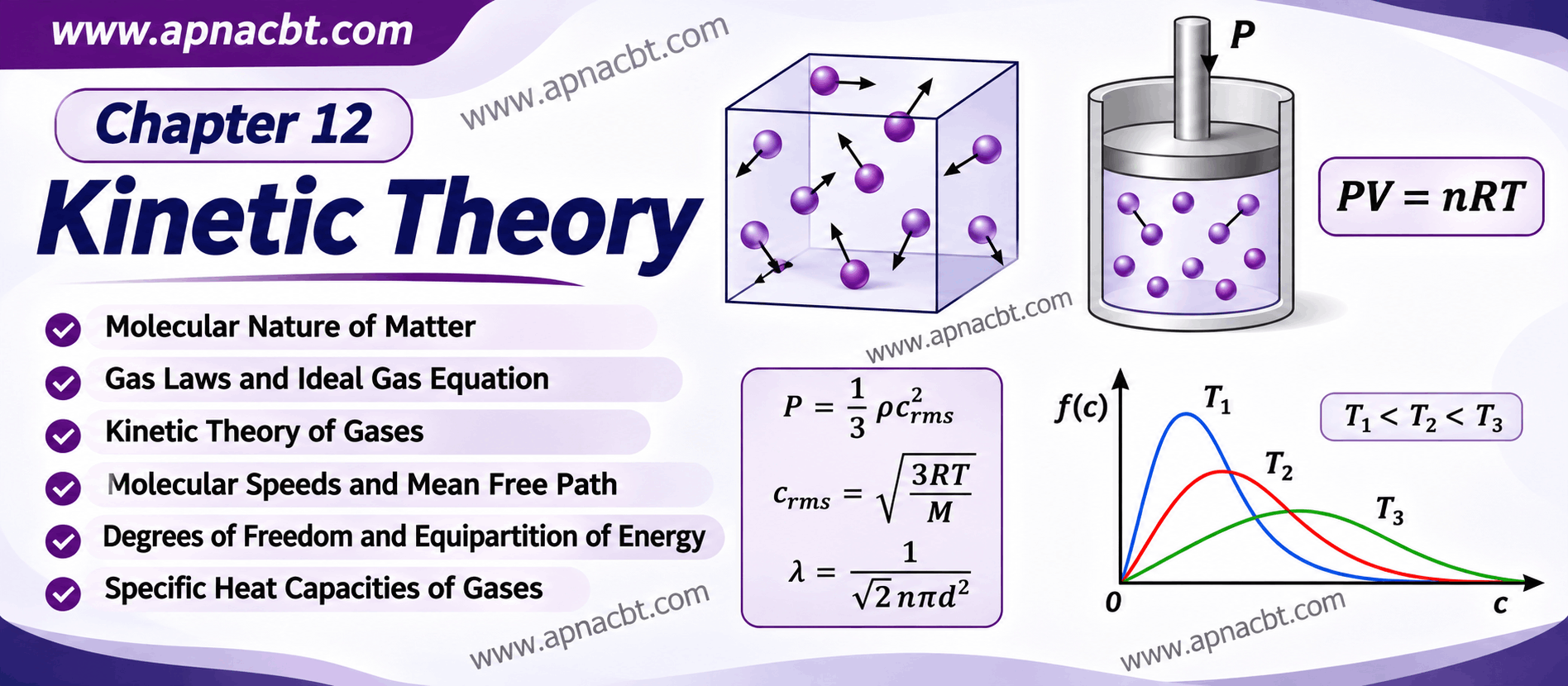
Kinetic Theory explains the macroscopic behaviour of gases in terms of the motion and collisions of their molecules. This chapter connects pressure, temperature and volume with molecular motion, kinetic energy, molecular speeds, degrees of freedom and the law of equipartition of energy.
These notes cover the important concepts, definitions, laws, derivations and formulae for CBSE Class 11 Physics board examinations and NEET preparation.
1. Molecular Nature of Matter
Atomic and molecular nature of matter
Matter is made up of tiny particles called atoms and molecules. These particles are in continuous motion and exert forces on one another. The properties of a substance depend on the nature, arrangement and motion of its constituent particles.
- Atom: The smallest unit of an element that takes part in chemical combination.
- Molecule: A group of two or more atoms chemically bonded together and capable of independent existence.
- Intermolecular space: The space between molecules.
- Intermolecular force: The force of attraction or repulsion between molecules.
Dalton’s atomic theory
- All matter is made up of atoms.
- Atoms of the same element have similar chemical properties.
- Atoms combine in simple whole-number ratios to form compounds.
- In a chemical reaction, atoms are rearranged; they are not created or destroyed.
Avogadro’s law
Equal volumes of all gases, at the same temperature and pressure, contain equal numbers of molecules.
2. Gas Laws
The experimental gas laws describe the relationship between pressure (P), volume (V), temperature (T) and amount of gas.
Boyle’s law
For a fixed mass of gas at constant temperature, the pressure is inversely proportional to its volume.
P ∝ 1/V; therefore, PV = constant or P₁V₁ = P₂V₂.
Charles’ law
At constant pressure, the volume of a fixed mass of gas is directly proportional to its absolute temperature.
V ∝ T; therefore, V/T = constant or V₁/T₁ = V₂/T₂.
Pressure law (Gay-Lussac’s law)
At constant volume, the pressure of a fixed mass of gas is directly proportional to its absolute temperature.
P ∝ T; therefore, P/T = constant or P₁/T₁ = P₂/T₂.
Avogadro’s law
At the same pressure and temperature, equal volumes of gases contain equal numbers of molecules. Hence, V ∝ n.
Combined gas law and ideal gas equation
For a fixed amount of gas, PV/T = constant. For n moles, the ideal gas equation is:
PV = nRT = NkBT
- P = pressure, V = volume, T = absolute temperature in kelvin.
- n = number of moles; R = universal gas constant.
- N = number of molecules; kB = Boltzmann constant.
3. Ideal Gas Equation and Gas Constants
Ideal gas
An ideal gas is a theoretical gas that obeys the gas equation PV = nRT under all conditions. Real gases approach ideal behaviour at sufficiently low pressure and high temperature.
Different forms of the ideal gas equation
- For n moles: PV = nRT.
- For N molecules: PV = NkBT.
- Using mass m and molar mass M: PV = (m/M)RT.
- Using number density N/V: P = (N/V)kBT.
Gas constants
Universal gas constant: R ≈ 8.314 J mol⁻¹ K⁻¹.
Boltzmann constant: kB = R/NA ≈ 1.38 × 10⁻²³ J K⁻¹.
Avogadro constant: NA ≈ 6.022 × 10²³ mol⁻¹.
Dalton’s law of partial pressures
For a mixture of non-reacting ideal gases, the total pressure is the sum of the partial pressures exerted by the individual gases:
P = P₁ + P₂ + P₃ + …
The partial pressure of a component is the pressure it would exert if it alone occupied the entire volume at the same temperature.
4. Kinetic Theory of an Ideal Gas
Kinetic theory explains the behaviour of an ideal gas by considering its molecules as tiny particles moving randomly and continuously. The measurable properties of a gas arise from the motion and collisions of these molecules.
Main assumptions of kinetic theory
- A gas consists of a very large number of molecules.
- The size of each molecule is negligible compared with the distance between molecules.
- Molecules are in continuous, random motion and obey Newton’s laws of motion.
- Between collisions, molecules move in straight lines with constant velocities.
- Collisions between molecules and with the walls of the container are perfectly elastic.
- Intermolecular forces are negligible except during collisions.
- The time spent in collisions is negligible compared with the time between successive collisions.
- Molecules have a range of speeds and directions; motion is random and there is no preferred direction.
Pressure due to molecular collisions
Gas molecules continuously collide with the walls of the container. The change in molecular momentum produces a force on the walls. Pressure is the normal force per unit area exerted by these collisions.
Equivalent forms are P = (1/3)(Nm/V)m₀crms² and PV = (1/3)Nm₀crms², where m₀ is the mass of one molecule.
Physical meaning
Pressure is a macroscopic effect of molecular motion. Increasing the average squared molecular speed increases the pressure if the number density remains unchanged.
5. Kinetic Interpretation of Temperature
Combining the kinetic theory expression for pressure with the ideal gas equation gives a direct relation between the average translational kinetic energy of a molecule and the absolute temperature.
(1/2)m₀crms² = (3/2)kBT
Therefore, the average translational kinetic energy per molecule is:
Average translational kinetic energy = (3/2)kBT
For one mole of an ideal gas, the total translational kinetic energy is (3/2)RT.
Important conclusions
- Absolute temperature is a measure of the average translational kinetic energy of gas molecules.
- At the same temperature, all ideal gases have the same average translational kinetic energy per molecule.
- The average kinetic energy is directly proportional to absolute temperature.
- At a given temperature, molecules of different gases generally have different speeds because their molecular masses differ.
6. Molecular Speeds: RMS, Average and Most Probable Speed
Gas molecules do not all move with the same speed. Their speeds are distributed over a range. Three useful measures are root-mean-square speed, average speed and most probable speed.
Root-mean-square speed
crms = √(3kBT/m₀) = √(3RT/M) = √(3P/ρ)
Average speed
For a Maxwell distribution of molecular speeds:
cavg = √(8kBT/πm₀) = √(8RT/πM)
Most probable speed
cmp = √(2kBT/m₀) = √(2RT/M)
Comparison
crms > cavg > cmp
All three characteristic speeds are proportional to √T and inversely proportional to the square root of molar mass. At the same temperature, lighter gas molecules have higher characteristic speeds.
7. Mean Free Path and Collision Frequency
Mean free path
The mean free path is the average distance travelled by a molecule between two successive collisions.
For hard-sphere molecules of diameter d and number density nv = N/V:
λ = 1/(√2 πd²nv)
Using the ideal gas equation, it can also be written as:
λ = kBT/(√2 πd²P)
Factors affecting mean free path
- At fixed temperature, increasing pressure increases number density and decreases mean free path.
- At fixed pressure, increasing temperature increases mean free path for a gas with fixed molecular diameter.
- A larger molecular diameter results in a smaller mean free path.
Collision frequency
Collision frequency is the average number of collisions made by a molecule per unit time. In the simple kinetic model, it is related to the mean speed and mean free path by z = cavg/λ.
Graham’s law of diffusion
Diffusion is the intermixing of gases due to the random motion of their molecules. At the same temperature and pressure, the rate of diffusion of a gas is inversely proportional to the square root of its density or molar mass.
r₁/r₂ = √(d₂/d₁) = √(M₂/M₁), where r is the rate of diffusion, d is gas density and M is molar mass.
Brownian motion
Brownian motion is the continuous, irregular zigzag motion of small particles suspended in a fluid. It occurs because the suspended particles are struck unevenly by the rapidly moving molecules of the surrounding fluid. It provides evidence for the molecular motion of matter.
8. Degrees of Freedom
The degrees of freedom of a molecule are the number of independent coordinates or modes of motion required to describe its energy. They determine how energy is distributed among the accessible motions of molecules.
Types of molecular motion
- Translational motion: Motion of the centre of mass along the x, y and z directions. It contributes three degrees of freedom.
- Rotational motion: Rotation of a molecule about axes through its centre of mass.
- Vibrational motion: Periodic motion of atoms within a molecule. Each active vibrational mode contributes two quadratic energy terms.
Common molecular models
- Monoatomic gas: 3 translational degrees of freedom; f = 3.
- Linear diatomic gas at ordinary temperatures: 3 translational + 2 rotational degrees of freedom; f = 5 when vibration is neglected.
- Non-linear polyatomic gas at ordinary temperatures: 3 translational + 3 rotational degrees of freedom; f = 6 when vibration is neglected.
9. Law of Equipartition of Energy
The law of equipartition of energy states that, at thermal equilibrium, energy is equally distributed among all independent quadratic degrees of freedom. Each such degree of freedom contributes an average energy of (1/2)kBT per molecule.
Average energy per molecule
For a molecule with f active quadratic degrees of freedom:
U per molecule = (f/2)kBT
Internal energy of n moles
U = (f/2)nRT
Examples
- Monoatomic gas (f = 3): U = (3/2)nRT.
- Linear diatomic gas with vibration neglected (f = 5): U = (5/2)nRT.
- Non-linear polyatomic gas with vibration neglected (f = 6): U = 3nRT.
10. Specific Heat Capacities of Gases
The specific heat capacity of a gas depends on the condition under which heat is supplied. The two important molar heat capacities are at constant volume and at constant pressure.
Molar heat capacity at constant volume (Cᵥ)
It is the heat required to raise the temperature of one mole of a gas by one kelvin while keeping its volume constant.
Cᵥ = (1/n)(dQ/dT)V
Molar heat capacity at constant pressure (Cₚ)
It is the heat required to raise the temperature of one mole of a gas by one kelvin while keeping its pressure constant.
Cₚ = (1/n)(dQ/dT)P
At constant pressure, some supplied heat is used to do expansion work. Therefore, for an ideal gas, Cₚ > Cᵥ.
Mayer’s relation
Cₚ − Cᵥ = R
Ratio of specific heats
γ = Cₚ/Cᵥ
For an ideal gas with f active degrees of freedom:
Cᵥ = (f/2)R, Cₚ = ((f+2)/2)R, and γ = (f+2)/f.
11. Specific Heat Capacities of Monoatomic, Diatomic and Polyatomic Gases
Monoatomic gases
For a monoatomic ideal gas, only three translational degrees of freedom are active in the basic model.
- f = 3
- Cᵥ = 3R/2
- Cₚ = 5R/2
- γ = 5/3
Diatomic gases
At ordinary temperatures, a linear diatomic molecule is commonly treated as having three translational and two rotational degrees of freedom; vibrational motion is neglected.
- f = 5
- Cᵥ = 5R/2
- Cₚ = 7R/2
- γ = 7/5
Non-linear polyatomic gases
For a non-linear polyatomic molecule with three translational and three rotational degrees of freedom, with vibration neglected:
- f = 6
- Cᵥ = 3R
- Cₚ = 4R
- γ = 4/3
12. Important Formulae and Board / NEET Revision Points
Gas laws and ideal gas
- Boyle’s law: PV = constant (T constant).
- Charles’ law: V/T = constant (P constant).
- Pressure law: P/T = constant (V constant).
- Ideal gas equation: PV = nRT = NkBT.
- Dalton’s law: P = P₁ + P₂ + …
Kinetic theory
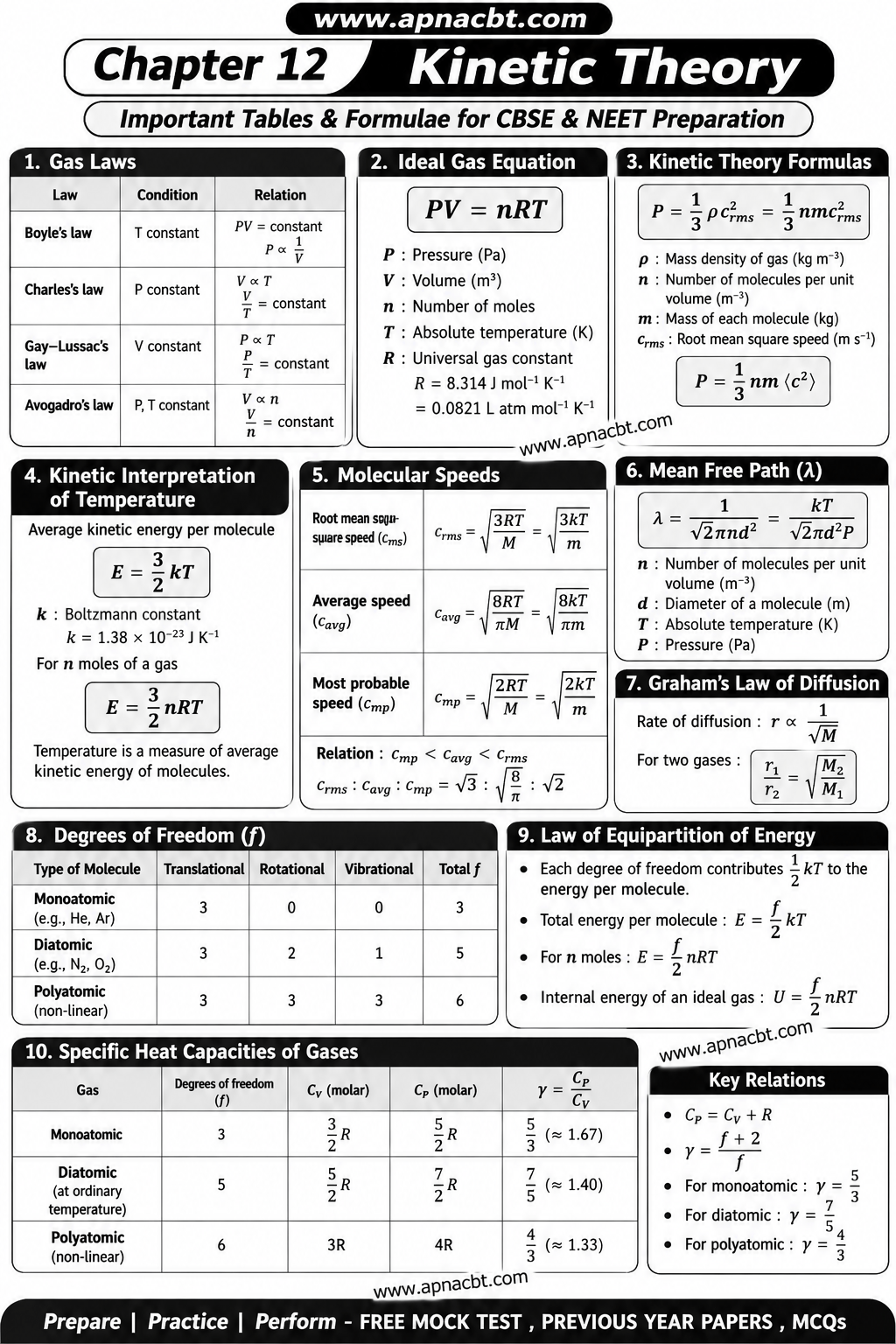
- P = (1/3)ρcrms².
- (1/2)m₀crms² = (3/2)kBT.
- Average translational kinetic energy per molecule = (3/2)kBT.
- crms = √(3RT/M).
- cavg = √(8RT/πM).
- cmp = √(2RT/M).
- crms > cavg > cmp.
Mean free path and molecular energy
- λ = 1/(√2πd²nv).
- Energy per molecule = (f/2)kBT.
- Internal energy of n moles = (f/2)nRT.
Heat capacities
- Cᵥ = (f/2)R.
- Cₚ = ((f+2)/2)R.
- Cₚ − Cᵥ = R.
- γ = Cₚ/Cᵥ = (f+2)/f.
Important conceptual points
- Gas pressure is caused by molecular collisions with container walls.
- Temperature is proportional to average translational kinetic energy.
- At equal temperature, different ideal gases have equal average translational kinetic energy per molecule.
- At equal temperature, lighter molecules have greater characteristic speeds.
- For an ideal gas, internal energy depends only on temperature.
- At constant pressure, Cₚ is greater than Cᵥ because the gas also performs expansion work.
13. Short-Answer Questions – 30 Questions
Answer all questions. Answers are provided together after the complete question list.
- What is meant by the molecular nature of matter?
- State Avogadro’s law.
- State Boyle’s law and write its mathematical expression.
- State Charles’ law.
- State the pressure law for a fixed mass of gas.
- Write the ideal gas equation and explain its symbols.
- What is an ideal gas?
- State Dalton’s law of partial pressures.
- What is the value and SI unit of the universal gas constant?
- Write the relation between the Boltzmann constant and the universal gas constant.
- List any four assumptions of the kinetic theory of an ideal gas.
- How is the pressure of a gas produced according to kinetic theory?
- Write the kinetic theory expression for the pressure of an ideal gas.
- What is the relation between average translational kinetic energy and absolute temperature?
- Define root-mean-square speed.
- Write the expression for the RMS speed of gas molecules.
- Define average speed of gas molecules.
- What is the most probable speed?
- Write the order of RMS, average and most probable speeds.
- What is mean free path?
- Write the expression for mean free path in terms of molecular diameter and number density.
- What are degrees of freedom?
- How many degrees of freedom does a monoatomic ideal gas have in the basic model?
- State the law of equipartition of energy.
- Write the average energy per molecule for f active degrees of freedom.
- Define molar specific heat capacity at constant volume.
- Define molar specific heat capacity at constant pressure.
- State Mayer’s relation for an ideal gas.
- Define the ratio of specific heats and write its expression.
- Why is Cₚ greater than Cᵥ for an ideal gas?
Answers to Short-Answer Questions
- Matter consists of tiny particles called atoms and molecules. These particles are in continuous motion and interact with one another.
- Equal volumes of all gases at the same temperature and pressure contain equal numbers of molecules. At constant T and P, V ∝ n.
- For a fixed mass of gas at constant temperature, pressure is inversely proportional to volume. PV = constant or P₁V₁ = P₂V₂.
- At constant pressure, the volume of a fixed mass of gas is directly proportional to its absolute temperature: V/T = constant.
- At constant volume, pressure is directly proportional to absolute temperature: P/T = constant.
- PV = nRT = NkBT, where P is pressure, V is volume, n is moles, R is universal gas constant, N is number of molecules and kB is Boltzmann constant.
- An ideal gas is a theoretical gas that obeys PV = nRT under all conditions.
- The total pressure of a mixture of non-reacting gases is the sum of their partial pressures: P = P₁ + P₂ + …
- R ≈ 8.314 J mol⁻¹ K⁻¹.
- kB = R/NA, where NA is Avogadro’s constant.
- Any four: molecules are numerous; molecular volume is negligible; motion is random; molecules obey Newton’s laws; collisions are elastic; intermolecular forces are negligible except during collisions.
- Gas molecules collide with the container walls and change their momentum. The resulting force per unit area produces gas pressure.
- P = (1/3)ρcrms², where ρ is gas density and crms is RMS speed.
- The average translational kinetic energy per molecule is (3/2)kBT.
- RMS speed is the square root of the mean of the squares of the molecular speeds.
- crms = √(3kBT/m₀) = √(3RT/M).
- Average speed is the arithmetic mean of the magnitudes of the speeds of all molecules. For a Maxwell distribution, cavg = √(8RT/πM).
- Most probable speed is the speed possessed by the largest number of molecules: cmp = √(2RT/M).
- crms > cavg > cmp.
- Mean free path is the average distance travelled by a molecule between two successive collisions.
- λ = 1/(√2πd²nv), where d is molecular diameter and nv is number density.
- Degrees of freedom are the number of independent coordinates or modes of motion needed to describe the energy of a molecule.
- Three translational degrees of freedom.
- At thermal equilibrium, energy is equally distributed among independent quadratic degrees of freedom, each contributing (1/2)kBT per molecule.
- Average energy per molecule = (f/2)kBT.
- Cᵥ is the heat required to raise the temperature of one mole of gas by one kelvin at constant volume.
- Cₚ is the heat required to raise the temperature of one mole of gas by one kelvin at constant pressure.
- Cₚ − Cᵥ = R.
- γ is the ratio of molar heat capacity at constant pressure to that at constant volume: γ = Cₚ/Cᵥ.
- At constant pressure, the gas expands and performs external work. At constant volume, no expansion work is done; hence Cₚ > Cᵥ.
14. Long-Answer Questions – 15 Questions
Answer all questions. Detailed answers are provided together after the complete question list.
- Explain Boyle’s law, Charles’ law, pressure law and Avogadro’s law. Obtain the ideal gas equation.
- State the assumptions of the kinetic theory of an ideal gas and explain how gas pressure arises.
- Derive the expression P = (1/3)ρcrms² for the pressure of an ideal gas.
- Using the kinetic theory and ideal gas equation, obtain the relation between average translational kinetic energy and absolute temperature.
- Explain RMS speed, average speed and most probable speed. Write their expressions and compare them.
- Define mean free path and obtain its expression for hard-sphere molecules. Explain the factors affecting it.
- Explain degrees of freedom and state the degrees of freedom of monoatomic, linear diatomic and non-linear polyatomic gases under the usual low-temperature model.
- State and explain the law of equipartition of energy. Obtain the expression for the internal energy of an ideal gas with f degrees of freedom.
- Derive expressions for Cᵥ, Cₚ and γ of an ideal gas in terms of its degrees of freedom.
- Explain Mayer’s relation and show why Cₚ − Cᵥ = R for one mole of an ideal gas.
- Obtain the molar heat capacities and ratio of specific heats for monoatomic, diatomic and non-linear polyatomic ideal gases, neglecting vibration.
- Explain the kinetic interpretation of temperature and discuss its important consequences.
- What is Dalton’s law of partial pressures? Explain partial pressure and write its relation for a mixture of ideal gases.
- A gas has density ρ and RMS speed crms. Derive the relation between its pressure, density and RMS speed, and explain the physical meaning of the result.
- Explain the important formulae of kinetic theory and describe how molecular mass and temperature affect the characteristic speeds of gas molecules.
Detailed Answers to Long-Answer Questions
- Gas laws and ideal gas equation:
Boyle’s law states that at constant temperature, PV = constant. Charles’ law states that at constant pressure, V/T = constant. The pressure law states that at constant volume, P/T = constant. Avogadro’s law states that at the same temperature and pressure, V ∝ n. Combining these proportionalities gives V ∝ nT/P, or PV ∝ nT. Introducing the universal gas constant R gives PV = nRT. Since n = N/NA and kB = R/NA, the equation can also be written as PV = NkBT. - Assumptions and origin of pressure:
An ideal gas contains a very large number of molecules. Their individual volumes are negligible compared with the container volume. Molecules move randomly, obey Newton’s laws and travel in straight lines between collisions. Collisions with one another and with the walls are perfectly elastic. Intermolecular forces are negligible except during collisions, and collision duration is negligible. When molecules strike a wall, their momentum normal to the wall changes. The wall experiences an equal and opposite impulse. The total force due to many collisions divided by the wall area is the gas pressure. - Pressure expression:
Consider N molecules, each of mass m₀, in a cubical container of side L. For a molecule with x-component of velocity cx, the momentum change at a collision with a wall perpendicular to x is 2m₀cx. The time between successive collisions with that wall is 2L/cx. Hence the average force due to this molecule is m₀cx²/L. Summing over all molecules, F = (m₀/L)Σcxi². Since area is L², P = (m₀/L³)Σcxi². Random motion gives equal mean squared components: mean(cx²) = mean(cy²) = mean(cz²) = (1/3)mean(c²). Therefore P = (1/3)(Nm₀/V)crms². Since ρ = Nm₀/V, P = (1/3)ρcrms². - Kinetic energy and temperature:
The kinetic theory equation is PV = (1/3)Nm₀crms². The ideal gas equation is PV = NkBT. Equating the right-hand sides gives (1/3)Nm₀crms² = NkBT. Dividing by N and multiplying by 3/2 gives (1/2)m₀crms² = (3/2)kBT. The left side is the average translational kinetic energy per molecule. Thus average translational kinetic energy is directly proportional to absolute temperature. - Three characteristic speeds:
RMS speed is the square root of the mean square speed: crms = √(3RT/M). Average speed is the arithmetic mean of molecular speed magnitudes: cavg = √(8RT/πM). Most probable speed is the speed corresponding to the maximum of the Maxwell speed distribution: cmp = √(2RT/M). Their order is crms > cavg > cmp. All are proportional to √T and inversely proportional to √M. - Mean free path:
Mean free path is the average distance travelled by a molecule between successive collisions. For hard-sphere molecules of diameter d and number density nv, the collision cross-section is πd². Accounting for relative molecular motion gives λ = 1/(√2πd²nv). Since nv = P/(kBT), λ = kBT/(√2πd²P). Thus, for fixed molecular size, mean free path decreases as pressure increases and increases with temperature at fixed pressure. - Degrees of freedom:
Degrees of freedom are the independent coordinates or modes that contribute to the energy of a molecule. A monoatomic molecule has three translational degrees of freedom. A linear diatomic molecule has three translational and two rotational degrees of freedom when vibration is neglected, giving f = 5. A non-linear polyatomic molecule has three translational and three rotational degrees of freedom under the same approximation, giving f = 6. Vibrational modes may become active at higher temperatures. - Equipartition and internal energy:
The law of equipartition states that each independent quadratic degree of freedom contributes an average energy (1/2)kBT per molecule at thermal equilibrium. For f degrees of freedom, average energy per molecule is (f/2)kBT. For N molecules, U = (f/2)NkBT. As NkB = nR, the internal energy is U = (f/2)nRT. This expression applies to an ideal gas with f active quadratic degrees of freedom. - Heat capacities:
For n moles, U = (f/2)nRT. At constant volume, dQ = dU, so Cᵥ = (1/n)(dU/dT) = (f/2)R. For an ideal gas, Mayer’s relation gives Cₚ = Cᵥ + R = ((f+2)/2)R. Therefore γ = Cₚ/Cᵥ = (f+2)/f. These are molar heat capacities. - Mayer’s relation:
For one mole of an ideal gas, the first law gives dQ = dU + P dV. At constant pressure, dQ = CₚdT. The internal energy change is dU = CᵥdT. From PV = RT, at constant pressure P dV = R dT. Thus CₚdT = CᵥdT + R dT. Dividing by dT gives Cₚ − Cᵥ = R. The difference exists because a gas supplied heat at constant pressure expands and performs work. - Heat capacities of gas types:
For a monoatomic gas, f = 3: Cᵥ = 3R/2, Cₚ = 5R/2 and γ = 5/3. For a linear diatomic gas with vibration neglected, f = 5: Cᵥ = 5R/2, Cₚ = 7R/2 and γ = 7/5. For a non-linear polyatomic gas with vibration neglected, f = 6: Cᵥ = 3R, Cₚ = 4R and γ = 4/3. These results follow from Cᵥ = fR/2, Cₚ = (f+2)R/2 and γ = (f+2)/f. - Kinetic interpretation of temperature:
Temperature is related to the average translational kinetic energy of molecules through (1/2)m₀crms² = (3/2)kBT. At a given temperature, all ideal gases have the same average translational kinetic energy per molecule, regardless of molecular mass. Lighter molecules therefore move faster on average than heavier molecules at the same temperature. Increasing absolute temperature increases the average translational kinetic energy and characteristic molecular speeds. - Dalton’s law:
The partial pressure of a gas in a mixture is the pressure it would exert if it alone occupied the full container volume at the mixture temperature. For a mixture of non-reacting ideal gases, the total pressure equals the sum of partial pressures: P = P₁ + P₂ + … + Pᵣ. For component i, PᵢV = nᵢRT. The law follows from the independent molecular contributions of the different gases to the total pressure. - Pressure, density and RMS speed:
From the kinetic theory of gases, PV = (1/3)Nm₀crms². Dividing by V gives P = (1/3)(Nm₀/V)crms². The mass density is ρ = Nm₀/V. Substitution gives P = (1/3)ρcrms². This shows that pressure increases with density and with the mean square molecular speed. - Formulae and dependence of molecular speeds:
The ideal gas equation is PV = nRT = NkBT. Pressure is P = (1/3)ρcrms². Average translational kinetic energy per molecule is (3/2)kBT. The speeds are crms = √(3RT/M), cavg = √(8RT/πM), and cmp = √(2RT/M). Each speed varies as √T and 1/√M. Therefore, increasing temperature increases molecular speeds, while increasing molar mass decreases them.
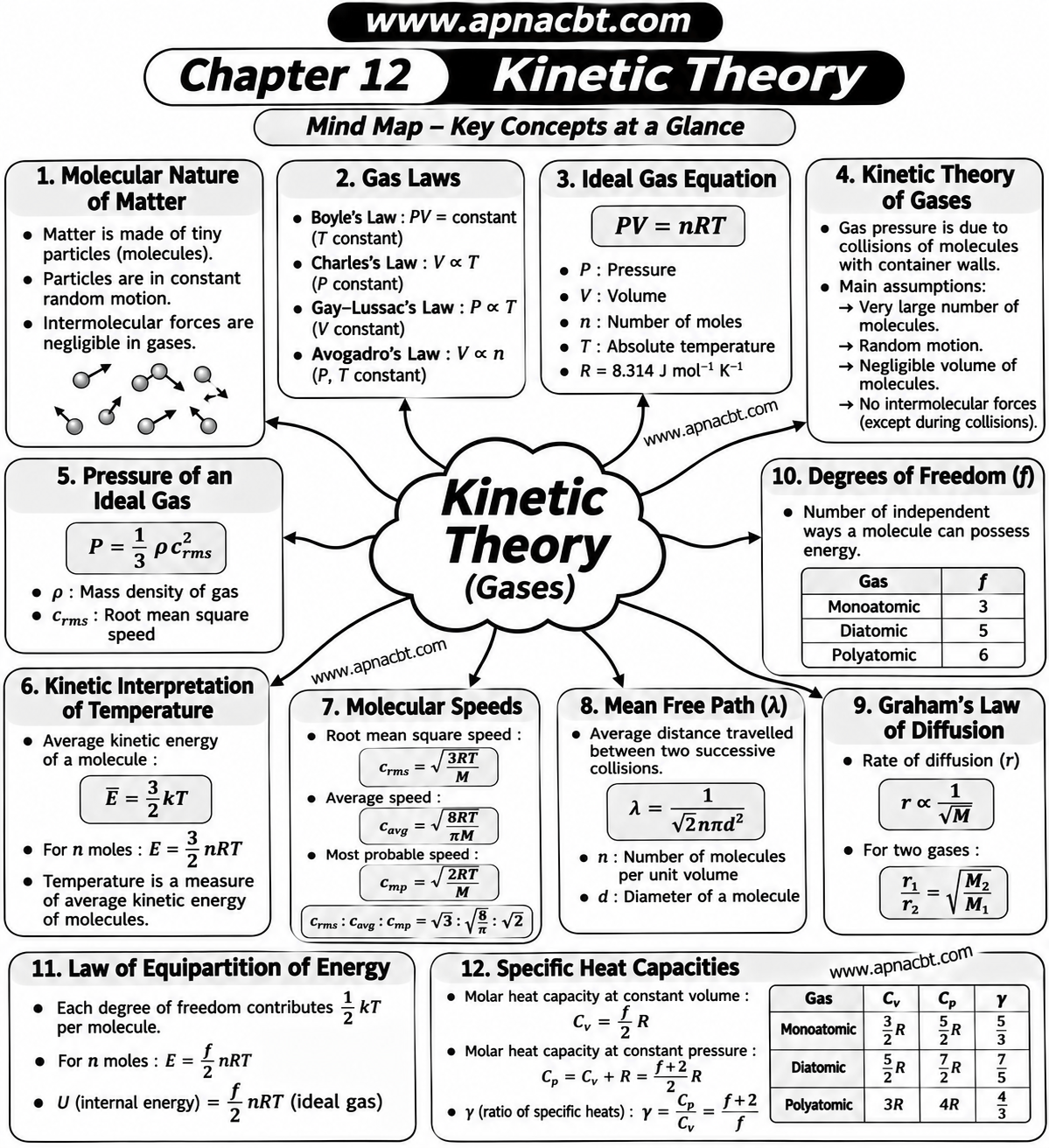
Kinetic Theory Mind Map
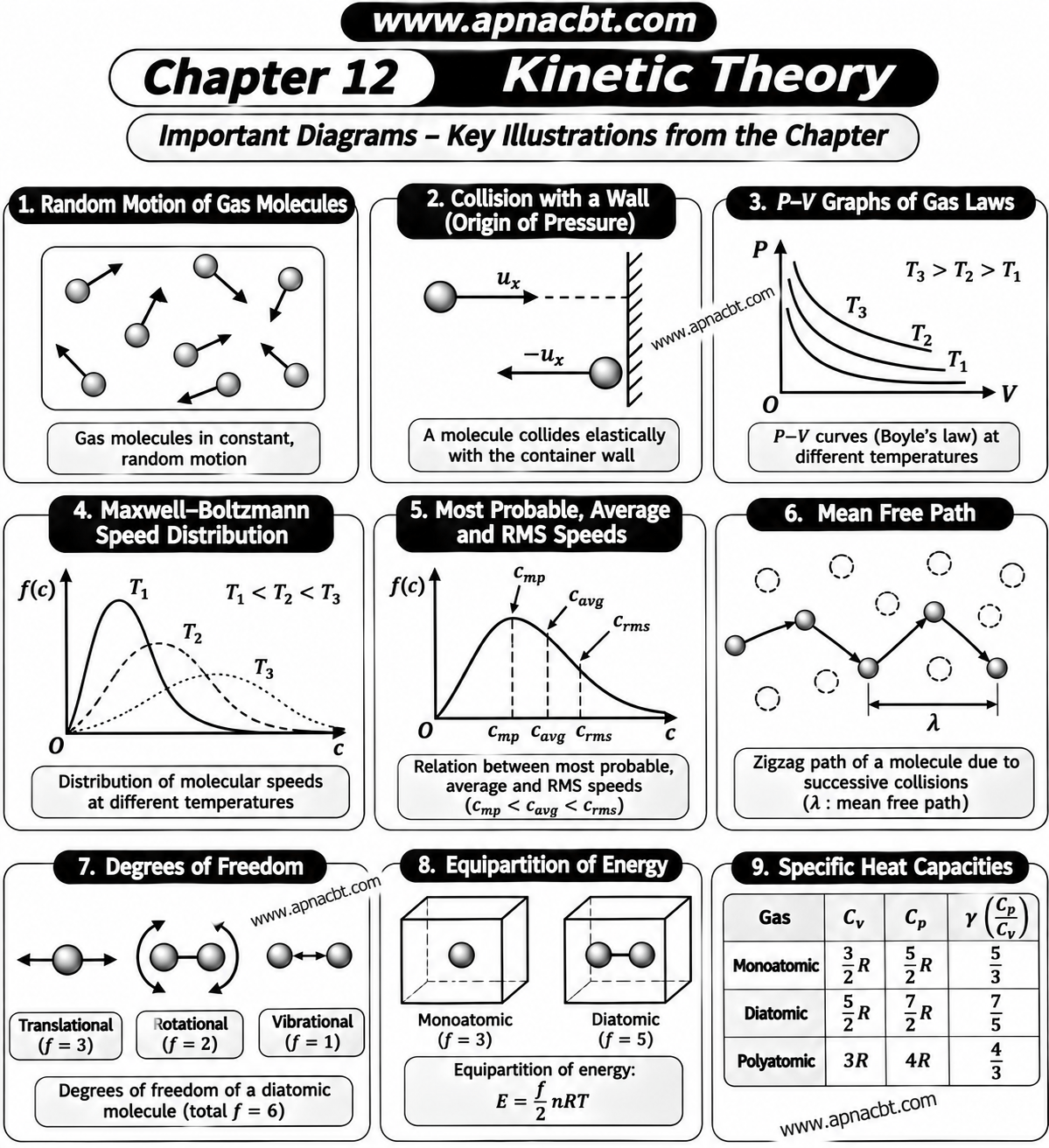
Important Diagrams – Kinetic Theory
Important Tables and Formulae – Kinetic Theory