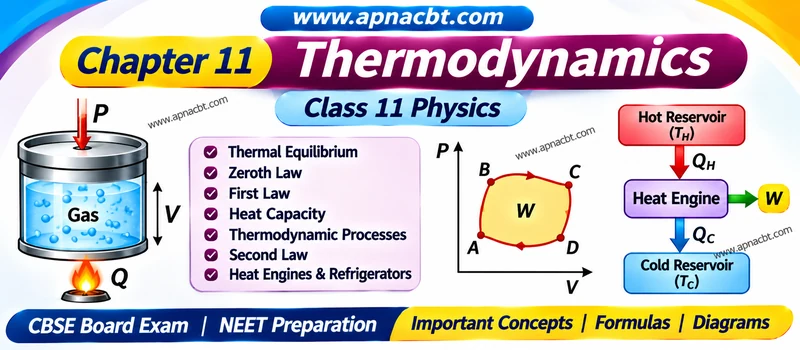
Chapter 11: Thermodynamics – Class 11 Physics
Exam-focused lesson prepared from the supplied Chapter 11 PDF for CBSE board examinations and NEET preparation. It covers thermodynamic systems and variables, thermal equilibrium, the zeroth and first laws, heat capacity, specific heat capacities of gases, thermodynamic processes, work done by a gas, the second law, heat engines, refrigerators, and reversible and irreversible processes.
Study focus: Understand sign conventions, interpret P–V diagrams, learn the equations for isothermal and adiabatic processes, compare Cp and Cv, and practise numerical problems using the first law of thermodynamics.
1. Introduction to Thermodynamics
Thermodynamics is the branch of physics that studies heat, temperature and the conversion of heat energy into other forms of energy and vice versa. It deals with the macroscopic properties of a system rather than the detailed motion of individual molecules.
- It describes bulk systems using measurable quantities such as pressure, volume and temperature.
- It explains how heat and work are related to changes in the internal energy of a system.
- It is concerned with the internal state of a system, not the motion of the system as a whole.
Core idea: Heat supplied to a system can change its internal energy and/or be used to perform work.
2. Thermodynamic System, Surroundings and Variables
A thermodynamic system is an assembly of a very large number of particles having definite macroscopic properties such as pressure, volume and temperature. Everything outside the system that can interact with it is called the surroundings. The boundary separates the system from its surroundings.
| Type of system | Exchange with surroundings | Example / description |
|---|---|---|
| Open system | Matter and energy | Water boiling in an open vessel; both mass and energy can cross the boundary. |
| Closed system | Energy, but not matter | Gas in a sealed cylinder with a movable piston. |
| Isolated system | Neither matter nor energy | An ideal perfectly insulated, sealed container. |
Thermodynamic variables: Pressure (P), volume (V), temperature (T), mass and composition describe the macroscopic state of a system. For a fixed amount of ideal gas, the equation of state is PV = nRT.
| Variable class | Meaning | Examples |
|---|---|---|
| Extensive variables | Depend on the size or amount of the system; values add when systems are combined. | Mass, volume, internal energy, number of moles. |
| Intensive variables | Do not depend on the size or amount of the system. | Pressure, temperature, density. |
A system is in thermodynamic equilibrium when its macroscopic variables do not change with time. During a rapid, non-equilibrium change, quantities such as pressure may not be uniform throughout the system.
Equation of state: For n moles of an ideal gas, PV = nRT. For one mole, PV = RT. A P–V curve at constant temperature is called an isotherm.
3. Thermal Equilibrium and Zeroth Law
Two bodies are in thermal equilibrium when they are in thermal contact and there is no net flow of heat between them. They have the same temperature.
Diathermic wall: A boundary that permits heat transfer. Adiabatic wall: A boundary that prevents heat transfer.
Zeroth law of thermodynamics: If two systems A and B are separately in thermal equilibrium with a third system C, then A and B are in thermal equilibrium with each other.
If TA = TC and TB = TC, then TA = TB. The zeroth law provides the basis for the concept and measurement of temperature.
Board/NEET point: The zeroth law establishes temperature as the property that is equal for systems in thermal equilibrium.
4. Heat, Internal Energy and Work
Heat (Q): Energy transferred between a system and its surroundings because of a temperature difference. Heat is energy in transit; it is not a property stored in a system.
Internal energy (U): The total microscopic kinetic and potential energy of the particles of a system, measured in the centre-of-mass frame. U = Uk + Up.
Work (W): Energy transferred when a force causes a displacement at the system boundary. For a gas expanding against an external pressure, work is associated with the change in volume.
| Quantity | Nature | State or path function? |
|---|---|---|
| Internal energy (U) | Energy of the system | State function |
| Heat (Q) | Energy transferred due to temperature difference | Path function |
| Work (W) | Energy transferred by mechanical interaction | Path function |
The change in internal energy depends only on the initial and final states. Heat and work depend on the path followed between those states.
Sign convention used in this lesson: Q is positive when heat is supplied to the system and negative when heat leaves it. W is positive when work is done by the system and negative when work is done on the system.
For expansion, W is positive; for compression, W is negative. For heat absorption, Q is positive; for heat rejection, Q is negative.
5. First Law of Thermodynamics
The first law of thermodynamics is the law of conservation of energy applied to thermodynamic systems. Heat supplied to a system is used to increase its internal energy and to perform work by the system.
First law: Q = ΔU + W
Equivalently, ΔU = Q − W.
Here Q is the heat supplied to the system, ΔU = U2 − U1 is the change in internal energy, and W is the work done by the system.
- If the system absorbs heat and does no work, its internal energy increases by the heat supplied.
- If a gas performs work while receiving no heat, its internal energy decreases.
- For a complete cyclic process, the system returns to its initial state, so ΔU = 0 and net heat supplied equals net work done.
Work in a quasi-static volume change: For a small change dV, dW = P dV. Therefore, W = ∫ P dV between the initial and final volumes. On a P–V diagram, the area under the process curve represents the work done by the gas.
For a cyclic process, the net work is the signed area enclosed by the cycle on the P–V diagram. A clockwise cycle represents positive net work by the gas; an anticlockwise cycle represents negative net work by the gas.
Common numerical step: Write Q = ΔU + W first, then substitute the signs of heat and work carefully.
6. Heat Capacity and Specific Heat Capacity
Heat capacity (C): The heat required to raise the temperature of a given body by one kelvin. If heat ΔQ raises its temperature by ΔT, C = ΔQ/ΔT.
Specific heat capacity (s): The heat required to raise the temperature of unit mass of a substance by one kelvin. s = ΔQ/(mΔT), or ΔQ = msΔT.
Molar specific heat capacity (C): The heat required to raise the temperature of one mole of a substance by one kelvin. C = ΔQ/(nΔT), or ΔQ = nCΔT.
| Quantity | Formula | SI unit |
|---|---|---|
| Heat capacity | C = ΔQ/ΔT | J K⁻¹ |
| Specific heat capacity | s = ΔQ/(mΔT) | J kg⁻¹ K⁻¹ |
| Molar specific heat capacity | C = ΔQ/(nΔT) | J mol⁻¹ K⁻¹ |
Specific heat capacity depends on the nature and temperature of the substance and, for gases, on the conditions under which heat is supplied. Heat capacity depends on the amount of substance.
Specific heat capacity of water: Approximately 4186 J kg⁻¹ K⁻¹ (or 4.186 J g⁻¹ K⁻¹). One calorie is defined as the heat required to raise the temperature of 1 g of water from 14.5°C to 15.5°C.
Mechanical equivalent of heat: Heat and work are both measured in joules in SI units. The older calorie unit is related to joule by approximately 1 cal = 4.186 J.
7. Specific Heat Capacities of Gases: Cᵥ, Cₚ and γ
For a gas, the molar specific heat capacity depends on the process because the gas may perform work while being heated. Two important values are measured at constant volume and constant pressure.
| Quantity | Condition | Meaning |
|---|---|---|
| Cᵥ | Constant volume | Molar heat capacity when volume is fixed; no work is done by the gas. |
| Cₚ | Constant pressure | Molar heat capacity when pressure is fixed; supplied heat raises internal energy and allows expansion work. |
For an ideal gas, Cp is greater than Cv, because at constant pressure some of the supplied heat is used to perform expansion work.
Mayer’s relation: Cp − Cv = R
Ratio of specific heats: γ = Cp/Cv
| Ideal gas model | Cᵥ | Cₚ | γ |
|---|---|---|---|
| Monoatomic | 3R/2 | 5R/2 | 5/3 |
| Diatomic (ordinary temperature, rotational modes active) | 5R/2 | 7R/2 | 7/5 |
| General relation | Cᵥ | Cᵥ + R | Cₚ/Cᵥ |
For an ideal gas, internal energy depends only on temperature. For a monoatomic ideal gas, U = (3/2)nRT; for a diatomic ideal gas at ordinary temperatures, U = (5/2)nRT, when vibrational modes are neglected.
Remember: Cₚ > Cᵥ and Cₚ − Cᵥ = R for an ideal gas.
8. Thermodynamic Processes
A thermodynamic process is a change in the state of a system from one equilibrium state to another. The important processes are classified by the variable that remains constant or by whether heat is exchanged.
| Process | Condition | Important relation / result |
|---|---|---|
| Isothermal | Temperature constant (ΔT = 0) | For ideal gas: PV = constant; ΔU = 0. |
| Adiabatic | No heat exchange (Q = 0) | For an ideal gas: PVᵞ = constant. |
| Isobaric | Pressure constant | W = P(V₂ − V₁). |
| Isochoric / Isovolumetric | Volume constant | W = 0; Q = ΔU. |
| Cyclic | Final state equals initial state | ΔU = 0; net Q = net W. |
Quasi-static process: A process carried out sufficiently slowly so that the system passes through a succession of equilibrium states. The pressure difference between the system and surroundings is infinitesimally small at each stage. It is an ideal limiting description.
Isothermal process: Temperature remains constant. For an ideal gas, PV = constant. The container must allow heat exchange and the process must be slow enough for thermal equilibrium to be maintained. Since ideal-gas internal energy depends only on temperature, ΔU = 0 and Q = W.
Work done by n moles of an ideal gas in a reversible isothermal process from (P₁,V₁,T) to (P₂,V₂,T): W = nRT ln(V₂/V₁) = nRT ln(P₁/P₂). In expansion W is positive and heat is absorbed; in compression W is negative and heat is released.
Adiabatic process: No heat enters or leaves the system (Q = 0). It can be approximated by using insulated walls or by carrying out a process rapidly. For an ideal gas, PVᵞ = constant, TVᵞ⁻¹ = constant and TᵞP¹⁻ᵞ = constant. During adiabatic expansion, the gas does work at the expense of internal energy and its temperature falls; during compression, its temperature rises.
Work done by an ideal gas in an adiabatic process is W = (P₁V₁ − P₂V₂)/(γ − 1) = nR(T₁ − T₂)/(γ − 1).
Isobaric process: Pressure remains constant. Work done is W = P(V₂ − V₁) = nR(T₂ − T₁).
Isochoric process: Volume remains constant, so dV = 0 and W = 0. From the first law, Q = ΔU.
Cyclic process: The system returns to its initial state. Since internal energy is a state function, ΔU over one complete cycle is zero.
On a P–V graph: isobaric = horizontal line; isochoric = vertical line; isothermal and adiabatic curves slope downwards during expansion. The adiabatic curve is steeper than the isothermal curve through the same state.
9. Second Law of Thermodynamics
The first law expresses conservation of energy but does not specify the direction in which a process occurs. The second law describes the direction of natural processes and places limits on the conversion of heat into work.
Kelvin–Planck statement: It is impossible to construct a cyclic heat engine whose sole effect is to absorb heat from a single reservoir and convert it completely into work. Therefore, no heat engine can have 100% efficiency.
Clausius statement: It is impossible to construct a self-acting device whose sole effect is to transfer heat from a colder body to a hotter body without external work.
The two statements are equivalent forms of the second law. A refrigerator transfers heat from a cold region to a warmer surrounding only when external work is supplied.
Perpetual motion machines: A machine violating the first law is called a perpetual motion machine of the first kind (PMM-I). A machine violating the second law is called a perpetual motion machine of the second kind (PMM-II). Neither is physically possible.
10. Heat Engines, Refrigerators and Efficiency
A heat engine is a device that operates in a cycle, absorbs heat Q₁ from a hot reservoir, performs work W and rejects heat Q₂ to a cold reservoir.
Energy balance: Q₁ = W + Q₂
Efficiency: η = W/Q₁ = (Q₁ − Q₂)/Q₁ = 1 − Q₂/Q₁
Since some heat must be rejected to the sink, the efficiency of a heat engine is always less than 100%.
Refrigerator: A refrigerator uses external work W to remove heat Q₂ from a low-temperature reservoir and deliver heat Q₁ to a high-temperature reservoir. Its coefficient of performance (COP) is β = Q₂/W.
For a refrigerator, Q₁ = Q₂ + W. A heat pump is assessed by the heat delivered to the hot region per unit work supplied.
| Device | Useful effect | Performance measure |
|---|---|---|
| Heat engine | Produces work from heat supplied by a hot source | η = W/Q₁ |
| Refrigerator | Removes heat from a cold space | β = Q₂/W |
| Heat pump | Delivers heat to a warm space | COP = Q₁/W |
The second law implies that a heat engine cannot convert all absorbed heat into work and a refrigerator cannot transfer heat from cold to hot without external work.
11. Reversible and Irreversible Processes; Key P–V Concepts
Reversible process: An ideal process that can be reversed so that both the system and surroundings return to their original states with no net change elsewhere. It must proceed quasi-statically and without dissipative effects such as friction.
Irreversible process: A process that cannot be exactly reversed without leaving changes in the system or surroundings. Natural processes are generally irreversible.
| Reversible process (ideal) | Irreversible process (natural) |
|---|---|
| Infinitely slow / quasi-static idealisation | Often rapid or proceeds through non-equilibrium states |
| No friction or dissipative loss | Friction, viscosity or other dissipation may occur |
| Can be reversed with no net change in system and surroundings | Reversal leaves changes in the surroundings |
| Ideal slow expansion/compression without friction | Free expansion, diffusion, heat flow across a finite temperature difference |
Important P–V graph facts: The work done by a gas equals the area under its P–V curve. The net work in a cycle equals the signed enclosed area. For the same initial state and expansion, an adiabatic curve is steeper than an isothermal curve.
Exam strategy: Identify the process first, write its condition, select the corresponding equation, apply the first law and then use the sign convention. Convert litres to cubic metres when pressure is in pascals and work is required in joules.
12. Short-Answer Questions – 30 Questions
Instructions: Attempt all questions before checking the answers. The answer key with explanatory responses is provided after the complete question list.
- Define thermodynamics.
- What is a thermodynamic system?
- Differentiate between an open and a closed system.
- What is an isolated system?
- Define intensive and extensive variables with examples.
- State the equation of state for n moles of an ideal gas.
- What is thermal equilibrium?
- State the zeroth law of thermodynamics.
- What is heat?
- Define internal energy.
- Distinguish between heat and work.
- State the first law of thermodynamics.
- What is heat capacity?
- Define specific heat capacity.
- What is molar specific heat capacity?
- What are Cᵥ and Cₚ?
- State Mayer’s relation for an ideal gas.
- Define the ratio of specific heats.
- What is an isothermal process?
- What is an adiabatic process?
- What is an isobaric process?
- What is an isochoric process?
- What is a cyclic process?
- Define a quasi-static process.
- What does the area under a P–V curve represent?
- State the Kelvin–Planck statement.
- State the Clausius statement.
- What is the efficiency of a heat engine?
- What is the coefficient of performance of a refrigerator?
- Differentiate between reversible and irreversible processes.
Answers to Short-Answer Questions
- Define thermodynamics. Thermodynamics is the branch of physics that studies heat, temperature and the conversion of heat into other forms of energy and vice versa.
- What is a thermodynamic system? A thermodynamic system is a specified collection of a large number of particles considered for studying its macroscopic properties such as pressure, volume and temperature.
- Differentiate between an open and a closed system. An open system exchanges both matter and energy with its surroundings. A closed system exchanges energy but not matter.
- What is an isolated system? An isolated system exchanges neither matter nor energy with its surroundings. It is an idealisation of a perfectly insulated and sealed system.
- Define intensive and extensive variables with examples. Intensive variables do not depend on the amount of substance, e.g. pressure and temperature. Extensive variables depend on the amount, e.g. mass, volume and internal energy.
- State the equation of state for n moles of an ideal gas. The ideal-gas equation is PV = nRT, where P is pressure, V is volume, n is number of moles, R is the universal gas constant and T is absolute temperature.
- What is thermal equilibrium? Two systems are in thermal equilibrium when there is no net heat flow between them; their temperatures are equal.
- State the zeroth law of thermodynamics. If systems A and B are separately in thermal equilibrium with a third system C, then A and B are in thermal equilibrium with each other.
- What is heat? Heat is energy transferred between a system and its surroundings due to a temperature difference. It is energy in transit.
- Define internal energy. Internal energy is the total microscopic kinetic and potential energy of the particles of a system.
- Distinguish between heat and work. Both are modes of energy transfer and path functions. Heat transfer occurs due to temperature difference, whereas work transfer occurs through mechanical interaction such as force acting through displacement.
- State the first law of thermodynamics. The first law is Q = ΔU + W, where Q is heat supplied, ΔU is change in internal energy and W is work done by the system.
- What is heat capacity? Heat capacity is the amount of heat required to raise the temperature of a body by one kelvin. C = ΔQ/ΔT.
- Define specific heat capacity. Specific heat capacity is the heat required to raise the temperature of unit mass of a substance by one kelvin. s = ΔQ/(mΔT).
- What is molar specific heat capacity? It is the heat required to raise the temperature of one mole of a substance by one kelvin. C = ΔQ/(nΔT).
- What are Cᵥ and Cₚ? Cᵥ is molar specific heat capacity at constant volume; Cₚ is molar specific heat capacity at constant pressure.
- State Mayer’s relation for an ideal gas. Mayer’s relation is Cₚ − Cᵥ = R, where R is the universal gas constant.
- Define the ratio of specific heats. The ratio of specific heats is γ = Cₚ/Cᵥ for a gas.
- What is an isothermal process? An isothermal process is a thermodynamic process in which temperature remains constant. For an ideal gas, PV = constant.
- What is an adiabatic process? An adiabatic process is one in which no heat is exchanged between the system and surroundings, so Q = 0.
- What is an isobaric process? An isobaric process is a process carried out at constant pressure.
- What is an isochoric process? An isochoric process is a process carried out at constant volume. Since volume does not change, work done by the gas is zero.
- What is a cyclic process? A cyclic process is a sequence of thermodynamic changes after which the system returns to its initial state. Its net change in internal energy is zero.
- Define a quasi-static process. A quasi-static process proceeds sufficiently slowly that the system passes through a succession of equilibrium states.
- What does the area under a P–V curve represent? The area under a P–V curve between two volumes represents the work done by the gas during the process.
- State the Kelvin–Planck statement. No cyclic heat engine can absorb heat from a single reservoir and convert it completely into work with no other effect.
- State the Clausius statement. Heat cannot flow by itself from a colder body to a hotter body; external work is required for such transfer.
- What is the efficiency of a heat engine? Efficiency is the ratio of work output to heat absorbed from the source: η = W/Q₁ = 1 − Q₂/Q₁.
- What is the coefficient of performance of a refrigerator? COP of a refrigerator is the heat removed from the cold space divided by the work supplied: β = Q₂/W.
- Differentiate between reversible and irreversible processes. A reversible process can be reversed without net change in system and surroundings. An irreversible process cannot; friction, rapid expansion and heat flow across a finite temperature difference are examples.
13. Long-Answer Questions – 15 Questions
Instructions: Write complete explanations, equations and relevant diagrams wherever required. All detailed answers are provided after the complete list of questions.
- Explain thermodynamic systems and classify them.
- Explain thermodynamic variables and distinguish intensive and extensive variables.
- State and explain the zeroth law of thermodynamics and its significance.
- Explain heat, work and internal energy. How do they differ?
- State the first law of thermodynamics and explain its applications to special cases.
- Define heat capacity, specific heat capacity and molar specific heat capacity. Give their units.
- Explain Cₚ and Cᵥ and derive Mayer’s relation for an ideal gas.
- Describe an isothermal process and derive the expression for work done by an ideal gas.
- Explain an adiabatic process and write its important equations.
- Compare isothermal and adiabatic processes.
- Explain isobaric, isochoric and cyclic processes with their work expressions.
- Explain the second law of thermodynamics using Kelvin–Planck and Clausius statements.
- Describe a heat engine and derive its efficiency expression.
- Explain the working principle of a refrigerator and define its coefficient of performance.
- Distinguish between reversible and irreversible processes and give examples.
Detailed Answers to Long-Answer Questions
- Explain thermodynamic systems and classify them. A thermodynamic system is a specified collection of particles or region selected for study. The surroundings are everything outside it that can interact with it, and the boundary separates the two. An open system exchanges both matter and energy, such as boiling water in an open vessel. A closed system exchanges energy but not matter, such as gas in a sealed cylinder with a movable piston. An isolated system exchanges neither matter nor energy; a perfectly sealed and insulated container is an ideal example. This classification depends on what can cross the system boundary.
- Explain thermodynamic variables and distinguish intensive and extensive variables. Thermodynamic variables describe the macroscopic equilibrium state of a system. Common variables include pressure, volume, temperature, mass and composition. Extensive variables depend on the size or amount of the system and are additive; examples are mass, volume, number of moles and internal energy. If a system is divided into two equal parts, these quantities are shared between the parts. Intensive variables do not depend on the size of the system; examples are pressure, temperature and density. For a fixed amount of ideal gas, the state equation is PV = nRT.
- State and explain the zeroth law of thermodynamics and its significance. The zeroth law states that if system A is in thermal equilibrium with system C and system B is also in thermal equilibrium with C, then A and B are in thermal equilibrium with each other. In thermal equilibrium, there is no net heat flow and the systems have equal temperatures. The law establishes temperature as a measurable thermodynamic property. It forms the scientific basis of temperature measurement: a thermometer acts as the third system and indicates the temperature of a body after thermal equilibrium is reached.
- Explain heat, work and internal energy. How do they differ? Heat is energy transferred because of a temperature difference. Work is energy transferred through mechanical interaction, such as expansion against an external pressure. Internal energy is the microscopic kinetic and potential energy possessed by the particles of the system. Internal energy is a state function and depends only on the state, whereas heat and work are path functions and depend on the process followed. Heat and work are not stored properties of a system; they describe energy crossing its boundary.
- State the first law of thermodynamics and explain its applications to special cases. The first law is Q = ΔU + W, where Q is heat supplied to the system, ΔU is change in internal energy and W is work done by the system. It is conservation of energy applied to thermodynamic systems. In an isochoric process W = 0, so Q = ΔU. In an adiabatic process Q = 0, so ΔU = −W. In an isothermal process involving an ideal gas, ΔU = 0, so Q = W. In a cyclic process ΔU = 0 over one complete cycle, so net heat supplied equals net work done.
- Define heat capacity, specific heat capacity and molar specific heat capacity. Give their units. Heat capacity C is the heat required to raise the temperature of a body by one kelvin: C = ΔQ/ΔT, with SI unit J K⁻¹. Specific heat capacity s is the heat required per unit mass per kelvin: s = ΔQ/(mΔT), with SI unit J kg⁻¹ K⁻¹. Molar specific heat capacity C is the heat required per mole per kelvin: C = ΔQ/(nΔT), with SI unit J mol⁻¹ K⁻¹. Specific and molar heat capacities are characteristic of the substance and conditions; heat capacity also depends on the amount of material.
- Explain Cₚ and Cᵥ and derive Mayer’s relation for an ideal gas. Cᵥ is the molar heat capacity at constant volume and Cₚ is the molar heat capacity at constant pressure. For one mole of an ideal gas, at constant volume no work is done, so dQᵥ = dU = CᵥdT. At constant pressure, dQₚ = dU + P dV = CᵥdT + P dV. From PV = RT for one mole at constant pressure, P dV = R dT. Therefore dQₚ = (Cᵥ + R)dT. But dQₚ = CₚdT. Hence Cₚ = Cᵥ + R, or Cₚ − Cᵥ = R. This is Mayer’s relation.
- Describe an isothermal process and derive the expression for work done by an ideal gas. An isothermal process takes place at constant temperature. For an ideal gas, PV = nRT and T is constant, so PV = constant. In a reversible quasi-static change, dW = P dV = (nRT/V)dV. Integrating from V₁ to V₂ gives W = nRT ln(V₂/V₁) = nRT ln(P₁/P₂). In expansion V₂ is greater than V₁, so work done by the gas is positive and heat is absorbed. In compression work done by the gas is negative and heat is released. Since the temperature of an ideal gas is unchanged, ΔU = 0 and the first law gives Q = W.
- Explain an adiabatic process and write its important equations. An adiabatic process is one in which no heat is exchanged with the surroundings, so Q = 0. It may be approximated by thermal insulation or by a very rapid process. For an ideal gas, the reversible adiabatic relations are PVᵞ = constant, TVᵞ⁻¹ = constant and TᵞP¹⁻ᵞ = constant, where γ = Cₚ/Cᵥ. Work done by the gas is W = (P₁V₁ − P₂V₂)/(γ − 1) = nR(T₁ − T₂)/(γ − 1). During adiabatic expansion the gas cools; during adiabatic compression it becomes hotter.
- Compare isothermal and adiabatic processes. In an isothermal process temperature remains constant, while in an adiabatic process no heat is exchanged. For an ideal gas, an isothermal process obeys PV = constant and an adiabatic process obeys PVᵞ = constant. In an isothermal change ΔU = 0; in an adiabatic change Q = 0 and ΔU = −W. An isothermal process requires sufficient heat exchange and slow operation, whereas an adiabatic process requires insulation or a sufficiently rapid change. On a P–V diagram, the adiabatic curve is steeper than the isothermal curve through the same state.
- Explain isobaric, isochoric and cyclic processes with their work expressions. In an isobaric process pressure is constant and work done is W = P(V₂ − V₁). For an ideal gas this can also be written W = nR(T₂ − T₁). In an isochoric process volume is constant, so dV = 0 and W = 0; the heat supplied changes internal energy. In a cyclic process the system returns to its initial state, so ΔU = 0. The net heat supplied over the cycle equals the net work done. On a P–V diagram the net work is the signed area enclosed by the cycle.
- Explain the second law of thermodynamics using Kelvin–Planck and Clausius statements. The second law gives the direction of natural processes and limits the conversion of heat into work. Kelvin–Planck states that no cyclic engine can take heat from a single reservoir and convert it completely into work without another effect. Thus a heat engine must reject some heat and cannot be 100% efficient. Clausius states that heat cannot flow spontaneously from a colder body to a hotter body without external work. A refrigerator therefore requires work to transfer heat from its cold interior to warmer surroundings. The two statements are equivalent forms of the second law.
- Describe a heat engine and derive its efficiency expression. A heat engine is a cyclic device that absorbs heat Q₁ from a hot source, performs work W and rejects heat Q₂ to a cold sink. By energy conservation, Q₁ = W + Q₂, so W = Q₁ − Q₂. Efficiency is the ratio of useful work output to heat absorbed: η = W/Q₁ = (Q₁ − Q₂)/Q₁ = 1 − Q₂/Q₁. Since Q₂ cannot be zero for a cyclic engine operating between reservoirs, η is less than one. This agrees with the Kelvin–Planck statement of the second law.
- Explain the working principle of a refrigerator and define its coefficient of performance. A refrigerator removes heat Q₂ from a low-temperature region and transfers it to a high-temperature surrounding by using external work W. The heat delivered to the surroundings is Q₁ = Q₂ + W. The coefficient of performance is the desired heat removed from the cold region divided by the work input: β = Q₂/W. A refrigerator does not violate the second law because external work is supplied to transfer heat from cold to hot. Without this work, heat cannot flow in that direction by itself.
- Distinguish between reversible and irreversible processes and give examples. A reversible process is an ideal process that can be reversed so that both the system and surroundings return to their original states without any net change elsewhere. It must be quasi-static and free from friction and other dissipative effects. An irreversible process cannot be exactly reversed without leaving changes in the surroundings. Examples include free expansion of a gas, diffusion of gases, heat transfer between bodies at different temperatures, frictional motion and sudden compression or expansion. Natural processes are generally irreversible.
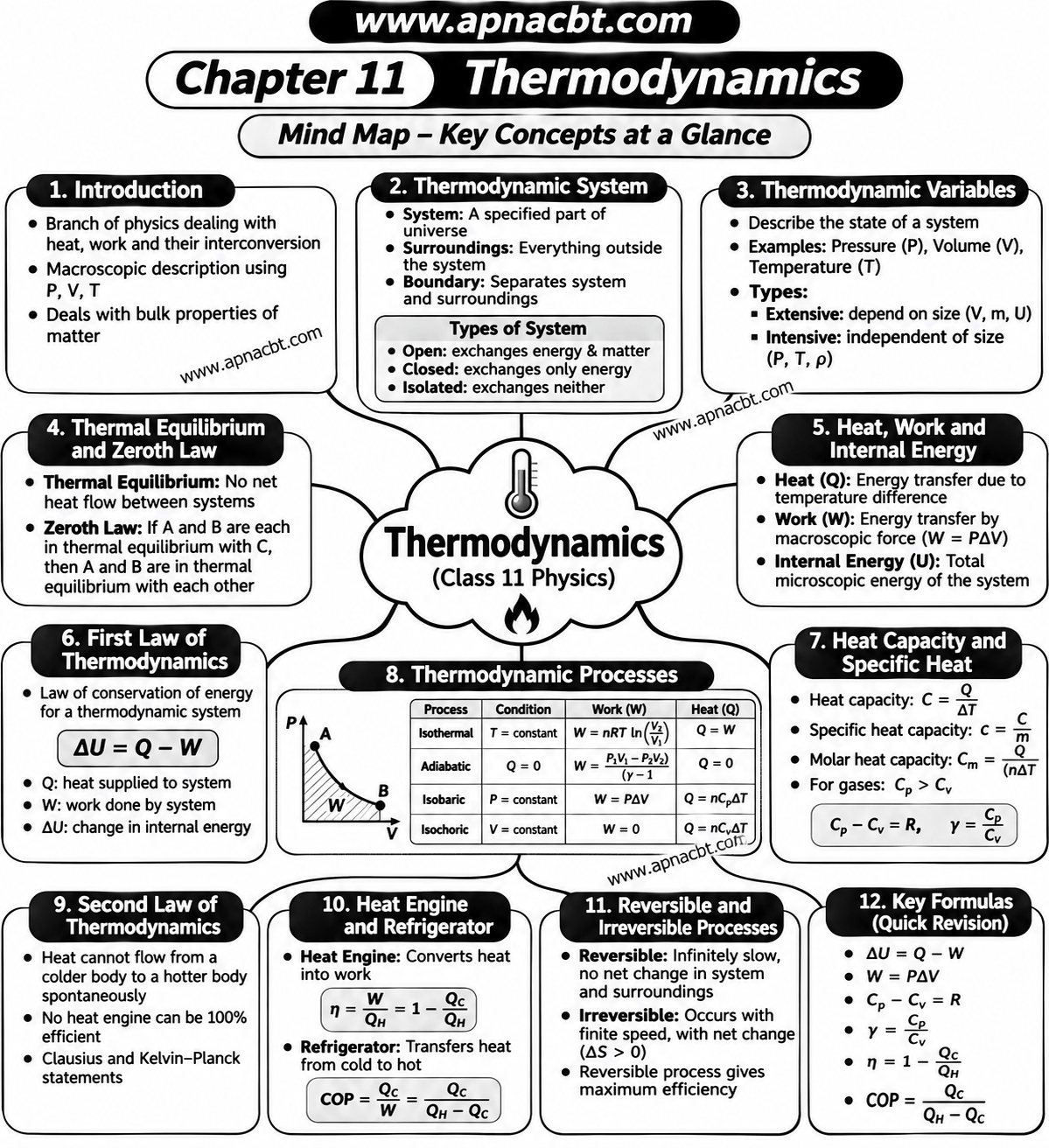
Thermodynamics Mind Map – Class 11 Physics Chapter 11
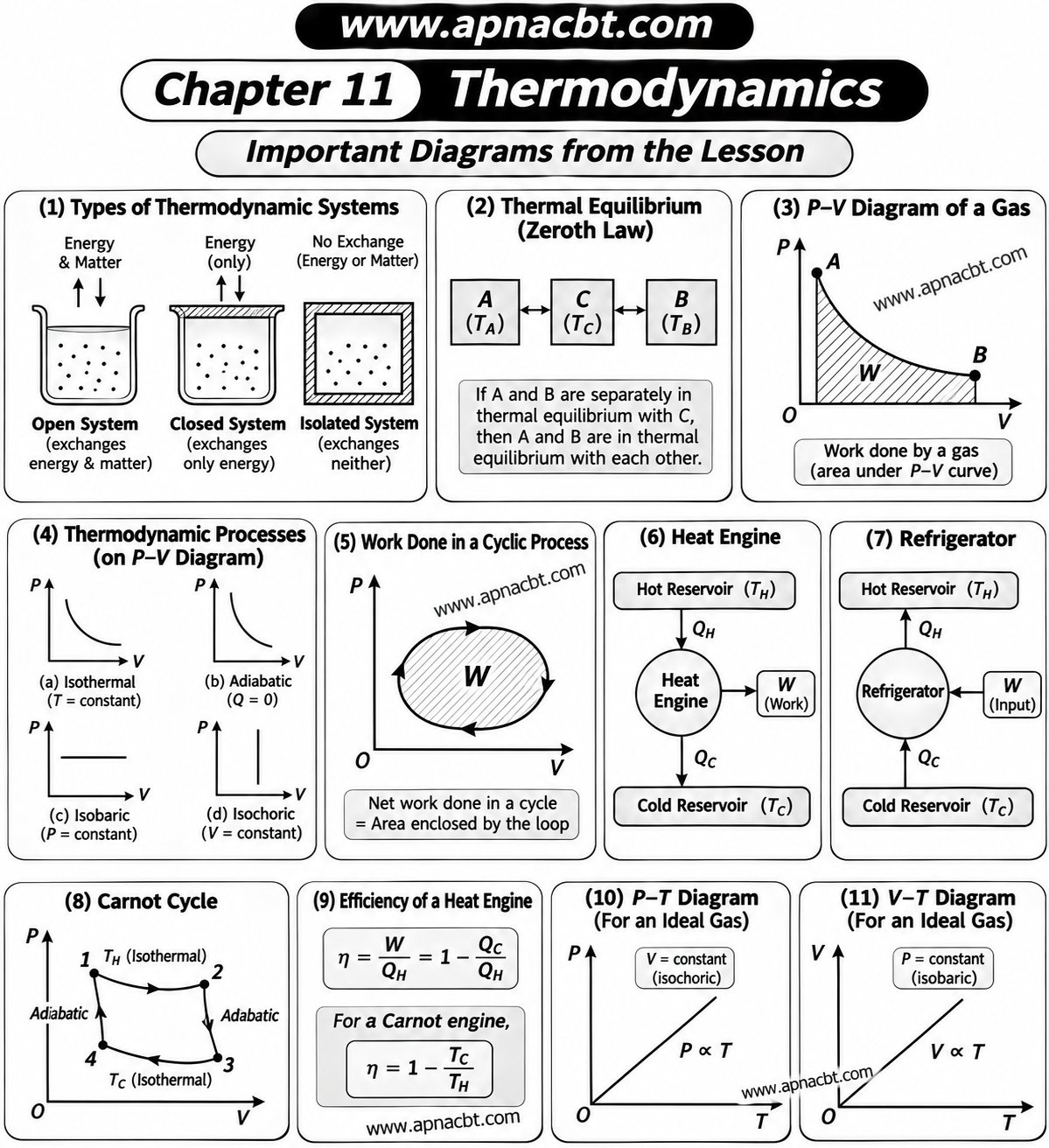
Important Diagrams – Thermodynamics Class 11 Physics Chapter 11
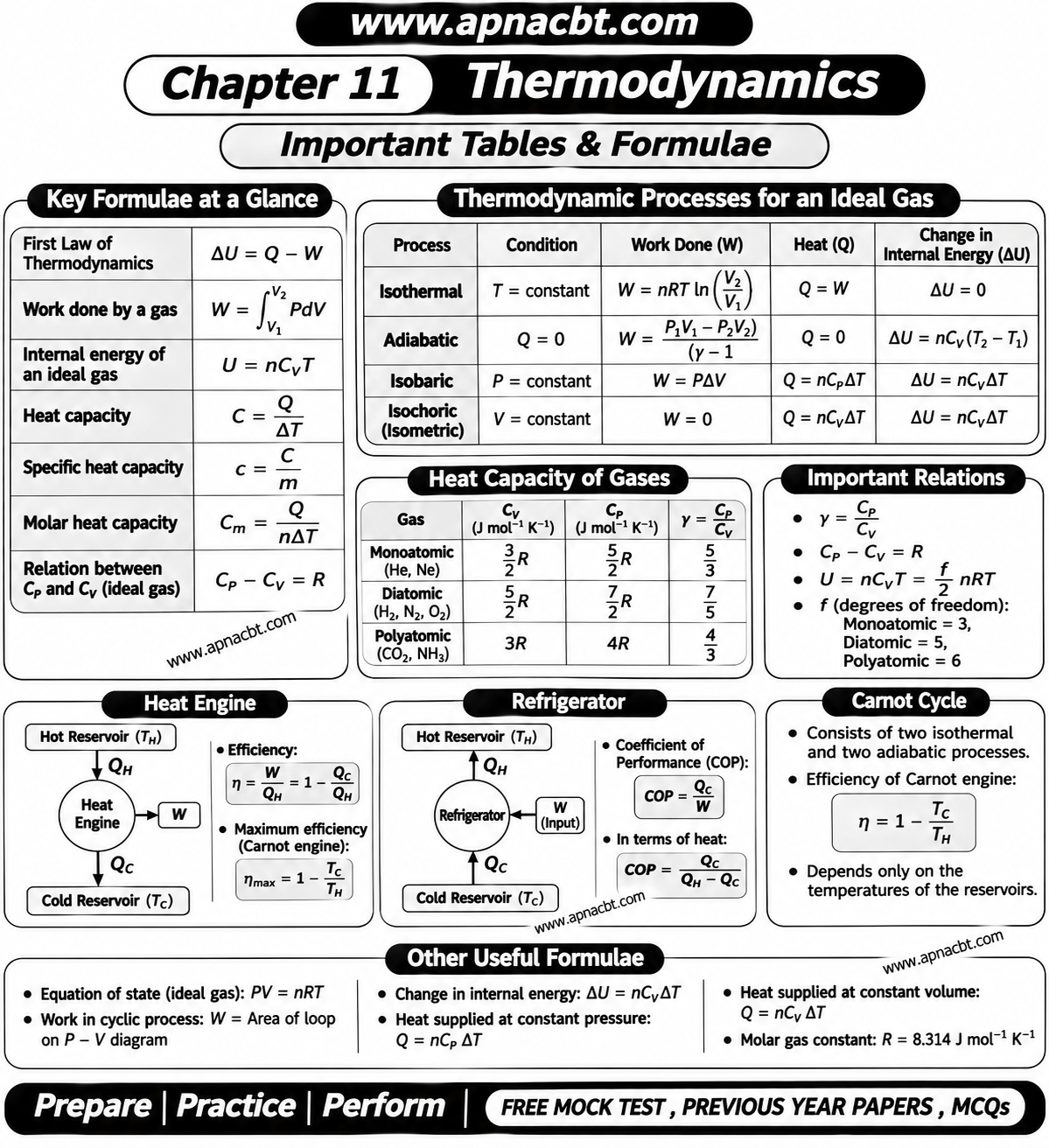
Important Tables and Formulae – Thermodynamics