Prepare Nuclei Class 12 Physics for CBSE Board Exams & NEET
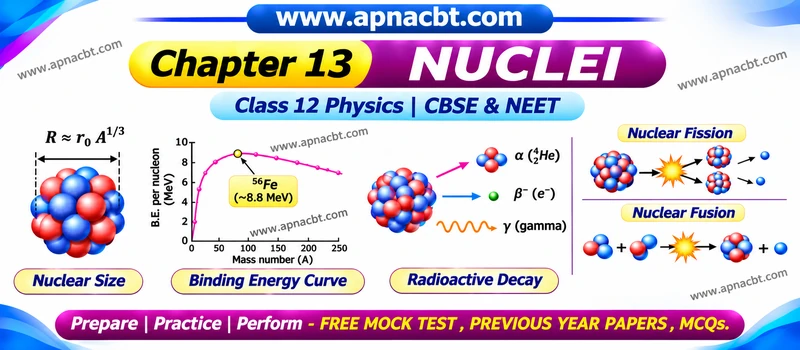
Nuclei Class 12 Physics covers nuclear composition, size, mass-energy equivalence, mass defect, binding energy, nuclear force, radioactivity and nuclear energy. This Level 01 lesson follows the attached Chapter 13 source and focuses on concepts, equations, graphs and reactions useful for CBSE Board and NEET preparation.
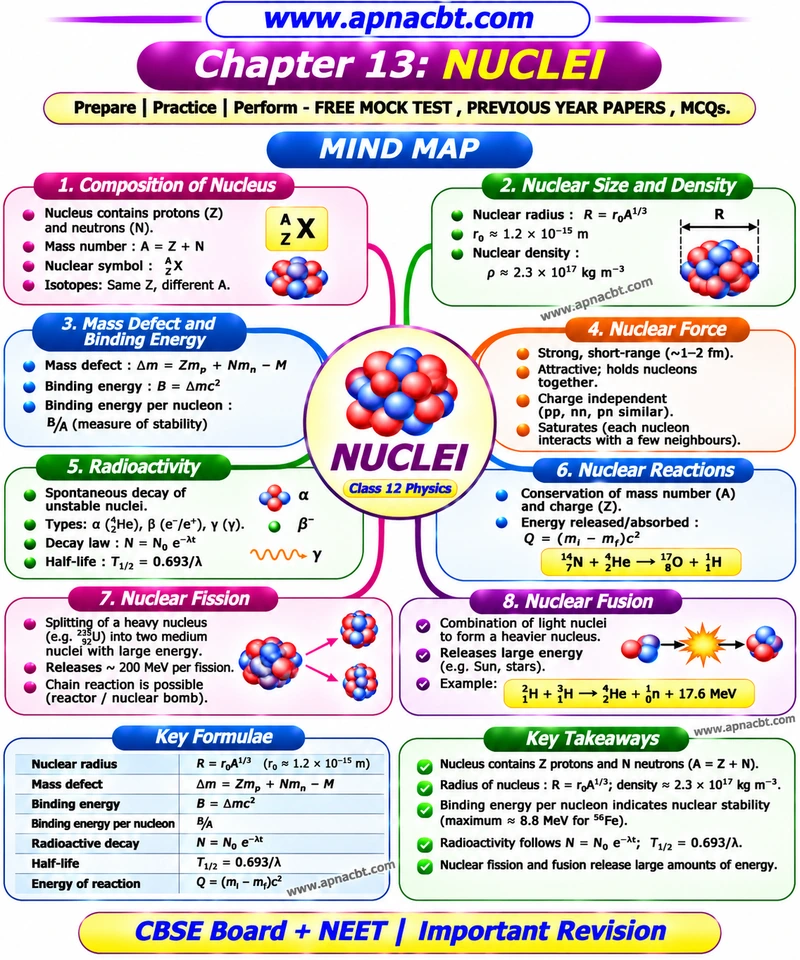
Study the chapter in sequence: composition and notation of nuclei, nuclear size and density, mass defect and binding energy, the binding-energy-per-nucleon curve, nuclear force, radioactive decay, fission and fusion.
Table of Contents
- Atomic Masses and Composition
- Size and Density of the Nucleus
- Mass-Energy and Mass Defect
- Binding Energy and Stability
- Nuclear Force
- Radioactivity
- Decay Law, Half-Life and Mean Life
- Alpha, Beta and Gamma Emissions
- Nuclear Reactions
- Nuclear Fission
- Nuclear Fusion
- Complete Revision
- Short Questions – 30
- Long Questions – 15
Atomic Masses and Composition of the Nucleus
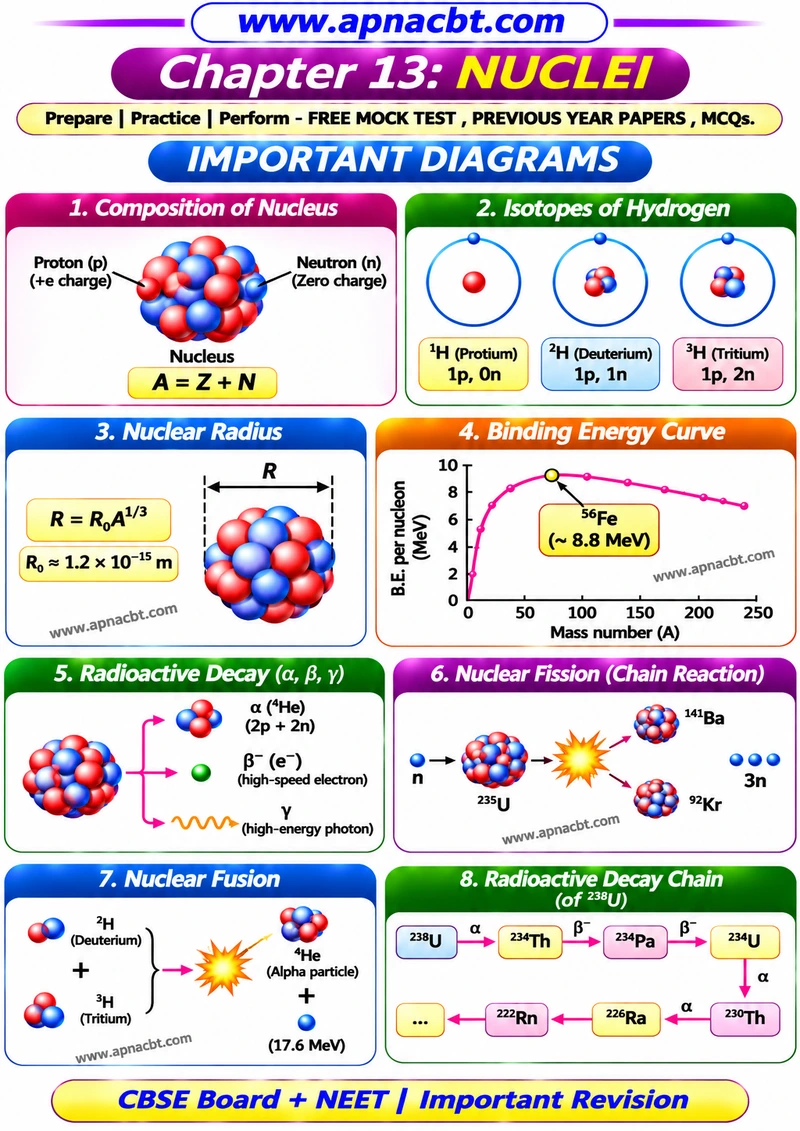
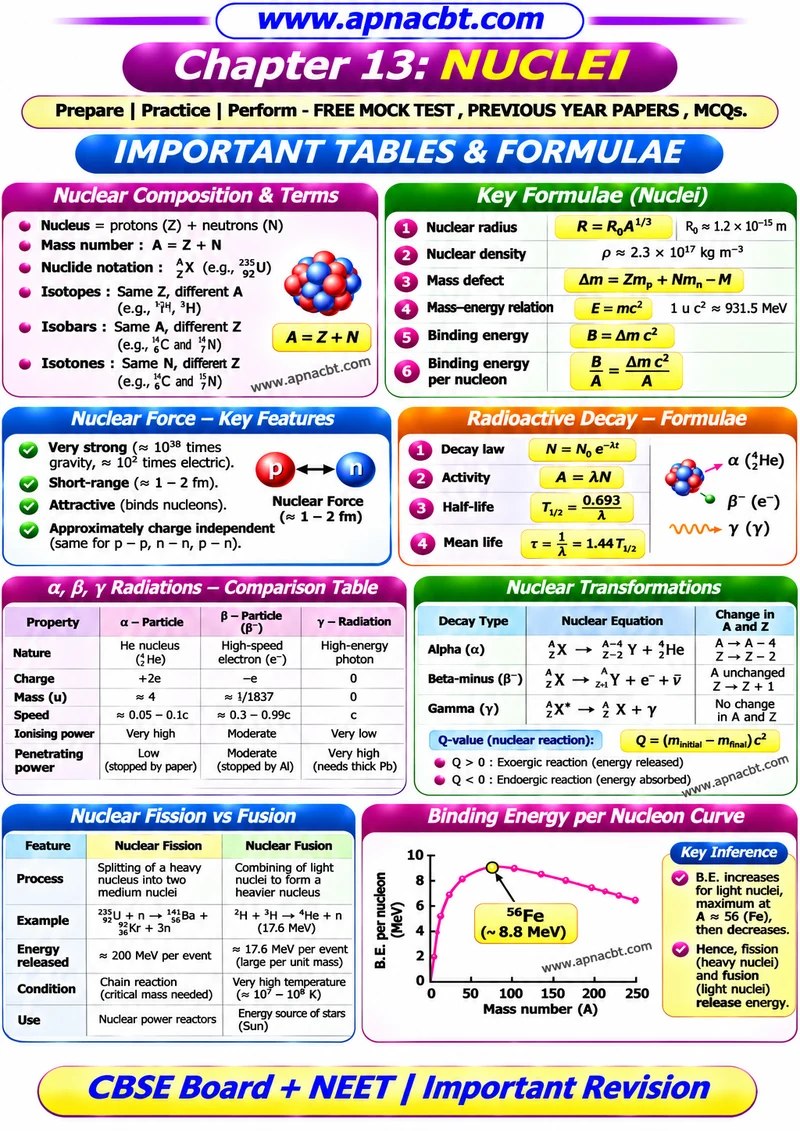
A nucleus contains protons and neutrons, called nucleons. Atomic number Z is the number of protons and mass number A is the total number of nucleons.
- N = A − Z.
- Nuclide notation is ⁽ᴬ⁾₍Z₎X.
- Isotopes: same Z, different A.
- Isobars: same A, different Z.
- Isotones: same neutron number, different Z.
The source gives 1 u = 1.660539 × 10⁻²⁷ kg and approximately 1 u = 931 MeV/c².
Size and Density of the Nucleus
Nuclear volume is proportional to A. Therefore R = R₀A1/3, with R₀ about 1.2 × 10⁻¹⁵ m. Thus R₁/R₂ = (A₁/A₂)1/3.
Nuclear mass is also approximately proportional to A, so average nuclear density is nearly independent of mass number. Nuclear matter is extremely compact.
Mass-Energy and Mass Defect
Einstein’s relation is E = mc². A bound nucleus has less mass than its separated nucleons. The difference is the mass defect.
Using nuclear masses, Δm = Zmₚ + (A−Z)mₙ − M. Binding energy is Eb = Δmc². With atomic mass units, 1 u c² is approximately 931.5 MeV.
Binding Energy and Nuclear Stability
Binding energy is the energy needed to separate a nucleus into free nucleons. Binding energy per nucleon is Eb/A. The source’s curve reaches a maximum near the iron region.
Light nuclei can release energy by fusion and heavy nuclei can release energy by fission because the products can have greater binding energy per nucleon than the initial nuclei.
Nuclear Force
Nuclear force is the strong attractive interaction that binds nucleons. It is very strong at nuclear distances, short-range, approximately charge independent apart from electromagnetic effects, and shows saturation.
These properties allow nuclei to remain bound despite proton-proton electrostatic repulsion.
Radioactivity
Radioactivity is the spontaneous transformation of an unstable nucleus with emission of radiation or particles. Individual decay is random, but a large sample follows a statistical law.
Radioactive decay does not depend on ordinary chemical conditions in the simple nuclear model.
Decay Law, Half-Life and Mean Life
The decay law is N = N₀e−λt. Activity is A = λN. Half-life is T1/2 = ln2/λ ≈ 0.693/λ. Mean life is τ = 1/λ ≈ 1.44T1/2.
After n half-lives, N = N₀/2ⁿ. These equations are high-value for numerical questions.
Alpha, Beta and Gamma Emissions
Alpha radiation consists of helium nuclei and has high ionising but low penetrating power. Beta radiation consists of electrons or positrons and has intermediate penetration. Gamma radiation is electromagnetic and highly penetrating.
Alpha decay changes A by −4 and Z by −2. Beta-minus keeps A unchanged and increases Z by one. Gamma changes neither A nor Z.
Nuclear Reactions and Conservation Laws
Nuclear reactions conserve charge, nucleon number, energy and momentum. Rest mass need not be conserved separately because mass and energy are interconvertible.
The Q-value is Q = (mass of reactants − mass of products)c². Balance both A and Z before interpreting a nuclear equation.
Nuclear Fission and Chain Reaction
Nuclear fission is the splitting of a heavy nucleus into lighter nuclei, usually with additional neutrons and release of energy. The energy comes from an increase in total binding energy.
A chain reaction occurs when neutrons from one fission produce further fissions. In a reactor, the neutron population is controlled.
Nuclear Fusion and Stellar Energy
Nuclear fusion combines light nuclei to form a heavier nucleus. If the product has greater binding energy per nucleon, energy is released. Fusion is the source of energy in stars.
Very high temperatures are required because positively charged nuclei repel one another.
Complete Revision – Must-Know Formulae and Facts
- A = Z + N
- R = R₀A1/3
- E = mc²
- Δm = sum of constituent masses − nuclear mass
- Eb = Δmc²
- Binding energy per nucleon = Eb/A
- N = N₀e−λt
- Activity = λN
- T1/2 = 0.693/λ
- τ = 1/λ
- Alpha: A−4, Z−2
- Beta-minus: A unchanged, Z+1
- Gamma: A and Z unchanged
Revise the binding-energy curve, mass-defect calculations, decay law and balanced nuclear reactions.
Related APNA CBT preparation: Level 01 Chapter-wise Preparation | APNA CBT Exams | NEET Preparation
Official reference: NCERT Physics Chapter 13 – Nuclei | CBSE Physics Curriculum 2026–27
For Nuclei Class 12 Physics, revise the binding-energy curve before solving fission and fusion questions.
For Nuclei Class 12 Physics numericals, keep mass units consistent when converting mass defect into energy.
For Nuclei Class 12 Physics objective practice, memorise the A and Z changes in alpha, beta and gamma decay.
Short Questions – 30 Questions with Detailed Answers
1. What are nucleons?
Answer: Protons and neutrons.
2. What is atomic number?
Answer: The number of protons, Z.
3. What is mass number?
Answer: The total number of protons and neutrons, A.
4. How many neutrons are in A=23, Z=11?
Answer: N=23−11=12.
5. What are isotopes?
Answer: Nuclides with the same Z but different A.
6. What are isobars?
Answer: Nuclides with the same A but different Z.
7. What are isotones?
Answer: Nuclides having the same neutron number.
8. State the nuclear-radius relation.
Answer: R=R₀A^(1/3).
9. What is mass defect?
Answer: The difference between separated-nucleon mass and nuclear mass.
10. Write E=mc².
Answer: Mass and energy are related by E=mc².
11. What is binding energy?
Answer: Energy required to separate a nucleus into free nucleons.
12. What is binding energy per nucleon?
Answer: E_b/A.
13. Where is binding energy per nucleon near maximum?
Answer: Near the iron region.
14. What is nuclear force?
Answer: Strong, short-range attraction between nucleons.
15. What is radioactivity?
Answer: Spontaneous transformation of an unstable nucleus.
16. What is decay constant?
Answer: Probability per unit time of decay for an undecayed nucleus.
17. Write the decay law.
Answer: N=N₀e^(−λt).
18. Define half-life.
Answer: Time for the number of undecayed nuclei to become half.
19. Relation of half-life and λ?
Answer: T₁/₂=0.693/λ.
20. Define mean life.
Answer: τ=1/λ.
21. Alpha decay changes A and Z how?
Answer: A−4 and Z−2.
22. Beta-minus changes A and Z how?
Answer: A unchanged and Z+1.
23. Gamma emission changes A and Z how?
Answer: Neither changes.
24. Which has greatest penetration?
Answer: Gamma radiation.
25. What is fission?
Answer: Splitting of a heavy nucleus with energy release.
26. What is fusion?
Answer: Combining light nuclei with energy release when products are more tightly bound.
27. Why does fission release energy?
Answer: Products can have greater total binding energy.
28. Why does fusion release energy?
Answer: The product can have greater binding energy than reactants.
29. What is a chain reaction?
Answer: Successive fissions caused by neutrons from earlier fissions.
30. What is Q-value?
Answer: Energy released or absorbed from the initial-final mass difference.
Long Questions – 15 Questions with Detailed Answers
1. Explain nuclear composition and notation.
Answer: A nucleus has Z protons and N neutrons; A=Z+N. It is represented by A over Z beside the element symbol. Isotopes have the same Z but different A.
2. Derive R∝A^(1/3).
Answer: Nuclear volume is proportional to A. Since V∝R³, R³∝A and therefore R∝A^(1/3).
3. Why is nuclear density nearly constant?
Answer: Both nuclear mass and nuclear volume are approximately proportional to A, so their ratio is nearly constant.
4. Explain mass defect and binding energy.
Answer: A bound nucleus has less mass than separated nucleons. The difference Δm corresponds to binding energy E_b=Δmc².
5. Explain binding energy per nucleon.
Answer: E_b/A measures average binding. Larger values generally mean greater stability. The curve peaks near iron.
6. State properties of nuclear force.
Answer: It is strong, short-range, approximately charge independent and saturating.
7. Derive radioactive decay law.
Answer: Using −dN=λNdt and integrating gives ln(N/N₀)=−λt, hence N=N₀e^(−λt).
8. Derive half-life relation.
Answer: At T₁/₂, N=N₀/2. Substitution gives T₁/₂=ln2/λ≈0.693/λ.
9. Compare alpha, beta and gamma.
Answer: Alpha is helium nuclei with high ionisation and low penetration; beta is electrons/positrons with intermediate penetration; gamma is electromagnetic and highly penetrating.
10. Explain conservation in nuclear reactions.
Answer: Charge, nucleon number, energy and momentum are conserved; rest mass may convert to energy.
11. Explain fission using binding energy.
Answer: Heavy nuclei can split into fragments with higher binding energy per nucleon, increasing total binding energy and releasing energy.
12. Explain fusion and stellar energy.
Answer: Light nuclei combine into a more tightly bound nucleus; the increase in binding energy is released. Stars obtain energy through fusion.
13. A sample has half-life 10 days. Fraction after 30 days?
Answer: Three half-lives pass, so fraction remaining is 1/8 or 12.5%.
14. How do fission and fusion relate to the binding-energy curve?
Answer: Both move nuclei toward the high-binding-energy middle region: heavy nuclei by fission and light nuclei by fusion.
15. How should students approach Nuclei Class 12 Physics?
Answer: For CBSE, learn concepts, derivations and numericals. For NEET, master formulae, decay changes, binding-energy graphs and nuclear-reaction patterns, then practise objective questions.