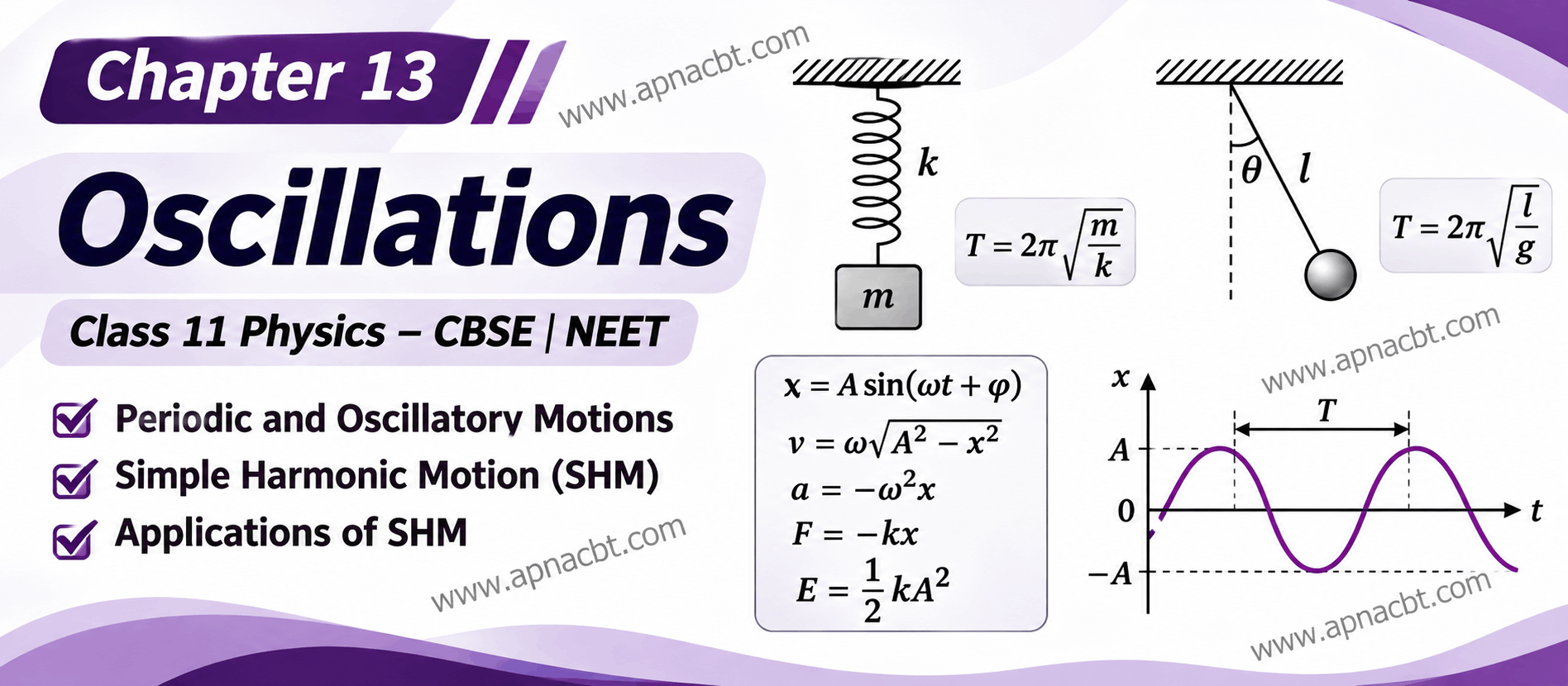
Chapter 13 – Oscillations explains periodic motion, oscillatory motion and simple harmonic motion (SHM). It develops the equations of displacement, velocity and acceleration in SHM, discusses energy changes during oscillation, and applies these principles to pendulums, spring–block systems, liquid columns and floating bodies.
This lesson is arranged for Class 11 Physics revision, CBSE board examinations and NEET preparation. Study the conditions, derivations and formulae carefully, and practise the questions at the end.
1. Periodic Motion and Oscillatory Motion
Periodic motion
A motion that repeats itself after equal intervals of time is called periodic motion. The fixed interval after which the motion repeats is its time period (T).
- Example: revolution of the Earth around the Sun.
- Example: motion of the hands of a clock.
- The time period is the time taken to complete one cycle.
Oscillatory motion
A body is said to execute oscillatory motion when it moves repeatedly to and fro about a fixed point, called the mean or equilibrium position, within a definite interval of time.
- Example: a simple pendulum swinging through small angles.
- Example: a mass attached to a spring and moving to and fro.
- Oscillatory motion is periodic when the oscillations repeat at equal intervals.
Periodic motion is not always oscillatory
Every oscillatory motion that repeats regularly is periodic, but every periodic motion is not oscillatory. The Earth’s revolution around the Sun is periodic but is not a to-and-fro motion about a fixed mean position.
Harmonic oscillations
An oscillation is harmonic when its displacement can be expressed as a sine or cosine function of time. Such motion is represented by a sinusoidal displacement–time curve.
Simple harmonic motion is a special type of oscillatory motion in which the restoring force or acceleration is directly proportional to the displacement from the mean position and is always directed towards that position.
2. Time Period, Frequency, Amplitude and Phase
Time period
The time taken by an oscillating particle to complete one full oscillation is called its time period.
SI unit: second (s).
Frequency
The number of complete oscillations made per unit time is called frequency.
\[ f = \frac{1}{T}, \qquad T = \frac{1}{f} \]
SI unit: hertz (Hz), where 1 Hz = 1 oscillation per second.
Angular frequency
Angular frequency is the rate of change of phase with time.
\[ \omega = 2\pi f = \frac{2\pi}{T} \]
SI unit: rad s−1.
Amplitude
The maximum displacement of an oscillating particle from its mean position is called amplitude (A). The distance between the two extreme positions is 2A.
Phase and initial phase
The phase specifies the state of an oscillating particle at a particular instant, including its displacement and direction of motion. In the expression
\[ x = A\sin(\omega t+\phi) \]
\(\phi\) is the initial phase or phase constant. The phase difference between two oscillations determines how far one oscillation leads or lags behind the other.
3. Simple Harmonic Motion – Definition and Force Law
Definition of SHM
A particle executes simple harmonic motion if its acceleration is directly proportional to its displacement from the mean position and is directed towards the mean position.
\[ a \propto -x \qquad \Rightarrow \qquad a=-\omega^2x \]
Since \(F=ma\), the restoring force is
\[ F=-m\omega^2x=-kx \]
where \(k=m\omega^2\) is the force constant for the SHM system. The negative sign indicates that the force acts opposite to the displacement.
Conditions for SHM
- A stable equilibrium or mean position must exist.
- A restoring force must act towards the mean position.
- For SHM, the restoring force must be proportional to displacement for the range considered.
Projection of uniform circular motion
The projection of a particle moving uniformly on a circle onto any diameter executes SHM. If the radius of the reference circle is A and its angular speed is \(\omega\), the projection has amplitude A and angular frequency \(\omega\).
For a reference circle, the displacement of the projection can be written as \(x=A\cos(\omega t+\phi)\) or an equivalent sine form depending on the chosen starting point.
4. Displacement, Velocity and Acceleration in SHM
Displacement equation
The displacement of a particle executing SHM may be represented by
\[ x=A\sin(\omega t+\phi) \]
where A is amplitude, \(\omega\) is angular frequency and \(\phi\) is initial phase. For a particle starting from the mean position and moving in the positive direction, \(\phi=0\), so \(x=A\sin\omega t\).
Velocity
Velocity is the time rate of change of displacement.
\[ v=\frac{dx}{dt}=A\omega\cos(\omega t+\phi) \]
Using \(\sin^2\theta+\cos^2\theta=1\),
\[ v^2=\omega^2(A^2-x^2) \]
\[ v=\pm\omega\sqrt{A^2-x^2} \]
The maximum speed occurs at the mean position, where x = 0:
\[ v_{\max}=A\omega \]
Acceleration
Acceleration is the time rate of change of velocity.
\[ a=\frac{dv}{dt}=-A\omega^2\sin(\omega t+\phi) \]
Since \(x=A\sin(\omega t+\phi)\),
\[ a=-\omega^2x \]
The magnitude of acceleration is maximum at the extreme positions:
\[ a_{\max}=A\omega^2 \]
Important positions
| Quantity | Mean position (x = 0) | Extreme position (x = ±A) |
|---|---|---|
| Displacement | Zero | Maximum magnitude A |
| Velocity | Maximum magnitude Aω | Zero |
| Acceleration | Zero | Maximum magnitude Aω², towards mean position |
| Restoring force | Zero | Maximum magnitude kA |
Displacement–time, velocity–time and acceleration–time graphs
For \(x=A\sin\omega t\), displacement is a sine curve. Velocity is a cosine curve and leads displacement by \(\pi/2\) radians. Acceleration is opposite in phase to displacement and is proportional to \(-x\). The three quantities repeat after the same time period T.
5. Energy in Simple Harmonic Motion
Kinetic energy
The kinetic energy of a particle of mass m moving with speed v is \(K=\frac12mv^2\). Using the velocity relation for SHM,
\[ K=\frac12m\omega^2(A^2-x^2) \]
Kinetic energy is maximum at the mean position and zero at the extreme positions.
Potential energy
For a linear restoring force \(F=-kx\), the potential energy measured from the mean position is
\[ U=\frac12kx^2=\frac12m\omega^2x^2 \]
Potential energy is zero at the mean position and maximum at the extreme positions.
Total mechanical energy
The total energy is the sum of kinetic and potential energies:
\[ E=K+U=\frac12m\omega^2A^2=\frac12kA^2 \]
Total mechanical energy remains constant in ideal SHM when damping and other energy losses are neglected.
| Position | Kinetic energy | Potential energy | Total energy |
|---|---|---|---|
| Mean (x = 0) | Maximum | Zero | Constant |
| Extreme (x = ±A) | Zero | Maximum | Constant |
| Intermediate | Part of total | Part of total | Constant |
Energy at a given displacement
\[ \frac{U}{E}=\frac{x^2}{A^2}, \qquad \frac{K}{E}=1-\frac{x^2}{A^2} \]
Thus, when the displacement is \(A/\sqrt2\), kinetic and potential energies are equal.
6. Force Law, Time Period and Frequency of SHM
General expression
For a system in which the restoring force is \(F=-kx\), Newton’s second law gives
\[ m\frac{d^2x}{dt^2}=-kx \]
\[ \frac{d^2x}{dt^2}+\frac{k}{m}x=0 \]
Comparing with the SHM equation,
\[ \omega=\sqrt{\frac{k}{m}} \]
Therefore,
\[ T=2\pi\sqrt{\frac{m}{k}}, \qquad f=\frac{1}{2\pi}\sqrt{\frac{k}{m}} \]
Inertia factor and spring factor
The mass m is the inertia factor and k is the spring factor. A larger mass increases the time period, while a larger spring constant decreases it.
Dependence
- \(T\propto\sqrt m\): increasing mass increases the time period.
- \(T\propto1/\sqrt k\): increasing spring constant decreases the time period.
- For an ideal spring–mass system, the time period is independent of amplitude, provided Hooke’s law remains valid.
7. Simple Pendulum and Second’s Pendulum
Simple pendulum
An ideal simple pendulum consists of a point mass (bob) suspended from a fixed support by a light, inextensible string. When displaced through a small angle and released, it oscillates about its mean position.
For a bob of mass m, string length l and angular displacement θ, the tangential restoring force is
\[ F=-mg\sin\theta \]
For small angular displacement, \(\sin\theta\approx\theta\), and if the arc displacement is x, \(x=l\theta\). Hence,
\[ F\approx-\frac{mg}{l}x \]
Comparing with \(F=-m\omega^2x\),
\[ \omega=\sqrt{\frac{g}{l}} \]
The time period is
\[ T=2\pi\sqrt{\frac{l}{g}} \]
Factors affecting the time period
- It depends on the length l of the pendulum.
- It depends on acceleration due to gravity g.
- For small oscillations, it is independent of the mass of the bob.
- For small oscillations, it is approximately independent of amplitude.
Second’s pendulum
A pendulum whose time period is 2 seconds is called a second’s pendulum. Its length is
\[ l=\frac{gT^2}{4\pi^2} \]
At \(g=9.8\,\text{m s}^{-2}\), its length is approximately 0.993 m (about 99.3 cm).
8. Other Applications of SHM – Liquid Column and Floating Cylinder
Oscillations of liquid in a U-tube
Consider a liquid of density ρ in a uniform U-tube of cross-sectional area A. Let L be the total length of the liquid column. If the liquid is displaced so that the difference in liquid levels is y, the restoring force is due to the weight of the excess liquid column.
The restoring force is
\[ F=-\rho A g y \]
The mass of the moving liquid column is \(m=\rho A L\). Therefore,
\[ a=\frac{F}{m}=-\frac{g}{L}y \]
This is SHM with \(\omega=\sqrt{g/L}\). Hence,
\[ T=2\pi\sqrt{\frac{L}{g}} \]
The time period depends on the total length of the liquid column and g; it is independent of the tube’s cross-sectional area and the liquid density under the stated ideal conditions.
Oscillations of a floating cylinder
Consider a uniform cylinder of cross-sectional area A, length l, material density ρ and mass m floating vertically in a liquid of density σ. If it is pushed down through a small distance y, the additional displaced liquid produces an upward restoring force.
\[ F=-A\sigma g y \]
The mass of the cylinder is \(m=A l\rho\). Therefore,
\[ \omega=\sqrt{\frac{A\sigma g}{m}}=\sqrt{\frac{\sigma g}{l\rho}} \]
and
\[ T=2\pi\sqrt{\frac{l\rho}{\sigma g}} \]
This result assumes small vertical oscillations and that the cylinder remains floating vertically without touching the container.
9. Spring–Block Systems and Combination of Springs
Horizontal spring–block system
A block of mass m attached to a spring of force constant k on a smooth horizontal surface executes SHM when displaced slightly and released.
\[ F=-kx,\qquad \omega=\sqrt{\frac{k}{m}},\qquad T=2\pi\sqrt{\frac{m}{k}} \]
Vertical spring–block system
When a mass m is attached to a vertical spring, the spring stretches by an equilibrium extension \(y_0\) such that \(ky_0=mg\). If the mass is displaced by a small distance x from this new equilibrium position, the net restoring force is \(F=-kx\). Thus,
\[ T=2\pi\sqrt{\frac{m}{k}} \]
The time period is independent of g; gravity changes the equilibrium extension but not the oscillation period.
Two springs in parallel
For two springs of constants \(k_1\) and \(k_2\) connected in parallel, both have the same extension and their restoring forces add.
\[ k_{\text{eq}}=k_1+k_2,\qquad T=2\pi\sqrt{\frac{m}{k_1+k_2}} \]
Two springs in series
For two springs connected in series, the same force acts through both springs and their extensions add.
\[ \frac{1}{k_{\text{eq}}}=\frac{1}{k_1}+\frac{1}{k_2} \]
\[ k_{\text{eq}}=\frac{k_1k_2}{k_1+k_2},\qquad T=2\pi\sqrt{\frac{m(k_1+k_2)}{k_1k_2}} \]
Identical springs
- Two identical springs in parallel: \(k_{\text{eq}}=2k\).
- Two identical springs in series: \(k_{\text{eq}}=k/2\).
- A spring cut into n equal pieces has the spring constant of each piece equal to nk.
10. Angular SHM, Loaded Spring Combinations and Other SHM Systems
Angular SHM
Angular SHM occurs when the restoring torque is proportional to angular displacement and opposite in direction:
\[ \tau=-C\theta \]
Using rotational dynamics, \(\tau=I\alpha\),
\[ \alpha=-\frac{C}{I}\theta \]
Therefore,
\[ \omega=\sqrt{\frac{C}{I}},\qquad T=2\pi\sqrt{\frac{I}{C}} \]
Here I is the moment of inertia about the axis and C is the torsional or angular restoring constant. The textbook discusses the small-angle pendulum torque as an example; the torque is proportional to angular displacement only for small angles.
Combination of loaded springs
When a mass is supported by multiple springs, determine the equivalent spring constant from the arrangement (series or parallel) and use the total moving mass. For springs attached to different sides of a block, the restoring contributions may add; identify the direction of each force before combining them.
Oscillating liquid and floating bodies
The U-tube and floating-cylinder examples show how a restoring force arises from a difference in liquid-column weight or buoyant force. If the net restoring force is proportional to displacement, the motion is SHM.
General method to test whether motion is SHM
- Choose the equilibrium position as the origin.
- Displace the system by a small amount x or θ.
- Calculate the net restoring force or torque.
- Check whether it has the form \(F=-kx\) or \(\tau=-C\theta\).
- If so, identify the inertia factor and restoring constant to obtain the time period.
11. Important Formulae, Graphs and CBSE–NEET Revision Points
Important formulae
| Concept | Formula |
|---|---|
| Frequency and time period | \(f=1/T\) |
| Angular frequency | \(\omega=2\pi f=2\pi/T\) |
| SHM displacement | \(x=A\sin(\omega t+\phi)\) |
| SHM velocity | \(v=A\omega\cos(\omega t+\phi)\) |
| Velocity at displacement x | \(v=\pm\omega\sqrt{A^2-x^2}\) |
| Maximum speed | \(v_{\max}=A\omega\) |
| Acceleration | \(a=-\omega^2x\) |
| Maximum acceleration | \(a_{\max}=A\omega^2\) |
| Restoring force | \(F=-m\omega^2x=-kx\) |
| Spring–mass time period | \(T=2\pi\sqrt{m/k}\) |
| Simple pendulum | \(T=2\pi\sqrt{l/g}\) |
| U-tube liquid column | \(T=2\pi\sqrt{L/g}\) |
| Floating cylinder | \(T=2\pi\sqrt{l\rho/(\sigma g)}\) |
| Angular SHM | \(T=2\pi\sqrt{I/C}\) |
| Kinetic energy | \(K=\frac12m\omega^2(A^2-x^2)\) |
| Potential energy | \(U=\frac12m\omega^2x^2\) |
| Total energy | \(E=\frac12m\omega^2A^2=\frac12kA^2\) |
Graph facts to remember
- Displacement–time graph in SHM is sinusoidal.
- Velocity is ahead of displacement by \(\pi/2\) in phase for the sine displacement convention.
- Acceleration is opposite in phase to displacement.
- Acceleration–displacement graph is a straight line through the origin with slope \(-\omega^2\).
- Potential energy varies as \(x^2\); kinetic energy varies as \(A^2-x^2\).
High-priority CBSE board topics
- Definition and conditions of SHM; derivation of displacement, velocity and acceleration relations.
- Energy in SHM and the constancy of total mechanical energy.
- Derivation of time period of a simple pendulum for small oscillations.
- Spring–mass system, vertical spring and combinations of springs.
- Applications: liquid oscillations in a U-tube and a floating cylinder.
High-priority NEET concepts
- Velocity and acceleration at mean and extreme positions.
- Energy ratios at a specified displacement.
- Time-period dependence on mass, spring constant, length and gravity.
- Equivalent spring constants in series and parallel.
- Phase difference and interpretation of SHM graphs.
12. Short-Answer Questions – 30 Questions
Questions
- Define periodic motion and time period.
- What is oscillatory motion? Give one example.
- Why is every periodic motion not necessarily oscillatory?
- Define simple harmonic motion.
- Write the condition for a particle to execute SHM in terms of acceleration.
- What is the physical meaning of the negative sign in \(F=-kx\)?
- Define amplitude, frequency and angular frequency.
- Write the relation between time period, frequency and angular frequency.
- What is phase in SHM?
- Write the displacement equation of a particle executing SHM.
- Obtain the expression for velocity in SHM.
- Write the relation between velocity and displacement in SHM.
- At which position is the speed of an SHM particle maximum?
- At which position is the acceleration of an SHM particle maximum?
- Write the expression for acceleration in SHM.
- What is the phase relationship between displacement and acceleration in SHM?
- Write the expression for the maximum speed of an SHM particle.
- Write the expression for the maximum acceleration of an SHM particle.
- Write the expressions for kinetic and potential energies in SHM.
- Why does the total mechanical energy remain constant in ideal SHM?
- At what displacement are the kinetic and potential energies equal?
- What is the time period of a mass attached to a spring?
- How does the time period of a spring–mass system change if its mass becomes four times?
- State the time period of a simple pendulum for small oscillations.
- What is a second’s pendulum?
- On which factors does the time period of a simple pendulum depend?
- Write the time period of liquid oscillations in a uniform U-tube.
- Write the equivalent spring constant for two springs connected in parallel.
- Write the equivalent spring constant for two springs connected in series.
- What is angular SHM? Write its time-period expression.
Answers
- Periodic motion: Motion that repeats itself after equal intervals of time. The time taken to complete one repetition or cycle is the time period T.
- Oscillatory motion: Repeated to-and-fro motion about a fixed mean or equilibrium position. Example: a simple pendulum oscillating through small angles.
- Periodic motion only needs to repeat after equal time intervals. It need not be a to-and-fro motion about a fixed point. The revolution of the Earth around the Sun is periodic but not oscillatory.
- SHM is oscillatory motion in which acceleration is directly proportional to displacement from the mean position and is always directed towards the mean position.
- \(a=-\omega^2x\), where x is displacement from the mean position and \(\omega\) is angular frequency.
- The negative sign indicates that the restoring force is opposite to the displacement and acts towards the equilibrium position.
- Amplitude A is the maximum displacement from the mean position. Frequency f is the number of oscillations per second. Angular frequency is \(\omega=2\pi f\).
- \(f=1/T\), \(T=1/f\), and \(\omega=2\pi f=2\pi/T\).
- Phase describes the state of oscillation at an instant, including the displacement and direction of motion. In \(x=A\sin(\omega t+\phi)\), the quantity \(\omega t+\phi\) is the phase.
- \(x=A\sin(\omega t+\phi)\), or an equivalent cosine form depending on the initial conditions.
- Differentiating displacement with respect to time gives \(v=A\omega\cos(\omega t+\phi)\).
- \(v^2=\omega^2(A^2-x^2)\), hence \(v=\pm\omega\sqrt{A^2-x^2}\).
- Speed is maximum at the mean position, where x = 0. Its maximum value is \(A\omega\).
- Acceleration magnitude is maximum at the extreme positions, where \(|x|=A\).
- \(a=-A\omega^2\sin(\omega t+\phi)=-\omega^2x\).
- Acceleration and displacement are opposite in phase (phase difference \(\pi\) radians).
- \(v_{\max}=A\omega\).
- \(a_{\max}=A\omega^2\).
- \(K=\frac12m\omega^2(A^2-x^2)\) and \(U=\frac12m\omega^2x^2\).
- In ideal SHM, energy continuously changes between kinetic and potential forms, but no energy is lost to damping or friction. Their sum remains \(\frac12m\omega^2A^2\).
- Set \(K=U\): \(A^2-x^2=x^2\), so \(|x|=A/\sqrt2\).
- \(T=2\pi\sqrt{m/k}\), where m is the mass and k is the spring constant.
- Since \(T\propto\sqrt m\), making the mass four times makes the time period two times.
- \(T=2\pi\sqrt{l/g}\), valid for small angular oscillations.
- A simple pendulum whose time period is 2 seconds is called a second’s pendulum.
- For small oscillations, it depends on the pendulum length l and acceleration due to gravity g. It is independent of bob mass and approximately independent of amplitude.
- \(T=2\pi\sqrt{L/g}\), where L is the total length of the moving liquid column.
- \(k_{\text{eq}}=k_1+k_2\).
- \(1/k_{\text{eq}}=1/k_1+1/k_2\), or \(k_{\text{eq}}=k_1k_2/(k_1+k_2)\).
- Angular SHM is oscillation in which restoring torque is proportional to and opposite to angular displacement: \(\tau=-C\theta\). Its time period is \(T=2\pi\sqrt{I/C}\).
13. Long-Answer Questions – 15 Questions
Questions
- Define simple harmonic motion and derive the expressions for displacement, velocity and acceleration of a particle executing SHM.
- Derive the relation between velocity and displacement in SHM. Hence obtain the maximum speed.
- Derive the expressions for kinetic energy, potential energy and total energy of a particle executing SHM. Explain the energy changes during oscillation.
- Derive the time period of a mass attached to a horizontal spring.
- Explain the vertical spring–block system and show that its time period is \(2\pi\sqrt{m/k}\).
- Derive the expression for the time period of a simple pendulum for small oscillations.
- Explain the motion of a liquid column in a U-tube and derive its time period.
- Derive the time period of small vertical oscillations of a floating cylinder.
- Derive the equivalent spring constant for two springs connected in series and obtain the time period of a mass attached to them.
- Derive the equivalent spring constant for two springs connected in parallel and obtain the time period of a mass attached to them.
- Explain the projection of uniform circular motion on a diameter as SHM.
- Explain the variation of displacement, velocity and acceleration during one complete oscillation, referring to their graphs and phase relationships.
- Derive the expression for the time period of angular SHM in terms of moment of inertia and restoring torque constant.
- A particle executes SHM with amplitude A. Derive the displacement at which its kinetic energy is twice its potential energy.
- Explain how to identify SHM from the restoring force or acceleration and discuss the physical significance of the inertia factor and spring factor.
Detailed Answers
- Definition and equations of SHM: In SHM, acceleration is proportional to displacement and opposite in direction: \(a=-\omega^2x\). A convenient displacement representation is \(x=A\sin(\omega t+\phi)\). Differentiating with respect to time gives velocity \(v=A\omega\cos(\omega t+\phi)\). Differentiating again gives acceleration \(a=-A\omega^2\sin(\omega t+\phi)\). Since \(x=A\sin(\omega t+\phi)\), \(a=-\omega^2x\). Thus the acceleration is directed towards the mean position and its magnitude is proportional to displacement.
- Velocity–displacement relation: From \(x=A\sin(\omega t+\phi)\) and \(v=A\omega\cos(\omega t+\phi)\), square the velocity equation: \(v^2=A^2\omega^2\cos^2(\omega t+\phi)\). Using \(\cos^2\theta=1-\sin^2\theta\) and \(\sin\theta=x/A\), obtain \(v^2=\omega^2(A^2-x^2)\). Therefore \(v=\pm\omega\sqrt{A^2-x^2}\). At the mean position x = 0, speed is maximum: \(v_{\max}=A\omega\).
- Energy in SHM: The kinetic energy is \(K=\frac12mv^2\). Substituting \(v^2=\omega^2(A^2-x^2)\), \(K=\frac12m\omega^2(A^2-x^2)\). The restoring force is \(F=-m\omega^2x\), so the potential energy measured from the mean position is \(U=\frac12m\omega^2x^2\). Adding, \(E=K+U=\frac12m\omega^2A^2\), which is constant. At the mean position, K is maximum and U is zero. At the extreme positions, K is zero and U is maximum. During motion, energy changes continuously between these forms while total mechanical energy remains constant in ideal SHM.
- Horizontal spring–mass system: Attach a mass m to a spring of force constant k on a smooth horizontal surface. When displaced by x, the spring exerts restoring force \(F=-kx\). By Newton’s second law, \(m a=-kx\), so \(a=-(k/m)x\). Comparing with \(a=-\omega^2x\), \(\omega^2=k/m\), hence \(\omega=\sqrt{k/m}\). Therefore \(T=2\pi/\omega=2\pi\sqrt{m/k}\).
- Vertical spring–block system: When a mass m is attached to a vertical spring, it stretches until the spring force balances its weight: \(ky_0=mg\). The mass is then displaced by a small distance x from this equilibrium position. The change in spring force produces a net restoring force \(F=-kx\); the constant gravitational force is already balanced at equilibrium. Thus \(ma=-kx\), giving \(\omega=\sqrt{k/m}\) and \(T=2\pi\sqrt{m/k}\). The period is independent of g because gravity only changes the equilibrium extension.
- Simple pendulum: A bob of mass m is suspended by a light inextensible string of length l. At angular displacement θ, the tangential restoring force is \(F=-mg\sin\theta\). For small θ, \(\sin\theta\approx\theta\). The arc displacement is \(x=l\theta\), so \(F\approx-mg(x/l)=-(mg/l)x\). Comparing with \(F=-m\omega^2x\), \(\omega^2=g/l\). Therefore \(T=2\pi\sqrt{l/g}\). This derivation is valid for small angular displacement.
- Liquid column in a U-tube: Let the total length of the liquid column be L and the tube cross-sectional area be A. If the liquid is displaced so that the difference in levels is y, the excess liquid column produces restoring force \(F=-\rho Agy\). The moving mass is \(m=\rho AL\). Hence \(a=F/m=-(g/L)y\). Comparing with \(a=-\omega^2y\), \(\omega=\sqrt{g/L}\). Thus \(T=2\pi\sqrt{L/g}\). Under the ideal assumptions, the period is independent of liquid density and tube area.
- Floating cylinder: Let a cylinder of length l, cross-sectional area A and density ρ float vertically in a liquid of density σ. If it is pushed down by a small distance y, the additional displaced liquid produces an upward restoring force \(F=-A\sigma gy\). The mass of the cylinder is \(m=Al\rho\). Therefore \(a=F/m=-(\sigma g/l\rho)y\). Comparing with \(a=-\omega^2y\), \(\omega^2=\sigma g/(l\rho)\). Hence \(T=2\pi\sqrt{l\rho/(\sigma g)}\).
- Springs in series: In series, the same force F acts in both springs. Their extensions are \(x_1=F/k_1\) and \(x_2=F/k_2\). Total extension \(x=x_1+x_2=F(1/k_1+1/k_2)\). If \(F=k_{\text{eq}}x\), then \(1/k_{\text{eq}}=1/k_1+1/k_2\), so \(k_{\text{eq}}=k_1k_2/(k_1+k_2)\). A mass m attached to this combination has \(T=2\pi\sqrt{m/k_{\text{eq}}}\).
- Springs in parallel: In parallel, both springs undergo the same extension x. The restoring forces are \(F_1=k_1x\) and \(F_2=k_2x\). Total force \(F=(k_1+k_2)x\). Thus \(k_{\text{eq}}=k_1+k_2\). The time period of a mass m is \(T=2\pi\sqrt{m/(k_1+k_2)}\).
- Projection of uniform circular motion: Consider a particle moving uniformly on a circle of radius A with angular speed ω. Its projection on a diameter has coordinate \(x=A\cos\omega t\), if the particle starts from the end of that diameter. Differentiating twice gives \(a=-A\omega^2\cos\omega t=-\omega^2x\). Thus the projection has acceleration proportional to displacement and directed towards the centre (mean position), so it executes SHM with amplitude A and angular frequency ω.
- Variation and phase: For \(x=A\sin\omega t\), displacement varies sinusoidally between −A and +A. Velocity is \(v=A\omega\cos\omega t\), so it is ahead of displacement by \(\pi/2\). Acceleration is \(a=-A\omega^2\sin\omega t\), so it is opposite in phase to displacement. At the mean position, displacement and acceleration are zero while speed is maximum. At either extreme, speed is zero and acceleration magnitude is maximum. All three quantities have the same time period T.
- Angular SHM: Suppose the restoring torque is proportional to angular displacement: \(\tau=-C\theta\). By rotational dynamics, \(\tau=I\alpha=I\,d^2\theta/dt^2\). Therefore \(d^2\theta/dt^2=-(C/I)\theta\). Comparing with the SHM equation gives angular frequency \(\omega=\sqrt{C/I}\). Hence \(T=2\pi\sqrt{I/C}\), where I is moment of inertia and C is the angular restoring constant.
- Kinetic energy twice potential energy: In SHM, \(K=\frac12m\omega^2(A^2-x^2)\) and \(U=\frac12m\omega^2x^2\). Given \(K=2U\), \(A^2-x^2=2x^2\). Thus \(A^2=3x^2\), giving \(|x|=A/\sqrt3\). The particle has this displacement on either side of the mean position.
- Identifying SHM: Select the equilibrium position and measure displacement x from it. Calculate the net force or acceleration. If \(F=-kx\), then \(a=-(k/m)x\), which is SHM with \(\omega=\sqrt{k/m}\). The mass m is the inertia factor: greater mass resists changes in motion and increases the period. The spring or restoring constant k is the spring factor: greater restoring strength increases angular frequency and decreases the period. If the restoring force is not proportional to displacement, the motion is not exact SHM, although it may approximate SHM for small displacements.
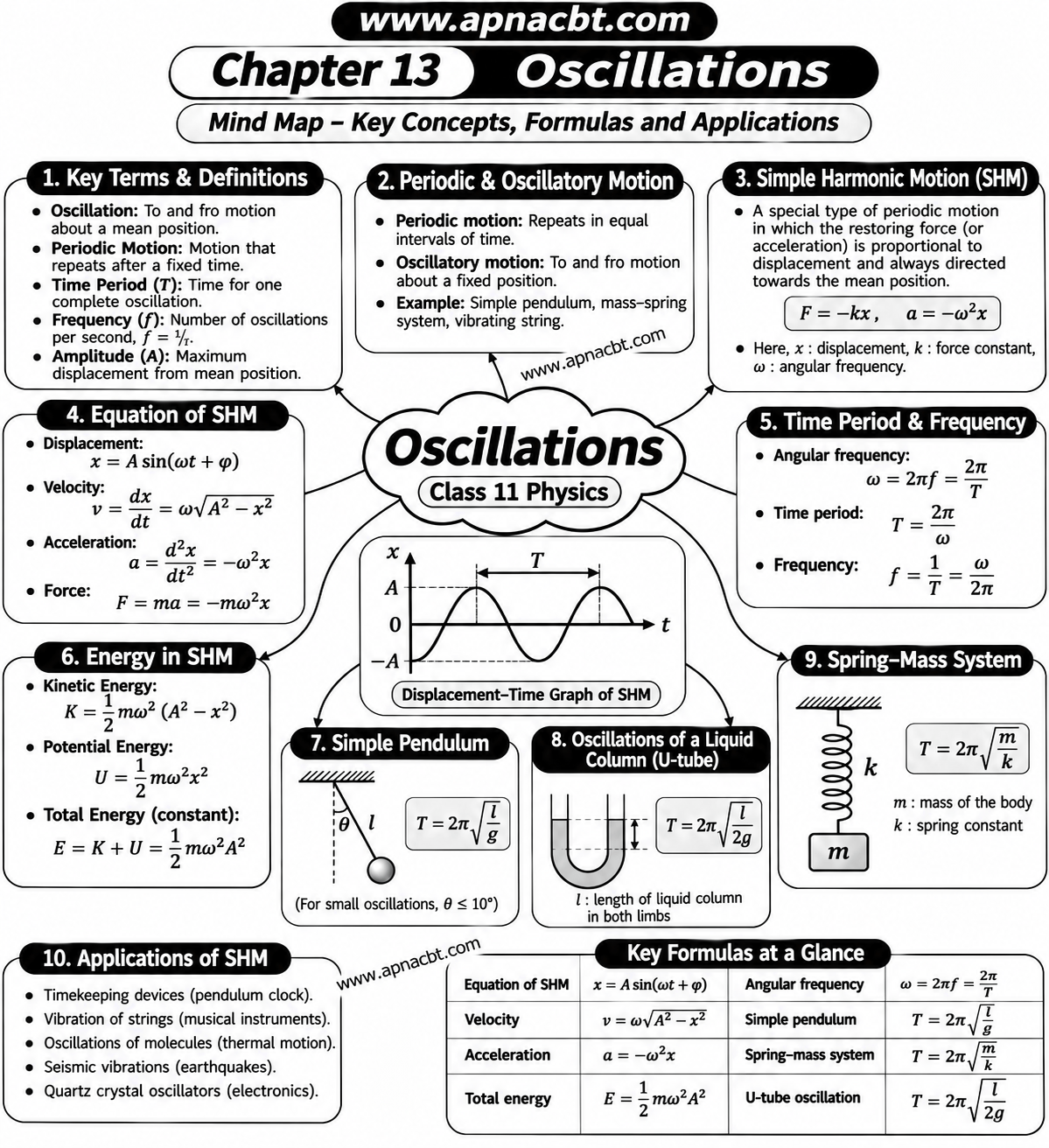
Oscillations Mind Map – Class 11 Physics Chapter 13
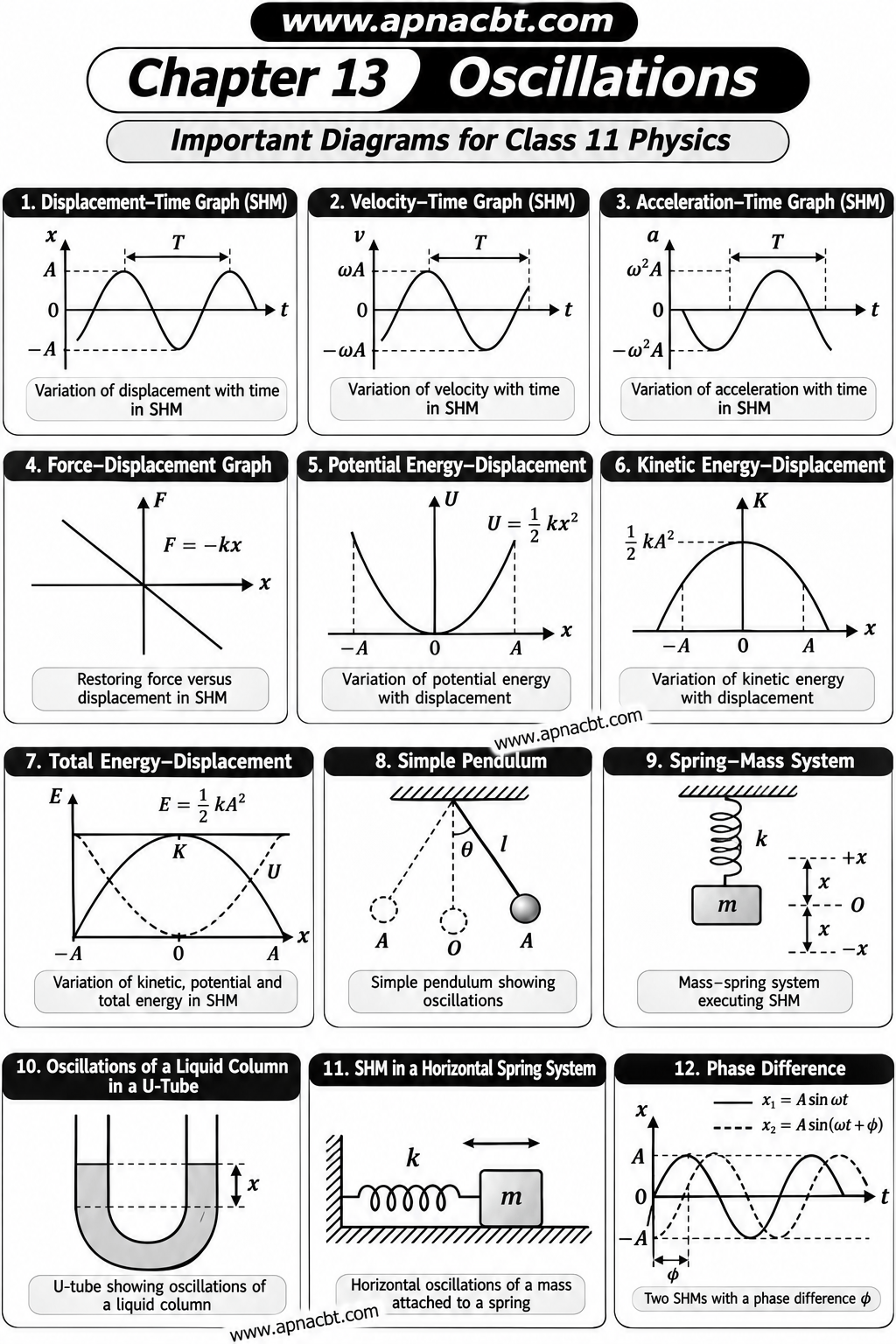
Important Diagrams – Oscillations Class 11 Physics Chapter 13
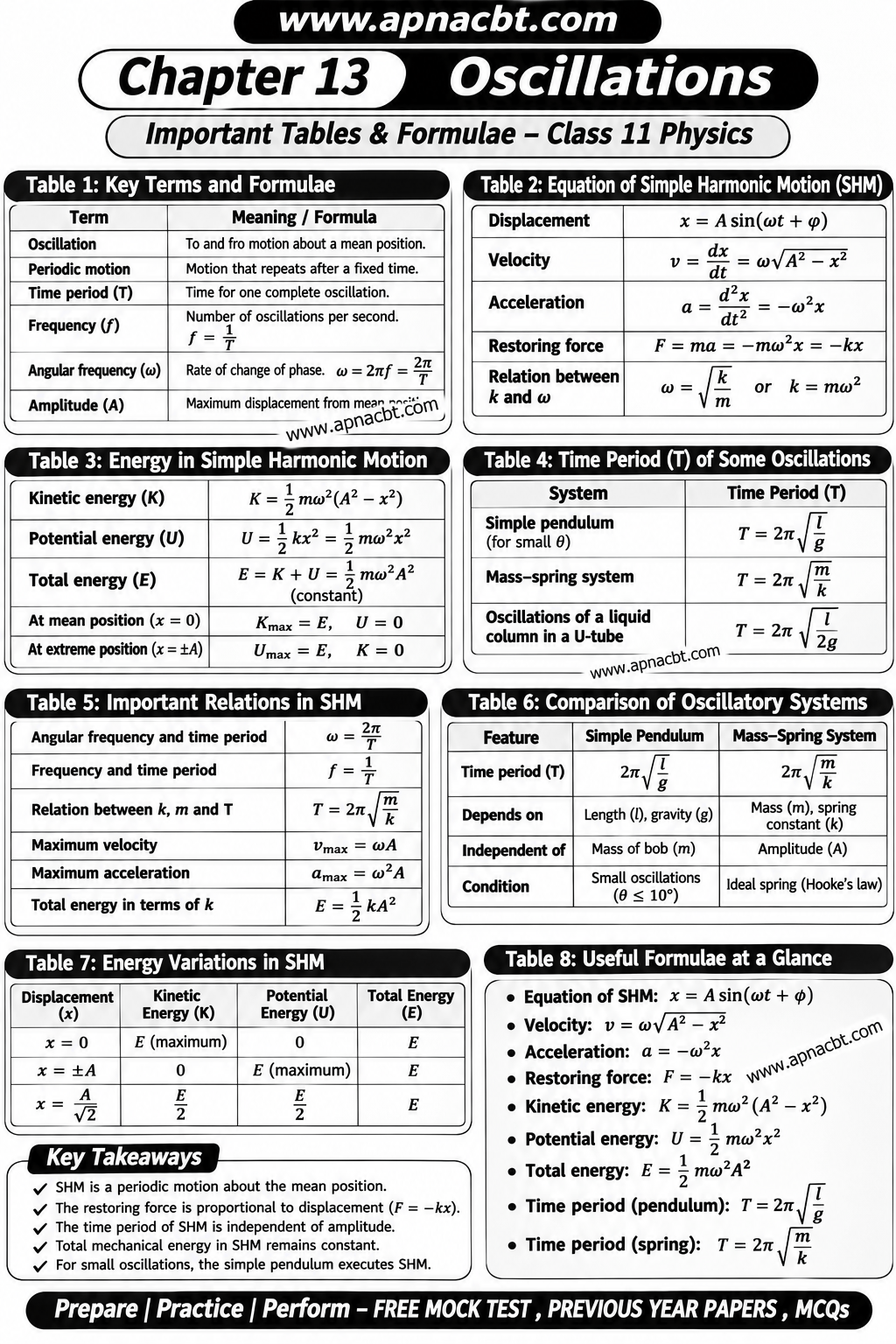
Important Tables and Formulae – Oscillations Class 11 Physics Chapter 13