Chapter 08: Electromagnetic Waves
Electromagnetic Waves are an important Class 12 Physics topic for CBSE Board Exams and NEET preparation. This Level 01 lesson covers displacement current, Maxwell’s equations, wave properties, electromagnetic spectrum, applications and key formulas.
Study this NCERT-based lesson before moving to chapter-wise MCQs, previous year questions and mock tests. The lesson follows the Class 12 Physics chapter structure and gives special attention to concepts that are repeatedly useful in board and entrance-exam preparation.
Table of Contents
- Electromagnetic Waves – Introduction and Exam Focus
- Displacement Current and Ampere-Maxwell Law
- Maxwell’s Equations and Electromagnetic Symmetry
- Production and Source of Electromagnetic Waves
- Nature and Properties of Electromagnetic Waves
- Speed, Wavelength, Frequency and Wave Equation
- Energy, Momentum and Radiation Pressure
- Electromagnetic Spectrum – Order and Classification
- Radio Waves and Microwaves
- Infrared and Visible Radiation
- Ultraviolet Rays and X-Rays
- Gamma Rays and High-Energy Radiation
- Quick Revision – Formulae, Comparisons and Common Mistakes
- 30 Short Questions – Electromagnetic Waves
- 15 Long Questions – Electromagnetic Waves
Related APNA CBT resources: APNA CBT Home | Class 12 Physics Preparation | Physics Practice and Mock Tests
Official resources: NCERT Physics – Electromagnetic Waves | CBSE Academic
Electromagnetic Waves – Introduction and Exam Focus
Electromagnetic Waves are coupled, time-varying electric and magnetic fields that propagate through space. NCERT develops this chapter from Maxwell's correction to Ampere's circuital law, called displacement current, and then explains the nature, production, properties and electromagnetic spectrum of these waves.
For CBSE Board Exams, concentrate on definitions, Maxwell's equations, displacement current, field relationships, wave speed, energy and momentum, and the electromagnetic spectrum. For NEET, focus on direct formula questions, field directions, wavelength-frequency comparisons, spectrum order and applications.
This APNA CBT Level 01 lesson is designed as a preparation stage before chapter-wise practice and mock tests. Keep the formulae, spectrum sequence and important diagrams together during revision.
Displacement Current and Ampere-Maxwell Law
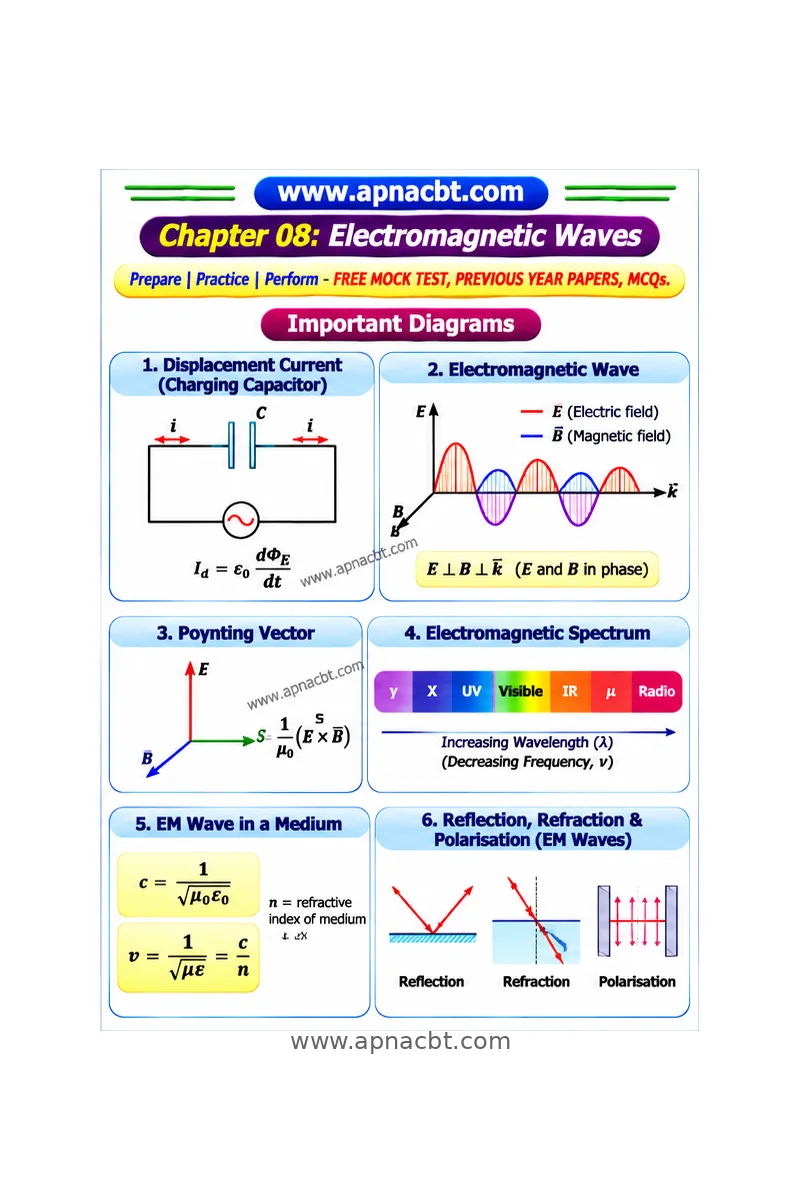
A changing electric field produces a magnetic field. Maxwell introduced displacement current to remove the inconsistency that appears when Ampere's circuital law is applied to a charging parallel-plate capacitor.
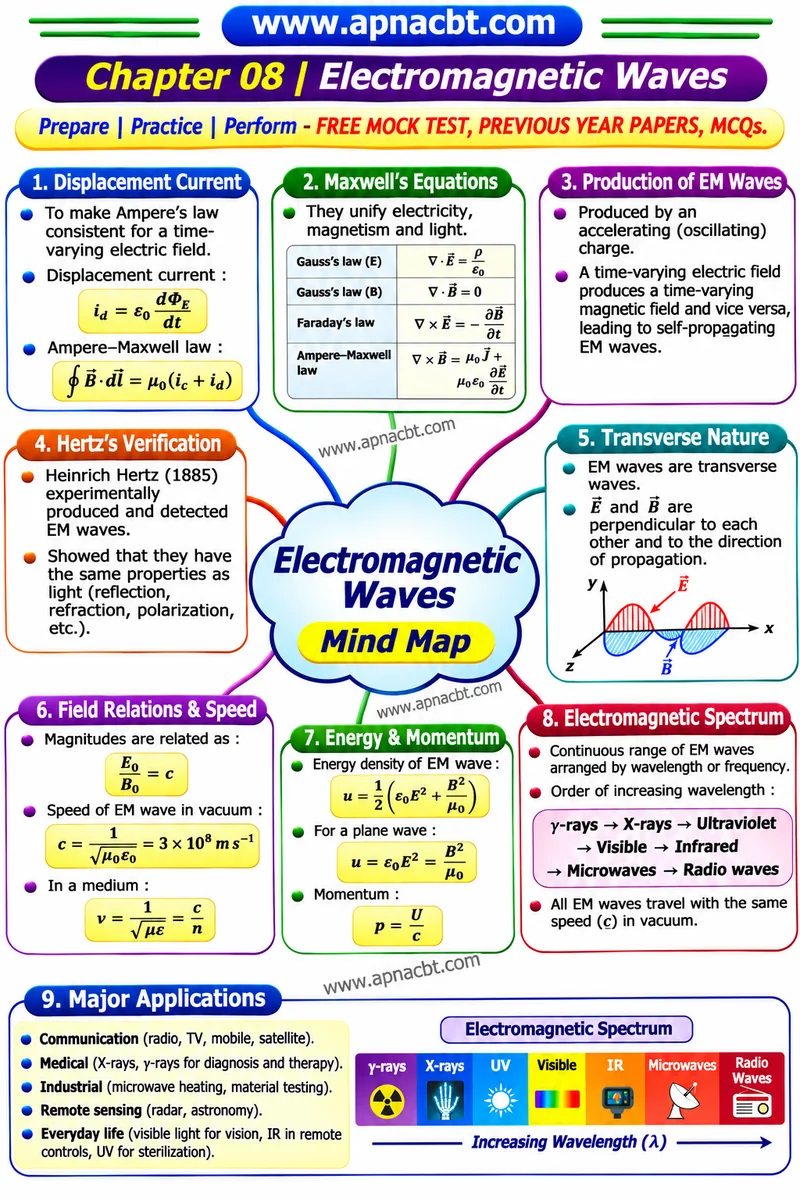
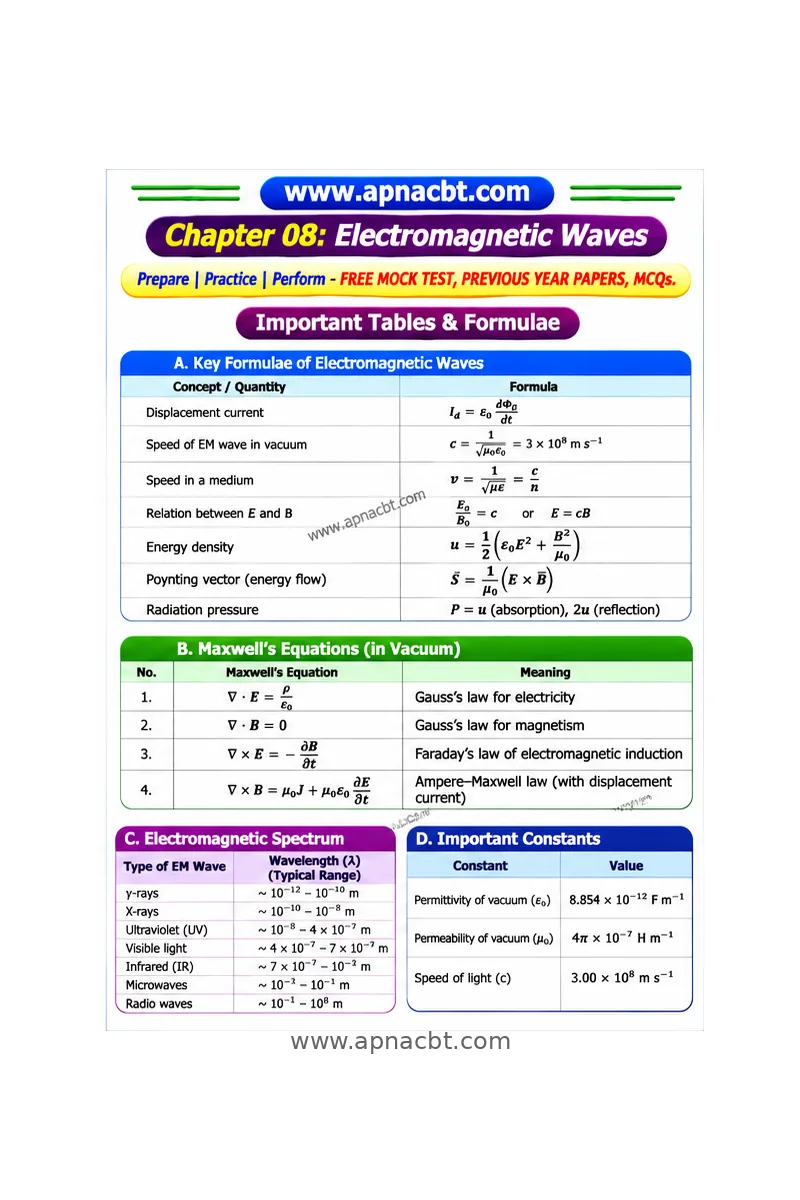
The displacement current is id = ε0(dΦE/dt), where ΦE is electric flux. The total current used in the corrected law is i = ic + id. Outside a charging capacitor, conduction current is present through the wire. Between the plates, conduction current is absent in the ideal gap but displacement current accounts for the same magnetic effect.
The Ampere-Maxwell law is written as ∮B·dl = μ0ic + μ0ε0(dΦE/dt). This is a high-value CBSE derivation and an important conceptual relation for NEET.
Maxwell’s Equations and Electromagnetic Symmetry
Maxwell's equations provide a unified mathematical description of electric and magnetic fields. At Class 12 level, remember their physical meaning: Gauss's law for electricity connects electric flux with charge, Gauss's law for magnetism expresses the absence of magnetic monopoles, Faraday's law connects changing magnetic flux with induced electric field, and the Ampere-Maxwell law connects magnetic circulation with conduction and displacement current.
Faraday's law shows that a time-varying magnetic field produces an electric field. Maxwell's correction adds the symmetrical idea that a time-varying electric field produces a magnetic field. Together, these ideas explain how coupled fields can sustain propagation through space.
In board answers, write the law, identify each term and state the physical conclusion rather than only listing equations.
Production and Source of Electromagnetic Waves
Electromagnetic radiation is produced by accelerating charges. A stationary charge produces an electrostatic field, while a steady current does not continuously radiate EM waves. An oscillating or accelerated charge produces time-varying electric and magnetic fields that can propagate outward.
An electric dipole is a basic source of electromagnetic radiation. If a charge oscillates harmonically with frequency ν, the emitted electromagnetic wave has the same frequency ν. Hertz experimentally produced and detected EM waves in the laboratory, providing important confirmation of Maxwell's prediction.
For NEET, remember the keyword accelerated charge. For CBSE, explain why a changing field can sustain the other field and hence form a propagating wave.
Nature and Properties of EM waves
EM waves are transverse waves. The electric field E and magnetic field B oscillate perpendicular to each other and perpendicular to the direction of propagation. They do not require a material medium and can travel through vacuum.
For a plane wave travelling along the z-direction, the electric field may be along the x-direction and the magnetic field along the y-direction. A representative form is E = E0 sin(kz − ωt) and B = B0 sin(kz − ωt), with k = 2π/λ.
The peak field magnitudes satisfy E0/B0 = c in vacuum. The fields are in phase in a plane electromagnetic wave. EM waves carry energy and momentum and can exert radiation pressure on matter.
Speed, Wavelength, Frequency and Wave Equation
The speed of an electromagnetic wave in vacuum is c = 1/√(μ0ε0), which has the value approximately 3 × 10^8 m s−1. In a material medium, the speed is v = 1/√(με), where μ and ε are the permeability and permittivity of the medium.
The basic wave relation is c = νλ in vacuum. Frequency is determined by the source and remains unchanged when an electromagnetic wave enters another medium, while its speed and wavelength can change.
For a sinusoidal wave, k = 2π/λ and ω = 2πν. These relations are frequently tested in numerical and one-line questions. Always keep units consistent when converting wavelength or frequency.
Energy, Momentum and Radiation Pressure
EM waves transport energy as they propagate. The energy is shared between the electric and magnetic fields. In a plane electromagnetic wave, the electric and magnetic contributions to the average energy density are equal.
EM waves also carry momentum. If an amount of energy U is transferred to a surface, the associated momentum magnitude is p = U/c for complete absorption. Radiation pressure results from the transfer of momentum when electromagnetic radiation interacts with a surface.
For CBSE, understand the physical meaning of energy and momentum transport. For NEET, remember the relation p = U/c and the fact that electromagnetic radiation can exert pressure even though it carries no rest mass.
Electromagnetic Spectrum – Order and Classification
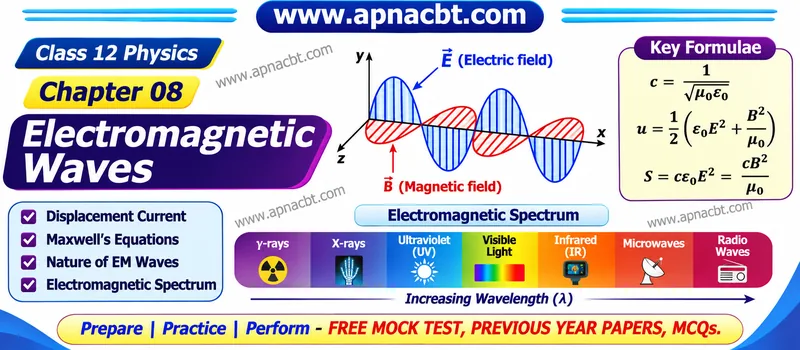
The electromagnetic spectrum is the orderly distribution of electromagnetic radiation according to wavelength or frequency. There are no perfectly sharp boundaries between neighbouring regions. From longest wavelength to shortest wavelength, the standard sequence is radio waves, microwaves, infrared, visible light, ultraviolet, X-rays and gamma rays.
As wavelength decreases, frequency and photon energy increase. Since c = νλ in vacuum, wavelength and frequency are inversely related. This order is one of the most important memory-based areas of the chapter.
For rapid revision, learn the sequence in both directions. Long wavelength means low frequency; short wavelength means high frequency. The common regions overlap, so their boundaries should not be treated as exact universal cut-offs.
Radio Waves and Microwaves
Radio waves are produced by accelerated charges in conducting wires and are widely used in radio and television communication. They occupy the long-wavelength, low-frequency side of the spectrum.
Microwaves have shorter wavelengths and frequencies in the gigahertz range. NCERT describes their use in radar systems, aircraft navigation and microwave ovens. Special devices such as magnetrons and klystrons can generate microwaves.
A microwave oven works by transferring microwave energy efficiently to water molecules in food. For exams, associate radio waves with communication and microwaves with radar, navigation and microwave heating.
Infrared and Visible Radiation
Infrared radiation lies next to the visible region on the longer-wavelength side. It is strongly associated with thermal effects because many substances absorb infrared radiation and convert the energy into increased molecular motion. Infrared lamps, detectors, satellite observations and remote-control systems are common applications.
Visible radiation is the part of the electromagnetic spectrum detected by the human eye. NCERT gives an approximate frequency range of 4 × 10^14 Hz to 7 × 10^14 Hz and wavelength range of about 700 nm to 400 nm.
In questions, remember the relative position: infrared has longer wavelength and lower frequency than visible light, while ultraviolet has shorter wavelength and higher frequency than visible light.
Ultraviolet Rays and X-Rays
Ultraviolet radiation lies beyond the violet end of visible light. The Sun is an important source, while special lamps and very hot bodies can also produce ultraviolet radiation. The ozone layer absorbs much of the Sun's ultraviolet radiation. UV is used for sterilisation, water purification and specialised medical applications, but excessive exposure can be harmful.
X-rays occupy the region beyond ultraviolet toward shorter wavelengths and higher frequencies. They can be generated by bombarding a metal target with high-energy electrons. X-rays are used for medical diagnosis and in the study or treatment of certain conditions.
For CBSE and NEET, compare UV and X-rays using wavelength, frequency, production, detection and applications rather than memorising only isolated facts.
Gamma Rays and High-Energy Radiation
Gamma rays occupy the shortest-wavelength, highest-frequency end of the electromagnetic spectrum. They are produced in nuclear reactions and emitted by radioactive nuclei. Their high energy allows them to penetrate matter strongly.
Gamma rays have important medical applications, including the destruction of cancer cells. Because high-energy radiation can damage living tissues, exposure must be carefully controlled.
The spectrum sequence is especially important here: gamma rays have higher frequency and higher photon energy than X-rays, while radio waves have the longest wavelengths and lowest frequencies among the main named regions.
Quick Revision – Formulae, Comparisons and Common Mistakes
The most important relations are id = ε0(dΦE/dt), i = ic + id, ∮B·dl = μ0ic + μ0ε0(dΦE/dt), E0/B0 = c, c = 1/√(μ0ε0), v = 1/√(με), c = νλ, k = 2π/λ and ω = 2πν.
Remember these comparisons: EM waves are transverse; E and B are mutually perpendicular and both are perpendicular to propagation; they can travel through vacuum; accelerated charges radiate them; and their speed in vacuum is the same for all spectrum regions.
Common mistakes include confusing conduction current with displacement current, reversing the spectrum order, treating wavelength as unchanged when a wave enters a medium, forgetting that frequency is fixed by the source, and using c = 3 × 10^8 m/s inside a material without checking the medium.
30 Short Questions – EM waves
These 30 questions revise definitions, laws, formulae, properties, spectrum order and applications for CBSE and NEET preparation.
1. What are EM waves?
Answer: They are coupled, time-varying electric and magnetic fields that propagate through space.
2. Who predicted EM waves theoretically?
Answer: James Clerk Maxwell predicted their existence from his unified electromagnetic theory.
3. Who experimentally verified EM waves?
Answer: Heinrich Rudolf Hertz experimentally produced and detected EM waves in the laboratory.
4. What is displacement current?
Answer: Displacement current is the current associated with a changing electric flux, given by id = ε0(dΦE/dt).
5. Write the expression for displacement current.
Answer: id = ε0(dΦE/dt).
6. What is conduction current?
Answer: Conduction current is the current produced by the directed flow of electric charges through a conductor.
7. Why was displacement current introduced?
Answer: It removes the inconsistency in applying Ampere's circuital law to a charging capacitor.
8. Write the Ampere-Maxwell law.
Answer: ∮B·dl = μ0ic + μ0ε0(dΦE/dt).
9. What produces electromagnetic radiation?
Answer: Accelerated charges produce electromagnetic radiation.
10. Can a stationary charge produce EM waves?
Answer: No. A stationary charge produces an electrostatic field but does not radiate EM waves.
11. What is the nature of EM waves?
Answer: EM waves are transverse waves.
12. How are E and B oriented in an electromagnetic wave?
Answer: The electric field, magnetic field and direction of propagation are mutually perpendicular.
13. What is the relation between peak electric and magnetic fields in vacuum?
Answer: E0/B0 = c.
14. What is the speed of EM waves in vacuum?
Answer: c = 1/√(μ0ε0), approximately 3 × 10^8 m/s.
15. Write the wave relation in vacuum.
Answer: c = νλ.
16. What happens to frequency when an electromagnetic wave enters another medium?
Answer: Its frequency remains unchanged because frequency is fixed by the source.
17. What happens to wavelength in a medium?
Answer: It changes because the wave speed changes while frequency remains the same.
18. What is wave number?
Answer: Wave number is k = 2π/λ.
19. What is angular frequency?
Answer: Angular frequency is ω = 2πν.
20. What is the electromagnetic spectrum?
Answer: It is the orderly classification of electromagnetic radiation according to wavelength or frequency.
21. Name the electromagnetic spectrum in increasing wavelength.
Answer: Gamma rays, X-rays, ultraviolet, visible light, infrared, microwaves and radio waves.
22. Which EM waves have the longest wavelength?
Answer: Radio waves.
23. Which EM waves have the highest frequency?
Answer: Gamma rays.
24. Which electromagnetic radiation is detected by the human eye?
Answer: Visible light.
25. State one use of radio waves.
Answer: Radio and television communication.
26. State one use of microwaves.
Answer: Radar systems or microwave ovens.
27. State one use of infrared radiation.
Answer: Remote controls or thermal applications.
28. State one use of ultraviolet radiation.
Answer: Sterilisation and water purification.
29. State one use of X-rays.
Answer: Medical diagnostic imaging.
30. State one use of gamma rays.
Answer: Medical treatment such as destroying cancer cells.
15 Long Questions – EM waves
These 15 questions focus on derivations, explanations, comparisons and high-value concepts for board examinations and entrance-test preparation.
1. Explain the need for displacement current.
Detailed Answer: For a charging capacitor, applying Ampere's circuital law to two different surfaces bounded by the same loop appears to give different currents. Maxwell resolved this inconsistency by introducing displacement current id = ε0(dΦE/dt). The corrected law uses conduction plus displacement current and gives the same magnetic field for either surface.
2. Derive the expression for displacement current.
Detailed Answer: For a parallel-plate capacitor, electric flux is ΦE = Q/ε0. Differentiating with respect to time gives dΦE/dt = (1/ε0)dQ/dt. Since conduction current i = dQ/dt, multiplying by ε0 gives id = ε0(dΦE/dt).
3. State and explain the Ampere-Maxwell law.
Detailed Answer: The corrected circuital law is ∮B·dl = μ0ic + μ0ε0(dΦE/dt). The first term represents conduction current and the second represents displacement current. Thus both a conduction current and a changing electric field can act as sources of magnetic field.
4. Explain how EM waves are produced.
Detailed Answer: Accelerating charges create time-varying electric and magnetic fields. A changing electric field produces a magnetic field through the displacement-current effect, while a changing magnetic field produces an electric field according to Faraday's law. The coupled fields can therefore propagate away from the source as an electromagnetic wave.
5. Explain the transverse nature of EM waves.
Detailed Answer: In a plane electromagnetic wave travelling in the z-direction, the electric field may oscillate along x and the magnetic field along y. Thus E, B and the direction of propagation are mutually perpendicular. This perpendicular arrangement is the defining transverse character of the wave.
6. Derive the speed relation for EM waves in vacuum.
Detailed Answer: Maxwell's equations lead to a wave speed determined by the electric permittivity and magnetic permeability of free space. The result is c = 1/√(μ0ε0), which is approximately 3 × 10^8 m/s. Its agreement with the measured speed of light established that light is electromagnetic radiation.
7. Explain the relationship between electric and magnetic field amplitudes.
Detailed Answer: For a plane electromagnetic wave in vacuum, the peak electric and magnetic fields satisfy E0/B0 = c. Therefore B0 = E0/c. The fields oscillate with the same frequency and are in phase for the ideal plane-wave description.
8. Explain energy and momentum carried by EM waves.
Detailed Answer: EM waves transport energy through space, with energy shared between their electric and magnetic fields. They also carry momentum. If energy U is completely transferred to a surface, the associated momentum transfer has magnitude p = U/c. Momentum transfer can produce radiation pressure.
9. Explain the electromagnetic spectrum in order.
Detailed Answer: In increasing wavelength, the spectrum is gamma rays, X-rays, ultraviolet, visible light, infrared, microwaves and radio waves. In increasing frequency the order is reversed. Since c = νλ in vacuum, shorter wavelength means higher frequency and higher photon energy.
10. Compare radio waves, microwaves and infrared radiation.
Detailed Answer: Radio waves have the longest wavelengths among these three and are used mainly for communication. Microwaves have shorter wavelengths and are used in radar, navigation and microwave ovens. Infrared has still shorter wavelength and is associated with thermal radiation, remote controls and detectors.
11. Explain visible and ultraviolet radiation with applications.
Detailed Answer: Visible light is the portion detected by the human eye, approximately 400–700 nm in wavelength. Ultraviolet has shorter wavelength and higher frequency. UV is produced by the Sun and special sources and is used for sterilisation and water purification. Excess exposure can be harmful, while the ozone layer provides important protection.
12. Explain X-rays and gamma rays.
Detailed Answer: X-rays are high-frequency electromagnetic radiation produced, for example, by high-energy electrons striking a metal target. They are widely used in medical imaging. Gamma rays have still higher frequencies and are emitted by radioactive nuclei or nuclear reactions. They have medical uses but can damage living tissue, so exposure must be controlled.
13. Explain what changes when an electromagnetic wave enters a medium.
Detailed Answer: The frequency remains fixed by the source. The speed changes according to v = 1/√(με), so the wavelength changes according to v = νλ. Thus frequency does not change at the boundary, whereas speed and wavelength generally do.
14. Write a CBSE-ready note on properties of EM waves.
Detailed Answer: EM waves are transverse, need no material medium, travel in vacuum at c, contain mutually perpendicular E and B fields, carry energy and momentum, are produced by accelerated charges and are not deflected as charged particles by electric or magnetic fields. Their spectrum ranges from radio waves to gamma rays.
15. Write the most important formulae and exam facts from the chapter.
Detailed Answer: Key relations are id = ε0(dΦE/dt), i = ic + id, ∮B·dl = μ0ic + μ0ε0(dΦE/dt), E0/B0 = c, c = 1/√(μ0ε0), v = 1/√(με), c = νλ, k = 2π/λ and ω = 2πν. The spectrum order and the applications of each region should also be memorised.