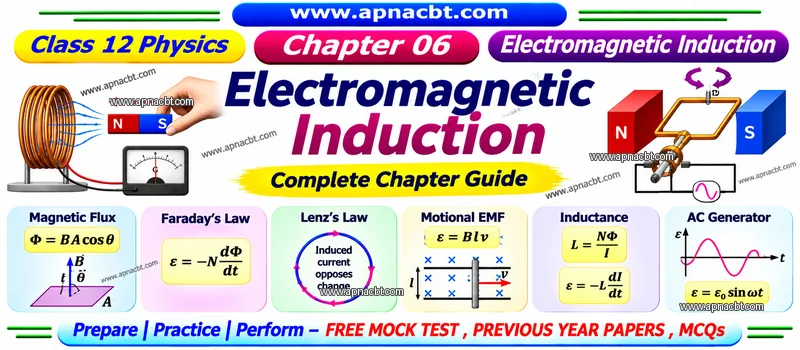
Electromagnetic Induction – Class 12 Physics, CBSE Board Exams and NEET Preparation
Electromagnetic Induction explains how a changing magnetic flux can produce an induced emf and current in a circuit. This Level 01 lesson is designed for Class 12 Physics, CBSE Board Exams, NEET and other competitive examinations. It covers magnetic flux, Faraday’s laws, Lenz’s law, motional emf, eddy currents, mutual induction, self-induction and the working of an AC generator. The lesson follows the attached NCERT-based source and keeps the most important definitions, equations, concepts and exam applications together for systematic preparation.
Table of Contents
- 1. Introduction to Electromagnetic Induction
- 2. Magnetic Flux
- 3. Faraday’s Laws of Electromagnetic Induction
- 4. Lenz’s Law and Conservation of Energy
- 5. Motional Electromotive Force
- 6. Eddy Currents
- 7. Inductance and Self-Induction
- 8. Mutual Induction
- 9. AC Generator
- 10. CBSE and NEET Exam-Focused Revision
- 11. Important Formulae, Units and Common Mistakes
- 12. NCERT and CBSE Learning Resources
- 13. Short Questions – 30 Questions with Detailed Answers
- 14. Long Questions – 15 Questions with Detailed Answers
Introduction to Electromagnetic Induction
Electromagnetic induction is the phenomenon in which an emf is induced when the magnetic flux linked with a circuit changes. Faraday and Henry established experimentally that a changing magnetic environment can produce an electrical effect in a conducting circuit.
The change in flux may be produced by changing the magnetic field, changing the area of the circuit within the field, or changing the orientation of the circuit. Therefore, a conductor does not need to be connected to a battery for an emf to appear.
For CBSE and NEET, remember the central idea: change in magnetic flux produces induced emf. If the circuit is closed, the induced emf can drive an induced current. If the circuit is open, an emf can still exist across its ends.
Useful preparation links: APNA CBT and APNA CBT Physics Practice.
Magnetic Flux
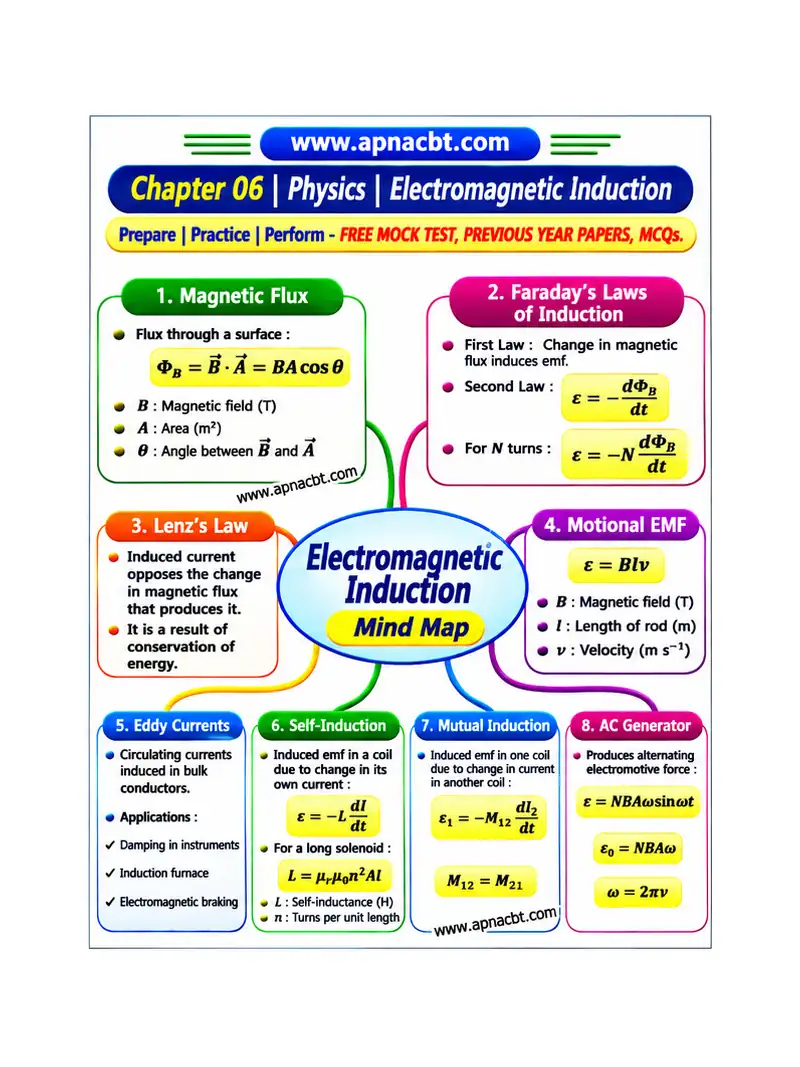
Magnetic flux measures the magnetic field passing through a surface. For a uniform magnetic field and a plane surface, the flux is given by ΦB = B A cos θ, where θ is the angle between the magnetic field and the area vector.
Flux is maximum when the area vector is parallel to the magnetic field, because cos 0° = 1. Flux is zero when the area vector is perpendicular to the magnetic field, because cos 90° = 0.
The SI unit of magnetic flux is the weber (Wb). For a coil of N turns, the flux linkage is NΦB. A change in flux linkage is the quantity that appears directly in Faraday’s law.
Exam tip: never confuse the angle between B and the plane of the coil with the angle between B and the area vector. The standard formula uses the angle between B and the area vector.
Faraday’s Laws of Electromagnetic Induction
Faraday’s first law states that whenever the magnetic flux linked with a circuit changes, an induced emf is produced in the circuit. The induced emf exists as long as the flux continues to change.
Faraday’s second law states that the magnitude of induced emf is proportional to the rate of change of magnetic flux. For a coil of N turns:
ε = −N dΦB/dt
The negative sign is explained by Lenz’s law. It indicates that the induced effect opposes the change responsible for producing it.
If the resistance of a closed circuit is R, the induced current is I = ε/R. In numerical problems, first identify how the flux changes and then differentiate or calculate the average rate of change.
For average induced emf, use εavg = −N ΔΦB/Δt. This is especially useful when the initial and final magnetic fluxes are directly given.
Lenz’s Law and Conservation of Energy
Lenz’s law gives the direction of induced current. The induced current flows in such a direction that its magnetic effect opposes the change in magnetic flux that produced it.
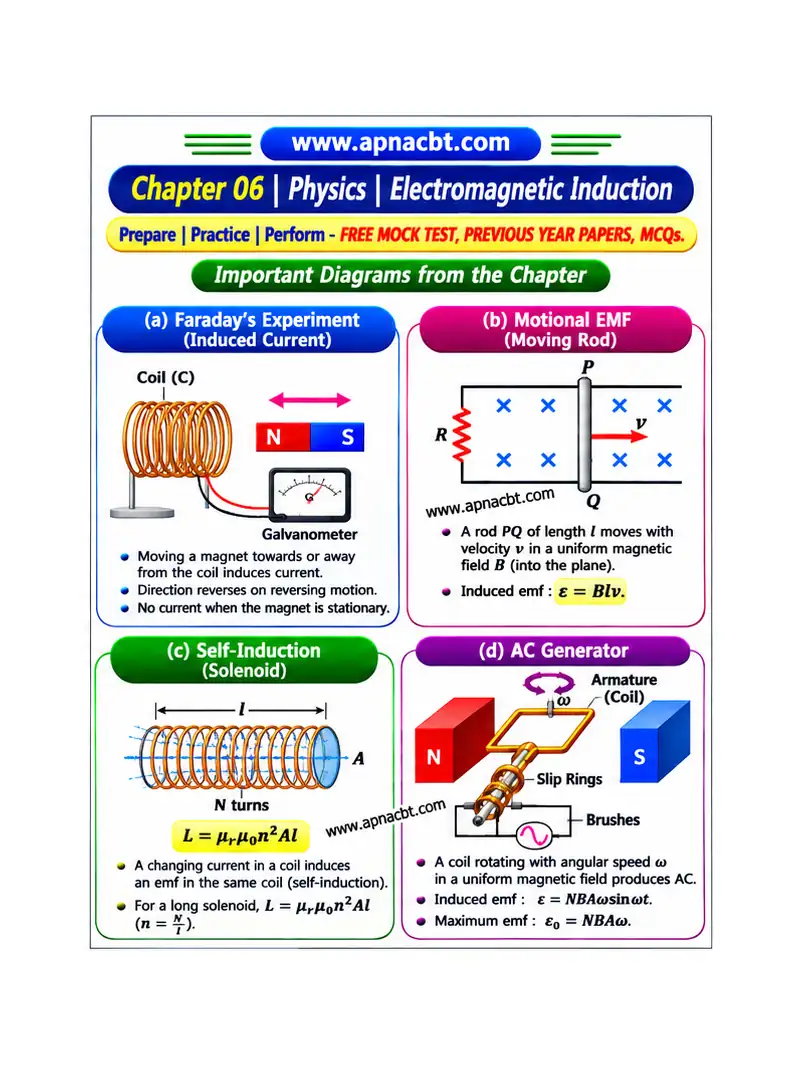
For example, when the north pole of a magnet approaches a coil, the near face of the coil behaves like a north pole so that it repels the approaching magnet. When the magnet moves away, the coil tends to attract it. This opposition requires external work and is consistent with conservation of energy.
Lenz’s law is represented mathematically by the negative sign in Faraday’s equation. In board examinations, a strong answer should mention both the direction of induced current and the conservation-of-energy interpretation.
A common mistake is to say that induced current always opposes the magnetic field. It actually opposes the change in magnetic flux, not necessarily the field itself.
Motional Electromotive Force
When a conducting rod moves through a magnetic field, free charges in the rod experience magnetic force. If the rod of length l moves with speed v perpendicular to a uniform magnetic field B, the motional emf is:
ε = B l v
The expression follows from the magnetic force on moving charges. The separation of charges creates a potential difference between the ends of the rod.
For a moving conductor, always check the relative directions of the rod, velocity and magnetic field. The maximum motional emf occurs when the relevant motion is perpendicular to the magnetic field.
For a rod moving on conducting rails, the changing area of the loop changes magnetic flux and produces the same result through Faraday’s law. This provides an important connection between flux change and motional emf.
Eddy Currents
Eddy currents are circulating currents induced in bulk conducting materials when the magnetic flux through them changes. They can produce heating and magnetic forces.
Applications include electromagnetic braking, induction heating, damping in certain instruments and other systems where controlled magnetic effects are useful. Eddy currents can also represent an unwanted energy loss in electrical machines, so laminated cores are used in suitable devices to reduce them.
For examinations, distinguish eddy currents from the useful current in a wire circuit. Eddy currents are generally closed circulating paths within the conducting body itself.
Inductance and Self-Induction
Inductance is the property of a circuit by which it opposes a change in current. In self-induction, a changing current in a coil changes the magnetic flux linked with the same coil and produces an induced emf in it.
The self-induced emf is:
ε = −L dI/dt
For a coil, flux linkage can be written as NΦB = LI. Therefore, inductance is the ratio of flux linkage to current, L = NΦB/I.
For a long solenoid of length l, cross-sectional area A and n turns per unit length, the self-inductance in a medium of relative permeability μr is:
L = μr μ0 n² A l
The SI unit of inductance is the henry (H). The induced emf always opposes the change in current, in accordance with Lenz’s law.
Mutual Induction
Mutual induction occurs when a changing current in one coil induces an emf in a nearby coil. If coil 2 carries a changing current I2, the induced emf in coil 1 is:
ε1 = −M12 dI2/dt
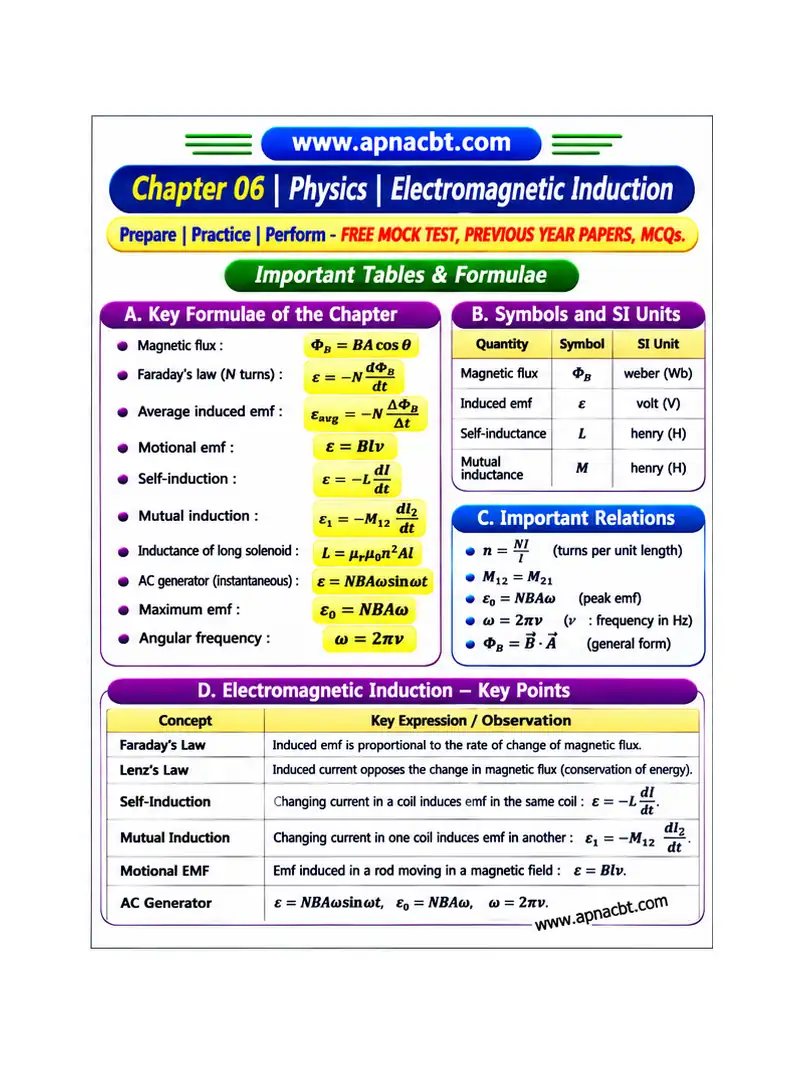
M is called mutual inductance. For the pair of coils, the mutual inductances are equal in the ideal reciprocal case: M12 = M21.
Mutual induction depends on the geometry and relative arrangement of the coils, including their separation and orientation. It is the basic principle behind transformer action, which is studied with alternating current.
For numerical questions, identify which coil has the changing current and which coil has the induced emf before assigning subscripts.
AC Generator
An AC generator converts mechanical energy into electrical energy using electromagnetic induction. A coil rotates in a uniform magnetic field, causing the magnetic flux through the coil to change periodically.
For a coil of N turns and area A rotating with angular speed ω in a magnetic field B, the instantaneous emf is:
ε = NBAω sin ωt
The maximum emf is ε0 = NBAω, so the equation can be written as ε = ε0 sin ωt.
The basic components include an armature coil, magnetic field, rotor arrangement, slip rings and brushes. The periodic reversal of emf produces alternating current.
The NCERT treatment also gives ω = 2πν, where ν is the frequency of rotation. Hence the emf can be written as ε = ε0 sin 2πνt.
CBSE and NEET Exam-Focused Revision
For CBSE Board Exams, prepare definitions, derivations, diagrams, laws, explanations and numerical applications. The highest-value written answers usually connect Faraday’s law with magnetic flux, Lenz’s law with conservation of energy, and motional emf with the motion of a conductor in a magnetic field.
For NEET and other objective examinations, focus on sign conventions, angle interpretation in flux, direction of induced current, proportionality relations and quick formula selection.
- Magnetic flux: ΦB = BA cos θ
- Faraday’s law: ε = −N dΦB/dt
- Average emf: εavg = −N ΔΦB/Δt
- Motional emf: ε = Blv
- Self-induced emf: ε = −L dI/dt
- Mutual induction: ε1 = −M dI2/dt
- AC generator: ε = NBAω sin ωt
Use APNA CBT practice resources after learning the concepts so that formula selection becomes automatic.
Important Formulae, Units and Common Mistakes
Key quantities: magnetic flux ΦB is measured in weber, emf ε in volt, current I in ampere, resistance R in ohm, and inductance L or mutual inductance M in henry.
Remember that the area vector is perpendicular to the surface. Therefore, the angle in ΦB = BA cos θ is measured between B and the area vector.
Do not remove the negative sign from Faraday’s law when explaining direction. For magnitude-only questions, use the magnitude of the induced emf, but for direction questions interpret the sign through Lenz’s law.
In a closed circuit, induced emf can establish current. In an open circuit, an induced emf can exist even though current cannot flow through the open path.
For a rotating coil, maximum emf occurs when the rate of change of flux is maximum, not when the flux itself is maximum.
NCERT and CBSE Learning Resources
Use the official NCERT Class 12 Physics textbook for the complete chapter, diagrams and derivations. The official NCERT textbook identifies Chapter 6 as Electromagnetic Induction and includes magnetic flux, Faraday’s law, Lenz’s law, motional emf, inductance and AC generator.
For the current CBSE academic framework, check the official CBSE curriculum and sample-question-paper resources before examinations.
Official NCERT Physics Part-I PDF
Official CBSE Class XII Physics Curriculum 2026–27
Official CBSE Class XII Sample Question Papers and Marking Schemes
Internal APNA CBT resources: Physics Preparation, Chapter-wise Practice, and Mock Tests.
Short Questions – 30 Questions with Detailed Answers
1. What is electromagnetic induction?
Answer: Electromagnetic induction is the production of induced emf in a circuit when the magnetic flux linked with the circuit changes.
2. Define magnetic flux.
Answer: Magnetic flux through a plane surface is the scalar product ΦB = B·A = BA cos θ, where θ is the angle between B and the area vector.
3. What is the SI unit of magnetic flux?
Answer: The SI unit is the weber (Wb).
4. State Faraday’s first law.
Answer: Whenever the magnetic flux linked with a circuit changes, an induced emf is produced in the circuit for as long as the change continues.
5. State Faraday’s second law.
Answer: The magnitude of induced emf is proportional to the rate of change of magnetic flux linkage. For N turns, ε = −N dΦB/dt.
6. What does the negative sign in Faraday’s law mean?
Answer: It represents Lenz’s law. The induced effect opposes the change in magnetic flux responsible for producing it.
7. State Lenz’s law.
Answer: The induced current flows in a direction such that its magnetic effect opposes the change in magnetic flux that produces the current.
8. Why is Lenz’s law consistent with conservation of energy?
Answer: The induced current opposes the change, so external work is required to maintain the change. That supplied mechanical energy is converted into electrical or thermal energy rather than being created from nothing.
9. When is magnetic flux maximum?
Answer: Flux is maximum when the area vector is parallel to the magnetic field, so θ = 0° and ΦB = BA.
10. When is magnetic flux zero?
Answer: Flux is zero when the area vector is perpendicular to the magnetic field, so θ = 90°.
11. What is induced emf?
Answer: Induced emf is the emf generated in a circuit because of a change in magnetic flux linked with it.
12. What is motional emf?
Answer: Motional emf is the emf induced when a conductor moves through a magnetic field. For perpendicular motion, ε = Blv.
13. State the condition for maximum motional emf.
Answer: The effective component of motion should be perpendicular to the magnetic field, giving ε = Blv for the standard perpendicular arrangement.
14. What are eddy currents?
Answer: Eddy currents are circulating currents induced inside bulk conducting materials when the magnetic flux through them changes.
15. Mention one useful application of eddy currents.
Answer: Electromagnetic braking is an important application. Eddy currents produce magnetic effects that oppose motion.
16. What is self-induction?
Answer: Self-induction is the phenomenon in which a changing current in a coil induces an emf in the same coil.
17. Define self-inductance.
Answer: Self-inductance L is defined through the flux linkage relation NΦB = LI. Its induced emf is ε = −L dI/dt.
18. What is the SI unit of self-inductance?
Answer: The SI unit is henry (H).
19. What is mutual induction?
Answer: Mutual induction is the phenomenon in which a changing current in one coil induces an emf in a nearby coil.
20. Write the mutual induction equation.
Answer: For coil 1 affected by changing current in coil 2, ε1 = −M12 dI2/dt.
21. What is mutual inductance?
Answer: Mutual inductance is the proportionality constant connecting induced emf in one coil with the rate of change of current in the other coil.
22. What energy conversion takes place in an AC generator?
Answer: An AC generator converts mechanical energy into electrical energy through electromagnetic induction.
23. Write the instantaneous emf of an AC generator.
Answer: For a rotating N-turn coil, ε = NBAω sin ωt.
24. What is the maximum emf of an AC generator?
Answer: The maximum emf is ε0 = NBAω.
25. What is the role of slip rings in an AC generator?
Answer: Slip rings maintain electrical contact between the rotating coil and the external circuit through brushes.
26. Why does the current from an AC generator reverse periodically?
Answer: As the coil rotates, the rate and direction of change of magnetic flux reverse periodically, so the induced emf and current reverse direction periodically.
27. What happens to induced emf if the rate of change of flux increases?
Answer: The magnitude of induced emf increases because Faraday’s law makes emf proportional to the rate of change of flux.
28. Can induced emf exist in an open circuit?
Answer: Yes. A changing flux can produce an emf across the open ends, although no sustained current flows through the open circuit.
29. Why are laminated cores used to reduce eddy-current losses?
Answer: Lamination restricts large circulating current paths inside the core, thereby reducing eddy-current heating and energy loss.
30. What is the relation between angular speed and frequency?
Answer: Angular speed and frequency are related by ω = 2πν, where ν is the number of revolutions per second.
Long Questions – 15 Questions with Detailed Answers
1. Explain electromagnetic induction and Faraday’s laws.
Answer: Electromagnetic induction is the production of emf when magnetic flux linked with a circuit changes. Faraday’s first law states that a change in flux produces induced emf. His second law gives its magnitude: ε = −N dΦB/dt. The negative sign represents Lenz’s law. Thus, both the existence and magnitude of induced emf are determined by changing flux and its rate of change.
2. Derive the expression for magnetic flux through a plane surface.
Answer: For a uniform magnetic field B passing through an area A, only the component normal to the surface contributes to flux. If θ is the angle between B and the area vector A, the normal component is B cos θ. Therefore ΦB = BA cos θ. Flux is maximum at θ = 0° and zero at θ = 90°.
3. Explain Lenz’s law using the conservation of energy.
Answer: Lenz’s law states that induced current opposes the change in magnetic flux. If the induced current supported the change instead, the change could continue without external work and energy would appear without an energy source. Instead, external work is required to move a magnet or conductor against the induced magnetic effect. This work is converted into electrical energy and/or heat, consistent with conservation of energy.
4. Derive the motional emf of a rod moving through a magnetic field.
Answer: Consider a rod of length l moving with speed v perpendicular to a uniform magnetic field B. A charge q in the rod experiences magnetic force qvB. The work done in moving charge through length l is W = qvBl. Since emf is work done per unit charge, ε = W/q = Blv. Hence the motional emf is ε = Blv.
5. Explain the relation between motional emf and Faraday’s law.
Answer: When a moving rod forms part of a circuit, its motion changes the area enclosed by the circuit. Since ΦB = BA for perpendicular field and area vector, changing area produces changing flux. Faraday’s law therefore gives an induced emf. The direct magnetic-force approach gives ε = Blv, which is consistent with the flux-change approach.
6. What are eddy currents? Explain their applications and disadvantage.
Answer: Eddy currents are circulating currents induced in bulk conductors by changing magnetic flux. They can be used for electromagnetic braking, induction heating and damping. However, in electrical machines they can cause unwanted heating and energy loss. Laminating suitable cores reduces these current loops and therefore reduces losses.
7. Define self-induction and derive the self-induced emf equation.
Answer: In self-induction, a changing current in a coil changes its own magnetic flux and induces an emf in the same coil. Flux linkage is proportional to current: NΦB = LI. Differentiating with respect to time gives d(NΦB)/dt = L dI/dt. Faraday’s law then gives ε = −L dI/dt.
8. Derive the self-inductance of a long solenoid.
Answer: For a long solenoid, magnetic field B = μrμ0nI. If its length is l and cross-sectional area is A, the number of turns is N = nl. Flux through one turn is ΦB = BA. Therefore NΦB = (nl)(μrμ0nI)A. Comparing with NΦB = LI gives L = μrμ0n²Al.
9. Explain mutual induction and write its mathematical relation.
Answer: When the current in one coil changes, its magnetic field and the flux through a nearby coil change. An emf is therefore induced in the second coil. If I2 is the current in coil 2, the induced emf in coil 1 is ε1 = −M12dI2/dt. Mutual inductance depends on the geometry, relative orientation and separation of the coils.
10. Explain the construction and working principle of an AC generator.
Answer: An AC generator has a rotating armature coil placed in a magnetic field, with slip rings and brushes connecting it to an external circuit. Rotation changes the magnetic flux through the coil. Faraday’s law induces an emf. As the coil completes successive half rotations, the direction of induced emf reverses, producing alternating emf and current.
11. Derive the emf equation of an AC generator.
Answer: Let a coil of N turns and area A rotate in a magnetic field B with angular speed ω. At time t, the angle is θ = ωt. The flux through the coil is Φ = BA cos ωt. By Faraday’s law, ε = −N dΦ/dt. Differentiating gives ε = NBAω sin ωt. Therefore ε0 = NBAω and ε = ε0 sin ωt.
12. Explain how changing magnetic field can produce an induced electric field.
Answer: A time-varying magnetic field can induce an electric field. In a stationary conductor, charges are not moving initially, so the magnetic part of the Lorentz force does not act on them. The induced electric field associated with the changing magnetic field provides the force that drives the induced emf and current. This is a central demonstration of the connection between electricity and magnetism.
13. A coil has N turns and its magnetic flux changes from Φ1 to Φ2 in time Δt. Obtain the average induced emf.
Answer: Faraday’s law gives εavg = −N ΔΦ/Δt. Since ΔΦ = Φ2 − Φ1, the average emf is εavg = −N(Φ2 − Φ1)/Δt. Its magnitude is N|Φ2 − Φ1|/Δt. The sign gives the direction according to Lenz’s law.
14. Compare self-induction and mutual induction.
Answer: In self-induction, the changing current and induced emf occur in the same coil, with ε = −L dI/dt. In mutual induction, a changing current in one coil induces emf in another coil, with ε1 = −M dI2/dt. Both oppose the change and have inductance measured in henry.
15. Explain the most important examination strategy for Electromagnetic Induction.
Answer: First identify what changes: magnetic field, area, orientation or current. Then write magnetic flux and apply Faraday’s law. Use Lenz’s law for direction, Blv for standard motional-emf problems, L dI/dt for self-induction, M dI/dt for mutual induction and NBAω sin ωt for an AC generator. In board answers, include the law, equation, substitution, unit and a concluding statement. In objective questions, carefully check the angle used in flux and the sign or direction of induced current.