Class XII Physics | Chapter 05 | Magnetism and Matter | Level 01 – Prepare
Table of Contents
- Introduction: Magnetism and Matter
- Bar Magnet and Magnetic Field Lines
- Magnetic Dipole and Field on Axial and Equatorial Lines
- Magnetic Dipole in a Uniform Magnetic Field
- Gauss’s Law of Magnetism
- Earth’s Magnetism and Its Elements
- Magnetisation and Magnetic Intensity
- Magnetic Susceptibility and Permeability
- Diamagnetic, Paramagnetic and Ferromagnetic Materials
- Magnetic Hysteresis
- Permanent Magnets and Electromagnets
- Important Formulae, Units and Quick Revision
- CBSE, NEET Preparation, Diagrams and Common Mistakes
- Short-Answer Questions – 30 Questions with Detailed Answers
- Long-Answer Questions – 15 Questions with Detailed Answers
Introduction: Magnetism and Matter
Magnetism and Matter – Class 12 Physics for CBSE Board Exams and NEET Preparation
Magnetism and Matter is an important Class 12 Physics chapter for CBSE Board Exams, NEET and other competitive examinations. It develops the idea of a magnet as a magnetic dipole and explains magnetic field lines, magnetic moment, torque, Earth’s magnetic field, magnetisation and the behaviour of magnetic materials.
In Magnetism and Matter, students learn why magnetic poles cannot be isolated, why magnetic field lines form closed continuous loops and how a bar magnet can be compared with a current-carrying solenoid. The chapter also introduces magnetic susceptibility, magnetic permeability and the classification of materials as diamagnetic, paramagnetic and ferromagnetic.
The attached NCERT-based source emphasises the bar magnet, dipole field, Earth’s magnetic field, magnetisation, susceptibility, permeability, magnetic materials and hysteresis as the core learning sequence.
Prepare | Practice | Perform: For CBSE, focus on definitions, derivations, labelled diagrams and numerical applications. For NEET, focus on formulae, sign and direction conventions, material properties, Earth’s magnetism and conceptual comparisons.
Bar Magnet and Magnetic Field Lines
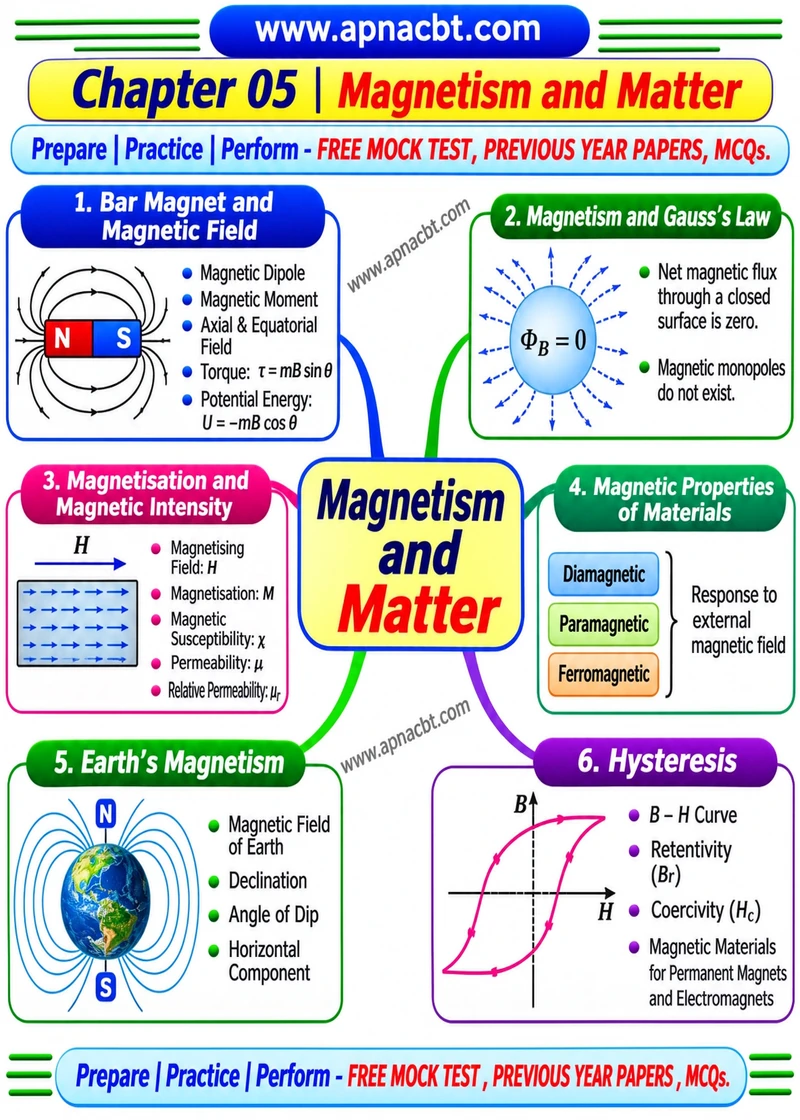
A bar magnet is a magnetic dipole with two poles, north (N) and south (S). Like poles repel and unlike poles attract. A freely suspended bar magnet tends to align approximately along the north-south direction. The poles always occur together; cutting a magnet produces smaller magnets rather than isolated magnetic monopoles.
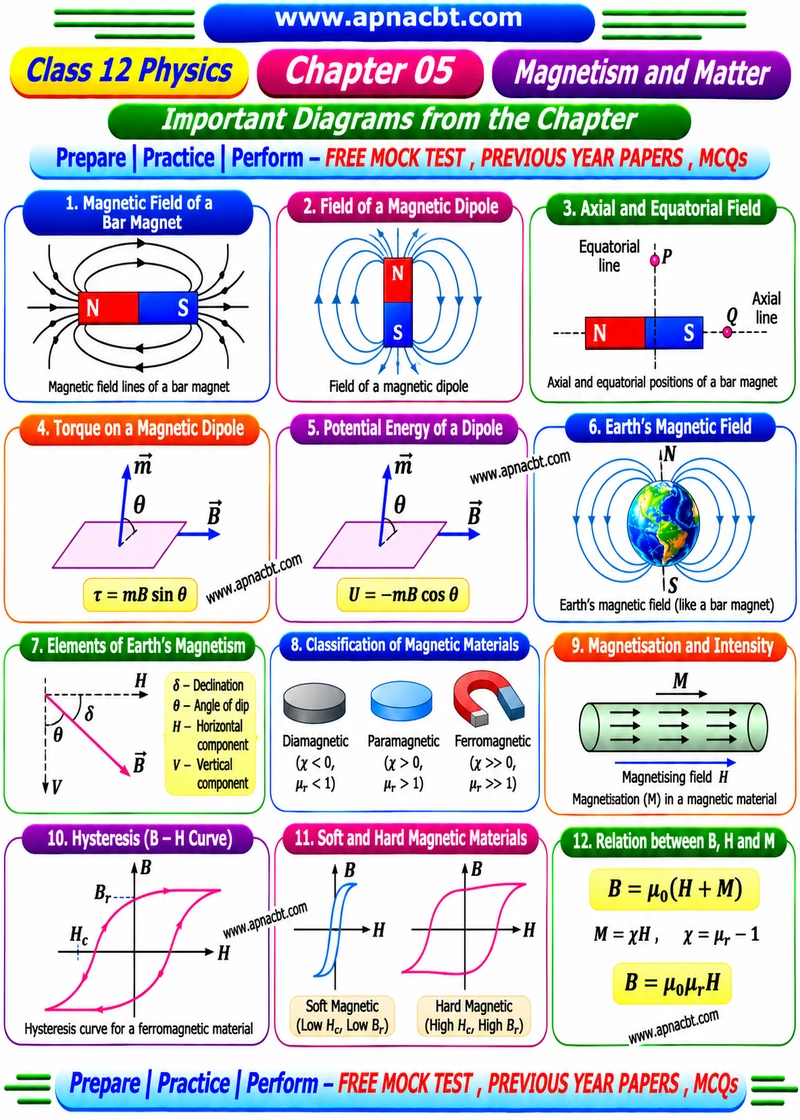
The magnetic field is represented by magnetic field lines. Outside a bar magnet, field lines emerge from the north pole and enter the south pole. Inside the magnet they continue from south to north, so the complete field-line pattern forms closed continuous loops. Field lines never intersect because the magnetic field would otherwise have two directions at the same point.
- The tangent to a field line gives the direction of magnetic field at that point.
- Closer field lines indicate a stronger magnetic field.
- Field lines are continuous closed curves.
- There are no isolated magnetic poles in classical magnetism.
Exam point: Repulsion is a reliable test for identifying a magnet because an unmagnetised piece of magnetic material may be attracted by a magnet, whereas like magnetic poles repel.
Magnetic Dipole and Field on Axial and Equatorial Lines
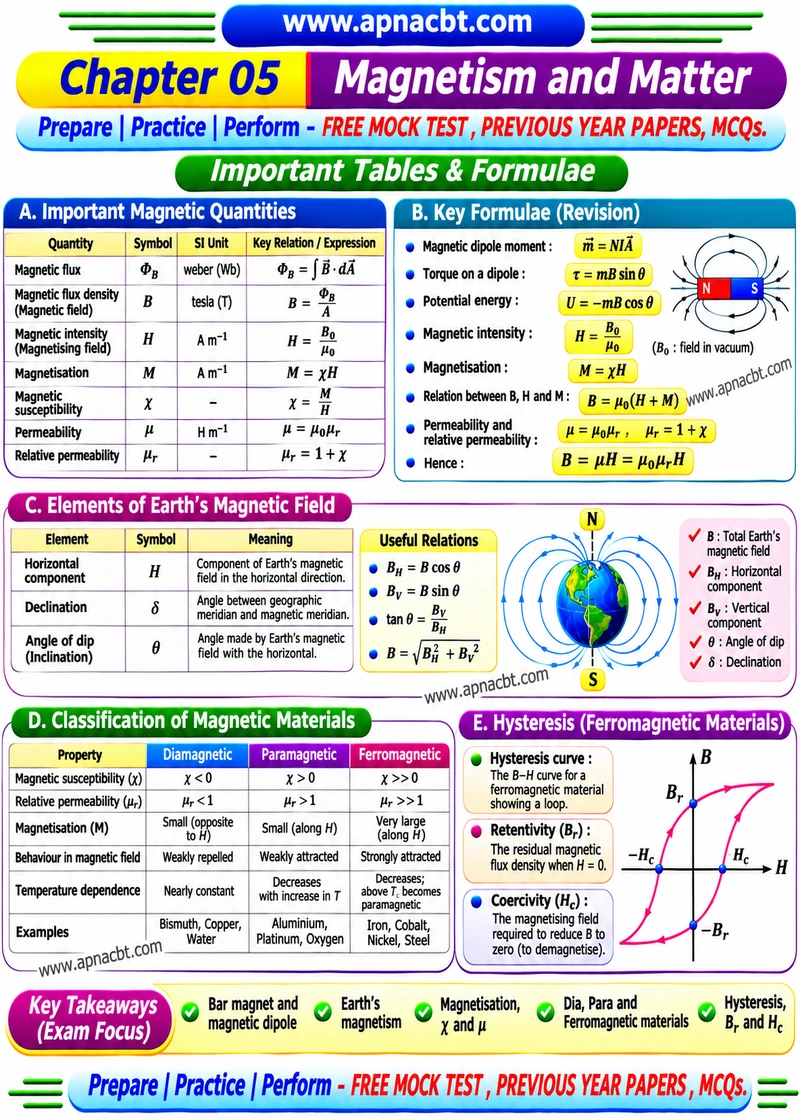
The magnetic moment m characterises the strength and orientation of a magnetic dipole. For a bar magnet represented by pole strength and magnetic length, the magnetic moment is directed from the south pole to the north pole. Its SI unit is A m2.
For a short bar magnet at a distance r much larger than its size, the magnetic field on the axial line is
Baxial = μ0 2m / (4πr3).
On the equatorial line, the magnitude is
Bequatorial = μ0 m / (4πr3),
with the direction opposite to the magnetic moment vector. Therefore, at the same distance in the far-field approximation, the axial field is twice the magnitude of the equatorial field.
The NCERT source also develops the analogy between an electric dipole and a magnetic dipole: electric dipole moment p corresponds to magnetic dipole moment m, while the electrostatic dipole field expressions map to the corresponding magnetic expressions.
NEET shortcut: Remember the ratio Baxial : Bequatorial = 2 : 1 for a short dipole at equal distance.
Magnetic Dipole in a Uniform Magnetic Field
When a magnetic dipole of moment m is placed in a uniform magnetic field B, the forces on the two poles are equal and opposite. Hence the net force on the ideal dipole is zero, but the forces form a couple that produces torque.
The torque is τ = m × B, with magnitude τ = mB sin θ, where θ is the angle between m and B. Torque is maximum at 90° and zero when the dipole is parallel or antiparallel to the field.
The potential energy of the dipole is U = −m · B = −mB cos θ. The stable equilibrium occurs when the magnetic moment is parallel to the magnetic field because the potential energy is minimum. The antiparallel orientation is unstable.
- θ = 0°: stable equilibrium, U = −mB.
- θ = 90°: torque is maximum, U = 0.
- θ = 180°: unstable equilibrium, U = +mB.
The source summary confirms that a bar magnet in a uniform field has zero net force, torque m × B and potential energy −m·B.
Gauss’s Law of Magnetism
Gauss’s law for magnetism states that the net magnetic flux through any closed surface is zero:
ΦB = ∮ B · dA = 0.
This result expresses the fact that magnetic field lines do not begin or end at isolated magnetic charges. The number of field lines entering a closed surface is balanced by the number leaving it. Therefore, magnetic monopoles are not observed as isolated sources or sinks of magnetic field.
For board examinations, write the law clearly and explain its physical meaning. For NEET, remember the contrast: electric flux through a closed surface can be non-zero when electric charge is enclosed, whereas net magnetic flux through a closed surface is always zero.
Earth’s Magnetism and Its Elements
Earth behaves approximately like a magnetic dipole, although the actual origin of Earth’s magnetic field is not a giant bar magnet inside the planet. The NCERT chapter discusses the hot, molten core and circulating currents as a plausible basis for the geomagnetic field, while noting that the detailed mechanism remains an area of research.
Three quantities are required to specify Earth’s magnetic field at a place: magnetic declination D, angle of dip or inclination I, and the horizontal component HE. These are called the elements of Earth’s magnetic field.
Magnetic declination
Declination is the angle between the geographic meridian and the magnetic meridian at a place.
Angle of dip
The angle of dip is the angle made by the total Earth’s magnetic field BE with the horizontal direction in the magnetic meridian plane.
Horizontal and vertical components
If ZE is the vertical component, then ZE = BE sin I and HE = BE cos I. Hence tan I = ZE/HE.
At the magnetic equator the dip is approximately zero, while near a magnetic pole the field is nearly vertical and the dip approaches 90°.
Magnetisation and Magnetic Intensity
Magnetisation M of a material is the net magnetic dipole moment per unit volume:
M = mnet/V.
Magnetisation is a vector quantity and its SI unit is A m−1. It describes how much magnetic dipole moment is developed in a material per unit volume when the material is subjected to a magnetising field.
Magnetic intensity H is the magnetising field intensity. In the standard SI treatment of a material placed in an external field B0, the source defines H = B0/μ0. H is a vector quantity with SI unit A m−1.
Inside a magnetised material, the magnetic field is related to H and M by
B = μ0(H + M).
This relation is fundamental to understanding magnetic materials and leads directly to the definitions of susceptibility and permeability.
Magnetic Susceptibility and Permeability
Magnetic susceptibility χ measures the response of a material to an applied magnetic field. For a linear material, M = χH. Susceptibility is dimensionless.
Substituting M = χH into B = μ0(H + M) gives
B = μ0(1 + χ)H.
Since B = μH, the magnetic permeability is
μ = μ0(1 + χ).
Relative permeability is defined by μr = μ/μ0, so for a linear material
μr = 1 + χ.
The source summary explicitly gives the relations μ = μ0μr and μr = 1 + χ.
- μ0: permeability of free space.
- μ: permeability of the material.
- μr: relative permeability, dimensionless.
- χ: magnetic susceptibility, dimensionless.
Diamagnetic, Paramagnetic and Ferromagnetic Materials
Magnetic materials are broadly classified into diamagnetic, paramagnetic and ferromagnetic materials. Their response differs because of the microscopic magnetic moments and their interaction with an external magnetic field.
| Property | Diamagnetic | Paramagnetic | Ferromagnetic |
|---|---|---|---|
| Susceptibility χ | Small and negative | Small and positive | Large and positive |
| Response to field | Weakly repelled | Weakly attracted | Strongly attracted |
| Magnetic moments | No permanent net atomic moment in the simple model | Permanent moments tend to align with field | Domains can align strongly |
| Relation between B and H | Approximately linear | Approximately linear | Non-linear |
| Hysteresis | Not characteristic | Not characteristic | Prominent |
Examples commonly used in the NCERT treatment include bismuth, copper and water for diamagnetic behaviour; aluminium and sodium for paramagnetic behaviour; and iron, cobalt and nickel for ferromagnetic behaviour.
NEET focus: The sign of χ is a fast discriminator: diamagnetic χ < 0, paramagnetic χ > 0 and ferromagnetic materials have a large positive response with non-linear magnetisation.
Magnetic Hysteresis
Ferromagnetic materials do not respond to an applied magnetic field in a perfectly reversible linear manner. The magnetisation depends not only on the present value of the applied field but also on the previous magnetic history of the material. This phenomenon is called magnetic hysteresis.
The B-H or magnetisation curve forms a hysteresis loop. Important terms include retentivity and coercivity. Retentivity is the ability of a material to retain magnetisation when the magnetising field is reduced to zero. Coercivity is the magnitude of reverse field required to reduce the residual magnetisation to zero.
For permanent magnets, a material with high retentivity and high coercivity is desirable. For transformer cores and repeated magnetisation applications, a narrow hysteresis loop and low energy loss are desirable. The area enclosed by the hysteresis loop represents energy dissipated per unit volume during a complete cycle of magnetisation.
The NCERT chapter notes that soft iron is suitable for electromagnets because it has high permeability and low retentivity. Materials used for transformer cores should also have a narrow hysteresis loop to reduce heating and energy loss.
Permanent Magnets and Electromagnets
A permanent magnet should retain its magnetisation for a long period. Ferromagnetic materials with high retentivity and high coercivity are suitable because they remain magnetised and resist demagnetisation.
An electromagnet is a temporary magnet produced by passing current through a coil, usually with a suitable ferromagnetic core. Soft iron is useful because its high permeability strengthens the magnetic field while its low retentivity allows the magnetism to disappear substantially when the current is switched off.
Electromagnets are used in electric bells, loudspeakers, telephone diaphragms and cranes for lifting iron and steel. The NCERT text also explains that a soft iron core inserted into a solenoid can greatly increase the magnetism of the arrangement.
| Application | Preferred property |
|---|---|
| Permanent magnet | High retentivity and high coercivity |
| Electromagnet | High permeability and low retentivity |
| Transformer core | Narrow hysteresis loop, low energy loss and suitable high resistivity |
Important Formulae, Units and Quick Revision
High-yield formulae for Magnetism and Matter:
- Magnetic dipole moment: m = pole strength × magnetic length.
- Magnetic field on axial line of a short dipole: BA = μ02m/(4πr3).
- Magnetic field on equatorial line: BE = μ0m/(4πr3) in magnitude, opposite to m.
- Torque on a dipole: τ = mB sin θ.
- Dipole potential energy: U = −mB cos θ.
- Gauss’s law for magnetism: ∮B · dA = 0.
- Magnetisation: M = mnet/V.
- Material field relation: B = μ0(H + M).
- Linear material: M = χH.
- Permeability: μ = μ0μr.
- Relative permeability: μr = 1 + χ for a linear material.
- Earth-field components: ZE = BE sin I and HE = BE cos I.
- Angle of dip: tan I = ZE/HE.
Important units: magnetic field B – tesla (T); magnetic moment m – A m2; magnetisation M – A m−1; magnetic intensity H – A m−1; magnetic flux – weber (Wb). The source summary lists the dimensions and units of these quantities for revision.
CBSE, NEET Preparation, Diagrams and Common Mistakes
CBSE Board preparation: Learn the definitions of magnetic moment, magnetic field, susceptibility, permeability, magnetisation, declination, dip, retentivity and coercivity. Practise derivations and labelled diagrams for the magnetic dipole, Earth’s magnetic field and hysteresis loop. Write formulae with symbols and SI units before substituting numerical values.
NEET preparation: Revise the axial/equatorial field ratio, torque and potential-energy conditions, Earth’s field components, susceptibility signs and permeability relations. Questions often test a single concept through a sign, ratio, direction or formula.
Important diagrams to practise:
- Bar magnet with magnetic field lines.
- Axial and equatorial positions of a magnetic dipole.
- Magnetic dipole in a uniform field.
- Earth’s magnetic field showing declination, dip and horizontal/vertical components.
- Magnetisation or B-H hysteresis loop.
- Soft-iron-core solenoid as an electromagnet.
Common mistakes to avoid:
- Do not say magnetic monopoles are isolated at the ends of an ordinary bar magnet.
- Do not confuse magnetic declination with angle of dip.
- Do not forget that the axial field is twice the equatorial field in magnitude for a short dipole at equal distance.
- Do not use μr = 1 + χ without the linear-material context.
- Do not confuse retentivity with coercivity.
For additional preparation, revise Current Electricity practice on APNA CBT and Moving Charges and Magnetism practice. You can also use Class 12 Physics resources on APNA CBT.
For authoritative syllabus and textbook reference, use the official NCERT textbooks and CBSE Academic resources.
Short-Answer Questions – 30 Questions with Detailed Answers
1. What is a magnet?
Answer: A magnet is a material that exhibits magnetic properties such as attraction of suitable magnetic materials and directional behaviour. A bar magnet has two poles, north and south, and behaves as a magnetic dipole.
2. Why can magnetic poles not be isolated?
Answer: Magnetic field lines form closed continuous loops and isolated magnetic monopoles are not observed. If a bar magnet is cut into two pieces, each piece becomes a smaller magnet with both north and south poles.
3. What is magnetic dipole moment?
Answer: Magnetic dipole moment m measures the strength and orientation of a magnetic dipole. For a simple bar magnet it equals pole strength multiplied by magnetic length. Its SI unit is A m2.
4. In which direction is the magnetic moment of a bar magnet directed?
Answer: The magnetic moment of a bar magnet is directed from its south pole to its north pole.
5. What is the SI unit of magnetic field?
Answer: The SI unit of magnetic field B is tesla (T). In the cgs system, gauss is used; 1 G = 10−4 T.
6. What do magnetic field lines represent?
Answer: They provide a graphical representation of the magnetic field. The tangent at any point gives the field direction, while the density of lines indicates the relative strength of the field.
7. Why do magnetic field lines never intersect?
Answer: If two field lines intersected, the tangent at the intersection would give two directions for the magnetic field at the same point. A vector field cannot have two directions at one point.
8. State the axial field of a short magnetic dipole.
Answer: At an axial point far from the dipole, BA = μ02m/(4πr3), where m is magnetic dipole moment and r is the distance from the centre.
9. State the equatorial field of a short magnetic dipole.
Answer: At an equatorial point far from the dipole, the magnitude is BE = μ0m/(4πr3). Its direction is opposite to the magnetic moment.
10. What is the ratio of axial to equatorial magnetic field at equal distance?
Answer: The ratio is BA : BE = 2 : 1 for a short magnetic dipole.
11. What is the torque on a magnetic dipole in a uniform field?
Answer: The torque is τ = m × B, and its magnitude is τ = mB sin θ. It tends to rotate the dipole so that its magnetic moment aligns with the applied field.
12. When is the torque on a magnetic dipole maximum?
Answer: Torque is maximum when θ = 90°, because sin 90° = 1. Thus τmax = mB.
13. Write the potential energy of a magnetic dipole.
Answer: The potential energy is U = −m · B = −mB cos θ. It is minimum when m is parallel to B.
14. State Gauss’s law for magnetism.
Answer: The net magnetic flux through any closed surface is zero: ∮B · dA = 0. It reflects the absence of isolated magnetic monopoles.
15. What are the elements of Earth’s magnetic field?
Answer: The three elements are magnetic declination D, angle of dip or inclination I, and the horizontal component HE of Earth’s magnetic field.
16. Define magnetic declination.
Answer: Magnetic declination is the angle between the geographic meridian and the magnetic meridian at a place.
17. Define angle of dip.
Answer: The angle of dip I is the angle made by Earth’s total magnetic field with the horizontal direction in the magnetic meridian plane.
18. Write the relation between Earth’s field and its horizontal component.
Answer: HE = BE cos I, where BE is the total field and I is the angle of dip.
19. Write the relation for the vertical component of Earth’s field.
Answer: ZE = BE sin I.
20. What is magnetisation?
Answer: Magnetisation M is the net magnetic dipole moment per unit volume of a material: M = mnet/V. Its SI unit is A m−1.
21. What is magnetic susceptibility?
Answer: For a linear material, magnetic susceptibility χ is defined by M = χH. It is dimensionless and indicates how strongly the material responds to an applied magnetising field.
22. What is magnetic permeability?
Answer: Magnetic permeability μ is defined through B = μH for a linear material. It indicates how readily a medium supports magnetic induction for a given magnetic intensity.
23. State the relation between relative permeability and susceptibility.
Answer: For a linear material, μr = 1 + χ. Also μ = μ0μr.
24. What is a diamagnetic material?
Answer: A diamagnetic material has a small negative magnetic susceptibility and is weakly repelled by an external magnetic field. Examples include bismuth and copper.
25. What is a paramagnetic material?
Answer: A paramagnetic material has a small positive susceptibility and is weakly attracted by an external magnetic field. Aluminium and sodium are common examples.
26. What is a ferromagnetic material?
Answer: A ferromagnetic material has a strong magnetic response, large positive susceptibility and a non-linear B-H relationship. Iron, cobalt and nickel are common examples.
27. What is magnetic hysteresis?
Answer: Hysteresis is the lag of magnetisation or magnetic induction behind the applied magnetising field during cyclic magnetisation. It produces a hysteresis loop.
28. Define retentivity.
Answer: Retentivity is the ability of a magnetic material to retain magnetisation after the external magnetising field has been reduced to zero.
29. Define coercivity.
Answer: Coercivity is the magnitude of reverse magnetic field required to reduce the residual magnetisation of a material to zero.
30. Why is soft iron used for electromagnets?
Answer: Soft iron has high magnetic permeability and low retentivity. It becomes strongly magnetised when current flows through the coil and loses most of its magnetism when the current is switched off, making it suitable for temporary magnets.
Long-Answer Questions – 15 Questions with Detailed Answers
1. Explain the important properties of a bar magnet and its magnetic field lines.
Answer: A bar magnet has two poles, north and south, which always occur together. Like poles repel and unlike poles attract. A freely suspended magnet aligns approximately in the north-south direction. Magnetic field lines emerge from the north pole outside the magnet and enter the south pole, while inside the magnet they continue from south to north. Thus the field lines form closed loops. The tangent to a field line gives the field direction and the density of lines represents field strength. Field lines do not intersect because the magnetic field has a unique direction at each point.
2. Derive the magnetic field of a short dipole on its axial line.
Answer: Consider a short magnetic dipole of moment m and a point on its axial line at distance r from its centre, where r is much greater than the magnetic length. The fields produced by the two poles are in the same direction at the axial point. On simplifying the difference of the pole contributions in the short-dipole approximation, the result is BA = μ02m/(4πr3). The field is directed along the magnetic moment on the appropriate axial side. The important dependence is BA ∝ m/r3.
3. Derive the magnetic field on the equatorial line of a short magnetic dipole.
Answer: At an equatorial point, the point is on the perpendicular bisector of the dipole. The fields due to the two poles have equal magnitudes and their components perpendicular to the dipole axis cancel, while the components along the dipole axis add. In the short-dipole approximation, the magnitude is BE = μ0m/(4πr3). Its direction is opposite to the magnetic moment. Therefore, at equal distance, the axial field is twice the equatorial field.
4. Explain the torque and potential energy of a magnetic dipole in a uniform magnetic field.
Answer: A magnetic dipole in a uniform field experiences equal and opposite forces on its poles. The net force is zero, but these forces form a couple. The torque is τ = m × B, with magnitude τ = mB sin θ. The potential energy is U = −m · B = −mB cos θ. At θ = 0°, the energy is minimum and the equilibrium is stable. At θ = 180°, the energy is maximum and the equilibrium is unstable. The torque is maximum at 90° and zero at 0° and 180°.
5. State and explain Gauss’s law for magnetism.
Answer: Gauss’s law for magnetism is ∮B · dA = 0 for every closed surface. The total magnetic flux entering the surface equals the total magnetic flux leaving it. Unlike electric charges, isolated magnetic poles are not observed. Consequently, magnetic field lines do not start from a single pole and end at another isolated pole; they form closed continuous loops. The law is an important conceptual statement about the absence of magnetic monopoles in the standard description of magnetism.
6. Explain Earth’s magnetic field and define its three elements.
Answer: Earth behaves approximately like a magnetic dipole. Its magnetic field at a location is described using three elements. Magnetic declination D is the angle between the geographic and magnetic meridians. Angle of dip I is the angle made by Earth’s total magnetic field with the horizontal in the magnetic meridian plane. The horizontal component HE is the horizontal part of the total field. If ZE is the vertical component, then ZE = BE sin I, HE = BE cos I, and tan I = ZE/HE.
7. Derive the relation between the horizontal and vertical components of Earth’s magnetic field.
Answer: Let the total field at a place be BE and let it make an angle I with the horizontal. Resolving BE into rectangular components gives the horizontal component HE = BE cos I and the vertical component ZE = BE sin I. Dividing the two equations gives tan I = ZE/HE. These relations are frequently used in numerical questions involving Earth’s magnetism.
8. Define magnetisation, magnetic intensity, susceptibility and permeability and establish their relations.
Answer: Magnetisation is the magnetic moment per unit volume, M = mnet/V. Magnetic intensity H represents the magnetising field. For a linear material, susceptibility is defined by M = χH. The magnetic field inside the material is B = μ0(H + M). Substituting M = χH gives B = μ0(1 + χ)H. Comparing this with B = μH gives μ = μ0(1 + χ). Since μr = μ/μ0, we obtain μr = 1 + χ.
9. Compare diamagnetic, paramagnetic and ferromagnetic materials.
Answer: Diamagnetic materials have small negative susceptibility and are weakly repelled by an external field. Paramagnetic materials have small positive susceptibility and are weakly attracted. Ferromagnetic materials have a strong positive response, large susceptibility and non-linear magnetisation. Ferromagnetic substances can retain magnetisation and show hysteresis. Typical examples are bismuth or copper for diamagnetism, aluminium for paramagnetism and iron, cobalt or nickel for ferromagnetism. The source material uses these three classes as the main classification of magnetic materials.
10. Explain magnetic hysteresis and the significance of the hysteresis loop.
Answer: When a ferromagnetic material is repeatedly magnetised and demagnetised, its magnetisation does not follow the same path during increasing and decreasing applied field. The resulting closed curve is the hysteresis loop. The residual magnetisation at zero applied field represents retentivity. The reverse field required to bring magnetisation to zero represents coercivity. The area enclosed by the loop corresponds to energy dissipated per unit volume in a complete cycle. A narrow loop is preferred when low energy loss is required, such as in transformer cores, while high retentivity and coercivity are desirable for permanent magnets.
11. Distinguish between permanent magnets and electromagnets.
Answer: A permanent magnet retains magnetisation after the magnetising field is removed and therefore requires high retentivity and high coercivity. An electromagnet is a temporary magnet produced by current through a coil, generally with a soft iron core. It should magnetise strongly and lose most of its magnetism when current is switched off, so high permeability and low retentivity are useful. Permanent magnets are used where a persistent magnetic field is needed, while electromagnets are used in bells, loudspeakers, relays, cranes and similar devices.
12. Explain why a bar magnet and a current-carrying solenoid can have similar magnetic fields.
Answer: A current-carrying solenoid produces a magnetic field pattern similar to that of a bar magnet. Its two ends behave approximately like north and south poles. The magnetic moment of a solenoid is m = NIA, where N is the number of turns, I is current and A is cross-sectional area. For a long solenoid, the field inside is approximately uniform, while outside it resembles the field pattern of a bar magnet. The NCERT treatment uses this analogy to understand the magnetic moment of a bar magnet and an equivalent solenoid.
13. A magnetic dipole of moment 0.50 A m² is placed in a 0.20 T field at 30°. Find the torque and potential energy.
Answer: Given m = 0.50 A m², B = 0.20 T and θ = 30°. Torque is τ = mB sin θ = 0.50 × 0.20 × 0.5 = 0.05 N m. Potential energy is U = −mB cos θ = −0.50 × 0.20 × 0.866 ≈ −0.0866 J. The negative energy indicates that this orientation is below the zero-energy reference used for a dipole perpendicular to the field.
14. A place has Earth’s magnetic field 4.0 × 10⁻⁵ T and dip angle 60°. Calculate the horizontal and vertical components.
Answer: Use HE = BE cos I and ZE = BE sin I. With BE = 4.0 × 10⁻⁵ T and I = 60°, HE = 4.0 × 10−5 × 0.5 = 2.0 × 10⁻⁵ T. ZE = 4.0 × 10−5 × 0.866 ≈ 3.46 × 10⁻⁵ T.
15. Explain the selection of magnetic materials for permanent magnets, electromagnets and transformer cores.
Answer: Permanent magnets should have high retentivity so that they retain magnetisation and high coercivity so that they resist demagnetisation. Electromagnets should use materials with high permeability and low retentivity so that they become strongly magnetised during current flow and lose magnetism when current is removed. Transformer cores undergo repeated magnetisation cycles, so they should have a narrow hysteresis loop and consequently low energy loss. Suitable high resistivity also helps reduce eddy-current losses. These material-property requirements are directly connected with the hysteresis behaviour discussed in the NCERT chapter.