
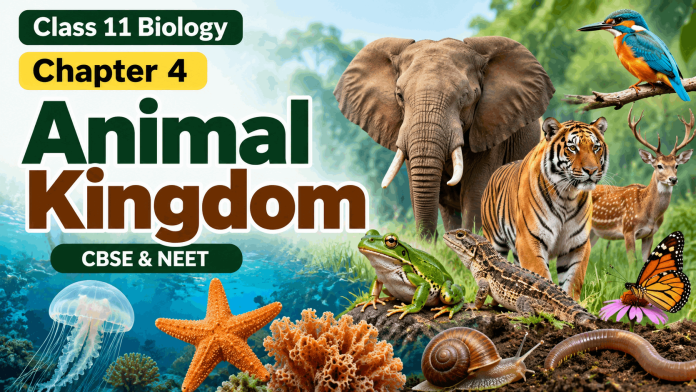
Animal Kingdom
NCERT Class 11 Biology | CBSE | NEET-UG Preparation
Study the basis of animal classification, the major non-chordate phyla, chordate characteristics and vertebrate classes. Revise important definitions, identifying features, examples and comparisons for CBSE examinations and NEET-UG.
Vertebrates: Cyclostomata, Pisces and Amphibia
Class Cyclostomata
- Jawless, elongated aquatic vertebrates.
- The mouth is circular and suctorial.
- Paired fins are absent.
- Many are ectoparasites on fishes.
Examples: Petromyzon and Myxine.
Pisces
Chondrichthyes:
- Endoskeleton is cartilaginous.
- Mouth is usually ventral.
- Gill slits are separate, and an operculum is generally absent.
- Swim bladder is absent.
- Fertilisation is internal in most members.
Examples: Scoliodon, Pristis, Trygon and Chimaera.
Osteichthyes:
- Endoskeleton is primarily bony.
- Gills are covered by an operculum.
- A swim bladder is usually present in bony fishes.
- Fertilisation is generally external in many familiar examples.
Examples: Labeo, Catla, Hippocampus and Exocoetus.
Class Amphibia
- They inhabit aquatic and terrestrial environments.
- The skin is generally moist and lacks scales.
- Respiration may occur through skin, lungs and gills in larvae.
- The heart is usually three-chambered.
- Development commonly includes an aquatic larval stage.
Examples: Rana, Bufo, Hyla and Salamandra.
| Feature | Chondrichthyes | Osteichthyes |
|---|---|---|
| Endoskeleton | Cartilaginous | Primarily bony |
| Gill covering | Separate gill slits generally present | Operculum generally present |
| Swim bladder | Absent | Usually present |
NEET focus: Revise jawless fishes, the differences between cartilaginous and bony fishes, and the moist skin and typical heart structure of amphibians.