

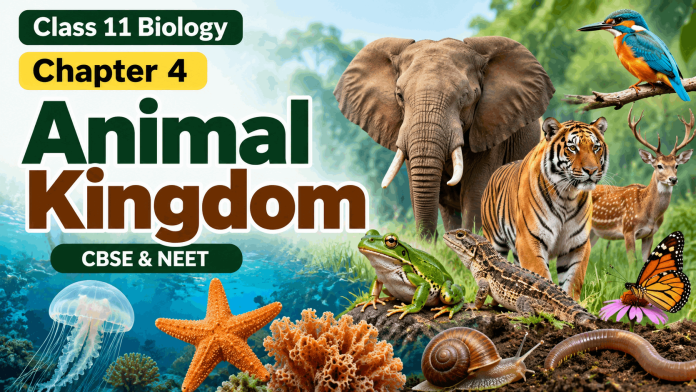
Animal Kingdom
NCERT Class 11 Biology | CBSE | NEET-UG Preparation
Study the basis of animal classification, the major non-chordate phyla, chordate characteristics and vertebrate classes. Revise important definitions, identifying features, examples and comparisons for CBSE examinations and NEET-UG.
Vertebrates: Reptilia, Aves and Mammalia
Class Reptilia
- The skin is dry and covered with horny scales or scutes.
- Respiration occurs through lungs.
- Fertilisation is internal.
- Most have a three-chambered heart; crocodilians have a four-chambered heart.
- Many terrestrial reptiles excrete uric acid.
Examples: Naja, Testudo, Calotes and Crocodylus.
Class Aves
- The body is covered with feathers.
- Forelimbs are modified into wings.
- Jaws form a beak, usually without teeth in living birds.
- Respiration occurs through lungs supplemented by air sacs.
- The heart is four-chambered.
- Birds are warm-blooded, and fertilisation is internal.
- Most birds lay eggs.
Examples: Columba, Corvus, Psittacula, Struthio and Pavo.
Class Mammalia
- Mammary glands produce milk for feeding young ones.
- The skin generally bears hair.
- External ears or pinnae are usually present.
- Respiration occurs through lungs, and a diaphragm assists breathing.
- The heart is four-chambered.
- Mammals are warm-blooded.
- Most give birth to young ones, but monotremes lay eggs.
Examples: Homo sapiens, Macaca, Canis, Pteropus, Delphinus and Ornithorhynchus.
Comparison of Vertebrate Classes
| Class | Respiration | Heart | Identifying feature |
|---|---|---|---|
| Pisces | Gills | Two-chambered in typical fishes | Aquatic; fins |
| Amphibia | Skin, lungs and/or gills | Usually three-chambered | Moist skin |
| Reptilia | Lungs | Usually three-chambered; four in crocodilians | Dry, scaly skin |
| Aves | Lungs with air sacs | Four-chambered | Feathers and wings |
| Mammalia | Lungs | Four-chambered | Mammary glands and hair |
NEET focus: Feathers identify Aves; mammary glands identify Mammalia; dry scales are typical of Reptilia; moist skin is typical of Amphibia.