

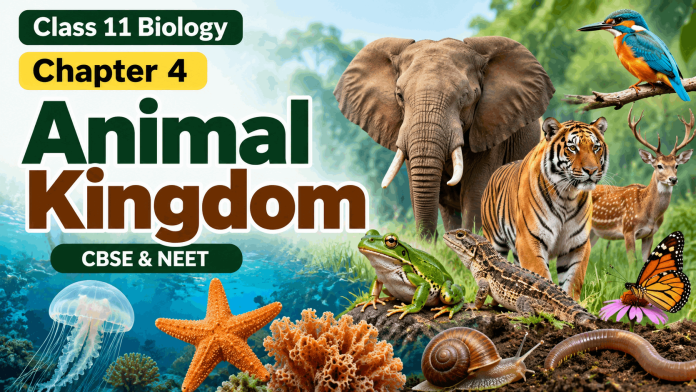
Animal Kingdom
NCERT Class 11 Biology | CBSE | NEET-UG Preparation
Study the basis of animal classification, the major non-chordate phyla, chordate characteristics and vertebrate classes. Revise important definitions, identifying features, examples and comparisons for CBSE examinations and NEET-UG.
Chordata and Its Fundamental Characteristics
Chordates possess a characteristic set of features at least during some stage of their life cycle.
Fundamental Features of Chordates
- Notochord: A supporting rod present at least during embryonic development.
- Dorsal hollow nerve cord: Located above the notochord.
- Pharyngeal gill slits: Present at some stage of development.
- Post-anal tail: A tail extending beyond the anus at some stage.
- Endostyle or thyroid gland: An additional characteristic feature.
Major Chordate Groups
| Group | Key feature | Examples |
|---|---|---|
| Urochordata | Notochord occurs in the larval tail. | Ascidia, Salpa |
| Cephalochordata | Notochord extends from head to tail and persists throughout life. | Branchiostoma (Amphioxus) |
| Vertebrata | Vertebral column and cranium are present. | Fishes, amphibians, reptiles, birds and mammals |
Chordates and Non-Chordates
| Feature | Non-Chordates | Chordates |
|---|---|---|
| Notochord | Absent | Present at least at one developmental stage |
| Nerve cord | Often ventral and solid in many groups | Dorsal and hollow |
| Post-anal tail | Not a defining chordate feature | Present at some stage |
NEET focus: Memorise the fundamental chordate features and distinguish Urochordata, Cephalochordata and Vertebrata.