

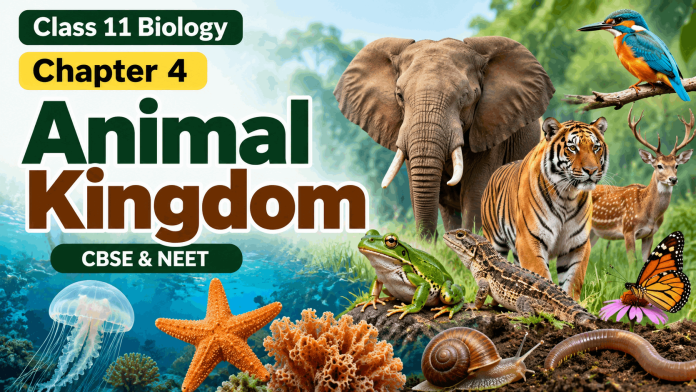
Animal Kingdom
NCERT Class 11 Biology | CBSE | NEET-UG Preparation
Study the basis of animal classification, the major non-chordate phyla, chordate characteristics and vertebrate classes. Revise important definitions, identifying features, examples and comparisons for CBSE examinations and NEET-UG.
Basis of Animal Classification
Animals are classified by comparing their body organisation, symmetry, germ layers, body cavity, segmentation and the presence or absence of a notochord.
Levels of Organisation
| Level | Characteristics | Examples |
|---|---|---|
| Cellular | Cells perform different functions, but true tissues are absent. | Porifera |
| Tissue | Similar cells form tissues that perform specific functions. | Cnidaria, Ctenophora |
| Organ | Different tissues combine to form organs. | Platyhelminthes |
| Organ-system | Organs work together in systems. | Many groups from Aschelminthes onwards |
Body Symmetry
- Asymmetry: The body cannot be divided into equal halves through a plane. Example: many sponges.
- Radial symmetry: Several planes passing through the central axis can divide the body into similar halves. Examples: Hydra and adult starfish.
- Bilateral symmetry: Only one plane divides the body into right and left halves. Examples: earthworm and humans.
Germ Layers
- Diploblastic: The embryo develops ectoderm and endoderm. Cnidarians are examples.
- Triploblastic: The embryo develops ectoderm, mesoderm and endoderm. Examples include annelids and chordates.
Body Cavity or Coelom
| Type | Meaning | Example |
|---|---|---|
| Acoelomate | A body cavity is absent. | Platyhelminthes |
| Pseudocoelomate | The body cavity is not completely lined by mesoderm. | Aschelminthes |
| Coelomate | The true coelom is lined by mesoderm. | Annelida |
Other Classification Features
- Segmentation: Repetition of body segments, clearly seen in annelids.
- Notochord: A supporting rod present at least during some stage of chordate development.
- Chordates: Possess a notochord at some developmental stage.
- Non-chordates: Lack a notochord.
CBSE and NEET focus: Learn the definitions of symmetry, germ layers and coelom. Practise identifying the correct classification feature from an animal example.