

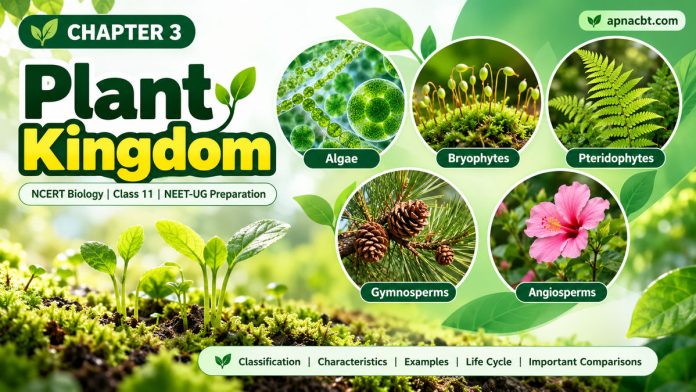
Plant Kingdom
NCERT Biology | Class 11 CBSE | NEET-UG Preparation
Chapter overview:
Learn the classification of the plant kingdom, major characteristics of algae, bryophytes, pteridophytes, gymnosperms and angiosperms, plant life cycles, and alternation of generations. This summary highlights important concepts for CBSE examinations and NEET-UG revision.
Important Comparisons and Quick Revision
Bryophytes versus pteridophytes
| Feature | Bryophytes | Pteridophytes |
|---|---|---|
| Vascular tissues | Absent | Present |
| True roots, stems and leaves | Absent | Generally present |
| Dominant generation | Gametophyte | Sporophyte |
| Plant body | Usually small gametophyte | Independent vascular sporophyte |
| Reproduction | Spores | Spores |
Gymnosperms versus angiosperms
| Feature | Gymnosperms | Angiosperms |
|---|---|---|
| Ovules | Not enclosed within an ovary | Enclosed within an ovary |
| Seeds | Naked | Enclosed within fruits |
| Flowers | True flowers absent | Present |
| Reproductive structures | Commonly cones or strobili | Flowers |
| Double fertilisation | Typical angiosperm double fertilisation absent | Characteristic feature |
Important examples to remember
- Green algae: Chlamydomonas, Volvox, Spirogyra, Chara.
- Brown algae: Ectocarpus, Dictyota, Laminaria, Sargassum, Fucus.
- Red algae: Polysiphonia, Porphyra, Gracilaria, Gelidium.
- Liverwort: Marchantia.
- Mosses: Funaria, Polytrichum, Sphagnum.
- Pteridophytes: Psilotum, Lycopodium, Selaginella, Equisetum, Pteris.
- Gymnosperms: Cycas, Pinus, Gnetum.
- Angiosperms: Wheat, maize, pea and mustard.
Revision strategy: Learn the defining features of each group first, then practise comparing pigments, stored food, dominant generations, vascular tissues and reproductive structures.