

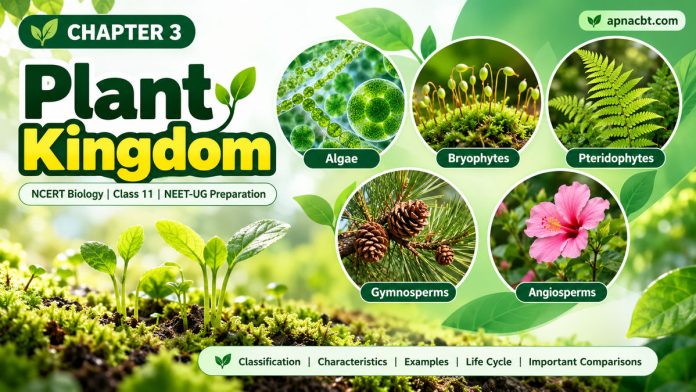
Plant Kingdom
NCERT Biology | Class 11 CBSE | NEET-UG Preparation
Chapter overview:
Learn the classification of the plant kingdom, major characteristics of algae, bryophytes, pteridophytes, gymnosperms and angiosperms, plant life cycles, and alternation of generations. This summary highlights important concepts for CBSE examinations and NEET-UG revision.
Plant Life Cycles and Alternation of Generations
Plants show different patterns of sexual reproduction and alternation between haploid and diploid phases. The two major phases are the gametophyte and sporophyte.
Gametophyte
- Haploid (n) generation.
- Develops from a haploid spore.
- Produces gametes by mitosis.
Sporophyte
- Diploid (2n) generation.
- Develops from the diploid zygote.
- Produces haploid spores through meiosis.
Major types of life cycles
- Haplontic: The haploid phase is dominant. The zygote is the main diploid stage and undergoes meiosis. Examples include Volvox, Spirogyra and some other algae.
- Diplontic: The diploid sporophyte is dominant. The haploid phase is limited to gametes or a short gametophytic stage. Examples include Fucus and seed plants.
- Haplo-diplontic: Both haploid and diploid multicellular phases occur. Examples include bryophytes and pteridophytes; the relative size and independence of the generations differ.
Dominant generation in plant groups
| Plant group | Dominant generation | Key feature |
|---|---|---|
| Bryophytes | Gametophyte | Sporophyte remains attached and nutritionally dependent to varying degrees. |
| Pteridophytes | Sporophyte | Independent vascular plant body; gametophyte is usually small. |
| Gymnosperms | Sporophyte | Gametophytes are highly reduced and dependent on the sporophyte. |
| Angiosperms | Sporophyte | Gametophytes are highly reduced; male gametophyte is pollen and female gametophyte is embryo sac. |
NEET focus: Understand where meiosis occurs, how spores and gametes are formed, and which generation is dominant in each major plant group.