

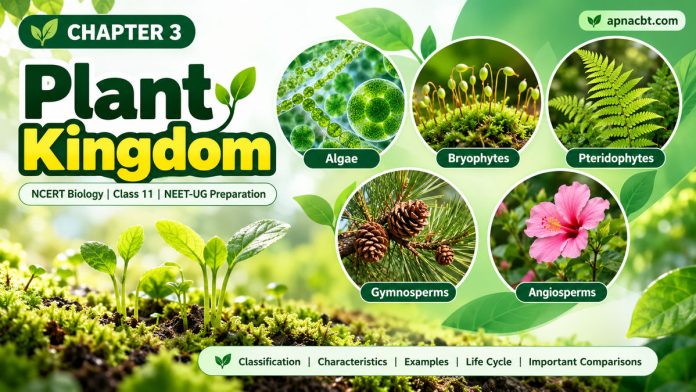
Plant Kingdom
NCERT Biology | Class 11 CBSE | NEET-UG Preparation
Chapter overview:
Learn the classification of the plant kingdom, major characteristics of algae, bryophytes, pteridophytes, gymnosperms and angiosperms, plant life cycles, and alternation of generations. This summary highlights important concepts for CBSE examinations and NEET-UG revision.
Angiosperms
Angiosperms are flowering plants. Their ovules are enclosed within an ovary, and after fertilisation the ovary usually develops into a fruit containing seeds.
Important characteristics
- The sporophyte is the dominant plant body.
- Roots, stems and leaves are differentiated.
- Flowers are the reproductive structures.
- Ovules are enclosed within the ovary.
- Seeds are enclosed within fruits.
- Male gametophytes develop from microspores and are represented by pollen grains.
- The female gametophyte, or embryo sac, develops within the ovule.
Double fertilisation
Double fertilisation is a characteristic feature of angiosperms. Two male gametes participate in two fusion events within the embryo sac.
- Syngamy: One male gamete fuses with the egg cell, forming a diploid zygote.
- Triple fusion: The other male gamete fuses with the two polar nuclei, or their secondary nucleus, forming the primary endosperm nucleus, which is usually triploid.
- Syngamy and triple fusion together are called double fertilisation.
- The zygote develops into the embryo, and the endosperm nourishes the developing embryo.
Monocotyledons and dicotyledons
| Feature | Monocotyledons | Dicotyledons |
|---|---|---|
| Cotyledons | One | Two |
| Leaf venation | Usually parallel | Usually reticulate |
| Root system | Usually fibrous | Usually taproot |
| Floral parts | Often in multiples of three | Often in multiples of four or five |
| Examples | Wheat, maize, rice | Pea, bean, mustard |
These are common patterns rather than rules without exceptions. Use the characteristics and examples prescribed in the NCERT syllabus for examination preparation.
Remember: Double fertilisation involves syngamy and triple fusion. Angiosperms differ from gymnosperms because their ovules are enclosed within an ovary.