

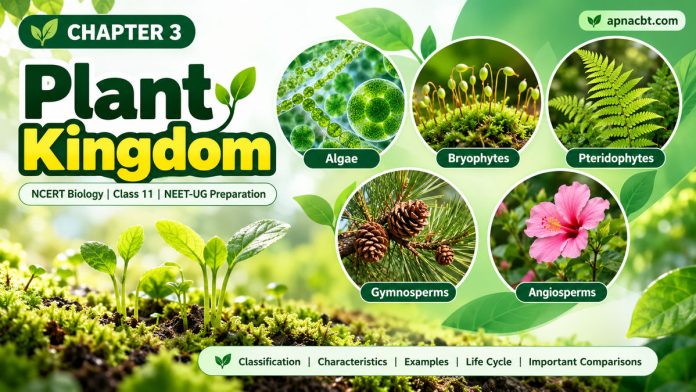
Plant Kingdom
NCERT Biology | Class 11 CBSE | NEET-UG Preparation
Chapter overview:
Learn the classification of the plant kingdom, major characteristics of algae, bryophytes, pteridophytes, gymnosperms and angiosperms, plant life cycles, and alternation of generations. This summary highlights important concepts for CBSE examinations and NEET-UG revision.
Gymnosperms
Gymnosperms are vascular seed-producing plants in which the ovules are not enclosed within an ovary. Their seeds are therefore described as naked seeds.
Important characteristics
- The sporophyte is the dominant plant body.
- Plants are usually woody, perennial and evergreen, although exceptions occur.
- Roots, stems and leaves are well differentiated.
- Many gymnosperms possess a taproot system.
- In some genera, roots form specialised associations, such as coralloid roots in Cycas.
- Leaves may be needle-like or scale-like, reducing water loss in many species.
- Reproductive structures are commonly organised into cones or strobili.
- Ovules are not enclosed in an ovary, and fruits are not formed.
Reproduction
- Gymnosperms are heterosporous.
- Microspores develop into male gametophytes, commonly represented by pollen grains.
- Megaspores develop within ovules and give rise to female gametophytes.
- Pollination transfers pollen to the ovule or its vicinity, depending on the group.
- Fertilisation leads to embryo development within the seed.
Examples and distinctive features
- Cycas: Has pinnate leaves and coralloid roots containing cyanobacteria. Male and female reproductive structures occur on separate plants.
- Pinus: Has needle-like leaves, commonly forms male and female cones, and often develops mycorrhizal associations.
- Gnetum: Has certain features that resemble those of angiosperms, such as broad leaves in some species.
Economic importance
- Wood from some gymnosperms is used in construction and paper production.
- Resins and other products are obtained from certain species.
- Several gymnosperms are used as ornamental plants.
NEET focus: Naked seeds, cones, heterospory, pollen grains and examples such as Cycas and Pinus are important revision points.