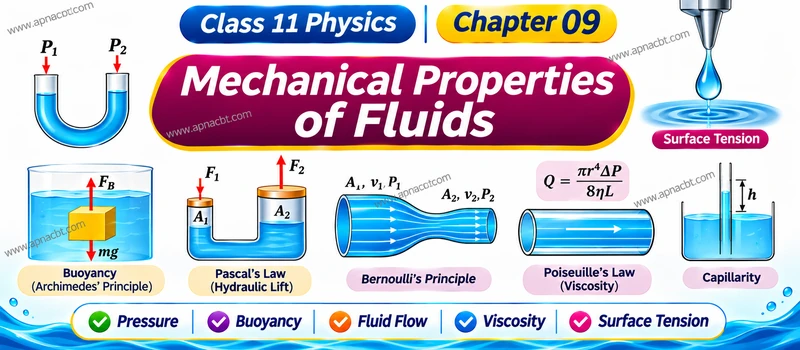
Chapter 09: Mechanical Properties of Fluids
Class 11 Physics | CBSE Board Examinations | NEET-UG Preparation
This lesson organises the chapter’s important concepts, laws, derivations, applications and formulae for CBSE board revision and NEET-UG preparation. The coverage follows the attached Chapter 09 PDF.
1. Fluids and Their Mechanical Behaviour
A fluid is a substance that can flow and does not have a fixed shape. Liquids and gases are fluids. A liquid has a definite volume but takes the shape of its container; a gas has neither a definite shape nor a definite volume. Fluid mechanics studies fluids at rest and in motion.
This chapter deals with pressure, buoyancy, flow of fluids, viscosity and surface tension. These properties explain phenomena such as floating bodies, hydraulic machines, flow through pipes, falling drops, capillary action and the formation of bubbles.
Fluid statics studies fluids at rest. Fluid dynamics studies fluids in motion. In an ideal-fluid model, the fluid is treated as incompressible and non-viscous; real fluids may have viscosity and may be compressible.
2. Pressure, Thrust and Units
Thrust is the total normal force exerted by a fluid on a surface. Pressure is thrust (normal force) per unit area:
P = F/A
Pressure is a scalar quantity. Its SI unit is pascal (Pa), where 1 Pa = 1 N m−2. Its dimensional formula is [ML−1T−2]. Other units used in the lesson include bar, atmosphere and millimetre of mercury. Standard atmospheric pressure is approximately 1.013 × 10⁵ Pa.
Pressure at a point in a fluid at rest acts equally in all directions. The force due to pressure on a plane surface acts perpendicular to that surface.
3. Pressure Variation with Depth and Pascal’s Law
In a liquid of density ρ at rest, pressure increases with depth because of the weight of the liquid above the point. At depth h below the free surface:
P = P0 + ρgh
Here P0 is the pressure at the surface. The gauge pressure is ρgh. At the same horizontal level in the same connected liquid at rest, pressure is equal. The result is independent of the shape of the vessel.
Pascal’s law: a change in pressure applied to an enclosed fluid is transmitted undiminished to every part of the fluid and to the walls of its container.
For a hydraulic machine with pistons of areas A1 and A2, ideal pressure transmission gives F1/A1 = F2/A2. A small force on a small piston can therefore produce a larger force on a larger piston. The force gain is accompanied by a corresponding increase in displacement; work is not multiplied in an ideal machine.
4. Applications of Pascal’s Law: Hydraulic Lift and Brakes
Hydraulic lift: two pistons of different areas are connected by an enclosed liquid. Pressure applied to the smaller piston is transmitted to the larger piston. If the piston areas are A and a, then F/A = f/a, so F = f(A/a). This principle is used to lift heavy vehicles and loads.
Hydraulic brakes: force applied to the brake pedal creates pressure in brake fluid. The pressure is transmitted through pipes to pistons at the wheels, which press brake shoes or pads against a drum or disc. The resulting friction slows or stops the vehicle.
These applications assume an enclosed fluid and ideal pressure transmission. In practice, friction, fluid properties and mechanical design affect performance.
5. Buoyancy, Archimedes’ Principle and Floatation
A body immersed partly or wholly in a fluid experiences an upward force called buoyant force or upthrust. It arises because fluid pressure is greater at the lower part of the body than at the upper part.
Archimedes’ principle: a body wholly or partially immersed in a fluid experiences an upward buoyant force equal to the weight of the fluid displaced by it.
FB = ρf Vd g, where ρf is fluid density and Vd is displaced-fluid volume.
The apparent weight of an immersed body is its actual weight minus the buoyant force: Wapparent = W − FB.
Floatation: a floating body displaces a weight of fluid equal to its own weight. For a floating body, weight = buoyant force. The fraction of volume submerged for a freely floating uniform body is ρbody/ρfluid. A body sinks if its average density exceeds that of the fluid, and floats if its average density is lower, subject to the usual equilibrium conditions.
6. Fluid Flow: Streamlines and Types of Flow
A streamline is a curve whose tangent at any point gives the direction of fluid velocity at that point. In steady flow, streamlines do not intersect. A tube formed by a bundle of streamlines is called a tube of flow; fluid does not cross its streamline boundary.
Steady flow: at any fixed point, fluid velocity remains constant with time. Unsteady flow: velocity at a point changes with time.
Laminar flow: fluid moves in smooth layers, with neighbouring layers sliding past one another. Turbulent flow: motion is irregular, with eddies and mixing. Whether flow is laminar or turbulent depends on factors such as speed, density, viscosity and the characteristic size of the passage.
For an incompressible fluid in steady flow, the volume flow rate is constant along a tube of flow.
7. Equation of Continuity
The equation of continuity expresses conservation of mass in steady flow. For an incompressible fluid, the volume crossing each cross-section per unit time is the same:
A1v1 = A2v2 = constant
Thus fluid speed is greater where the cross-sectional area is smaller. The volume flow rate is Q = Av. For a compressible fluid, the mass-flow relation is ρAv = constant along the tube.
Applications include the increase in speed of water at a narrow section of a pipe and the change in flow speed through a nozzle.
8. Bernoulli’s Principle and Bernoulli’s Equation
For an ideal fluid in steady flow, the sum of pressure energy, kinetic energy and potential energy per unit volume remains constant along a streamline.
P + ½ρv² + ρgh = constant
Here P is pressure, ρ is fluid density, v is speed and h is height above a chosen reference level. Between two points:
P1 + ½ρv1² + ρgh1 = P2 + ½ρv2² + ρgh2
At the same height, an increase in speed is accompanied by a decrease in pressure. Bernoulli’s equation applies to steady flow of an ideal, incompressible, non-viscous fluid along a streamline, with no energy added or removed between the points.
9. Applications of Bernoulli’s Principle
- Venturimeter: a constricted section in a pipe produces a speed and pressure difference. The pressure difference is used to determine flow speed or flow rate.
- Atomiser and spray: fast-moving air over a tube opening lowers pressure; the higher atmospheric pressure on the liquid pushes it up and it is carried as droplets.
- Lift on an aerofoil: pressure differences associated with airflow around an aerofoil contribute to aerodynamic lift. The full aerodynamic explanation also involves the flow pattern and momentum transfer.
- Roof lifting in strong winds: fast air over a roof can create lower pressure outside than inside, producing an upward resultant force.
- Efflux from a tank: for a large open tank and a small opening at depth h, Torricelli’s result is v = √(2gh), under ideal assumptions.
10. Viscosity and Newton’s Law of Viscosity
Viscosity is the internal friction of a fluid that opposes relative motion between adjacent layers. When one layer moves relative to another, a tangential viscous force acts to oppose the relative motion.
For a Newtonian fluid and a velocity gradient perpendicular to the flow:
F = ηA(dv/dx) in magnitude, where η is the coefficient of viscosity, A is the area of contact and dv/dx is the velocity gradient.
Thus η = (F/A)/(dv/dx). Its SI unit is Pa s or N s m−2; dimensional formula [ML−1T−1]. The coefficient of viscosity measures resistance to flow. In liquids, viscosity generally decreases as temperature rises; in gases, it generally increases with temperature.
Viscosity is a property of the fluid and depends on temperature and, for some fluids, pressure and composition.
11. Poiseuille’s Law and Flow Through a Tube
For steady laminar flow of a Newtonian fluid through a long, straight, circular tube of radius r and length l, the volume flow rate is:
Q = V/t = (πr⁴ΔP)/(8ηl)
Here ΔP is the pressure difference between the tube ends and η is the coefficient of viscosity. The result shows that flow rate is proportional to the fourth power of tube radius and to pressure difference, and inversely proportional to viscosity and tube length.
Hydraulic resistance R is defined by ΔP = RQ. For a cylindrical tube, R = 8ηl/(πr⁴). For tubes in series, resistances add. For tubes in parallel, reciprocal resistances add.
Poiseuille’s law assumes laminar flow, a rigid cylindrical tube, a Newtonian fluid and steady conditions. It should not be applied without checking these assumptions.
12. Stokes’ Law and Terminal Velocity
Stokes’ law: for a small sphere moving slowly through a viscous fluid under laminar conditions, the viscous drag is F = 6πηrv, where r is sphere radius, v is speed and η is fluid viscosity.
A sphere falling through a fluid accelerates initially. As its speed increases, viscous drag increases. Eventually the downward effective weight (weight minus buoyancy) is balanced by upward viscous drag. The net force becomes zero and the sphere moves with constant terminal velocity.
For a sphere of density ρs falling in a fluid of density ρf, balancing forces gives:
vt = [2r²(ρs − ρf)g]/(9η)
This expression applies under Stokes-flow conditions for a small sphere and low Reynolds number.
13. Surface Tension and Molecular Forces
Molecules inside a liquid experience cohesive attractions from neighbouring molecules in all directions. A molecule at the free surface has fewer neighbouring liquid molecules above it, so the resultant cohesive force is inward. The surface tends to contract and behaves as if it were under tension.
Surface tension (S or T) is the tangential force per unit length acting along a line drawn on the liquid surface, perpendicular to that line:
S = F/l
SI unit: N m−1. Its dimensions are [MT−2]. Surface tension is also numerically equal to surface energy per unit area for a liquid surface at constant temperature.
Cohesive force acts between molecules of the same substance. Adhesive force acts between molecules of different substances. Their relative strengths help determine whether a liquid wets a solid surface.
14. Surface Energy and Work Done in Changing Surface Area
Creating additional liquid surface requires work against the inward molecular forces. This work is stored as surface energy. For a single liquid surface, the increase in surface energy is ΔU = SΔA. Thus surface tension equals surface energy per unit area.
A soap film has two free surfaces. If a movable wire of length l is displaced by x, the increase in area is ΔA = 2lx, and the force due to surface tension is F = 2Sl. Work done is W = F x = 2Slx = SΔA.
For a liquid drop of radius r, surface area is 4πr². For a soap bubble, there are inner and outer surfaces, so the total surface area is approximately 8πr² when the film is thin.
15. Excess Pressure Inside Drops and Bubbles
A curved liquid surface has a pressure difference across it due to surface tension.
- Liquid drop: excess pressure ΔP = 2S/r.
- Soap bubble: excess pressure ΔP = 4S/r, because it has two liquid–air surfaces.
- Air bubble inside a liquid: excess pressure ΔP = 2S/r, for one interface.
For a spherical surface, smaller radius means greater excess pressure when surface tension is the same. When two bubbles of different radii are connected, air tends to flow from the smaller bubble (higher pressure) to the larger bubble (lower pressure), subject to the connecting arrangement.
16. Angle of Contact, Meniscus and Capillarity
Angle of contact is the angle between the tangent to the liquid surface and the solid surface, measured through the liquid at the point of contact. It depends on the nature of the liquid, solid and surrounding medium, and on temperature and impurities.
A liquid that wets a surface generally has an acute contact angle and forms a concave meniscus (for example, water in clean glass). A non-wetting liquid generally has an obtuse contact angle and forms a convex meniscus (for example, mercury in glass).
Capillarity is the rise or fall of a liquid in a narrow tube due to surface tension and the balance of adhesive and cohesive forces. The capillary rise or fall is:
h = (2S cos θ)/(ρgr)
where r is tube radius, θ is contact angle, ρ is liquid density and S is surface tension. For a wetting liquid, cos θ is positive and the liquid rises; for a non-wetting liquid, cos θ is negative and the level is depressed. Capillary rise is greater in narrower tubes.
17. Important Formulae, Units and Exam Checks
| Concept | Formula | SI unit / note |
|---|---|---|
| Pressure | P = F/A | Pa |
| Pressure at depth | P = P₀ + ρgh | Gauge pressure = ρgh |
| Pascal’s law | F₁/A₁ = F₂/A₂ | Ideal hydraulic system |
| Buoyant force | FB = ρfVdg | N |
| Continuity | A₁v₁ = A₂v₂ | Incompressible steady flow |
| Bernoulli | P + ½ρv² + ρgh = constant | Along a streamline |
| Viscous force | F = ηA(dv/dx) | Magnitude for Newtonian fluid |
| Poiseuille flow | Q = πr⁴ΔP/(8ηl) | m³ s⁻¹ |
| Stokes drag | F = 6πηrv | N |
| Terminal speed | vₜ = 2r²(ρₛ−ρf)g/(9η) | Small sphere, Stokes regime |
| Surface tension | S = F/l = ΔU/ΔA | N m⁻¹ |
| Drop excess pressure | ΔP = 2S/r | One surface |
| Soap bubble excess pressure | ΔP = 4S/r | Two surfaces |
| Capillary rise/fall | h = 2S cosθ/(ρgr) | Sign depends on θ |
Dimensions: pressure [ML⁻¹T⁻²]; viscosity [ML⁻¹T⁻¹]; surface tension [MT⁻²]. Check whether a question concerns gauge or absolute pressure, one or two liquid surfaces, and whether flow assumptions for Bernoulli, Poiseuille or Stokes law are satisfied.
18. Short-answer Questions – 30 Questions
Questions
- Define a fluid.
- Define thrust.
- Define pressure and give its SI unit.
- Write the dimensional formula of pressure.
- What is gauge pressure at depth h in a liquid?
- State Pascal’s law.
- State one application of Pascal’s law.
- State Archimedes’ principle.
- What is buoyant force?
- What is the condition for a floating body?
- Define a streamline.
- Distinguish laminar and turbulent flow.
- State the equation of continuity for an incompressible fluid.
- State Bernoulli’s principle.
- Write Bernoulli’s equation.
- What is viscosity?
- State Newton’s law of viscosity.
- Give the SI unit of coefficient of viscosity.
- State Poiseuille’s law.
- What is hydraulic resistance?
- State Stokes’ law.
- Define terminal velocity.
- Define surface tension.
- Give the SI unit of surface tension.
- Distinguish cohesive and adhesive forces.
- What is surface energy?
- Write excess pressure inside a liquid drop.
- Write excess pressure inside a soap bubble.
- Define angle of contact.
- What is capillarity?
Answers
- Define a fluid.
A substance that can flow and does not have a fixed shape; liquids and gases are fluids. - Define thrust.
The total normal force exerted by a fluid on a surface in contact with it. - Define pressure and give its SI unit.
Pressure is normal force per unit area, P = F/A. Its SI unit is pascal (Pa). - Write the dimensional formula of pressure.
[ML⁻¹T⁻²]. - What is gauge pressure at depth h in a liquid?
P_g = ρgh, where ρ is liquid density and g is acceleration due to gravity. - State Pascal’s law.
A change in pressure applied to an enclosed fluid is transmitted undiminished to every part of the fluid and to the container walls. - State one application of Pascal’s law.
Hydraulic lift or hydraulic brakes. - State Archimedes’ principle.
A body immersed wholly or partly in a fluid experiences an upward force equal to the weight of the fluid displaced. - What is buoyant force?
The upward force exerted by a fluid on a body immersed in it. - What is the condition for a floating body?
Its weight equals the buoyant force; it displaces a weight of fluid equal to its own weight. - Define a streamline.
A curve whose tangent at any point gives the direction of fluid velocity at that point. - Distinguish laminar and turbulent flow.
Laminar flow occurs in smooth layers; turbulent flow is irregular and contains eddies and mixing. - State the equation of continuity for an incompressible fluid.
A₁v₁ = A₂v₂ = constant. - State Bernoulli’s principle.
For ideal steady flow, pressure, kinetic and potential energy per unit volume have a constant sum along a streamline. - Write Bernoulli’s equation.
P + ½ρv² + ρgh = constant. - What is viscosity?
The internal friction of a fluid that opposes relative motion between adjacent layers. - State Newton’s law of viscosity.
For a Newtonian fluid, tangential viscous force per area is proportional to the velocity gradient: F/A = η(dv/dx). - Give the SI unit of coefficient of viscosity.
Pa s or N s m⁻². - State Poiseuille’s law.
For laminar flow through a cylindrical tube, Q = πr⁴ΔP/(8ηl). - What is hydraulic resistance?
The ratio of pressure difference to volume flow rate, R = ΔP/Q. - State Stokes’ law.
The viscous drag on a small sphere moving slowly through a fluid is F = 6πηrv. - Define terminal velocity.
The constant velocity attained when the net force on a body moving through a fluid becomes zero. - Define surface tension.
Tangential force per unit length acting on a liquid surface, perpendicular to the line considered. - Give the SI unit of surface tension.
N m⁻¹. - Distinguish cohesive and adhesive forces.
Cohesive forces act between molecules of the same substance; adhesive forces act between molecules of different substances. - What is surface energy?
The work required to create unit additional area of a liquid surface, at constant temperature. - Write excess pressure inside a liquid drop.
ΔP = 2S/r. - Write excess pressure inside a soap bubble.
ΔP = 4S/r, because the bubble has two surfaces. - Define angle of contact.
The angle between the tangent to the liquid surface and the solid surface, measured through the liquid at the contact point. - What is capillarity?
The rise or fall of a liquid in a narrow tube due to surface tension and adhesive/cohesive interactions.
19. Long-answer Questions – 15 Questions
Questions
- Explain pressure variation with depth in a liquid at rest.
- State and explain Pascal’s law. Describe a hydraulic lift.
- State Archimedes’ principle and explain floatation.
- Explain streamlines, steady flow, laminar flow and turbulent flow.
- Derive the equation of continuity for an incompressible fluid.
- State Bernoulli’s theorem and write its mathematical form. Mention conditions.
- Explain any three applications of Bernoulli’s principle.
- Define viscosity and derive the expression for coefficient of viscosity from Newton’s law.
- State Poiseuille’s law and explain the factors affecting volume flow rate.
- State Stokes’ law and derive the terminal velocity of a small sphere falling through a viscous liquid.
- Explain surface tension using molecular forces.
- Define surface energy and obtain the work done in increasing the area of a soap film.
- Obtain expressions for excess pressure inside a liquid drop and a soap bubble.
- Explain angle of contact and capillary rise or fall.
- Compare pressure, viscosity and surface tension, including units and dimensions.
Detailed Answers
- Explain pressure variation with depth in a liquid at rest.
Consider a horizontal layer of liquid at depth h and area A. The pressure force at its top is P₀A, the pressure force at its bottom is PA, and its weight is ρAhg. For equilibrium, PA = P₀A + ρAhg. Dividing by A gives P = P₀ + ρgh. Thus pressure increases linearly with depth and depends on liquid density and g, not on the shape of the vessel. - State and explain Pascal’s law. Describe a hydraulic lift.
Pascal’s law states that a pressure change applied to an enclosed fluid is transmitted undiminished throughout the fluid and to its walls. In a hydraulic lift, two pistons of areas a and A are connected by a liquid. If force f is applied to the smaller piston, pressure is f/a. The same pressure acts on the larger piston, so F/A = f/a and F = fA/a. A larger piston can therefore exert a larger force. The larger piston moves through a smaller distance, so an ideal lift does not create energy. - State Archimedes’ principle and explain floatation.
Archimedes’ principle states that an immersed body experiences an upward force equal to the weight of fluid displaced: F_B = ρ_fV_dg. A body floats when its weight is balanced by buoyant force. Hence a floating body displaces fluid whose weight equals the body’s weight. If average body density is less than fluid density, it can float; if greater, it sinks under ordinary conditions. The apparent weight of a submerged body is W − F_B. - Explain streamlines, steady flow, laminar flow and turbulent flow.
A streamline is a curve tangent to the local fluid velocity. In steady flow, velocity at a fixed point does not change with time and streamlines remain fixed. In laminar flow, fluid moves in smooth layers with little mixing. In turbulent flow, velocity fluctuates irregularly and eddies form. Flow type depends on speed, viscosity, density and passage dimensions. - Derive the equation of continuity for an incompressible fluid.
In time Δt, fluid crossing area A₁ travels distance v₁Δt, so volume crossing is A₁v₁Δt. At another section, volume is A₂v₂Δt. Conservation of mass for an incompressible fluid of constant density requires these volumes to be equal. Therefore A₁v₁Δt = A₂v₂Δt, giving A₁v₁ = A₂v₂. Hence speed is larger in a narrower section. - State Bernoulli’s theorem and write its mathematical form. Mention conditions.
Bernoulli’s theorem states that for steady flow of an ideal fluid, the total pressure, kinetic and gravitational potential energy per unit volume remains constant along a streamline. Its equation is P + ½ρv² + ρgh = constant. It assumes steady, incompressible, non-viscous flow along a streamline, with no energy supplied or removed between the points. - Explain any three applications of Bernoulli’s principle.
A venturimeter uses the pressure difference between wide and narrow sections of a pipe to determine flow rate. In an atomiser, fast air over a tube opening lowers pressure and atmospheric pressure pushes liquid up, producing a spray. In a tank with a small opening, Bernoulli’s equation gives Torricelli’s speed v = √(2gh) for an ideal large tank. The pressure difference around an aerofoil also contributes to lift. - Define viscosity and derive the expression for coefficient of viscosity from Newton’s law.
Viscosity is internal friction that opposes relative motion between adjacent fluid layers. Newton’s law states that tangential force is proportional to area and velocity gradient: F ∝ A(dv/dx). Introducing the coefficient η gives F = ηA(dv/dx) in magnitude. Therefore η = (F/A)/(dv/dx). Its SI unit is Pa s and dimensions are [ML⁻¹T⁻¹]. - State Poiseuille’s law and explain the factors affecting volume flow rate.
For steady laminar flow of a Newtonian fluid through a cylindrical tube, Q = πr⁴ΔP/(8ηl). Flow rate increases with pressure difference ΔP and the fourth power of radius r. It decreases with viscosity η and tube length l. The fourth-power dependence makes flow very sensitive to tube radius. The law assumes a rigid circular tube, steady laminar flow and a Newtonian fluid. - State Stokes’ law and derive the terminal velocity of a small sphere falling through a viscous liquid.
Stokes’ law gives viscous drag F_d = 6πηrv on a small sphere moving slowly through a viscous fluid. At terminal speed, weight minus buoyancy equals drag: (4/3)πr³ρ_sg − (4/3)πr³ρ_fg = 6πηrv_t. Rearranging gives v_t = 2r²(ρ_s−ρ_f)g/(9η). This applies to a small sphere in the Stokes regime. - Explain surface tension using molecular forces.
Molecules inside a liquid experience cohesive attractions in all directions, so their resultant force is approximately zero. Molecules at the free surface have fewer neighbours above them and experience a net inward attraction. The surface therefore tends to contract and minimise area. Surface tension is the tangential force per unit length at the surface, S = F/l. Its SI unit is N m⁻¹. - Define surface energy and obtain the work done in increasing the area of a soap film.
Surface energy is the work needed to create additional liquid surface area. For a soap film with two surfaces and a movable wire of length l, the surface-tension force is F = 2Sl. If the wire moves by x, work done is W = Fx = 2Slx. The increase in total area is ΔA = 2lx, so W = SΔA. Thus surface energy per unit area equals surface tension. - Obtain expressions for excess pressure inside a liquid drop and a soap bubble.
For a spherical liquid drop, surface tension acts along one surface. The pressure difference required to balance the surface-tension force is ΔP = 2S/r. A soap bubble has two liquid–air surfaces, inner and outer, so the surface-tension contribution is doubled and ΔP = 4S/r. Therefore a soap bubble has twice the excess pressure of a liquid drop of the same radius and surface tension. - Explain angle of contact and capillary rise or fall.
The angle of contact is measured through the liquid between the tangent to the liquid surface and the solid surface at the point of contact. It depends on the liquid, solid and surrounding medium. Balancing the upward vertical component of surface tension around the tube circumference with the weight of the liquid column gives 2πrS cosθ = ρgπr²h. Hence h = 2S cosθ/(ρgr). For an acute angle, the liquid rises; for an obtuse angle, it is depressed. - Compare pressure, viscosity and surface tension, including units and dimensions.
Pressure is normal force per unit area, P = F/A; SI unit Pa and dimensions [ML⁻¹T⁻²]. Viscosity measures resistance to relative motion between fluid layers; its coefficient η has SI unit Pa s and dimensions [ML⁻¹T⁻¹]. Surface tension is tangential force per unit length, S = F/l; SI unit N m⁻¹ and dimensions [MT⁻²]. They describe different fluid properties and should not be interchanged.
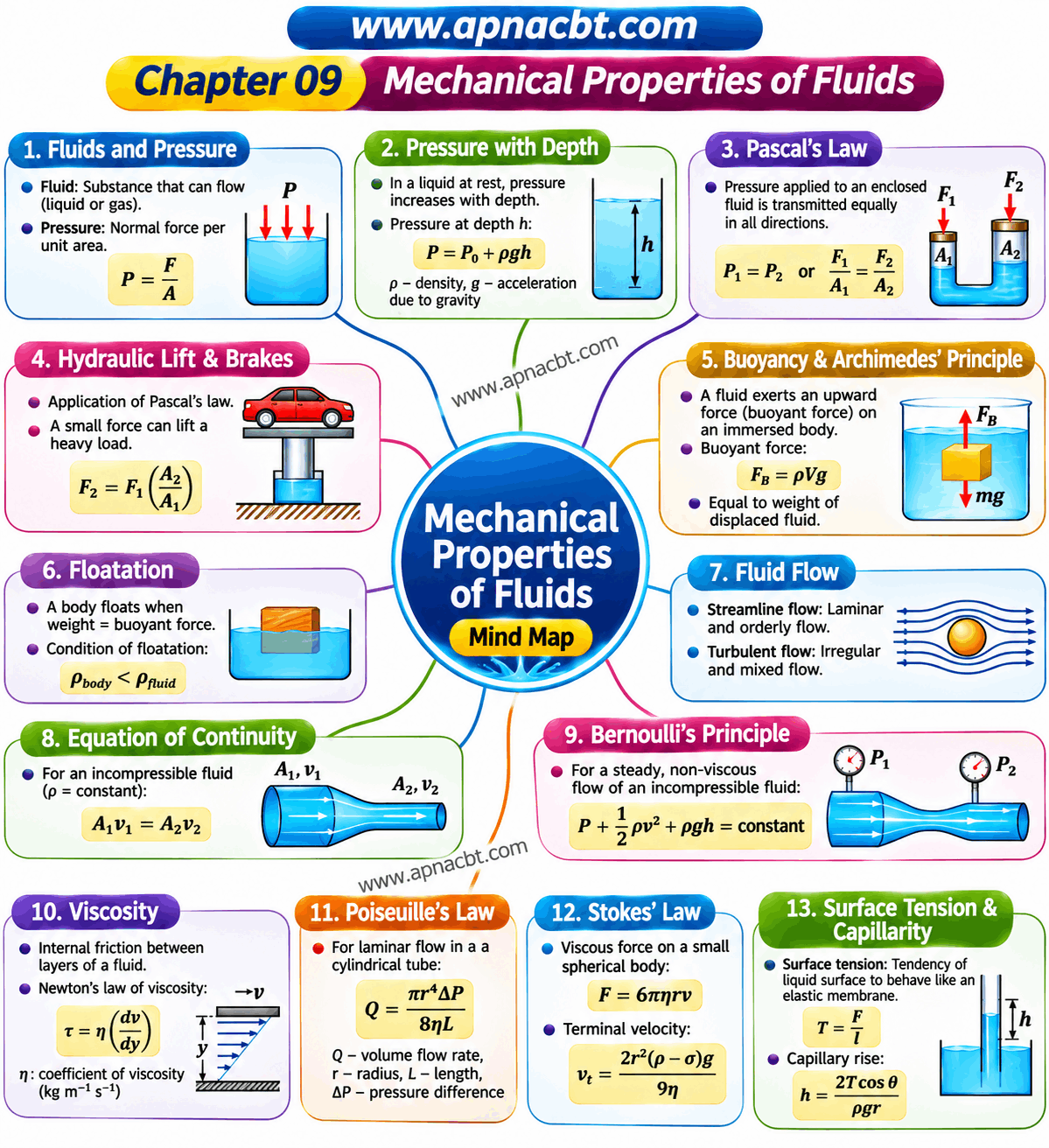
Mechanical Properties of Fluids Class 11 Physics Mind Map
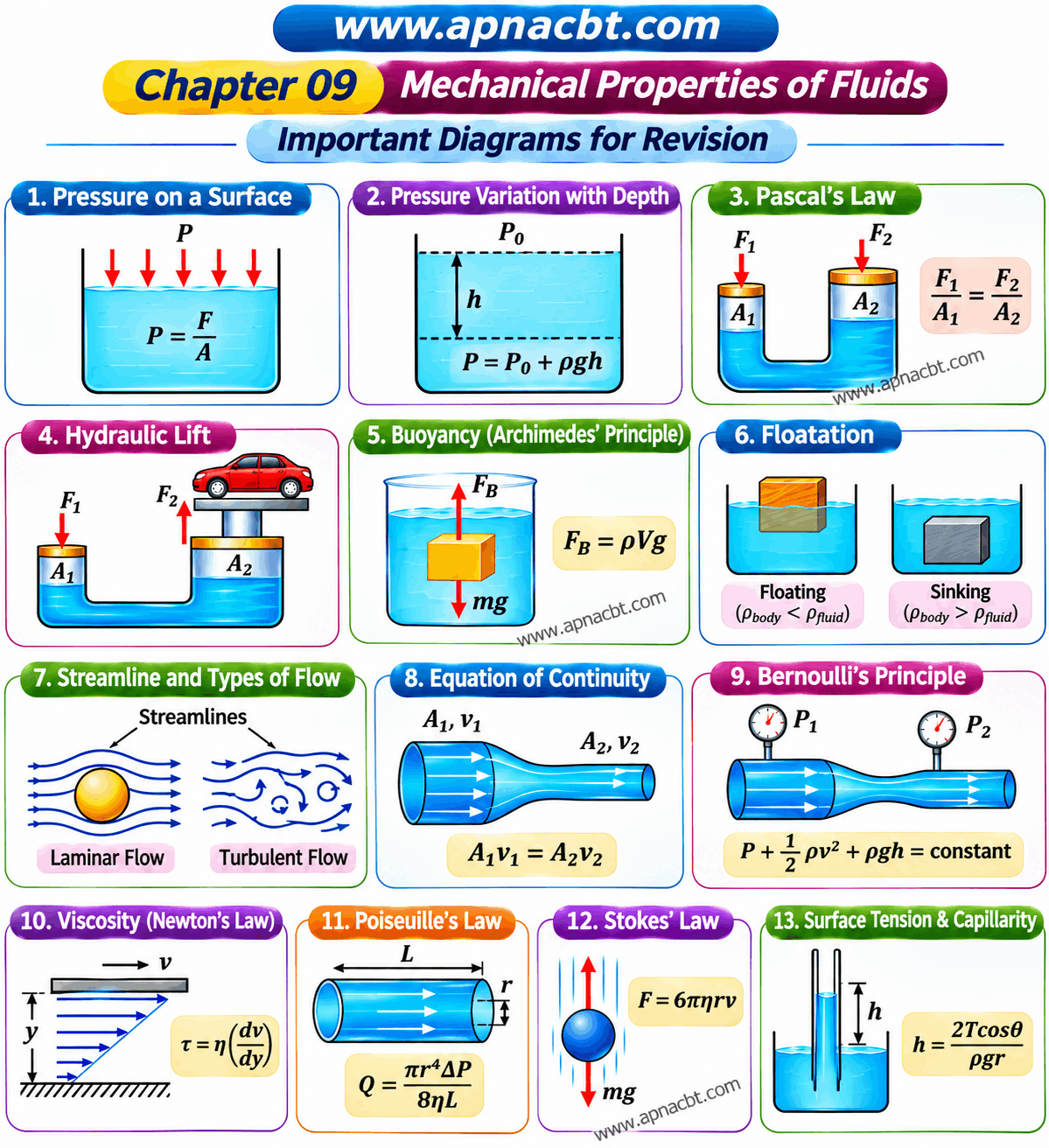
Mechanical Properties of Fluids Class 11 Physics – Important Diagrams
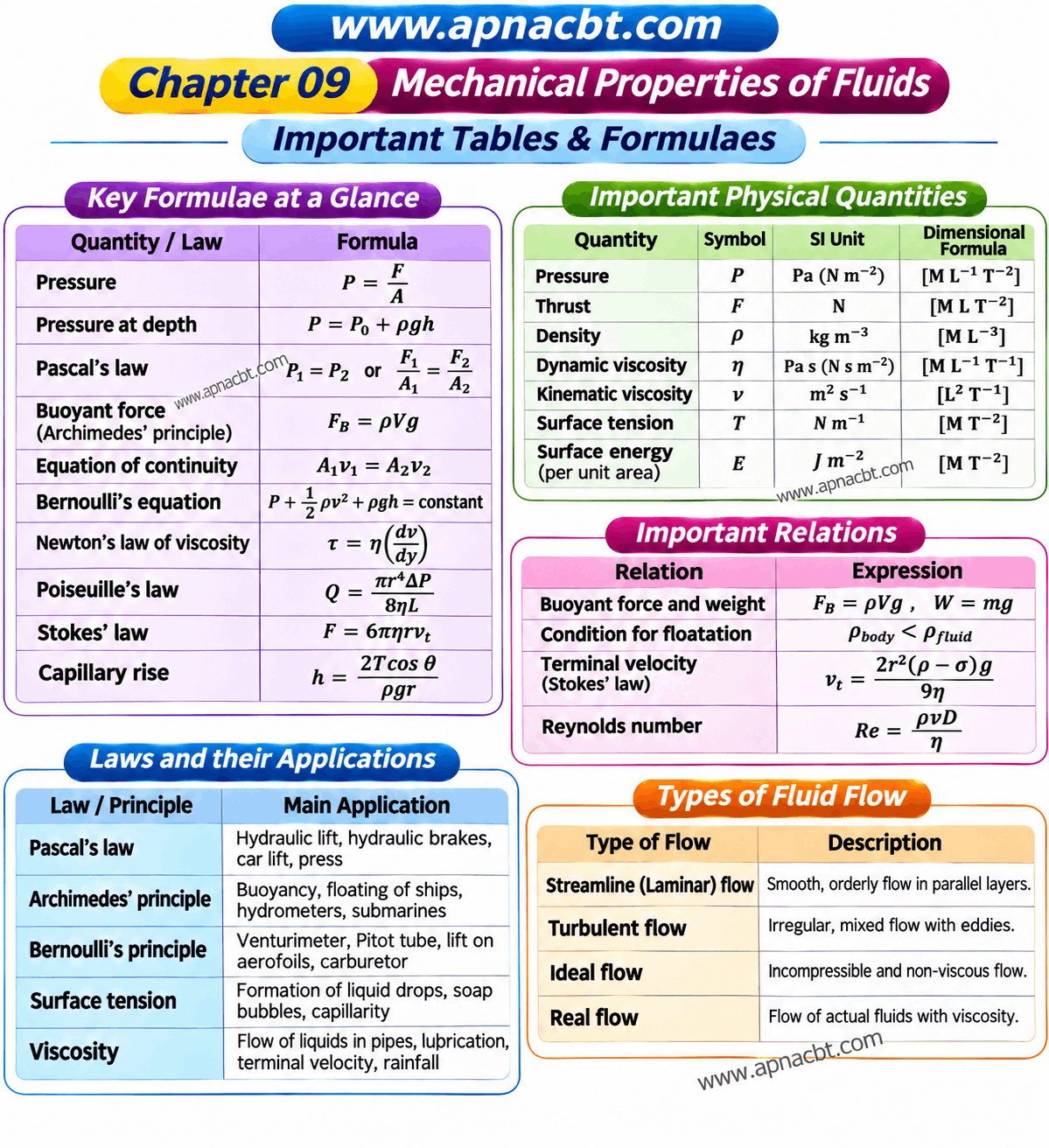
Mechanical Properties of Fluids Class 11 Physics – Important Tables and Formulae