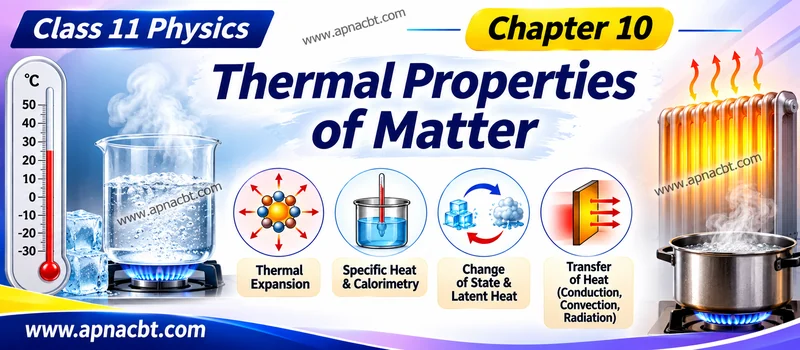
Thermal Properties of Matter
This chapter explains heat and temperature, thermal expansion, specific heat capacity, change of state, calorimetry and the different modes of heat transfer. It also covers thermal conductivity, convection, thermal radiation and the laws governing emission and cooling.
Chapter: 10 Class: 11 Physics
Useful for: CBSE Board Examinations, NCERT revision and NEET-UG preparation
1. Heat and Temperature
Heat
Heat is energy transferred from one body to another because of a temperature difference. It flows naturally from a body at higher temperature to a body at lower temperature until thermal equilibrium is reached. Heat is meaningful as energy in transfer; it is not a substance stored in a body.
The dynamic theory describes matter as consisting of molecules in continuous random motion. Molecules may have translational, vibrational and rotational motion. The energy associated with the configuration and random motion of molecules is called internal energy.
Units of heat
- SI unit: joule (J).
- CGS unit: calorie (cal).
- One calorie is the heat required to raise the temperature of 1 g of water from 14.5°C to 15.5°C.
- 1 cal = 4.186 J ≈ 4.2 J.
Temperature
Temperature indicates the thermal condition of a body and determines the direction of heat flow. Two bodies in thermal equilibrium have the same temperature.
Temperature scales
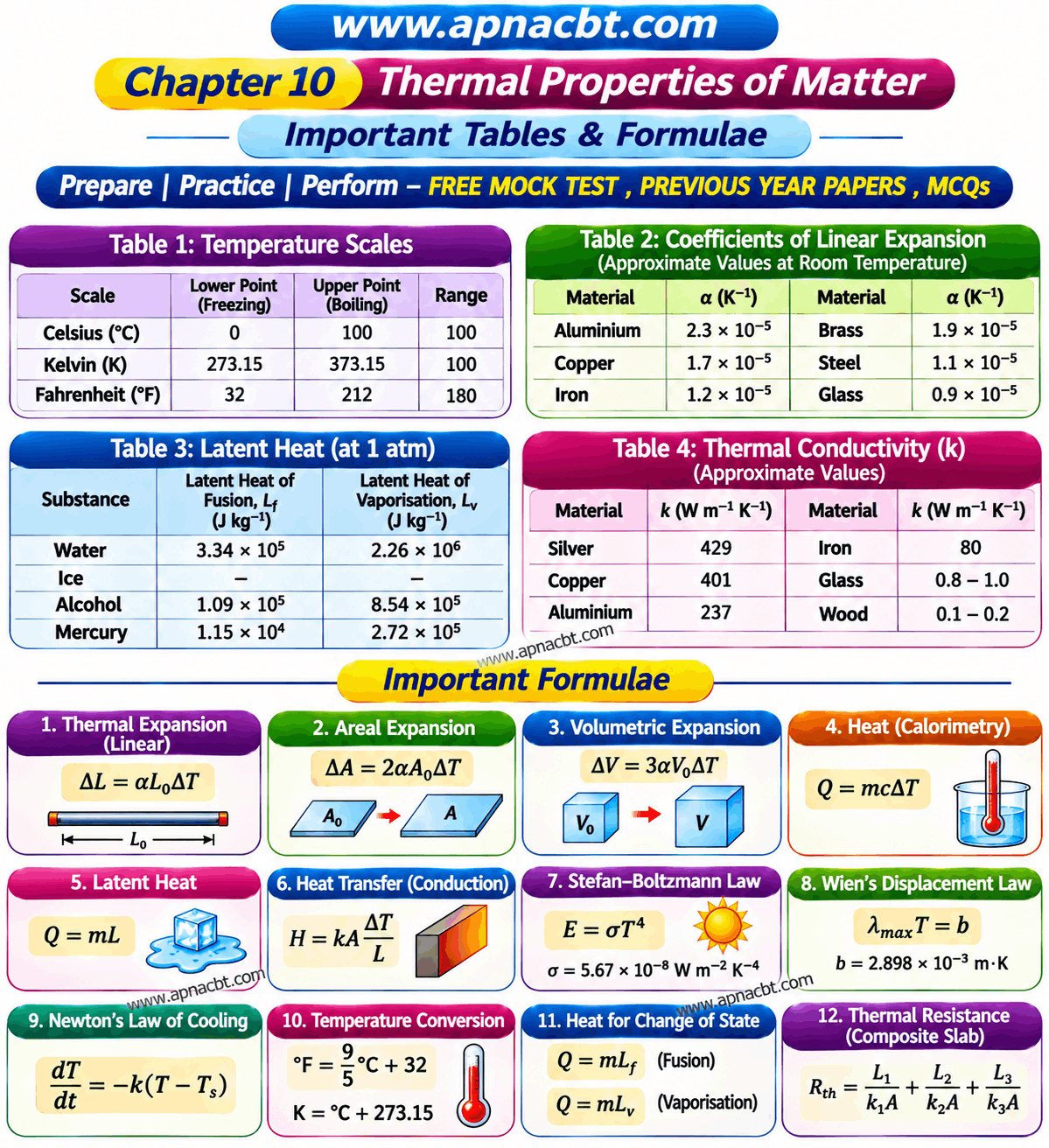
For Celsius (C), Fahrenheit (F), Kelvin (K) and Réaumur (R) scales, the conversion relations are:
- F = (9/5)C + 32
- K = C + 273.15
- R = (4/5)C
- C/5 = (F − 32)/9 = (K − 273.15)/5 = R/4
The Kelvin scale is an absolute temperature scale. Absolute zero is 0 K, corresponding to −273.15°C.
Thermometry
A thermometer measures temperature using a property that changes with temperature. The source discusses temperature scales and the use of fixed points to calibrate thermometers.
2. Thermal Expansion
Most solids, liquids and gases expand on heating and contract on cooling. Thermal expansion is the increase in dimensions of a body due to a rise in temperature.
Types of expansion
- Linear expansion: increase in length.
- Superficial expansion: increase in area.
- Volume or cubical expansion: increase in volume.
Coefficient of linear expansion
The coefficient of linear expansion α is the fractional change in length per unit rise in temperature:
α = ΔL/(L₀ ΔT)
Therefore, ΔL = αL₀ΔT and L = L₀(1 + αΔT).
Coefficient of superficial expansion
β = ΔA/(A₀ΔT). For an isotropic solid, approximately β = 2α.
Coefficient of volume expansion
γ = ΔV/(V₀ΔT). For an isotropic solid, approximately γ = 3α.
Expansion of a hole
When a metal sheet containing a hole is heated uniformly, the hole also expands. The diameter of the hole increases as though the hole were made of the same material.
Applications and effects
- Expansion joints are provided in railway tracks and bridges to allow expansion in hot weather.
- Metal rims can be heated before fitting them around wheels; cooling produces a tight fit.
- Different expansion of materials can be used in bimetallic strips.
- Expansion must be considered in the design of pipes, measuring instruments and structures.
Anomalous expansion of water
Water behaves differently from most liquids between 0°C and 4°C. When water is heated from 0°C to 4°C, its volume decreases and its density increases. At 4°C, water has maximum density. On cooling from 4°C to 0°C, it expands. This behaviour is called anomalous expansion of water.
In cold regions, the surface water of a lake can cool and freeze while deeper water remains near 4°C. This helps aquatic life survive below the ice layer.
3. Specific Heat Capacity and Heat Capacity
Specific heat capacity
Specific heat capacity of a substance is the amount of heat required to raise the temperature of unit mass of the substance by one degree.
Q = mcΔT, where Q is heat supplied, m is mass, c is specific heat capacity and ΔT is the change in temperature.
SI unit of specific heat capacity: J kg⁻¹ K⁻¹.
Heat capacity
Heat capacity is the amount of heat required to raise the temperature of a given body by one degree:
C = Q/ΔT = mc.
SI unit: J K⁻¹.
Molar specific heat
Molar specific heat is the heat required to raise the temperature of one mole of a substance by one degree. For gases, specific heat may be specified at constant volume (Cᵥ) or at constant pressure (Cₚ).
Water equivalent
The water equivalent of a body is the mass of water that would absorb or release the same amount of heat as the body for the same change in temperature. If the body’s heat capacity is C, its water equivalent in mass units is W = C/cᵥᵥₐₜₑᵣ.
Importance of specific heat
Water has a high specific heat capacity. Consequently, it heats up and cools down comparatively slowly. The source relates this property to moderation of climate near large water bodies and to the use of water as a coolant.
4. Change of State and Latent Heat
A substance can change from solid to liquid, liquid to gas, gas to liquid or liquid to solid when heat is supplied or removed under suitable conditions. During a change of state at a fixed pressure, the temperature remains constant until the change is complete.
Latent heat
Latent heat is the heat absorbed or released during a change of state without a change in temperature. Specific latent heat is the heat required to change the state of unit mass of a substance.
Q = mL, where L is the specific latent heat.
- Latent heat of fusion (Lᶠ): heat required to convert unit mass of solid into liquid at its melting point.
- Latent heat of vaporisation (Lᵥ): heat required to convert unit mass of liquid into vapour at its boiling point.
- Latent heat of sublimation: heat required for direct conversion from solid to vapour.
The source gives the latent heat of fusion of ice as approximately 3.3 × 10⁵ J kg⁻¹ and latent heat of vaporisation of water as approximately 22.6 × 10⁵ J kg⁻¹.
Melting and boiling
Melting is the change from solid to liquid. Boiling is the rapid conversion of liquid into vapour throughout the liquid at its boiling point. Evaporation takes place at the surface and can occur below the boiling point.
Effect of pressure and phase diagram
The melting point and boiling point can depend on pressure. A pressure–temperature (P–T) diagram represents the regions in which solid, liquid and vapour phases are stable. The curves indicate conditions of coexistence of two phases; the triple point is the condition at which all three phases coexist in equilibrium.
Evaporation and cooling
During evaporation, molecules with comparatively higher kinetic energy escape from the liquid surface. The average kinetic energy of the remaining liquid decreases, producing cooling. Increasing surface area, air movement and temperature generally increases the rate of evaporation; higher humidity reduces it.
5. Calorimetry
Calorimetry is the branch of physics concerned with measurement of heat. When bodies at different temperatures are placed in thermal contact in an insulated system, heat flows from the hotter body to the colder body until they reach a common temperature.
Principle of calorimetry: Heat lost by the hot body = Heat gained by the cold body, provided heat exchange with the surroundings is negligible.
Equations used
- For a temperature change: Q = mc(T₂ − T₁).
- For melting or freezing: Q = mLᶠ.
- For vaporisation or condensation: Q = mLᵥ.
In a mixture problem, write the heat lost by the hotter component and equate it to the heat gained by the colder component, including the calorimeter when its heat capacity is given.
Typical calorimetry procedure
- Identify each body and its initial temperature.
- Identify the final equilibrium temperature or the state change.
- Write heat lost and heat gained separately.
- Include latent heat if melting, freezing, boiling or condensation occurs.
- Apply conservation of energy and solve with consistent units.
6. Transfer of Heat: Overview
Heat is transferred from a region of higher temperature to a region of lower temperature by three principal modes:
- Conduction: transfer through a material without bulk movement of the material.
- Convection: transfer by the actual movement of fluid (liquid or gas).
- Radiation: transfer by electromagnetic thermal radiation; it does not require a material medium.
Conduction is important in solids, convection in fluids, while radiation can take place through vacuum. Heat from the Sun reaches the Earth by radiation.
7. Conduction and Thermal Conductivity
Conduction is the transfer of heat from the hotter part to the colder part of a body without appreciable bulk movement of the material. In metals, conduction is aided by free electrons; in non-metals, energy is transferred mainly through molecular or lattice interactions.
Thermal conductivity
Thermal conductivity k measures the ability of a material to conduct heat. For a uniform rod of length L and cross-sectional area A, whose ends are maintained at temperatures T₁ and T₂ (T₁ > T₂), the heat conducted in time t in the steady state is:
Q = kA(T₁ − T₂)t/L
Rate of heat flow: H = Q/t = kA(T₁ − T₂)/L.
SI unit of thermal conductivity: W m⁻¹ K⁻¹. A larger value of k indicates a better conductor.
Temperature gradient
The rate of change of temperature with distance along the direction of heat flow is called temperature gradient. In magnitude, the temperature gradient for a rod with end temperatures T₁ and T₂ is (T₁ − T₂)/L.
Thermal resistance
For a slab or rod, thermal resistance is the ratio of temperature difference to rate of heat flow:
Rₜₕ = (T₁ − T₂)/H = L/(kA).
Applications of poor conductors
- Fibre glass and trapped air in refrigerator walls reduce heat transfer.
- Sawdust around ice reduces heat entering it because trapped air is a poor conductor.
- Birds fluff their feathers to trap air and reduce heat loss.
- Wooden handles on cooking utensils reduce heat transfer to the hand.
- Double walls with trapped air reduce heat transfer in insulated structures.
- A new quilt traps more air and therefore provides better insulation.
8. Convection and Convection Currents
Convection is the transfer of heat in fluids by the actual motion of fluid particles. When a portion of a fluid is heated, it generally expands, becomes less dense and rises; cooler, denser fluid moves in to replace it. This circulation establishes convection currents.
Types of convection
- Natural convection: fluid motion occurs due to density differences caused by temperature differences.
- Forced convection: fluid motion is produced by an external device such as a fan or pump.
Examples and applications
- Heating water in a vessel produces convection currents.
- Air circulation helps maintain room temperature in heating and air-conditioning systems.
- Blood circulation transfers heat through the human body; the heart acts as a pump.
- Air-conditioning and heating a liquid by brisk stirring are examples of forced convection.
Land breeze and sea breeze
During the day, land heats faster than the sea. Air over the land becomes warmer and rises; cooler air from the sea moves towards the land. This is sea breeze. At night, land cools faster than the sea. Air over the relatively warmer sea rises and cooler air flows from land towards the sea; this is land breeze.
Monsoon circulation described in the source
Seasonal differences in heating of land and ocean establish large-scale convection currents. Moist air moving from the ocean can rise near land or mountains, cool and form clouds, leading to rainfall.
9. Thermal Radiation
Thermal radiation is the transfer of heat energy by electromagnetic waves. It does not require a material medium and can travel through vacuum. The Sun heats the Earth by radiation.
Properties of thermal radiation
- Thermal radiation can travel through vacuum.
- It travels in straight lines in a uniform medium.
- It obeys the inverse-square law: intensity from a point source varies inversely as the square of distance.
- When radiation falls on a body, it may be reflected, absorbed or transmitted.
Reflectance, absorptance and transmittance
- Reflectance (r): fraction of incident radiation reflected by a body.
- Absorptance (a): fraction of incident radiation absorbed.
- Transmittance (t): fraction of incident radiation transmitted.
For the incident radiation, r + a + t = 1. A body may reflect, absorb and transmit different fractions depending on its material and surface.
Good absorbers and emitters
Dull, dark surfaces are generally good absorbers and good emitters of thermal radiation. Polished and shiny surfaces are generally poor absorbers and emitters and good reflectors.
Black body
A perfect black body absorbs all the radiation incident on it, irrespective of wavelength and direction. It is also an ideal emitter. A small opening in a hollow enclosure is used as an approximation to a black body.
Emissive power
Emissive power is the radiant energy emitted per unit area per unit time by a surface. Its SI unit is W m⁻².
10. Laws of Thermal Radiation
Stefan–Boltzmann law
The total energy radiated per unit area per unit time by a perfect black body is proportional to the fourth power of its absolute temperature:
E = σT⁴
For a body at temperature T in surroundings at temperature T₀, the net rate of energy loss per unit area for an ideal black body is Eₙₑₜ = σ(T⁴ − T₀⁴). Here σ is the Stefan–Boltzmann constant, approximately 5.67 × 10⁻⁸ W m⁻² K⁻⁴.
Kirchhoff’s law of radiation
At a given temperature and wavelength, the ratio of emissive power to absorptive power is the same for all bodies and is equal to the corresponding value for a black body. Thus, a good absorber is also a good emitter under the same conditions.
Wien’s displacement law
The wavelength corresponding to maximum emission of a black body is inversely proportional to its absolute temperature:
λₘₐₓT = b, where b is Wien’s displacement constant.
Newton’s law of cooling
For a small temperature difference between a body and its surroundings, the rate of loss of heat (or rate of fall of temperature) is directly proportional to the excess temperature of the body over its surroundings:
−dT/dt ∝ (T − T₀).
The law is applicable when the temperature difference is small and the conditions of the surroundings remain approximately constant. The source also discusses cooling curves and experimental verification of the law.
11. Important Formulae and Units
| Quantity / concept | Formula | SI unit |
|---|---|---|
| Heat for temperature change | Q = mcΔT | J |
| Heat capacity | C = Q/ΔT = mc | J K⁻¹ |
| Specific heat capacity | c = Q/(mΔT) | J kg⁻¹ K⁻¹ |
| Latent heat | Q = mL | J kg⁻¹ |
| Linear expansion | ΔL = αL₀ΔT | K⁻¹ for α |
| Area expansion | ΔA = βA₀ΔT; β ≈ 2α | K⁻¹ for β |
| Volume expansion | ΔV = γV₀ΔT; γ ≈ 3α | K⁻¹ for γ |
| Heat conduction | Q/t = kA(T₁ − T₂)/L | W |
| Thermal resistance | Rₜₕ = L/(kA) | K W⁻¹ |
| Stefan–Boltzmann law | E = σT⁴ | W m⁻² |
| Wien’s displacement law | λₘₐₓT = constant | m K |
| Newton’s law of cooling | −dT/dt ∝ (T − T₀) | K s⁻¹ for rate |
Remember: Temperature differences have the same numerical value in kelvin and degree Celsius. Absolute temperatures in radiation laws must be expressed in kelvin.
12. Short-Answer Questions – 30 Questions
Questions
- Define heat. In which direction does heat flow naturally?
- What is internal energy?
- State the SI and CGS units of heat. Write the relation between calorie and joule.
- What is temperature? What is meant by thermal equilibrium?
- Write the relation between Celsius and Fahrenheit temperature scales.
- Convert a temperature difference of 1°C into kelvin.
- Define thermal expansion and name its three types.
- Define the coefficient of linear expansion and write its formula.
- Write the relation between the coefficients of linear and superficial expansion for an isotropic solid.
- Write the relation between the coefficients of linear and volume expansion for an isotropic solid.
- What happens to the diameter of a hole in a metal plate when the plate is heated uniformly?
- What is anomalous expansion of water? At what temperature does water have maximum density?
- Define specific heat capacity and state its SI unit.
- Define heat capacity. How is it related to specific heat capacity?
- What is water equivalent?
- Define latent heat and specific latent heat.
- Distinguish between latent heat of fusion and latent heat of vaporisation.
- Why does the temperature remain constant during a change of state?
- What is calorimetry? State its principle.
- Write the expression for heat gained or lost when the temperature of a body changes.
- Name the three modes of heat transfer.
- What is conduction? Give one example.
- Define thermal conductivity and write its SI unit.
- Write the expression for the rate of heat conduction through a uniform rod.
- What is thermal resistance? Write its expression for a uniform rod.
- What is convection? Distinguish between natural and forced convection.
- Explain briefly the formation of sea breeze.
- Why can thermal radiation travel through vacuum?
- State the Stefan–Boltzmann law.
- State Newton’s law of cooling and mention the condition under which it is applicable.
Answers
- Heat is energy transferred between bodies due to a temperature difference. It flows naturally from higher temperature to lower temperature.
- Internal energy is the energy associated with the configuration and random motion of the molecules of a body.
- The SI unit is joule (J) and the CGS unit is calorie (cal). 1 cal = 4.186 J, approximately 4.2 J.
- Temperature indicates the thermal condition of a body and determines the direction of heat flow. Thermal equilibrium is the condition in which bodies in thermal contact have the same temperature and there is no net heat flow.
- F = (9/5)C + 32, or C/5 = (F − 32)/9.
- A temperature difference of 1°C is equal to a temperature difference of 1 K.
- Thermal expansion is the increase in dimensions of a body on heating. Its types are linear, superficial and volume (cubical) expansion.
- The coefficient of linear expansion is the fractional increase in length per unit original length per unit rise in temperature: α = ΔL/(L₀ΔT).
- For an isotropic solid, the coefficient of superficial expansion is approximately β = 2α.
- For an isotropic solid, the coefficient of volume expansion is approximately γ = 3α.
- The hole also expands. Its diameter increases as though the hole were made of the same material as the plate.
- Water contracts when heated from 0°C to 4°C and expands when cooled from 4°C to 0°C. Its density is maximum at 4°C.
- Specific heat capacity is the heat required to raise the temperature of unit mass of a substance by one degree. Its SI unit is J kg⁻¹ K⁻¹.
- Heat capacity is the heat required to raise the temperature of a body by one degree. It is related by C = mc.
- Water equivalent is the mass of water that has the same heat capacity as the given body.
- Latent heat is heat absorbed or released during a change of state without temperature change. Specific latent heat is the heat required to change the state of unit mass.
- Latent heat of fusion is associated with solid–liquid change; latent heat of vaporisation is associated with liquid–vapour change.
- The heat supplied or removed is used to change the internal arrangement and phase of the substance rather than to change its temperature. Therefore, temperature remains constant during the change of state at fixed pressure.
- Calorimetry is the measurement of heat. Its principle is: heat lost by the hotter body equals heat gained by the colder body, if heat exchange with surroundings is negligible.
- Q = mcΔT, where m is mass, c is specific heat capacity and ΔT is temperature change.
- The three modes are conduction, convection and radiation.
- Conduction is heat transfer through a material without bulk movement of the material. Example: the far end of a metal rod becomes hot when the other end is heated.
- Thermal conductivity measures a material’s ability to conduct heat. Its SI unit is W m⁻¹ K⁻¹.
- H = Q/t = kA(T₁ − T₂)/L.
- Thermal resistance is the ratio of temperature difference to rate of heat flow. For a uniform rod, Rₜₕ = L/(kA).
- Convection is heat transfer by bulk movement of a fluid. Natural convection is caused by density differences; forced convection is produced by an external device such as a fan or pump.
- During the day, land heats faster than the sea. Warm air over land rises and cooler air from the sea moves towards land, producing sea breeze.
- Thermal radiation is electromagnetic radiation and does not need a material medium. It can therefore travel through vacuum.
- The Stefan–Boltzmann law states that the emissive power of a perfect black body is proportional to the fourth power of its absolute temperature: E = σT⁴.
- Newton’s law of cooling states that for a small temperature difference, the rate of cooling is proportional to the excess temperature of the body over its surroundings: −dT/dt ∝ (T − T₀).
13. Long-Answer Questions – 15 Questions
Questions
- Explain heat and temperature. Discuss the temperature scales and derive the relation connecting Celsius, Fahrenheit and Kelvin scales.
- Explain linear, superficial and volume expansion. Derive the relations between their coefficients for an isotropic solid.
- Explain anomalous expansion of water and discuss its importance for aquatic life in cold regions.
- Define specific heat capacity and heat capacity. Derive the relation between them and explain the meaning of water equivalent.
- Explain change of state and latent heat. Distinguish between latent heat of fusion, vaporisation and sublimation.
- Explain the principle of calorimetry and describe how it is applied to determine the final temperature of a mixture.
- Describe the three modes of heat transfer and compare conduction, convection and radiation.
- Define thermal conductivity. Derive the expression for the rate of heat conduction through a uniform rod in the steady state.
- Explain thermal resistance and discuss applications of poor conductors of heat in everyday life.
- Explain natural and forced convection with examples. Describe the formation of land breeze and sea breeze.
- What is thermal radiation? Explain reflectance, absorptance and transmittance, and state their relation.
- What is a perfect black body? Explain why a black body is a good absorber and emitter of radiation.
- State and explain Stefan–Boltzmann law. Write the expression for net radiated energy when the surroundings are at temperature T₀.
- State Kirchhoff’s law of radiation and explain its implication for good absorbers and good emitters.
- State Newton’s law of cooling. Explain its physical meaning and the condition under which it is valid. Also state Wien’s displacement law.
Answers
- Heat is energy transferred because of a temperature difference. It flows from a hotter body to a colder body. Temperature indicates the thermal condition of a body. For fixed points on the Celsius, Fahrenheit and Kelvin scales, the intervals are divided in the ratios 100, 180 and 100 respectively. Hence C/100 = (F − 32)/180 = (K − 273.15)/100, which gives C/5 = (F − 32)/9 = (K − 273.15)/5. Thus, F = (9/5)C + 32 and K = C + 273.15.
- In linear expansion, length changes: α = ΔL/(L₀ΔT). In superficial expansion, area changes: β = ΔA/(A₀ΔT). In volume expansion, volume changes: γ = ΔV/(V₀ΔT). For an isotropic solid, let each linear dimension L become L(1 + αΔT). The new area is A(1 + αΔT)² ≈ A(1 + 2αΔT), neglecting the small square term. Therefore β ≈ 2α. The new volume is V(1 + αΔT)³ ≈ V(1 + 3αΔT), so γ ≈ 3α.
- Water shows anomalous expansion between 0°C and 4°C. On heating from 0°C to 4°C, its volume decreases; on cooling from 4°C to 0°C, its volume increases. Its density is maximum at 4°C. In a lake during winter, surface water cools and becomes denser until it reaches 4°C and sinks. Water cooled below 4°C is less dense and remains near the surface, where it may freeze. The ice layer acts as insulation, allowing deeper water to remain liquid and helping aquatic organisms survive.
- Specific heat capacity c is the heat required to raise unit mass by one degree: c = Q/(mΔT). Heat capacity C is the heat required to raise the temperature of the whole body by one degree: C = Q/ΔT. Dividing the expressions gives C = mc. Water equivalent W is the mass of water having the same heat capacity as the body. If cᵥ is the specific heat capacity of water, W = C/cᵥ = mc/cᵥ.
- A change of state is conversion from one physical phase to another. During the change, heat is absorbed or released without a temperature change at fixed pressure. Specific latent heat L is the heat required per unit mass, so Q = mL. Latent heat of fusion relates to solid–liquid conversion; latent heat of vaporisation relates to liquid–vapour conversion; latent heat of sublimation relates to direct solid–vapour conversion.
- Calorimetry measures heat exchanged between bodies. In an insulated system, conservation of energy gives heat lost by hot bodies = heat gained by cold bodies. For a body changing temperature, use Q = mcΔT. For a phase change, use Q = mL. For a mixture, calculate the heat lost by each hot component and equate it to the heat gained by each cold component, including the calorimeter if its heat capacity is known. Solve the resulting energy-balance equation for the final temperature.
- Conduction transfers heat through a material without bulk motion, and is common in solids. Convection transfers heat by bulk movement of a fluid. Radiation transfers heat by electromagnetic waves and does not require a medium. For example, heat travels along a metal rod by conduction, circulating water transfers heat by convection, and sunlight reaches Earth by radiation.
- Thermal conductivity k is a measure of the ability of a material to conduct heat. Consider a rod of length L and area A, with ends at T₁ and T₂. In steady state, heat conducted is proportional to area A, temperature difference (T₁ − T₂), and time t, and inversely proportional to length L. Thus Q ∝ A(T₁ − T₂)t/L. Introducing the material constant k gives Q = kA(T₁ − T₂)t/L. Therefore the rate of heat flow is H = Q/t = kA(T₁ − T₂)/L.
- Thermal resistance is the temperature difference required per unit rate of heat flow. From H = kA(T₁ − T₂)/L, Rₜₕ = (T₁ − T₂)/H = L/(kA). Poor conductors and trapped air reduce heat transfer. They are used in refrigerator insulation, sawdust around ice, bird feathers, wooden utensil handles, double-walled houses and quilts.
- In natural convection, heating produces density differences that cause fluid to circulate. In forced convection, a fan or pump drives the fluid. During the day, land becomes hotter than the sea; air above land rises and cooler sea air moves towards land, producing sea breeze. At night, land cools faster than the sea; warmer air above the sea rises and cooler air moves from land to sea, producing land breeze.
- Thermal radiation is energy transfer by electromagnetic waves and can occur through vacuum. When radiation is incident on a body, some is reflected, some absorbed and some transmitted. Reflectance r is the reflected fraction, absorptance a is the absorbed fraction and transmittance t is the transmitted fraction. By conservation of incident energy, r + a + t = 1.
- A perfect black body absorbs all incident radiation at every wavelength and from every direction. It has zero reflectance and zero transmittance. At a given temperature, it is also the maximum possible emitter. A small aperture in a hollow enclosure approximates a black body because radiation entering the opening undergoes repeated reflections and is almost completely absorbed.
- Stefan–Boltzmann law states that the total emissive power of a perfect black body is proportional to the fourth power of its absolute temperature: E = σT⁴. Here σ is the Stefan–Boltzmann constant. If the surroundings are at absolute temperature T₀, the net energy radiated per unit area per unit time is Eₙₑₜ = σ(T⁴ − T₀⁴) for an ideal black body.
- Kirchhoff’s law states that, at thermal equilibrium and for a given wavelength and temperature, the ratio of emissive power to absorptive power is the same for all bodies and equals the corresponding black-body value. Therefore, a surface that absorbs radiation effectively also emits radiation effectively under the same conditions. Dull, dark surfaces are generally good absorbers and emitters; polished surfaces are generally poor absorbers and emitters.
- Newton’s law of cooling states that when the temperature difference between a body and its surroundings is small, the rate of loss of heat or rate of fall of temperature is proportional to the excess temperature: −dT/dt ∝ (T − T₀). The proportionality holds when surrounding conditions remain steady and the excess temperature is small. Wien’s displacement law states that the wavelength of maximum emission is inversely proportional to absolute temperature: λₘₐₓT = b.
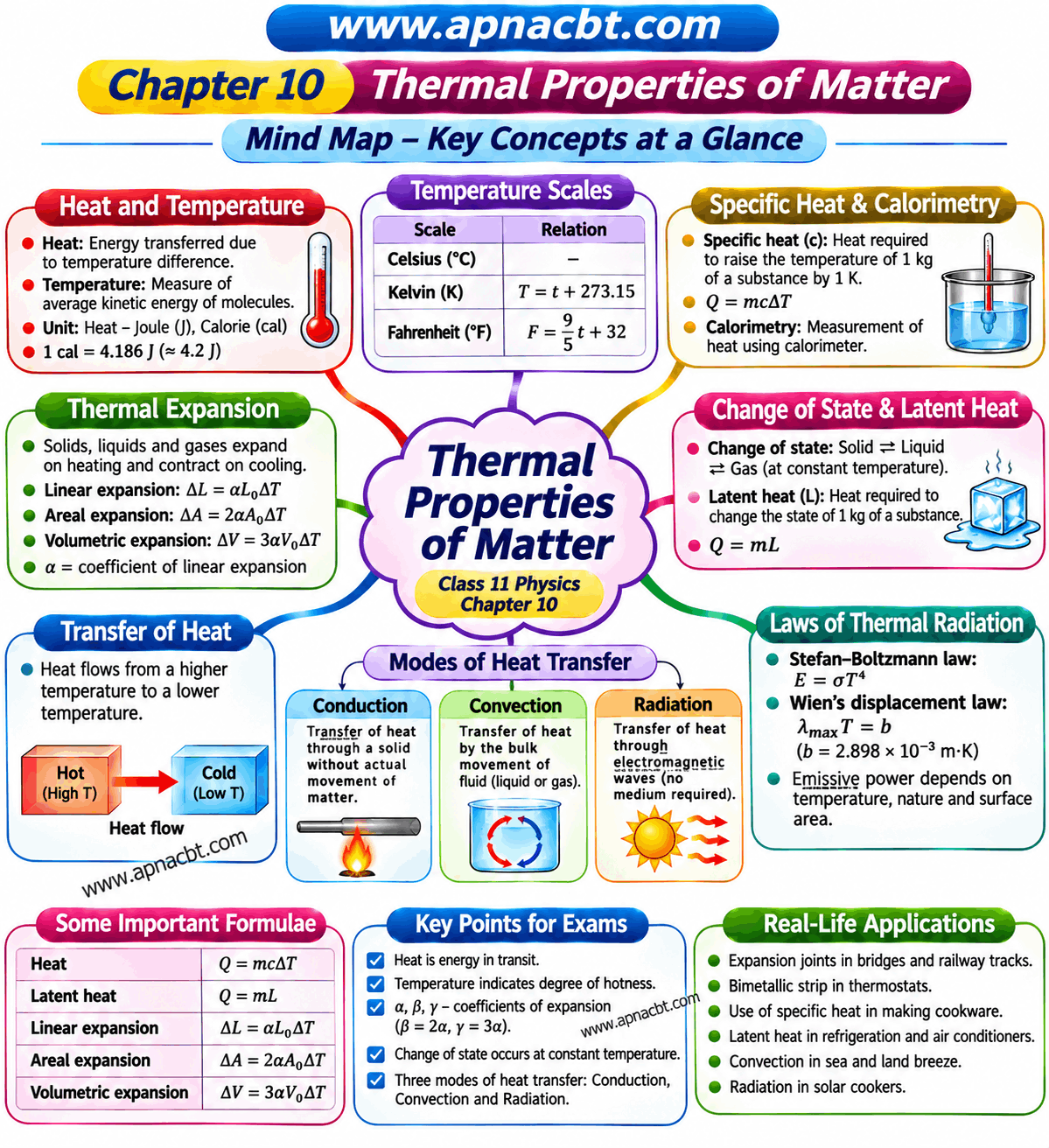
Thermal Properties of Matter Mind Map
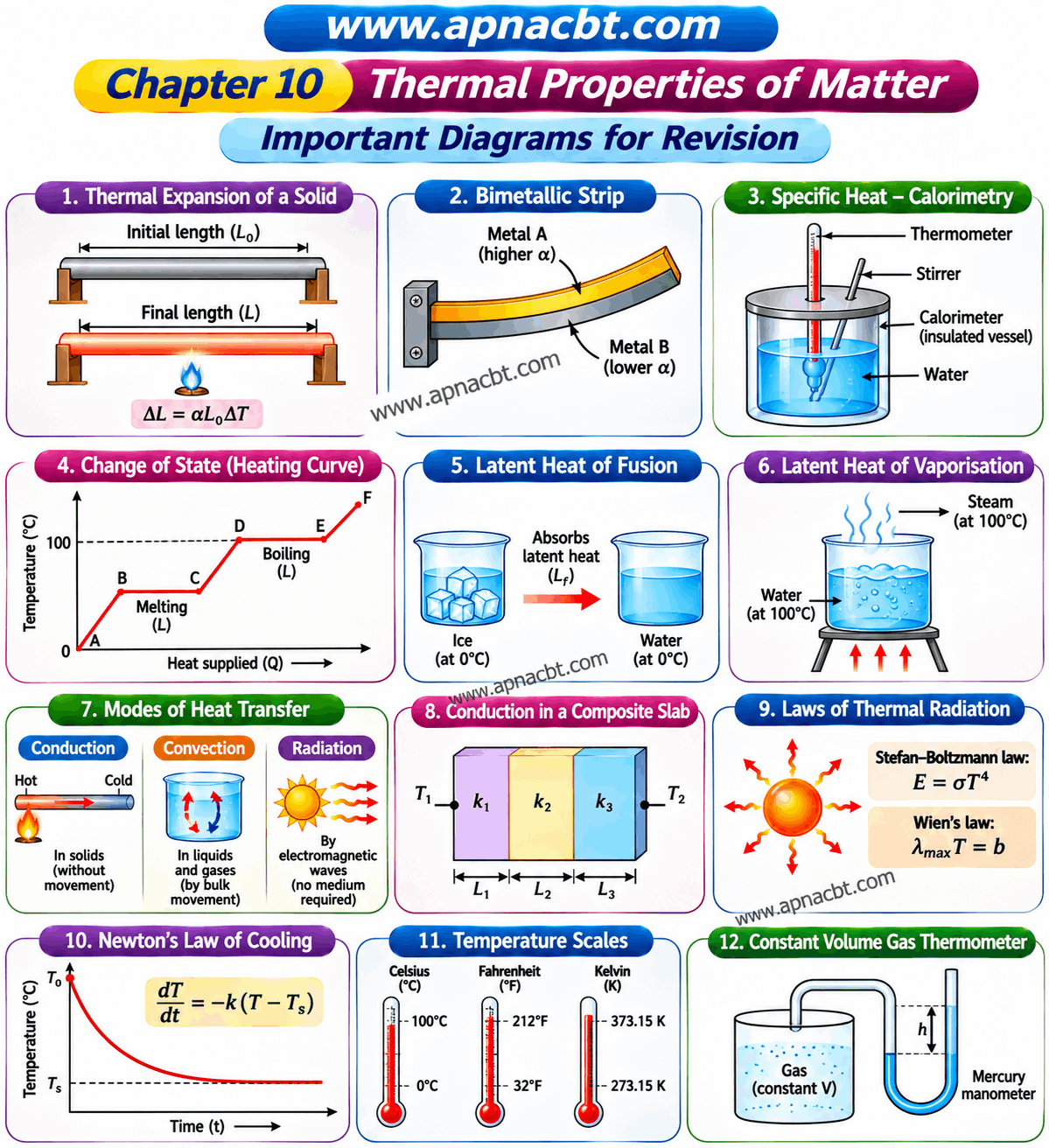
Important Diagrams – Thermal Properties of Matter
Important Tables and Formulae – Thermal Properties of Matter