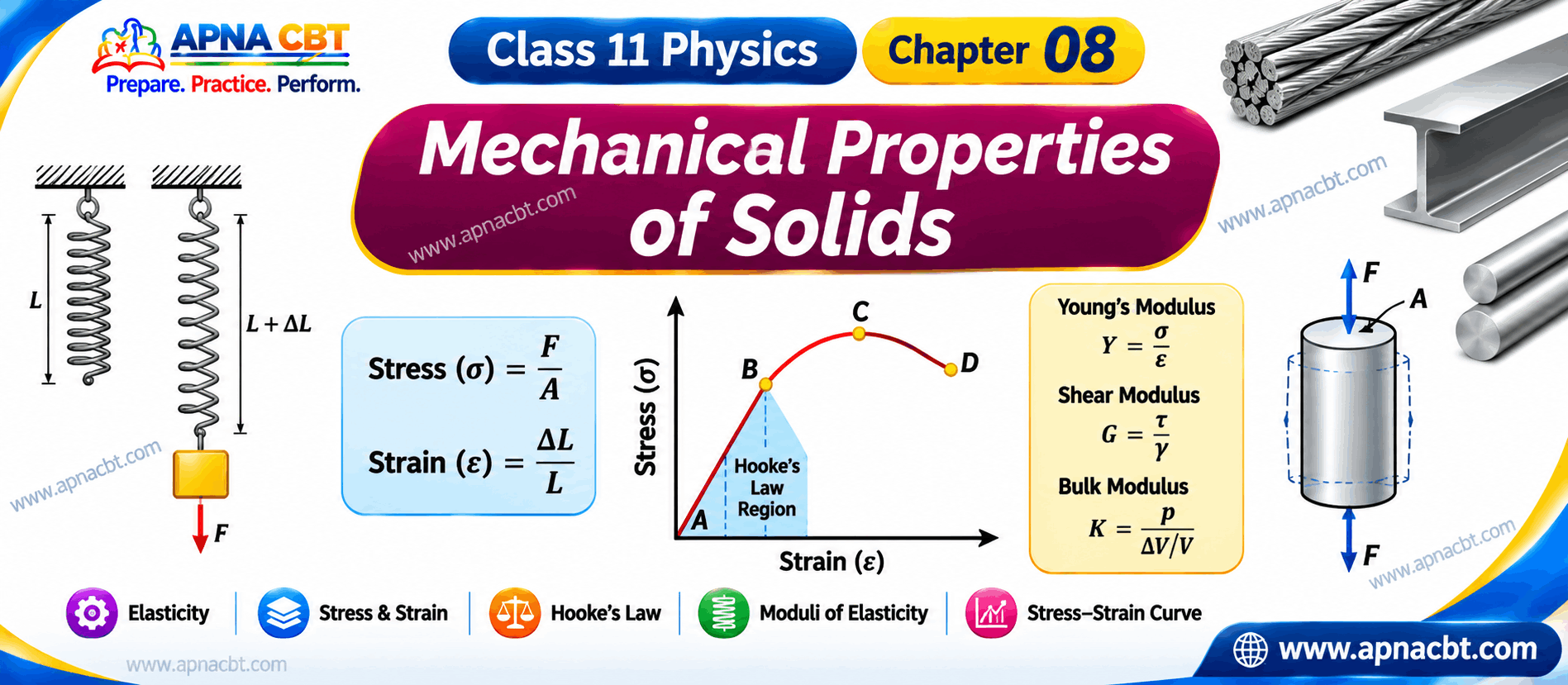
Chapter 08: Mechanical Properties of Solids
Class 11 Physics | CBSE Board Examinations | NEET-UG Preparation
This lesson covers the important concepts, definitions, laws, elastic moduli, formulae and applications of Mechanical Properties of Solids. It is organised for CBSE board revision and NEET-UG preparation.
1. Elastic Behaviour of Solids and Molecular Model
A rigid body is an ideal body whose shape and size do not change under an applied force. Real solids are not perfectly rigid: sufficiently large forces can stretch, compress, bend or twist them.
Elasticity is the property by which a body tends to regain its original shape and size after the deforming force is removed. Plasticity is the property of undergoing permanent deformation. A perfectly elastic body recovers completely and immediately; a perfectly plastic body retains its deformation.
In the molecular model of a solid, atoms or molecules occupy stable equilibrium positions due to interatomic or intermolecular forces. Deformation displaces them from equilibrium. When the external force is removed, restoring forces tend to bring the particles back to their original positions. The spring-ball model represents atoms as balls and interatomic forces as springs.
Deforming force: an external force that changes or tends to change the shape, size or configuration of a body. Mechanical properties describe a material’s response to such forces, including strength and resistance to deformation.
2. Stress: Meaning, Formula and Types
Stress is the internal restoring force developed per unit area when a body is deformed by an external force.
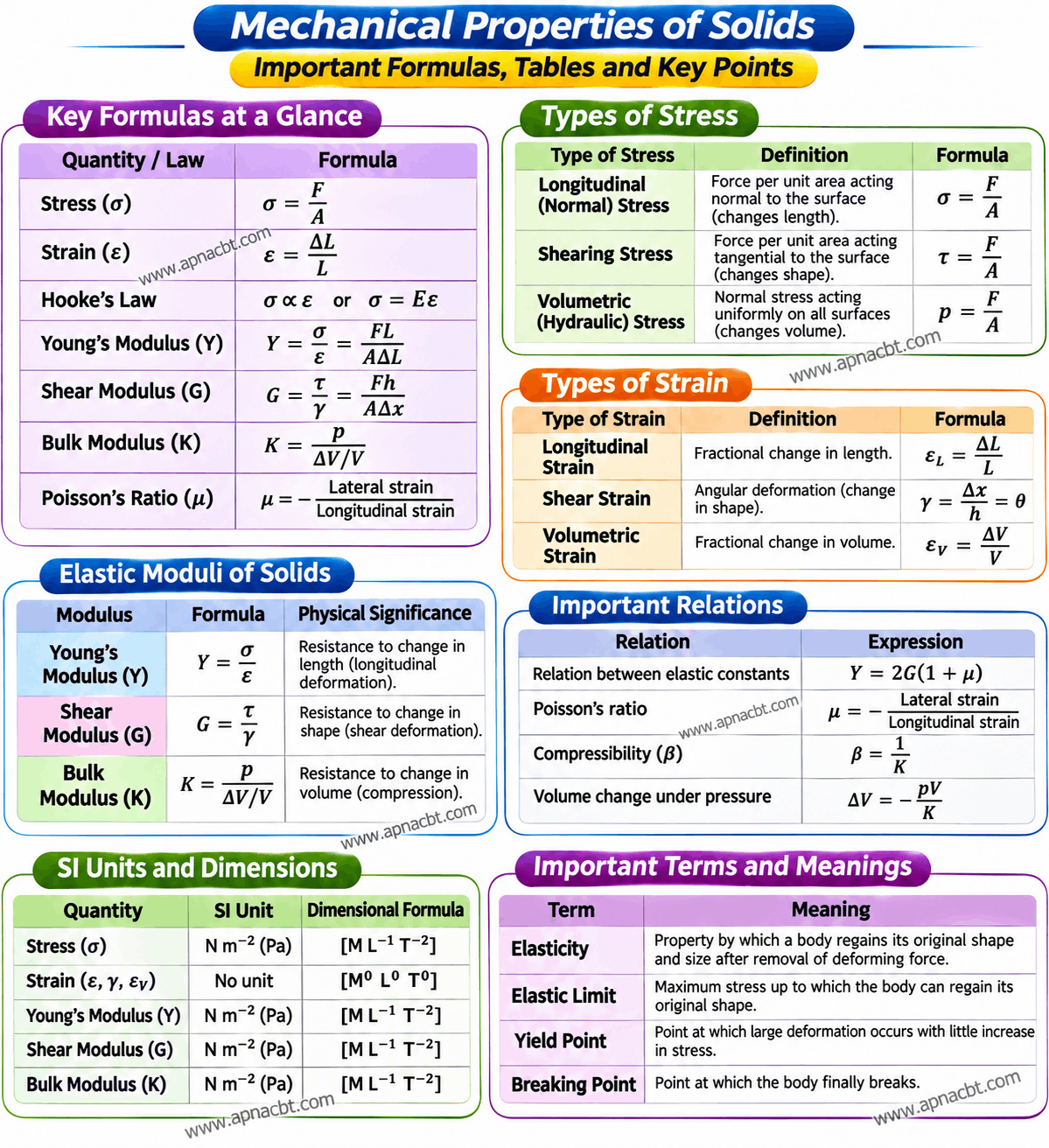
Stress = Restoring force / Area = F/A
SI unit: pascal (Pa) or N m−2. Dimensional formula: [ML−1T−2]. Stress is not generally treated as a simple scalar in full mechanics; in elementary uniaxial problems, its magnitude and the type/direction are specified.
- Longitudinal stress: force acts perpendicular to the cross-sectional area and changes length. Tensile stress increases length; compressive stress decreases length.
- Volume or hydraulic stress: uniform pressure acts over the surface and changes volume.
- Shearing stress: tangential force acts parallel to a surface and changes shape.
- Torsional stress: twisting action produces shear within a body, such as a shaft.
A wire suspended vertically may experience stress even without an attached load because its own weight acts on its cross-sections.
3. Strain and Its Types
Strain is the ratio of change in dimension to the original dimension. It measures the relative deformation and is dimensionless.
- Longitudinal strain: ε = ΔL/L, where ΔL is change in length and L is original length. It may be tensile or compressive.
- Volume strain: εv = ΔV/V, the ratio of change in volume to original volume.
- Shearing strain: γ = Δx/L = tan θ ≈ θ for small angular deformation, where Δx is relative lateral displacement and L is the separation/height.
Strain has no SI unit and no dimensions. Unlike stress, it does not have the unit N m−2. A strain of 0.001 means a dimensional change of one part in a thousand.
4. Hooke’s Law, Proportional Limit and Elastic Limit
Hooke’s law: within the proportional limit, stress is directly proportional to strain.
Stress ∝ Strain and Stress = Modulus of elasticity × Strain.
For an ideal spring, F = −kx, where k is the spring constant and the negative sign indicates that the restoring force opposes displacement. The magnitude is F = kx.
Proportional limit is the maximum range over which stress is proportional to strain. Elastic limit is the maximum stress up to which the body completely regains its original shape and size after removal of the force. Beyond the elastic limit, permanent deformation may remain. A material may continue deforming plastically and eventually fracture at the breaking point.
Do not confuse proportional limit with elastic limit: they describe related but not identical limits.
5. Young’s Modulus and Longitudinal Elasticity
Young’s modulus (Y) is the ratio of longitudinal stress to longitudinal strain, within the elastic range.
Y = (F/A)/(ΔL/L) = FL/(AΔL)
For a wire of radius r, A = πr². Therefore Y = FL/(πr²ΔL). For a suspended load M, F = Mg, so Y = MgL/(πr²ΔL).
SI unit: Pa (N m−2); dimensions [ML−1T−2]. A larger Young’s modulus means a material undergoes less longitudinal strain for a given stress and is harder to stretch or compress. Steel has a larger Young’s modulus than rubber and many softer materials.
Experimental determination: suspend a known load from the experimental wire, measure its extension using a scale/vernier arrangement, and use Y = FL/(AΔL). A reference wire can compensate for changes in the support and surroundings. A load-extension graph is linear through the origin while Hooke’s law is obeyed.
6. Shear Modulus or Modulus of Rigidity
Shear modulus (G or η) is the ratio of shearing stress to shearing strain.
G = (F/A)/(Δx/L) = FL/(AΔx)
It measures resistance to change in shape. Its SI unit is Pa and dimensions are [ML−1T−2]. For small angular deformation, shearing strain γ ≈ θ in radians.
For most common isotropic materials, shear modulus is smaller than Young’s modulus. Fluids at rest cannot sustain a static shear stress; their shear modulus is zero in the equilibrium-fluid model.
7. Bulk Modulus and Compressibility
Bulk modulus (B or K) is the ratio of hydraulic pressure (increase in pressure) to the magnitude of volume strain.
B = −ΔP/(ΔV/V) = −VΔP/ΔV
The negative sign indicates that an increase in pressure generally causes a decrease in volume. SI unit: Pa; dimensions [ML−1T−2]. Bulk modulus describes resistance to uniform compression and applies to solids, liquids and gases.
Compressibility is the reciprocal of bulk modulus: β = 1/B. Its SI unit is Pa−1. A material with a large bulk modulus has a small compressibility.
For an ideal gas, the bulk modulus depends on the thermodynamic condition: isothermal B = P and adiabatic B = γP, where γ = Cp/Cv.
8. Stress–Strain Curve and Material Behaviour
A stress–strain curve shows how stress changes with strain for a material. In the initial straight-line region, stress is proportional to strain and the slope gives the relevant modulus of elasticity.
- Proportional region: Hooke’s law is obeyed; stress is proportional to strain.
- Elastic region: on removing the load, the specimen returns to its original dimensions.
- Yielding/plastic region: permanent deformation develops; unloading does not restore the original dimensions fully.
- Ultimate stress: maximum engineering stress reached in the test.
- Breaking point: the specimen fractures.
Ductile materials can undergo considerable plastic deformation before breaking. Brittle materials break with comparatively little plastic deformation. The exact curve and characteristic points depend on the material and test conditions.
9. Applications, Comparisons and Important Exam Points
Why steel is used in structures: its high Young’s modulus and strength make it resist deformation under load. Material selection also depends on yield strength, toughness, density, corrosion resistance and design conditions.
Elasticity versus plasticity: elastic deformation is recoverable; plastic deformation is permanent. Strength versus stiffness: strength concerns the stress a material can withstand before yielding or breaking, whereas stiffness is related to elastic modulus.
Three elastic moduli: Young’s modulus concerns change in length, shear modulus concerns change in shape, and bulk modulus concerns change in volume.
Exam checks: stress has units of Pa; strain is dimensionless. Use cross-sectional area A = πr² for a circular wire. Convert millimetres and centimetres to metres before substitution. For small shear angles, use radians and γ ≈ θ. In bulk modulus, retain the negative sign in the defining equation or explicitly use the magnitude of volume compression.
10. Important Formulae and Quick Revision
| Quantity | Formula | SI unit |
|---|---|---|
| Stress | σ = F/A | Pa |
| Longitudinal strain | ε = ΔL/L | Dimensionless |
| Volume strain | εᵥ = ΔV/V | Dimensionless |
| Shear strain | γ = Δx/L ≈ θ | Dimensionless |
| Hooke’s law (spring) | F = −kx | N |
| Young’s modulus | Y = FL/(AΔL) | Pa |
| Shear modulus | G = (F/A)/(Δx/L) | Pa |
| Bulk modulus | B = −ΔP/(ΔV/V) | Pa |
| Compressibility | β = 1/B | Pa⁻¹ |
| Wire area | A = πr² | m² |
| Young’s modulus of wire under load M | Y = MgL/(πr²ΔL) | Pa |
Modulus dimensions: [ML⁻¹T⁻²]. Strain: dimensionless. Hooke’s law applies only within the proportional/linear elastic region as appropriate to the material.
11. Short-answer Questions – 30 Questions
Questions
- What is a rigid body?
- Define elasticity.
- What is plasticity?
- What is a deforming force?
- Explain elasticity using the molecular model.
- Define stress and write its SI unit.
- Write the dimensional formula of stress.
- Name the main types of stress.
- Define longitudinal strain.
- Define volume strain.
- Define shearing strain.
- What is the SI unit of strain?
- State Hooke’s law.
- Write Hooke’s law for an ideal spring.
- What is the proportional limit?
- What is the elastic limit?
- Define Young’s modulus.
- Write the formula for Young’s modulus.
- What is the SI unit of Young’s modulus?
- What does a high Young’s modulus indicate?
- Define shear modulus.
- Write the formula for shear modulus.
- Define bulk modulus.
- Write the formula for bulk modulus.
- Why is there a negative sign in bulk modulus?
- Define compressibility.
- What is the SI unit of compressibility?
- What is a ductile material?
- What is a brittle material?
- What is the difference between stiffness and strength?
Answers
- What is a rigid body?
An ideal body whose shape and size remain unchanged when a force is applied. - Define elasticity.
The property of a material by which it regains its original shape and size after the deforming force is removed. - What is plasticity?
The property of a material by which it undergoes permanent deformation and does not fully regain its original shape after the force is removed. - What is a deforming force?
An external force that changes or tends to change the shape, size or configuration of a body. - Explain elasticity using the molecular model.
Deformation displaces atoms or molecules from equilibrium positions; interatomic forces act as restoring forces and tend to return them to their original positions. - Define stress and write its SI unit.
Stress is restoring force per unit area, σ = F/A. Its SI unit is pascal (Pa) or N m⁻². - Write the dimensional formula of stress.
[ML⁻¹T⁻²]. - Name the main types of stress.
Longitudinal (tensile or compressive), volume/hydraulic, and shearing stress; torsional stress is a twisting form involving shear. - Define longitudinal strain.
The ratio of change in length to original length: ε = ΔL/L. - Define volume strain.
The ratio of change in volume to original volume: εᵥ = ΔV/V. - Define shearing strain.
The ratio of relative lateral displacement to the separation/height, γ = Δx/L; for small angles it is approximately θ in radians. - What is the SI unit of strain?
Strain is dimensionless and has no SI unit. - State Hooke’s law.
Within the proportional limit, stress is directly proportional to strain. - Write Hooke’s law for an ideal spring.
F = −kx, where k is the spring constant and x is displacement from equilibrium. - What is the proportional limit?
The maximum range over which stress is directly proportional to strain. - What is the elastic limit?
The maximum stress up to which a body completely regains its original shape and size after removal of the deforming force. - Define Young’s modulus.
The ratio of longitudinal stress to longitudinal strain within the elastic range. - Write the formula for Young’s modulus.
Y = (F/A)/(ΔL/L) = FL/(AΔL). - What is the SI unit of Young’s modulus?
Pascal (Pa) or N m⁻². - What does a high Young’s modulus indicate?
The material undergoes small longitudinal strain for a given stress and is difficult to stretch or compress. - Define shear modulus.
The ratio of shearing stress to shearing strain. - Write the formula for shear modulus.
G = (F/A)/(Δx/L) = FL/(AΔx). - Define bulk modulus.
The ratio of increase in pressure to the magnitude of the corresponding volume strain. - Write the formula for bulk modulus.
B = −ΔP/(ΔV/V) = −VΔP/ΔV. - Why is there a negative sign in bulk modulus?
Because an increase in pressure generally produces a decrease in volume. - Define compressibility.
Compressibility is the reciprocal of bulk modulus: β = 1/B. - What is the SI unit of compressibility?
Pa⁻¹. - What is a ductile material?
A material that can undergo considerable plastic deformation before fracture. - What is a brittle material?
A material that fractures with comparatively little plastic deformation. - What is the difference between stiffness and strength?
Stiffness is resistance to elastic deformation and is related to elastic modulus; strength is the ability to withstand stress before yielding or breaking.
12. Long-answer Questions – 15 Questions
Questions
- Explain the elastic behaviour of solids using the molecular model.
- Define stress. Explain its types with examples.
- Explain the three types of strain and state their expressions.
- State Hooke’s law. Explain proportional limit and elastic limit.
- Define Young’s modulus and derive its expression for a wire.
- Describe an experiment to determine Young’s modulus of a wire.
- Define shear modulus and derive its expression.
- Define bulk modulus and explain the negative sign.
- What is compressibility? Establish its relation with bulk modulus.
- Explain the stress–strain curve of a ductile material.
- Distinguish between ductile and brittle materials.
- Differentiate Young’s modulus, shear modulus and bulk modulus.
- Explain why steel is preferred over rubber for many structural applications.
- A wire of length L and area A is stretched by force F. Obtain the expression for extension and discuss the factors affecting it.
- Explain the key features and applications of elastic moduli in engineering.
Detailed Answers
- Explain the elastic behaviour of solids using the molecular model.
Atoms or molecules in a solid occupy stable equilibrium positions because of interatomic or intermolecular forces. When an external deforming force is applied, their equilibrium separations change and the body changes shape or size. The interatomic forces then act to oppose the displacement. When the external force is removed, these restoring forces tend to bring the particles back to their equilibrium positions. The recovery of the original shape and size is elastic behaviour. The spring-ball model represents atoms by balls and interatomic forces by springs. - Define stress. Explain its types with examples.
Stress is the internal restoring force per unit area developed in a body under deformation, σ = F/A. Longitudinal stress acts normally to a cross-section and may be tensile (stretching a wire) or compressive (shortening a pillar). Hydraulic or volume stress is produced by uniform pressure and changes volume, as when a body is compressed in a fluid. Shearing stress acts tangentially to a surface and changes shape, as when the top face of a block is pushed sideways while its bottom is fixed. Torsional stress is shear produced by twisting, as in a rotating shaft. Stress has SI unit Pa and dimensions [ML⁻¹T⁻²]. - Explain the three types of strain and state their expressions.
Strain is relative deformation and is dimensionless. Longitudinal strain is the change in length divided by original length, ε = ΔL/L. Volume strain is the change in volume divided by original volume, εᵥ = ΔV/V. Shearing strain is the relative lateral displacement of one face divided by the separation of the faces, γ = Δx/L = tan θ; for small angular deformation, γ ≈ θ when θ is in radians. Strain has no SI unit. - State Hooke’s law. Explain proportional limit and elastic limit.
Hooke’s law states that, within the proportional limit, stress is directly proportional to strain: σ = Eε, where E is the relevant modulus. For a spring, the restoring force is F = −kx. The proportional limit is the greatest stress up to which stress remains proportional to strain. The elastic limit is the greatest stress up to which the body completely recovers its original dimensions after the force is removed. Beyond the elastic limit, permanent deformation can remain. The two limits are related but should not be treated as identical definitions. - Define Young’s modulus and derive its expression for a wire.
Consider a wire of original length L and cross-sectional area A. A tensile force F produces an extension ΔL. Longitudinal stress is F/A and longitudinal strain is ΔL/L. Young’s modulus is their ratio: Y = (F/A)/(ΔL/L) = FL/(AΔL). For a circular wire A = πr², so Y = FL/(πr²ΔL). If a mass M is suspended, F = Mg and Y = MgL/(πr²ΔL). Its SI unit is Pa. - Describe an experiment to determine Young’s modulus of a wire.
Suspend a reference wire and an experimental wire of the same length from a rigid support. Attach a scale to the reference wire and a pointer/vernier arrangement to the experimental wire. Measure the original length L and radius r of the experimental wire. Add known loads gradually and measure the extension ΔL for each load. The applied force is F = Mg and the cross-sectional area is A = πr². Calculate Y = FL/(AΔL). A graph of load against extension is a straight line through the origin while the wire obeys Hooke’s law. The reference wire helps compensate for common changes in the support. - Define shear modulus and derive its expression.
Take a block of height L and face area A with its lower face fixed. A tangential force F applied to the upper face produces a lateral displacement Δx. Shearing stress is F/A and shearing strain is Δx/L. Therefore shear modulus G = (F/A)/(Δx/L) = FL/(AΔx). For small deformation, the shear strain is approximately the angle θ in radians. Its SI unit is Pa. - Define bulk modulus and explain the negative sign.
Bulk modulus measures resistance to uniform compression. If pressure increases by ΔP and volume changes by ΔV from initial volume V, volume strain is ΔV/V. Since compression gives ΔV<0 for ΔP>0, bulk modulus is defined as B = −ΔP/(ΔV/V) = −VΔP/ΔV so that B is positive for ordinary compression. Its SI unit is Pa and its dimensions are [ML⁻¹T⁻²]. - What is compressibility? Establish its relation with bulk modulus.
Compressibility is the fractional change in volume per unit increase in pressure, with the sign convention chosen to make it positive. Since B = −ΔP/(ΔV/V), its reciprocal is β = 1/B = −(ΔV/V)/ΔP. Thus a large bulk modulus corresponds to a small compressibility, meaning the material is difficult to compress. The SI unit of compressibility is Pa⁻¹. - Explain the stress–strain curve of a ductile material.
Initially the stress–strain graph is a straight line through the origin, showing Hooke’s law; its slope is Young’s modulus in a tensile test. Up to the elastic range, the specimen returns to its original dimensions on unloading. Beyond the elastic limit, plastic deformation occurs and some strain remains after unloading. The stress may rise to an ultimate value, after which deformation localises and the specimen eventually fractures at the breaking point. A ductile material exhibits a substantial plastic region before fracture. - Distinguish between ductile and brittle materials.
Ductile materials undergo appreciable plastic deformation before fracture and can often be drawn into wires; examples include copper and mild steel under suitable conditions. Brittle materials show little plastic deformation and fracture comparatively suddenly; examples include glass and many ceramics. The distinction is based on the stress–strain response, not simply on whether a material is hard or soft. - Differentiate Young’s modulus, shear modulus and bulk modulus.
Young’s modulus is longitudinal stress divided by longitudinal strain and measures resistance to change in length. Shear modulus is shearing stress divided by shearing strain and measures resistance to change in shape. Bulk modulus is hydraulic pressure increase divided by the magnitude of volume strain and measures resistance to change in volume. All three have SI unit Pa and dimensions [ML⁻¹T⁻²], but describe different modes of deformation. - Explain why steel is preferred over rubber for many structural applications.
Steel has a much larger Young’s modulus than rubber, so for the same stress it undergoes much smaller longitudinal strain. It also has suitable strength and toughness for many structural designs. Rubber is highly deformable and has a much smaller elastic modulus. Actual engineering selection also considers yield strength, fatigue, toughness, density, corrosion and safety factors. - A wire of length L and area A is stretched by force F. Obtain the expression for extension and discuss the factors affecting it.
Young’s modulus is Y = FL/(AΔL). Rearranging, ΔL = FL/(AY). Thus extension increases with applied force and original length, and decreases with cross-sectional area and Young’s modulus. For a circular wire A = πr², so ΔL = FL/(πr²Y). This relation is valid within the linear elastic range. - Explain the key features and applications of elastic moduli in engineering.
Elastic moduli quantify stiffness under different types of deformation. Young’s modulus is used when designing rods, wires, columns and beams against extension or compression. Shear modulus is important for shafts, torsion members and components subjected to tangential forces. Bulk modulus is important for components and materials under pressure, including hydraulic systems and fluid compression. Engineers use these moduli with strength, toughness, fatigue limits and safety factors to choose dimensions and materials.
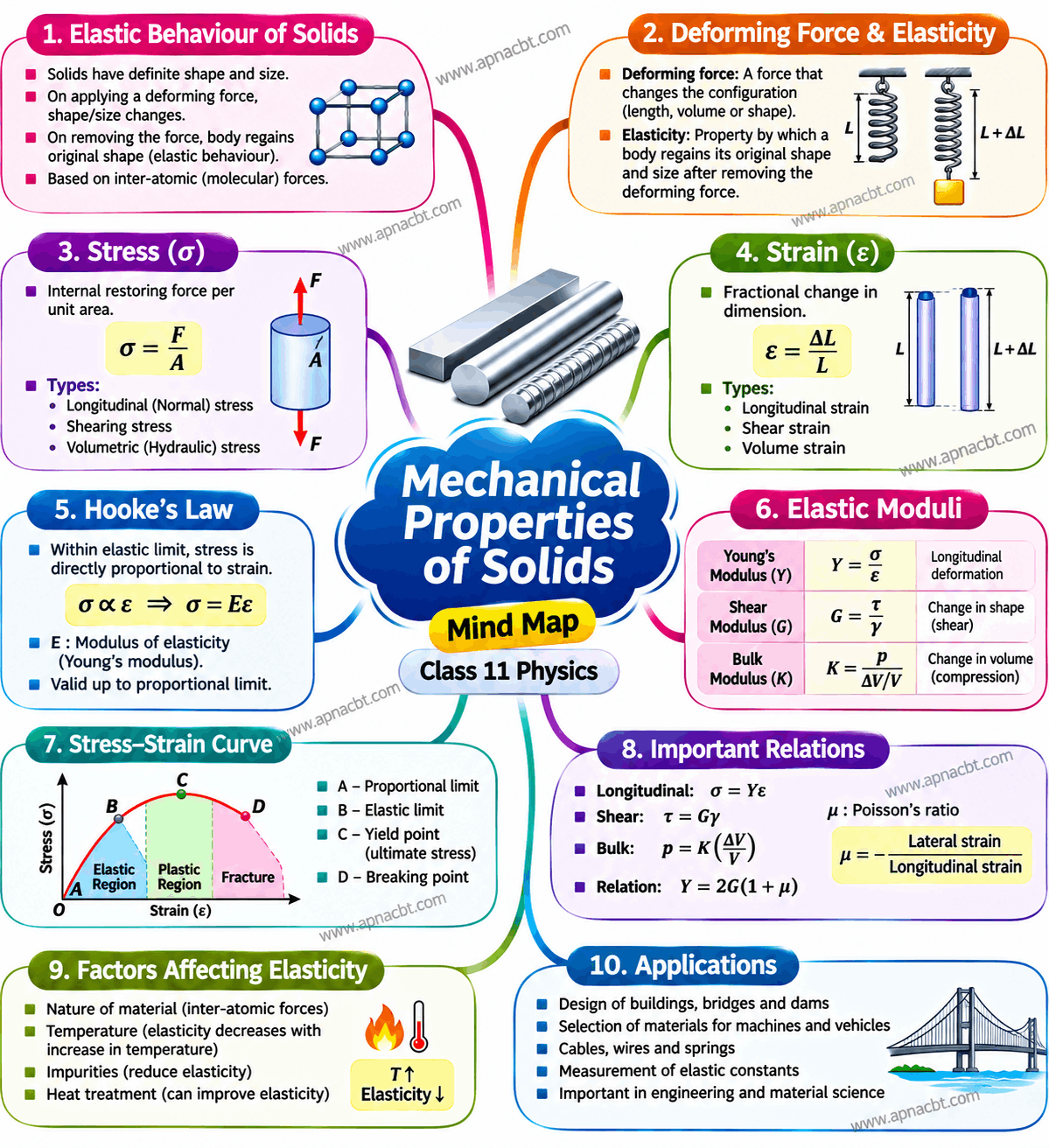
Mechanical Properties of Solids Physics Mind Map
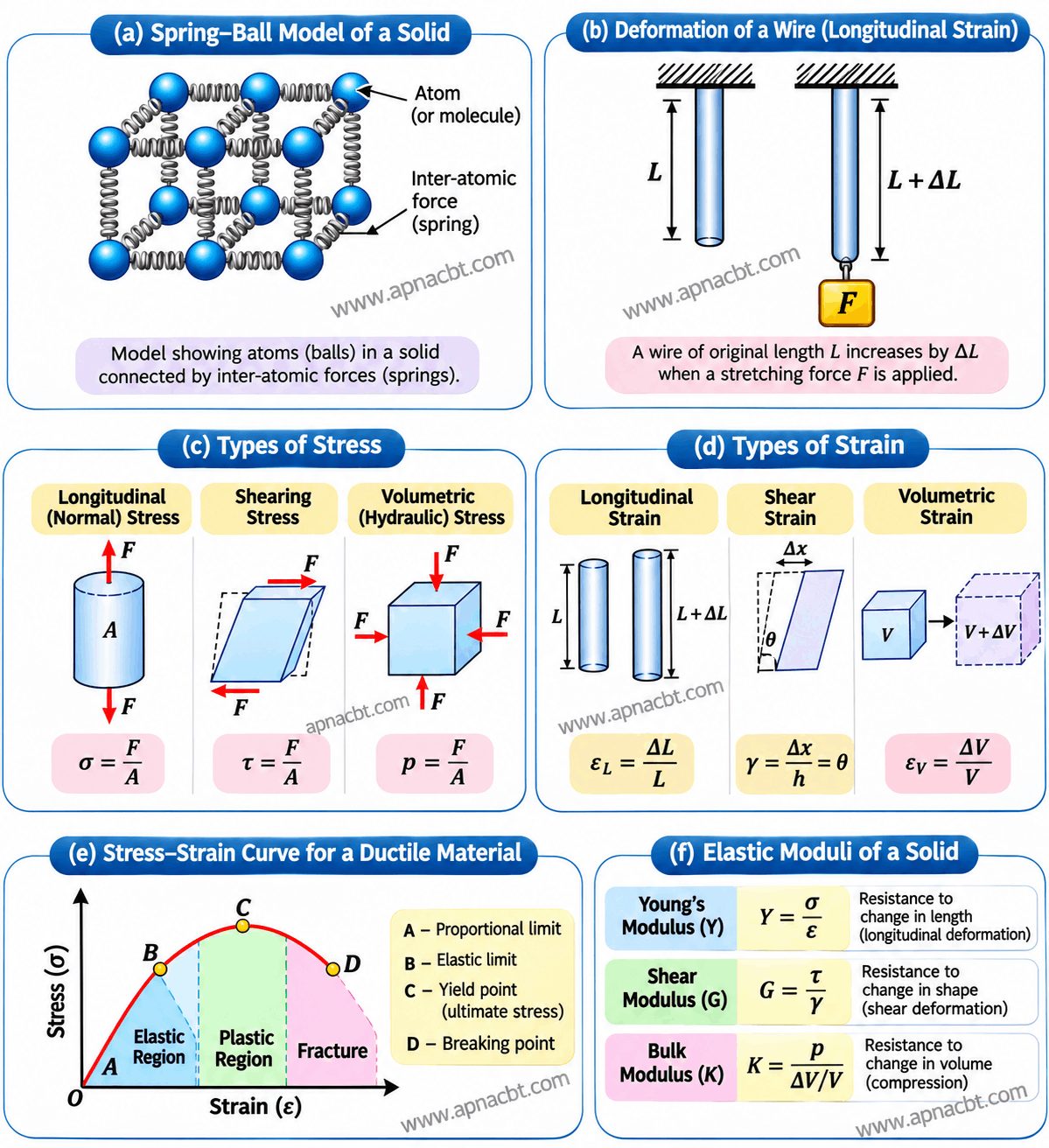
Mechanical Properties of Solids Physics – Important Diagrams
Mechanical Properties of Solids Physics – Important Tables and Formulas