1. Introduction to Motion and Mechanics
Motion
Motion is the change in position of an object with respect to time and a reference point. The study of motion along a straight line is called rectilinear or one-dimensional motion.
Mechanics
Mechanics is the branch of physics that deals with the study of motion of material objects. It is broadly classified into:
- Statics: Study of objects at rest.
- Kinematics: Description of motion without considering the causes of motion.
- Dynamics: Study of the effects of forces that cause or change motion.
Rest and motion are relative
An object is at rest if its position does not change with time with respect to a chosen reference point. It is in motion if its position changes with time with respect to that reference point. A book is at rest relative to a table but moves relative to an observer on the Moon. Therefore, rest and motion are not absolute.
2. Types of Motion, Point Object and Frame of Reference
Types of motion
- Rectilinear motion: Motion of a particle along a straight line.
- Translatory motion: Motion in which every point of a body moves through the same distance in the same interval of time.
- Circular motion: Motion of a particle along a circular path.
- Rotatory motion: Motion in which the particles of a body move in concentric circles about an axis of rotation.
- Oscillatory motion: Repeated to-and-fro motion about a fixed or mean position.
- Vibratory motion: Rapid to-and-fro motion of a body or its parts.
Point object
An object may be treated as a point object when the distance travelled is very large compared with its own dimensions, so that its size can be neglected for describing the motion. A bus travelling between two cities may be treated as a point object. A tumbling bowl falling from a table generally cannot be treated as one.
Frame of reference
A frame of reference is a coordinate system used to specify the position and describe the motion of an object. The Cartesian coordinate system uses coordinates (x, y, z). If all coordinates remain unchanged with time in a chosen frame, the object is at rest in that frame. If no frame is specified, the ground is commonly taken as the reference frame.
Motion in one, two and three dimensions
- One-dimensional: Only one coordinate changes with time; examples include a car on a straight road and a sprinter on a straight track.
- Two-dimensional: Two coordinates change; examples include a boat moving in a river and a projectile moving in a plane.
- Three-dimensional: All three coordinates change; examples include a flying bird, an aeroplane moving freely and random motion of gas molecules.
3. Distance and Displacement
Distance
Distance is the actual length of the path travelled by an object during a given time interval. It is a scalar quantity, has magnitude only, and is never negative. Its SI unit is metre (m).
Displacement
Displacement is the change in position of an object. It is the vector drawn from the initial position to the final position, with direction from initial to final position. It is a vector quantity and may be positive, negative or zero in one-dimensional motion.
Displacement = Final position − Initial position
Distance and displacement: key differences
- Distance is the actual path length; displacement is the shortest directed separation between initial and final positions.
- Distance is scalar; displacement is vector.
- Distance is non-negative; displacement can be positive, negative or zero along a chosen axis.
- Distance depends on the path followed; displacement depends only on initial and final positions.
- For a round trip ending at the starting point, displacement is zero, while distance is generally non-zero.
Important: The magnitude of displacement is always less than or equal to the distance travelled.
Illustration
If a person completes a semicircular path of radius R, the distance travelled is πR and the magnitude of displacement is the diameter, 2R.
4. Speed and Velocity
Speed
Speed is the rate of change of distance with time. It is a scalar quantity.
Average speed = Total distance travelled / Total time taken
Instantaneous speed = ds/dt
Instantaneous speed is the speed of an object at a particular instant. A speedometer measures the instantaneous speed of a vehicle.
Uniform and variable speed
An object has uniform speed if it covers equal distances in equal intervals of time, however small the intervals may be. If it covers unequal distances in equal intervals or equal distances in unequal intervals, its speed is variable or non-uniform.
Velocity
Velocity is the rate of change of displacement with time. It is a vector quantity and has both magnitude and direction.
Average velocity = Total displacement / Total time taken
Instantaneous velocity = dx/dt
Uniform and non-uniform velocity
An object has uniform velocity when it undergoes equal displacements in equal intervals of time in the same direction. A change in magnitude or direction of velocity means the velocity is changing.
Average speed and average velocity
Average speed is based on total distance, whereas average velocity is based on total displacement. Their magnitudes are equal only in suitable motion where distance travelled equals the magnitude of displacement and direction does not reverse.
5. Uniform and Non-uniform Motion
Uniform motion
In uniform motion along a straight line, an object travels equal distances in equal intervals of time and its speed remains constant. For uniform velocity, equal displacements occur in equal time intervals in a fixed direction.
Non-uniform motion
Motion is non-uniform when the object travels with variable speed or its velocity changes with time. A vehicle moving through busy traffic is a common example.
Position-time graph
- The slope of a position-time graph gives velocity.
- A straight line with constant slope represents uniform velocity.
- A horizontal position-time graph represents an object at rest.
- A curved position-time graph indicates changing velocity.
Velocity-time graph
- The slope of a velocity-time graph gives acceleration.
- The area under a velocity-time graph gives displacement.
- A horizontal velocity-time graph represents constant velocity and zero acceleration.
Graph interpretation
For a position-time graph, a steeper slope indicates greater speed when direction is the same. A negative slope indicates negative velocity. For a velocity-time graph, a positive slope indicates positive acceleration and a negative slope indicates negative acceleration.
6. Accelerated Motion
Acceleration
Acceleration is the rate of change of velocity with time. It is a vector quantity. Its SI unit is m s−2.
Average acceleration: aav = (v − u) / (t − t0)
For an interval beginning at t = 0, aav = (v − u) / t.
Instantaneous acceleration: a = dv/dt
Uniform acceleration
An object has uniform acceleration if its velocity changes by equal amounts in equal intervals of time, however small those intervals may be.
Non-uniform acceleration
Acceleration is non-uniform when the velocity changes by unequal amounts in equal intervals of time, or when acceleration itself varies with time.
Positive and negative acceleration
The sign of acceleration depends on the chosen positive direction. Negative acceleration does not always mean slowing down. An object slows down when velocity and acceleration are in opposite directions, and speeds up when they are in the same direction.
Free fall
Free fall is motion under the influence of gravity alone, when air resistance and other forces are neglected. Near Earth’s surface, the magnitude of acceleration due to gravity is represented by g and is approximately 9.8 m s−2. The sign of g depends on the chosen positive direction.
7. Graphical Representation of Accelerated Motion
Velocity-time graph
For uniformly accelerated motion, the velocity-time graph is a straight line. Its slope gives acceleration:
a = (v − u) / t
The area under the velocity-time graph between two instants gives the displacement during that interval.
Position-time graph
For uniform velocity, the position-time graph is a straight line. For constant acceleration, the position-time graph is generally a parabola because position depends quadratically on time.
Acceleration-time graph
The area under an acceleration-time graph gives the change in velocity during the interval. A horizontal acceleration-time graph represents constant acceleration.
Important graph facts
- Slope of x-t graph = velocity.
- Slope of v-t graph = acceleration.
- Area under v-t graph = displacement.
- Area under a-t graph = change in velocity.
When interpreting graphs, observe the sign of the slope and whether the area is above or below the time axis. Signed area is used for displacement and change in velocity.
8. Kinematic Equations for Uniformly Accelerated Motion
For motion in a straight line with constant acceleration, let u be initial velocity, v be final velocity after time t, a be constant acceleration and s be displacement during that time.
First equation of motion
v = u + at
Second equation of motion
s = ut + ½at²
Third equation of motion
v² = u² + 2as
Displacement using average velocity
For constant acceleration, average velocity = (u + v)/2. Therefore:
s = [(u + v)/2]t
Meaning of symbols
- u = initial velocity (m s−1)
- v = final velocity (m s−1)
- a = constant acceleration (m s−2)
- t = time interval (s)
- s = displacement (m)
Conditions for use
These equations apply to one-dimensional motion with constant acceleration. Choose a positive direction first and use consistent signs for displacement, velocity and acceleration. They should not be applied directly when acceleration varies with time.
Equations from calculus
Since a = dv/dt, integration for constant a gives v = u + at. Using v = dx/dt and integrating again gives s = ut + ½at². Eliminating time gives v² = u² + 2as.
9. Motion Under Gravity, Reaction Time and Stopping Distance
Freely falling bodies
For a body moving vertically under gravity alone, the kinematic equations apply with acceleration equal to g or −g according to the selected positive direction.
- If downward is positive: a = +g.
- If upward is positive: a = −g.
For a body released from rest and taking downward as positive: v = gt and h = ½gt². For a body thrown vertically upward, taking upward as positive: v = u − gt and y = ut − ½gt².
At the highest point
For a body thrown vertically upward, its instantaneous velocity becomes zero at the highest point. Its acceleration is still downward and has magnitude g.
Reaction time
Reaction time is the time taken by a person to respond to a stimulus. During the driver’s reaction time, a moving vehicle continues to travel before braking begins.
Stopping distance
Stopping distance is the total distance travelled from the moment a driver notices a need to stop until the vehicle comes to rest. It includes reaction distance and braking distance. It increases with initial speed and depends on braking conditions.
10. Relative Velocity in One-dimensional Motion
Relative velocity
The velocity of one object as observed from another moving object is called relative velocity. For two objects A and B moving along the same straight line:
vAB = vA − vB
Here vAB is the velocity of A relative to B. The result depends on the chosen positive direction.
Same direction
If two objects move in the same direction, their relative speed is the difference between their speeds when both speeds are expressed with the same positive sign.
Opposite directions
If two objects move in opposite directions, their relative speed is the sum of their speed magnitudes.
Meeting and overtaking
For objects moving towards each other, the closing speed is the sum of their speed magnitudes. For objects moving in the same direction, the faster object catches the slower one at a rate equal to the difference in their speeds.
11. Important Formulae and Exam Revision Points
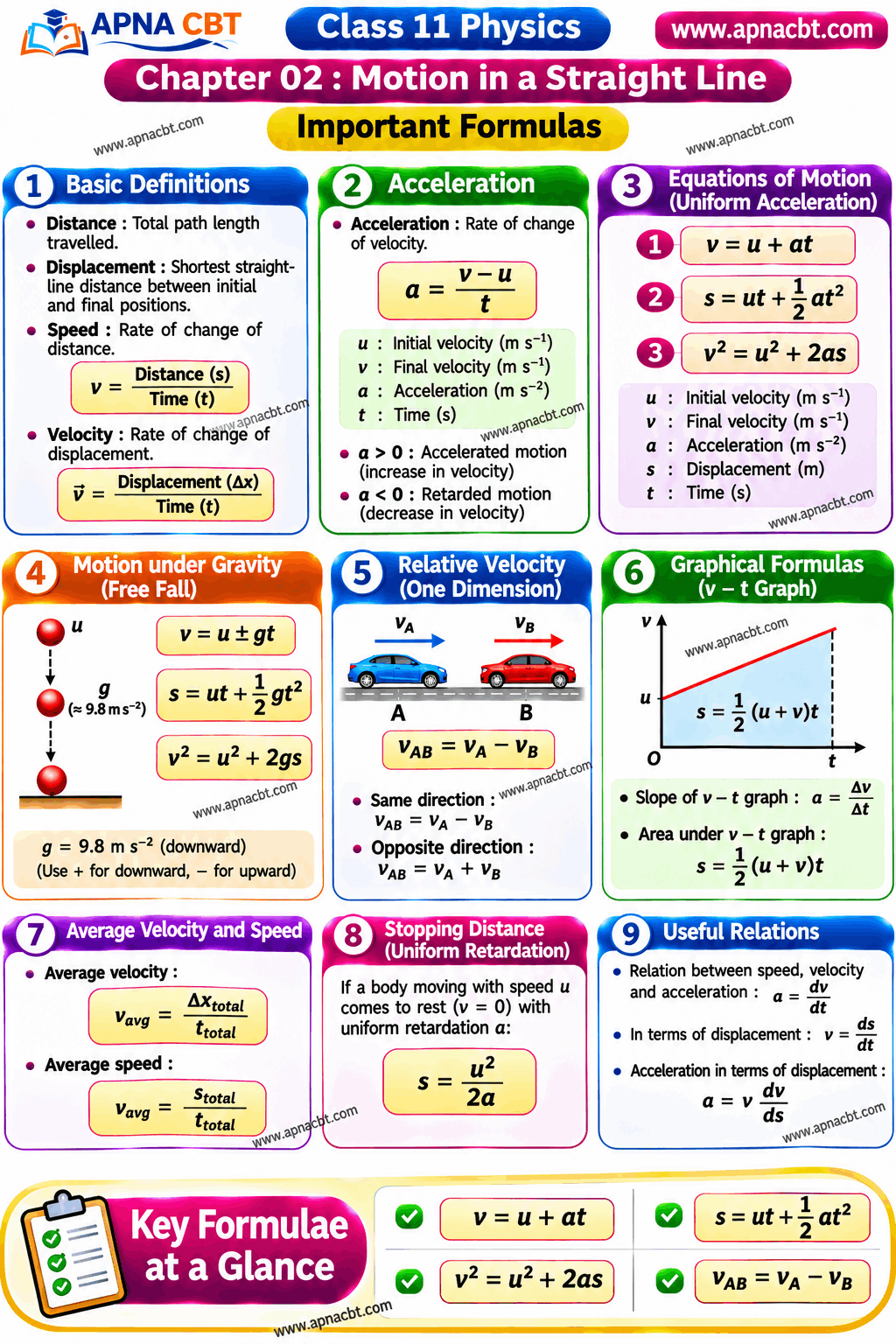
- Displacement: Δx = x2 − x1
- Average speed = total distance / total time
- Average velocity = total displacement / total time
- Instantaneous velocity: v = dx/dt
- Instantaneous speed = magnitude of instantaneous velocity
- Average acceleration: a = (v − u)/t
- Instantaneous acceleration: a = dv/dt
- First equation: v = u + at
- Second equation: s = ut + ½at²
- Third equation: v² = u² + 2as
- Displacement using average velocity: s = [(u + v)/2]t
- Relative velocity: vAB = vA − vB
- Velocity-time graph slope = acceleration
- Velocity-time graph area = displacement
- Acceleration-time graph area = change in velocity
CBSE and NEET preparation focus
Be confident in scalar-vector distinctions, distance-displacement calculations, average speed and average velocity, graph slopes and areas, sign conventions, constant-acceleration equations, free-fall problems and relative velocity. Practise numerical problems with units and a clearly stated positive direction.
12. Short-answer Questions – 30 Questions
Questions
- Define motion.
- What is mechanics? Name its three branches.
- Distinguish between kinematics and dynamics.
- Why are rest and motion called relative terms?
- Define rectilinear motion.
- What is translatory motion?
- Define circular motion and rotatory motion.
- What is oscillatory motion? Give one example.
- When can an object be treated as a point object?
- What is a frame of reference?
- Define one-dimensional motion and give one example.
- What is two-dimensional motion? Give one example.
- Define three-dimensional motion.
- Define distance and state its SI unit.
- Define displacement.
- Why is distance a scalar quantity and displacement a vector quantity?
- Can displacement be zero when distance is not zero? Explain.
- State the relation between distance and magnitude of displacement.
- Define speed and write its SI unit.
- What is instantaneous speed? Name the instrument used to measure it.
- Define velocity.
- Write the expression for average velocity.
- What is uniform velocity?
- Define acceleration and state its SI unit.
- Distinguish between uniform and non-uniform acceleration.
- What does the slope of a position-time graph represent?
- What does the area under a velocity-time graph represent?
- Write the three equations of uniformly accelerated motion.
- What is free fall?
- Define relative velocity in one-dimensional motion.
Answers
- Motion is the change in position of an object with time with respect to a reference point.
- Mechanics is the study of motion of material objects. Its branches are statics, kinematics and dynamics.
- Kinematics describes motion without studying its causes; dynamics studies the effects of forces that cause or change motion.
- The state of an object depends on the observer and the reference frame. The same object may be at rest in one frame and moving in another.
- Rectilinear motion is motion along a straight line.
- Translatory motion is motion in which every point of a body moves through the same distance in the same interval of time.
- Circular motion is motion along a circular path. Rotatory motion is motion of a body about an axis, with its particles moving in concentric circles about that axis.
- Oscillatory motion is repeated to-and-fro motion about a mean position. The motion of a simple pendulum is an example.
- An object can be treated as a point object when its dimensions are negligible compared with the distance involved in the motion.
- A frame of reference is a coordinate system or reference system used to specify an object’s position and describe its motion.
- One-dimensional motion occurs when only one coordinate changes with time; a car moving along a straight road is an example.
- Two-dimensional motion occurs when two coordinates change with time; projectile motion in a plane is an example.
- Three-dimensional motion occurs when all three coordinates specifying position change with time.
- Distance is the actual length of the path travelled. Its SI unit is metre (m).
- Displacement is the change in position, directed from the initial position to the final position.
- Distance has magnitude only and is scalar. Displacement has magnitude and direction and is vector.
- Yes. In a round trip, the final position may be the initial position, making displacement zero even though a non-zero distance was travelled.
- The magnitude of displacement is always less than or equal to the distance travelled.
- Speed is the rate of change of distance with time. Its SI unit is m s⁻¹.
- Instantaneous speed is speed at a particular instant. A speedometer measures it.
- Velocity is the rate of change of displacement with time and has both magnitude and direction.
- Average velocity = total displacement / total time taken.
- Uniform velocity means equal displacements in equal time intervals in the same direction.
- Acceleration is the rate of change of velocity with time. Its SI unit is m s⁻².
- Uniform acceleration means equal changes in velocity in equal time intervals; non-uniform acceleration means the change in velocity per equal interval is not constant.
- The slope of a position-time graph represents velocity.
- The signed area under a velocity-time graph represents displacement.
- v = u + at; s = ut + ½at²; v² = u² + 2as.
- Free fall is motion under gravity alone, neglecting air resistance and other forces.
- Relative velocity of A with respect to B is vAB = vA − vB, using a common positive direction.
13. Long-answer Questions – 15 Questions
Questions
- Explain rest and motion and show why they are relative. Describe the importance of a frame of reference.
- Explain the different types of motion with suitable examples.
- Explain one-dimensional, two-dimensional and three-dimensional motion with examples.
- Define distance and displacement. Compare them with at least four differences.
- Explain speed, average speed and instantaneous speed with their mathematical expressions.
- Explain velocity, average velocity and instantaneous velocity. Distinguish speed from velocity.
- Explain uniform and non-uniform motion. Describe the information obtained from position-time and velocity-time graphs.
- Define acceleration. Explain average and instantaneous acceleration, uniform and non-uniform acceleration.
- Explain how velocity-time and acceleration-time graphs are used to determine acceleration, displacement and change in velocity.
- Derive the three equations of uniformly accelerated motion using the velocity-time graph.
- Obtain the equations of uniformly accelerated motion using calculus.
- Explain the motion of a freely falling body and discuss the sign convention for upward and downward motion.
- Explain vertical upward motion and obtain expressions for time to reach maximum height and maximum height attained.
- Explain reaction time and stopping distance in the context of road safety.
- Define relative velocity and explain the cases of two objects moving in the same and opposite directions.
Detailed Answers
- Rest and motion: An object is at rest if its position does not change with time relative to a chosen reference point. It is in motion if its position changes relative to that point. These descriptions depend on the observer. A suitcase is at rest relative to a train compartment but moves relative to the ground when the train travels. A frame of reference provides the coordinate system used to specify position. Cartesian coordinates (x, y, z) are commonly used. Motion can be described only after selecting a reference frame.
- Types of motion: Rectilinear motion takes place along a straight line. Translatory motion occurs when every point of a body moves through the same distance in the same time interval. Circular motion follows a circular path. In rotatory motion, particles of a body move in concentric circles about an axis. Oscillatory motion is repeated to-and-fro motion about a mean position, as in a pendulum. Vibratory motion is to-and-fro motion of a body or its parts, as in a vibrating string.
- Dimensions of motion: In one-dimensional motion, one coordinate changes with time; a car on a straight road is an example. In two-dimensional motion, two coordinates change and the object moves in a plane; a boat moving across a river or projectile motion illustrates it. In three-dimensional motion, all three coordinates change; a flying bird or random motion of gas molecules provides examples.
- Distance and displacement: Distance is the actual path length and is scalar, whereas displacement is the directed change in position and is vector. Distance depends on the path followed, while displacement depends only on the initial and final positions. Distance cannot be negative and is zero only if no path is travelled. Displacement may be positive, negative or zero in one dimension. Its magnitude cannot exceed distance. In a complete round trip, displacement is zero although distance is non-zero.
- Speed: Speed is distance travelled per unit time. Average speed is total distance divided by total time. Instantaneous speed is the limiting value of average speed as the time interval approaches zero, represented by ds/dt. Speed is scalar and its SI unit is m s⁻¹. A speedometer indicates the instantaneous speed of a vehicle.
- Velocity: Velocity is displacement per unit time. Average velocity equals total displacement divided by total time. Instantaneous velocity is the limiting value of average velocity for a very small time interval and is represented by dx/dt. Velocity is vector, whereas speed is scalar. Speed gives only magnitude; velocity includes direction. The magnitude of average velocity is not greater than average speed.
- Uniform and non-uniform motion: In uniform motion, equal distances are covered in equal intervals of time and speed remains constant. In non-uniform motion, speed changes with time. The slope of a position-time graph gives velocity; a straight line with constant slope indicates uniform velocity. The slope of a velocity-time graph gives acceleration, while its area gives displacement. A horizontal velocity-time graph indicates constant velocity.
- Acceleration: Acceleration is the rate of change of velocity. Average acceleration is change in velocity divided by the time interval, aav = (v − u)/t. Instantaneous acceleration is a = dv/dt. Its SI unit is m s⁻². Uniform acceleration produces equal changes in velocity in equal time intervals. Non-uniform acceleration varies with time. The sign of acceleration depends on the selected axis; an object slows down when acceleration and velocity are in opposite directions.
- Motion graphs: The slope of a velocity-time graph is acceleration. For constant acceleration, the graph is a straight line. The signed area under the velocity-time graph gives displacement. The area under an acceleration-time graph gives change in velocity. A position-time graph’s slope gives velocity. These graph properties allow motion to be analysed even when a complete algebraic expression is not supplied.
- Equations from velocity-time graph: For constant acceleration, the graph is a straight line. Its slope gives a = (v − u)/t, hence v = u + at. The displacement equals the area under the graph. The area of the trapezium is s = ½(u + v)t. Substituting v = u + at gives s = ut + ½at². Since s = ½(u + v)t and t = (v − u)/a, eliminating t gives v² − u² = 2as, or v² = u² + 2as.
- Equations using calculus: Acceleration a = dv/dt. For constant a, integrating from initial velocity u at t = 0 to velocity v at time t gives v − u = at, so v = u + at. Since v = dx/dt, integrate dx/dt = u + at to obtain displacement s = ut + ½at². Eliminating t between the first two equations gives v² = u² + 2as.
- Free fall and sign convention: A freely falling body moves under gravity alone when air resistance is neglected. Near Earth’s surface, acceleration has magnitude g ≈ 9.8 m s⁻² and acts downward. If downward is chosen positive, a = +g; if upward is chosen positive, a = −g. For a body released from rest with downward positive, v = gt and h = ½gt². The same physical motion can be described using either convention if signs are applied consistently.
- Vertical upward motion: Choose upward as positive. The acceleration is −g. The velocity after time t is v = u − gt. At maximum height, v = 0, so time to reach the highest point is t = u/g. Using v² = u² − 2gH and v = 0 gives maximum height H = u²/(2g). If the body returns to the launch level and air resistance is neglected, the time of ascent equals the time of descent, and total time of flight is 2u/g.
- Reaction time and stopping distance: Reaction time is the interval between noticing a hazard and beginning a response. A vehicle continues moving during this interval, covering reaction distance. After braking begins, it covers braking distance before stopping. Stopping distance is the sum of reaction distance and braking distance. Higher initial speed increases stopping distance; road condition, tyres, brakes and vehicle load also influence it. Maintaining safe distance and avoiding distraction reduce road risk.
- Relative velocity: Relative velocity is the velocity of one object as measured from another. Along a straight line, vAB = vA − vB. If both objects move in the same direction, relative speed is the difference of their speed magnitudes. If they move in opposite directions, relative speed is the sum of their speed magnitudes. For two objects approaching each other, the closing speed is the sum; for overtaking in the same direction, the closing speed is the difference. Signs must be assigned using one common positive direction.
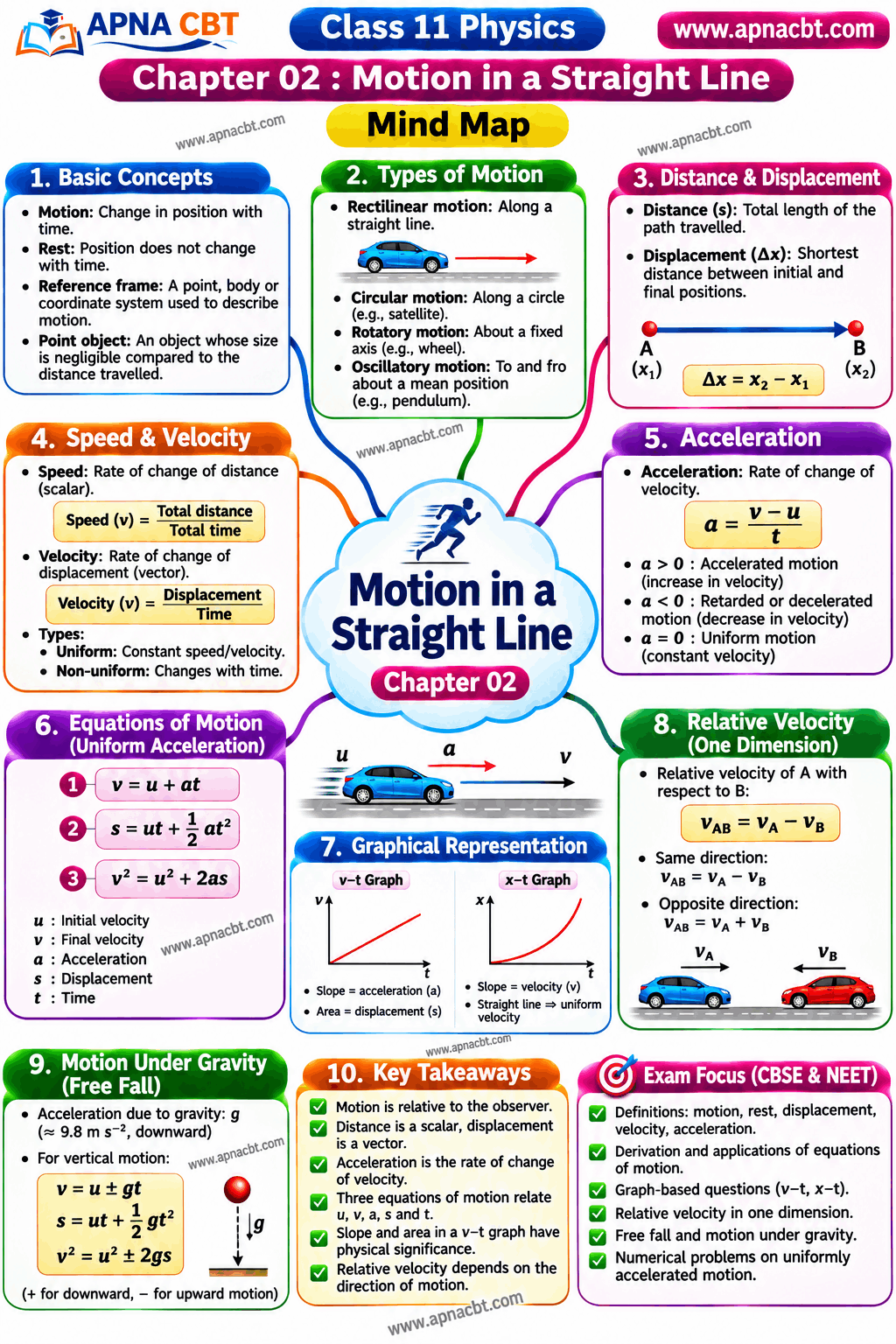
Motion in a Straight Line Class 11 Physics Mind Map
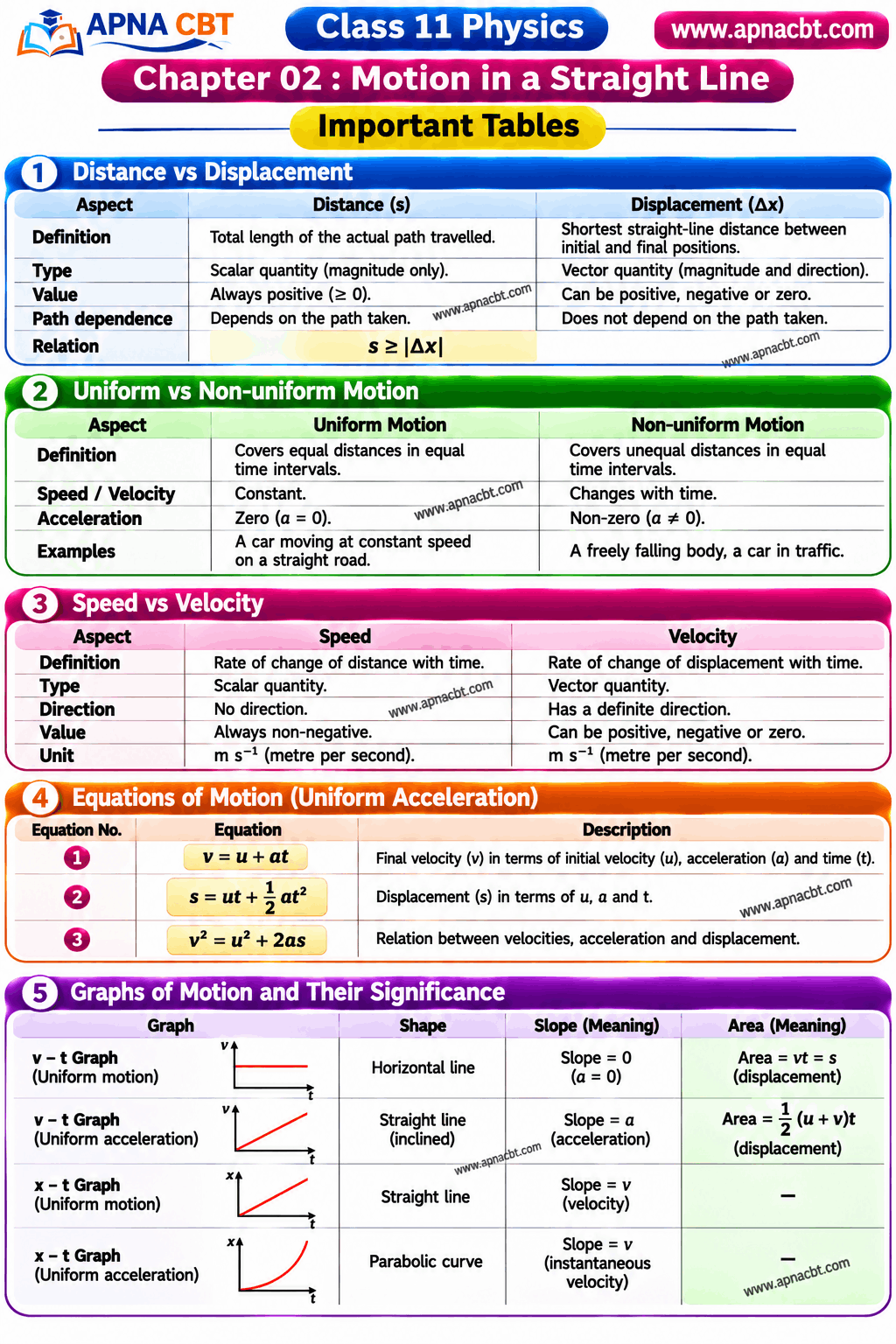
Motion in a Straight Line Class 11 Physics – Important Tables for Quick Revision
Motion in a Straight Line Class 11 Physics – Important Diagrams and Graphs
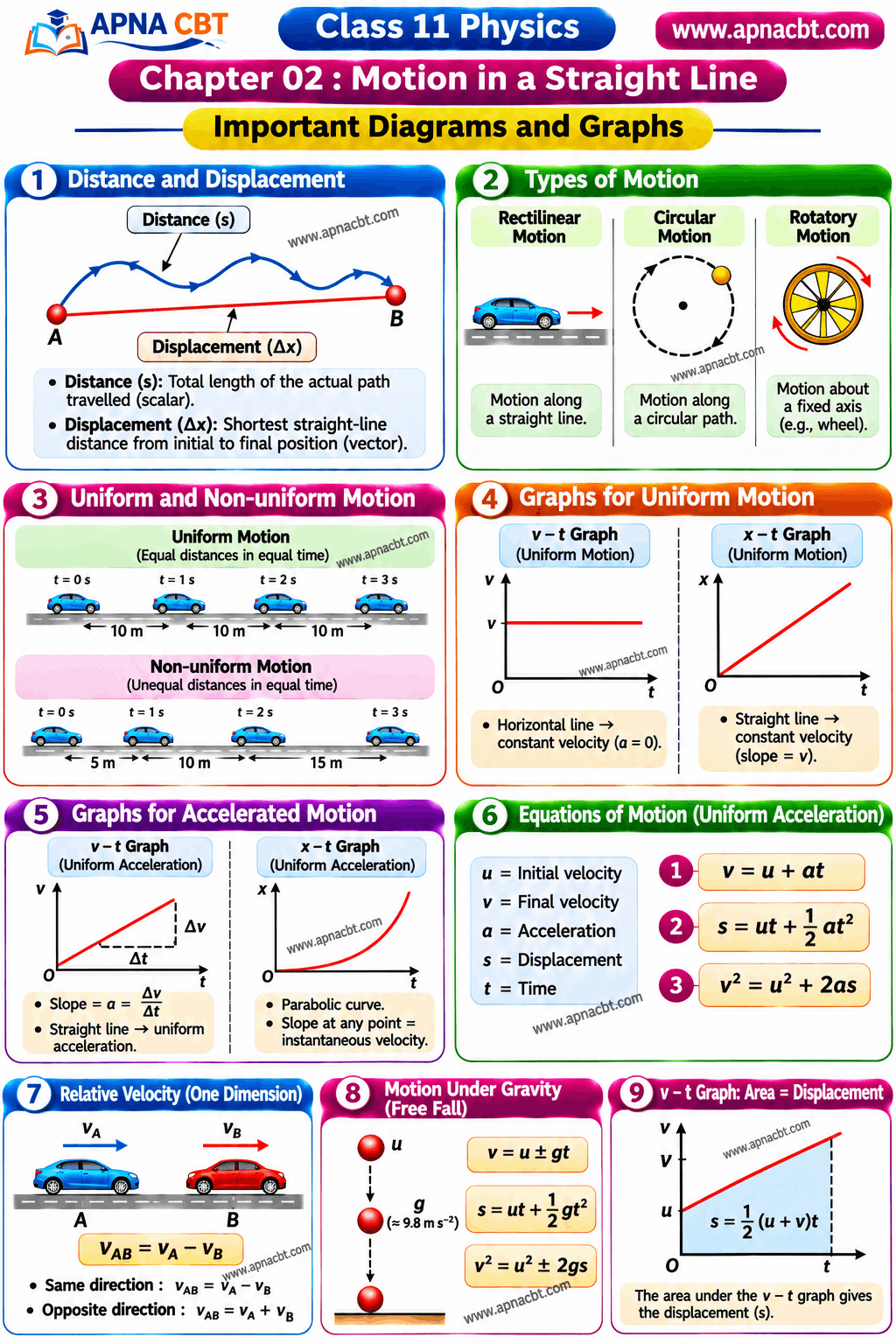
Motion in a Straight Line Class 11 Physics – Important Formulas and Equations