Chapter 03: Motion in a Plane
Class 11 Physics | CBSE Board Examination | NEET-UG Preparation
This lesson is organised around the important concepts, definitions, vector operations, equations and applications covered in the supplied chapter material. Use the numbered sections for focused study and revision.
1. Introduction to Motion in a Plane
In one-dimensional motion, an object’s direction can be described using positive and negative signs. In two-dimensional motion (a plane) and three-dimensional motion (space), an object can move in many directions. Vector quantities, which have both magnitude and direction, are therefore required to describe such motion.
This chapter develops scalar and vector quantities, vector operations, motion in a plane with constant acceleration, projectile motion, relative velocity in two dimensions and uniform circular motion.
Chapter learning focus
- Distinguish scalar and vector quantities.
- Represent, add, subtract and resolve vectors.
- Use rectangular components to describe motion in a plane.
- Apply vector kinematics to projectile motion.
- Describe angular motion and centripetal acceleration in circular motion.
2. Scalars, Vectors and Types of Vectors
Scalar quantities
Physical quantities having magnitude only and no direction are scalars. A scalar is specified by a number and its appropriate unit. Examples given in the lesson include mass, volume, density, time, temperature and electric current.
Vector quantities
Physical quantities having both magnitude and direction are vectors. Examples include displacement, velocity, force and momentum.
| Scalars | Vectors |
|---|---|
| Have magnitude only. | Have magnitude and direction. |
| Change when magnitude changes. | Change when magnitude or direction changes. |
| Added by ordinary algebraic laws. | Added using vector-addition laws. |
Representation
A vector is represented by a directed line segment. Its length represents magnitude and its arrowhead represents direction. The initial point is the tail and the terminal point is the head.
Polar and axial vectors
- Polar vectors: Have a point of application and act along a direction; examples are displacement, velocity and force.
- Axial vectors: Represent rotational effects and act along the axis of rotation according to the right-hand screw rule; examples are angular velocity, torque and angular momentum.
Other vector types
- Fixed/localised vector: Its initial point is fixed.
- Free/non-localised vector: Its initial point is not fixed.
- Unit vector: Has magnitude one and indicates direction only. For vector A, its unit vector is  = A/|A|.
- Equal vectors: Have equal magnitudes and the same direction.
- Negative vector: Has the same magnitude as the original vector but the opposite direction.
- Co-initial vectors: Have the same initial point.
- Collinear vectors: Act along the same or parallel lines.
- Zero/null vector: Has zero magnitude and no definite direction.
Scalar multiplication: Multiplication of vector A by a positive real number changes its magnitude but not its direction. Multiplication by a negative real number reverses its direction. Thus, 2A is along A, while −A is opposite to A.
3. Addition and Subtraction of Vectors
Resultant vector
The resultant of two or more vectors is the single vector that produces the same effect as the vectors acting together. For vectors A and B, R = A + B.
Triangle law of vector addition
If two vectors are represented in magnitude and direction by two sides of a triangle taken in the same order, their resultant is represented by the third side taken in the opposite order. Place the tail of the second vector at the head of the first; the resultant joins the tail of the first to the head of the second.
Parallelogram law
If two vectors acting at a point are represented by the two adjacent sides of a parallelogram, their resultant is represented by the diagonal through the common initial point.
For magnitudes A and B with angle θ between them:
Magnitude: R = √(A² + B² + 2AB cos θ)
Direction relative to A: tan β = B sin θ / (A + B cos θ)
Special cases
- Same direction (θ = 0°): R = A + B.
- Opposite directions (θ = 180°): R = |A − B|.
- Perpendicular vectors (θ = 90°): R = √(A² + B²).
Properties of vector addition
- Only vectors of the same physical nature can be added.
- Commutative law: A + B = B + A.
- Associative law: (A + B) + C = A + (B + C).
Subtraction
Subtraction of B from A is addition of the negative vector: A − B = A + (−B). Reverse the direction of B, then add it to A.
4. Resolution of Vectors and Rectangular Components
Resolution is the process of splitting a vector into two or more component vectors that together produce the same effect as the original vector. Components along mutually perpendicular directions are called rectangular components.
Two-dimensional components
For a vector A making angle θ with the positive x-axis:
- Horizontal component: Ax = A cos θ
- Vertical component: Ay = A sin θ
- Vector form: A = Ax î + Ay ĵ
- Magnitude: A = √(Ax² + Ay²)
- Direction: tan θ = Ay/Ax
Here î and ĵ are unit vectors along the x- and y-axes.
Three-dimensional components
A vector in three dimensions can be written as A = Ax î + Ay ĵ + Az k̂, and its magnitude is √(Ax² + Ay² + Az²).
Applications illustrated in the lesson
- Pedalling a bicycle: The applied force on the pedal can be resolved into components along and perpendicular to the crank. The component perpendicular to the crank produces the turning effect.
- Walking: The force exerted by the foot on the ground and the ground’s reaction can be understood through horizontal and vertical components.
Important point: A vector may have many possible component resolutions, but its rectangular components along three mutually perpendicular axes are uniquely specified.
5. Scalar Product (Dot Product) of Two Vectors
The scalar product of vectors A and B is a scalar defined by A · B = AB cos θ, where θ is the angle between the vectors.
Meaning
A · B is the magnitude of one vector multiplied by the component of the other vector along it. It has no direction.
Important results
- A · B = B · A (commutative).
- A · A = A².
- For perpendicular vectors, A · B = 0.
- For parallel vectors in the same direction, A · B = AB.
- For antiparallel vectors, A · B = −AB.
Unit-vector relations
î · î = ĵ · ĵ = k̂ · k̂ = 1; and î · ĵ = ĵ · k̂ = k̂ · î = 0.
Cartesian form
If A = Axî + Ayĵ + Azk̂ and B = Bxî + Byĵ + Bzk̂, then A · B = AxBx + AyBy + AzBz.
Applications included in the lesson
- Work done by a constant force: W = F · s.
- Instantaneous power: P = F · v.
6. Vector Product (Cross Product) of Two Vectors
The vector product of A and B is a vector whose magnitude is AB sin θ and whose direction is perpendicular to the plane containing A and B, determined by the right-hand rule.
Magnitude: |A × B| = AB sin θ.
Important properties
- A × B = −(B × A) (anti-commutative).
- A × A = 0.
- For parallel or antiparallel vectors, A × B = 0.
- For perpendicular vectors, |A × B| = AB.
Unit-vector relations
î × ĵ = k̂; ĵ × k̂ = î; k̂ × î = ĵ. Reversing the order changes the sign.
Cartesian form
A × B = (AyBz − AzBy)î + (AzBx − AxBz)ĵ + (AxBy − AyBx)k̂.
Applications
- Torque: τ = r × F.
- Angular momentum: L = r × p.
- Area of a parallelogram formed by A and B: |A × B|.
- Area of the triangle formed by A and B: ½|A × B|.
7. Position, Displacement and Velocity in a Plane
Position vector
The position vector specifies the position of a particle relative to the origin. For a point (x, y), r = x î + y ĵ. In three dimensions, r = x î + y ĵ + z k̂.
Displacement vector
Displacement is the change in position and is independent of the path followed. If the initial and final position vectors are r1 and r2, then Δr = r2 − r1. In two dimensions, Δr = (x2 − x1)î + (y2 − y1)ĵ.
|Δr| = √[(Δx)² + (Δy)²]. The magnitude of displacement is less than or equal to the path length.
Average velocity
Average velocity is displacement divided by the corresponding time interval: vav = Δr/Δt. Its components are vx = Δx/Δt and vy = Δy/Δt.
Magnitude: |vav| = √(vx² + vy²); direction is given by tan θ = vy/vx.
Instantaneous velocity
Instantaneous velocity is the limiting value of average velocity as the time interval approaches zero: v = limΔt→0(Δr/Δt) = dr/dt. It is tangent to the trajectory at the instant considered.
8. Acceleration and Motion with Constant Acceleration in a Plane
Average and instantaneous acceleration
Average acceleration is the change in velocity divided by the time interval: aav = Δv/Δt. Instantaneous acceleration is a = dv/dt.
Acceleration is a vector. In two dimensions, a = axî + ayĵ.
Constant acceleration equations
For initial velocity v0 and constant acceleration a:
- Velocity: v = v0 + at.
- Position: r = r0 + v0t + ½at².
In rectangular components:
- vx = v0x + axt; vy = v0y + ayt.
- x = x0 + v0xt + ½axt².
- y = y0 + v0yt + ½ayt².
The equations are applied separately along perpendicular axes. For projectile motion near Earth’s surface, horizontal acceleration is zero and vertical acceleration is due to gravity.
9. Relative Velocity in Two Dimensions
Relative velocity describes the velocity of one object as observed from another moving object. The relative velocity of A with respect to B is the vector difference between their velocities:
vAB = vA − vB.
In component form, vAB,x = vAx − vBx and vAB,y = vAy − vBy.
The magnitude is √[(vAx − vBx)² + (vAy − vBy)²]. The direction follows from the ratio of the y- and x-components.
Relative velocity is a vector quantity; both magnitude and direction matter. If two objects move with equal velocity vectors, their relative velocity is zero.
10. Projectile Motion: Basic Concepts and Trajectory
A projectile is an object projected into the air that subsequently moves under the influence of gravity, neglecting air resistance. Its motion is analysed by resolving the initial velocity into horizontal and vertical components.
Projection at an angle θ
If the initial speed is u:
- Horizontal component: ux = u cos θ.
- Vertical component: uy = u sin θ.
- Horizontal acceleration: ax = 0.
- Vertical acceleration: ay = −g (taking upward as positive).
Horizontal motion is uniform, while vertical motion is uniformly accelerated under gravity. The combination produces a parabolic trajectory for projection and landing at the same level.
Velocity at time t
vx = u cos θ; vy = u sin θ − gt.
Position at time t
x = (u cos θ)t; y = (u sin θ)t − ½gt².
Eliminating time gives the parabolic trajectory: y = x tan θ − [g x²/(2u² cos² θ)].
11. Projectile Motion: Time of Flight, Maximum Height and Range
For a projectile projected with speed u at angle θ and landing at the same horizontal level:
- Time of flight: T = 2u sin θ/g.
- Time to reach maximum height: tm = u sin θ/g.
- Maximum height: H = u² sin² θ/(2g).
- Horizontal range: R = u² sin 2θ/g.
At maximum height, the vertical component of velocity is zero, but the horizontal component remains u cos θ.
Important range results
- For a given initial speed, the range is maximum at θ = 45° (same-level projection).
- Complementary angles θ and (90° − θ) give equal horizontal ranges for the same initial speed.
- Maximum range on the same horizontal level is u²/g.
Projectile fired horizontally from a height
For horizontal projection with speed u from height h:
- Time to reach the ground: t = √(2h/g).
- Horizontal range: R = ut = u√(2h/g).
- Horizontal velocity remains u; vertical velocity at time t is gt downward.
Scope: The formulas for time of flight, maximum height and range above assume the projectile returns to its launch level and air resistance is neglected.
12. Uniform Circular Motion and Angular Quantities
Uniform circular motion is motion along a circular path with constant speed. Although the speed is constant, velocity changes continuously because its direction changes.
Angular displacement and angular velocity
- Angular displacement θ is the angle turned through by the radius vector.
- Angular velocity: ω = dθ/dt; for uniform circular motion, ω = 2π/T = 2πf.
- Linear speed: v = rω.
Time period and frequency
Time period T is the time taken for one revolution. Frequency f is the number of revolutions per unit time. T = 1/f.
Angular acceleration and linear acceleration
Angular acceleration α = dω/dt. Tangential acceleration is at = rα, and in vector form at = α × r as presented in the lesson.
Centripetal acceleration
In uniform circular motion, acceleration is directed radially inward, towards the centre:
- ac = v²/r.
- ac = rω².
A centripetal force is necessary to maintain circular motion. Without it, an object cannot continue along the circular path.
13. Tangential and Radial Acceleration; Formula Revision
For motion along a curved path, acceleration can have two mutually perpendicular components:
- Tangential acceleration: Changes the magnitude of velocity; at = d|v|/dt.
- Radial (centripetal) acceleration: Changes the direction of velocity; ar = v²/r.
The resultant acceleration magnitude is a = √(at² + ar²), since the components are perpendicular.
Quick formula sheet
| Concept | Formula |
|---|---|
| Unit vector | Â = A/|A| |
| Resultant of two vectors | R = √(A² + B² + 2AB cos θ) |
| Rectangular components | Ax = A cos θ; Ay = A sin θ |
| Dot product | A · B = AB cos θ |
| Cross product magnitude | |A × B| = AB sin θ |
| Displacement | Δr = r2 − r1 |
| Average velocity | vav = Δr/Δt |
| Instantaneous velocity | v = dr/dt |
| Acceleration | a = dv/dt |
| Relative velocity | vAB = vA − vB |
| Projectile time of flight | T = 2u sin θ/g |
| Projectile maximum height | H = u² sin² θ/(2g) |
| Projectile range | R = u² sin 2θ/g |
| Linear and angular speed | v = rω |
| Centripetal acceleration | ac = v²/r = rω² |
14. Short-answer Questions – 30 Questions
Questions
- What is a scalar quantity?
- What is a vector quantity?
- How is a vector represented?
- Define a unit vector.
- What are polar vectors? Give examples.
- What are axial vectors? Give examples.
- What are equal vectors?
- What is a zero vector?
- State the triangle law of vector addition.
- Write the parallelogram law expression for resultant magnitude.
- What is vector subtraction?
- What is resolution of a vector?
- Write the rectangular components of a vector A at angle θ to x-axis.
- Define scalar product.
- When is the dot product of two vectors zero?
- Define vector product.
- What is the cross product of two parallel vectors?
- Define position vector.
- Write the position vector of a point (x, y).
- Define displacement vector.
- Define average velocity.
- Write the expression for instantaneous velocity.
- Define acceleration.
- Write the relative velocity of A with respect to B.
- What is projectile motion?
- What is the horizontal acceleration of an ideal projectile?
- Write the time-of-flight formula for a projectile returning to its launch level.
- At what angle is the horizontal range maximum for same-level projection?
- Define uniform circular motion.
- Write the expression for centripetal acceleration.
Answers
- What is a scalar quantity?
A physical quantity having magnitude only and no direction; examples include mass, time and temperature. - What is a vector quantity?
A physical quantity having both magnitude and direction; examples include displacement, velocity and force. - How is a vector represented?
By a directed line segment; its length represents magnitude and its arrowhead represents direction. - Define a unit vector.
A vector of magnitude one that indicates the direction of a given vector; Â = A/|A|. - What are polar vectors? Give examples.
Vectors with a point of application and direction of action, such as displacement, velocity and force. - What are axial vectors? Give examples.
Vectors representing rotational effects and directed along the axis of rotation, such as angular velocity, torque and angular momentum. - What are equal vectors?
Vectors having the same magnitude and the same direction. - What is a zero vector?
A vector whose magnitude is zero; it is also called a null vector. - State the triangle law of vector addition.
If two vectors are represented by two sides of a triangle taken in the same order, the third side taken in the opposite order represents their resultant. - Write the parallelogram law expression for resultant magnitude.
R = √(A² + B² + 2AB cos θ), where θ is the angle between the vectors. - What is vector subtraction?
Subtraction of B from A is addition of the negative of B: A − B = A + (−B). - What is resolution of a vector?
The process of splitting a vector into component vectors that together have the same effect as the original vector. - Write the rectangular components of a vector A at angle θ to x-axis.
Aₓ = A cos θ and Aᵧ = A sin θ. - Define scalar product.
The dot product A · B = AB cos θ; its result is a scalar. - When is the dot product of two vectors zero?
When the vectors are perpendicular, because cos 90° = 0. - Define vector product.
The cross product A × B has magnitude AB sin θ and direction perpendicular to the plane containing the vectors. - What is the cross product of two parallel vectors?
Zero, because sin 0° = 0 (or sin 180° = 0). - Define position vector.
The vector drawn from the origin to the position of a particle. - Write the position vector of a point (x, y).
r = x î + y ĵ. - Define displacement vector.
The change in position vector: Δr = r₂ − r₁; it is independent of the path followed. - Define average velocity.
Displacement divided by the corresponding time interval: vₐᵥ = Δr/Δt. - Write the expression for instantaneous velocity.
v = lim(Δt→0) Δr/Δt = dr/dt. - Define acceleration.
The rate of change of velocity with time; instantaneous acceleration is a = dv/dt. - Write the relative velocity of A with respect to B.
vAB = vA − vB. - What is projectile motion?
The motion of an object projected into the air and thereafter moving under gravity, neglecting air resistance. - What is the horizontal acceleration of an ideal projectile?
Zero, when air resistance is neglected. - Write the time-of-flight formula for a projectile returning to its launch level.
T = 2u sin θ/g. - At what angle is the horizontal range maximum for same-level projection?
At 45°, for a given initial speed. - Define uniform circular motion.
Motion along a circular path with constant speed. - Write the expression for centripetal acceleration.
a꜀ = v²/r = rω², directed towards the centre of the circular path.
15. Long-answer Questions – 15 Questions
Questions
- Explain scalars and vectors and distinguish between them.
- Explain the representation and classification of vectors.
- State and explain the triangle law and parallelogram law of vector addition.
- Derive the magnitude and direction of the resultant of two vectors.
- Explain resolution of a vector into rectangular components.
- Define scalar product and discuss its properties and applications.
- Define vector product and discuss its properties and applications.
- Explain position and displacement vectors in two dimensions.
- Explain average and instantaneous velocity in a plane.
- Explain motion in a plane with constant acceleration and obtain the component equations.
- Explain relative velocity in two dimensions.
- Explain projectile motion and show why its trajectory is parabolic.
- Derive the time of flight, maximum height and horizontal range of a projectile.
- Describe a projectile projected horizontally from a height.
- Explain uniform circular motion and derive centripetal acceleration.
Detailed Answers
- Explain scalars and vectors and distinguish between them.
Scalars have magnitude only and are specified by a number and unit; examples include mass, volume, density, time, temperature and electric current. Vectors have both magnitude and direction; examples include displacement, velocity, force and momentum. Scalars are added by ordinary algebraic laws, whereas vectors require vector-addition laws. A vector changes if its magnitude or direction changes; a scalar changes when its magnitude changes. - Explain the representation and classification of vectors.
A vector is represented by a directed line segment. Its length indicates magnitude and the arrowhead indicates direction. Polar vectors include displacement, velocity and force. Axial vectors represent rotational effects and follow the right-hand screw rule; examples are angular velocity, torque and angular momentum. Vectors may also be fixed or free, equal, negative, unit, co-initial, collinear or zero vectors according to their defining properties. - State and explain the triangle law and parallelogram law of vector addition.
Triangle law: place the tail of the second vector at the head of the first; the vector joining the tail of the first to the head of the second is the resultant. Parallelogram law: represent two vectors from a common point by adjacent sides of a parallelogram; the diagonal through the common point gives the resultant. For magnitudes A and B with included angle θ, R = √(A² + B² + 2AB cos θ), and tan β = B sin θ/(A + B cos θ). - Derive the magnitude and direction of the resultant of two vectors.
Resolve vector B into components parallel and perpendicular to A. The parallel component is B cos θ and the perpendicular component is B sin θ. The resultant components are Rₓ = A + B cos θ and Rᵧ = B sin θ. By Pythagoras, R² = (A + B cos θ)² + (B sin θ)² = A² + B² + 2AB cos θ. Hence R = √(A² + B² + 2AB cos θ), and tan β = Rᵧ/Rₓ = B sin θ/(A + B cos θ). - Explain resolution of a vector into rectangular components.
Resolution splits a vector into components along selected directions. For a vector A making angle θ with the positive x-axis, the horizontal component is Aₓ = A cos θ and the vertical component is Aᵧ = A sin θ. In vector notation A = Aₓ î + Aᵧ ĵ. Its magnitude is √(Aₓ² + Aᵧ²) and its direction is given by tan θ = Aᵧ/Aₓ. In three dimensions, A = Aₓ î + Aᵧ ĵ + A_z k̂. - Define scalar product and discuss its properties and applications.
The scalar product is A · B = AB cos θ. It is a scalar and is commutative: A · B = B · A. A · A = A²; the dot product is zero for perpendicular vectors, positive for an acute angle and negative for an obtuse angle. In Cartesian form it is AₓBₓ + AᵧBᵧ + A_zB_z. Applications in the lesson include work W = F · s and instantaneous power P = F · v. - Define vector product and discuss its properties and applications.
The vector product A × B has magnitude AB sin θ and direction perpendicular to the plane containing A and B, given by the right-hand rule. It is anti-commutative: A × B = −B × A; A × A = 0; and the product is zero for parallel vectors. Unit-vector relations include î × ĵ = k̂, ĵ × k̂ = î and k̂ × î = ĵ. Applications include torque τ = r × F, angular momentum L = r × p and area of a parallelogram |A × B|. - Explain position and displacement vectors in two dimensions.
For a particle at coordinates (x, y), the position vector is r = x î + y ĵ. If it moves to (x′, y′), the new position vector is r′ = x′î + y′ĵ. The displacement is Δr = r′ − r = (x′ − x)î + (y′ − y)ĵ. Its magnitude is √[(x′ − x)² + (y′ − y)²]. Displacement joins initial and final positions and does not depend on the path; its magnitude cannot exceed the path length. - Explain average and instantaneous velocity in a plane.
Average velocity is the displacement divided by the time interval: vₐᵥ = Δr/Δt. Its components are vₓ = Δx/Δt and vᵧ = Δy/Δt, with magnitude √(vₓ² + vᵧ²). Instantaneous velocity is the limiting value as Δt tends to zero: v = dr/dt. It is tangent to the trajectory at the instant considered. - Explain motion in a plane with constant acceleration and obtain the component equations.
For constant acceleration a, v − v₀ = at, so v = v₀ + at. The displacement equals average velocity multiplied by time: r − r₀ = [(v₀ + v)/2]t = v₀t + ½at². Thus r = r₀ + v₀t + ½at². Along x and y axes: vₓ = v₀ₓ + aₓt; vᵧ = v₀ᵧ + aᵧt; x = x₀ + v₀ₓt + ½aₓt²; y = y₀ + v₀ᵧt + ½aᵧt². - Explain relative velocity in two dimensions.
The velocity of A relative to B is the vector difference vAB = vA − vB. Its components are vAB,x = vAx − vBx and vAB,y = vAy − vBy. Its magnitude is √[(vAx − vBx)² + (vAy − vBy)²]. The direction is obtained from the component ratio. Since velocity is a vector, relative velocity depends on both the magnitudes and directions of the two velocities. - Explain projectile motion and show why its trajectory is parabolic.
A projectile moves under gravity after projection, neglecting air resistance. For initial speed u at angle θ, uₓ = u cos θ and uᵧ = u sin θ. Horizontal acceleration is zero and vertical acceleration is −g. At time t, x = u cos θ·t and y = u sin θ·t − ½gt². From x, t = x/(u cos θ). Substitution gives y = x tan θ − gx²/(2u²cos²θ), which is a quadratic equation in x; hence the trajectory is a parabola. - Derive the time of flight, maximum height and horizontal range of a projectile.
For a projectile returning to its launch level, vertical displacement after time T is zero: 0 = u sin θ·T − ½gT². The non-zero solution gives T = 2u sin θ/g. At maximum height vertical velocity is zero: 0 = u sin θ − gtₘ, so tₘ = u sin θ/g. Substituting into vertical displacement gives H = u²sin²θ/(2g). Horizontal range is horizontal speed multiplied by time: R = u cos θ·T = u²sin2θ/g. - Describe a projectile projected horizontally from a height.
For horizontal projection with speed u from height h, initial vertical velocity is zero. Vertical motion gives h = ½gt², so time to reach the ground is t = √(2h/g). Horizontal motion is uniform, so range R = ut = u√(2h/g). At impact, horizontal velocity remains u and vertical velocity has magnitude gt downward. The horizontal and vertical motions are treated independently. - Explain uniform circular motion and derive centripetal acceleration.
In uniform circular motion, speed is constant but velocity direction changes continuously. The velocity at each point is tangential to the circle. For a small angular displacement Δθ, the change in velocity satisfies Δv/v = Δs/r. Dividing by Δt and taking the limit gives a = v(1/r)(ds/dt) = v²/r, directed towards the centre. Since v = rω, a꜀ = rω². This inward acceleration is centripetal acceleration.
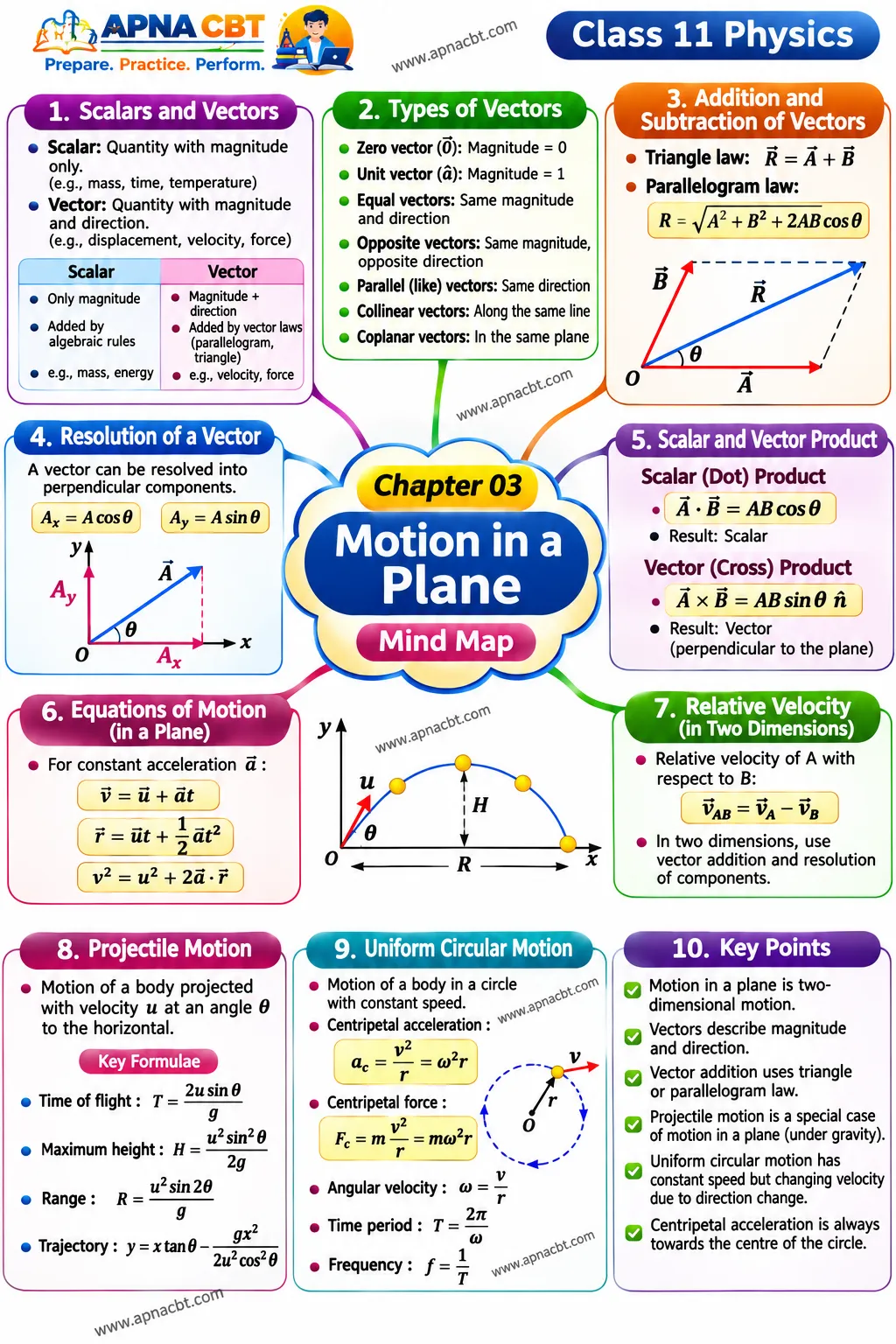
Motion in a Plane Class 11 Physics Mind Map
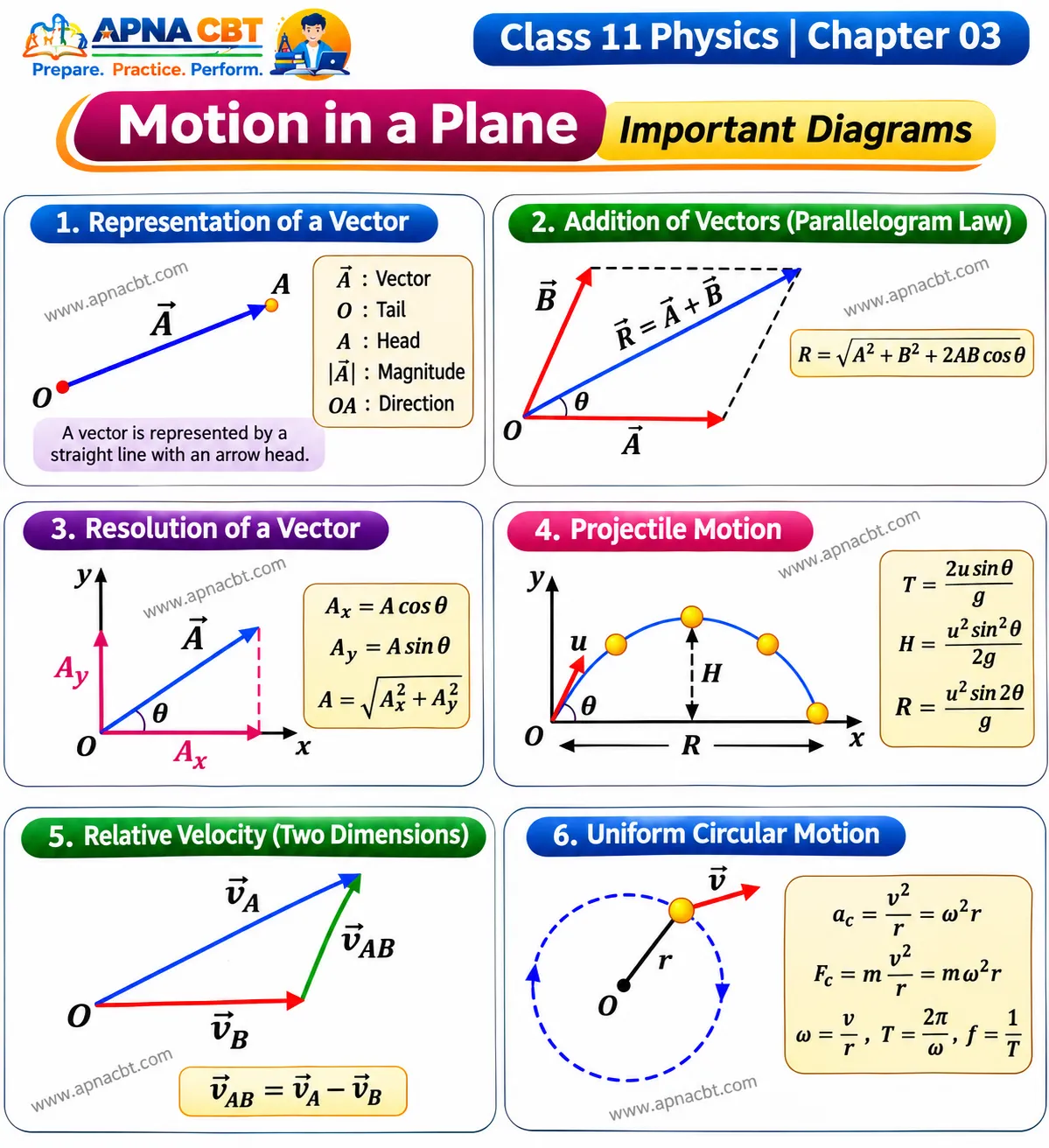
Motion in a Plane Class 11 Physics – Important Diagrams and Illustrations
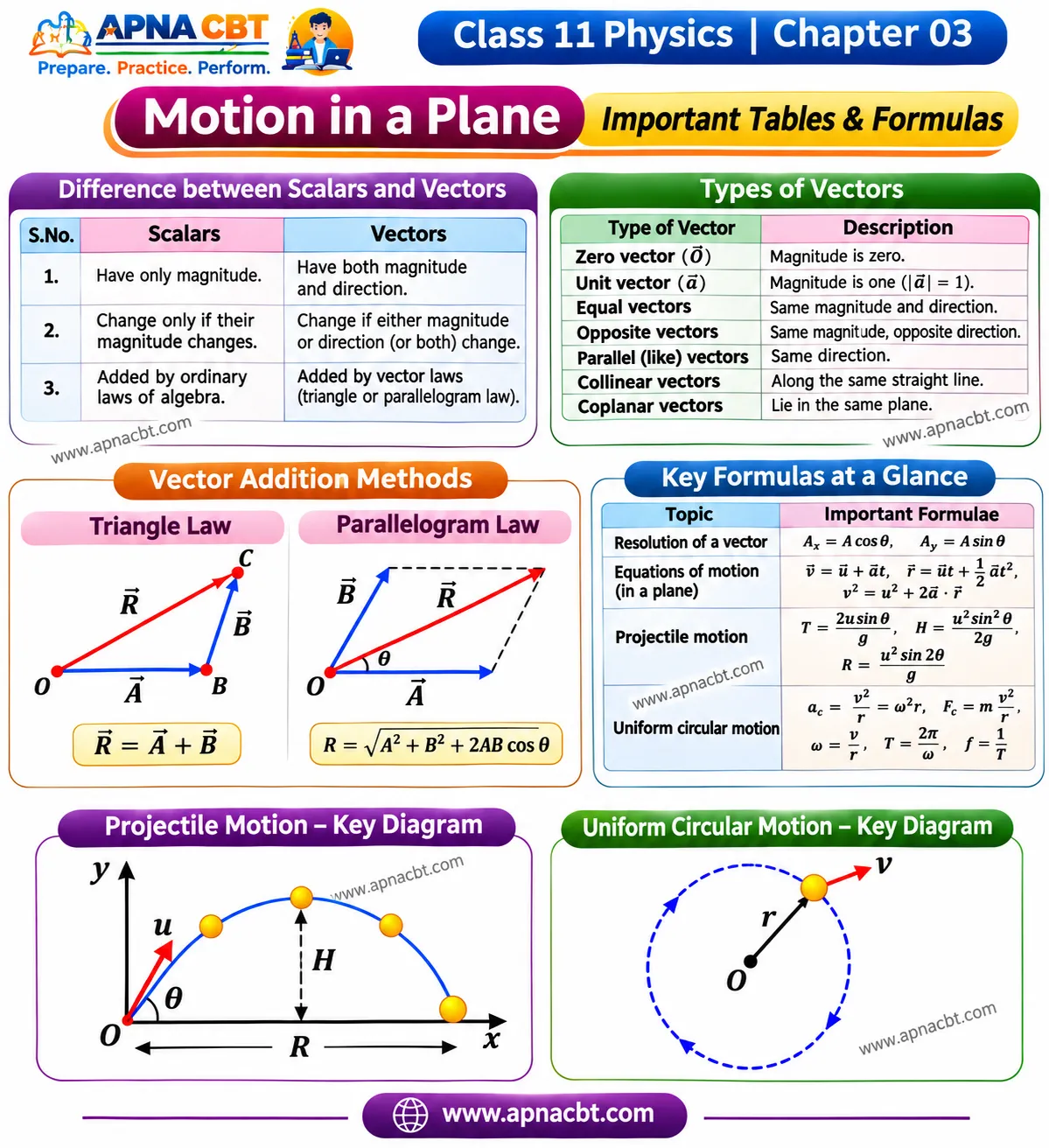
Motion in a Plane Class 11 Physics – Important Tables and Formulas