Units and Measurements – Class 11 Physics
Chapter 01 | CBSE Board Examination and NEET-UG Preparation
Physics is a quantitative science based on measurement. A physical measurement is expressed by a numerical value and a unit. This chapter covers physical quantities, systems of units, SI units, practical units, significant figures, errors in measurement, dimensions and dimensional analysis.
1. Physical Quantities and Measurement
Physical quantities are quantities that can be measured directly or indirectly and in terms of which the laws of physics can be expressed. Examples include length, mass, time, force, temperature and electric current.
Types of physical quantities
- Fundamental or base quantities: Independent quantities that are not expressed in terms of other physical quantities.
- Derived quantities: Quantities obtained from fundamental quantities. Examples: velocity, acceleration, force, momentum, area and volume.
Measurement
Measurement is the process of comparing a physical quantity with a standard quantity of the same kind, called its unit.
Measured quantity = Numerical value × Unit
\(Q = nU\), where \(Q\) is the physical quantity, \(n\) is its numerical value and \(U\) is the unit.
For a fixed physical quantity, the numerical value is inversely proportional to the size of the unit. A smaller unit gives a larger numerical value.
Characteristics of a good unit
- It should be accurately defined and unambiguous.
- It should be of convenient size.
- It should not change with time or place.
- It should be easily reproducible and accessible.
- It should be independent of physical conditions such as temperature and pressure.
- It should be internationally accepted.
Board focus: Define physical quantity, unit and measurement. Explain why the numerical value changes when the unit changes.
2. Fundamental and Derived Units
Fundamental units are units of fundamental quantities and cannot be expressed in terms of other units. Derived units are expressed as combinations of fundamental units.
| Quantity | Expression | SI unit |
|---|---|---|
| Area | Length × breadth | m² |
| Volume | Length × breadth × height | m³ |
| Velocity | Displacement / time | m s⁻¹ |
| Acceleration | Velocity / time | m s⁻² |
| Force | Mass × acceleration | kg m s⁻² (N) |
| Work | Force × displacement | kg m² s⁻² (J) |
| Power | Work / time | kg m² s⁻³ (W) |
| Density | Mass / volume | kg m⁻³ |
Example: Unit of speed = metre / second = m s⁻¹. Hence, speed has a derived unit.
3. Systems of Units
A system of units is a complete set of units used to measure fundamental and derived physical quantities.
| System | Length | Mass | Time | Force unit |
|---|---|---|---|---|
| CGS | centimetre (cm) | gram (g) | second (s) | dyne |
| MKS | metre (m) | kilogram (kg) | second (s) | newton (N) |
| FPS | foot (ft) | pound (lb) | second (s) | poundal (pdl) |
In the FPS system, \(1\,pdl = 1\,lb\,ft\,s^{-2}\). The SI system is the internationally accepted system of units.
4. International System of Units (SI)
SI stands for the French term Système International d’Unités. It is the internationally accepted system used in scientific, technical, industrial and commercial work.
Seven SI base quantities and units
| Base quantity | SI unit | Symbol |
|---|---|---|
| Length | metre | m |
| Mass | kilogram | kg |
| Time | second | s |
| Electric current | ampere | A |
| Thermodynamic temperature | kelvin | K |
| Amount of substance | mole | mol |
| Luminous intensity | candela | cd |
Definitions of SI base units
- Metre (m): Defined by fixing the speed of light in vacuum at exactly 299,792,458 m s⁻¹.
- Kilogram (kg): Defined by fixing the Planck constant at exactly \(6.62607015 \times 10^{-34}\) J s.
- Second (s): Defined using the caesium-133 hyperfine transition frequency, \(9,192,631,770\) Hz.
- Ampere (A): Defined by fixing the elementary charge at exactly \(1.602176634 \times 10^{-19}\) C.
- Kelvin (K): Defined by fixing the Boltzmann constant at exactly \(1.380649 \times 10^{-23}\) J K⁻¹.
- Mole (mol): One mole contains exactly \(6.02214076 \times 10^{23}\) specified elementary entities.
- Candela (cd): Defined using the luminous efficacy of monochromatic radiation of frequency \(540 \times 10^{12}\) Hz.
Supplementary units presented in the source
| Quantity | Unit | Symbol |
|---|---|---|
| Plane angle | radian | rad |
| Solid angle | steradian | sr |
Radian: Plane angle subtended at the centre of a circle by an arc equal in length to its radius. \(\theta = s/r\).
Steradian: Solid angle subtended at the centre of a sphere by a surface area equal to the square of the radius. \(\Omega = A/r^2\).
Advantages of SI
- Coherent system: derived units follow by multiplication or division of base units.
- Rational system: one agreed unit is assigned to a physical quantity.
- Metric system: multiples and submultiples are powers of ten.
- Absolute system: it avoids gravitational units.
- Internationally accepted.
5. Conventions for Writing SI Units and Symbols
- Unit symbols are generally written in lowercase letters.
- A symbol is written with an initial capital letter when the unit is named after a scientist, for example N, J and Pa.
- Unit symbols are not followed by a full stop.
- Symbols are not written in plural form.
- The full name of a unit is written in lowercase, even when named after a scientist.
- A space is generally left between the numerical value and the unit symbol, for example 25 m.
Examples: 5 kg, 12 s, 20 N, 40 J and 300 K.
6. Metric Prefixes and Powers of Ten
Prefixes are used to express very large or very small quantities conveniently as multiples or submultiples of SI units.
| Power | Prefix | Symbol |
|---|---|---|
| 10¹⁸ | exa | E |
| 10¹⁵ | peta | P |
| 10¹² | tera | T |
| 10⁹ | giga | G |
| 10⁶ | mega | M |
| 10³ | kilo | k |
| 10² | hecto | h |
| 10¹ | deca | da |
| 10⁻¹ | deci | d |
| 10⁻² | centi | c |
| 10⁻³ | milli | m |
| 10⁻⁶ | micro | µ |
| 10⁻⁹ | nano | n |
| 10⁻¹² | pico | p |
| 10⁻¹⁵ | femto | f |
| 10⁻¹⁸ | atto | a |
Examples: 1 km = 10³ m; 1 cm = 10⁻² m; 1 µm = 10⁻⁶ m; 1 nm = 10⁻⁹ m; 1 pm = 10⁻¹² m.
7. Some Common Practical Units
Units of large and small distances
| Unit | Meaning / use | Conversion |
|---|---|---|
| Light year (ly) | Distance travelled by light in vacuum in one year; used in astronomy. | ≈ 9.46 × 10¹⁵ m |
| Astronomical unit (AU) | Mean distance between Earth and Sun. | ≈ 1.496 × 10¹¹ m |
| Parsec (pc) | Distance at which 1 AU subtends an angle of 1 arcsecond. | ≈ 3.08 × 10¹⁶ m ≈ 3.26 ly |
| Fermi (fm) | Used for nuclear dimensions. | 1 fm = 10⁻¹⁵ m |
| Angstrom (Å) | Used for atomic dimensions and wavelengths. | 1 Å = 10⁻¹⁰ m |
| Nanometre (nm) | Used for small lengths and wavelengths. | 1 nm = 10⁻⁹ m |
| Micron (µm) | Used for very small distances. | 1 µm = 10⁻⁶ m |
Other practical units listed in the lesson source
- Area: barn (nuclear cross-section), acre (1 acre ≈ 4047 m²) and hectare (1 hectare = 10⁴ m²).
- Mass: tonne (1000 kg), quintal (100 kg), slug (about 14.57 kg), pound (about 0.4536 kg) and atomic mass unit (1 u ≈ 1.66 × 10⁻²⁷ kg).
- Time: solar day, sidereal day, solar year, tropical year, leap year, lunar month (about 27.3 days) and shake (10⁻⁸ s).
- Pressure: bar and torr. 1 bar = 10⁵ Pa; 1 torr is approximately 1 mm of mercury; 1 atmosphere is approximately 760 torr.
NEET focus: Learn the conversions and distinguish a light year (unit of distance) from a year (unit of time).
8. Coherent System, Need for Measurement and Order of Magnitude
A coherent system of units is one in which derived units can be obtained from fundamental units by multiplication or division without introducing an additional numerical factor. SI is a coherent system for all branches of physics.
Need for measurement: Quantitative description of natural phenomena requires measurement of relevant physical quantities, such as distance, time, mass, temperature and energy.
Order of magnitude is the power of ten nearest to the magnitude of a quantity. If a number is expressed as \(N=n \times 10^x\), the nearest power of ten gives its order of magnitude. The source uses the practical criterion that if \(0.5
| Number | Scientific form | Order of magnitude |
|---|---|---|
| 6 | 6 × 10⁰ | 10¹ (nearest power) |
| 43 | 4.3 × 10¹ | 10² (nearest power) |
| 444 | 4.44 × 10² | 10³ (nearest power) |
| 669000 | 6.69 × 10⁵ | 10⁶ (nearest power) |
| 0.132 | 1.32 × 10⁻¹ | 10⁻¹ |
9. Significant Figures
Every measurement has limited precision. Significant figures are the reliable digits in a measured value together with the first uncertain digit. A measurement with more significant figures generally indicates greater precision.
Rules for counting significant figures
- All non-zero digits are significant. Example: 17.25 has four significant figures.
- Zeros between non-zero digits are significant. Example: 2008 has four significant figures.
- Zeros to the right of the decimal point but before the first non-zero digit are not significant. Example: 0.006302 has four significant figures.
- Trailing zeros in a number without a decimal point are generally not significant. Example: 1200 has two significant figures unless otherwise indicated.
- Trailing zeros in a number with a decimal point are significant. Example: 6.700 has four significant figures.
- The number of significant figures does not change when the unit changes. Scientific notation avoids ambiguity.
Example: 4.700 m = 470.0 cm = 4700 mm. The measurement has four significant figures; write it as \(4.700 \times 10^3\) mm to show this clearly.
10. Rounding Off and Arithmetic Operations with Significant Figures
Rounding-off rules
- If the first digit to be dropped is less than 5, leave the preceding digit unchanged. Example: 6.83 to one decimal place = 6.8.
- If it is greater than 5, increase the preceding digit by one. Example: 7.78 to one decimal place = 7.8.
- If 5 is followed by non-zero digits, increase the preceding digit by one.
- If 5 is followed by no non-zero digit, leave the preceding digit unchanged when it is even.
- If 5 is followed by no non-zero digit, increase the preceding digit by one when it is odd.
Rules for arithmetic operations
Addition and subtraction: Retain as many decimal places as are present in the quantity with the fewest decimal places.
Example: 5.1 + 2.38 + 1.016 = 8.496, reported as 8.5.
Multiplication and division: Retain as many significant figures as are present in the quantity with the fewest significant figures.
Example: 4.6 × 0.128 = 0.5888, reported to two significant figures as 0.59.
11. Errors in Measurement and Their Estimation
A measured value may differ from the true value because of limitations in the measuring instrument, observation or experimental method. The source chapter discusses mean value, absolute error, relative error and percentage error.
Mean value
For measured values \(a_1,a_2,\ldots,a_n\), the mean value is:
\(\bar a = (a_1+a_2+\cdots+a_n)/n\).
Absolute error
The absolute error in an observation is the magnitude of the difference between that observation and the mean value:
\(\Delta a_i = |a_i-\bar a|\).
Mean absolute error:
\(\Delta \bar a = (\Delta a_1+\Delta a_2+\cdots+\Delta a_n)/n\).
Relative and percentage error
Relative error = Mean absolute error / Mean value.
Percentage error = Relative error × 100.
The final result may be expressed as \(a=\bar a\pm\Delta\bar a\).
Combination of errors
- Addition or subtraction: Absolute errors add. If \(z=x\pm y\), then \(\Delta z=\Delta x+\Delta y\).
- Multiplication or division: Relative errors add. If \(z=xy\) or \(z=x/y\), then \(\Delta z/z=\Delta x/x+\Delta y/y\).
- Power: If \(z=x^n\), then \(\Delta z/z=|n|(\Delta x/x)\).
- For a product of powers \(z=x^a y^b/w^c\), the maximum fractional error is the sum of the absolute power-weighted fractional errors.
NEET focus: Be able to calculate mean value, absolute error, relative error, percentage error and maximum error in a derived quantity.
12. Dimensions of Physical Quantities
The dimensions of a physical quantity are the powers to which fundamental quantities are raised to represent that quantity. In mechanics, mass, length and time are commonly represented by M, L and T.
For example, velocity = displacement / time, so its dimensions are \([LT^{-1}]\).
Dimensional formulae of important quantities
| Quantity | Dimensional formula |
|---|---|
| Area | [L²] |
| Volume | [L³] |
| Velocity | [LT⁻¹] |
| Acceleration | [LT⁻²] |
| Momentum | [MLT⁻¹] |
| Force | [MLT⁻²] |
| Work / Energy | [ML²T⁻²] |
| Power | [ML²T⁻³] |
| Pressure / Stress | [ML⁻¹T⁻²] |
| Density | [ML⁻³] |
| Impulse | [MLT⁻¹] |
| Torque | [ML²T⁻²] |
| Angular momentum | [ML²T⁻¹] |
| Frequency | [T⁻¹] |
| Gravitational constant G | [M⁻¹L³T⁻²] |
| Surface tension | [MT⁻²] |
| Coefficient of viscosity | [ML⁻¹T⁻¹] |
| Young’s modulus | [ML⁻¹T⁻²] |
| Planck constant | [ML²T⁻¹] |
13. Dimensional Formula and Dimensional Equation
Dimensional formula: An expression showing the powers of fundamental quantities that represent the dimensions of a physical quantity.
Dimensional equation: An equation obtained by equating a physical quantity with its dimensional formula.
Example: Force = mass × acceleration.
\([F]=[M][LT^{-2}]=[MLT^{-2}]\).
Thus, \([F]=[MLT^{-2}]\) is the dimensional formula of force; writing force equal to this dimensional expression gives its dimensional equation.
Dimensional variables and constants
- Dimensional variables: Physical quantities whose values and dimensions may be involved in a relation, for example length, velocity and force.
- Dimensionless variables: Quantities having no dimensions, for example strain, refractive index and coefficient of friction.
- Dimensional constants: Constants with dimensions, for example gravitational constant G and Planck constant h.
- Dimensionless constants: Constants without dimensions, for example π and numerical constants.
14. Principle of Homogeneity of Dimensions
The principle of homogeneity states that the dimensions of all terms in a correct physical equation must be the same. Quantities can be added, subtracted or compared only when they have the same dimensions.
Example: Checking \(s=ut+\frac12 at^2\)
Dimensions of displacement, \([s]=[L]\).
Dimensions of \(ut\) = \([LT^{-1}][T]=[L]\).
Dimensions of \(at^2\) = \([LT^{-2}][T^2]=[L]\).
All terms have dimensions of length. The equation is dimensionally homogeneous.
Important: Dimensional homogeneity is a necessary condition for a physical equation to be correct, but it does not prove that the equation is physically correct.
15. Applications of Dimensional Analysis
Main applications
- To convert a physical quantity from one system of units to another.
- To check the dimensional correctness of physical equations.
- To derive a possible relation between physical quantities.
Conversion between systems of units
The magnitude of a physical quantity remains unchanged when the system of units changes. If a quantity has dimensions \([M^aL^bT^c]\), its numerical value changes according to the sizes of the selected base units.
If \(n_1\) and \(n_2\) are the numerical values in two systems, then:
\(n_1 M_1^aL_1^bT_1^c=n_2 M_2^aL_2^bT_2^c\).
Deriving relations by dimensions
Suppose a quantity depends on variables \(x,y,z\). Assume a product-of-powers relation \(Q=kx^a y^b z^c\), where k is dimensionless. Substitute dimensions and equate powers of M, L and T to determine the unknown exponents.
Example – time period of a simple pendulum: If \(T\) depends on length \(l\) and acceleration due to gravity \(g\), assume \(T=kl^a g^b\). Equating dimensions gives \(a=1/2\), \(b=-1/2\), hence \(T=k\sqrt{l/g}\). Dimensional analysis does not determine the value of k.
16. Limitations of Dimensional Analysis
- It cannot determine numerical dimensionless constants such as 1, 2, π or e.
- It cannot derive a relation when the quantity depends on more variables than can be resolved by the available independent dimensions.
- It cannot indicate whether a physical quantity is a scalar or a vector.
- It cannot derive relations involving trigonometric, exponential or logarithmic functions.
- It cannot determine equations containing addition or subtraction of separate terms in their exact form.
- A dimensionally correct equation may still be physically incorrect.
Board focus: State any four limitations with suitable explanation.
17. Important Comparisons, Formulae and NEET Revision
Frequently tested dimensional comparisons
| Quantities | Dimensional formula | Conclusion |
|---|---|---|
| Work and torque | [ML²T⁻²] | Same dimensions, different physical meanings |
| Impulse and momentum | [MLT⁻¹] | Same dimensions |
| Pressure and stress | [ML⁻¹T⁻²] | Same dimensions |
| Energy per unit volume and pressure | [ML⁻¹T⁻²] | Same dimensions |
| Angular momentum and Planck constant | [ML²T⁻¹] | Same dimensions |
Quick formula sheet
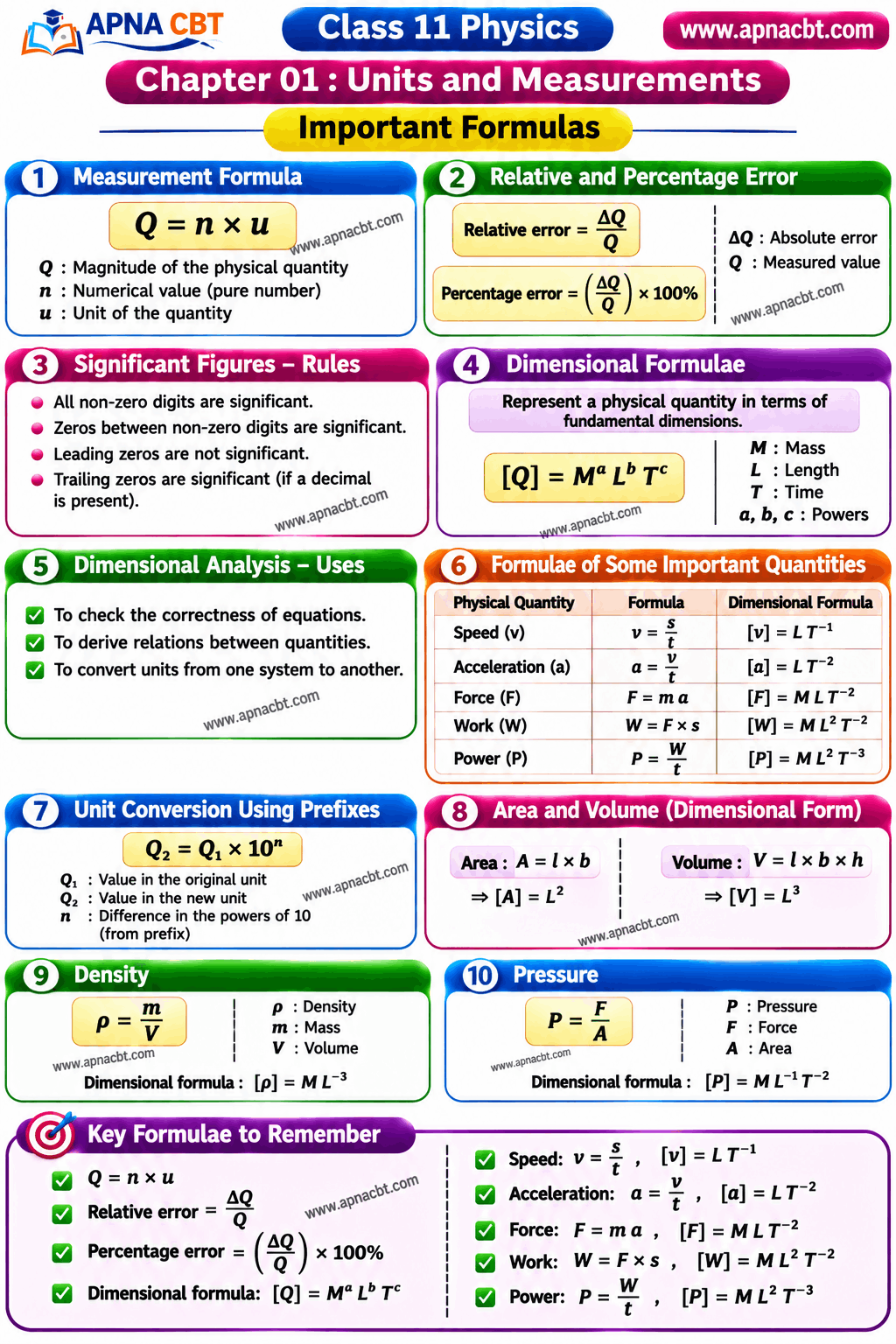
- Measured quantity: \(Q=nU\)
- Mean value: \(\bar a=\sum a_i/n\)
- Absolute error: \(\Delta a_i=|a_i-\bar a|\)
- Relative error: \(\Delta\bar a/\bar a\)
- Percentage error: relative error × 100
- For \(z=x^a y^b\), maximum fractional error: \(|a|\Delta x/x+|b|\Delta y/y\)
- Velocity: \([LT^{-1}]\); acceleration: \([LT^{-2}]\); force: \([MLT^{-2}]\)
- Work: \([ML^2T^{-2}]\); power: \([ML^2T^{-3}]\); pressure: \([ML^{-1}T^{-2}]\)
NEET and CBSE checklist
- Memorise all seven SI base quantities and units.
- Practise prefixes and practical-unit conversions.
- Count significant figures and apply rounding rules.
- Solve mean, absolute, relative and percentage error problems.
- Memorise dimensional formulae of common mechanical and thermal quantities.
- Practise homogeneity checks and dimensional derivations.
- Remember the limitations of dimensional analysis.
18. Short-Answer Questions – 30 Questions
Questions
- Define a physical quantity. Give two examples.
- Distinguish between fundamental and derived quantities.
- What is meant by measurement of a physical quantity?
- Write the relation between a physical quantity, numerical value and unit.
- State any four characteristics of a good physical unit.
- What are CGS, MKS and FPS systems? Name their fundamental units.
- Write the seven SI base quantities and their units.
- Define one radian and one steradian.
- State any four advantages of the SI system.
- Write four conventions for writing SI unit symbols.
- Define light year, astronomical unit and parsec.
- What is an atomic mass unit? State its approximate value in kilograms.
- What is a coherent system of units?
- Define order of magnitude.
- What are significant figures?
- How many significant figures are present in 0.006302, 6.700 and 1200?
- Why is scientific notation useful in reporting measurements?
- State the rules for rounding off a measured value.
- State the rule for addition and subtraction using significant figures.
- State the rule for multiplication and division using significant figures.
- Define mean absolute error and relative error.
- What is percentage error? Write its formula.
- Write the rules for combining errors in addition and subtraction.
- Write the rule for percentage error in a quantity raised to a power.
- Define dimensions of a physical quantity.
- Distinguish between dimensional formula and dimensional equation.
- Write the dimensional formulae of force, work, power and pressure.
- State the principle of homogeneity of dimensions.
- Mention three applications of dimensional analysis.
- State any four limitations of dimensional analysis.
Answers
- A physical quantity is a measurable property that can be used to express physical laws. Examples are length and mass.
- Fundamental quantities are independent and form the basis of measurement, such as length, mass and time. Derived quantities are obtained from them, such as velocity, force and density.
- Measurement is the comparison of a physical quantity with a standard quantity of the same kind, called its unit.
- \(Q=nU\), where Q is the measured quantity, n is its numerical value and U is the unit.
- A good unit should be accurately defined, stable with time and place, reproducible, accessible, convenient in size and internationally accepted. Any four are sufficient.
- CGS uses centimetre, gram and second; MKS uses metre, kilogram and second; FPS uses foot, pound and second.
- Length–metre (m); mass–kilogram (kg); time–second (s); electric current–ampere (A); temperature–kelvin (K); amount of substance–mole (mol); luminous intensity–candela (cd).
- One radian is the plane angle subtended at the centre of a circle by an arc equal to its radius. One steradian is the solid angle subtended at the centre of a sphere by an area equal to the square of its radius.
- SI is coherent, rational, metric, absolute and internationally accepted. Any four may be stated.
- Symbols are not followed by a full stop; they are not pluralised; symbols named after scientists begin with a capital letter; full unit names are written in lowercase.
- A light year is the distance travelled by light in vacuum in one year. AU is the mean Earth–Sun distance. A parsec is the distance at which 1 AU subtends one arcsecond.
- One atomic mass unit is one-twelfth of the mass of a carbon-12 atom. Its approximate value is \(1.66\times10^{-27}\) kg.
- A coherent system is one in which derived units are obtained from base units by multiplication or division without introducing extra numerical factors.
- Order of magnitude is the nearest power of ten representing the size of a physical quantity.
- Significant figures are all reliably known digits in a measurement together with the first uncertain digit.
- 0.006302 has four; 6.700 has four; 1200 has two significant figures when no decimal point or other indication is given.
- Scientific notation makes very large and small numbers compact and removes ambiguity in the number of significant figures.
- If the dropped digit is below 5, leave the preceding digit unchanged. If above 5, increase it by one. For an exact 5, use the even/odd convention described in the lesson.
- For addition and subtraction, retain the number of decimal places present in the least precise term.
- For multiplication and division, retain the number of significant figures present in the factor with the fewest significant figures.
- Mean absolute error is the average of the absolute deviations of observations from their mean. Relative error is mean absolute error divided by the mean value.
- Percentage error is relative error multiplied by 100.
- For addition or subtraction, absolute errors add: \(\Delta z=\Delta x+\Delta y\).
- If \(z=x^n\), the maximum fractional error is \(\Delta z/z=|n|\Delta x/x\).
- Dimensions are the powers to which fundamental quantities are raised to represent a physical quantity.
- A dimensional formula expresses a quantity in powers of base dimensions. A dimensional equation equates the physical quantity to that dimensional expression.
- Force: [MLT⁻²]; work: [ML²T⁻²]; power: [ML²T⁻³]; pressure: [ML⁻¹T⁻²].
- The dimensions of all terms in a correct physical equation must be identical. Only quantities of the same dimensions can be added, subtracted or equated.
- Unit conversion, checking dimensional correctness of equations and deriving possible relations among physical quantities.
- It cannot determine dimensionless constants, distinguish scalar from vector, derive trigonometric/exponential/logarithmic relations or determine the exact form of equations with multiple additive terms.
19. Long-Answer Questions – 15 Questions
Questions
- Explain physical quantities, measurement, fundamental units and derived units with suitable examples.
- Describe the CGS, MKS, FPS and SI systems of units. List the seven SI base quantities and units.
- Explain the definitions of radian and steradian and discuss the advantages of the SI system.
- Describe metric prefixes and explain the important practical units used for measuring large and small distances, mass, time and pressure.
- Explain significant figures and all the rules used to count them, with examples.
- Explain the rules of rounding off and arithmetic operations involving significant figures.
- Define mean value, absolute error, mean absolute error, relative error and percentage error. Explain how errors are reported.
- Explain the rules for combining errors in sums, differences, products, quotients and powers.
- Define dimensions, dimensional formula and dimensional equation. Derive the dimensional formulae of force, work, power and pressure.
- State and explain the principle of homogeneity of dimensions. Use it to check the equation \(s=ut+\frac12at^2\).
- Explain the three main applications of dimensional analysis.
- Using dimensional analysis, derive the relation for the time period of a simple pendulum in terms of its length and acceleration due to gravity.
- Explain how dimensional analysis is used to convert a physical quantity from one system of units to another.
- Discuss the limitations of dimensional analysis with suitable examples.
- Explain the dimensional classification of variables and constants. Give examples of dimensional and dimensionless quantities and constants.
Detailed Answers
- Physical quantities and measurement: Physical quantities are measurable properties used to express physical laws, for example length, mass, time, force and temperature. Measurement is comparison with a standard quantity of the same kind. The result is written as \(Q=nU\), where n is the numerical value and U is the unit. Fundamental quantities are independent, such as length, mass and time. Derived quantities are obtained from fundamental quantities: velocity = length/time, acceleration = length/time² and force = mass × acceleration. Their units are therefore derived from base units.
- Systems of units: CGS uses centimetre, gram and second; MKS uses metre, kilogram and second; FPS uses foot, pound and second. SI is the internationally accepted metric system. Its seven base units are metre, kilogram, second, ampere, kelvin, mole and candela, corresponding to length, mass, time, electric current, thermodynamic temperature, amount of substance and luminous intensity.
- Radian, steradian and SI advantages: One radian is the angle at the centre of a circle subtended by an arc equal to the radius, \(\theta=s/r\). One steradian is the solid angle at the centre of a sphere subtended by area equal to \(r^2\), \(\Omega=A/r^2\). SI is coherent because derived units follow from base units; rational because it provides agreed units; metric because prefixes are powers of ten; absolute because it avoids gravitational units; and internationally accepted.
- Prefixes and practical units: Prefixes represent powers of ten: kilo \(10^3\), mega \(10^6\), giga \(10^9\), milli \(10^{-3}\), micro \(10^{-6}\), nano \(10^{-9}\), pico \(10^{-12}\). Distance units include light year (about \(9.46\times10^{15}\) m), AU (about \(1.496\times10^{11}\) m), parsec (about \(3.08\times10^{16}\) m), fermi (\(10^{-15}\) m), angstrom (\(10^{-10}\) m) and micron (\(10^{-6}\) m). Mass units include tonne, quintal, pound and atomic mass unit. Time units include solar day, sidereal day, lunar month and shake. Pressure units include bar and torr.
- Significant figures: Significant figures include all certain digits and the first uncertain digit. All non-zero digits are significant. Zeros between non-zero digits are significant. Leading zeros before the first non-zero digit are not significant. Trailing zeros without a decimal point are generally not significant, while trailing zeros after a decimal point are significant. The number of significant figures does not change with the unit. Scientific notation is useful to show the intended precision.
- Rounding and arithmetic: If the first dropped digit is less than 5, leave the preceding digit unchanged; if greater than 5, increase it by one. For an exact 5, the even/odd rule is applied. In addition and subtraction, retain the least number of decimal places among the data. In multiplication and division, retain the least number of significant figures among the factors. These rules ensure that the result does not claim greater precision than the measurements support.
- Errors in measurement: For n observations, mean value is \(\bar a=\sum a_i/n\). Absolute error in each observation is \(\Delta a_i=|a_i-\bar a|\). Mean absolute error is the average of these absolute errors. Relative error is mean absolute error divided by the mean value; percentage error is relative error multiplied by 100. The result is reported as \(a=\bar a\pm\Delta\bar a\).
- Combination of errors: For \(z=x+y\) or \(x-y\), absolute errors add: \(\Delta z=\Delta x+\Delta y\). For \(z=xy\) or \(x/y\), fractional errors add: \(\Delta z/z=\Delta x/x+\Delta y/y\). For \(z=x^n\), fractional error is \(|n|\Delta x/x\). For a general product of powers, multiply each fractional error by the absolute value of its exponent and add the results to obtain maximum fractional error.
- Dimensions: Dimensions indicate powers of fundamental quantities. In mechanics, mass, length and time are represented by M, L and T. Force = mass × acceleration, so \([F]=[M][LT^{-2}]=[MLT^{-2}]\). Work = force × displacement, so \([W]=[ML^2T^{-2}]\). Power = work/time, so \([P]=[ML^2T^{-3}]\). Pressure = force/area, so \([p]=[ML^{-1}T^{-2}]\).
- Homogeneity: The dimensions of every term in a valid physical equation must be identical. For \(s=ut+\frac12at^2\), displacement has dimension [L]. The term ut has dimensions \([LT^{-1}][T]=[L]\). The term at² has dimensions \([LT^{-2}][T^2]=[L]\). All terms have dimensions of length, so the equation is dimensionally homogeneous. This test cannot alone prove physical correctness.
- Applications: Dimensional analysis is used to convert units between systems, test dimensional consistency of equations and derive possible relations between physical quantities. It helps identify the powers of variables in a product-of-powers relation by equating the dimensions on both sides.
- Simple pendulum relation: Suppose time period T depends on length l and gravitational acceleration g. Assume \(T=kl^a g^b\), where k is dimensionless. Dimensions give \([T]=[L]^a[LT^{-2}]^b=[L^{a+b}T^{-2b}]\). Equating powers: \(a+b=0\) and \(-2b=1\). Thus \(b=-1/2\) and \(a=1/2\). Therefore \(T=k\sqrt{l/g}\). Dimensional analysis cannot determine k.
- Conversion of units: The magnitude of a physical quantity is invariant. If Q has dimensions \([M^aL^bT^c]\), and the base-unit sizes in two systems are \(M_1,L_1,T_1\) and \(M_2,L_2,T_2\), then \(n_1M_1^aL_1^bT_1^c=n_2M_2^aL_2^bT_2^c\). This relation gives the numerical value in the new system.
- Limitations: Dimensional analysis cannot determine pure numerical constants such as 2 or π; cannot decide whether a quantity is scalar or vector; cannot derive equations involving trigonometric, exponential or logarithmic functions; and cannot give the exact form of equations with multiple additive terms. It may also fail to determine all exponents when too many independent variables are involved. A dimensionally correct equation is not necessarily physically correct.
- Variables and constants: Dimensional variables have dimensions, such as length, velocity and force. Dimensionless variables have no dimensions, such as strain and refractive index. Dimensional constants have fixed values with dimensions, such as G and Planck constant h. Dimensionless constants have no dimensions, such as π and numerical coefficients. The distinction is based on dimensions, not on whether the value changes.
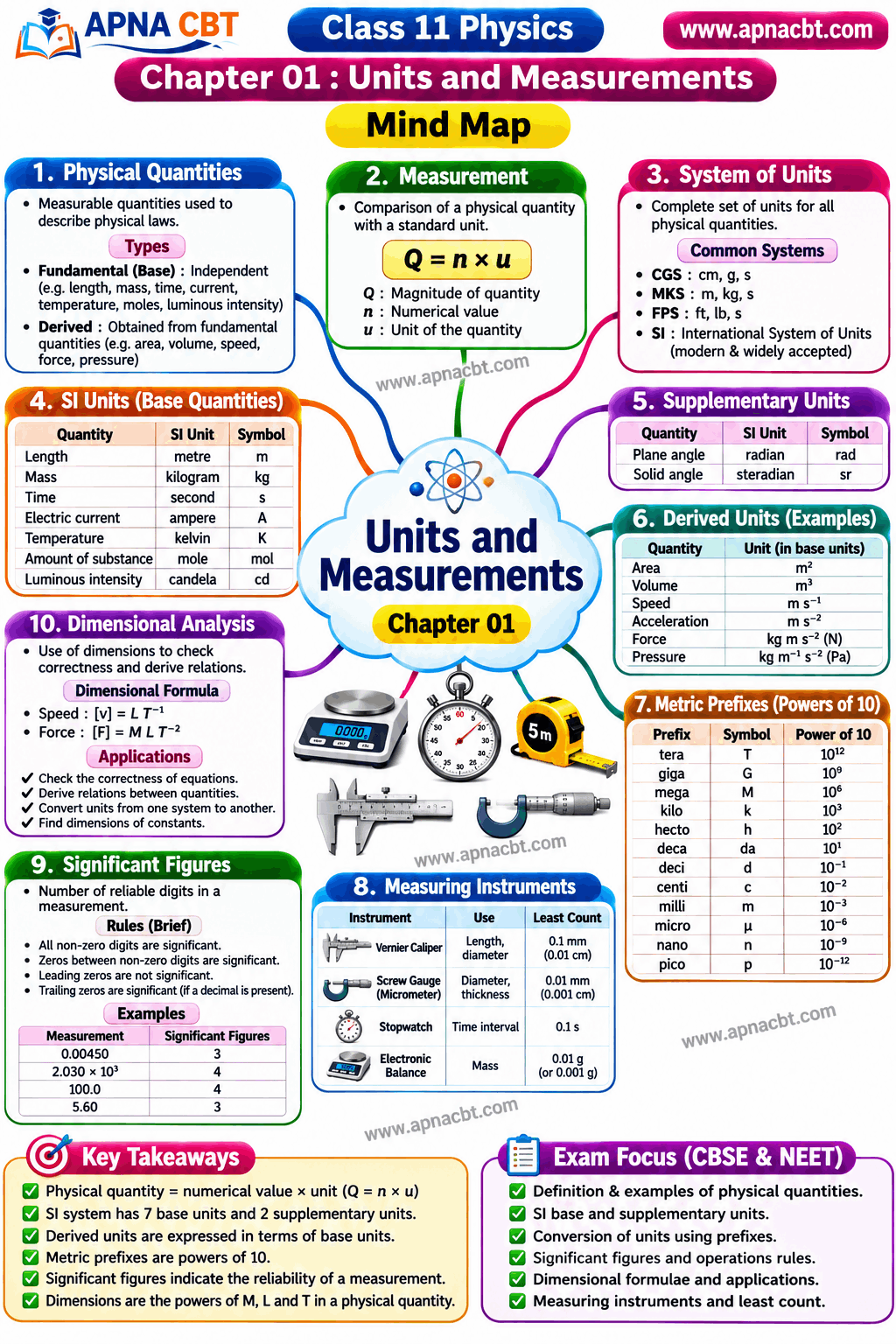
Units and Measurements Class 1 Physics Mind Map
Units and Measurements Class 11 Physics – Important Diagrams and Illustrations
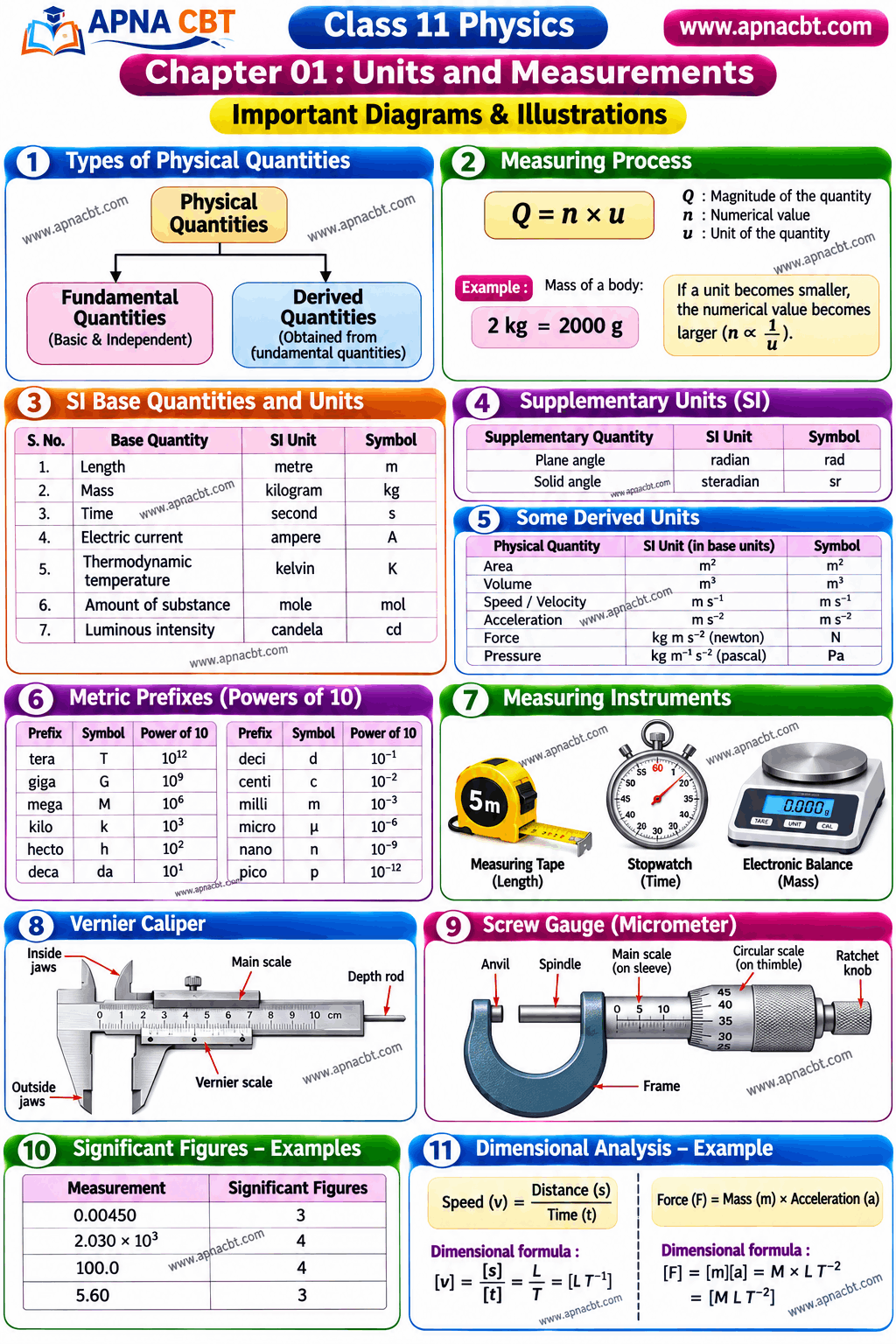
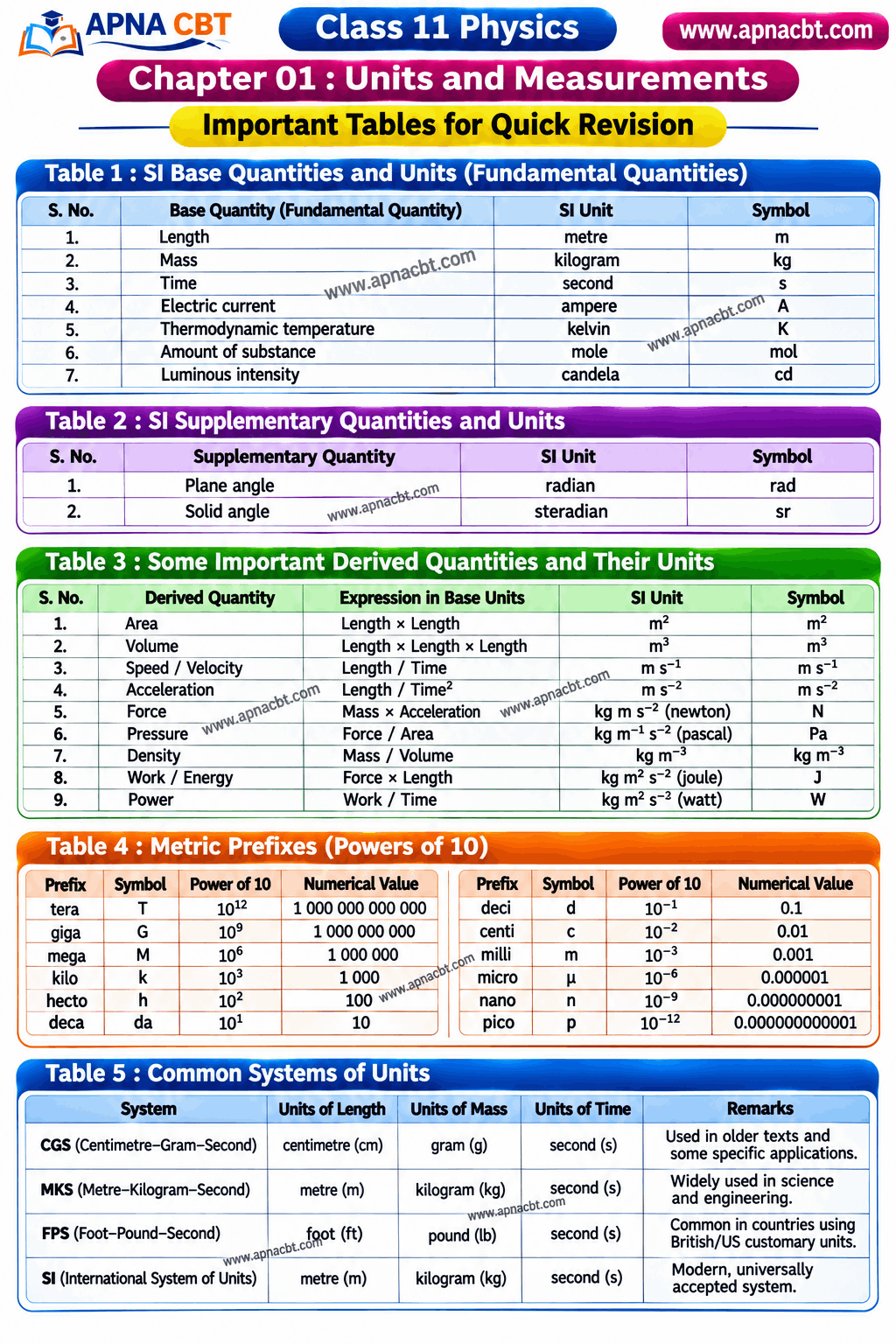
Units and Measurements Class 11 Physics – Important Tables
Units and Measurements Class 11 Physics – Important Formulas