Chapter 05: General Principles of Metallurgy
Introduction to General Principles of Metallurgy
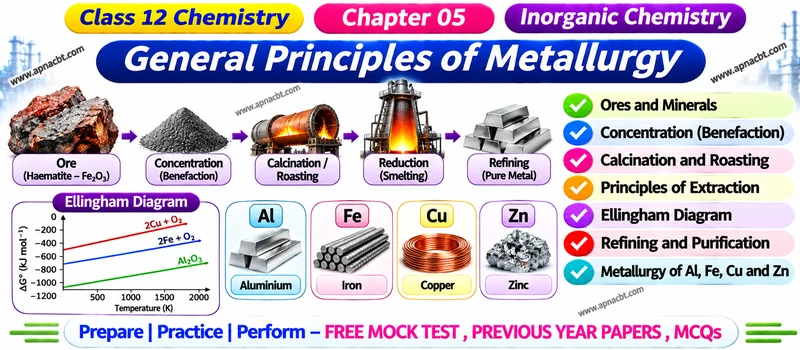
General Principles of Metallurgy explains how metals are obtained from ores and purified. This Class 12 Chemistry lesson covers concentration, leaching, roasting, calcination, reduction, thermodynamics, electrochemical extraction, refining and extraction of aluminium, iron, copper and zinc for CBSE and NEET.
Table of Contents
- 1. Occurrence of Metals, Minerals, Ores and Metallurgy
- 2. Concentration of Ores
- 3. Conversion of Concentrated Ore into Oxide and Crude Metal
- 4. Thermodynamic Principles and Ellingham Diagram
- 5. Applications of Thermodynamics: Iron, Copper and Zinc
- 6. Electrochemical Principles and Electrometallurgy
- 7. Aluminium Extraction and Hall-Heroult Process
- 8. Hydrometallurgy, Oxidation and Recovery of Metals
- 9. Refining of Metals
- 10. Uses of Aluminium, Copper, Zinc and Iron
- 11. High-Yield Revision: Processes, Equations and Exam Comparisons
- 12. NCERT-Based Exam Strategy and Concept Revision
- 13. Short-Answer Questions – 30 Questions with Detailed Answers
- 14. Long-Answer Questions – 15 Questions with Detailed Answers
1. Occurrence of Metals, Minerals, Ores and Metallurgy
Minerals and Ores
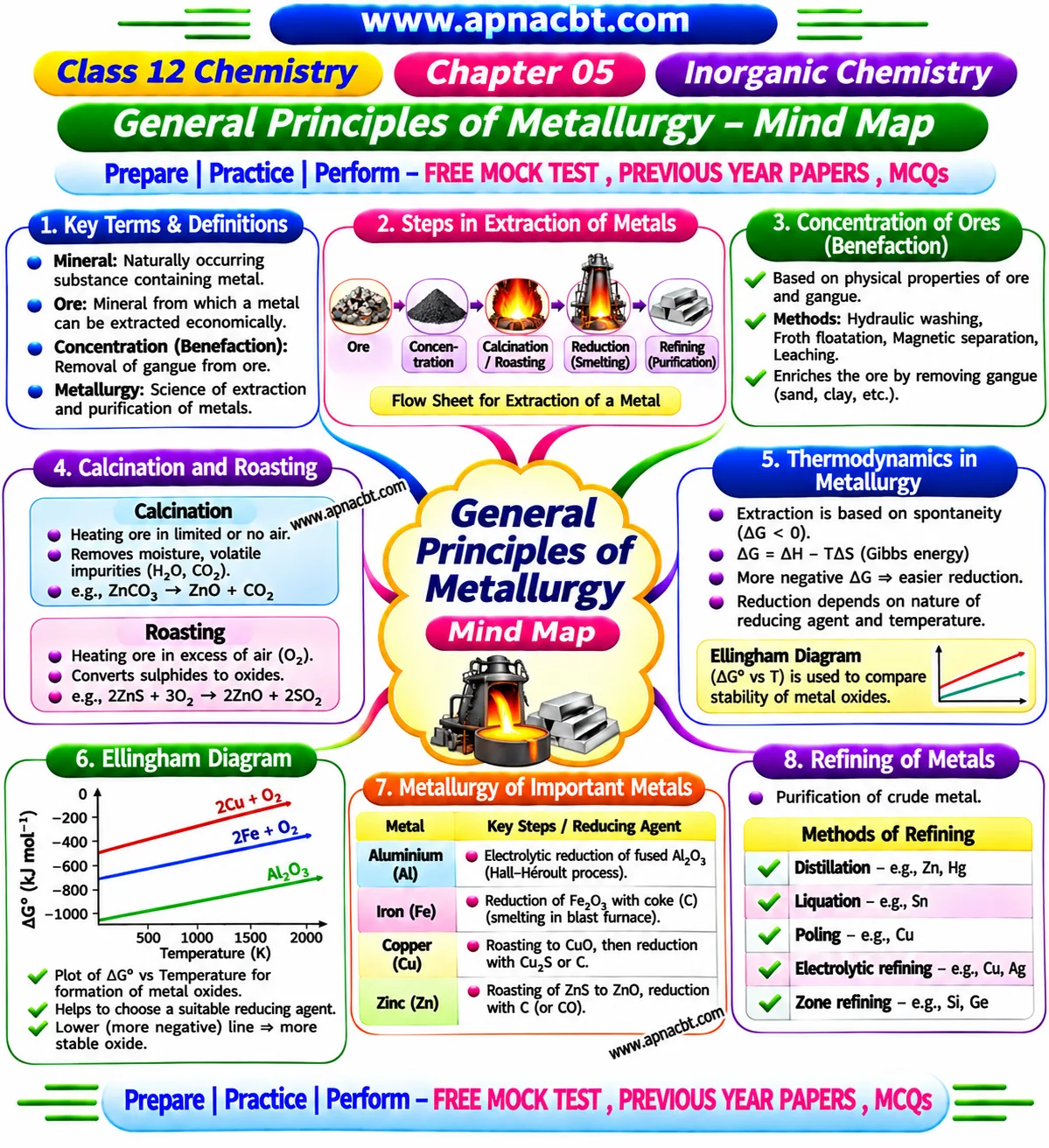
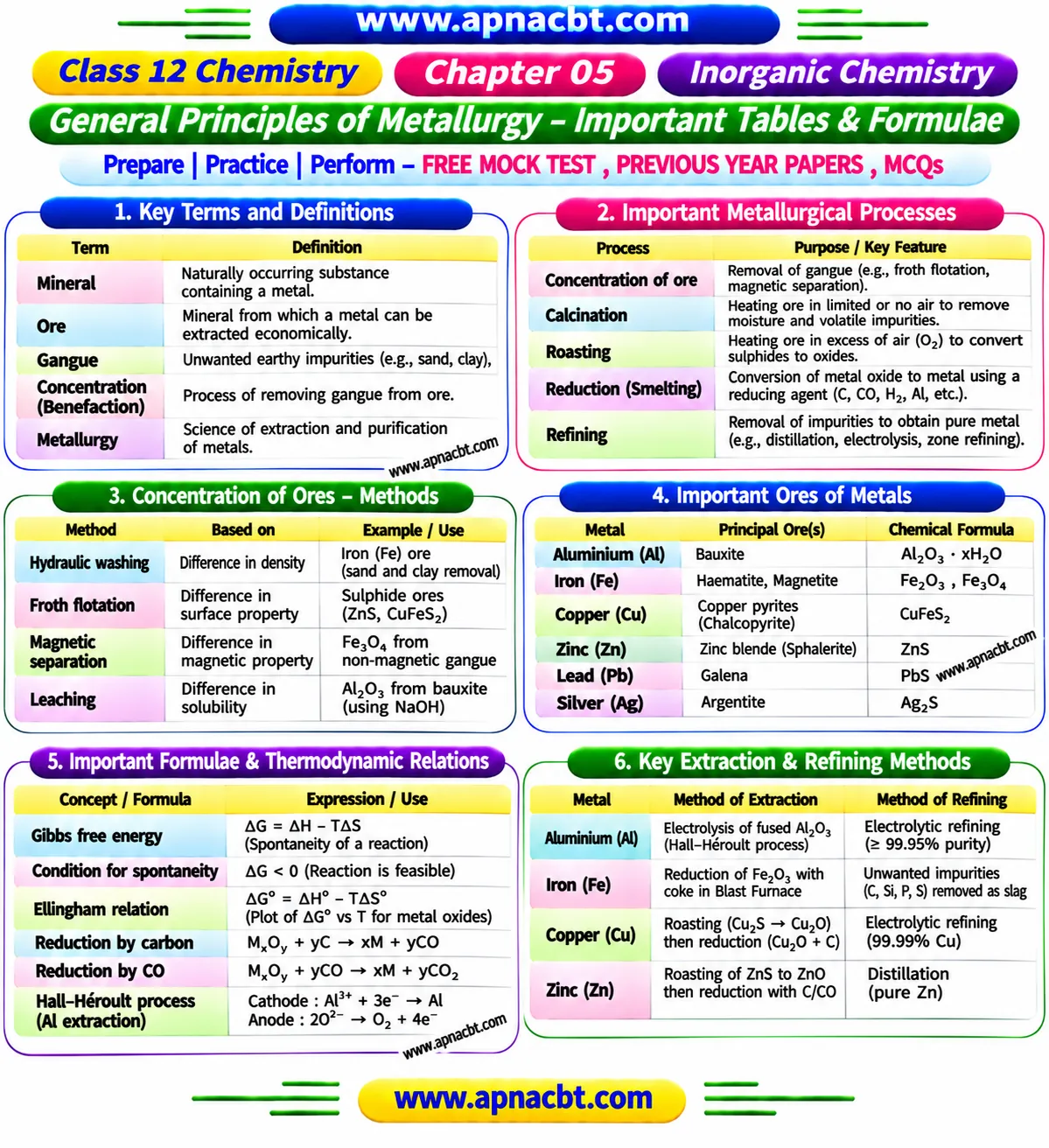
Only a few elements occur in the free state. Many metals occur in the earth’s crust as compounds. A mineral is a naturally occurring chemical substance found in the earth’s crust. A mineral from which a metal can be extracted conveniently and economically is called an ore. Ores are generally associated with unwanted earthy materials called gangue.
The chapter identifies important ores such as bauxite for aluminium; haematite and magnetite for iron; copper pyrites, malachite, cuprite and copper glance for copper; and zinc blende, calamine and zincite for zinc.
Metallurgy
The complete scientific and technological process used for isolation of a metal from its ore is called metallurgy. The broad sequence is concentration of the ore, isolation of the metal from the concentrated ore, and purification or refining of the metal.
Exam focus: Do not confuse mineral with ore. Every ore is a mineral, but every mineral is not an ore.
2. Concentration of Ores
Concentration, dressing or benefaction means removal of unwanted materials from the ore. Ores are generally crushed and graded before concentration. The selected method depends on differences in physical properties between the ore and gangue.
Hydraulic Washing
Hydraulic washing is based on differences in specific gravities. A stream of water washes away lighter gangue while heavier ore particles remain behind. It is a form of gravity separation.
Magnetic Separation
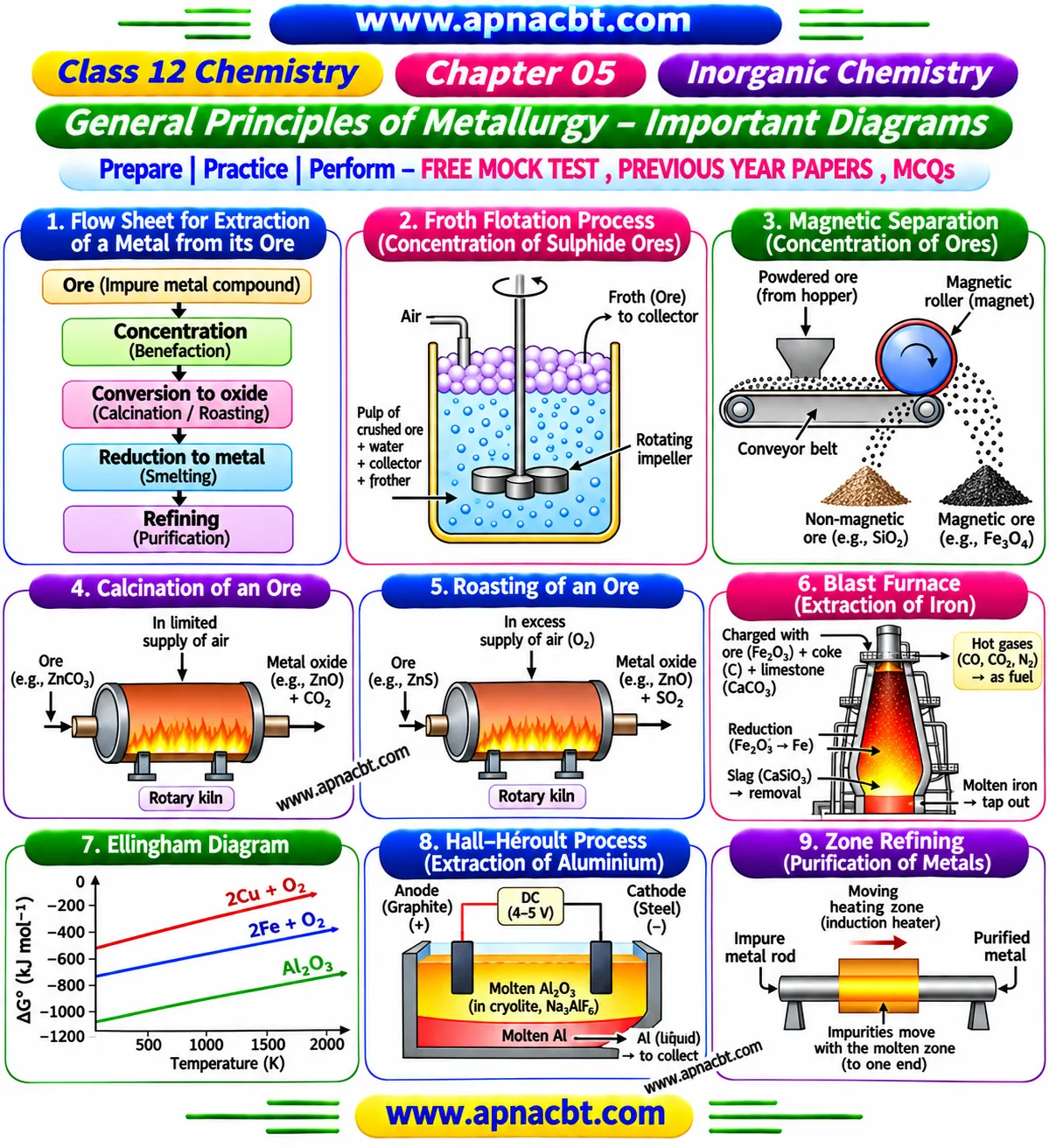
Magnetic separation uses differences in magnetic properties. If either the ore or gangue is attracted by a magnetic field, the two components can be separated. Iron-containing ores can be concentrated by this method.
Froth Flotation
Froth flotation is important for sulphide ores. Powdered ore is mixed with water, collectors and froth stabilisers. Collectors such as pine oil, fatty acids and xanthates make mineral particles non-wettable, while stabilisers maintain the froth. Air and agitation produce mineral-rich froth, which is skimmed off.
Depressants can selectively prevent one sulphide mineral from entering the froth. In a mixture containing ZnS and PbS, NaCN acts as a depressant for ZnS and allows PbS to come into the froth.
Leaching
Leaching dissolves a desired component in a suitable solvent. In bauxite, concentrated NaOH dissolves alumina as sodium aluminate. Neutralisation with CO2 precipitates hydrated alumina, which is heated to obtain Al2O3.
Leaching is also used in the metallurgy of gold and silver using cyanide solutions in the presence of oxygen, followed by recovery of the metal through a displacement reaction.
3. Conversion of Concentrated Ore into Oxide and Crude Metal
Calcination
Calcination involves heating an ore strongly, generally in the absence or limited supply of air, to remove volatile matter. Hydrated ores lose water and carbonate ores release carbon dioxide.
Examples include: Fe2O3·xH2O → Fe2O3 + xH2O; ZnCO3 → ZnO + CO2.
Roasting
Roasting involves heating the ore in a regular supply of air at a temperature below the melting point of the metal. Sulphide ores are commonly converted into oxides with release of sulphur dioxide.
For example: 2ZnS + 3O2 → 2ZnO + 2SO2; 2PbS + 3O2 → 2PbO + 2SO2; 2Cu2S + 3O2 → 2Cu2O + 2SO2.
Reduction of Oxide
Metal oxides may be reduced using carbon, carbon monoxide or another suitable metal. A simplified reaction is MxOy + yC → xM + yCO. The reducing agent removes oxygen from the metal oxide and is itself oxidised.
Exam comparison: Calcination mainly removes volatile matter such as H2O and CO2; roasting commonly oxidises sulphide ores in air and releases SO2.
4. Thermodynamic Principles and Ellingham Diagram
Gibbs Energy Criterion
The thermodynamic part of General Principles of Metallurgy is based on Gibbs energy. For a process, ΔG = ΔH − TΔS. A reaction is thermodynamically feasible at a specified temperature when the Gibbs energy change is negative.
During extraction, reduction of a metal oxide is coupled with oxidation of a reducing agent. If the combined reaction has negative ΔG, the reduction is feasible. Increasing temperature can make ΔG more negative when the entropy term favours the reaction.
Ellingham Diagram
An Ellingham diagram plots standard Gibbs energy change, ΔG°, against temperature for oxidation reactions. It helps compare the stability of metal oxides and determine whether a reducing agent can reduce a particular oxide at a chosen temperature.
Lower positions on the diagram correspond to more negative Gibbs energies for oxide formation and therefore more stable oxides. A reducing agent can reduce another oxide when the overall coupled reaction has a negative ΔG under the selected conditions.
Important Interpretation
- More negative ΔG° of oxide formation generally indicates greater oxide stability.
- The intersection of relevant oxidation curves can indicate the temperature region where reduction becomes feasible.
- Formation of gaseous products and suitable changes in physical state can influence entropy and therefore Gibbs energy.
- Thermodynamic feasibility does not guarantee a fast reaction; activation energy and kinetic factors also matter.
5. Applications of Thermodynamics: Iron, Copper and Zinc
Extraction of Iron
Concentrated iron oxide ores are treated in a blast furnace with coke and limestone. Hot air is blown through the furnace. Carbon monoxide formed in the furnace reduces iron oxides to iron. Limestone acts as a flux and helps form slag with silica.
Important reduction steps include Fe2O3 → Fe3O4 → FeO → Fe. The overall process occurs through several temperature zones. The iron obtained from the blast furnace contains about 4% carbon and smaller quantities of impurities such as sulphur, phosphorus, silicon and manganese and is called pig iron.
Cast iron has slightly lower carbon content and is hard and brittle. Wrought iron is a purer commercial form produced by further removal of impurities.
Extraction of Copper
Cu2O is relatively easy to reduce. Sulphide ores may first be roasted to form copper(I) oxide, which can then be reduced by coke. During smelting, silica helps remove iron oxide as iron silicate slag. Copper matte contains Cu2S and FeS and is treated in a silica-lined converter.
Extraction of Zinc
Zinc sulphide is roasted to zinc oxide, followed by reduction with coke. Zinc is volatile at the temperatures involved, so the vapour is collected by rapid chilling. Zinc can subsequently be purified, including by fractional distillation.
NEET point: The choice of reducing agent depends on thermodynamic feasibility, temperature and practical considerations. Cost and process conditions must also be considered.
6. Electrochemical Principles and Electrometallurgy
Some metals cannot be obtained conveniently by carbon reduction because their oxides are very stable. Electrochemical principles are useful for extracting such metals. The relation ΔG° = −nFE° connects Gibbs energy with cell potential.
In electrolysis, metal ions are reduced at the cathode. Suitable electrodes, electrolyte composition and applied potential are selected according to the reactivity of the metal. Flux may be added to improve conductivity or lower the melting point of a molten mass.
Electrode Potential
More reactive metals generally have more negative standard reduction potentials and are more difficult to reduce from their ions. A redox reaction becomes feasible when the overall cell potential is positive, corresponding to a negative ΔG°.
Hydrometallurgical Recovery of Copper
Low-grade copper ores can be treated by hydrometallurgy. Copper is leached using acid or bacteria, and the solution containing Cu2+ can be treated with iron scrap or hydrogen. For example, Cu2+ + H2 → Cu + 2H+.
When comparing iron and zinc scraps for copper recovery, zinc is more reactive and can reduce Cu2+ more readily, but iron is generally preferred in practice because it is cheaper.
7. Aluminium Extraction and Hall-Heroult Process
Purification of Bauxite
Bauxite is treated with concentrated NaOH. Alumina dissolves to form sodium aluminate. The solution is then neutralised with CO2, often using a seed of freshly prepared hydrated alumina to induce precipitation. Hydrated alumina is filtered, dried and heated to produce pure Al2O3.
Electrolysis
Pure Al2O3 is dissolved in molten Na3AlF6 or CaF2. Cryolite lowers the melting point of the mixture and improves its electrical conductivity. The fused material is electrolysed in the Hall-Heroult process.
The carbon-lined steel vessel acts as the cathode and graphite serves as the anode. At the cathode, Al3+ gains electrons to form liquid aluminium. Oxygen released at the anode reacts with carbon, producing CO and CO2.
The overall simplified reaction is 2Al2O3 + 3C → 4Al + 3CO2. Carbon anodes are consumed during the process and therefore must be replaced.
High-yield: Cryolite is not the reducing agent. Its important roles are lowering the melting point and increasing conductivity of the electrolyte.
8. Hydrometallurgy, Oxidation and Recovery of Metals
Oxidation-Based Extraction
Some extraction processes involve oxidation rather than simple reduction. Chlorine is obtained from brine by electrolysis. In aqueous NaCl electrolysis, chlorine is produced along with hydrogen and aqueous NaOH. In molten NaCl electrolysis, sodium metal is produced instead of aqueous NaOH.
Gold and Silver
Gold and silver can be leached using cyanide solutions in the presence of oxygen. For gold, the metal forms a soluble dicyanoaurate complex. Zinc then displaces gold from the complex because zinc acts as a reducing agent.
These reactions illustrate how selective dissolution followed by a displacement reaction can recover a metal from a low-concentration source.
Key Concept
The extraction route depends on ore composition, metal reactivity, thermodynamic feasibility and practical conditions.
9. Refining of Metals
Metals obtained by extraction normally contain impurities. Refining produces metals of higher purity by exploiting differences between the metal and impurities.
Distillation and Liquation
Distillation is useful for low-boiling metals such as zinc and mercury. The impure metal is vaporised and the vapour is condensed as a purer product. Liquation is suitable for low-melting metals such as tin; the molten metal flows away from higher-melting impurities on a sloping surface.
Electrolytic Refining
In electrolytic refining, the impure metal is the anode and a thin strip of pure metal is the cathode. A suitable soluble salt of the metal forms the electrolyte. Metal dissolves from the anode and deposits at the cathode.
For copper: anode Cu → Cu2+ + 2e−; cathode Cu2+ + 2e− → Cu. Less reactive impurities such as silver, gold and platinum may collect in anode mud, while more reactive metals can remain in solution.
Zone Refining
Zone refining depends on greater solubility of impurities in molten metal than in solid metal. A moving heater creates a molten zone; pure metal crystallises behind it while impurities move toward one end, which is removed. It is useful for high-purity silicon and germanium.
Vapour Phase Refining
The metal is converted into a volatile compound and then decomposed to recover pure metal. In the Mond process, nickel forms volatile Ni(CO)4, which decomposes on heating to give pure nickel. The van Arkel method uses iodine for purification of zirconium or titanium.
Chromatographic Refining
Column chromatography is useful when the element is available in minute quantities and its impurities have chemical properties close to those of the element.
10. Uses of Aluminium, Copper, Zinc and Iron
Aluminium is used in foils, conductors and lightweight alloys. Copper is used in wires, pipes and alloys such as brass and bronze. Zinc is used for galvanising, batteries and alloys. Cast iron, wrought iron and steel have major engineering uses.
11. High-Yield Revision: Processes, Equations and Exam Comparisons
Essential Process Sequence in General Principles of Metallurgy
Ore → concentration → conversion to suitable compound → reduction/extraction → crude metal → refining → pure metal.
Must-Remember Equations
- ΔG = ΔH − TΔS
- ΔG° = −nFE°
- ZnCO3 → ZnO + CO2
- 2ZnS + 3O2 → 2ZnO + 2SO2
- Cu2O + C → 2Cu + CO
- FeO + SiO2 → FeSiO3
- 2Al2O3 + 3C → 4Al + 3CO2
- Cu2+ + H2 → Cu + 2H+
Fast Comparisons
- Mineral vs ore: an ore is an economically useful mineral for metal extraction.
- Calcination vs roasting: calcination mainly removes volatile matter; roasting heats the ore in air and commonly oxidises sulphides.
- Pig iron vs cast iron: pig iron contains about 4% carbon; cast iron has slightly lower carbon and is hard and brittle.
- Zone refining vs electrolytic refining: zone refining uses distribution between solid and liquid phases; electrolytic refining uses electrode reactions.
- Hydraulic washing vs magnetic separation: the former uses density differences; the latter uses magnetic properties.
12. NCERT-Based Exam Strategy and Concept Revision
For CBSE Board Exams
Prepare definitions, distinctions, process sequences, balanced equations, thermodynamic reasoning and refining principles. Practise explaining why a particular reducing agent is selected and why a process is carried out at a particular temperature.
For NEET
Focus on ore–metal matching, concentration methods, reagents, products, oxidation states, equations, Ellingham diagram interpretation, electrode-potential concepts and refining methods. Learn the exact role of collectors, depressants, flux, cryolite, coke and silica.
Concept Revision for General Principles of Metallurgy
Remember the chapter as a decision chain: identify the ore, remove gangue, convert the compound into a reducible form, select a thermodynamically suitable extraction method, obtain crude metal and choose refining based on the physical or chemical difference between metal and impurity.
Use the NCERT Chemistry textbook portal, APNA CBT and its chapter-wise practice area.
13. Short-Answer Questions – 30 Questions with Detailed Answers
Short-Answer Practice
- What is a mineral?
A mineral is a naturally occurring substance in the earth’s crust.
- What is an ore?
An ore is a mineral from which a metal can be extracted economically.
- What is gangue?
Gangue is unwanted earthy impurity associated with an ore.
- Define metallurgy.
Metallurgy is the scientific and technological process used for isolation of a metal from its ore.
- Name the three broad stages of metal extraction.
They are concentration of the ore, isolation of the metal from the concentrated ore, and purification or refining.
- What is concentration of an ore?
It removes unwanted materials and is also called dressing or benefaction.
- State the principle of hydraulic washing.
It uses differences in specific gravities of ore and gangue.
- What is the principle of magnetic separation?
It uses differences in magnetic properties of ore and gangue.
- What is froth flotation?
It is a concentration method mainly used for sulphide ores in which mineral particles are carried by froth while gangue is preferentially wetted by water.
- What is the role of a collector in froth flotation?
A collector makes mineral particles non-wettable so they attach to froth.
- What is the role of a depressant?
A depressant selectively prevents a particular sulphide mineral from entering the froth. NaCN can depress ZnS in separation of ZnS and PbS.
- What is leaching?
Leaching dissolves the desired ore component in a suitable solvent.
- What is calcination?
Calcination heats an ore to remove volatile matter.
- What is roasting?
Roasting heats an ore in air, commonly oxidising sulphides.
- Why are sulphide ores often converted into oxides?
Metal oxides are generally easier to reduce to the metal than the corresponding sulphides.
- Write the Gibbs energy equation.
The equation is ΔG = ΔH − TΔS.
- When is a reaction thermodynamically feasible?
At a specified temperature, a reaction is thermodynamically feasible when its Gibbs energy change is negative.
- What is an Ellingham diagram?
It is a plot of standard Gibbs energy change against temperature for oxidation reactions and is used to assess the feasibility of reduction of metal oxides.
- Why is cryolite used in aluminium extraction?
Cryolite lowers the melting point of the electrolyte and improves its electrical conductivity.
- What is the Hall-Heroult process?
It is the electrolytic extraction of aluminium by electrolysis of alumina dissolved in molten cryolite-containing electrolyte.
- What is pig iron?
Pig iron is the iron obtained from the blast furnace and contains about 4% carbon with smaller amounts of other impurities.
- Why is silica added in copper metallurgy?
Silica combines with iron oxide to form iron silicate slag, helping remove iron impurity.
- What is hydrometallurgy?
Hydrometallurgy uses aqueous solutions to dissolve and recover metals, as in treatment of low-grade copper ores.
- What is electrolytic refining?
The impure metal is used as anode and pure metal as cathode in an electrolyte containing a soluble salt of the metal; metal transfers from anode to cathode.
- What is zone refining?
Zone refining uses a moving molten zone in which impurities are more soluble; repeated movement concentrates impurities at one end.
- What is the Mond process?
It is vapour-phase refining of nickel through formation and thermal decomposition of volatile nickel tetracarbonyl, Ni(CO)4.
- What is the van Arkel method used for?
It is used to obtain very pure zirconium or titanium by converting the metal into a volatile iodide and then decomposing it.
- Which refining method is suitable for minute quantities of an element?
Column chromatography is suitable when the element is available in minute quantities and impurities have similar chemical properties.
- Why is zinc obtained by reduction with coke rather than CO in the NCERT treatment?
The choice of reducing agent depends on thermodynamic and temperature considerations. For zinc oxide, carbon is a suitable reducing agent under the required conditions.
- What happens during electrolysis of aqueous NaCl?
Chlorine is produced at the anode, hydrogen at the cathode, and aqueous NaOH remains as a product in the solution.
14. Long-Answer Questions – 15 Questions with Detailed Answers
Long-Answer Practice
- Explain the complete sequence involved in metallurgy.
Metallurgy begins with a suitable ore, followed by concentration, conversion to a suitable compound, reduction and refining: concentration → extraction → crude metal → refining.
- Explain froth flotation with the role of collectors, froth stabilisers and depressants.
Powdered sulphide ore is suspended in water with collectors and froth stabilisers. Air and agitation produce mineral-rich froth, which is skimmed. Depressants selectively prevent one sulphide from floating; NaCN depresses ZnS while PbS floats.
- Differentiate calcination and roasting with examples.
Calcination involves heating an ore to remove volatile matter, usually with limited or no air. ZnCO3 on heating gives ZnO and CO2. Roasting involves heating the ore in a regular supply of air. Sulphide ores are oxidised, for example 2ZnS + 3O2 → 2ZnO + 2SO2. Therefore calcination is mainly associated with decomposition and removal of volatile components, whereas roasting is commonly an oxidation process.
- Explain the thermodynamic basis of metal extraction and the Ellingham diagram.
Feasibility follows ΔG = ΔH − TΔS. Reduction is feasible when overall ΔG is negative. An Ellingham diagram plots ΔG° against temperature to compare oxide stability and reduction conditions.
- Describe extraction of iron in a blast furnace.
Concentrated iron oxide ores are mixed with coke and limestone and fed into a blast furnace. Hot air enters from the bottom. Carbon produces carbon monoxide, which reduces iron oxides through stages such as Fe2O3 → Fe3O4 → FeO → Fe. Limestone decomposes and helps remove silica as slag. The iron obtained contains about 4% carbon and other impurities and is called pig iron. Further treatment produces cast iron, wrought iron or steel depending on composition and processing.
- Explain extraction of copper from sulphide ores.
Sulphide ores are roasted or smelted. If iron is present, silica is added so FeO forms iron silicate slag: FeO + SiO2 → FeSiO3. Copper matte containing Cu2S and FeS is formed. In the converter, air is blown through the matte in the presence of silica. Iron is removed as slag and sulphur-containing copper compounds undergo oxidation and self-reduction to produce copper. Copper obtained is then refined electrolytically.
- Explain the extraction of zinc from zinc blende.
Zinc blende, ZnS, is first roasted in air: 2ZnS + 3O2 → 2ZnO + 2SO2. Zinc oxide is then reduced with coke: ZnO + C → Zn + CO. Because zinc is volatile at the operating temperature, the zinc vapour is collected by rapid chilling. The metal can then be purified, including by fractional distillation.
- Describe purification of bauxite and the Hall-Heroult process.
Bauxite is digested with concentrated NaOH at elevated temperature and pressure to form sodium aluminate. Neutralisation with CO2 precipitates hydrated alumina, and seeding promotes precipitation. The hydrated alumina is filtered, dried and heated to give Al2O3. The purified alumina is dissolved in molten cryolite or a related fluoride-containing electrolyte. Electrolysis is carried out in the Hall-Heroult cell. Al3+ is reduced at the cathode to liquid aluminium, while oxygen reacts with carbon anodes to form CO and CO2.
- Explain electrolytic refining of copper.
Impure copper is made the anode and a thin strip of pure copper is used as the cathode. Acidified CuSO4 solution acts as electrolyte. At the anode, Cu → Cu2+ + 2e−. At the cathode, Cu2+ + 2e− → Cu. Copper therefore transfers from the impure anode to the pure cathode. Less reactive impurities such as silver, gold and platinum may collect in anode mud, which can itself be valuable.
- Explain zone refining and its applications.
Zone refining is based on greater solubility of impurities in molten metal than in solid metal. A heater creates a small molten zone in an impure rod. As the heater moves, pure metal crystallises behind the molten zone and impurities move with the molten region. Repeated movement concentrates impurities at one end, which is cut off. The method is especially useful for producing very high purity semiconductor materials such as silicon and germanium.
- Explain vapour phase refining with the Mond and van Arkel processes.
Vapour phase refining requires formation of a volatile compound that can later decompose easily. In the Mond process, nickel reacts with CO at about 330–350 K to form volatile Ni(CO)4, which decomposes at about 450–470 K to give pure nickel. In the van Arkel method, zirconium reacts with iodine to form volatile ZrI4, which decomposes on a hot tungsten filament to deposit pure zirconium.
- Explain the role of electrode potential in metallurgical extraction.
ΔG° = −nFE°. Positive E° corresponds to negative ΔG° and feasible redox change. Highly reactive metals have more negative reduction potentials and are often extracted by electrolysis. Electrode and electrolyte selection must consider competing reactions.
- Explain hydrometallurgy with the example of low-grade copper ores.
Hydrometallurgy uses aqueous solutions to selectively dissolve a metal from its ore. Low-grade copper ores can be leached with acid or through bacterial action. The resulting solution contains Cu2+. Copper can then be recovered by treating the solution with a suitable reducing agent such as iron scrap or hydrogen. For example, Cu2+ + H2 → Cu + 2H+. The method is useful when conventional high-temperature treatment is less suitable for low-grade material.
- Discuss the main refining methods and when they are used.
Distillation suits volatile metals such as zinc and mercury; liquation suits low-melting metals such as tin. Electrolytic refining is used for metals such as copper. Zone refining gives very high purity, especially for semiconductors. Vapour phase refining suits metals forming volatile compounds, while chromatography is useful for minute quantities.
- Compare the extraction principles for aluminium, iron, copper and zinc.
Aluminium is highly reactive and its oxide is very stable, so it is extracted by electrolysis of purified Al2O3 dissolved in a molten fluoride-containing electrolyte. Iron oxides can be reduced in a blast furnace using CO and coke. Copper can be obtained from sulphide ores through roasting, smelting, slag formation and self-reduction, followed by refining. Zinc sulphide is roasted to ZnO and reduced with coke; zinc vapour is then collected and purified. The different routes arise from differences in oxide stability, metal reactivity, ore composition and practical feasibility.