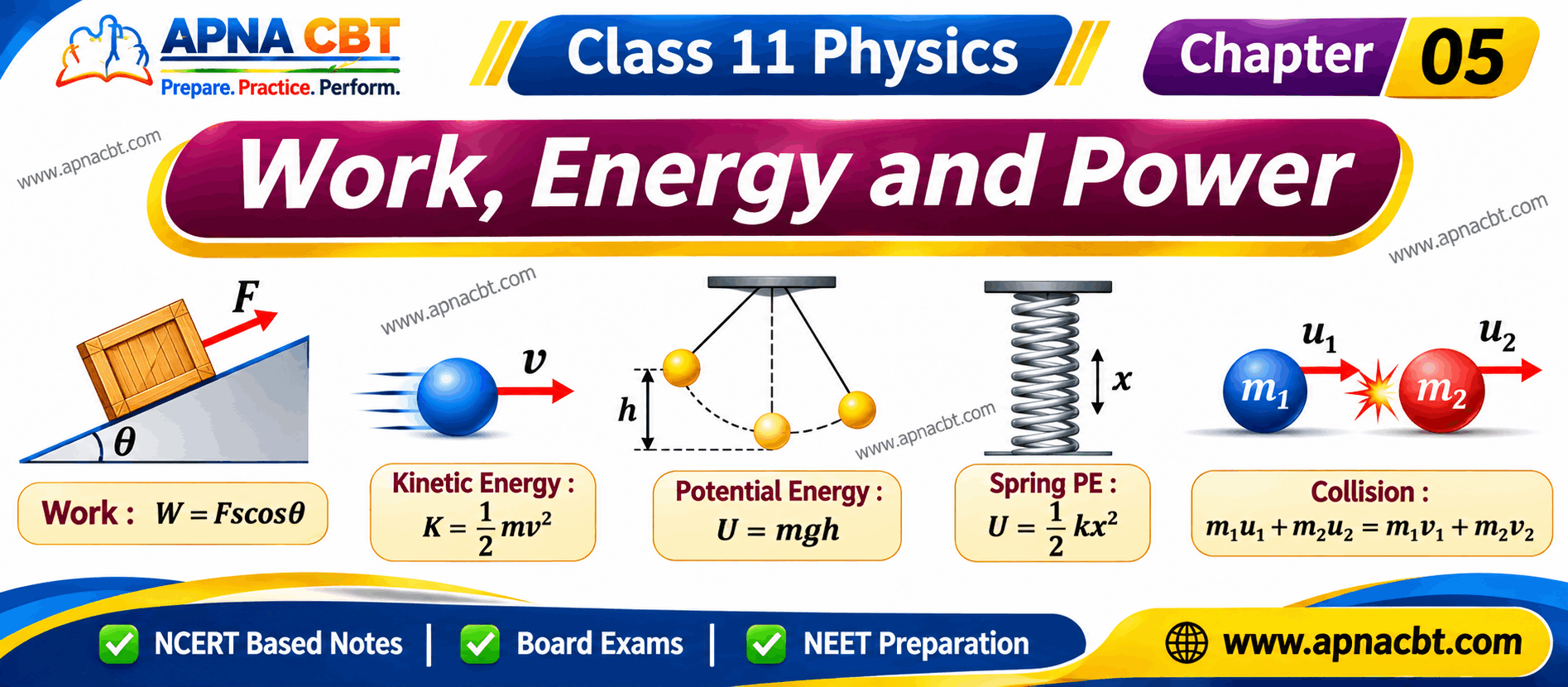
Chapter 05: Work, Energy and Power
Class 11 Physics | CBSE Board Examinations | NEET-UG Preparation
This lesson covers the important concepts, definitions, laws, derivations, applications and formulae from Work, Energy and Power. Review each numbered section and practise the questions for board examinations and NEET preparation.
1. Scalar Product or Dot Product of Vectors
The scalar product (dot product) of vectors A and B is defined as A · B = AB cos θ, where θ is the angle between them. The result is a scalar quantity.
- Commutative: A · B = B · A.
- Distributive: A · (B + C) = A · B + A · C.
- A · A = A²; perpendicular vectors have zero dot product.
- In Cartesian form, A · B = AₓBₓ + AᵧBᵧ + A𝓏B𝓏.
- For unit vectors: i·i = j·j = k·k = 1 and i·j = j·k = k·i = 0.
The dot product is useful when calculating work, projections and the component of one vector along another.
2. Work Done by a Constant Force
Work is done by a force when it produces displacement. For a constant force F causing displacement s at angle θ to the force, W = F s cos θ = F · s.
- Work is a scalar quantity; SI unit: joule (J).
- 1 J = 1 N m.
- Only the component of force along the displacement does work. A perpendicular component does no work.
- If force or displacement is zero, work is zero.
Examples: a person lifting a load does positive work against gravity; a coolie walking horizontally with a load applies an upward force while displacement is horizontal, so the work done by the supporting force on the load is zero.
3. Positive, Negative and Zero Work
- Positive work: Force has a component along displacement (θ < 90°). Example: gravity on a falling body.
- Negative work: Force has a component opposite displacement (θ > 90°). Example: friction on a sliding block or gravity on a body moving upward.
- Zero work: Force is perpendicular to displacement (θ = 90°), or force/displacement is zero. Example: centripetal force in uniform circular motion.
The sign of work depends on the angle between force and displacement, not simply on whether the force is called applied or resistive.
4. Work Done by Several Forces and Rectangular Components
When several forces act on a body, the total or net work is the algebraic sum of the work done by individual forces: Wnet = ΣWᵢ. Equivalently, Wnet = Fnet · s for constant net force.
In rectangular components, W = Fₓsₓ + Fᵧsᵧ + F𝓏s𝓏. This is especially useful when force and displacement are given in vector form.
For a block moving on a horizontal surface, normal reaction and weight do zero work if displacement is horizontal; applied force and friction may do positive and negative work respectively.
5. Work Done by a Variable Force
If force changes with position, work cannot generally be calculated using one constant force value. For a force along the x-axis:
W = ∫ₓ₁ˣ² F(x) dx.
Graphically, work equals the signed area under the force–displacement graph between the initial and final positions. Areas above the x-axis are positive and areas below it are negative.
For a varying force in more than one dimension, the general expression is W = ∫ F · dr.
6. Kinetic Energy and Its Expression
Kinetic energy is the energy possessed by a body due to its motion. For a body of mass m moving with speed v:
K = ½mv².
- Kinetic energy is a scalar and is never negative.
- SI unit: joule (J); dimensional formula: [ML²T⁻²].
- It depends on the square of speed. Doubling speed makes kinetic energy four times.
- For the same kinetic energy, momentum magnitude is p = √(2mK).
7. Work–Energy Theorem
The work–energy theorem states that the net work done by all forces on a particle equals the change in its kinetic energy.
Wnet = Kf − Ki = ½mv² − ½mu².
For a constant net force, use W = Fs cos θ and Newton’s second law to obtain the theorem. It also holds for variable forces when work is evaluated by integration.
The theorem concerns the change in kinetic energy. Work done may also be stored as potential energy or dissipated as thermal energy, depending on the system and forces involved.
8. Work–Energy Theorem for Variable Force and Applications
For one-dimensional motion, F = m dv/dt and dx/dt = v. Therefore, F dx = m v dv. Integrating between initial and final velocities gives:
W = ∫F dx = ∫mu dv = ½m(v² − u²).
Applications include finding the stopping distance of a vehicle, the average resistive force on a bullet, speed after moving through a known force region, and the work done by friction. Always use net work when applying the theorem.
9. Potential Energy and Its Types
Potential energy is the energy associated with the position of a body in a force field or the configuration of a system. Its value is defined relative to a chosen zero or reference configuration.
- Gravitational potential energy: Associated with separation in a gravitational field.
- Elastic potential energy: Stored when an elastic object such as a spring is stretched or compressed.
- Electrostatic potential energy: Associated with the configuration of electric charges.
- Chemical energy is also associated with molecular configuration and interactions.
10. Gravitational Potential Energy Near Earth
Near Earth’s surface, if the gravitational field is approximately uniform, the change in gravitational potential energy when a body is raised through height h is ΔU = mgh.
If the zero level is chosen at the ground, U = mgh. The change in potential energy depends on vertical height change, not the path followed. Work done by gravity is Wg = −ΔU.
For large distances from Earth, the gravitational potential energy with zero at infinity is U = −GMm/r. Near the surface, the mgh expression is a useful approximation.
11. Conservative and Non-conservative Forces
A force is conservative if the work done between two points is independent of the path. Its work over any closed path is zero, and a potential energy function can be defined. Examples: gravitational force and ideal spring force.
A force is non-conservative if its work depends on the path. Work over a closed path is generally non-zero. Examples: kinetic friction and viscous drag.
For a conservative force, WA→B = U(A) − U(B) = −ΔU. For a one-dimensional conservative force, F(x) = −dU/dx.
12. Mechanical Energy and Conservation of Mechanical Energy
Mechanical energy is the sum of kinetic and potential energies: E = K + U.
When only conservative forces do work (or non-conservative work is zero), total mechanical energy remains constant:
Kᵢ + Uᵢ = K𝒇 + U𝒇.
In free fall without air resistance, loss of gravitational potential energy equals gain in kinetic energy. With friction or air resistance, mechanical energy may be transformed into thermal or other forms, although total energy is conserved.
13. Potential Energy of a Spring and Spring Force
For an ideal spring within its elastic limit, Hooke’s law gives the restoring force F = −kx, where x is displacement from natural length and k is the spring constant.
The elastic potential energy stored in a spring stretched or compressed by x is U = ½kx². It is the area under the magnitude of the force–displacement graph from 0 to x.
Work done by the spring in moving from x₁ to x₂ is Wspring = ½k(x₁² − x₂²). The spring force is conservative.
14. Motion in a Vertical Circle
In vertical circular motion, gravity changes the speed of the body at different points. At the highest point, the minimum speed required to maintain a taut string is vtop = √(gr), because tension is just zero there.
For a particle just completing a vertical circle, conservation of mechanical energy between the lowest and highest points gives vbottom² = vtop² + 4gr = 5gr, hence vbottom,min = √(5gr).
At any point, apply both energy conservation and the radial force equation. The string remains taut only if its tension is non-negative.
15. Power, Average Power and Instantaneous Power
Power is the rate of doing work or transferring energy.
Average power = W/Δt; instantaneous power P = dW/dt = F · v.
- SI unit: watt (W), where 1 W = 1 J s⁻¹.
- For constant force and velocity, P = Fv cos θ.
- Horsepower is a non-SI unit; 1 metric horsepower is approximately 735.5 W.
- 1 kilowatt-hour = 3.6 × 10⁶ J. It is a unit of energy, not power.
16. Collisions: Momentum and Energy
A collision is a short-duration interaction in which bodies exert large forces on one another. During an isolated collision, total linear momentum is conserved, even though the momentum of each individual body may change.
Kinetic energy may or may not be conserved. In an elastic collision, total kinetic energy is conserved. In an inelastic collision, some initial kinetic energy is transformed into heat, sound, deformation or internal energy. Total energy remains conserved.
Collisions may be head-on (one-dimensional) or oblique (two-dimensional).
17. Elastic, Inelastic and Perfectly Inelastic Collisions
- Elastic collision: Total momentum and total kinetic energy are conserved; coefficient of restitution e = 1.
- Inelastic collision: Momentum is conserved for an isolated system, but kinetic energy is not; for ordinary passive collisions 0 ≤ e < 1.
- Perfectly inelastic collision: Bodies stick together after collision and move with a common velocity; e = 0. The loss of kinetic energy is maximum for the given initial conditions and momentum conservation.
- Superelastic collision: Internal energy is released, so kinetic energy of translational motion can increase; e may exceed 1.
18. One-dimensional Collisions and Coefficient of Restitution
For two bodies of masses m₁ and m₂ with initial velocities u₁ and u₂ and final velocities v₁ and v₂, conservation of momentum gives:
m₁u₁ + m₂u₂ = m₁v₁ + m₂v₂.
The coefficient of restitution for a head-on collision is the ratio of relative speed of separation to relative speed of approach:
e = (v₂ − v₁)/(u₁ − u₂), using a consistent sign convention for the chosen direction.
For a perfectly inelastic collision, v₁ = v₂ = v = (m₁u₁ + m₂u₂)/(m₁ + m₂).
19. Special Cases of One-dimensional Elastic Collisions
For a one-dimensional elastic collision, both momentum and kinetic energy are conserved.
- For equal masses, if one body is initially at rest, the bodies exchange velocities.
- If a light body collides elastically head-on with a very massive body at rest, the light body approximately rebounds with the same speed in the opposite direction.
- If a very massive body collides elastically with a much lighter stationary body, the massive body’s speed changes very little and the lighter body moves away at approximately twice the initial speed of the massive body.
These are limiting or special cases; use the conservation equations for general masses and velocities.
20. Two-dimensional or Oblique Collisions
In an oblique collision, velocities are not along one common line. Resolve momentum into perpendicular components and conserve each component for an isolated system:
Σpₓ(before) = Σpₓ(after), and Σpᵧ(before) = Σpᵧ(after).
For an elastic oblique collision, total kinetic energy is also conserved. In a perfectly inelastic oblique collision, the bodies stick together and their common velocity is obtained from the vector sum of initial momenta divided by total mass.
21. Important Formulae and CBSE/NEET Revision
| Concept | Formula |
|---|---|
| Scalar product | A · B = AB cos θ |
| Work (constant force) | W = Fs cos θ |
| Work (variable force) | W = ∫F · dr |
| Kinetic energy | K = ½mv² |
| Work–energy theorem | Wnet = ΔK |
| Gravitational PE near Earth | U = mgh; ΔU = mgΔh |
| Gravitational PE (general) | U = −GMm/r |
| Mechanical energy | E = K + U |
| Spring force | F = −kx |
| Spring potential energy | U = ½kx² |
| Conservative force | F(x) = −dU/dx |
| Vertical circle minimum speed at top | vtop = √(gr) |
| Minimum bottom speed for complete loop | vbottom = √(5gr) |
| Average power | Pavg = W/Δt |
| Instantaneous power | P = F · v |
| Energy conversion | 1 kWh = 3.6 × 10⁶ J |
| Momentum conservation | m₁u₁ + m₂u₂ = m₁v₁ + m₂v₂ |
| Coefficient of restitution | e = relative speed of separation / relative speed of approach |
Exam reminders
- Work is a scalar and can be positive, negative or zero.
- Use net work in the work–energy theorem.
- Potential energy is defined relative to a reference level.
- Mechanical energy is conserved only when non-conservative work is absent or negligible.
- Momentum is conserved in an isolated collision; kinetic energy is conserved only in an elastic collision.
- Power is the rate of energy transfer; kWh measures energy.
22. Short-answer Questions – 30 Questions
Questions
- Define scalar product of two vectors.
- State two properties of the dot product.
- When is the dot product of two vectors zero?
- Define work done by a constant force.
- What is the SI unit of work?
- When is work positive?
- Give one example of negative work.
- Give one example of zero work.
- What does the area under a force–displacement graph represent?
- Define kinetic energy and write its expression.
- State the work–energy theorem.
- What is potential energy?
- Write gravitational potential energy near Earth’s surface.
- Define a conservative force.
- Give two examples of conservative forces.
- Give two examples of non-conservative forces.
- Define mechanical energy.
- State the conservation of mechanical energy.
- State Hooke’s law for a spring.
- Write the potential energy stored in a spring.
- Define power and write its SI unit.
- Write the expression for instantaneous power.
- Convert one kilowatt-hour into joules.
- What is a collision?
- What quantities are conserved in an isolated collision?
- Define elastic collision.
- Define perfectly inelastic collision.
- Define coefficient of restitution.
- What is an oblique collision?
- State the minimum speed at the top of a vertical circle for a taut string.
Answers
- Define scalar product of two vectors.
A · B = AB cos θ, where θ is the angle between the vectors. Its value is a scalar. - State two properties of the dot product.
It is commutative, A·B = B·A, and distributive, A·(B+C) = A·B + A·C. - When is the dot product of two vectors zero?
When either vector is zero or when the two non-zero vectors are perpendicular. - Define work done by a constant force.
Work is the scalar product of force and displacement: W = Fs cos θ. - What is the SI unit of work?
Joule (J); 1 J = 1 N m. - When is work positive?
When the force has a component in the direction of displacement; for θ < 90°, W is positive. - Give one example of negative work.
Friction acting on a block sliding over a rough surface does negative work. - Give one example of zero work.
Centripetal force in uniform circular motion does zero work because it is perpendicular to instantaneous displacement. - What does the area under a force–displacement graph represent?
The signed work done by the force over the displacement interval. - Define kinetic energy and write its expression.
Kinetic energy is energy due to motion; K = ½mv². - State the work–energy theorem.
Net work done on a body equals its change in kinetic energy: Wnet = Kf − Ki. - What is potential energy?
Energy associated with the position of a body in a force field or the configuration of a system. - Write gravitational potential energy near Earth’s surface.
For a chosen zero level, U = mgh. - Define a conservative force.
A force whose work between two points is path-independent and whose work over a closed path is zero. - Give two examples of conservative forces.
Gravitational force and ideal spring force. - Give two examples of non-conservative forces.
Kinetic friction and viscous drag. - Define mechanical energy.
The sum of kinetic and potential energies: E = K + U. - State the conservation of mechanical energy.
If only conservative forces do work, the total mechanical energy remains constant. - State Hooke’s law for a spring.
Within its elastic limit, the restoring force is F = −kx. - Write the potential energy stored in a spring.
U = ½kx², where x is extension or compression from natural length. - Define power and write its SI unit.
Power is the rate of doing work; its SI unit is watt (W). - Write the expression for instantaneous power.
P = dW/dt = F·v. - Convert one kilowatt-hour into joules.
1 kWh = 3.6 × 10⁶ J. - What is a collision?
A short-duration interaction between bodies during which they exert large forces on one another. - What quantities are conserved in an isolated collision?
Total linear momentum is conserved; kinetic energy is conserved only if the collision is elastic. - Define elastic collision.
A collision in which total momentum and total kinetic energy are conserved; e = 1. - Define perfectly inelastic collision.
A collision in which bodies stick together and move with a common velocity; e = 0. - Define coefficient of restitution.
The ratio of relative speed of separation to relative speed of approach along the line of impact. - What is an oblique collision?
A collision in which the initial velocities are not along a single common line and momentum must be resolved into components. - State the minimum speed at the top of a vertical circle for a taut string.
vtop = √(gr), when the tension is just zero at the top.
23. Long-answer Questions – 15 Questions
Questions
- Explain scalar product and derive its Cartesian component form.
- Derive the expression for work done by a constant force and explain its sign.
- Explain work done by a variable force using a force–displacement graph.
- State and prove the work–energy theorem for a constant force.
- Derive the work–energy theorem for a variable force.
- Explain potential energy and distinguish gravitational, elastic and electrostatic potential energy.
- Explain conservative and non-conservative forces with their properties.
- State and explain the law of conservation of mechanical energy with an example.
- Derive the expression for elastic potential energy stored in a spring.
- Explain motion in a vertical circle and derive the minimum speed at the lowest point for completing a loop.
- Define power and derive its relation with force and velocity.
- Explain elastic, inelastic and perfectly inelastic collisions.
- Derive the final velocities for a one-dimensional elastic collision.
- Explain perfectly inelastic collision in one dimension and obtain the common velocity.
- Explain two-dimensional collisions and show how momentum is conserved.
Detailed Answers
- Explain scalar product and derive its Cartesian component form.
The scalar product of vectors A and B is A·B = AB cos θ, where θ is the angle between them. It is a scalar. Write A = Aₓi + Aᵧj + A𝓏k and B = Bₓi + Bᵧj + B𝓏k. Expanding the dot product and using i·i = j·j = k·k = 1 and i·j = j·k = k·i = 0 gives A·B = AₓBₓ + AᵧBᵧ + A𝓏B𝓏. This expression is useful for calculating work and vector projections. - Derive the expression for work done by a constant force and explain its sign.
For a constant force F making angle θ with displacement s, the component along displacement is F cos θ. Work is the product of this component and displacement: W = Fs cos θ = F·s. If θ is acute, work is positive; if obtuse, it is negative; if θ = 90°, it is zero. Work is scalar and its SI unit is joule. - Explain work done by a variable force using a force–displacement graph.
When force varies with position, divide the displacement into small intervals Δx. Over a sufficiently small interval, force is approximately constant and the work is ΔW ≈ F(x)Δx. Adding all intervals and taking the limit gives W = ∫ₓ₁ˣ² F(x) dx. On an F–x graph, this integral is the signed area under the curve. Regions above the x-axis contribute positive work and regions below it contribute negative work. - State and prove the work–energy theorem for a constant force.
The net work on a mass m is W = Fs. From Newton’s second law F = ma and the kinematic relation v² − u² = 2as, so s = (v² − u²)/(2a). Therefore W = ma × (v² − u²)/(2a) = ½mv² − ½mu². Since K = ½mv², Wnet = Kf − Ki = ΔK. The theorem says net work changes the kinetic energy. - Derive the work–energy theorem for a variable force.
For one-dimensional motion, F = ma = m dv/dt. Since v = dx/dt, F dx = m(dv/dt)dx = mv dv. Integrating from initial position and speed to final position and speed gives W = ∫F dx = ∫ᵤᵛ mv dv = ½m(v² − u²). Hence the net work equals the change in kinetic energy. - Explain potential energy and distinguish gravitational, elastic and electrostatic potential energy.
Potential energy is energy associated with position in a force field or the configuration of a system. Gravitational potential energy arises from gravitational interaction; near Earth U = mgh for a selected reference. Elastic potential energy is stored when a spring is stretched or compressed; U = ½kx². Electrostatic potential energy arises from the configuration of electric charges. Potential energy is defined relative to a chosen zero configuration. - Explain conservative and non-conservative forces with their properties.
A conservative force does path-independent work between two points; its work over a closed path is zero and a potential energy function can be defined. Examples are gravity and ideal spring force. For such a force W = −ΔU and in one dimension F = −dU/dx. A non-conservative force has path-dependent work and generally non-zero work over a closed path. Friction and viscous drag are examples. Their work often converts mechanical energy into thermal energy. - State and explain the law of conservation of mechanical energy with an example.
When only conservative forces do work, the sum of kinetic and potential energies remains constant: K + U = constant. For a body falling freely from rest from height H, at height h above ground its speed satisfies ½mv² + mgh = mgH. Thus loss of gravitational potential energy equals gain in kinetic energy. Air resistance or friction can cause mechanical energy to change into thermal energy. - Derive the expression for elastic potential energy stored in a spring.
For an ideal spring, the restoring force is F = −kx. To stretch it slowly through displacement x, the external force has magnitude kx. The work done by the external force is the area under the force–displacement graph, a triangle of base x and height kx. Therefore U = ½ × x × kx = ½kx². The same expression applies to compression by magnitude x. - Explain motion in a vertical circle and derive the minimum speed at the lowest point for completing a loop.
At the highest point, the minimum condition for a string to remain taut is zero tension. The centripetal condition is mg + T = mvtop²/r, so at T = 0, vtop² = gr. Between bottom and top, the rise in height is 2r. Conservation of mechanical energy gives ½mvbottom² = ½mvtop² + mg(2r). Substituting vtop² = gr gives vbottom² = 5gr, so the minimum bottom speed is √(5gr). - Define power and derive its relation with force and velocity.
Power is the rate of doing work: P = dW/dt. For a small displacement dr under force F, dW = F·dr. Dividing by dt gives P = F·(dr/dt) = F·v. Thus instantaneous power is the dot product of force and velocity. Average power is total work divided by the time interval. SI unit is watt. - Explain elastic, inelastic and perfectly inelastic collisions.
In an elastic collision, total momentum and total kinetic energy are conserved and e = 1. In an inelastic collision, momentum is conserved for an isolated system, but kinetic energy decreases as some is converted into internal energy, heat, sound or deformation; ordinarily 0 ≤ e < 1. In a perfectly inelastic collision, bodies stick together after impact and move with one common velocity; e = 0. Total energy is conserved in all cases. - Derive the final velocities for a one-dimensional elastic collision.
For masses m₁ and m₂ with initial velocities u₁ and u₂ and final velocities v₁ and v₂, momentum conservation gives m₁u₁ + m₂u₂ = m₁v₁ + m₂v₂. Conservation of kinetic energy gives m₁u₁² + m₂u₂² = m₁v₁² + m₂v₂². Factoring the energy equation and combining with momentum gives u₁ − u₂ = −(v₁ − v₂), or relative speed of separation equals relative speed of approach. Solving the two equations yields v₁ = [(m₁−m₂)u₁ + 2m₂u₂]/(m₁+m₂) and v₂ = [2m₁u₁ + (m₂−m₁)u₂]/(m₁+m₂). - Explain perfectly inelastic collision in one dimension and obtain the common velocity.
In a perfectly inelastic collision, the bodies stick together after collision. For masses m₁ and m₂ with initial velocities u₁ and u₂ and common final velocity v, momentum conservation gives m₁u₁ + m₂u₂ = (m₁+m₂)v. Therefore v = (m₁u₁ + m₂u₂)/(m₁+m₂). Kinetic energy is not conserved; some is transformed into internal energy, heat, sound or deformation. - Explain two-dimensional collisions and show how momentum is conserved.
For an isolated system, total momentum is a vector and remains constant. In a two-dimensional collision, resolve the momentum vectors into x and y components. Then m₁u₁ₓ + m₂u₂ₓ = m₁v₁ₓ + m₂v₂ₓ and m₁u₁ᵧ + m₂u₂ᵧ = m₁v₁ᵧ + m₂v₂ᵧ. These component equations determine unknown final velocities. For elastic collisions, add conservation of total kinetic energy; for perfectly inelastic collisions, the bodies share a common final velocity vector.
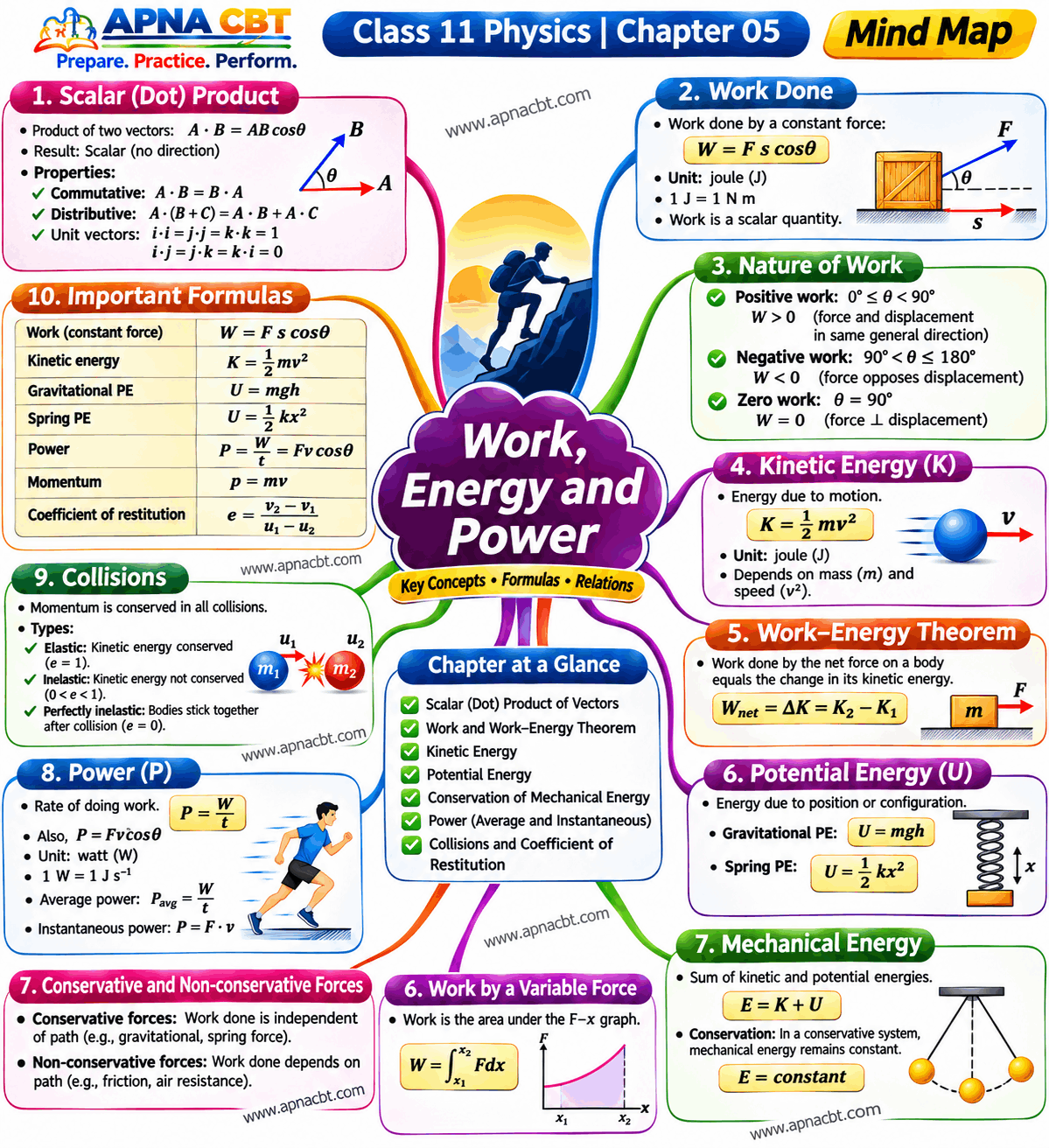
Work, Energy and Power Class 11 Physics Mind Map
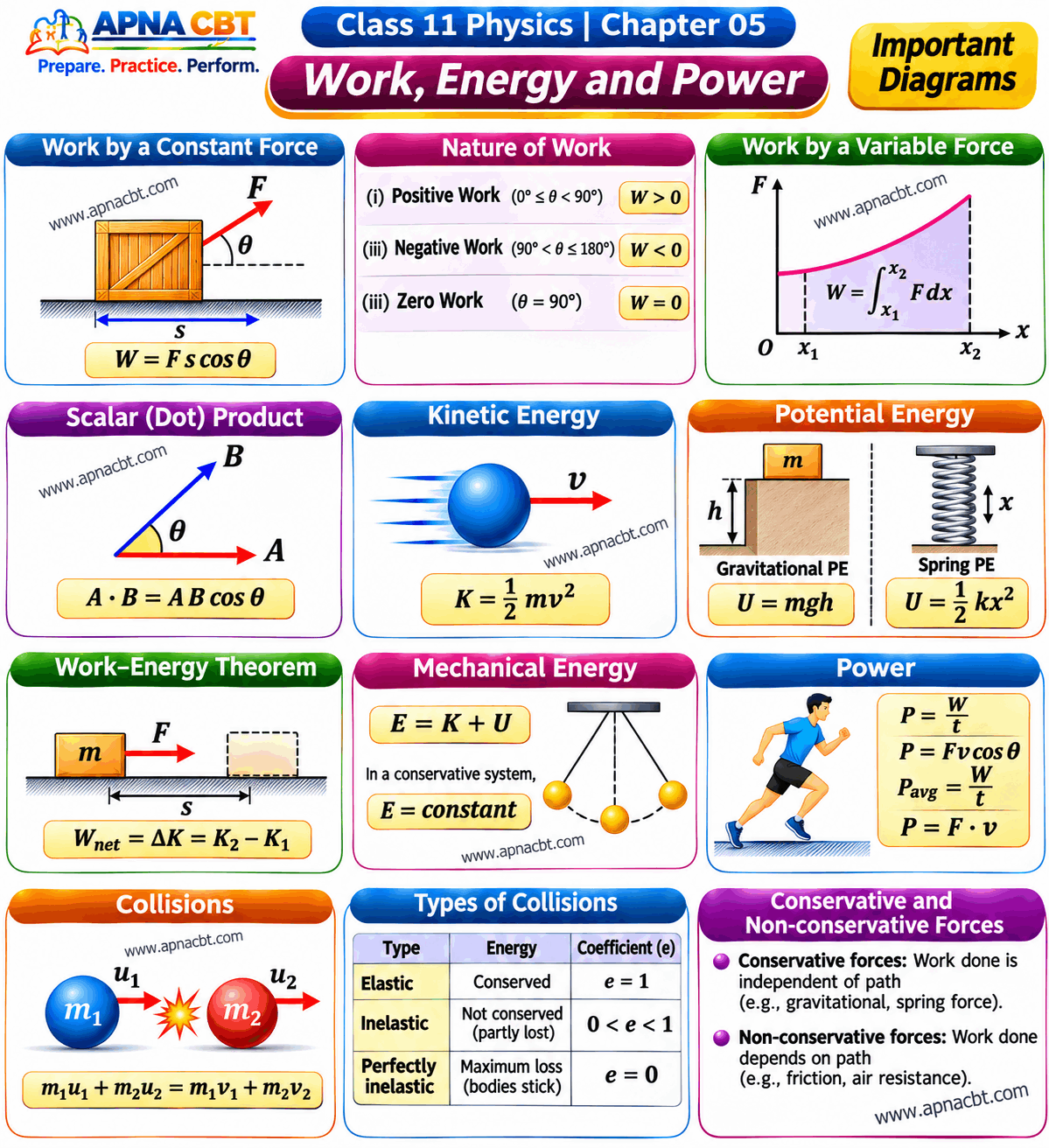
Work, Energy and Power Class 11 Physics – Important Diagrams and Illustrations
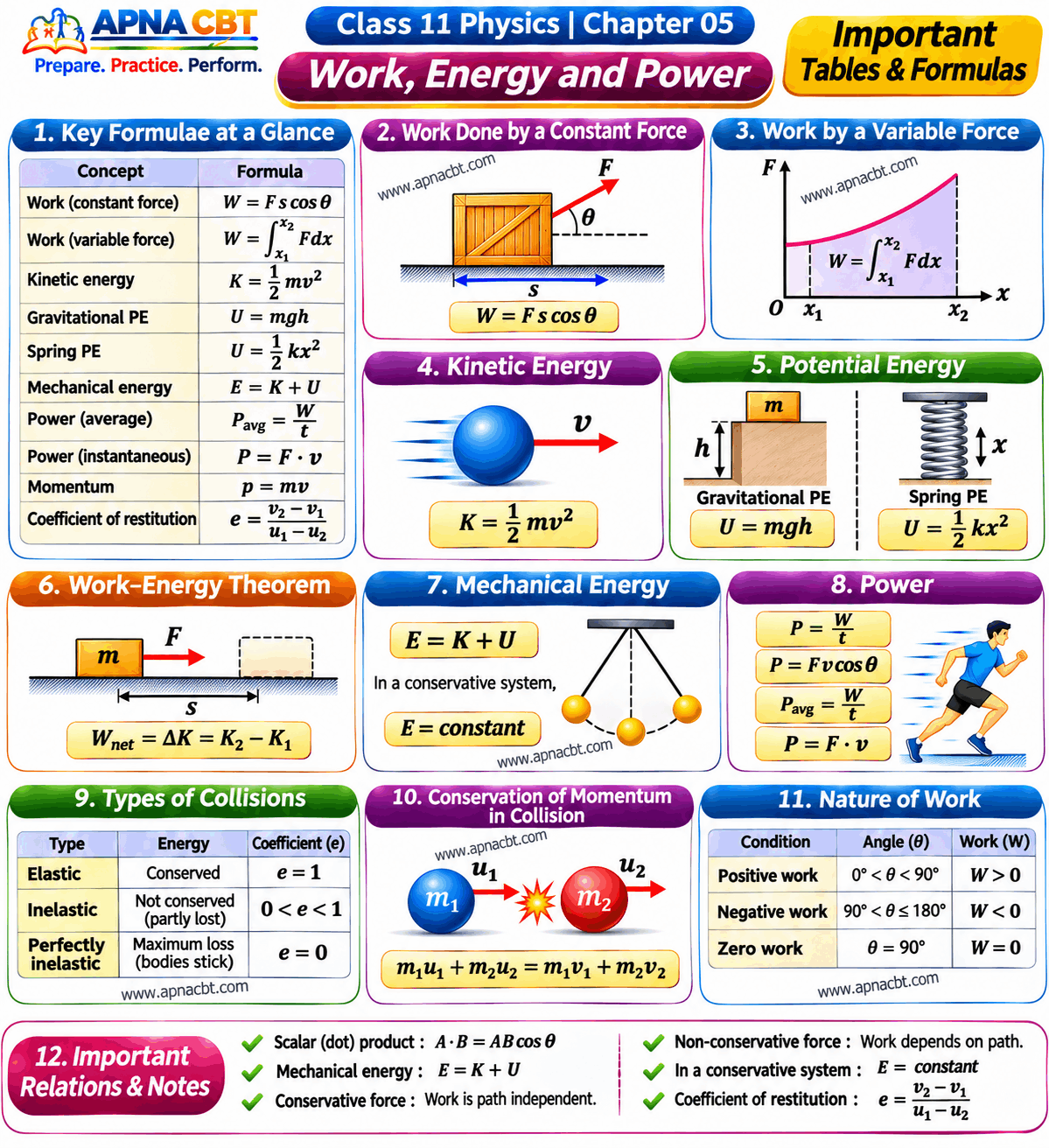
Work, Energy and Power Class 11 Physics – Important Tables and Formulas