


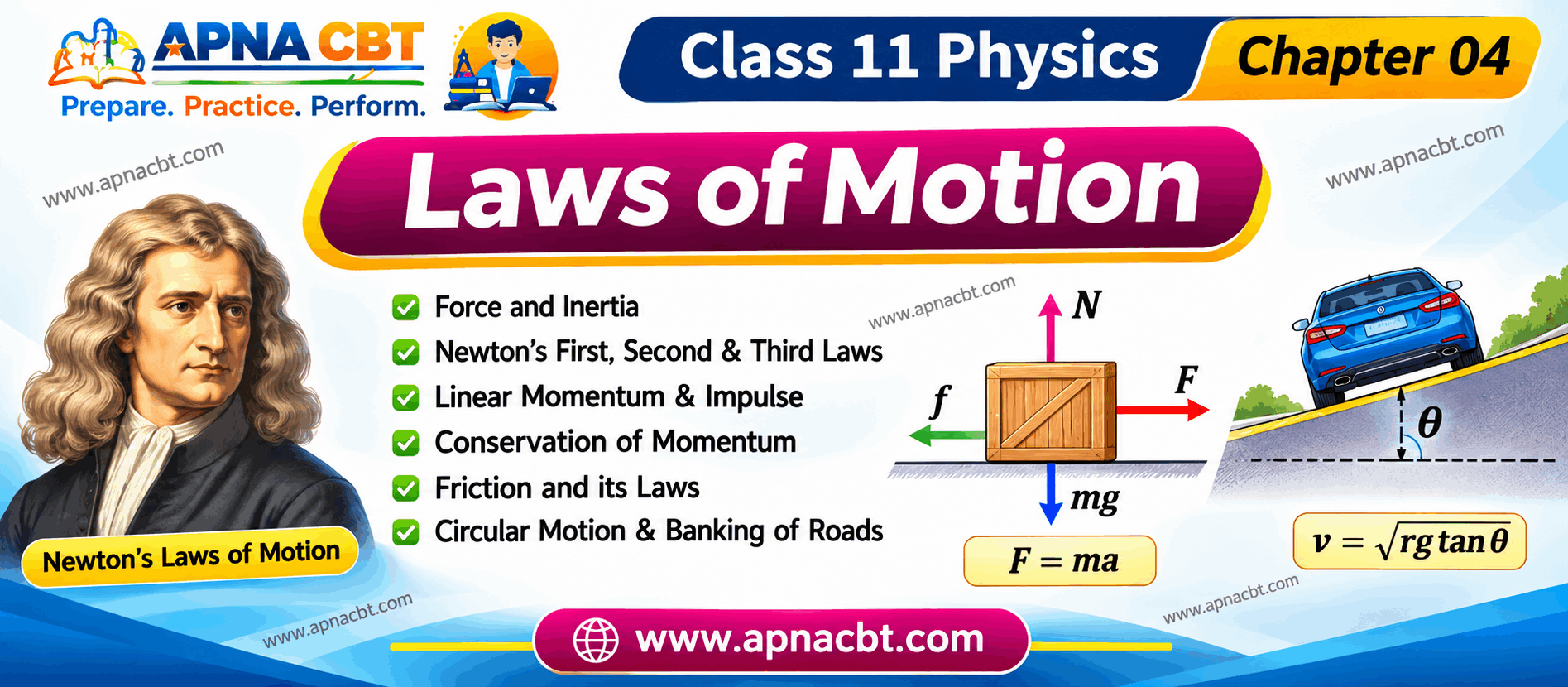
Chapter 04: Laws of Motion
Class 11 Physics | CBSE Board Examinations | NEET-UG Preparation
This lesson covers the important concepts, laws, forces, derivations, applications and formulae from Laws of Motion. Study the numbered sections and practise the questions for conceptual clarity and exam preparation.
1. Force, Aristotle’s Fallacy and Galileo’s Idea of Inertia
Force is a push or pull that changes or tends to change the state of rest, uniform motion or direction of motion of a body. Force describes the interaction between a body and its surroundings.
- Contact forces: Act when bodies are in physical contact, such as friction and tension.
- Non-contact forces: Act without direct physical contact, such as gravitational and magnetic forces.
Aristotle’s fallacy
Aristotle suggested that a continuous external force is required to maintain uniform motion. Everyday objects appear to stop when the applied force is removed, which led to this view.
Galileo’s contribution
Galileo explained that objects stop in everyday situations mainly because opposing forces such as friction act on them. In the absence of friction and other external forces, a moving body would continue with constant velocity.
Galileo’s inclined-plane idea
An object accelerates while moving down an inclined plane and retards while moving up. On a frictionless horizontal plane, it would continue moving with uniform velocity. This reasoning led to the concept of inertia.
2. Newton’s First Law of Motion and Inertia
Newton’s first law: Every body continues in its state of rest or of uniform motion in a straight line unless acted upon by a net external force.
The first law is also called the law of inertia. It gives a qualitative definition of force and identifies the tendency of a body to resist a change in its state of motion.
Inertia
Inertia is the property of a body by virtue of which it resists any change in its state of rest or uniform straight-line motion. Mass is a measure of inertia: greater mass means greater inertia.
Types of inertia
- Inertia of rest: A body at rest tends to remain at rest. Example: passengers tend to fall backward when a stationary bus starts suddenly.
- Inertia of motion: A moving body tends to continue moving. Example: passengers tend to fall forward when a moving bus stops suddenly.
- Inertia of direction: A body resists a change in direction. Example: passengers are pushed sideways when a vehicle takes a sharp turn.
Applications
Mud particles leave a rotating wheel tangentially when they lose contact with it. A person jumping from a moving vehicle continues to move forward due to inertia and must take steps to avoid falling.
Inertial frame
Newton’s first law is valid in an inertial frame of reference, which is a frame at rest or moving with constant velocity. An accelerating frame is non-inertial.
3. Linear Momentum and Newton’s Second Law
Linear momentum is the product of mass and velocity. It is a vector quantity directed along velocity.
p = mv; SI unit: kg m s−1.
Newton’s second law states that the net external force on a body is equal to the rate of change of its momentum and acts in the direction of that change.
F = dp/dt. For constant mass, F = ma.
Vector form and components
Fx = max, Fy = may, and Fz = maz. The net force is the vector sum of all external forces.
SI and other units
The SI unit of force is the newton (N). One newton is the force that produces an acceleration of 1 m s−2 in a mass of 1 kg. Thus, 1 N = 1 kg m s−2.
Important interpretation
- Acceleration is in the direction of the net force, not necessarily the direction of velocity.
- If net force is zero, acceleration is zero and momentum remains constant.
- A force can change the magnitude or direction of velocity, or both.
4. Impulse and Impulse–Momentum Theorem
Impulse is the product of force and the time interval for which it acts. For a constant force, J = F Δt. For a variable force, impulse is the time integral of force.
Impulse–momentum theorem: The impulse of the net force acting on a body equals the change in its momentum.
J = Δp = pf − pi = mv − mu (for constant mass).
Force–time graph
The area under a force–time graph over a time interval gives the impulse during that interval.
Applications
- A cricketer moves the hands backward while catching a ball, increasing the stopping time and reducing the average force.
- Airbags and cushioned surfaces increase collision time and reduce the force on a person.
- A long follow-through in striking or kicking increases the impulse delivered to the object.
5. Conservation of Linear Momentum
The total linear momentum of a system remains constant if the net external force acting on the system is zero. Internal forces may act between particles, but they do not change the total momentum of an isolated system.
For two interacting bodies, m1u1 + m2u2 = m1v1 + m2v2, provided external impulse is negligible.
Applications
- Recoil of a gun: A bullet moves forward and the gun recoils backward so that total momentum is conserved.
- Rocket propulsion: A rocket moves forward by ejecting gases backward. The rocket and expelled gases exchange momentum.
- Collisions: Total momentum before and after a collision is conserved for an isolated system.
Rocket propulsion
The thrust on a rocket is related to the rate at which exhaust gases are expelled and their relative speed. The rocket gains forward momentum as the gases carry momentum backward. The system must be considered as the rocket together with its exhaust gases.
6. Newton’s Third Law of Motion
Newton’s third law: To every action, there is an equal and opposite reaction. If body A exerts a force on body B, body B simultaneously exerts an equal and opposite force on body A.
In vector form, FAB = −FBA.
Characteristics of action–reaction pairs
- They are equal in magnitude and opposite in direction.
- They act simultaneously.
- They act on two different bodies, not on the same body.
- They are of the same nature.
- They do not cancel each other when considering one body alone.
Examples
- Walking: the foot pushes the ground backward; the ground pushes the person forward.
- Swimming: a swimmer pushes water backward; water pushes the swimmer forward.
- Gun recoil: the gun pushes the bullet forward; the bullet exerts an opposite force on the gun.
- A book on a table: the book pushes the table downward; the table exerts an upward contact force on the book.
Common exam point: Weight and normal reaction on a book resting on a table are not an action–reaction pair because both act on the same body. Their respective reaction forces act on Earth and on the table.
7. Common Forces in Mechanics: Weight, Normal Force, Tension and Spring Force
Weight
Weight is the gravitational force exerted by Earth on a body. Near Earth’s surface, W = mg, directed vertically downward.
Normal force
The normal force is the contact force exerted by a surface perpendicular to the contact surface. It is not always equal to mg; its value depends on the other forces and the acceleration perpendicular to the surface.
Tension
Tension is the pulling force transmitted through a taut string, rope or cable. For an ideal massless string passing over a smooth, massless pulley, the tension is the same throughout the string.
Spring force
For an ideal spring within its elastic limit, Hooke’s law gives F = −kx, where x is the displacement from the natural length and k is the spring constant. The negative sign indicates that the spring force is restoring.
Free-body diagram
A free-body diagram represents one selected body in isolation and shows all external forces acting on it. Draw weight, normal force, tension, friction, applied forces and any other relevant external force. Do not include forces exerted by the selected body on other bodies.
8. Equilibrium of a Particle and Concurrent Forces
A particle is in equilibrium when the vector sum of all external forces acting on it is zero.
ΣF = 0. In two dimensions, ΣFx = 0 and ΣFy = 0. In three dimensions, ΣFz = 0 also.
Equilibrium does not necessarily mean that the particle is at rest. A particle moving with constant velocity is also in equilibrium because its acceleration is zero.
Concurrent forces
Forces whose lines of action pass through a common point are called concurrent forces. Their vector sum must be zero for equilibrium.
Three-force equilibrium
When three coplanar concurrent forces keep a particle in equilibrium, their vector sum is zero. The triangle law can be used to represent the forces as a closed triangle. Lami’s theorem may be applied when exactly three concurrent coplanar forces keep a particle in equilibrium:
F1/sin α = F2/sin β = F3/sin γ, where each angle is between the other two forces.
Method for solving equilibrium problems
- Draw the free-body diagram.
- Choose convenient perpendicular axes.
- Resolve each force into components.
- Apply ΣFx = 0 and ΣFy = 0.
- Solve the simultaneous equations and check signs and units.
9. Pseudo Force and Non-inertial Frames
A pseudo force is an apparent force introduced when Newton’s laws are applied from an accelerating, non-inertial frame. It does not arise from a physical interaction between two bodies.
For an observer in a frame accelerating with acceleration aframe, the pseudo force on a body of mass m is:
Fpseudo = −m aframe.
It acts opposite to the acceleration of the reference frame. A pseudo force has no action–reaction partner because it is not an interaction force.
Example: accelerating bus
When a bus accelerates forward, a passenger may appear to move backward relative to the bus. In the bus frame, a backward pseudo force is introduced to describe the passenger’s apparent motion.
Remember: In an inertial frame, use real forces only. In a non-inertial frame, include the appropriate pseudo force if applying Newton’s laws in that frame.
10. Friction: Static, Limiting and Kinetic Friction
Friction is the component of contact force parallel to the surfaces in contact that opposes relative motion or the tendency of relative motion.
Static friction
Static friction acts when the surfaces have no relative motion. It adjusts its magnitude as required, up to a maximum value. Thus, fs ≤ μsN.
Limiting friction
The maximum value of static friction, just before slipping begins, is called limiting friction: flim = μsN.
Kinetic or sliding friction
Kinetic friction acts when surfaces slide relative to each other. Its approximate magnitude is fk = μkN.
Coefficients of friction
μs and μk are dimensionless. For many ordinary surfaces, μk is less than μs, though actual values depend on the materials and conditions.
Important distinction
Static friction is not always equal to μsN; it takes the value needed to prevent slipping, up to the limiting value. Kinetic friction is approximately μkN during sliding.
11. Laws of Friction, Angle of Friction and Angle of Repose
Common empirical laws of dry friction
- Friction acts parallel to the surfaces in contact and opposes relative motion or its tendency.
- Limiting friction is proportional to the normal reaction: flim = μsN.
- For a given pair of surfaces, the coefficient of friction depends on the nature and condition of the surfaces.
- For ordinary dry surfaces, sliding friction is approximately independent of the apparent area of contact and is usually less than limiting friction.
Angle of friction
The angle of friction φ is the angle between the resultant of the normal reaction and limiting friction and the normal reaction. At limiting equilibrium, tan φ = flim/N = μs.
Angle of repose
The angle of repose θ is the maximum angle of an inclined plane with the horizontal at which a body just begins to slide down. At this condition, tan θ = μs. Therefore, for the same pair of surfaces, angle of repose equals angle of friction.
12. Rolling Friction and Uses of Friction
Rolling friction is the resistance opposing the rolling motion of a body over a surface. It is generally smaller than sliding friction for comparable conditions. It depends on the nature and deformation of the surfaces and the normal force.
Friction as a useful force
- Friction between the ground and feet enables walking.
- Tyres obtain grip on roads due to friction.
- Brakes use friction to slow or stop vehicles.
- Friction allows writing with a pencil and holding objects.
Friction as a disadvantage
- It causes wear and tear in machine parts.
- It converts useful mechanical energy into heat.
- It reduces the efficiency of machines.
Increasing and reducing friction
Friction can be increased by using rough or high-grip surfaces, tyre treads or sand on slippery ground. It can be reduced using lubricants, polishing, ball bearings and rollers where suitable.
13. Circular Motion and Centripetal Force
A body moving along a circular path continuously changes the direction of its velocity. Even at constant speed, it has acceleration directed towards the centre, called centripetal acceleration.
ac = v²/r = rω², where v is linear speed, r is radius and ω is angular speed.
The net inward force required to produce this acceleration is the centripetal force:
Fc = mv²/r = mrω².
Centripetal force is not a new type of force. It is the name given to the resultant inward force, which may be supplied by tension, friction, gravity, normal reaction or a combination of forces.
Examples
- A stone tied to a string: tension provides the centripetal force.
- A vehicle turning on a level road: friction provides the required centripetal force.
- A satellite in orbit: gravitational attraction provides the centripetal force.
14. Banking of Roads and Circular Motion Applications
When a vehicle moves around a curved road, it needs an inward centripetal force. On a level road this force is generally provided by friction between the tyres and road.
Banked road
A road is banked by raising its outer edge so that the normal reaction has a horizontal component towards the centre of the curve. For an ideal frictionless banked road, the design relation is:
tan θ = v²/(rg), where θ is the banking angle, v is the design speed and r is the radius of the curve.
Why roads are banked
- The horizontal component of the normal reaction helps provide centripetal force.
- It reduces reliance on tyre-road friction at the design speed.
- It helps vehicles negotiate curves more safely when designed appropriately.
For a real road, friction may also act, and the safe speed range depends on banking angle, coefficient of friction, radius and vehicle conditions.
15. Important Formulae and Board/NEET Revision
| Concept | Formula / Result |
|---|---|
| Linear momentum | p = mv |
| Newton’s second law | F = dp/dt; for constant mass, F = ma |
| Impulse | J = FΔt = Δp (constant force) |
| Momentum conservation | Σpinitial = Σpfinal (if net external impulse is zero) |
| Weight | W = mg |
| Spring force | F = −kx |
| Equilibrium | ΣF = 0 |
| Static friction | fs ≤ μsN |
| Limiting friction | flim = μsN |
| Kinetic friction | fk = μkN |
| Angle of friction | tan φ = μs |
| Angle of repose | tan θ = μs |
| Centripetal acceleration | ac = v²/r = rω² |
| Centripetal force | Fc = mv²/r = mrω² |
| Banking of road (ideal) | tan θ = v²/(rg) |
| Pseudo force | Fpseudo = −m aframe |
Exam approach
- Identify the system and draw a clear free-body diagram.
- Distinguish mass from weight and static friction from limiting friction.
- Use momentum conservation only when external impulse is zero or negligible.
- Remember that action and reaction act on different bodies.
- In circular motion, identify the actual force or forces providing the inward resultant.
- Check units, vector directions and limiting conditions in numerical problems.
16. Short-answer Questions – 30 Questions
Questions
- Define force.
- What are contact forces? Give two examples.
- What are non-contact forces? Give two examples.
- What is inertia?
- Why is mass a measure of inertia?
- Name the three types of inertia.
- State Newton’s first law of motion.
- What is an inertial frame of reference?
- Define linear momentum and write its SI unit.
- State Newton’s second law.
- Write Newton’s second law for constant mass.
- Define impulse.
- State the impulse–momentum theorem.
- What does the area under a force–time graph represent?
- State the law of conservation of linear momentum.
- State Newton’s third law.
- Why do action and reaction not cancel each other?
- Define normal force.
- What is tension?
- State Hooke’s law for an ideal spring.
- What is a free-body diagram?
- What is the condition for equilibrium of a particle?
- Does equilibrium mean that a body must be at rest?
- What is pseudo force?
- Define static friction.
- What is limiting friction?
- Write the formula for kinetic friction.
- Define angle of repose.
- What is centripetal force?
- Write the formula for centripetal acceleration.
Answers
- Define force.
Force is a push or pull that changes or tends to change the state of rest, uniform motion or direction of motion of a body. - What are contact forces? Give two examples.
Forces acting through physical contact between bodies; examples include friction and tension. - What are non-contact forces? Give two examples.
Forces acting without direct physical contact; examples include gravitational and magnetic forces. - What is inertia?
The property of a body by which it resists a change in its state of rest or uniform straight-line motion. - Why is mass a measure of inertia?
A larger mass offers greater resistance to a change in motion; hence mass measures inertia. - Name the three types of inertia.
Inertia of rest, inertia of motion and inertia of direction. - State Newton’s first law of motion.
A body remains at rest or in uniform straight-line motion unless acted upon by a net external force. - What is an inertial frame of reference?
A frame at rest or moving with constant velocity in which Newton’s first law is valid. - Define linear momentum and write its SI unit.
Linear momentum is p = mv; its SI unit is kg m s⁻¹. - State Newton’s second law.
The net external force is equal to the rate of change of momentum and acts in that direction. - Write Newton’s second law for constant mass.
F = ma. - Define impulse.
Impulse is the time integral of force; for constant force, J = FΔt. - State the impulse–momentum theorem.
The impulse of the net force equals the change in momentum: J = Δp. - What does the area under a force–time graph represent?
Impulse delivered during the time interval. - State the law of conservation of linear momentum.
The total momentum of a system remains constant when the net external force or external impulse is zero. - State Newton’s third law.
To every action there is an equal and opposite reaction. - Why do action and reaction not cancel each other?
They act on two different bodies, so they do not cancel in the free-body diagram of one body. - Define normal force.
The contact force exerted by a surface perpendicular to the contact surface. - What is tension?
The pulling force transmitted through a taut string, rope or cable. - State Hooke’s law for an ideal spring.
Within its elastic limit, the restoring force is F = −kx. - What is a free-body diagram?
A diagram showing one isolated body and all external forces acting on it. - What is the condition for equilibrium of a particle?
The vector sum of all external forces must be zero: ΣF = 0. - Does equilibrium mean that a body must be at rest?
No. A body moving with constant velocity is also in equilibrium. - What is pseudo force?
An apparent force introduced when describing motion from an accelerating, non-inertial frame. - Define static friction.
Friction acting when there is no relative motion between the contacting surfaces. - What is limiting friction?
The maximum value of static friction just before slipping begins. - Write the formula for kinetic friction.
fₖ = μₖN. - Define angle of repose.
The maximum inclination of a plane with the horizontal at which a body just begins to slide. - What is centripetal force?
The net inward force required to keep a body moving along a circular path. - Write the formula for centripetal acceleration.
a꜀ = v²/r = rω².
17. Long-answer Questions – 15 Questions
Questions
- Explain Aristotle’s view, Galileo’s reasoning and the law of inertia.
- State Newton’s first law and explain the three types of inertia with examples.
- Define linear momentum and derive Newton’s second law in its momentum form.
- Explain impulse and derive the impulse–momentum theorem.
- Explain the law of conservation of linear momentum and state its conditions.
- State Newton’s third law and explain its important characteristics with examples.
- Explain the common forces acting on a body in mechanics.
- What is equilibrium of a particle? Explain the conditions for equilibrium in two dimensions.
- Explain pseudo force and why it is introduced in a non-inertial frame.
- Explain static friction, limiting friction and kinetic friction.
- State the laws of dry friction and explain angle of friction and angle of repose.
- Discuss the advantages and disadvantages of friction and methods of controlling it.
- Derive the expression for centripetal acceleration and centripetal force.
- Explain banking of roads and derive the ideal banking relation.
- Explain the applications of conservation of momentum in recoil and rocket propulsion.
Detailed Answers
- Explain Aristotle’s view, Galileo’s reasoning and the law of inertia.
Aristotle believed that a continuous external force was needed to maintain uniform motion. Galileo explained that everyday objects stop because opposing forces such as friction act on them. Using inclined-plane reasoning, he concluded that on a frictionless horizontal surface a body would continue with uniform velocity. Newton’s first law formalises this idea: a body remains at rest or in uniform straight-line motion unless acted upon by a net external force. This property is called inertia. - State Newton’s first law and explain the three types of inertia with examples.
Newton’s first law states that a body continues in its state of rest or uniform straight-line motion unless acted upon by a net external force. Inertia of rest is the tendency to remain at rest; passengers tend to fall backward when a bus starts suddenly. Inertia of motion is the tendency to continue moving; passengers tend to fall forward when a moving bus stops. Inertia of direction is resistance to a change in direction; passengers are pushed sideways when a vehicle turns sharply. Mass measures inertia. - Define linear momentum and derive Newton’s second law in its momentum form.
Linear momentum is p = mv. Newton’s second law states that the net force is proportional to the rate of change of momentum and is in the direction of that change. In SI units the proportionality constant is one, so F = dp/dt. For constant mass, F = d(mv)/dt = m(dv/dt) = ma. Thus F = ma is the constant-mass form of Newton’s second law. - Explain impulse and derive the impulse–momentum theorem.
Impulse is the integral of force over time: J = ∫F dt. From Newton’s second law F = dp/dt, so F dt = dp. Integrating between initial and final times gives ∫F dt = ∫dp = p_f − p_i. Therefore J = Δp. For constant force, J = FΔt. The theorem explains why increasing the time taken to stop a moving object reduces the average force for a given momentum change. - Explain the law of conservation of linear momentum and state its conditions.
For a system of interacting particles, internal forces occur in equal and opposite pairs and do not change the total momentum of the system. If the net external force is zero, dP/dt = 0, so total momentum P remains constant. For two bodies, m₁u₁ + m₂u₂ = m₁v₁ + m₂v₂. The law applies when the net external force or external impulse on the system is zero or negligible during the interval considered. - State Newton’s third law and explain its important characteristics with examples.
Newton’s third law states that if body A exerts a force on body B, body B simultaneously exerts an equal and opposite force on A. The forces are equal, opposite, simultaneous and of the same nature, but act on different bodies. Examples include walking, swimming, recoil of a gun and the contact interaction between a book and a table. Action and reaction cannot cancel in the free-body diagram of a single body because they act on different objects. - Explain the common forces acting on a body in mechanics.
Weight is the gravitational force W = mg, vertically downward near Earth. Normal force is the contact force perpendicular to a surface. Tension is the pulling force transmitted by a taut string or cable. Spring force is the restoring force F = −kx within the elastic limit. Friction acts parallel to surfaces and opposes relative motion or its tendency. A free-body diagram should show all external forces acting on the selected body. - What is equilibrium of a particle? Explain the conditions for equilibrium in two dimensions.
A particle is in equilibrium when the vector sum of all external forces is zero. In two dimensions, resolving forces along perpendicular axes gives ΣFₓ = 0 and ΣFᵧ = 0. Equilibrium may correspond to rest or constant velocity. For three concurrent coplanar forces, the forces can be represented by a closed triangle. Lami’s theorem can be used for three concurrent coplanar forces in equilibrium: F₁/sin α = F₂/sin β = F₃/sin γ, where each angle is between the other two forces. - Explain pseudo force and why it is introduced in a non-inertial frame.
A pseudo force is an apparent force used when applying Newton’s laws in an accelerating frame. If the frame accelerates with a_frame, a body of mass m experiences a pseudo force F_pseudo = −m a_frame in that frame. It acts opposite to the frame’s acceleration. For example, a passenger in a forward-accelerating bus appears to move backward relative to the bus. Pseudo force is not caused by a physical interaction and has no action–reaction pair. - Explain static friction, limiting friction and kinetic friction.
Static friction acts when there is no relative sliding and adjusts to the value needed to prevent motion, up to a maximum. Thus f_s ≤ μ_sN. Limiting friction is the maximum static friction just before slipping: f_lim = μ_sN. Kinetic friction acts during sliding and is approximately f_k = μ_kN. For many ordinary surfaces μ_k is less than μ_s. The coefficients are dimensionless and depend on the nature and condition of the surfaces. - State the laws of dry friction and explain angle of friction and angle of repose.
Dry friction acts parallel to the contact surfaces and opposes relative motion or its tendency. Limiting friction is proportional to normal reaction, f_lim = μ_sN. The coefficient depends on the nature and condition of the surfaces. The angle of friction φ is the angle between the resultant contact reaction and the normal; tan φ = μ_s. The angle of repose θ is the maximum inclination at which a body just begins to slide; tan θ = μ_s. Hence the angle of repose equals the angle of friction for the same surfaces. - Discuss the advantages and disadvantages of friction and methods of controlling it.
Friction enables walking, gripping objects, writing, tyre-road traction and braking. However, it causes wear, produces unwanted heat and reduces machine efficiency. It can be increased by using rough surfaces, tyre treads or sand on slippery roads. It can be reduced by lubrication, polishing, ball bearings and rollers where appropriate. The aim is not always to eliminate friction but to control it according to the application. - Derive the expression for centripetal acceleration and centripetal force.
In circular motion, velocity is tangential and changes direction continuously. For a small angular displacement Δθ, the velocity change satisfies Δv/v ≈ Δθ. Since Δs = rΔθ, dividing by Δt and taking the limit gives a = (v/r)(ds/dt) = v²/r, directed towards the centre. Using v = rω gives a_c = rω². By Newton’s second law, the inward resultant force is F_c = ma_c = mv²/r = mrω². - Explain banking of roads and derive the ideal banking relation.
On a banked road, the outer edge is raised so that the normal reaction is inclined. For an ideal frictionless banked curve, the vertical component of normal reaction balances weight: N cos θ = mg. The horizontal component supplies centripetal force: N sin θ = mv²/r. Dividing the equations gives tan θ = v²/(rg). Banking reduces dependence on friction at the design speed. Real roads may also use friction, and safe speed depends on road and vehicle conditions. - Explain the applications of conservation of momentum in recoil and rocket propulsion.
In gun recoil, the gun and bullet are initially at rest, so total momentum is zero. After firing, the bullet gains forward momentum and the gun gains equal backward momentum, keeping total momentum conserved if external impulse is negligible. In rocket propulsion, gases are expelled backward at high speed. The exhaust carries backward momentum and the rocket gains forward momentum. The rocket-plus-exhaust system conserves momentum when external forces are negligible over the interval. Rocket thrust is related to the rate of ejection of mass and exhaust speed relative to the rocket.
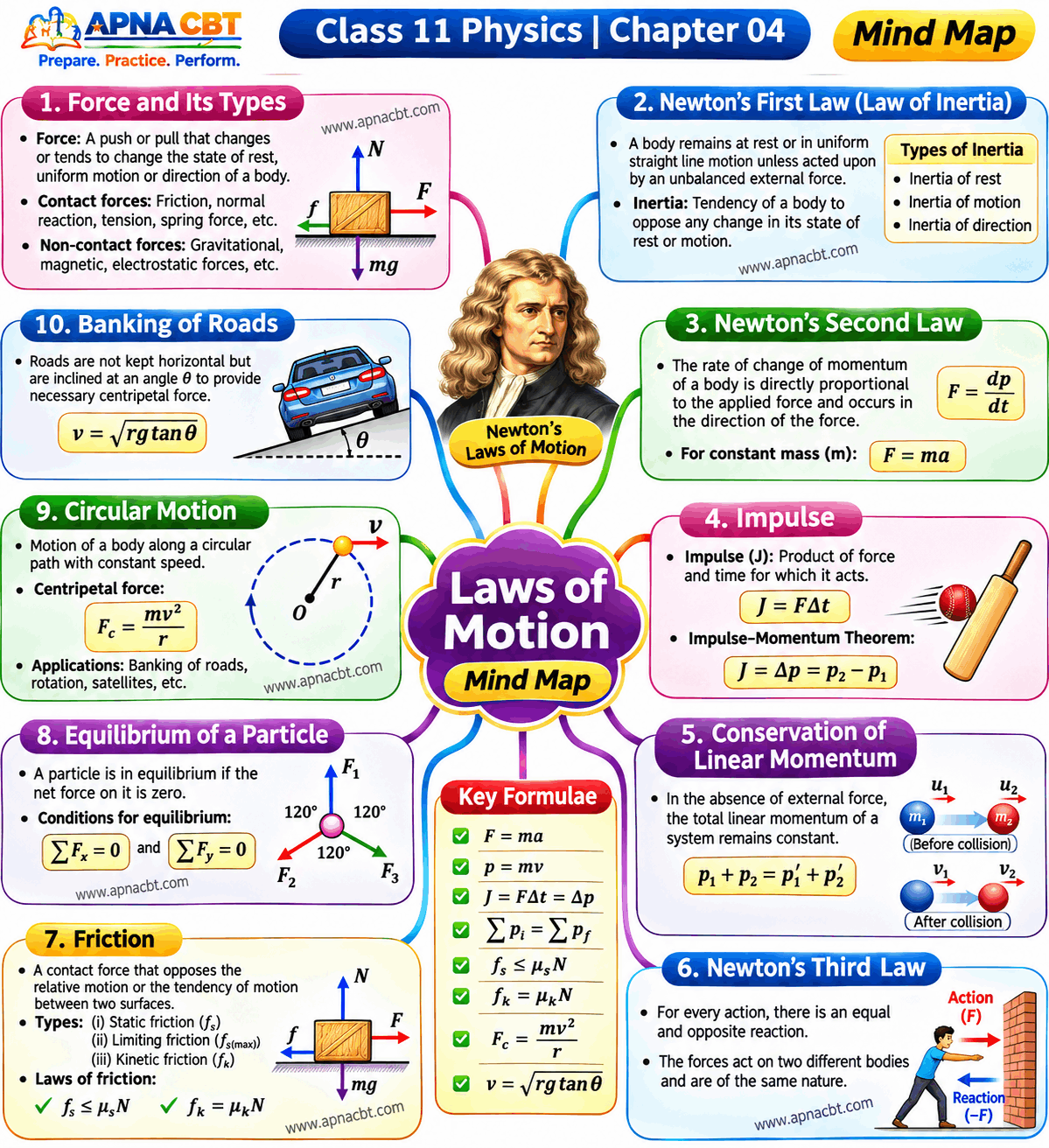
Laws of Motion Class 11 Physics Mind Map
Laws of Motion Class 11 Physics – Important Diagrams and Illustrations
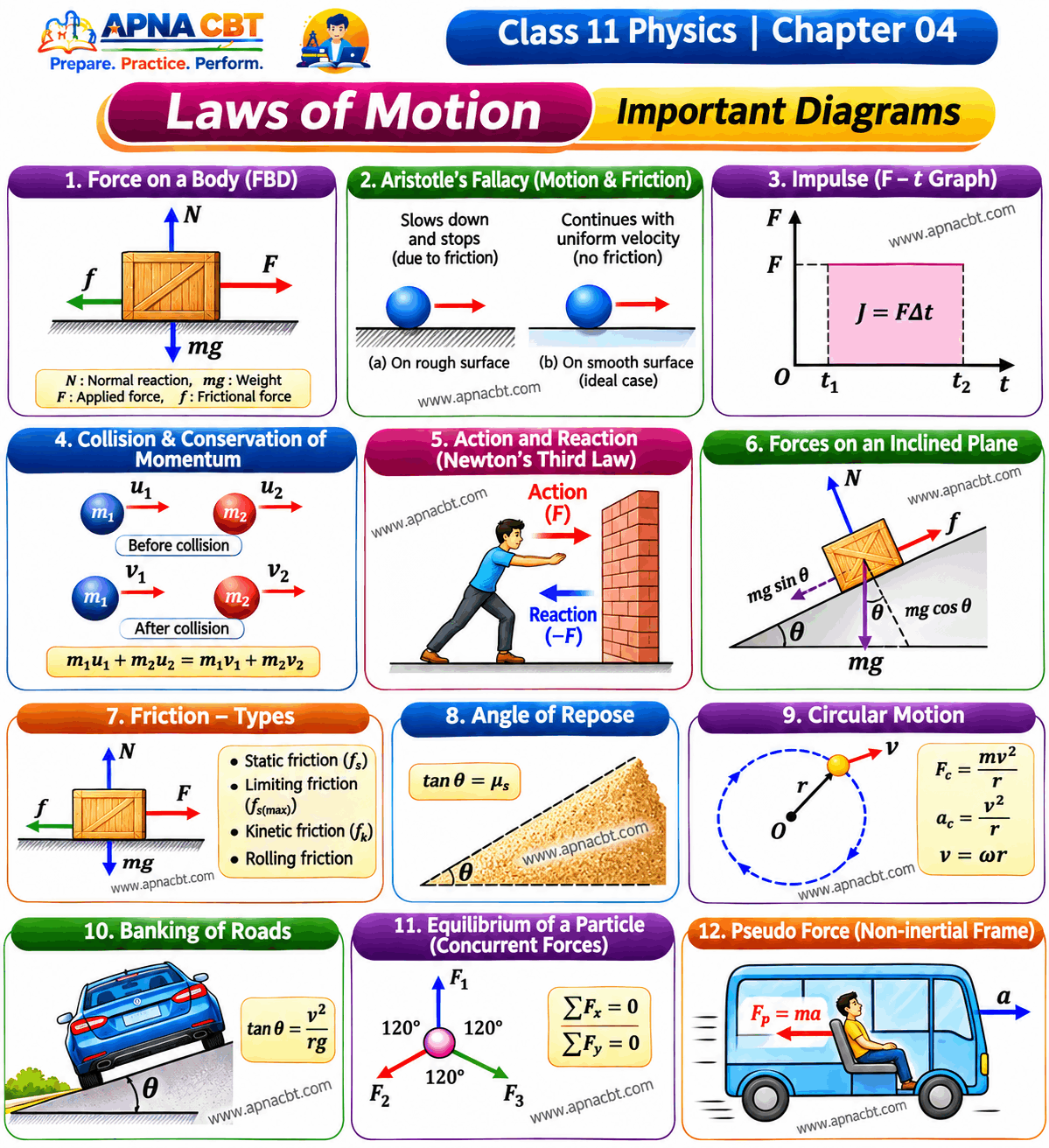
Laws of Motion Class 11 Physics – Important Tables, Formulas and Diagrams

