Chapter 06: System of Particles and Rotational Motion
Class 11 Physics | CBSE Board Examinations | NEET-UG Preparation
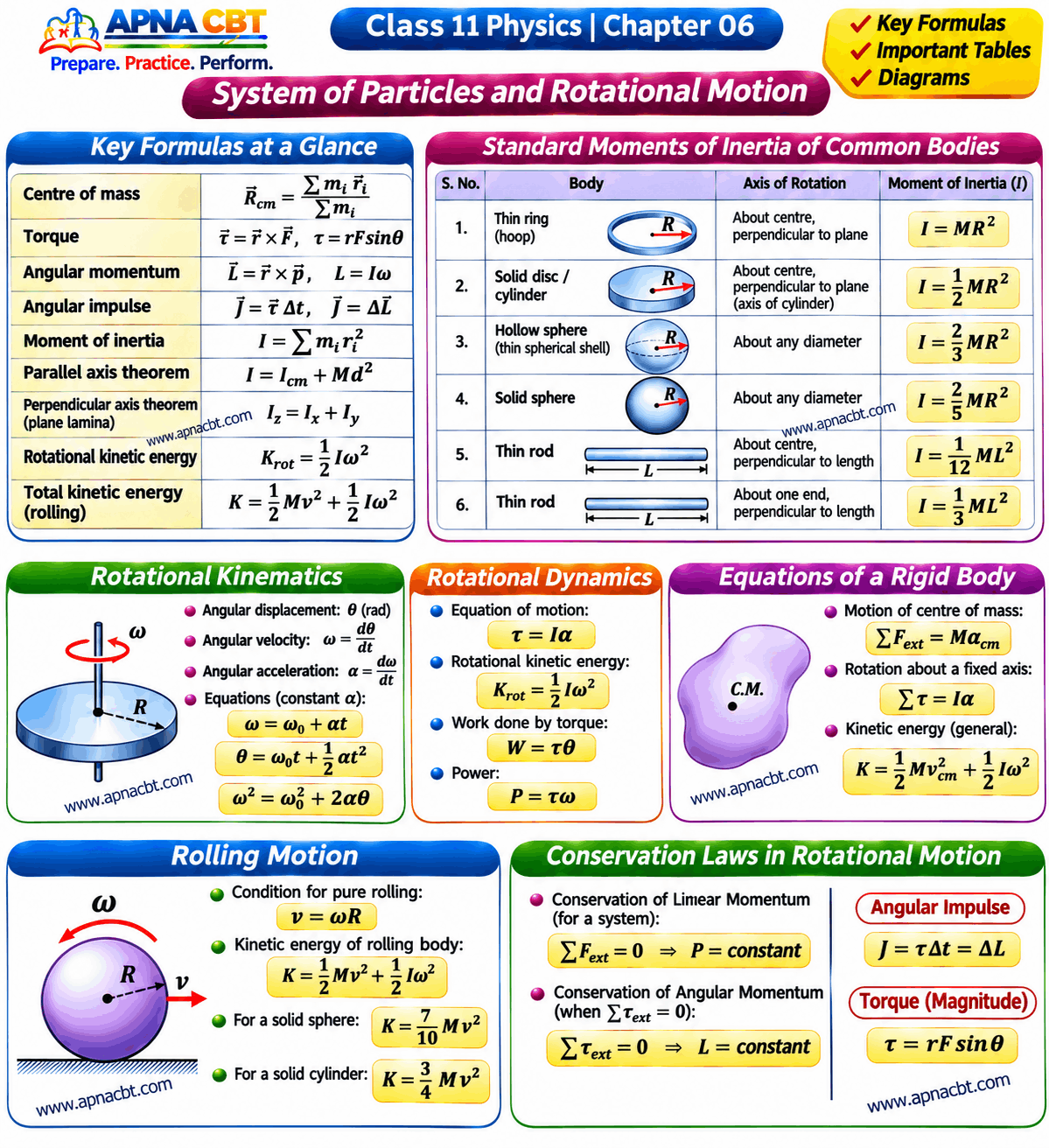
This lesson covers the important concepts, definitions, laws, derivations, standard results and formulae from System of Particles and Rotational Motion. Study the numbered sections and practise the short-answer and long-answer questions for board examinations and NEET preparation.
1. System of Particles, Internal and External Forces
A system of particles is a collection of particles considered together. A finite-sized body can be treated as a system of a very large number of particles.
- Internal forces: Forces exerted by particles of the system on one another. They occur in equal and opposite pairs according to Newton’s third law.
- External forces: Forces exerted on the system by agents outside it. The net external force determines the acceleration of the centre of mass.
For an isolated system, the net external force is zero and total linear momentum remains constant.
2. Rigid Body and Types of Motion
A rigid body is an ideal system in which the distance between every pair of particles remains constant during motion.
- Pure translation: Every particle has the same displacement, velocity and acceleration at a given instant.
- Pure rotation: Particles move in circles about a fixed axis. All particles have the same angular velocity, while their linear speeds depend on distance from the axis: v = rω.
- Combined translation and rotation: The body translates while rotating, as in a rolling wheel or cylinder.
Precession is the slow change in the direction of the rotation axis, as observed in a spinning top.
3. Centre of Mass: Meaning and Position
The centre of mass (COM) is the weighted average position of the mass distribution of a system. The translational motion of the system can be described as if its total mass were concentrated at the COM and the net external force acted there.
For particles of masses m₁, m₂, … at position vectors r₁, r₂, …:
RCM = (Σmᵢrᵢ)/(Σmᵢ); total mass M = Σmᵢ.
In Cartesian coordinates, xCM = Σmᵢxᵢ/M, yCM = Σmᵢyᵢ/M and zCM = Σmᵢzᵢ/M. For two particles, the COM lies closer to the heavier mass.
4. Centre of Mass of Continuous and Symmetric Bodies
For a continuous body, replace the summation by integration:
xCM = (1/M)∫x dm, with corresponding expressions for y and z.
- A uniform thin rod has its COM at its midpoint.
- A uniform circular ring or disc has its COM at its geometric centre.
- A uniform rectangular or square plate has its COM at the intersection of its diagonals.
- For a uniform semicircular wire of radius R, the COM lies on its symmetry axis at a distance 2R/π from the centre.
- For a uniform semicircular lamina, the COM lies on its symmetry axis at a distance 4R/(3π) from the centre.
For a body with symmetry and uniform density, the COM is located at its geometric centre. For irregular mass distributions, use integration or divide the body into simpler parts.
5. Motion of the Centre of Mass and Conservation of Momentum
The total linear momentum of a system is equal to the total mass multiplied by the velocity of its centre of mass:
P = M VCM.
Newton’s second law for a system is Fext = M aCM = dP/dt. Internal forces cancel in pairs when summed over the complete system.
If the net external force is zero, P is constant and the centre of mass moves with constant velocity. This is the law of conservation of linear momentum.
6. Rotational Motion: Angular Variables
Angular displacement θ is the angle swept by a rotating body, measured in radians. Angular velocity is ω = dθ/dt and angular acceleration is α = dω/dt.
- For rotation about a fixed axis, every point has the same angular displacement, angular velocity and angular acceleration.
- Linear speed of a point at perpendicular distance r is v = rω.
- Tangential acceleration is at = rα.
- Radial (centripetal) acceleration is ar = rω² = v²/r, directed towards the axis.
Angular displacement is measured in radians; ω has SI unit rad s⁻¹ and α has SI unit rad s⁻².
7. Torque or Moment of Force
Torque measures the turning effect of a force about a point or axis. Its vector expression is τ = r × F, where r is the position vector from the axis to the point of application.
Magnitude: τ = rF sin θ = F × perpendicular distance from the axis to the line of action of the force.
- SI unit: newton metre (N m); dimensional formula: [ML²T⁻²].
- Torque is a vector; its direction is given by the right-hand rule.
- A force whose line of action passes through the axis produces zero torque about that axis.
- A couple consists of two equal, opposite and parallel forces separated by a perpendicular distance. Its torque magnitude is Fd.
8. Angular Momentum and Its Conservation
The angular momentum of a particle about a point is L = r × p, where p = mv. Its magnitude is L = mvr sin θ. SI unit: kg m² s⁻¹.
For a rigid body rotating about a fixed principal axis, L = Iω. The net external torque is the rate of change of angular momentum:
τext = dL/dt.
If net external torque is zero, angular momentum is conserved. A spinning skater rotates faster by pulling the arms inward because the moment of inertia decreases while angular momentum remains constant.
9. Angular Impulse and Torque on a System
Angular impulse is the time integral of torque. For constant torque, angular impulse = τΔt. In general:
∫τ dt = ΔL.
Thus angular impulse equals the change in angular momentum. For a system of particles, the rate of change of total angular momentum about a fixed origin is determined by the net external torque; internal torques cancel under the usual central-force conditions.
10. Equilibrium of a Rigid Body and Couple
A rigid body is in complete equilibrium when both translational and rotational equilibrium conditions are satisfied:
ΣF = 0 and Στ = 0.
Translational equilibrium prevents acceleration of the centre of mass; rotational equilibrium prevents angular acceleration. The torque equation may be taken about any convenient point when the body is in equilibrium.
A couple produces rotation without a net force. The moment of a couple is independent of the point about which torque is calculated.
11. Moment of Inertia and Radius of Gyration
Moment of inertia (I) about an axis measures resistance to angular acceleration. For discrete particles:
I = Σmᵢrᵢ²; for a continuous body, I = ∫r² dm.
It depends on total mass, distribution of mass and the chosen axis. SI unit: kg m²; dimensional formula: [ML²].
Radius of gyration k is defined by I = Mk², so k = √(I/M). It is the distance from the axis at which the entire mass could be imagined concentrated without changing I.
12. Standard Moments of Inertia
| Body and axis | Moment of inertia |
|---|---|
| Thin rod, through centre and perpendicular to length | ML²/12 |
| Thin rod, through one end and perpendicular to length | ML²/3 |
| Circular ring, through centre perpendicular to plane | MR² |
| Circular disc, through centre perpendicular to plane | MR²/2 |
| Solid cylinder, about its symmetry axis | MR²/2 |
| Solid sphere, about a diameter | 2MR²/5 |
| Thin spherical shell, about a diameter | 2MR²/3 |
| Rectangular plate, through centre perpendicular to plane | M(a²+b²)/12 |
These standard results apply to uniform bodies with the stated axes. Always identify the axis before selecting a formula.
13. Parallel and Perpendicular Axis Theorems
Parallel axis theorem: If ICM is the moment of inertia about an axis through the centre of mass and I is about a parallel axis at distance d, then I = ICM + Md².
Perpendicular axis theorem: For a plane lamina, the moment of inertia about an axis perpendicular to its plane through a point equals the sum of the moments of inertia about two mutually perpendicular axes in its plane through the same point: Iz = Ix + Iy.
The perpendicular axis theorem applies to plane laminae, not arbitrary three-dimensional bodies.
14. Kinematics of Rotational Motion with Constant Angular Acceleration
For constant angular acceleration α, the rotational equations are analogous to the linear equations:
- ω = ω₀ + αt
- θ − θ₀ = ω₀t + ½αt²
- ω² = ω₀² + 2α(θ − θ₀)
Here ω₀ is initial angular velocity, ω is final angular velocity and θ − θ₀ is angular displacement. Use radians and a consistent sign convention.
15. Dynamics of Rotational Motion About a Fixed Axis
For a rigid body rotating about a fixed axis, Newton’s second law for rotation is:
Στ = Iα
when I is constant and the axis is fixed. This is the rotational analogue of F = ma. Angular acceleration is produced by net external torque and is inversely proportional to moment of inertia for a given torque.
Rotational kinetic energy is Krot = ½Iω². Work done by torque is W = ∫τ dθ, and power is P = τω for torque and angular velocity along the same axis.
16. Rolling Motion and Pure Rolling
Rolling motion combines translation of the centre of mass and rotation about the centre of mass. In pure rolling without slipping:
vCM = Rω and aCM = Rα along the direction of motion for constant radius.
The point of contact with a stationary surface is instantaneously at rest relative to the surface. The topmost point has speed 2vCM relative to the ground in pure rolling.
Total kinetic energy is the sum of translational and rotational parts:
K = ½MvCM² + ½ICMω².
17. Rolling Down an Inclined Plane and Energy
For a body rolling down an incline without slipping, gravitational potential energy is converted into translational and rotational kinetic energy:
Mgh = ½Mv² + ½ICMω², with v = Rω.
For a body released from rest on an incline of angle θ, the acceleration is:
a = g sin θ / [1 + ICM/(MR²)].
For the same mass and radius, a body with smaller I/(MR²) generally accelerates faster. Static friction provides the torque required for rolling; in ideal pure rolling it does no work at the instantaneous contact point.
18. Important Formulae and CBSE/NEET Revision
| Concept | Formula |
|---|---|
| Centre of mass | RCM = Σmᵢrᵢ / M |
| COM acceleration | Fext = MaCM |
| Linear momentum | P = MVCM |
| Linear speed in rotation | v = rω |
| Tangential acceleration | at = rα |
| Torque | τ = r × F; |τ| = rF sin θ |
| Angular momentum | L = r × p; fixed axis L = Iω |
| Angular impulse | ∫τdt = ΔL |
| Rotational dynamics | τ = Iα |
| Moment of inertia | I = Σmr² = ∫r²dm |
| Radius of gyration | I = Mk² |
| Parallel axis theorem | I = ICM + Md² |
| Perpendicular axis theorem | Iz = Ix + Iy |
| Rotational kinematics | ω = ω₀ + αt; θ = θ₀ + ω₀t + ½αt² |
| Rotational kinetic energy | K = ½Iω² |
| Rotational power | P = τω |
| Pure rolling | v = Rω; a = Rα |
| Rolling kinetic energy | K = ½Mv² + ½Iω² |
Exam reminders: Always specify the axis for moment of inertia and torque. Apply both ΣF = 0 and Στ = 0 for rigid-body equilibrium. Angular momentum is conserved only when net external torque is zero. Pure rolling requires v = Rω.
19. Short-answer Questions – 30 Questions
Questions
- What is a system of particles?
- Define a rigid body.
- What are internal forces?
- What is pure translational motion?
- Define centre of mass.
- Write the position vector of the centre of mass.
- Where is the centre of mass of a uniform thin rod?
- What is precession?
- State the relation between linear speed and angular speed.
- Define torque.
- Write the SI unit of torque.
- Define angular momentum of a particle.
- Write angular momentum of a rigid body about a fixed axis.
- State the law of conservation of angular momentum.
- What is angular impulse?
- State the conditions for equilibrium of a rigid body.
- Define moment of inertia.
- What is the SI unit of moment of inertia?
- Define radius of gyration.
- State the parallel axis theorem.
- State the perpendicular axis theorem.
- Write the rotational form of Newton’s second law.
- Write the expression for rotational kinetic energy.
- Write the rotational kinematic equation for angular velocity.
- What is pure rolling?
- What is the velocity of the topmost point of a wheel in pure rolling?
- Write the total kinetic energy of a rolling body.
- What is a couple?
- When is angular momentum conserved?
- Write the acceleration of a body rolling down an incline.
Answers
- What is a system of particles?
A collection of particles considered together as one physical system. - Define a rigid body.
An ideal body in which the distance between every pair of particles remains constant during motion. - What are internal forces?
Forces exerted by particles of a system on one another; they occur in equal and opposite pairs. - What is pure translational motion?
Motion in which every particle of a body has the same displacement, velocity and acceleration at an instant. - Define centre of mass.
The mass-weighted average position of a system, whose motion is governed by the net external force. - Write the position vector of the centre of mass.
R_CM = (Σm_i r_i)/(Σm_i). - Where is the centre of mass of a uniform thin rod?
At its midpoint. - What is precession?
The change in direction of the rotation axis of a spinning body, such as a spinning top. - State the relation between linear speed and angular speed.
v = rω, where r is the perpendicular distance from the axis. - Define torque.
The turning effect of a force about a point or axis; τ = r × F. - Write the SI unit of torque.
Newton metre (N m). - Define angular momentum of a particle.
L = r × p, where r is position vector and p is linear momentum. - Write angular momentum of a rigid body about a fixed axis.
L = Iω. - State the law of conservation of angular momentum.
If net external torque is zero, total angular momentum remains constant. - What is angular impulse?
The time integral of torque; it equals the change in angular momentum. - State the conditions for equilibrium of a rigid body.
The net force and net torque must both be zero: ΣF = 0 and Στ = 0. - Define moment of inertia.
I = Σm_i r_i²; it measures resistance to angular acceleration about a specified axis. - What is the SI unit of moment of inertia?
kg m². - Define radius of gyration.
The distance k from the axis at which the total mass may be assumed concentrated so that I = Mk². - State the parallel axis theorem.
I = I_CM + Md², where d is the distance between parallel axes. - State the perpendicular axis theorem.
For a plane lamina, I_z = I_x + I_y for mutually perpendicular axes through the same point. - Write the rotational form of Newton’s second law.
Στ = Iα for a rigid body about a fixed axis with constant I. - Write the expression for rotational kinetic energy.
K_rot = ½Iω². - Write the rotational kinematic equation for angular velocity.
ω = ω₀ + αt for constant angular acceleration. - What is pure rolling?
Rolling without slipping, for which v_CM = Rω. - What is the velocity of the topmost point of a wheel in pure rolling?
2v_CM relative to the ground. - Write the total kinetic energy of a rolling body.
K = ½Mv_CM² + ½I_CMω². - What is a couple?
Two equal, opposite and parallel forces separated by a perpendicular distance, producing a turning effect. - When is angular momentum conserved?
When the net external torque on the system is zero. - Write the acceleration of a body rolling down an incline.
a = g sinθ/[1 + I_CM/(MR²)] for rolling without slipping.
20. Long-answer Questions – 15 Questions
Questions
- Explain the centre of mass of a system and derive its position vector.
- Derive the equation of motion of the centre of mass.
- Explain translational, rotational and combined motion of a rigid body.
- Explain centre of mass of continuous and symmetric bodies with examples.
- State and explain conservation of linear momentum for a system.
- Define torque and derive its magnitude. Explain the couple.
- Define angular momentum and establish its relation with torque.
- Explain conservation of angular momentum with an example.
- Explain angular impulse and its relation to angular momentum.
- State and explain the conditions for equilibrium of a rigid body.
- Define moment of inertia and radius of gyration. Explain their significance.
- State and explain the parallel and perpendicular axis theorems.
- Derive the rotational kinematic equations for constant angular acceleration.
- Explain rotational dynamics, rotational kinetic energy, work and power.
- Explain pure rolling and derive the energy and acceleration relations for a body rolling down an incline.
Detailed Answers
- Explain the centre of mass of a system and derive its position vector.
For particles of masses m₁, m₂, … at position vectors r₁, r₂, …, the centre of mass is the mass-weighted average position. If total mass M = Σmᵢ, then M R_CM = Σmᵢrᵢ. Hence R_CM = (Σmᵢrᵢ)/M. In Cartesian coordinates, x_CM = Σmᵢxᵢ/M, y_CM = Σmᵢyᵢ/M and z_CM = Σmᵢzᵢ/M. The centre of mass may lie inside or outside the material of a body. - Derive the equation of motion of the centre of mass.
For each particle, Newton’s second law gives dpᵢ/dt = Fᵢ,external + ΣFᵢj,internal. Adding over all particles, internal forces cancel in equal and opposite pairs. Thus dP/dt = F_ext. Since total momentum P = M V_CM for constant total mass, F_ext = M a_CM. Therefore the centre of mass moves as if the total mass were concentrated there and the net external force acted on it. - Explain translational, rotational and combined motion of a rigid body.
In pure translation, every particle has the same velocity and acceleration at an instant, and the body does not change orientation. In pure rotation about a fixed axis, every particle describes a circle centred on the axis; all particles share the same angular velocity, but linear speed is v = rω. In combined motion, the centre of mass translates while the body rotates about it, as in a rolling wheel. - Explain centre of mass of continuous and symmetric bodies with examples.
For a continuous body, the mass elements dm are integrated: x_CM = (1/M)∫x dm, with similar expressions for y and z. In a uniform rod the COM is at the midpoint. In a uniform ring or disc it is at the centre. Symmetry places the COM on the symmetry axes; for a uniform semicircular wire it is 2R/π from the circle centre along the symmetry axis, while for a semicircular lamina it is 4R/(3π). Irregular distributions require integration or subdivision into simple components. - State and explain conservation of linear momentum for a system.
The total momentum of a system is P = M V_CM. The equation of motion is dP/dt = F_ext. If the net external force is zero, dP/dt = 0, so P remains constant. Internal forces cannot change total momentum because they cancel in equal and opposite pairs. This principle is used in recoil, explosions and collisions. - Define torque and derive its magnitude. Explain the couple.
Torque is the vector product τ = r × F, where r is measured from the axis to the point of application. Its magnitude is τ = rF sinθ, equal to force multiplied by the perpendicular distance from the axis to the line of action. A couple consists of two equal and opposite parallel forces separated by distance d. The net force is zero but the couple produces torque of magnitude Fd, independent of the reference point. - Define angular momentum and establish its relation with torque.
For a particle, angular momentum is L = r × p. Differentiating, dL/dt = dr/dt × p + r × dp/dt. Since dr/dt = v and p = mv, the first term v × mv is zero. Using dp/dt = F gives dL/dt = r × F = τ. Hence net torque equals the rate of change of angular momentum. For a rigid body about a fixed axis, L = Iω. - Explain conservation of angular momentum with an example.
From τ_ext = dL/dt, if net external torque is zero then L is constant. For rotation about a fixed axis with constant mass distribution at each instant, Iω remains constant. A skater spinning with arms extended has a larger moment of inertia and lower angular speed. Pulling the arms inward reduces I, so ω increases to conserve angular momentum. - Explain angular impulse and its relation to angular momentum.
Angular impulse is the integral of torque over the time interval: J_angular = ∫τdt. Since τ = dL/dt, integration gives ∫τdt = L_f − L_i = ΔL. For constant torque, angular impulse is τΔt. Its SI unit is N m s, equivalent to kg m² s⁻¹. - State and explain the conditions for equilibrium of a rigid body.
A rigid body is in equilibrium only when its translational and rotational accelerations are zero. Translational equilibrium requires vector sum of external forces ΣF = 0. Rotational equilibrium requires sum of external torques about a point or axis Στ = 0. Both conditions must be satisfied. These equations are used to solve problems involving beams, supports, levers and suspended bodies. - Define moment of inertia and radius of gyration. Explain their significance.
Moment of inertia about an axis is I = Σmᵢrᵢ² or I = ∫r²dm. It depends on mass, mass distribution and the selected axis. It is the rotational analogue of inertial mass. Radius of gyration k is defined by I = Mk², or k = √(I/M). It represents the effective distance at which the entire mass could be concentrated to give the same moment of inertia. - State and explain the parallel and perpendicular axis theorems.
The parallel axis theorem states that the moment of inertia about any axis parallel to an axis through the centre of mass is I = I_CM + Md², where M is total mass and d is the separation. The perpendicular axis theorem applies to a plane lamina: I_z = I_x + I_y, where x and y are perpendicular axes in the plane and z is perpendicular to the plane, all passing through the same point. These theorems help calculate moments of inertia about shifted or perpendicular axes. - Derive the rotational kinematic equations for constant angular acceleration.
For constant angular acceleration α, α = dω/dt. Integrating from ω₀ at t = 0 to ω at time t gives ω = ω₀ + αt. Since ω = dθ/dt, integrating gives θ − θ₀ = ω₀t + ½αt². Eliminating t between these two equations gives ω² = ω₀² + 2α(θ − θ₀). These equations apply when α is constant. - Explain rotational dynamics, rotational kinetic energy, work and power.
For a rigid body about a fixed axis, net torque τ = Iα when I is constant. The rotational kinetic energy is K = ½Iω². A small angular displacement dθ under torque τ gives work dW = τdθ, so total work W = ∫τdθ. Power is the rate of doing rotational work, P = dW/dt = τω for torque and angular velocity along the same axis. These are rotational analogues of F = ma, ½mv², W = ∫F·dr and P = F·v. - Explain pure rolling and derive the energy and acceleration relations for a body rolling down an incline.
For pure rolling without slipping, the point of contact is instantaneously at rest relative to the surface, giving v_CM = Rω and a_CM = Rα. Total kinetic energy is the sum of translation and rotation: K = ½Mv² + ½I_CMω². For a body descending a height h, Mgh = ½Mv² + ½Iω². Using ω = v/R gives v² = 2gh/[1 + I/(MR²)]. On an incline of angle θ, the acceleration is a = g sinθ/[1 + I/(MR²)].
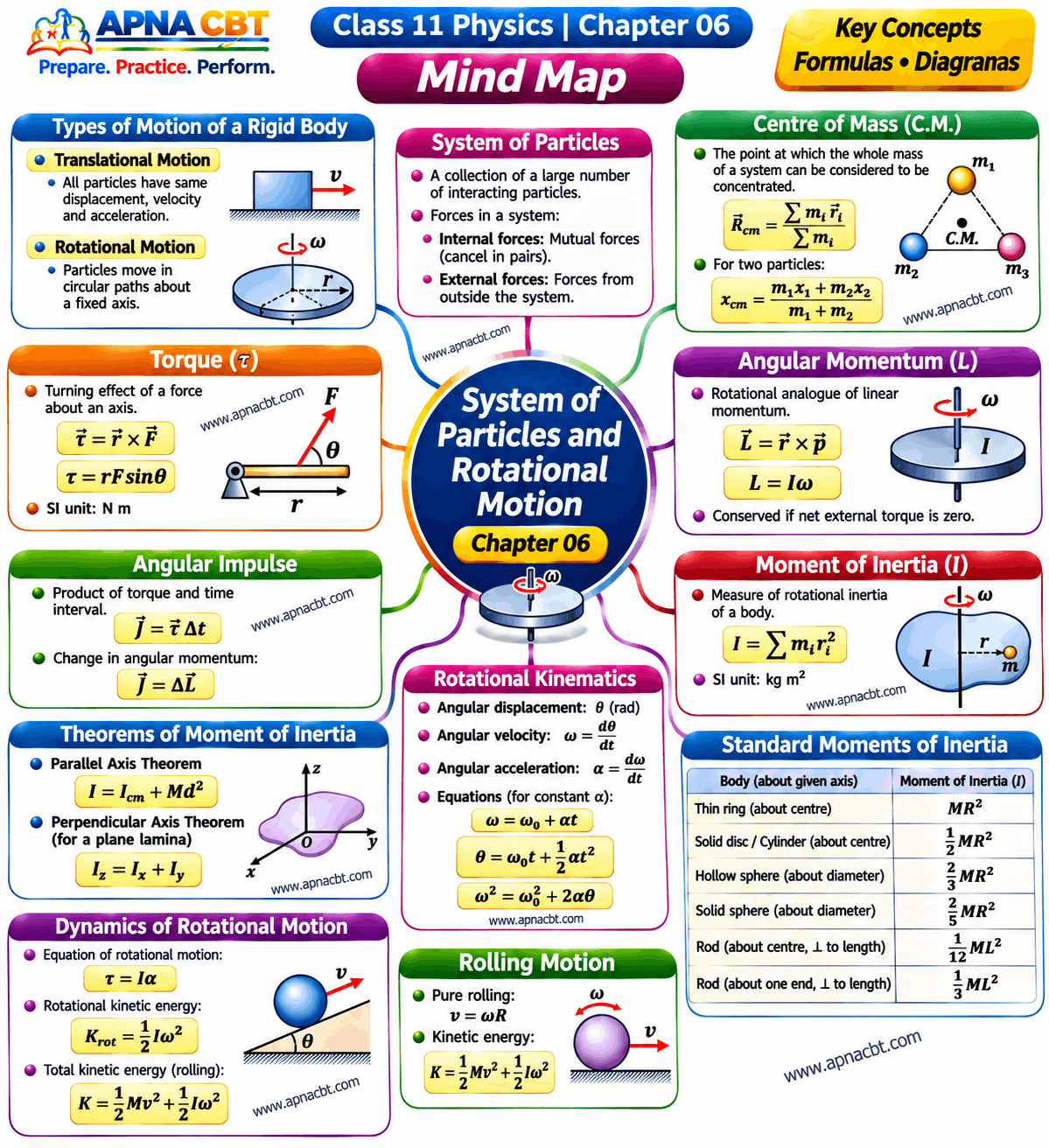
System of Particles and Rotational Motion Physics Mind Map
System of Particles and Rotational Motion Class 11 Physics – Important Diagrams and Illustrations
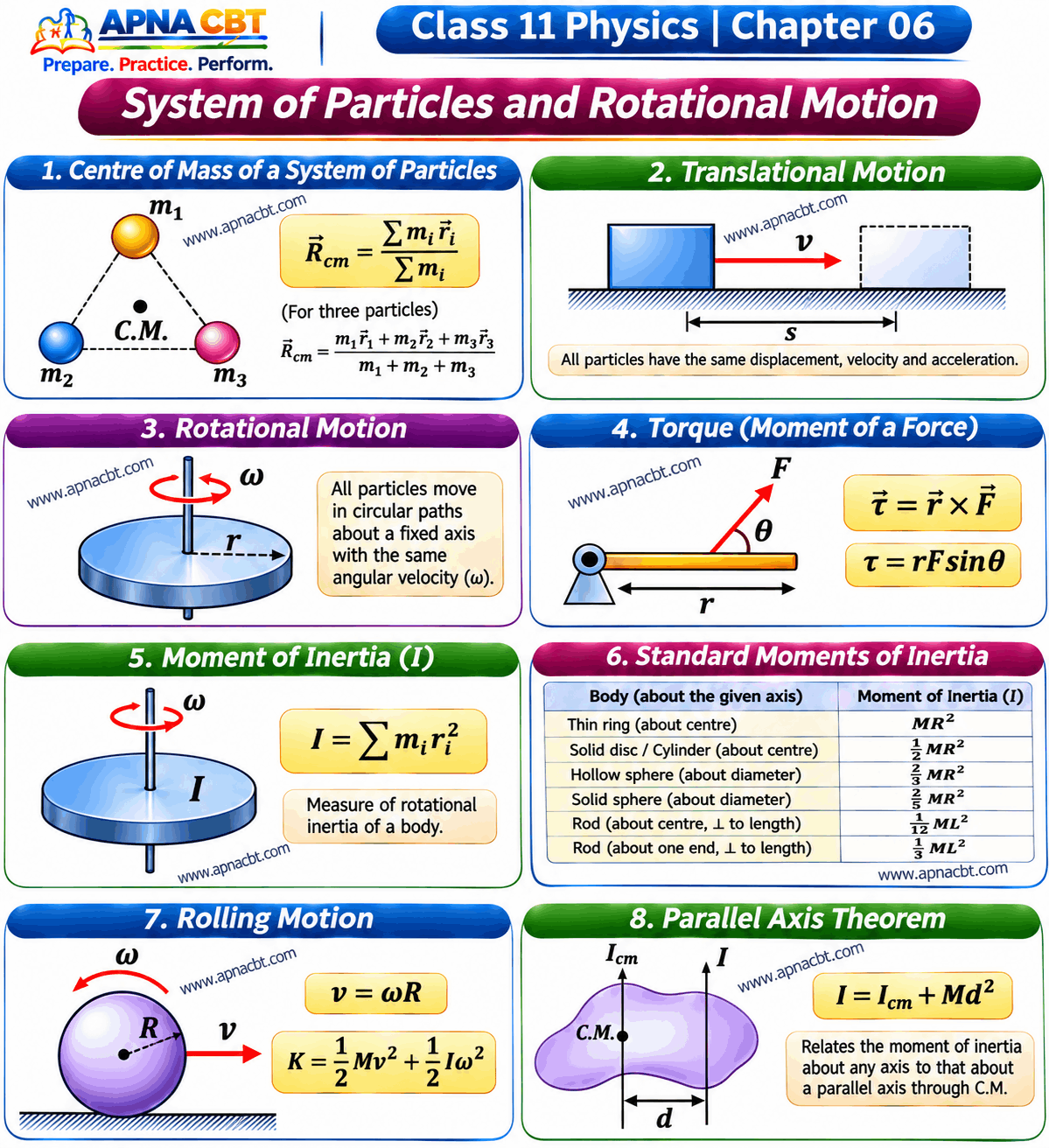
System of Particles and Rotational Motion Class 11 Physics – Important Tables and Formulas