Chapter 14 – Waves | Class 11 Physics
This lesson covers wave motion, types of waves, the equation of a plane progressive wave, sound waves and speed of sound, the principle of superposition, reflection of waves, stationary waves, vibrations of strings and air columns, and beats. It is organised for CBSE board examination revision and NEET preparation.
1. Wave Motion and Basic Terminology
Wave motion
A wave is a disturbance that travels through a medium or space, transferring energy from one point to another without the net transport of matter. In a mechanical wave, particles of the medium oscillate about their mean positions while the disturbance propagates.
Examples include ripples on water, sound travelling through air and waves travelling along a stretched string. Mechanical waves require a material medium for propagation.
Important terms
- Amplitude (A): Maximum displacement of a particle from its mean position.
- Wavelength (λ): Distance between two successive particles in the same phase, such as two consecutive crests or compressions.
- Time period (T): Time taken by a particle to complete one oscillation.
- Frequency (f): Number of oscillations per second; \(f=1/T\). SI unit is hertz (Hz).
- Angular frequency (ω): \(\omega=2\pi f=2\pi/T\).
- Wave number (k): \(k=2\pi/\lambda\), the spatial angular frequency.
- Phase: Quantity describing the state of oscillation of a particle at a given time.
- Wave speed (v): Speed at which the disturbance or a point of constant phase travels.
Frequency, wavelength and wave speed
In one time period, a progressive wave travels a distance equal to one wavelength. Therefore,
v = λ/T = fλ = ω/k
Types of waves
- Mechanical waves: Require a material medium, for example sound and waves on a string.
- Electromagnetic waves: Do not require a material medium and can travel through vacuum.
- Transverse waves: Particle displacement is perpendicular to the direction of propagation. Examples include waves on a stretched string and electromagnetic waves.
- Longitudinal waves: Particle displacement is parallel to the direction of propagation. Sound waves in air are longitudinal.
Longitudinal waves contain alternate compressions and rarefactions. Transverse waves contain crests and troughs.
2. Equation of a Plane Progressive Wave
A progressive wave travels through a medium while each particle performs oscillatory motion. Consider a wave travelling in the positive x-direction. If the particle at the origin has displacement \(y(0,t)=A\sin\omega t\), the disturbance reaches a point x after a time \(x/v\).
The displacement at position x and time t is therefore:
y(x,t) = A sin(ωt − kx + φ)
For a wave travelling in the negative x-direction:
y(x,t) = A sin(ωt + kx + φ)
Here A is amplitude, ω is angular frequency, k is wave number and φ is the initial phase constant. Since \(k=2\pi/\lambda\) and \(\omega=2\pi/T\), the equation may also be written as:
y(x,t) = A sin[2π(t/T − x/λ) + φ] for propagation in the +x direction.
Phase difference
For two points separated by distance Δx at the same instant, the magnitude of phase difference is:
Δφ = kΔx = 2πΔx/λ
For one point observed at two instants separated by Δt, the phase difference is:
Δφ = ωΔt = 2πΔt/T
- Particles separated by an integral multiple of λ are in the same phase.
- Particles separated by an odd multiple of λ/2 are in opposite phase.
3. Particle Velocity, Particle Acceleration and Wave Speed
For a progressive wave \(y=A\sin(\omega t-kx)\), the particle velocity is the time derivative of displacement at a fixed position:
u = ∂y/∂t = Aω cos(ωt − kx)
Maximum particle speed is \(u_{\max}=Aω\).
Particle acceleration is the second time derivative:
a = ∂²y/∂t² = −ω²y
Thus, each particle executes SHM with angular frequency ω, and its acceleration is proportional to its displacement from the mean position and directed towards it.
Distinguish particle speed and wave speed
- Wave speed describes the propagation of a constant phase through the medium.
- Particle velocity describes the instantaneous motion of a medium particle.
- For a sinusoidal wave, maximum particle speed is Aω, whereas wave speed is \(v=ω/k=fλ\).
The relation between maximum particle speed and wave speed is \(u_{\max}/v=kA=2πA/λ\).
4. Sound Waves and Properties of Sound
Sound is a mechanical wave produced by a vibrating source. In air and other fluids, sound propagates as a longitudinal wave through successive compressions and rarefactions. The particles of the medium vibrate parallel to the direction in which the sound wave travels.
Characteristics of sound
- Pitch: Related to frequency. Higher frequency generally means higher pitch.
- Loudness: Related to the intensity of sound and the sensitivity of the ear. For a given medium, intensity is proportional to the square of the wave amplitude.
- Quality or timbre: Helps distinguish sounds from different sources even when their pitch and loudness are similar; it depends on the waveform and its harmonics.
- Intensity: Sound energy crossing unit area per unit time, measured in W m⁻².
For a sinusoidal sound wave, intensity is proportional to the square of amplitude and to the square of frequency when the other relevant medium properties are fixed.
Speed of sound in a medium
The speed of a longitudinal wave depends on the elastic property and density of the medium. In general,
v = √(elastic modulus / density)
For a fluid, the relevant elastic modulus is the bulk modulus B, so \(v=√(B/ρ)\). For a solid rod, the longitudinal wave speed is related to Young’s modulus Y and density ρ: \(v=√(Y/ρ)\).
Sound generally travels faster in solids than in liquids and gases because solids are much less compressible. The speed also depends on temperature and the physical properties of the medium.
5. Speed of Sound in Gases – Newton and Laplace
Newton’s formula
Newton assumed that the compressions and rarefactions during sound propagation in a gas are isothermal. Using the bulk modulus of a gas as its pressure P, Newton obtained:
v = √(P/ρ)
This value is lower than the experimentally observed speed of sound in air.
Laplace correction
Laplace pointed out that the compressions and rarefactions occur rapidly, so there is insufficient time for heat exchange with the surroundings. The changes are approximately adiabatic. The effective bulk modulus is γP, where γ is the ratio of specific heats.
v = √(γP/ρ)
Using the ideal gas equation, this may be expressed as:
v = √(γRT/M) = √(γkBT/m)
Here R is the universal gas constant, T is absolute temperature, M is molar mass, kB is Boltzmann’s constant and m is the mass of one molecule.
Temperature and other factors
- For a given gas, \(v∝√T\), where T is in kelvin.
- At constant temperature, the ideal-gas expression shows that speed depends on γ and molar mass.
- For air near ordinary conditions, the speed increases by approximately 0.6 m s⁻¹ for each 1°C rise in temperature, as an approximate rule.
- Humidity can affect the speed of sound in air because it changes the effective density of the mixture.
6. Principle of Superposition and Interference of Waves
Principle of superposition
When two or more waves overlap in a medium, the resultant displacement of a particle is the algebraic sum of the displacements produced by the individual waves at that instant.
y = y₁ + y₂ + y₃ + …
The waves continue to travel after overlapping, provided the medium behaves linearly.
Superposition of two waves of the same frequency
For two waves of equal frequency travelling in the same direction, their resultant is also sinusoidal. The resultant amplitude depends on the individual amplitudes and phase difference:
Aᵣ = √(A₁² + A₂² + 2A₁A₂ cos φ)
- Constructive interference: When the waves are in phase, φ = 2nπ. For equal amplitudes, the resultant amplitude is 2A.
- Destructive interference: When the waves are in opposite phase, φ = (2n+1)π. For equal amplitudes, the resultant displacement is zero.
For coherent sources, the path difference conditions are:
- Constructive: Δx = nλ.
- Destructive: Δx = (n + 1/2)λ.
Coherent sources have the same frequency and a constant phase difference. Interference is a redistribution of energy; energy is not destroyed.
7. Reflection of Waves and Stationary Waves
Reflection of waves
When a wave reaches a boundary, it may be reflected. A pulse reflected from a fixed end of a stretched string is inverted, producing a phase change of π. A pulse reflected from a free end is not inverted.
Stationary or standing waves
Stationary waves are formed by the superposition of two waves of the same frequency, wavelength and amplitude travelling in opposite directions. For two such waves,
y₁ = A sin(ωt − kx), y₂ = A sin(ωt + kx)
The resultant displacement is:
y = 2A sin ωt cos kx
The amplitude at position x is \(2A|cos kx|\), so different points have different amplitudes.
- Nodes: Points where displacement is always zero.
- Antinodes: Points where amplitude is maximum.
- Distance between two consecutive nodes = λ/2.
- Distance between two consecutive antinodes = λ/2.
- Distance between a node and its nearest antinode = λ/4.
All particles between two adjacent nodes oscillate in the same phase, while particles in neighbouring segments separated by a node oscillate in opposite phase. There is no net transfer of energy along an ideal stationary wave pattern.
8. Vibrations of a Stretched String
A stretched string fixed at both ends supports stationary waves. The ends are nodes. If the length of the string is L, the allowed wavelengths satisfy:
L = nλₙ/2, λₙ = 2L/n
The frequency of the nth harmonic is:
fₙ = nv/(2L) = n/(2L) √(F/μ)
Here F is the tension in the string, μ is mass per unit length and \(v=√(F/μ)\) is the transverse wave speed on the string.
Harmonics and overtones
- Fundamental frequency: \(f₁=v/(2L)\), the lowest allowed frequency.
- Second harmonic: \(f₂=2f₁\).
- Third harmonic: \(f₃=3f₁\).
- For a string fixed at both ends, all integral harmonics are present in the ideal model.
The fundamental is also called the first harmonic. The first overtone is the second harmonic; the second overtone is the third harmonic.
Frequency increases when tension increases and decreases when the vibrating length or linear mass density increases, according to \(f₁=(1/2L)√(F/μ)\).
9. Vibrations of Air Columns – Organ Pipes
An organ pipe is a hollow tube in which the air column vibrates and produces sound. The boundary conditions at the ends determine the allowed modes.
Open organ pipe
An open pipe has displacement antinodes at both ends. For a pipe of length L,
L = nλₙ/2; fₙ = nv/(2L), n = 1, 2, 3, …
Its fundamental frequency is \(f₁=v/(2L)\). All integral harmonics are present in the ideal model.
Closed organ pipe
A pipe closed at one end has a displacement node at the closed end and an antinode at the open end. The allowed wavelengths are:
L = (2n−1)λₙ/4
The frequencies are:
fₙ = (2n−1)v/(4L), n = 1, 2, 3, …
Only odd harmonics occur in an ideal closed pipe. Its fundamental frequency is \(f₁=v/(4L)\); the next allowed frequency is 3f₁, followed by 5f₁.
End correction
The displacement antinode in an open end lies slightly outside the physical end of the pipe. The effective length is therefore greater than the physical length. For a pipe with one open end, the effective length is often written \(L_{eff}=L+e\); for a pipe open at both ends, \(L_{eff}=L+2e\), where e is the end correction at one end.
10. Beats
Beats are periodic variations in the intensity or loudness of sound produced when two sound waves of nearly equal frequencies and comparable amplitudes superpose at a point.
If the frequencies are f₁ and f₂, the beat frequency is:
fᵦ = |f₁ − f₂|
The number of beats heard per second is equal to the difference between the two frequencies. The time between successive maxima in loudness is the beat period:
Tᵦ = 1/|f₁ − f₂|
For two equal-amplitude waves, the resultant amplitude varies periodically. The sound becomes alternately louder and weaker as the waves move in and out of phase.
Applications of beats
- Comparing two sound frequencies.
- Tuning musical instruments by adjusting one frequency until beats become slower.
- Estimating a small difference between two frequencies.
11. Important Formulae and CBSE / NEET Revision Points
Wave motion
- Wave speed: \(v=fλ=ω/k\)
- Angular frequency: \(ω=2πf=2π/T\)
- Wave number: \(k=2π/λ\)
- Progressive wave in +x direction: \(y=A sin(ωt−kx+φ)\)
- Progressive wave in −x direction: \(y=A sin(ωt+kx+φ)\)
- Phase difference: \(Δφ=2πΔx/λ=2πΔt/T\)
- Particle velocity amplitude: \(u_{max}=Aω\)
- Particle acceleration: \(a=−ω²y\)
Sound
- Speed in a fluid: \(v=√(B/ρ)\)
- Newton’s formula for a gas: \(v=√(P/ρ)\)
- Laplace’s formula: \(v=√(γP/ρ)=√(γRT/M)\)
- Speed in a stretched string: \(v=√(F/μ)\)
Superposition and stationary waves
- Resultant displacement: \(y=y₁+y₂\)
- Resultant amplitude: \(Aᵣ=√(A₁²+A₂²+2A₁A₂cosφ)\)
- Stationary wave: \(y=2A sinωt coskx\)
- Node-to-node and antinode-to-antinode distance: λ/2
- Nearest node-to-antinode distance: λ/4
Strings and organ pipes
- String fixed at both ends: \(fₙ=nv/(2L)=n/(2L)√(F/μ)\)
- Open pipe: \(fₙ=nv/(2L)\)
- Closed pipe: \(fₙ=(2n−1)v/(4L)\)
Beats
- Beat frequency: \(fᵦ=|f₁−f₂|\)
- Beat period: \(Tᵦ=1/fᵦ\)
High-priority revision points
- Differentiate transverse and longitudinal waves using the direction of particle vibration.
- Identify the direction of propagation from the sign in the progressive-wave equation.
- Do not confuse particle velocity with wave velocity.
- Apply the adiabatic correction in Laplace’s formula for sound in gases.
- For stationary waves, remember the node and antinode spacing.
- For a string fixed at both ends and an open pipe, all integral harmonics are allowed.
- For an ideal closed pipe, only odd harmonics are allowed.
- Use the absolute difference of frequencies to calculate beat frequency.
12. Short-Answer Questions – 30 Questions
Questions
- What is wave motion?
- Define amplitude and wavelength.
- Define time period and frequency. Write the relation between them.
- What is angular frequency? Give its relation with frequency.
- Distinguish between transverse and longitudinal waves.
- What are compressions and rarefactions?
- Write the relation between wave speed, frequency and wavelength.
- What is the wave number? Write its SI unit.
- Write the equation of a plane progressive wave travelling in the positive x-direction.
- How can the direction of propagation be identified from a wave equation?
- Define phase difference and write its expression for two points separated by distance Δx.
- Distinguish between particle velocity and wave velocity.
- Write expressions for particle velocity and acceleration in a sinusoidal progressive wave.
- Why is sound in air a longitudinal wave?
- What are pitch, loudness and quality of sound?
- Write the general expression for the speed of a longitudinal wave in a fluid.
- State Newton’s formula for the speed of sound in a gas.
- Why did Newton’s formula require correction?
- State Laplace’s corrected formula for the speed of sound in a gas.
- How does the speed of sound in an ideal gas depend on absolute temperature?
- State the principle of superposition of waves.
- What is constructive interference? State its path-difference condition.
- What is destructive interference? State its path-difference condition.
- What are coherent sources?
- What are stationary waves? How are they formed?
- Define nodes and antinodes. State the distance between successive nodes.
- What is the fundamental frequency of a stretched string fixed at both ends?
- Distinguish between an open organ pipe and a closed organ pipe in terms of allowed harmonics.
- What are beats? Write the expression for beat frequency.
- What is the beat period? Write its relation with beat frequency.
Answers
- Wave motion: It is the propagation of a disturbance through a medium or space, transferring energy from one place to another without net transport of matter.
- Amplitude: Maximum displacement of a particle from its mean position. Wavelength: Distance between two nearest particles in the same phase, such as successive crests or compressions.
- Time period (T): Time for one complete oscillation. Frequency (f): Number of oscillations per second. Their relation is \(f=1/T\).
- Angular frequency is the rate of change of phase with time. It is \(ω=2πf\), measured in rad s⁻¹.
- In a transverse wave, particle displacement is perpendicular to propagation. In a longitudinal wave, particle displacement is parallel to propagation.
- Compressions are regions where particles are closer together and pressure or density is higher. Rarefactions are regions where particles are farther apart and pressure or density is lower.
- The relation is \(v=fλ\), where v is wave speed, f is frequency and λ is wavelength.
- Wave number is \(k=2π/λ\). Its SI unit is rad m⁻¹ (often written m⁻¹ when radians are treated as dimensionless).
- For propagation in the positive x-direction, \(y=A sin(ωt−kx+φ)\).
- A phase of the form \(\omega t-kx\) indicates propagation in +x; \(\omega t+kx\) indicates propagation in −x.
- Phase difference is the difference between phases of two oscillations. For separation Δx at the same instant, \(Δφ=kΔx=2πΔx/λ\).
- Wave velocity is the speed of propagation of a constant phase. Particle velocity is the instantaneous velocity of a medium particle as it oscillates about its mean position.
- For \(y=A sin(ωt−kx)\), particle velocity is \(u=Aω cos(ωt−kx)\), and acceleration is \(a=−ω²y\).
- Sound in air produces alternate compressions and rarefactions. Air particles vibrate parallel to the direction of propagation, so the wave is longitudinal.
- Pitch is associated mainly with frequency; loudness with sound intensity and ear response; quality or timbre distinguishes sounds with different waveforms or harmonic content.
- The speed is \(v=√(B/ρ)\), where B is the bulk modulus and ρ is the density of the fluid.
- Newton’s formula is \(v=√(P/ρ)\), where P is gas pressure and ρ is gas density.
- Newton assumed isothermal changes. Sound compressions and rarefactions occur rapidly and are approximately adiabatic, so the isothermal assumption gives a value that is too low.
- Laplace’s formula is \(v=√(γP/ρ)\), where γ is the ratio of specific heats.
- For a given ideal gas, \(v=√(γRT/M)\), hence \(v∝√T\).
- The resultant displacement due to overlapping waves is the algebraic sum of the displacements due to each wave at that instant.
- Constructive interference occurs when waves arrive in phase. The path difference is \(Δx=nλ\), where n is an integer.
- Destructive interference occurs when waves arrive in opposite phase. The path difference is \(Δx=(n+1/2)λ\).
- Coherent sources have the same frequency and maintain a constant phase difference.
- Stationary waves are formed by superposition of two waves of the same frequency, wavelength and amplitude travelling in opposite directions.
- A node is a point of zero displacement; an antinode is a point of maximum amplitude. The distance between successive nodes is λ/2.
- For a string of length L, fixed at both ends, the fundamental frequency is \(f₁=v/(2L)=(1/2L)√(F/μ)\).
- An ideal open pipe supports all integral harmonics. An ideal pipe closed at one end supports only odd harmonics.
- Beats are periodic variations in loudness produced by superposition of two waves with nearly equal frequencies. Beat frequency is \(fᵦ=|f₁−f₂|\).
- Beat period is the time between successive loudness maxima. It is \(Tᵦ=1/fᵦ\).
13. Long-Answer Questions – 15 Questions
Questions
- Explain wave motion and describe the important terms used in wave motion. Derive the relation \(v=fλ\).
- Derive the equation of a plane progressive wave travelling along the positive x-direction. Explain the meaning of each quantity.
- For a sinusoidal progressive wave, obtain expressions for particle velocity and particle acceleration. Distinguish these from wave velocity.
- Explain transverse and longitudinal waves with suitable examples. Describe compressions and rarefactions.
- Derive the expression for the speed of a longitudinal wave in a fluid and state the meaning of bulk modulus and density.
- Explain Newton’s formula for the speed of sound in a gas and derive Laplace’s correction.
- State and explain the principle of superposition. Obtain the expression for the resultant amplitude of two waves of the same frequency and discuss constructive and destructive interference.
- Explain the formation of stationary waves by superposition of two identical waves travelling in opposite directions. Derive the positions of nodes and antinodes.
- Discuss the properties of stationary waves and compare them with progressive waves.
- Derive the expression for the frequencies of a stretched string fixed at both ends. Explain fundamental frequency and harmonics.
- Derive the expression for the fundamental frequency and harmonics of an open organ pipe.
- Derive the expression for the allowed frequencies of a pipe closed at one end. Explain why only odd harmonics are present.
- What is end correction in an organ pipe? Explain effective length for open and closed pipes.
- Explain the formation of beats and derive the expression for beat frequency.
- Compare the frequencies and harmonics of a stretched string, an open organ pipe and a closed organ pipe. Include the relevant formulae.
Detailed Answers
- Wave motion and terminology: Wave motion is the propagation of a disturbance that transfers energy without net transport of matter. Amplitude A is the maximum displacement; wavelength λ is the distance between successive points in the same phase; time period T is the time for one oscillation; frequency \(f=1/T\); angular frequency \(ω=2πf\); and wave number \(k=2π/λ\). In one time period, the wave advances by one wavelength. Therefore \(v=λ/T=fλ\).
- Progressive-wave equation: Let the source at x=0 oscillate as \(y(0,t)=A sinωt\). A point at distance x is reached after time \(x/v\). Its displacement is \(y(x,t)=A sin[ω(t−x/v)]\). Since \(k=ω/v=2π/λ\), \(y=A sin(ωt−kx)\). A phase constant φ may be added: \(y=A sin(ωt−kx+φ)\). The negative sign before kx denotes propagation in +x. For propagation in −x, \(y=A sin(ωt+kx+φ)\).
- Particle velocity and acceleration: For \(y=A sin(ωt−kx)\), differentiating with respect to time at fixed x gives \(u=∂y/∂t=Aω cos(ωt−kx)\). Thus \(u_{max}=Aω\). Differentiating again gives \(a=∂²y/∂t²=−Aω² sin(ωt−kx)=−ω²y\). The particle performs SHM. Wave velocity is \(v=ω/k=fλ\), the propagation speed of phase; particle velocity is the oscillatory velocity of the medium particle.
- Transverse and longitudinal waves: In transverse waves, particles vibrate perpendicular to propagation and the wave has crests and troughs; a wave on a stretched string is an example. In longitudinal waves, particles vibrate parallel to propagation and form compressions and rarefactions; sound in air is an example. Mechanical waves require a medium, whereas electromagnetic waves do not require a material medium.
- Speed in a fluid: The speed of a longitudinal disturbance depends on the medium’s resistance to compression and its inertia. For a fluid, the restoring property is its bulk modulus B and the inertia per unit volume is represented by density ρ. The resulting expression is \(v=√(B/ρ)\). A large bulk modulus increases wave speed, while a large density decreases it, if the other quantity remains fixed.
- Newton and Laplace: Newton used the isothermal bulk modulus of a gas, B=P, and obtained \(v=√(P/ρ)\). This underestimates the observed speed because rapid compressions and rarefactions do not allow enough time for heat exchange. Laplace treated the changes as adiabatic, for which \(B=γP\). Hence \(v=√(γP/ρ)\). Using \(P=ρRT/M\), we obtain \(v=√(γRT/M)\).
- Superposition and interference: When waves overlap, the resultant displacement is \(y=y₁+y₂\). For two waves of the same angular frequency, \(y₁=A₁sinωt\) and \(y₂=A₂sin(ωt+φ)\). Resolving into sine and cosine components gives resultant amplitude \(Aᵣ=√(A₁²+A₂²+2A₁A₂cosφ)\). For φ=2nπ, interference is constructive; for φ=(2n+1)π, it is destructive. The corresponding path differences are nλ and (n+1/2)λ.
- Formation of stationary waves: Take two waves \(y₁=A sin(ωt−kx)\) and \(y₂=A sin(ωt+kx)\). Their sum is \(y=2A sinωt coskx\). The amplitude is \(2A|coskx|\). Nodes occur when \(coskx=0\), giving \(kx=(n+1/2)π\), or \(x=(2n+1)λ/4\). Antinodes occur when \(|coskx|=1\), giving \(kx=nπ\), or \(x=nλ/2\), for this choice of origin.
- Properties and comparison: Stationary waves have fixed nodes and antinodes; amplitude varies with position; particles between adjacent nodes oscillate in the same phase; neighbouring segments oscillate in opposite phase; and there is no net energy transfer along an ideal stationary pattern. Progressive waves travel through the medium, carry energy, and have the same amplitude at all positions in an ideal uniform medium; their phase changes continuously with position.
- Stretched string: For a string fixed at both ends, both ends are nodes. The boundary condition is \(L=nλ_n/2\), so \(λ_n=2L/n\). The wave speed is \(v=√(F/μ)\). Therefore \(f_n=v/λ_n=nv/(2L)=n/(2L)√(F/μ)\). The fundamental is \(f₁=v/(2L)\); the nth harmonic has frequency nf₁. All integral harmonics are allowed.
- Open organ pipe: Both open ends are displacement antinodes. The allowed pattern satisfies \(L=nλ_n/2\), so \(λ_n=2L/n\). Thus \(f_n=nv/(2L)\), where n=1,2,3,… The fundamental frequency is \(v/(2L)\), and all integral harmonics occur in the ideal pipe.
- Closed organ pipe: The closed end is a displacement node and the open end is an antinode. The allowed lengths are \(L=(2n−1)λ_n/4\). Therefore \(f_n=(2n−1)v/(4L)\). The sequence is \(f₁,3f₁,5f₁,\ldots\); even harmonics are absent in the ideal model.
- End correction: At an open end, the displacement antinode lies slightly outside the pipe’s physical end. The effective length exceeds the measured length. If e is the correction at one open end, a pipe open at one end has \(L_{eff}=L+e\), while a pipe open at both ends has \(L_{eff}=L+2e\). Frequency calculations should use effective length when end correction is required.
- Beats: Consider two equal-amplitude waves of close frequencies \(f₁\) and \(f₂\). Their superposition can be written as a rapidly oscillating factor multiplied by a slowly varying amplitude factor. The amplitude envelope varies with the difference frequency. Loudness maxima recur at a rate equal to \(|f₁−f₂|\). Hence beat frequency \(fᵦ=|f₁−f₂|\), and the interval between successive maxima is \(Tᵦ=1/|f₁−f₂|\).
- Comparison: A string fixed at both ends has \(f_n=nv/(2L)\), with all harmonics. An open pipe has the same ideal harmonic sequence \(f_n=nv/(2L)\), with all harmonics. A pipe closed at one end has \(f_n=(2n−1)v/(4L)\), so only odd harmonics occur. For a string, \(v=√(F/μ)\); for a gas-filled pipe, v is the speed of sound in the gas. The boundary conditions determine the allowed wavelengths.
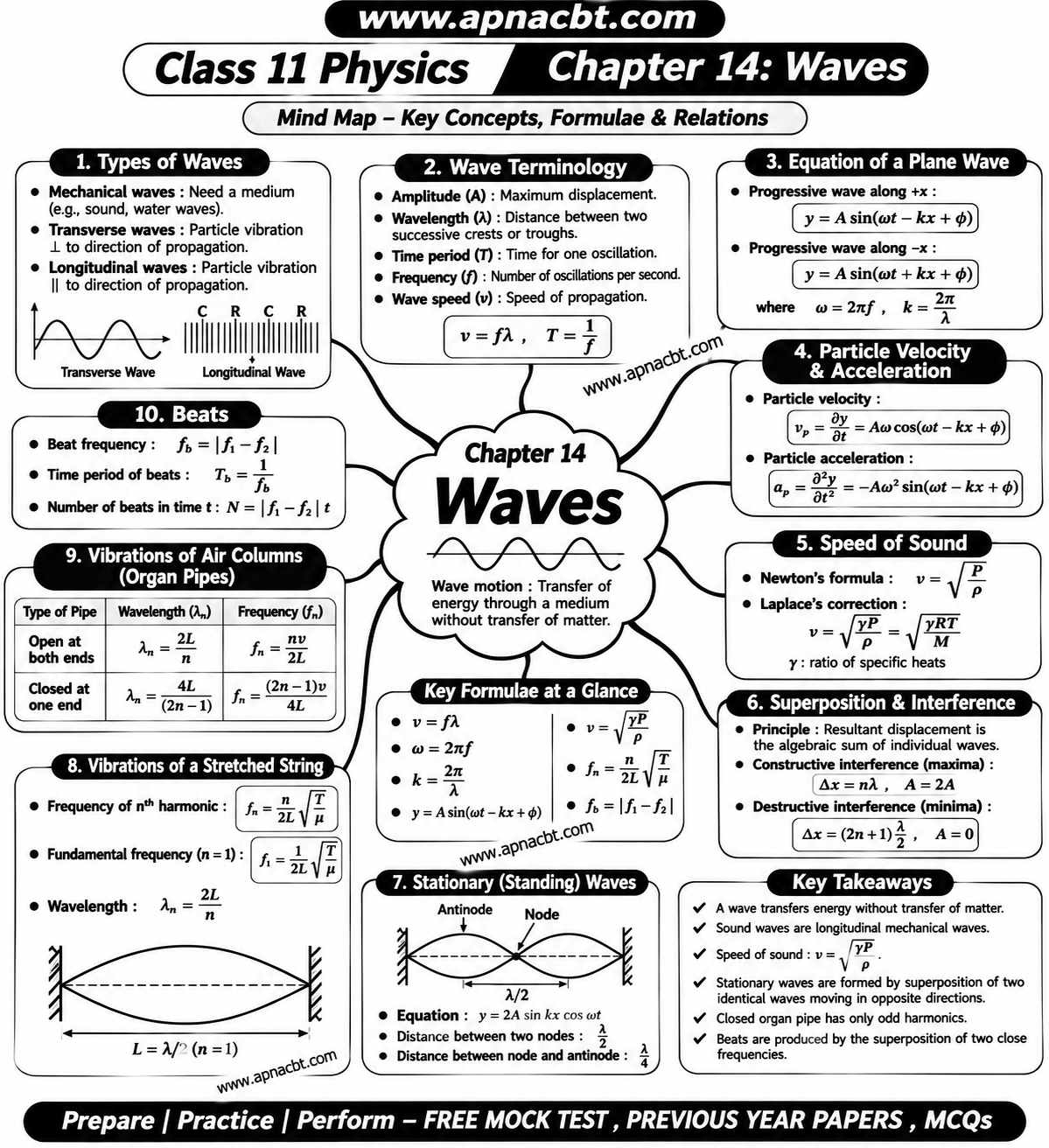
Waves Mind Map – Class 11 Physics Chapter 14 | APNA CBT
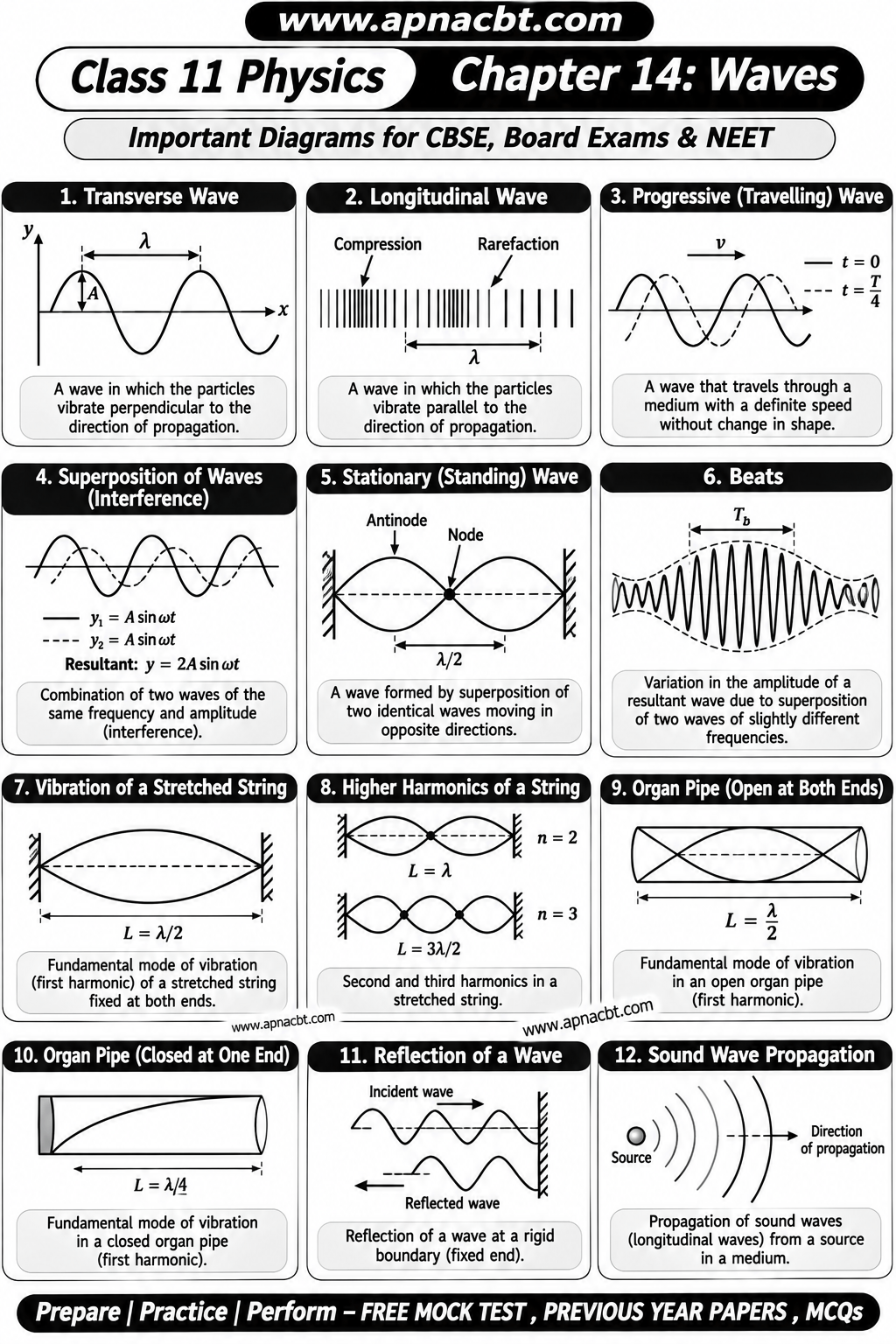
Important Diagrams – Waves Class 11 Physics Chapter 14
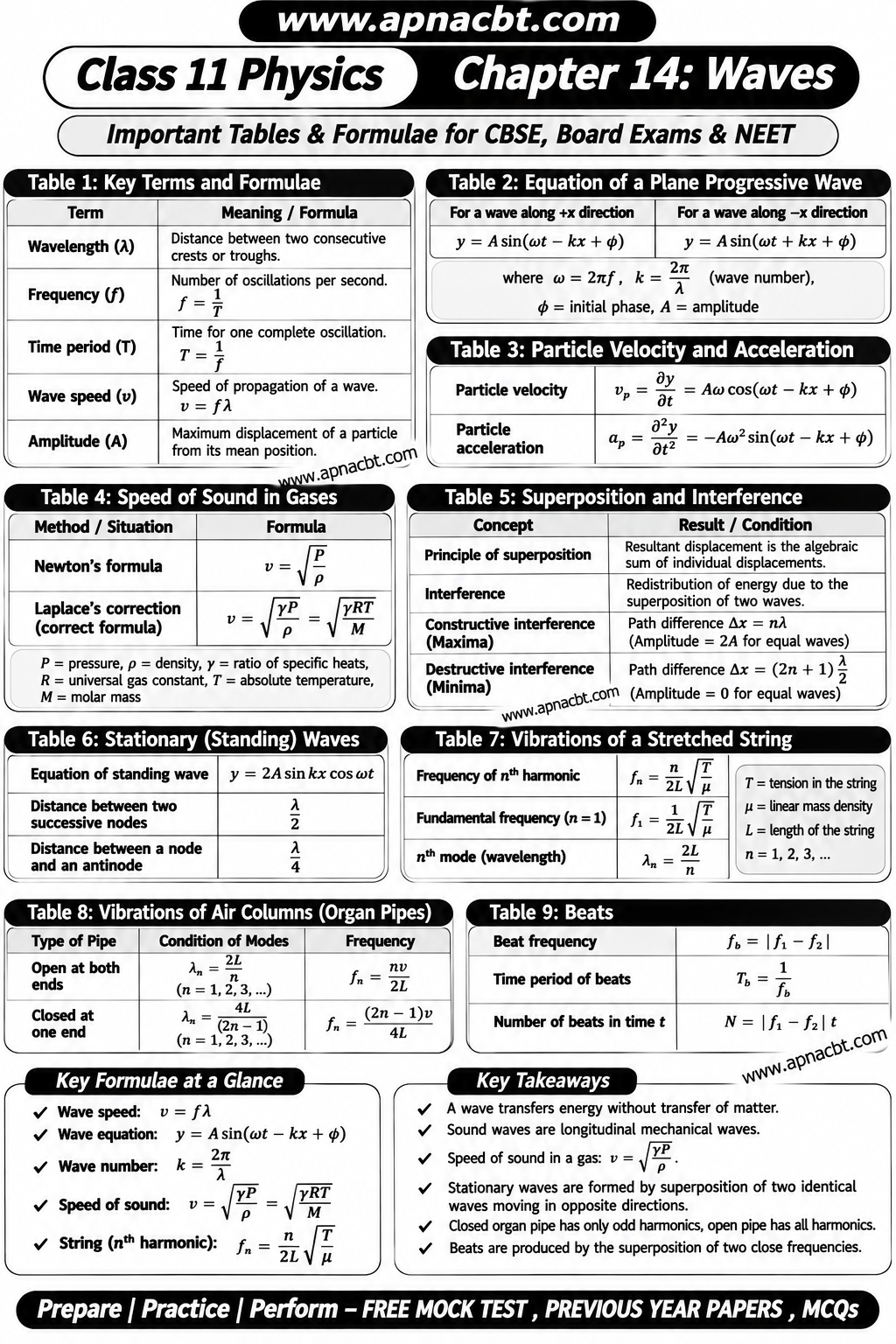
Important Tables and Formulae – Waves Class 11 Physics Chapter 14 | APNA CBT