Chapter 01 – Some Basic Concepts of Chemistry
This chapter introduces the basic language and quantitative principles of chemistry: matter and its classification, measurement and SI units, laws of chemical combination, Dalton’s atomic theory, atomic and molecular masses, mole concept, percentage composition, empirical and molecular formulae, stoichiometry and concentration of solutions.
Exam focus: Learn the definitions, laws and formulae, and practise numerical problems involving mole conversions, isotopic abundance, formula calculations, limiting reagents, molarity and molality.
1. Importance and Scope of Chemistry
Meaning of Chemistry
Chemistry is the branch of science that deals with the composition, structure, properties and transformations of matter. It explains how substances are formed and how they undergo physical and chemical changes.
Applications
- Agriculture and food: Fertilisers such as urea and ammonium sulphate improve crop production. Pesticides and fungicides protect crops, while preservatives help prevent food spoilage.
- Medicine: Chemistry contributes to the preparation of antacids, analgesics, antibiotics and medicines used to treat serious diseases.
- Industry: It is essential in manufacturing pharmaceuticals, polymers, paper, textiles, cement, paints, dyes, petroleum products, soaps and detergents.
- Daily life and environment: Chemistry helps us understand fuels, water treatment, corrosion, pollution and the materials used in everyday products.
2. Nature and Classification of Matter
Matter
Matter is anything that has mass and occupies space. It is made up of particles such as atoms, molecules or ions.
Physical Classification
- Solids: Definite shape and volume; particles are closely packed.
- Liquids: Definite volume but no definite shape; they flow and take the shape of their container.
- Gases: Neither definite shape nor definite volume; they expand to fill a container and are highly compressible.
Interconversion of States
Changes in temperature or pressure can convert matter from one state to another. Melting: solid to liquid; freezing: liquid to solid; vaporisation: liquid to gas; condensation: gas to liquid; sublimation: solid directly to gas; deposition: gas directly to solid.
Chemical Classification
- Pure substances: Have fixed composition and characteristic properties. They are elements or compounds.
- Elements: Contain one kind of atom; they may be metals, non-metals or metalloids.
- Compounds: Contain two or more elements chemically combined in a fixed proportion by mass. Their properties differ from those of their constituent elements.
- Mixtures: Contain two or more substances physically mixed in variable proportions. Components retain their properties and can often be separated physically.
Homogeneous and Heterogeneous Mixtures
A homogeneous mixture has uniform composition throughout, for example salt solution. A heterogeneous mixture has non-uniform composition or more than one phase, for example sand in water or dusty air.
Separation of Mixtures
Methods include filtration, evaporation, crystallisation, sublimation, distillation, fractional distillation, chromatography and separating-funnel techniques. The method depends on differences in physical properties.
3. Properties of Matter, Measurement and SI Units
Physical and Chemical Properties
Physical properties can be observed or measured without changing the chemical identity of a substance. Examples: colour, odour, density, melting point and boiling point. Chemical properties describe the ability to undergo chemical change, such as combustibility or reactivity with acids and bases.
Measurement and SI System
A physical quantity is measured by comparing it with an accepted standard. A measurement has a numerical value and a unit. The International System of Units (SI) provides a common system.
| Base quantity | SI unit | Symbol |
|---|---|---|
| Length | metre | m |
| Mass | kilogram | kg |
| Time | second | s |
| Electric current | ampere | A |
| Thermodynamic temperature | kelvin | K |
| Amount of substance | mole | mol |
| Luminous intensity | candela | cd |
Units of other physical quantities are derived from these base units. For example, density has SI unit kg m−3.
Mass and Weight
Mass is the amount of matter in a body and remains constant for that body. Weight is the gravitational force acting on it and can vary with gravitational acceleration. Mass is measured in kg; weight in newton (N).
Volume and Density
Volume is the space occupied by a substance. Its SI unit is m3. Common conversions:
- 1 L = 1000 mL = 1000 cm3 = 1 dm3
- 1 mL = 1 cm3
- 1 m3 = 1000 L
Density = Mass / Volume. Common units are kg m−3 and g cm−3.
Temperature Scales
Kelvin is the SI unit of temperature. K = °C + 273.15; °F = (9/5 × °C) + 32; °C = (5/9) × (°F − 32).
Measuring Instruments
An analytical balance measures mass accurately. Burettes, pipettes, graduated cylinders and volumetric flasks are used to measure or deliver liquid volumes.
4. Laws of Chemical Combination
Law of Conservation of Mass
Proposed by Lavoisier. Mass is neither created nor destroyed in a chemical reaction. In a closed system, total mass of reactants equals total mass of products.
Law of Definite Proportions
Proposed by Proust. A given compound always contains the same elements combined in a fixed proportion by mass, irrespective of its source or preparation. Water contains hydrogen and oxygen in a 1 : 8 mass ratio.
Law of Multiple Proportions
When two elements form more than one compound, the masses of one element that combine with a fixed mass of the other are in a simple whole-number ratio. For CO and CO2, oxygen masses combining with a fixed mass of carbon are in the ratio 1 : 2.
Gay-Lussac’s Law of Gaseous Volumes
When gases react, the volumes of reacting gases and gaseous products, measured at the same temperature and pressure, bear simple whole-number ratios.
Avogadro’s Law
Equal volumes of gases at the same temperature and pressure contain equal numbers of molecules. At constant temperature and pressure, gas volume is directly proportional to the number of moles: V ∝ n.
5. Dalton’s Atomic Theory
Dalton proposed an atomic theory to explain the laws of chemical combination. Its principal postulates are:
- All matter is made up of extremely small particles called atoms.
- Atoms of the same element were considered identical in mass and properties; atoms of different elements were considered different.
- Atoms are neither created nor destroyed in ordinary chemical reactions; they are rearranged.
- Compounds form when atoms of different elements combine in simple whole-number ratios.
- The kinds and relative numbers of atoms are fixed in a given compound.
Modern View
Atoms contain subatomic particles, and isotopes of the same element may have different masses. Nuclear reactions can transform atoms. These discoveries refine some original postulates, but Dalton’s theory remains useful for ordinary chemical reactions and stoichiometry.
6. Atomic Mass, Molecular Mass, Formula Mass and Molar Mass
Atomic Mass Unit
One unified atomic mass unit (u) is defined as one-twelfth of the mass of one carbon-12 atom.
Atomic Mass and Isotopes
Atomic mass is expressed in u. The atomic mass of an element may be a weighted average of the masses of its naturally occurring isotopes.
Average atomic mass = Σ (isotopic mass × fractional abundance)
When abundance is a percentage, divide it by 100 to obtain the fractional abundance.
Molecular Mass
Molecular mass is the sum of the atomic masses of all atoms in one molecule. Example: H2O = 2(1) + 16 = 18 u.
Formula Mass
Ionic solids are represented by formula units. Formula mass is the sum of atomic masses represented in the formula unit. Example: NaCl = 23 + 35.5 = 58.5 u.
Molar Mass
Molar mass is the mass of one mole of a substance. Its commonly used unit is g mol−1. The numerical value of molar mass in g mol−1 equals the corresponding atomic, molecular or formula mass in u.
7. Mole Concept and Avogadro Constant
Definition of Mole
The mole is the SI unit of amount of substance. One mole contains exactly 6.02214076 × 10²³ specified elementary entities. This is the Avogadro constant (NA); in calculations it is commonly approximated as 6.022 × 10²³ mol−1. Entities may be atoms, molecules, ions, electrons or other specified particles.
Important Relationships
- Moles: n = given mass / molar mass
- Number of entities: N = n × NA
- Moles from particles: n = N / NA
- Mass: m = n × M, where M is molar mass
- For a gas: n = V / Vm, when molar volume is known for the stated conditions
Molar Volume of a Gas
At 273.15 K and 1 atm, the molar volume of an ideal gas is approximately 22.4 L mol−1. Always check the temperature and pressure stated in a question because gas volume depends on conditions.
Counting Atoms in Compounds
First calculate molecules using moles × Avogadro constant. Then multiply by the number of atoms of the required element in each molecule. One molecule of CO2 has one carbon atom and two oxygen atoms; one mole of CO2 contains one mole of carbon atoms and two moles of oxygen atoms.
8. Percentage Composition and Empirical and Molecular Formulae
Percentage Composition
Percentage composition gives the percentage by mass of each element in a compound.
Mass % of an element = (Mass of that element in one mole of compound / Molar mass of compound) × 100
Empirical Formula
The empirical formula represents the simplest whole-number ratio of atoms of different elements.
Steps to Determine an Empirical Formula
- Write the percentage or mass of each element.
- If percentages are given, assume 100 g of compound.
- Convert each element’s mass into moles by dividing by its atomic mass.
- Divide all mole values by the smallest value.
- Convert the ratios into the smallest whole numbers. Multiply all ratios by a suitable integer if needed.
- Write the formula using these ratios as subscripts.
Molecular Formula
The molecular formula gives the actual number of atoms of each element in one molecule. It is a whole-number multiple of the empirical formula.
n = Molecular molar mass / Empirical formula mass
Molecular formula = (Empirical formula)n
9. Chemical Equations and Stoichiometric Calculations
Balanced Chemical Equation
A chemical equation represents a reaction using symbols and formulae. A balanced equation has the same number of atoms of each element on both sides, in accordance with conservation of mass.
Example: 2H2 + O2 → 2H2O. Coefficients represent relative numbers of molecules or moles, not masses.
Stoichiometry
Stoichiometry is the quantitative study of reactants and products. The coefficients of a balanced equation provide the mole ratios used in calculations.
- Write the correct equation and balance it.
- Convert the given quantity into moles.
- Use the balanced equation’s mole ratio.
- Convert calculated moles into the required mass, particles or gas volume.
- Check units and significant figures.
Limiting Reagent
The limiting reagent is consumed completely first and determines the maximum amount of product. To identify it, compare available moles divided by the corresponding balanced-equation coefficient. The smallest value identifies the limiting reagent.
Solution Reactions and Dilution
When molarity and volume in litres are known, moles = M × V. For dilution of the same solute without loss of solute: M1V1 = M2V2.
10. Concentration of Solutions and Formula Revision
Methods of Expressing Concentration
- Mass percentage: (Mass of solute / Mass of solution) × 100.
- Volume percentage: (Volume of solute / Volume of solution) × 100.
- Mass-by-volume percentage: (Mass of solute in g / Volume of solution in mL) × 100.
- Parts per million (ppm): For mass-based dilute solutions, (Mass of solute / Mass of solution) × 106.
- Mole fraction: xA = moles of A / total moles of all components. Sum of mole fractions = 1.
Molarity (M)
Molarity is the number of moles of solute per litre of solution: M = moles of solute / volume of solution in litres. Unit: mol L−1. Molarity can change with temperature because solution volume may change.
Molality (m)
Molality is the number of moles of solute per kilogram of solvent: m = moles of solute / mass of solvent in kg. Unit: mol kg−1. Molality is independent of temperature because it is based on mass.
Quick Formula Table
| Concept | Formula |
|---|---|
| Density | Mass / Volume |
| Moles from mass | n = m / Mm |
| Number of particles | N = nNA |
| Mass from moles | m = nMm |
| Gas moles | n = V / Vm (stated conditions) |
| Element percentage | (Mass of element / Molar mass) × 100 |
| Formula factor | n = Molecular molar mass / Empirical formula mass |
| Molarity | M = moles / solution volume (L) |
| Molality | m = moles / solvent mass (kg) |
| Mole fraction | xA = nA / total moles |
| Dilution | M1V1 = M2V2 |
11. Short-Answer Questions – 30 Questions
Questions
- Define chemistry. Mention two areas in which it is applied.
- What is matter? Name its three common physical states.
- Differentiate between a pure substance and a mixture.
- Distinguish homogeneous and heterogeneous mixtures with examples.
- Why is water a compound whereas brass is a mixture?
- Define physical and chemical properties with one example each.
- List the seven SI base quantities and their units.
- Differentiate between mass and weight.
- Define density and write its SI unit.
- Convert 25 °C into kelvin.
- State the law of conservation of mass.
- State the law of definite proportions.
- State the law of multiple proportions with an example.
- State Gay-Lussac’s law of gaseous volumes.
- State Avogadro’s law.
- Write any four postulates of Dalton’s atomic theory.
- Define one atomic mass unit (u).
- Calculate molecular mass of CO2. (C = 12, O = 16)
- What is molar mass? State its commonly used unit.
- Define one mole and give the Avogadro constant.
- How many molecules are present in 0.5 mol of water?
- Calculate moles in 9 g of water. (Molar mass = 18 g mol−1)
- How many oxygen atoms are present in one molecule of H2SO4?
- Define empirical formula and molecular formula.
- What is percentage composition by mass?
- Write the relationship between molecular and empirical formulae.
- What is stoichiometry?
- Define limiting reagent.
- Define molarity and write its unit.
- Differentiate between molarity and molality.
Answers
- Chemistry is the science of the composition, structure, properties and transformations of matter. It is applied in agriculture through fertilisers and crop-protection chemicals, and in medicine through the preparation of drugs.
- Matter is anything that has mass and occupies space. Its three common states are solid, liquid and gas.
- A pure substance has fixed composition and characteristic properties, e.g. pure copper or water. A mixture contains substances in variable proportions, e.g. air or brass.
- A homogeneous mixture has uniform composition, e.g. salt solution. A heterogeneous mixture has non-uniform composition, e.g. sand and water.
- Water contains hydrogen and oxygen chemically combined in a fixed 1 : 8 mass ratio. Brass contains copper and zinc physically mixed in variable proportions.
- A physical property can be observed without changing chemical identity, e.g. density. A chemical property describes reactivity, e.g. magnesium reacting with oxygen.
- Length—metre (m); mass—kilogram (kg); time—second (s); electric current—ampere (A); temperature—kelvin (K); amount—mole (mol); luminous intensity—candela (cd).
- Mass is the amount of matter and remains constant for a body. Weight is gravitational force and varies with gravitational acceleration. Units: kg and N respectively.
- Density is mass per unit volume: ρ = m/V. SI unit: kg m−3.
- K = 25 + 273.15 = 298.15 K.
- Mass is neither created nor destroyed in a chemical reaction. In a closed system, total reactant mass equals total product mass.
- A pure compound always contains the same elements combined in a fixed proportion by mass, regardless of source or method of preparation.
- When two elements form more than one compound, masses of one element combining with a fixed mass of the other are in a small whole-number ratio. In CO and CO2, oxygen masses for a fixed carbon mass are in the ratio 1 : 2.
- Volumes of reacting gases and gaseous products, measured at the same temperature and pressure, are in simple whole-number ratios.
- Equal gas volumes at the same temperature and pressure contain equal numbers of molecules. At constant temperature and pressure, V ∝ n.
- Any four: matter consists of atoms; atoms of a given element were considered identical; atoms of different elements differ; compounds form in simple whole-number ratios; chemical reactions rearrange atoms.
- One u is one-twelfth of the mass of one carbon-12 atom.
- CO2 molecular mass = 12 + 2(16) = 44 u.
- Molar mass is the mass of one mole of a substance. Common unit: g mol−1.
- One mole contains exactly 6.02214076 × 10²³ specified entities; approximately 6.022 × 10²³ mol−1.
- N = nNA = 0.5 × 6.022 × 1023 = 3.011 × 10²³ molecules.
- n = mass/molar mass = 9/18 = 0.5 mol.
- One molecule of H2SO4 contains 4 oxygen atoms.
- Empirical formula gives the simplest whole-number atom ratio. Molecular formula gives the actual number of each type of atom in a molecule.
- It is the mass percentage of each element in a compound: (mass of element in one mole / molar mass of compound) × 100.
- Molecular formula = (Empirical formula)n, where n = molecular molar mass / empirical formula mass.
- Stoichiometry is the quantitative study of reactants and products using the mole ratios of a balanced chemical equation.
- The limiting reagent is consumed first and determines the maximum amount of product formed.
- Molarity is moles of solute per litre of solution. Unit: mol L−1 or M.
- Molarity is moles per litre of solution and may change with temperature. Molality is moles per kilogram of solvent and is temperature-independent.
12. Long-Answer Questions – 15 Questions
Questions
- Explain the physical and chemical classification of matter. Distinguish elements, compounds and mixtures with examples.
- Describe the seven SI base quantities. Explain mass, weight, volume and density.
- State and explain the major laws of chemical combination with examples.
- Explain Dalton’s atomic theory and mention its limitations in the light of modern discoveries.
- Define atomic mass unit, average atomic mass, molecular mass, formula mass and molar mass. Explain average atomic mass calculation from isotopic abundance.
- Define the mole and derive relationships between mass, moles and particles. Calculate molecules in 36 g of water.
- Calculate average atomic mass of chlorine using 75.77% of 35Cl (34.9689 u) and 24.23% of 37Cl (36.9659 u).
- Explain percentage composition. Calculate percentages of C, H and O in glucose C6H12O6. (C = 12, H = 1, O = 16)
- Explain empirical formula determination. A compound contains 40% C, 6.67% H and 53.33% O. Find its empirical formula.
- Explain the relationship between empirical and molecular formulae. A compound has empirical formula CH2O and molar mass 180 g mol−1. Find its molecular formula.
- Explain stoichiometric calculations using 2H2 + O2 → 2H2O.
- Define limiting reagent. When 4 mol H2 reacts with 1 mol O2, identify it and calculate water formed and excess reactant remaining.
- Define molarity and molality. Calculate molarity of 5.85 g NaCl in 500 mL solution. (Molar mass = 58.5 g mol−1)
- Explain mass percentage, volume percentage, mass-by-volume percentage, ppm and mole fraction.
- Compare molarity and molality. Calculate molality when 18 g glucose (180 g mol−1) is dissolved in 180 g water.
Detailed Answers
- Physical classification: Solids have definite shape and volume; liquids have definite volume but take the shape of their container; gases have neither definite shape nor definite volume and are compressible. Chemical classification: Matter is divided into pure substances and mixtures. Pure substances are elements or compounds. An element contains one kind of atom, e.g. copper. A compound contains elements chemically combined in a fixed ratio, e.g. water. A mixture contains substances physically combined in variable proportions, e.g. air, salt solution or brass. Mixtures may be homogeneous or heterogeneous.
- The seven SI base quantities are length—metre; mass—kilogram; time—second; electric current—ampere; temperature—kelvin; amount of substance—mole; luminous intensity—candela. Mass is amount of matter (kg). Weight is gravitational force, W = mg (N). Volume is space occupied (m3). Density is mass per unit volume, ρ = m/V (kg m−3).
- Conservation of mass: Total mass remains constant in a closed-system chemical reaction. Definite proportions: A compound has fixed elemental mass proportions; water has H:O = 1:8 by mass. Multiple proportions: If two elements form multiple compounds, the masses combining with a fixed mass of the other are in a small whole-number ratio; CO and CO2 give an oxygen ratio 1:2 for fixed carbon. Gay-Lussac: Reacting gas volumes and gaseous product volumes have simple whole-number ratios at the same temperature and pressure. Avogadro: Equal gas volumes at the same temperature and pressure contain equal numbers of molecules.
- Dalton proposed that matter consists of atoms; atoms of a given element were considered identical; atoms of different elements differ; compounds form by combination in simple whole-number ratios; and chemical reactions rearrange atoms. Modern discoveries show atoms contain subatomic particles, isotopes have different masses, and nuclear reactions can transform atoms. These modify the original postulates, but the theory remains useful for ordinary chemical reactions.
- One u is one-twelfth the mass of a carbon-12 atom. Average atomic mass is the weighted mean of isotopic masses: Σ(isotopic mass × fractional abundance). Molecular mass is the sum of atomic masses in a molecule. Formula mass is the sum in an ionic formula unit. Molar mass is the mass of one mole, usually g mol−1. For water, molecular mass = 18 u and molar mass = 18 g mol−1.
- One mole contains 6.022 × 10²³ specified entities. n = m/M; N = nNA; m = nM. For 36 g H2O, molar mass = 18 g mol−1; n = 36/18 = 2 mol. Molecules = 2 × 6.022 × 1023 = 1.2044 × 1024.
- Average atomic mass = (34.9689 × 0.7577) + (36.9659 × 0.2423) = 35.45 u approximately. Each isotope mass is multiplied by its fractional abundance and the contributions are added.
- Molar mass of glucose = 6(12) + 12(1) + 6(16) = 180 g mol−1. Carbon = (72/180) × 100 = 40%. Hydrogen = (12/180) × 100 = 6.67%. Oxygen = (96/180) × 100 = 53.33%. Total = 100%.
- Assume 100 g: C = 40 g, H = 6.67 g, O = 53.33 g. Moles: C = 40/12 = 3.33; H = 6.67/1 = 6.67; O = 53.33/16 = 3.33. Divide by 3.33: ratio C:H:O = 1:2:1. Empirical formula = CH2O.
- n = molecular molar mass / empirical formula mass. Empirical formula mass of CH2O = 12 + 2 + 16 = 30. n = 180/30 = 6. Molecular formula = (CH2O)6 = C6H12O6.
- Stoichiometry uses the coefficients of a balanced equation to calculate reactant and product quantities. Balance the equation, convert the known amount to moles, apply the coefficient ratio, then convert to the required unit. In 2H2 + O2 → 2H2O, 2 mol H2 react with 1 mol O2 to form 2 mol H2O. Thus 4 mol H2 with 2 mol O2 forms 4 mol water.
- Equation: 2H2 + O2 → 2H2O. Four moles H2 would require 2 mol O2, but only 1 mol is available. Therefore O2 is the limiting reagent. One mole O2 reacts with 2 mol H2 and forms 2 mol H2O. Hydrogen remaining = 4 − 2 = 2 mol; water formed = 2 mol.
- Moles NaCl = 5.85/58.5 = 0.1 mol. Volume = 500 mL = 0.5 L. Molarity = 0.1/0.5 = 0.20 mol L−1 (0.20 M). Molarity is moles per litre of solution; molality is moles per kilogram of solvent.
- Mass % = mass solute / mass solution × 100. Volume % = volume solute / volume solution × 100. Mass-by-volume % gives grams of solute per 100 mL solution. ppm = mass solute / mass solution × 106 on a mass basis. Mole fraction = moles of component / total moles; all mole fractions add to 1.
- Molarity is moles per litre of solution and can vary with temperature because volume changes. Molality is moles per kilogram of solvent and is temperature-independent. Glucose moles = 18/180 = 0.1 mol. Water mass = 180 g = 0.180 kg. Molality = 0.1/0.180 = 0.556 mol kg−1.
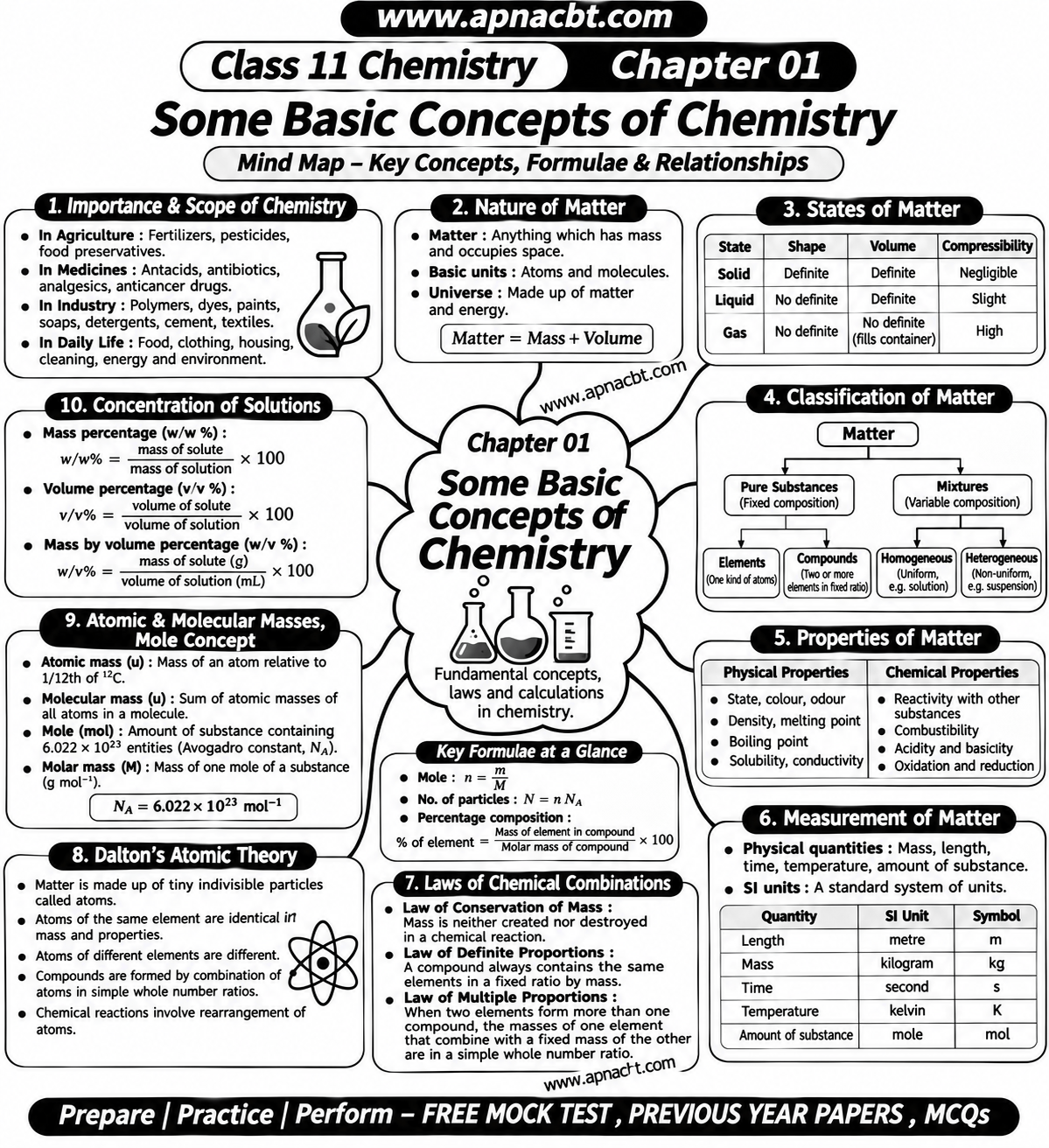
Some Basic Concepts of Chemistry Class 11 – Chapter 01 Mind Map
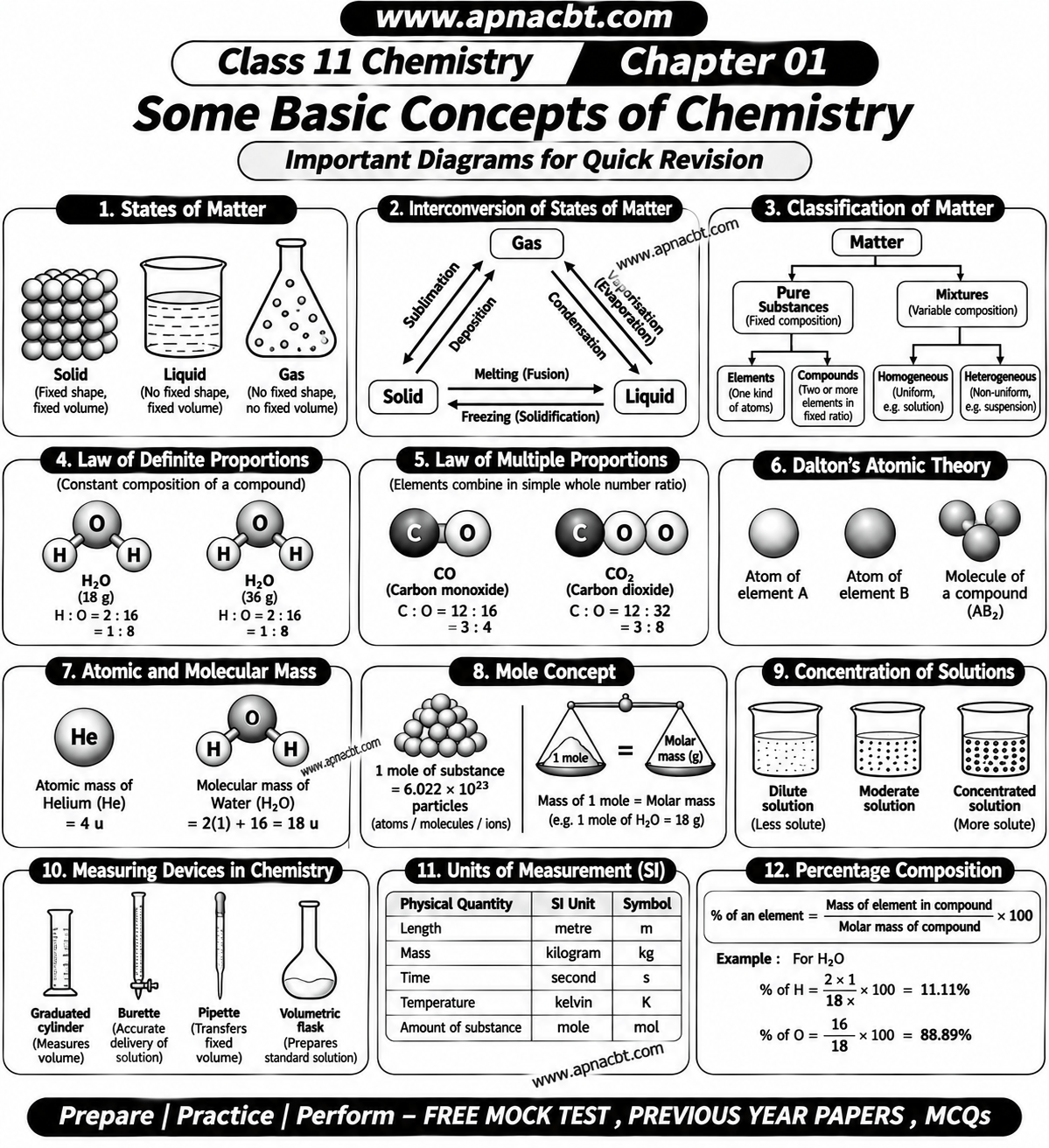
Some Basic Concepts of Chemistry Class 11 – Important Diagrams
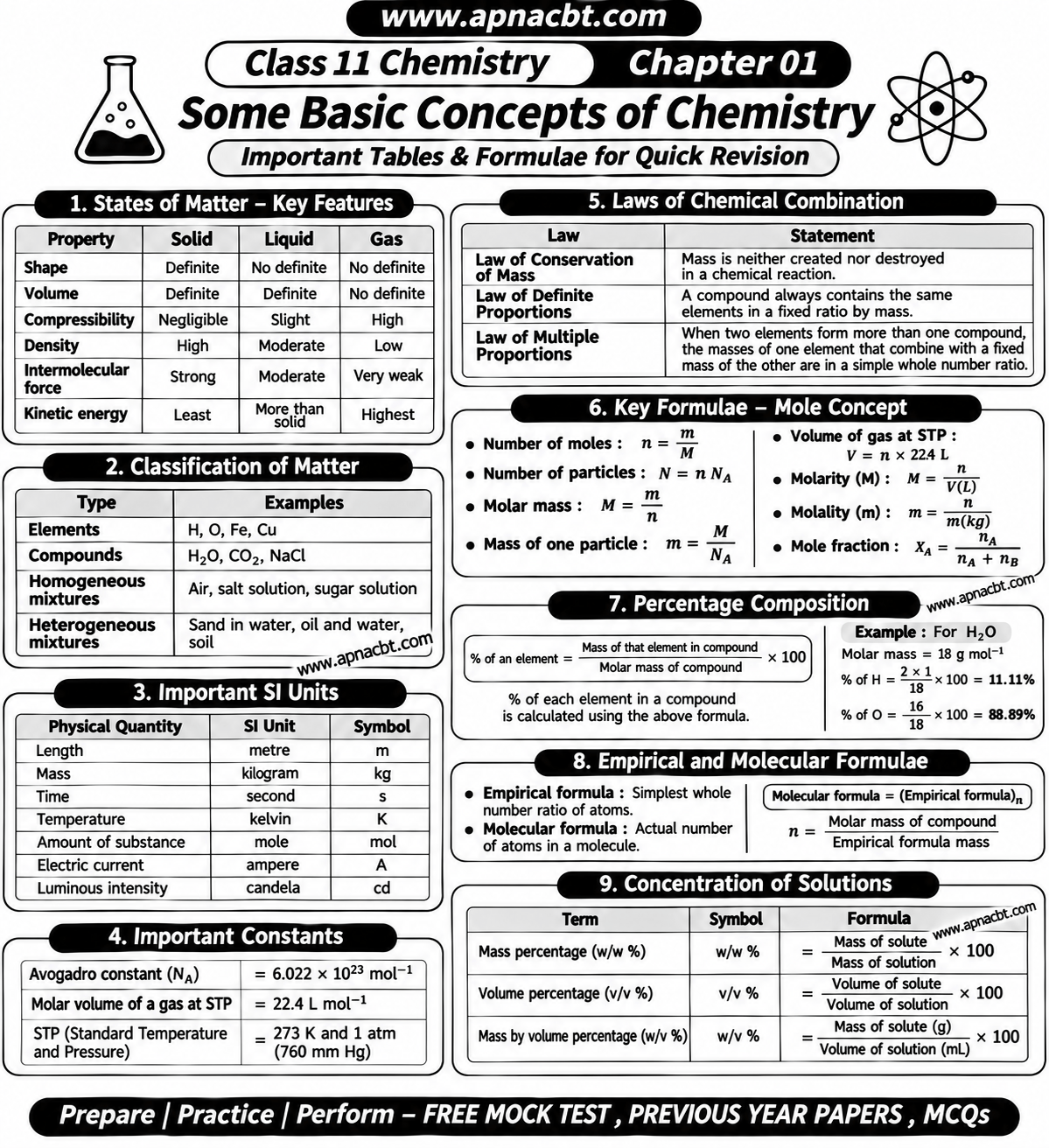
Some Basic Concepts of Chemistry Class 11 – Important Tables and Formulae