Chapter 07: Gravitation
Class 11 Physics | CBSE Board Examinations | NEET-UG Preparation
This lesson presents the important concepts, laws, derivations, diagrams-in-words, standard results and formulae from Gravitation. It is organised for conceptual study, CBSE board revision and NEET-UG practice. Use the final two sections to test short-answer and long-answer understanding.
1. Introduction to Gravitation and Planetary Motion
Gravitation is the universal attractive interaction between any two bodies having mass. It explains falling bodies, the motion of the Moon around Earth and the revolution of planets around the Sun.
The chapter introduces the historical development of planetary models: the geocentric model placed Earth at the centre, while the heliocentric model places the Sun at the centre of the planetary system. Observations by Tycho Brahe helped Johannes Kepler formulate the laws of planetary motion. Newton then explained these laws using universal gravitation.
- Gravitation: mutual attraction between any two masses.
- Gravity: the gravitational attraction exerted by a celestial body, such as Earth, on nearby objects.
2. Kepler’s Laws of Planetary Motion
First law – Law of orbits: Every planet moves around the Sun in an elliptical orbit, with the Sun at one focus. The nearest point is perihelion and the farthest point is aphelion. For an ellipse of semi-major axis a and eccentricity e, the distances from the Sun at perihelion and aphelion are a(1 − e) and a(1 + e), respectively.
Second law – Law of areas: The line joining a planet and the Sun sweeps out equal areas in equal intervals of time. Therefore, areal velocity is constant. A planet moves faster near perihelion and slower near aphelion.
Third law – Law of periods: The square of the orbital period T is proportional to the cube of the semi-major axis a: T² ∝ a³. For a planet orbiting a much heavier Sun, T²/a³ = 4π²/(GMSun).
The second law follows from conservation of angular momentum because gravitational force is a central force and its torque about the Sun is zero.
3. Newton’s Universal Law of Gravitation
Every particle in the universe attracts every other particle with a force that is directly proportional to the product of their masses and inversely proportional to the square of the distance between their centres.
F = Gm₁m₂/r²
- G is the universal gravitational constant: approximately 6.67 × 10⁻¹¹ N m² kg⁻².
- The force acts along the line joining the centres and is always attractive.
- For two bodies, the forces are equal in magnitude and opposite in direction.
- Gravitational force has infinite range and obeys the principle of superposition.
For extended spherically symmetric bodies, the external gravitational force can be calculated as if their masses were concentrated at their centres, provided the bodies do not overlap.
4. Gravitational Constant and Principle of Superposition
The constant G is universal and does not depend on the nature of the interacting bodies or the medium. Its SI unit is N m² kg⁻² and its dimensions are [M⁻¹L³T⁻²].
When several masses act on a test mass, the resultant gravitational force is the vector sum of the individual forces:
Fnet = F₁ + F₂ + F₃ + …
Calculate each force separately using its direction, then add the vectors. Gravitational forces are attractive, so each contribution points towards the mass producing it.
5. Acceleration Due to Gravity at Earth’s Surface
The gravitational force on a body of mass m at Earth’s surface is F = GMEm/RE². From F = mg:
g = GME/RE²
Near Earth’s surface, g is approximately 9.8 m s⁻². It is independent of the mass of the freely falling object when air resistance is neglected. The value depends on the mass and radius of the attracting planet.
Rearranging gives ME = gRE²/G. The average density of Earth can be estimated from ρ = ME/[(4/3)πRE³] = 3g/(4πGRE).
6. Variation of g with Height and Depth
At height h: At a distance RE + h from Earth’s centre, gh = GME/(RE + h)². Therefore, gh = g[RE/(RE + h)]². For h much smaller than RE, gh ≈ g(1 − 2h/RE).
At depth d: Assuming Earth has uniform density, only the mass inside radius RE − d contributes to the net force. Thus gd = g(1 − d/RE). It decreases linearly with depth and becomes zero at Earth’s centre.
For h = d when both are small compared with Earth’s radius, the decrease in g at height h is approximately twice the decrease at depth d.
7. Gravitational Field and Field Intensity
A gravitational field is the region around a mass in which another mass experiences gravitational force. Gravitational field intensity at a point is the gravitational force per unit test mass:
E = F/m = −GM/r² r̂
Its magnitude for a point mass is GM/r²; its direction is towards the attracting mass. SI unit: N kg⁻¹, equivalent to m s⁻². It is a vector quantity.
For multiple masses, the net field is the vector sum of their individual fields. The field due to a spherically symmetric body outside it is the same as that of a point mass at its centre.
8. Gravitational Field of a Ring, Spherical Shell and Solid Sphere
Uniform ring: At a point on its axis at distance x from the centre, the transverse components cancel. The field magnitude is E = GMx/(R² + x²)3/2, directed towards the ring. At the centre, the net field is zero.
Thin spherical shell: Outside the shell, the field is as if the entire mass were concentrated at its centre: E = GM/r². At every point inside a uniform thin shell, the net field is zero.
Uniform solid sphere: Outside, E = GM/r². Inside at distance r from the centre, E = GMr/R³, so the field increases linearly from zero at the centre to its surface value. These results assume spherical symmetry and uniform density for the solid sphere.
9. Gravitational Potential
Gravitational potential at a point is the work done per unit mass by an external agent in bringing a small test mass from infinity to that point slowly, taking potential at infinity as zero.
For a point mass M at distance r:
V = −GM/r
Potential is a scalar quantity. Its SI unit is J kg⁻¹ and its dimensions are [L²T⁻²]. Potentials due to several masses add algebraically: V = Σ(−Gmᵢ/rᵢ).
The negative sign indicates that the gravitational interaction is attractive and that a positive amount of energy is needed to take a bound mass from a finite distance to infinity.
10. Gravitational Potential of Shells and Solid Spheres
Thin spherical shell: Outside, V = −GM/r. Inside the shell, the field is zero, so potential is constant and equal to its surface value, V = −GM/R.
Uniform solid sphere: Outside, V = −GM/r. Inside at distance r from the centre, V = −GM(3R² − r²)/(2R³). At the centre, V = −3GM/(2R), and at the surface V = −GM/R.
Remember that zero field does not imply zero potential. Inside a spherical shell the field is zero but the potential is a non-zero constant when the reference is taken at infinity.
11. Relation Between Gravitational Field and Potential
The gravitational field is the negative spatial rate of change of gravitational potential:
E = −dV/dr for radial variation, or in vector form E = −∇V.
The negative sign means that the field points in the direction in which potential decreases most rapidly. For a point mass, differentiating V = −GM/r gives the inward field of magnitude GM/r².
12. Gravitational Potential Energy
Gravitational potential energy is the energy associated with the configuration of masses. Taking zero potential energy at infinite separation, two point masses M and m separated by r have:
U = −GMm/r = mV
For a body near Earth’s surface, where height change h is small compared with Earth’s radius, the change in potential energy is approximately ΔU = mgh. This is a change in energy; the absolute Newtonian potential energy with zero at infinity is negative.
For several source masses, the potential energy of a test mass is the algebraic sum of its pairwise interaction energies.
13. Escape Speed and Escape Energy
Escape speed is the minimum speed required for a body projected from a planet’s surface to reach infinity with zero final speed, neglecting air resistance and other celestial bodies.
Using conservation of mechanical energy: ½mve² − GMm/R = 0. Therefore:
ve = √(2GM/R) = √(2gR)
For Earth, escape speed is approximately 11.2 km s⁻¹. It does not depend on the mass of the escaping object. Escape energy from the surface is GMm/R. Escape speed is independent of the direction of projection in the ideal isolated spherical model.
14. Earth Satellites and Orbital Velocity
A satellite remains in orbit because gravity supplies the centripetal force. For a circular orbit of radius r = RE + h:
GMEm/r² = mv²/r, hence vo = √(GME/r).
The orbital speed decreases as orbital radius increases. Near Earth’s surface, vo ≈ √(gRE) ≈ 7.9 km s⁻¹. Orbital speed is independent of satellite mass.
The time period is T = 2πr/v = 2π√(r³/GME). Therefore T² = 4π²r³/(GME), which is the satellite form of Kepler’s third law.
15. Energy of an Orbiting Satellite and Binding Energy
For a satellite of mass m in a circular orbit of radius r:
- Kinetic energy: K = GMm/(2r).
- Potential energy: U = −GMm/r.
- Total mechanical energy: E = K + U = −GMm/(2r).
The total energy is negative for a bound circular orbit. The binding energy is the minimum energy required to remove the satellite from the orbit to infinity; its magnitude is GMm/(2r).
For a satellite close to Earth’s surface, use r ≈ RE. For higher orbits, do not replace r by Earth’s radius.
16. Geostationary and Polar Satellites
Geostationary satellite: It moves in a circular orbit in the equatorial plane from west to east, with the same angular speed and period as Earth’s rotation (approximately 24 hours, more precisely one sidereal day). It appears stationary above one point on the equator and is useful for communication and broadcasting.
Polar satellite: It travels in an orbit passing close to the north and south poles. As Earth rotates beneath it, the satellite can observe different regions of the planet. Such satellites are useful for mapping, weather observation and remote sensing.
17. Weightlessness and Apparent Weight
Weightlessness is the condition in which the apparent weight of a body, measured by the normal reaction of a supporting surface, becomes zero. In an orbiting spacecraft, both the spacecraft and astronaut are in continuous free fall towards Earth, so the astronaut does not press on the floor and the normal reaction is zero.
Gravity is not absent in an orbiting spacecraft. It is gravity that provides the centripetal acceleration needed for the orbit. A person standing on the Moon is not weightless because the Moon exerts a gravitational force and the surface provides a normal reaction.
18. Important Formulae and CBSE/NEET Revision
| Concept | Formula |
|---|---|
| Universal gravitation | F = Gm₁m₂/r² |
| Kepler’s third law | T² = 4π²a³/(GM) |
| Gravity at surface | g = GM/R² |
| Gravity at height | gₕ = g[R/(R+h)]² |
| Gravity at depth (uniform Earth) | g_d = g(1 − d/R) |
| Field intensity | E = GM/r² (towards M) |
| Potential of point mass | V = −GM/r |
| Potential energy | U = −GMm/r |
| Near-surface change in PE | ΔU ≈ mgh |
| Escape speed | vₑ = √(2GM/R) = √(2gR) |
| Orbital speed | vₒ = √(GM/r) |
| Satellite period | T = 2π√(r³/GM) |
| Satellite kinetic energy | K = GMm/(2r) |
| Satellite potential energy | U = −GMm/r |
| Satellite total energy | E = −GMm/(2r) |
| Field–potential relation | E = −dV/dr |
Exam reminders: Distinguish G (universal constant) from g (local acceleration due to gravity). Use distance from the centre, not height above the surface, in inverse-square formulas. In satellite problems r = R + h. Gravitational potential and potential energy are negative when zero is chosen at infinity. A body in orbit is not outside Earth’s gravitational field.
19. Short-answer Questions – 30 Questions
Questions
- State Newton’s universal law of gravitation.
- What is the SI value and unit of G?
- State Kepler’s first law.
- What is perihelion?
- State Kepler’s second law.
- State Kepler’s third law.
- Why is gravitational force called a central force?
- Define acceleration due to gravity.
- Write the expression for g at a planet’s surface.
- Does g depend on the mass of a freely falling object?
- How does g vary with height h?
- Write the expression for g at depth d inside a uniform Earth.
- What is the value of g at Earth’s centre in the uniform-density model?
- Define gravitational field intensity.
- What is the SI unit of gravitational field intensity?
- Define gravitational potential.
- Write gravitational potential due to a point mass.
- Why is gravitational potential negative?
- Write the relation between potential energy and potential.
- Write the gravitational potential energy of two point masses.
- When can change in gravitational potential energy be written as mgh?
- Define escape speed.
- Write the escape speed from a spherical planet.
- Does escape speed depend on the mass of the projectile?
- What provides centripetal force for an orbiting satellite?
- Write the orbital speed of a satellite in a circular orbit.
- Write the time period of a circular satellite orbit.
- What is a geostationary satellite?
- What is weightlessness?
- Why does an astronaut feel weightless in an orbiting spacecraft?
Answers
- State Newton’s universal law of gravitation.
Every two masses attract each other with force F = Gm₁m₂/r² along the line joining their centres. - What is the SI value and unit of G?
G ≈ 6.67 × 10⁻¹¹ N m² kg⁻². - State Kepler’s first law.
Every planet moves in an elliptical orbit with the Sun at one focus. - What is perihelion?
The point in a planet’s orbit nearest to the Sun. - State Kepler’s second law.
The line joining a planet and the Sun sweeps out equal areas in equal intervals of time. - State Kepler’s third law.
The square of the orbital period is proportional to the cube of the semi-major axis: T² ∝ a³. - Why is gravitational force called a central force?
It acts along the line joining the centres of the interacting masses. - Define acceleration due to gravity.
The acceleration produced in a freely falling body due to gravitational attraction of a celestial body. - Write the expression for g at a planet’s surface.
g = GM/R². - Does g depend on the mass of a freely falling object?
No. Neglecting air resistance, g is independent of the mass of the falling object. - How does g vary with height h?
gₕ = g[R/(R+h)]². - Write the expression for g at depth d inside a uniform Earth.
g_d = g(1 − d/R). - What is the value of g at Earth’s centre in the uniform-density model?
Zero. - Define gravitational field intensity.
Gravitational force experienced per unit test mass at a point; E = F/m. - What is the SI unit of gravitational field intensity?
N kg⁻¹, equivalent to m s⁻². - Define gravitational potential.
Work done per unit mass by an external agent in bringing a test mass slowly from infinity to the point. - Write gravitational potential due to a point mass.
V = −GM/r. - Why is gravitational potential negative?
Because gravity is attractive and potential is taken as zero at infinity; a positive input of energy is needed to move a mass to infinity. - Write the relation between potential energy and potential.
U = mV. - Write the gravitational potential energy of two point masses.
U = −Gm₁m₂/r. - When can change in gravitational potential energy be written as mgh?
For small height changes near a planet’s surface where g is approximately constant. - Define escape speed.
The minimum launch speed needed for a body to reach infinity with zero residual speed, neglecting other bodies and resistance. - Write the escape speed from a spherical planet.
vₑ = √(2GM/R) = √(2gR). - Does escape speed depend on the mass of the projectile?
No, it is independent of the projectile’s mass. - What provides centripetal force for an orbiting satellite?
The gravitational attraction of the planet. - Write the orbital speed of a satellite in a circular orbit.
vₒ = √(GM/r), where r is measured from the planet’s centre. - Write the time period of a circular satellite orbit.
T = 2π√(r³/GM). - What is a geostationary satellite?
A satellite in an equatorial circular orbit moving west to east with Earth’s rotational period, appearing fixed over one point on the equator. - What is weightlessness?
A condition in which apparent weight or supporting normal reaction is zero. - Why does an astronaut feel weightless in an orbiting spacecraft?
The astronaut and spacecraft are both in free fall, so there is no supporting normal reaction, although gravity is still acting.
20. Long-answer Questions – 15 Questions
Questions
- State and explain Kepler’s three laws of planetary motion.
- Derive the expression for gravitational force between two point masses.
- Show that Kepler’s second law follows from conservation of angular momentum.
- Derive acceleration due to gravity at the surface of a planet.
- Explain the variation of acceleration due to gravity with height and depth.
- Define gravitational field intensity and derive its expression for a point mass.
- Obtain the gravitational field on the axis of a uniform ring.
- Explain gravitational field inside and outside a uniform spherical shell and a solid sphere.
- Define gravitational potential and derive its value for a point mass.
- Explain gravitational potential inside and outside a spherical shell and a uniform solid sphere.
- Establish the relation between gravitational field and potential.
- Derive gravitational potential energy of two point masses and explain the near-surface approximation.
- Derive the expression for escape speed from a planet.
- Derive orbital velocity, time period and total energy of a satellite in a circular orbit.
- Explain geostationary satellites, polar satellites and weightlessness.
Detailed Answers
- State and explain Kepler’s three laws of planetary motion.
Kepler’s first law (law of orbits) states that planets move in elliptical orbits with the Sun at one focus. The nearest and farthest points are perihelion and aphelion. The second law (law of areas) states that the radius vector sweeps equal areas in equal times, so areal velocity is constant; a planet moves faster near perihelion. The third law (law of periods) states T² ∝ a³, where a is the semi-major axis. For a planet orbiting a much heavier central mass M, T² = 4π²a³/(GM). - Derive the expression for gravitational force between two point masses.
Consider point masses m₁ and m₂ separated by distance r. Experimentally, the force is proportional to each mass, so F ∝ m₁m₂. It is inversely proportional to the square of separation, so F ∝ 1/r². Combining the proportionalities gives F = Gm₁m₂/r², where G is the universal gravitational constant. The force is attractive and acts along the line joining the masses. The two bodies exert equal and opposite forces on each other. - Show that Kepler’s second law follows from conservation of angular momentum.
The gravitational force on a planet is directed along the radius vector to the Sun. Therefore torque about the Sun is τ = r × F = 0. Since dL/dt = τ, angular momentum L remains constant. In a small time dt, the area swept is dA = ½|r × v|dt. Hence dA/dt = |L|/(2m), which is constant. Thus equal areas are swept in equal intervals of time. - Derive acceleration due to gravity at the surface of a planet.
For a planet of mass M and radius R, the gravitational force on a body of mass m at the surface is F = GMm/R². By Newton’s second law, F = mg. Equating gives mg = GMm/R², so g = GM/R². The expression shows that g depends on the planet’s mass and radius but not on the mass of the falling body. - Explain the variation of acceleration due to gravity with height and depth.
At height h, distance from the planet’s centre is R+h, so gₕ = GM/(R+h)² = g[R/(R+h)]². For h much smaller than R, binomial expansion gives gₕ ≈ g(1−2h/R). At depth d in a uniform-density planet, only the mass within radius R−d contributes; this gives g_d = g(1−d/R). Thus g decreases with both height and depth, and becomes zero at the centre in the uniform-density model. - Define gravitational field intensity and derive its expression for a point mass.
Field intensity is the gravitational force per unit positive test mass at a point. A test mass m at distance r from source mass M experiences F = GMm/r² towards M. Dividing by m gives E = GM/r² towards M. In vector form, E = −(GM/r²)r̂. Its SI unit is N kg⁻¹ and it is a vector quantity. - Obtain the gravitational field on the axis of a uniform ring.
Take a ring of mass M and radius R. At a point on its axis at distance x from the centre, every ring element is at the same distance √(R²+x²). The transverse components of the field contributions cancel by symmetry, while axial components add. The axial component from the complete ring is E = GMx/(R²+x²)^(3/2), directed towards the ring. At x=0, the field is zero. - Explain gravitational field inside and outside a uniform spherical shell and a solid sphere.
For a thin uniform spherical shell, the field outside is the same as that of a point mass M at the centre, E = GM/r². Inside the shell, contributions cancel and the net field is zero. For a uniform solid sphere, outside E = GM/r². Inside at radius r, the enclosed mass is M(r³/R³), so E = G[M(r³/R³)]/r² = GMr/R³. The field is zero at the centre and increases linearly to the surface value. - Define gravitational potential and derive its value for a point mass.
Gravitational potential is the work done per unit mass by an external agent in bringing a small test mass slowly from infinity to the point. For source mass M, the potential is V = −∫∞ʳ (GM/x²) dx = −GM/r, taking V=0 at infinity. Potential is scalar, with SI unit J kg⁻¹. - Explain gravitational potential inside and outside a spherical shell and a uniform solid sphere.
For a thin shell, outside potential is V=−GM/r. Inside, field is zero, so potential is constant and equal to its surface value −GM/R. For a uniform solid sphere, outside V=−GM/r. Inside at distance r from the centre, integration of the field gives V=−GM(3R²−r²)/(2R³). At the centre V=−3GM/(2R), and at the surface V=−GM/R. Potential remains continuous at the surface. - Establish the relation between gravitational field and potential.
For a small radial displacement dr, the change in potential is dV = −E dr, where E is the radial field component taken positive outward. Therefore E = −dV/dr. In three dimensions, the vector relation is E = −∇V. The field points towards decreasing potential. - Derive gravitational potential energy of two point masses and explain the near-surface approximation.
Take the potential at infinity to be zero. The potential due to mass M at separation r is V=−GM/r. A second mass m has potential energy U=mV=−GMm/r. Near the surface of a planet, at height h much smaller than R, the change in potential energy is ΔU = GMm[1/R−1/(R+h)]. Using h≪R, this becomes approximately GMm h/R² = mgh. - Derive the expression for escape speed from a planet.
A body of mass m is projected from the surface of a planet of mass M and radius R. At the minimum escape speed, its final speed at infinity is zero. By conservation of mechanical energy, initial energy ½mvₑ²−GMm/R equals final energy zero. Thus ½mvₑ²=GMm/R, giving vₑ=√(2GM/R)=√(2gR). The projectile mass cancels. - Derive orbital velocity, time period and total energy of a satellite in a circular orbit.
For a satellite of mass m in circular orbit radius r, gravity supplies centripetal force: GMm/r²=mv²/r, so v=√(GM/r). The time period is T=2πr/v=2π√(r³/GM). Kinetic energy K=½mv²=GMm/(2r); potential energy U=−GMm/r. Total energy E=K+U=−GMm/(2r), so the orbit is bound. - Explain geostationary satellites, polar satellites and weightlessness.
A geostationary satellite moves in a circular equatorial orbit from west to east with a period equal to Earth’s rotation, so it appears fixed above one equatorial location and is useful for communications. A polar satellite passes near both poles; Earth rotates beneath it, enabling global mapping and observation. An astronaut in an orbiting spacecraft feels weightless because both are in free fall and the supporting normal reaction is zero. Gravity is not zero; it provides the centripetal force.
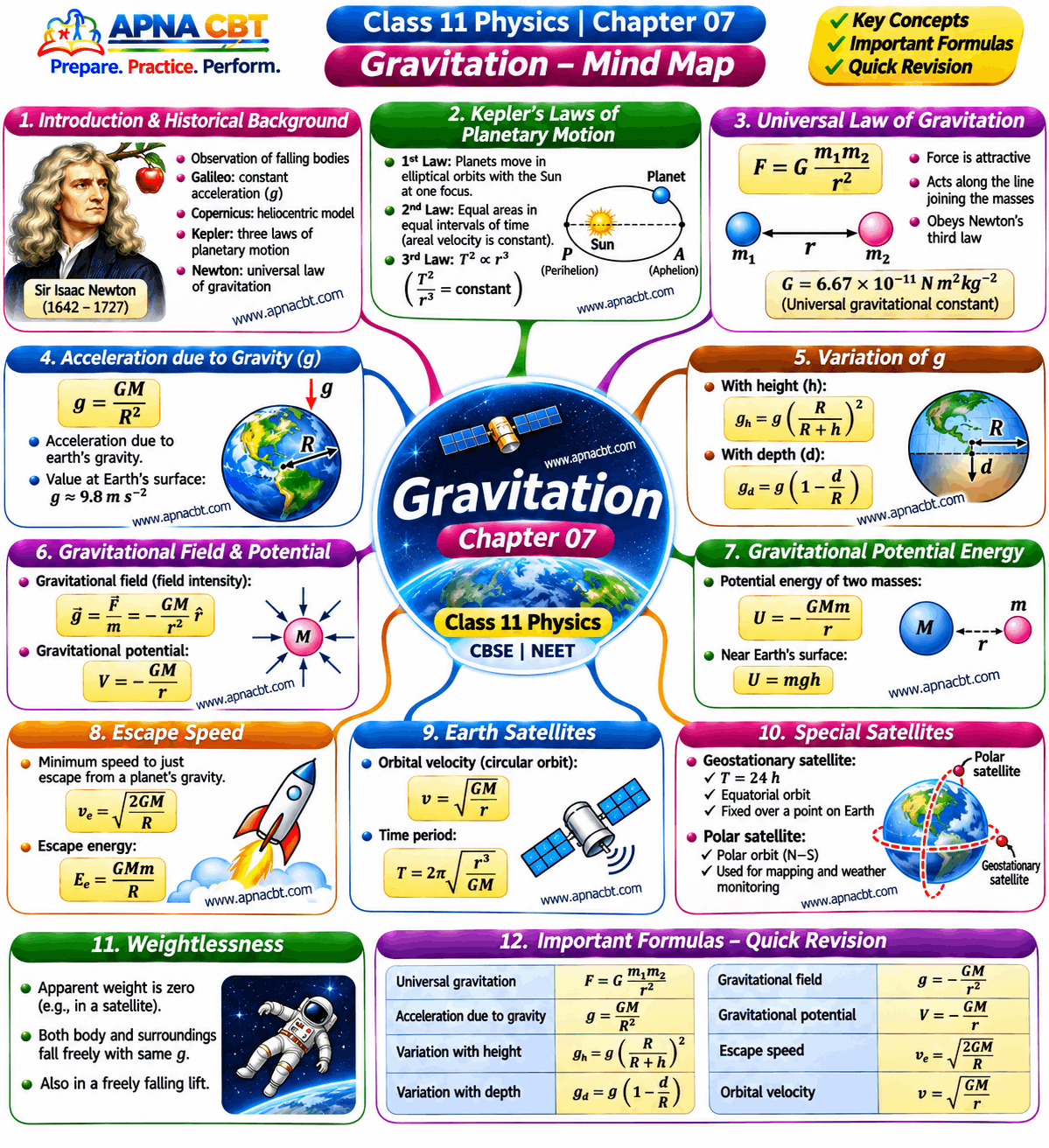
Gravitation Class 11 Physics Mind Map
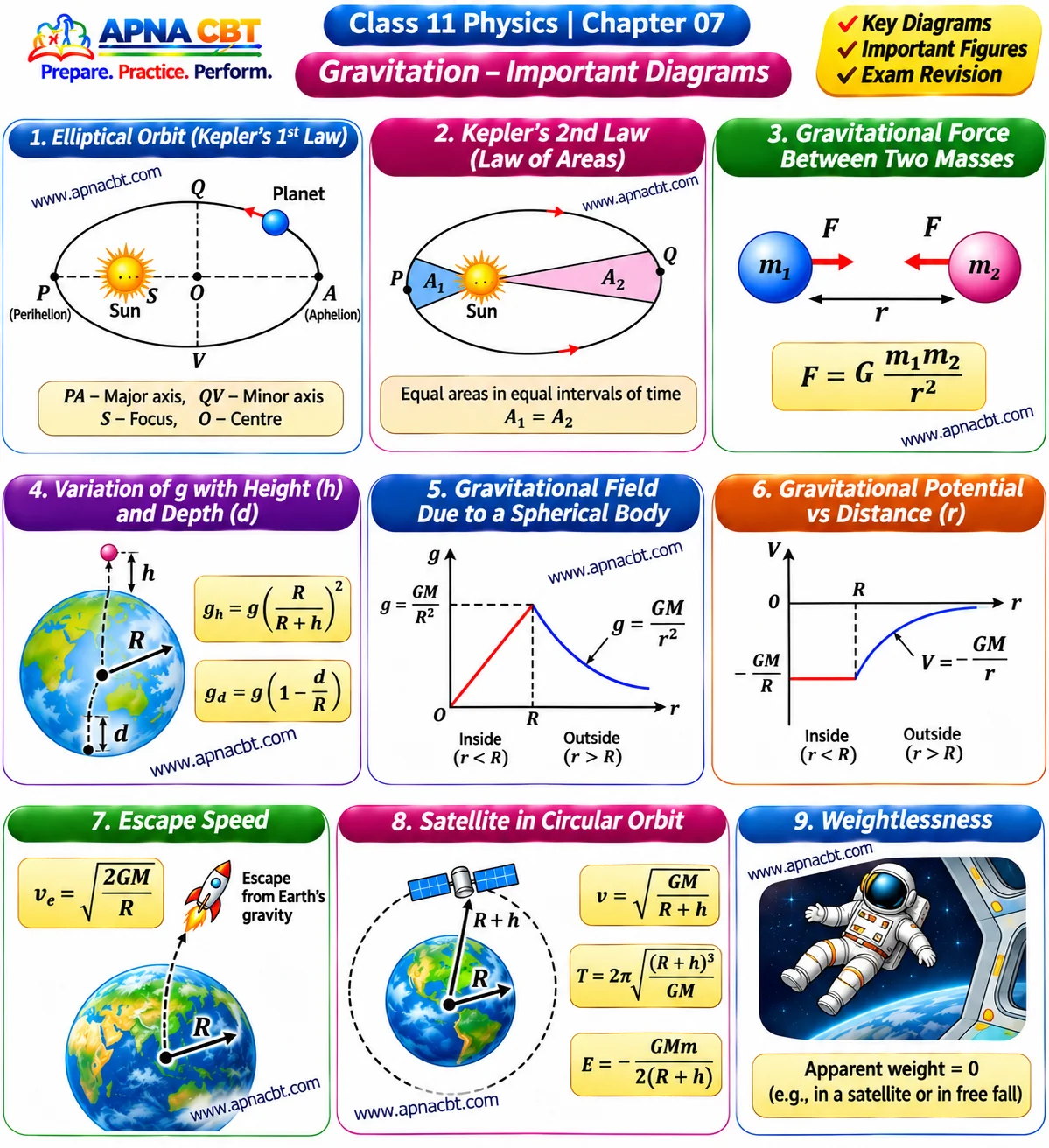
Gravitation Class 11 Physics – Important Diagrams and Illustrations
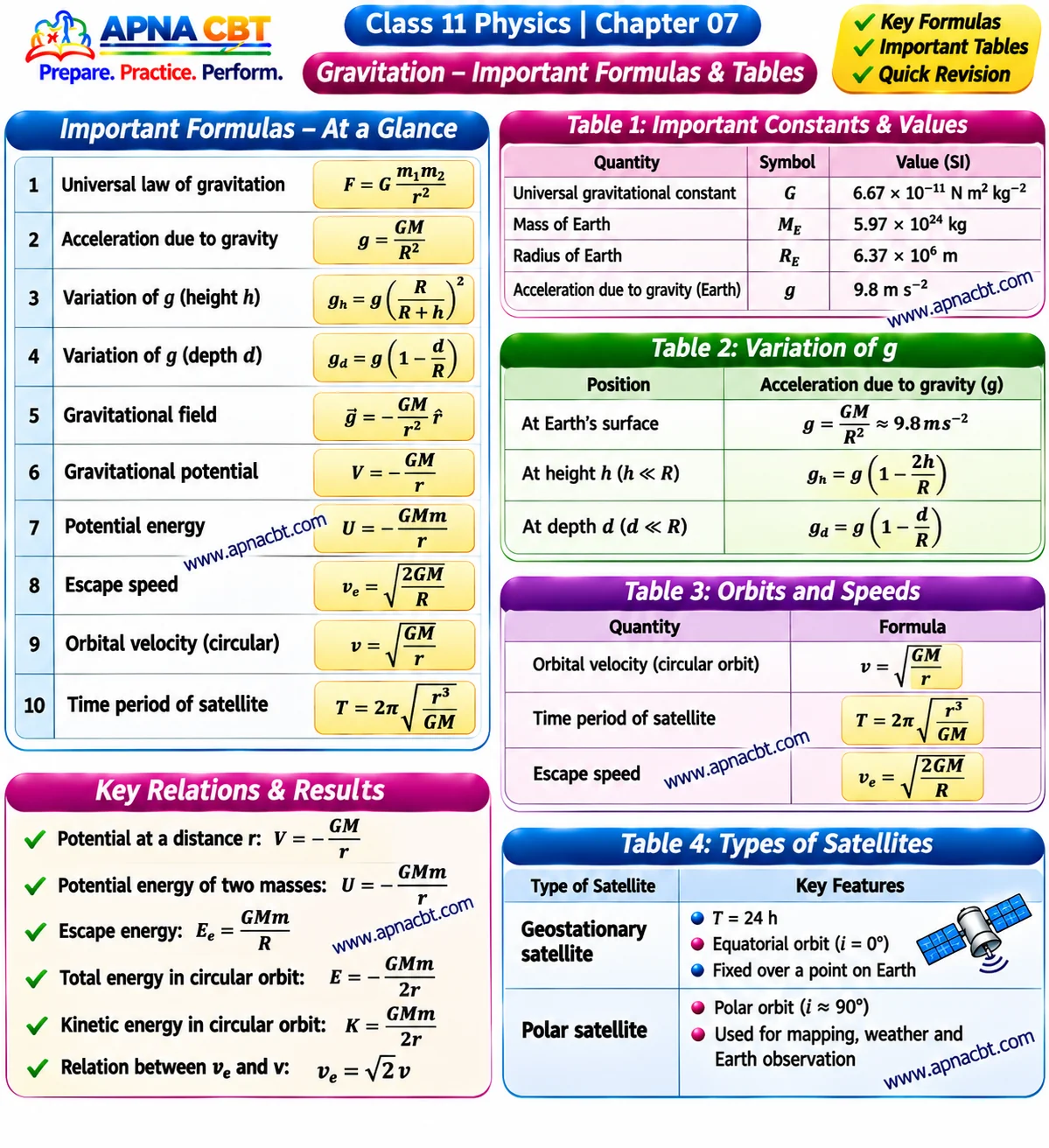
Gravitation Class 11 Physics – Important Tables and Formulas