1. Introduction to Equilibrium and Reversible Processes
Meaning of Equilibrium
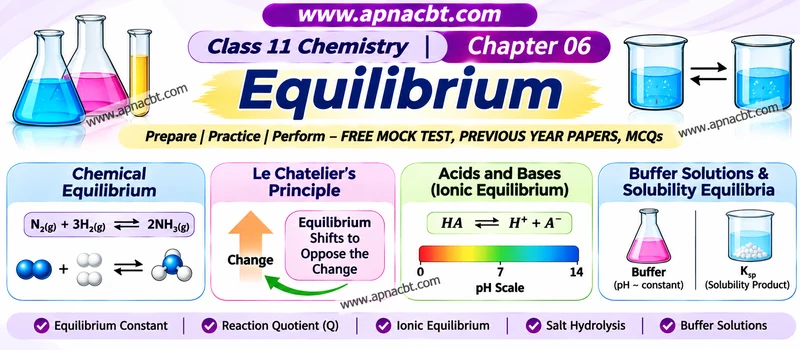
Equilibrium is the state of a reversible process in which measurable properties such as pressure, concentration and temperature remain constant with time. Equilibrium is dynamic: forward and reverse processes continue, but occur at equal rates. Chemical equilibrium is established in a closed system.
Reversible and Irreversible Processes
- Reversible reaction: proceeds in both forward and backward directions under the same conditions. It is represented by ⇌.
- Irreversible reaction: proceeds predominantly in one direction under the stated conditions and is represented by →.
- Dynamic equilibrium: forward rate equals reverse rate; concentrations remain constant, but need not be equal.
Characteristics of Chemical Equilibrium
- It is dynamic and is attained in a closed system.
- At a fixed temperature, the equilibrium constant has a definite value for a specified reaction.
- Reactant and product concentrations become constant, not necessarily equal.
- Equilibrium can be approached from either direction.
- A catalyst speeds up the attainment of equilibrium but does not change the equilibrium composition or equilibrium constant.
Physical Equilibrium
Equilibrium can occur during physical changes without formation of a new chemical substance.
- Solid–liquid: ice(s) ⇌ water(l) at the melting point.
- Liquid–vapour: water(l) ⇌ water vapour(g) in a closed vessel; rate of evaporation equals rate of condensation.
- Solid–vapour: iodine(s) ⇌ iodine vapour(g) or camphor(s) ⇌ camphor vapour(g).
- Solute–solution: sugar(s) ⇌ sugar(aq) in a saturated solution.
- Gas dissolution: gas(g) ⇌ gas(aq), with dissolution and escape occurring at equal rates.
Equilibrium versus Steady State
At equilibrium there is no net change because opposing processes balance. A steady state can also show constant measured quantities, but may involve continuous input and output and need not have equal opposing reaction rates.
Exam Focus
Remember: equilibrium is dynamic; it requires a closed system for an isolated reversible reaction mixture; equal rates do not mean equal concentrations.
2. Law of Chemical Equilibrium and Equilibrium Constant
Law of Mass Action
At a given temperature, the rate of a chemical reaction is proportional to the product of the active masses (approximately concentrations for dilute solutions) of the reactants, each raised to its stoichiometric coefficient.
Equilibrium Constant in Concentration Terms (Kc)
For the general reaction:
aA + bB ⇌ cC + dD
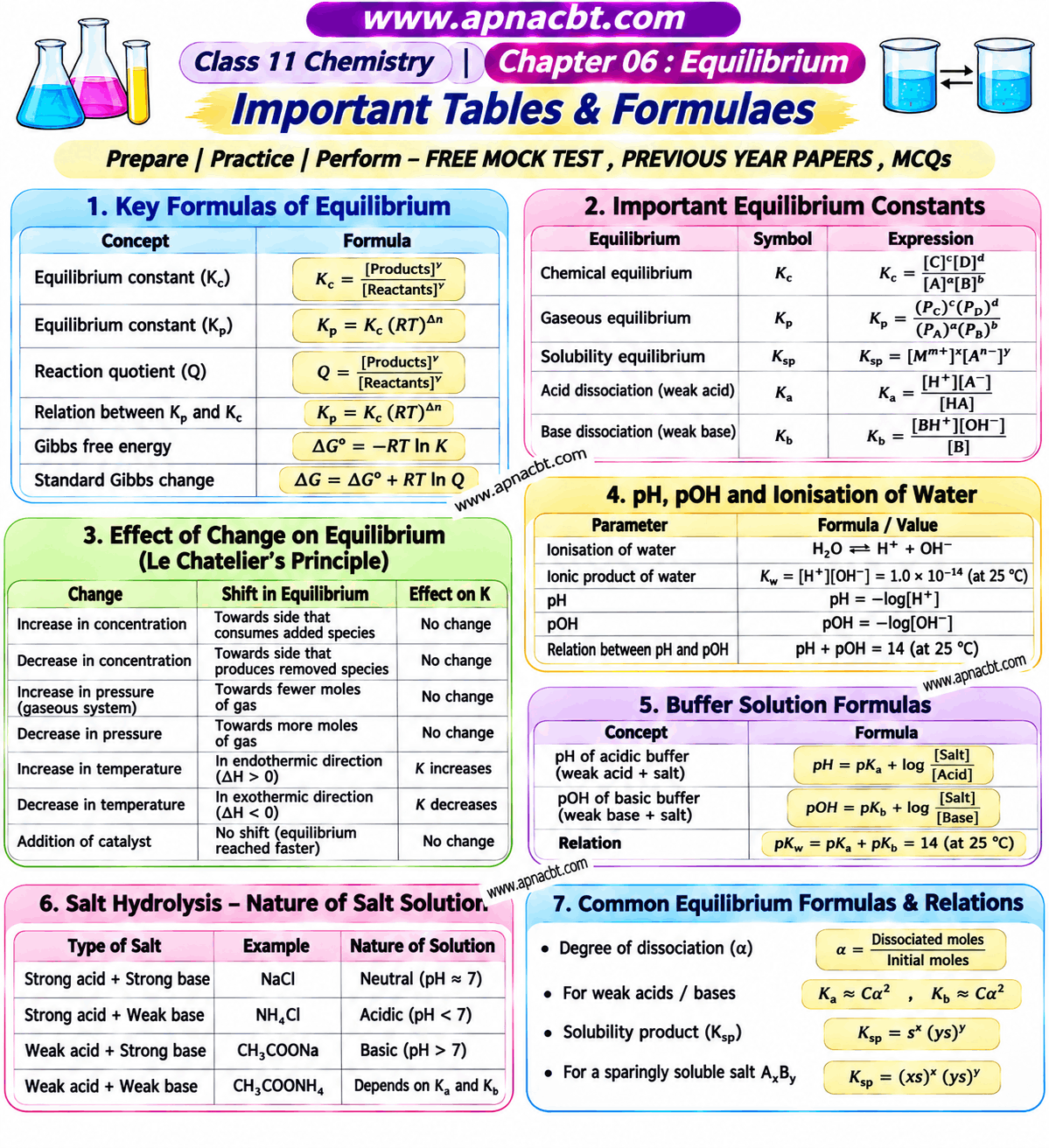
Kc = [C]c[D]d / ([A]a[B]b)
Square brackets denote equilibrium molar concentrations. The exponents are the balanced-equation coefficients, not the reaction orders.
Equilibrium Constant in Pressure Terms (Kp)
For gaseous equilibria, partial pressures may be used:
Kp = (pC)c(pD)d / ((pA)a(pB)b)
For ideal gases:
Kp = Kc(RT)Δng
where Δng = total gaseous product coefficients − total gaseous reactant coefficients. Include only gaseous species in Δng.
Important Rules for Equilibrium Expressions
- Pure solids and pure liquids are omitted because their active masses are constant.
- Concentrations or partial pressures are evaluated at equilibrium.
- If the reaction is reversed, the new constant is 1/K.
- If the balanced equation is multiplied by n, the new constant is Kn.
- If reactions are added, their equilibrium constants are multiplied.
Magnitude of K
- K much greater than 1: products are favoured at equilibrium.
- K much less than 1: reactants are favoured at equilibrium.
- K near 1: appreciable amounts of both sides may be present.
The value of K does not tell how fast equilibrium is reached. Reaction rate depends on kinetics.
Worked Illustration
For N2(g) + 3H2(g) ⇌ 2NH3(g),
Kc = [NH3]2 / ([N2][H2]3)
Here Δng = 2 − 4 = −2, so Kp = Kc(RT)−2.
3. Homogeneous and Heterogeneous Equilibria
Homogeneous Equilibrium
All reactants and products are in the same physical phase.
Examples:
- H2(g) + I2(g) ⇌ 2HI(g)
- N2(g) + 3H2(g) ⇌ 2NH3(g)
- CH3COOH(aq) ⇌ H+(aq) + CH3COO−(aq)
Heterogeneous Equilibrium
Reactants and products are present in different physical phases.
Examples:
- CaCO3(s) ⇌ CaO(s) + CO2(g)
- NH4HS(s) ⇌ NH3(g) + H2S(g)
- H2O(l) ⇌ H2O(g)
Writing Heterogeneous Equilibrium Expressions
Pure solids and liquids are not included. For example:
CaCO3(s) ⇌ CaO(s) + CO2(g), Kp = pCO₂
For NH4HS(s) ⇌ NH3(g) + H2S(g):
Kp = pNH₃ × pH₂S
Applications of Equilibrium Constant
- Predicting the direction in which a reaction proceeds by comparing Q with K.
- Estimating the extent of reaction and relative amounts of reactants and products.
- Calculating unknown equilibrium concentrations or partial pressures.
- Understanding industrial equilibria such as ammonia synthesis and sulphur trioxide formation.
4. Reaction Quotient, Q, and Prediction of Reaction Direction
Reaction Quotient
The reaction quotient Q has the same mathematical form as the equilibrium constant, but it is calculated using concentrations or partial pressures at any instant, not necessarily at equilibrium.
Comparing Q with K
- Q < K: net forward reaction occurs; products form until Q becomes K.
- Q > K: net reverse reaction occurs; reactants form until Q becomes K.
- Q = K: the system is at equilibrium.
Important Points
Q changes when the composition changes. At a fixed temperature, K remains constant for a specified reaction. A change in concentration, pressure or volume can alter Q and cause the system to move towards equilibrium.
Numerical Method
- Write and balance the chemical equation.
- Write the expression for Q.
- Substitute the current concentrations or partial pressures.
- Compare Q with K and state the net direction.
5. Relationship Between Equilibrium Constant and Gibbs Energy
Gibbs Energy and Reaction Quotient
The Gibbs energy change under non-standard conditions is related to the standard Gibbs energy change by:
ΔG = ΔG° + RT ln Q
At equilibrium, ΔG = 0 and Q = K. Therefore:
ΔG° = −RT ln K
or, using common logarithms:
ΔG° = −2.303 RT log K
Interpretation
- K > 1 gives ΔG° < 0: products are favoured under standard conditions.
- K < 1 gives ΔG° > 0: reactants are favoured under standard conditions.
- K = 1 gives ΔG° = 0.
Spontaneity at a Given Composition
- ΔG < 0: forward direction is spontaneous.
- ΔG > 0: forward direction is non-spontaneous; reverse direction is favoured.
- ΔG = 0: equilibrium.
Temperature Dependence
The equilibrium constant changes with temperature. The standard Gibbs energy can also be expressed as:
ΔG° = ΔH° − TΔS°
Use consistent units for ΔH°, TΔS° and R. Convert kJ to J when using R = 8.314 J mol−1 K−1.
6. Le Chatelier’s Principle and Factors Affecting Equilibrium
Le Chatelier’s Principle
When a system at equilibrium is subjected to a change in concentration, pressure, volume or temperature, the equilibrium shifts in the direction that tends to oppose the imposed change.
Effect of Concentration
- Adding a reactant generally shifts equilibrium in the forward direction.
- Removing a reactant generally shifts it in the backward direction.
- Adding a product generally shifts it backward.
- Removing a product generally shifts it forward.
Changing concentration changes Q, not K, provided temperature is unchanged. Adding a pure solid or liquid does not shift equilibrium if its phase remains present.
Effect of Pressure and Volume
For gaseous equilibria, increasing pressure by decreasing volume favours the side with fewer moles of gas. Decreasing pressure favours the side with more moles of gas.
- If Δng is negative, increased pressure favours products.
- If Δng is positive, increased pressure favours reactants.
- If Δng = 0, pressure change has no effect on the equilibrium composition in the ideal-gas approximation.
Adding an inert gas at constant volume does not change the partial pressures of reacting gases and does not shift equilibrium. At constant pressure, adding inert gas can increase volume and may shift a gaseous equilibrium towards the side with more gas moles.
Effect of Temperature
- For an exothermic forward reaction (ΔH < 0), increasing temperature shifts equilibrium backward and decreases K.
- For an endothermic forward reaction (ΔH > 0), increasing temperature shifts equilibrium forward and increases K.
- Decreasing temperature produces the opposite shift.
Temperature is the only one of these common disturbances that changes the value of K.
Effect of Catalyst
A catalyst increases the rates of forward and reverse reactions and helps equilibrium establish faster. It does not change K or the equilibrium composition.
Industrial Applications
Haber process: N2(g) + 3H2(g) ⇌ 2NH3(g), ΔH < 0. High pressure favours ammonia because the product side has fewer gas moles. Lower temperature favours the exothermic forward reaction, while a practical compromise temperature is used to obtain a useful rate. Removing ammonia helps drive the reaction forward.
Contact process: 2SO2(g) + O2(g) ⇌ 2SO3(g), ΔH < 0. Increased pressure and lower temperature favour SO3; industrial conditions balance yield, rate and cost.
7. Ionic Equilibrium, Acids and Bases
Ionic Equilibrium
Ionic equilibrium is established in solutions of weak electrolytes between unionised molecules and ions. Strong electrolytes ionise almost completely in dilute aqueous solution; weak electrolytes ionise only partially.
Arrhenius Concept
- Acid produces H+ (more accurately H3O+) in aqueous solution.
- Base produces OH− in aqueous solution.
Brønsted–Lowry Concept
- Acid: proton donor.
- Base: proton acceptor.
- Conjugate acid–base pairs differ by one proton.
Example: NH3 + H2O ⇌ NH4+ + OH−. NH3 is a base and NH4+ its conjugate acid; H2O is an acid and OH− its conjugate base.
Lewis Concept
- Lewis acid: electron-pair acceptor, e.g. BF3, AlCl3 and H+.
- Lewis base: electron-pair donor, e.g. NH3, H2O and OH−.
Ionisation of Weak Acids and Bases
For HA ⇌ H+ + A−:
Ka = [H+][A−] / [HA]
For BOH ⇌ B+ + OH− (where this representation is appropriate):
Kb = [B+][OH−] / [BOH]
Larger Ka means a stronger acid; larger Kb means a stronger base. pKa = −log Ka and pKb = −log Kb; lower pK means greater strength.
Degree of Ionisation
For a weak monoprotic acid of initial concentration C, if ionisation is small:
Ka ≈ Cα²; α ≈ √(Ka/C)
Percentage ionisation = 100α. This approximation is valid only when α is small compared with 1.
Factors Affecting Acid Strength
Acid strength depends on the stability of the conjugate base, bond polarity and bond strength, solvent and molecular structure. Do not use electronegativity alone as a universal rule when comparing acids across a group.
8. Ionisation of Water, pH and pOH
Ionic Product of Water
Water undergoes slight self-ionisation:
2H2O(l) ⇌ H3O+(aq) + OH−(aq)
Kw = [H+ ][OH−]
At 25°C, Kw = 1.0 × 10⁻¹⁴ and pKw = 14. The value changes with temperature.
pH and pOH
pH = −log[H+]; pOH = −log[OH−]
pH + pOH = pKw
At 25°C, pH + pOH = 14.
- Neutral solution: [H+] = [OH−]; pH = 7 at 25°C.
- Acidic solution: [H+] > [OH−]; pH < 7 at 25°C.
- Basic solution: [H+] < [OH−]; pH > 7 at 25°C.
Neutrality means equal hydrogen and hydroxide ion concentrations; neutral pH is not always 7 at temperatures other than 25°C.
Strong Acids and Bases
For a strong monoprotic acid of concentration C, [H+] ≈ C and pH = −log C. For a strong monobasic base, [OH−] ≈ C and pOH = −log C, subject to concentration and activity limitations.
Weak Acid Approximation
For a weak monoprotic acid HA of concentration C:
[H+] ≈ √(KaC); pH ≈ ½(pKa − log C)
For a weak base B:
[OH−] ≈ √(KbC); pOH ≈ ½(pKb − log C)
These expressions assume small ionisation and should not be used when the approximation fails.
Common Ion Effect
The ionisation of a weak electrolyte is suppressed by adding a strong electrolyte containing an ion common to the equilibrium. For example, adding CH3COONa suppresses the ionisation of CH3COOH.
9. Salt Hydrolysis and pH of Salt Solutions
Salt Hydrolysis
Salt hydrolysis is the reaction of salt ions with water to produce an acidic or basic solution. The nature of the solution depends on the strengths of the parent acid and base.
Salt of Strong Acid and Strong Base
Example: NaCl. Neither ion undergoes appreciable hydrolysis. The solution is approximately neutral at 25°C.
Salt of Weak Acid and Strong Base
Example: CH3COONa. The anion hydrolyses:
CH3COO− + H2O ⇌ CH3COOH + OH−
The solution is basic. For a salt concentration C:
Kh = Kw/Ka; [OH−] ≈ √(KhC)
pH = ½(pKw + pKa + log C)
Salt of Strong Acid and Weak Base
Example: NH4Cl. The cation hydrolyses:
NH4+ + H2O ⇌ NH3 + H3O+
The solution is acidic. For a salt concentration C:
Kh = Kw/Kb; [H+] ≈ √(KhC)
pH = ½(pKw − pKb − log C)
Salt of Weak Acid and Weak Base
Both ions hydrolyse. At 25°C, for a salt formed from a weak acid and weak base, the approximate pH is:
pH = ½(pKw + pKa − pKb)
The solution is acidic, basic or approximately neutral depending on the relative strengths of the acid and base. These salt-pH formulae assume ideal dilute solutions and the usual small-hydrolysis approximations.
10. Buffer Solutions and Solubility Equilibria
Buffer Solutions
A buffer solution resists a significant change in pH when small amounts of acid or base are added or when it is diluted moderately.
Acidic Buffer
Contains a weak acid and its salt with a strong base, e.g. CH3COOH and CH3COONa.
pH = pKa + log([salt]/[acid])
Basic Buffer
Contains a weak base and its salt with a strong acid, e.g. NH4OH/NH3 and NH4Cl.
pOH = pKb + log([salt]/[base])
At 25°C, pH = 14 − pOH. Buffer capacity is greatest when the acid/base and conjugate salt concentrations are comparable.
Solubility Equilibrium
A sparingly soluble ionic solid establishes equilibrium between undissolved solid and its ions in a saturated solution. For example:
AgCl(s) ⇌ Ag+(aq) + Cl−(aq)
Solubility Product (Ksp)
For AgCl:
Ksp = [Ag+][Cl−]
For a general salt AxBy(s) ⇌ xAy+ + yBx−:
Ksp = [Ay+]x[Bx−]y
Relation Between Ksp and Molar Solubility
- AB ⇌ A+ + B−: Ksp = s².
- AB2 ⇌ A2+ + 2B−: Ksp = 4s³.
- A2B ⇌ 2A+ + B2−: Ksp = 4s³.
- A2B3 ⇌ 2A3+ + 3B2−: Ksp = 108s⁵.
These relationships assume dissolution in pure water without common ions or other side reactions.
Ionic Product and Precipitation
- Qsp < Ksp: solution is unsaturated; no precipitation.
- Qsp = Ksp: solution is saturated and at equilibrium.
- Qsp > Ksp: precipitation is thermodynamically favoured until the ionic product falls to Ksp.
Common Ion Effect on Solubility
Adding a soluble electrolyte containing an ion common to the sparingly soluble salt generally decreases its solubility. Example: NaCl decreases the solubility of AgCl by increasing [Cl−].
Applications
Solubility equilibria are used in selective precipitation, qualitative inorganic analysis, water treatment, removal of ions and understanding mineral formation.
11. Short-Answer Questions – 30 Questions with Answers
Questions
- Define dynamic equilibrium.
- Why is a closed vessel generally required to establish chemical equilibrium?
- State two characteristics of chemical equilibrium.
- Distinguish between homogeneous and heterogeneous equilibrium.
- Write the Kc expression for N2(g) + 3H2(g) ⇌ 2NH3(g).
- Write the relation between Kp and Kc.
- What is Δng in the relation between Kp and Kc?
- Why are pure solids and pure liquids omitted from equilibrium expressions?
- What does a very large value of K indicate?
- How does the equilibrium constant change when a reaction is reversed?
- What happens to K when the balanced equation is multiplied by 2?
- Define reaction quotient Q.
- Predict the direction of reaction when Q is less than K.
- State the relationship between ΔG° and K.
- What is Le Chatelier’s principle?
- What is the effect of a catalyst on equilibrium?
- How does increased pressure affect a gaseous equilibrium with fewer product-side gas moles?
- How does temperature affect the equilibrium constant of an exothermic forward reaction?
- Define ionic equilibrium.
- State the Brønsted–Lowry definitions of acid and base.
- What is the conjugate base of H2CO3 after loss of one proton?
- Define Ka and pKa.
- Write the ionic product of water at 25°C.
- What is the pH of a neutral aqueous solution at 25°C?
- What is the common ion effect?
- What is salt hydrolysis?
- Give one example each of an acidic buffer and a basic buffer.
- Write the Henderson–Hasselbalch equation for an acidic buffer.
- Define solubility product.
- What condition indicates precipitation in terms of Qsp and Ksp?
Answers
- Dynamic equilibrium is a state in which forward and reverse reaction rates are equal, so concentrations remain constant while both reactions continue.
- A closed vessel prevents reactants or products from escaping, allowing both forward and reverse processes to continue until their rates become equal.
- It is dynamic, and the forward and reverse rates are equal. Concentrations remain constant at a fixed temperature.
- In homogeneous equilibrium all species are in one phase; in heterogeneous equilibrium they are present in more than one phase.
- Kc = [NH3]2/([N2][H2]3).
- Kp = Kc(RT)Δng.
- Δng is the sum of stoichiometric coefficients of gaseous products minus that of gaseous reactants.
- Their activities are constant and incorporated into the equilibrium constant.
- Products are strongly favoured at equilibrium, though the exact composition depends on stoichiometry and initial conditions.
- The new equilibrium constant is 1/K.
- The new constant is K².
- Q is the ratio of product and reactant activities in the equilibrium-constant expression, evaluated at any instant.
- The net reaction proceeds in the forward direction to form products until Q = K.
- ΔG° = −RT ln K.
- A system at equilibrium shifts in the direction that tends to oppose an imposed change in concentration, pressure, volume or temperature.
- A catalyst speeds up both forward and reverse reactions equally in the sense of lowering activation barriers; it does not change K or equilibrium composition.
- Equilibrium shifts towards the side with fewer gaseous moles.
- Increasing temperature decreases K for an exothermic forward reaction because the reverse direction is endothermic.
- Ionic equilibrium is the dynamic equilibrium between unionised molecules and ions in a solution of a weak electrolyte.
- A Brønsted–Lowry acid donates a proton; a Brønsted–Lowry base accepts a proton.
- HCO3−.
- Ka is the acid-ionisation equilibrium constant. pKa = −log Ka.
- Kw = [H+][OH−] = 1.0 × 10⁻¹⁴ at 25°C.
- pH = 7 at 25°C.
- Suppression of ionisation of a weak electrolyte by adding a strong electrolyte containing a common ion.
- Salt hydrolysis is the reaction of salt ions with water to produce an acidic or basic solution.
- Acidic buffer: CH3COOH/CH3COONa. Basic buffer: NH3/NH4Cl.
- pH = pKa + log([salt]/[acid]).
- Ksp is the equilibrium constant for dissolution of a sparingly soluble salt, expressed as the product of equilibrium ion concentrations raised to their stoichiometric powers.
- Precipitation is favoured when Qsp > Ksp.
12. Long-Answer Questions – 15 Questions with Detailed Answers
Questions
- Explain dynamic chemical equilibrium and discuss its important characteristics with a suitable example.
- State the law of chemical equilibrium and derive the expressions for Kc and Kp for a general gaseous reaction. Establish the relation between them.
- Differentiate homogeneous and heterogeneous equilibria. Explain how equilibrium expressions are written for heterogeneous systems.
- Explain the significance of the magnitude of the equilibrium constant and describe how equilibrium constants change when a reaction is reversed, multiplied or combined.
- Define reaction quotient. Explain how comparison of Q with K predicts the direction of a reaction.
- Derive the relationship ΔG° = −RT ln K and explain the significance of K greater than, less than or equal to 1.
- State Le Chatelier’s principle and explain the effects of concentration, pressure, volume, temperature and catalyst on equilibrium.
- Explain the industrial importance of equilibrium in the Haber process and Contact process.
- Explain Arrhenius, Brønsted–Lowry and Lewis concepts of acids and bases with examples.
- Derive the approximate expression for the ionisation constant and degree of ionisation of a weak acid. Explain the common ion effect.
- Explain the ionic product of water, pH, pOH and the relationship between them. Discuss acidic, basic and neutral solutions.
- Explain salt hydrolysis and derive the pH expressions for salts of a weak acid with a strong base and a weak base with a strong acid.
- What are buffer solutions? Explain acidic and basic buffers and derive their Henderson–Hasselbalch equations.
- Define solubility product. Derive Ksp–solubility relationships for AB, AB2 and A2B3 type salts.
- Explain ionic product, precipitation criterion and the common ion effect on the solubility of sparingly soluble salts.
Detailed Answers
- Dynamic equilibrium: Consider N2O4(g) ⇌ 2NO2(g) in a closed vessel. Initially the forward reaction dominates. As NO2 accumulates, the reverse reaction rate increases. Eventually the forward and reverse rates become equal. Both reactions continue, but there is no net change in composition. Equilibrium is dynamic, occurs in a closed system, has equal opposing rates and constant macroscopic composition. The concentrations need not be equal. A catalyst changes the time needed to reach equilibrium, not the equilibrium position.
- Law and expressions: For aA + bB ⇌ cC + dD, the law of mass action gives the equilibrium ratio Kc = [C]c[D]d/([A]a[B]b). For gases, Kp is the corresponding ratio of partial pressures. Since pi = [i]RT for an ideal gas, substitution gives Kp = Kc(RT)(c+d−a−b) when all species are gaseous. Thus Kp = Kc(RT)Δng. Pure solids and liquids are omitted.
- Types: Homogeneous equilibrium has all species in one phase, e.g. H2(g) + I2(g) ⇌ 2HI(g). Heterogeneous equilibrium has more than one phase, e.g. CaCO3(s) ⇌ CaO(s) + CO2(g). The expression for the latter is Kp = pCO₂; the activities of pure solids are constant and are absorbed into K. This rule prevents pure solid or liquid amounts from appearing in the equilibrium expression.
- Magnitude and transformations: K ≫ 1 indicates product-favoured equilibrium; K ≪ 1 indicates reactant-favoured equilibrium; K near 1 indicates appreciable amounts of both may exist. Reversing a reaction changes K to 1/K. Multiplying all coefficients by n changes K to Kn. Adding reactions multiplies their constants. These operations follow directly from the equilibrium expressions.
- Reaction quotient: Q has the same algebraic form as K but uses instantaneous concentrations or partial pressures. If Q < K, the system forms products; if Q > K, it forms reactants; if Q = K, it is at equilibrium. For example, for N2 + 3H2 ⇌ 2NH3, Qc = [NH3]2/([N2][H2]3). Calculate Q and compare it with K to identify the net direction.
- Gibbs energy relation: Under non-standard conditions, ΔG = ΔG° + RT ln Q. At equilibrium, ΔG = 0 and Q = K. Therefore 0 = ΔG° + RT ln K, giving ΔG° = −RT ln K. If K > 1, ln K is positive and ΔG° is negative; if K < 1, ΔG° is positive; if K = 1, ΔG° is zero. This describes standard-state thermodynamic favourability, not reaction speed.
- Le Chatelier’s principle: A system shifts to oppose a disturbance. Adding reactant or removing product generally favours the forward direction; adding product favours the reverse direction. Increasing pressure by decreasing volume favours the side with fewer gaseous moles; pressure has no ideal-gas effect when gaseous mole numbers are equal. Increasing temperature favours the endothermic direction. For an exothermic forward reaction, heating shifts backward and lowers K. A catalyst speeds both directions and does not alter K or equilibrium composition.
- Industrial equilibria: In the Haber process, N2 + 3H2 ⇌ 2NH3 is exothermic and reduces gas moles. High pressure favours ammonia. Lower temperature favours the forward reaction, but a moderate practical temperature is selected to maintain a suitable rate. An iron-based catalyst speeds attainment of equilibrium, and ammonia is removed to drive further conversion. In the Contact process, 2SO2 + O2 ⇌ 2SO3 is exothermic and reduces gas moles. Pressure and temperature are chosen to balance conversion, speed and cost; a catalyst is used to accelerate the reaction.
- Acid–base concepts: Arrhenius acids produce H+ in water and bases produce OH−. Brønsted–Lowry acids donate protons and bases accept protons; in NH3 + H2O ⇌ NH4+ + OH−, NH3 accepts a proton. Lewis acids accept an electron pair, e.g. BF3, while Lewis bases donate an electron pair, e.g. NH3. The Lewis concept is broader because a proton is not required.
- Weak acid ionisation: For HA ⇌ H+ + A−, initial concentration C and degree of ionisation α give equilibrium concentrations C(1−α), Cα and Cα. Thus Ka = Cα²/(1−α). If α is small, 1−α ≈ 1 and α ≈ √(Ka/C); [H+] ≈ √(KaC). Adding a salt such as CH3COONa supplies CH3COO−, shifting the acid-ionisation equilibrium to the left and suppressing ionisation: the common ion effect.
- Water and pH: Water ionises slightly: 2H2O ⇌ H3O+ + OH−. Kw = [H+][OH−] = 10−14 at 25°C. Taking negative logarithms gives pH + pOH = pKw = 14 at 25°C. Acidic solutions have [H+] greater than [OH−], basic solutions have the reverse, and neutral solutions have equal concentrations. Neutral pH is 7 only at 25°C.
- Salt hydrolysis: A salt of a weak acid and strong base, such as CH3COONa, produces OH− by anion hydrolysis. Kh = Kw/Ka; [OH−] ≈ √(KhC), so pH = ½(pKw + pKa + log C). A salt of a strong acid and weak base, such as NH4Cl, produces H3O+. Kh = Kw/Kb; [H+] ≈ √(KhC), so pH = ½(pKw − pKb − log C). These are dilute-solution approximations.
- Buffers: An acidic buffer contains a weak acid and its conjugate-base salt, such as CH3COOH/CH3COONa. The common ion suppresses acid ionisation. From Ka = [H+][A−]/[HA], rearrangement and taking negative logarithms gives pH = pKa + log([salt]/[acid]). A basic buffer contains a weak base and its conjugate-acid salt, e.g. NH3/NH4Cl. Similarly pOH = pKb + log([salt]/[base]); at 25°C pH = 14 − pOH. Buffers resist pH changes by consuming small added amounts of acid or base.
- Solubility product: For AB(s) ⇌ A+ + B−, if molar solubility is s, then [A+] = s and [B−] = s, so Ksp = s². For AB2(s) ⇌ A2+ + 2B−, concentrations are s and 2s, giving Ksp = s(2s)² = 4s³. For A2B3 ⇌ 2A3+ + 3B2−, concentrations are 2s and 3s, giving Ksp = (2s)²(3s)³ = 108s⁵.
- Precipitation and common ion: Calculate Qsp from the ion concentrations after mixing. If Qsp exceeds Ksp, precipitation is favoured; if it equals Ksp, the solution is saturated; if it is smaller, the solution is unsaturated. Adding a common ion increases the corresponding ion concentration and shifts dissolution equilibrium towards the solid, reducing solubility. This principle is useful in selective precipitation and qualitative analysis.
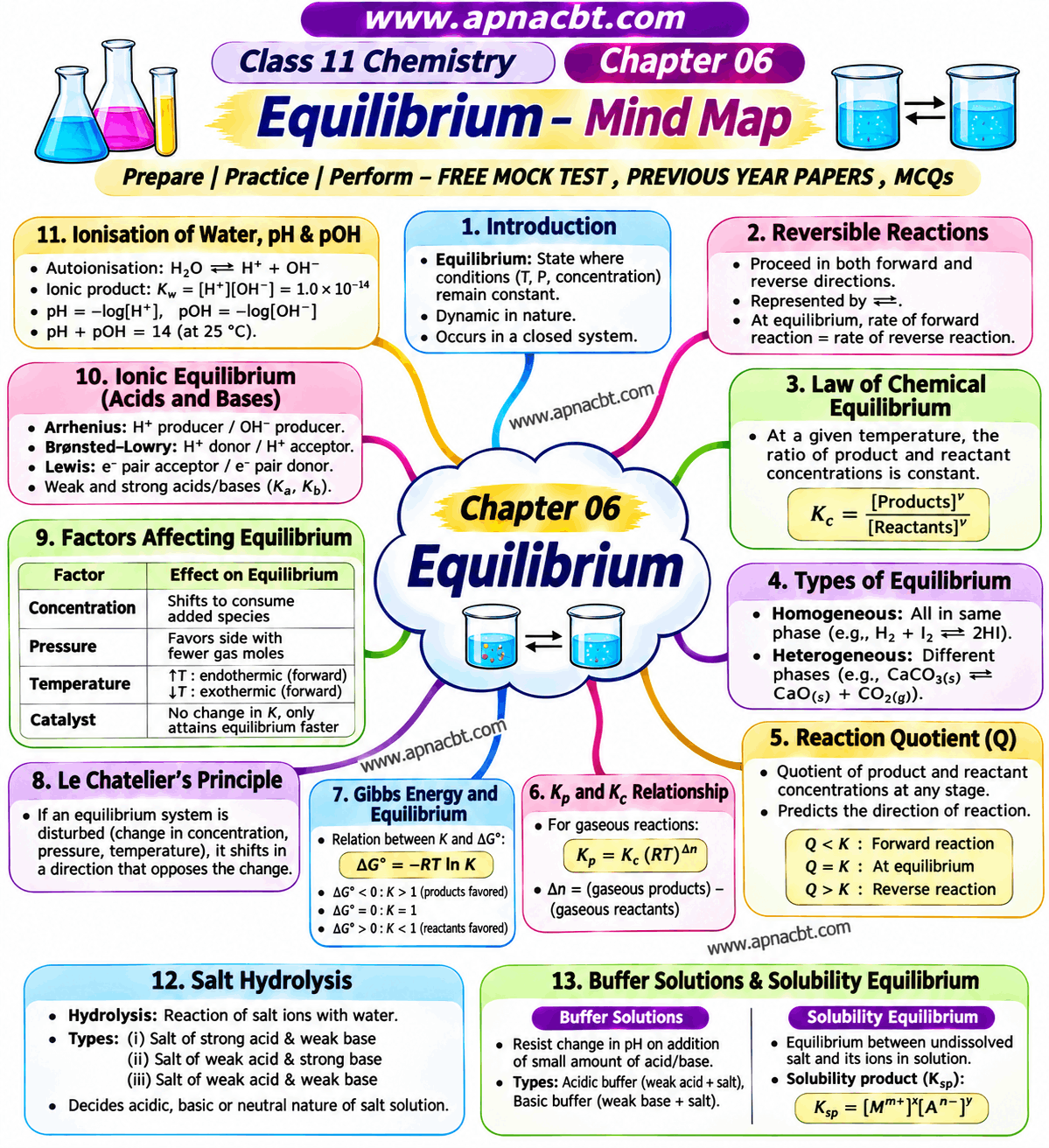
Equilibrium Class 11 Chemistry – Chapter 06 Mind Map
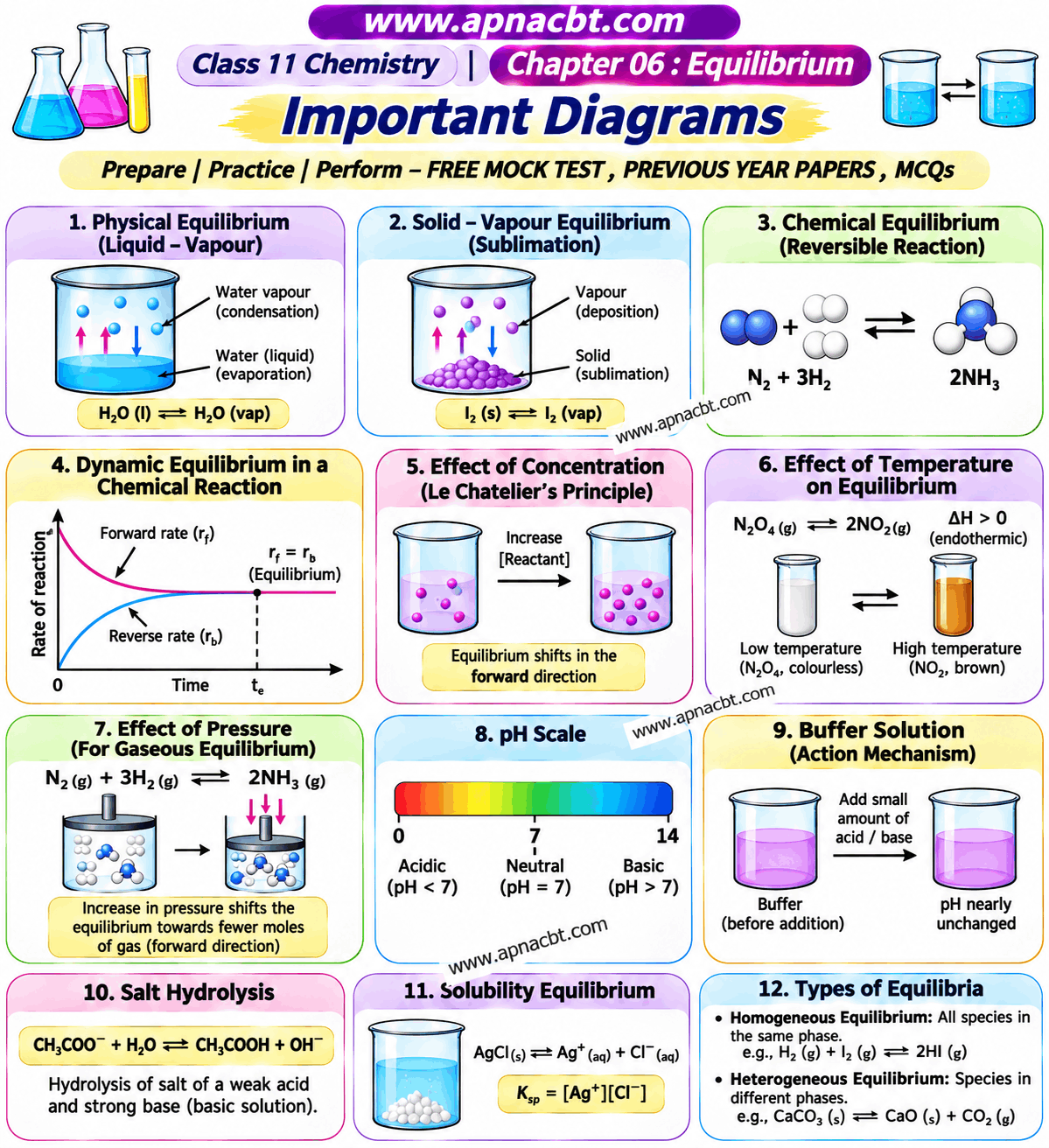
Equilibrium Class 11 Chemistry – Important Diagrams Chapter 06
Equilibrium Class 11 Chemistry – Important Tables and Formulae