1. Introduction to Redox Reactions and Their Importance
Meaning of Redox Reactions
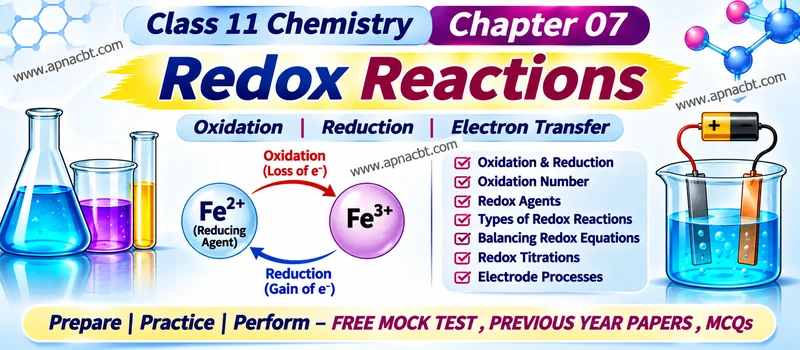
Redox reactions are chemical reactions in which oxidation and reduction take place simultaneously. The word redox is formed by combining the words reduction and oxidation. Whenever one species loses electrons or undergoes an increase in oxidation number, another species gains electrons or undergoes a decrease in oxidation number.Importance and Applications
Redox processes are involved in:- Combustion of fuels and release of energy.
- Respiration and several biological processes.
- Extraction and refining of metals.
- Working of dry cells, batteries and electrochemical cells.
- Corrosion and rusting of metals.
- Manufacture of chemicals such as caustic soda.
- Bleaching, disinfection and several industrial processes.
Examples
- 2Mg(s) + O2(g) → 2MgO(s)
- CH4(g) + 2O2(g) → CO2(g) + 2H2O(l)
- Zn(s) + Cu2+(aq) → Zn2+(aq) + Cu(s)
Exam Focus
Understand the meaning of redox reactions and be able to identify the species oxidised and reduced in a given chemical equation.2. Classical Concepts of Oxidation and Reduction
Classical Definition of Oxidation
Oxidation was initially defined as the addition of oxygen to a substance. The definition was later extended to include:- Addition of oxygen or another electronegative element.
- Removal of hydrogen or another electropositive element.
- 2Mg + O2 → 2MgO: magnesium is oxidised by addition of oxygen.
- Mg + Cl2 → MgCl2: magnesium is oxidised by addition of chlorine.
- 2H2S + O2 → 2S + 2H2O: hydrogen is removed from hydrogen sulphide.
Classical Definition of Reduction
Reduction was initially defined as the removal of oxygen from a substance. It was extended to include:- Removal of oxygen or another electronegative element.
- Addition of hydrogen or another electropositive element.
- 2HgO → 2Hg + O2: mercuric oxide is reduced by removal of oxygen.
- CH2=CH2 + H2 → CH3–CH3: ethene is reduced by addition of hydrogen.
Simultaneous Nature
Oxidation and reduction always occur simultaneously. In a reaction, the substance that is oxidised causes reduction of another substance, while the substance that is reduced causes oxidation of another substance.Example
H2S + Cl2 → 2HCl + S Hydrogen sulphide is oxidised to sulphur, while chlorine is reduced to hydrogen chloride.Exam Focus
Practise identifying oxidation and reduction using oxygen/hydrogen transfer as well as electronegative/electropositive element transfer.3. Redox Reactions in Terms of Electron Transfer
Electronic Concept
The modern electronic definitions are:- Oxidation: Loss of one or more electrons.
- Reduction: Gain of one or more electrons.
- Oxidising agent (oxidant): Electron acceptor; it undergoes reduction.
- Reducing agent (reductant): Electron donor; it undergoes oxidation.
Example: Formation of Sodium Chloride
Overall reaction: 2Na(s) + Cl2(g) → 2NaCl(s) Oxidation half-reaction: 2Na(s) → 2Na+ + 2e− Reduction half-reaction: Cl2(g) + 2e− → 2Cl− Sodium loses electrons and is oxidised. Chlorine gains electrons and is reduced. Therefore, sodium is the reducing agent and chlorine is the oxidising agent.Competitive Electron Transfer
A more reactive metal can transfer electrons to the ions of a less reactive metal. For example: Zn(s) + Cu2+(aq) → Zn2+(aq) + Cu(s) Zinc is oxidised and Cu2+ is reduced. The relative tendency of metals to lose electrons can be compared using displacement reactions. The order illustrated in the chapter is: Zn > Cu > Ag in electron-releasing tendency.Redox Couples
A redox couple consists of the oxidised and reduced forms of the same species. It is written as oxidised form/reduced form, for example Zn2+/Zn and Cu2+/Cu.Exam Focus
Always remember: the oxidising agent is reduced, and the reducing agent is oxidised. Do not interchange these terms.4. Oxidation Number: Meaning and Rules
Meaning
Oxidation number (oxidation state) is the charge assigned to an atom in a compound or ion according to a set of rules, assuming that shared electrons are assigned to the more electronegative atom. It is a bookkeeping concept and does not always represent the actual charge on an atom in a covalent compound.Rules for Assigning Oxidation Numbers
- Free elements: The oxidation number of an atom in its uncombined state is zero. Examples: H2, O2, Cl2, O3, P4, S8, Na and Mg.
- Monoatomic ions: The oxidation number equals the charge on the ion. Examples: Na+ = +1, Mg2+ = +2, Fe3+ = +3 and Cl− = −1.
- Alkali metals: Usually +1 in compounds.
- Alkaline earth metals: Usually +2 in compounds.
- Aluminium: Usually +3 in its compounds.
- Oxygen: Usually −2. In peroxides it is −1; in superoxides its average oxidation number is −1/2. In OF2, oxygen is +2, and in O2F2, each oxygen is +1.
- Hydrogen: Usually +1; in metal hydrides such as NaH and CaH2, it is −1.
- Fluorine: Always −1 in its compounds.
- Other halogens: Usually −1 in binary metal halides, but may have positive oxidation numbers in compounds with oxygen or more electronegative halogens.
- Neutral compounds: The algebraic sum of oxidation numbers of all atoms is zero.
- Polyatomic ions: The algebraic sum of oxidation numbers equals the net charge of the ion.
Worked Examples
Example 1: Oxidation number of sulphur in H2SO4 Let sulphur = x. 2(+1) + x + 4(−2) = 0 2 + x − 8 = 0; therefore x = +6. Example 2: Oxidation number of chromium in Cr2O72− Let chromium = x. 2x + 7(−2) = −2 2x − 14 = −2; therefore x = +6. Example 3: Oxidation number of manganese in KMnO4 (+1) + x + 4(−2) = 0; therefore x = +7. Example 4: Oxidation number of oxygen in H2O2 2(+1) + 2x = 0; therefore x = −1.Fractional Oxidation Number
A fractional oxidation number generally represents an average oxidation state when atoms of the same element occupy different oxidation states in a structure. Examples include Fe3O4, C3O2 and S4O62−. It does not necessarily mean that an individual atom has a fractional number of electrons transferred.Stock Notation
The oxidation state of a metal may be shown using a Roman numeral in brackets after its name or symbol, for example iron(II), iron(III), Sn(II) and Sn(IV).Exam Focus
Practise oxidation-number calculations in compounds, polyatomic ions, peroxides, superoxides, hydrides and mixed-valence compounds.5. Oxidation, Reduction, Oxidising Agent and Reducing Agent Using Oxidation Numbers
Definitions Based on Oxidation Number
- Oxidation: Increase in oxidation number.
- Reduction: Decrease in oxidation number.
- Oxidising agent: A species that brings about oxidation of another species and itself gets reduced.
- Reducing agent: A species that brings about reduction of another species and itself gets oxidised.
- Redox reaction: A reaction in which oxidation numbers of the reacting species change.
Worked Example
CuO(s) + H2(g) → Cu(s) + H2O(g) Copper changes from +2 in CuO to 0 in Cu: reduction. Hydrogen changes from 0 in H2 to +1 in H2O: oxidation. CuO is the oxidising agent and H2 is the reducing agent.Another Example
2Cu2O + Cu2S → 6Cu + SO2 Copper changes from +1 to 0 and is reduced. Sulphur changes from −2 to +4 and is oxidised. Cu(I) in Cu2O acts as the oxidant, while sulphur in Cu2S acts as the reductant.Quick Identification Method
- Assign oxidation numbers to the relevant atoms on both sides.
- Find the atoms whose oxidation numbers change.
- An increase indicates oxidation; a decrease indicates reduction.
- The reactant containing the atom reduced is generally the oxidising agent.
- The reactant containing the atom oxidised is generally the reducing agent.
Exam Focus
Questions asking for the substance oxidised, substance reduced, oxidant and reductant are common conceptual and application-based questions.6. Types of Redox Reactions
1. Combination Reactions
Two or more substances combine to form a single product. A combination reaction is redox when at least one element changes oxidation number. Examples:- C(s) + O2(g) → CO2(g)
- 2Mg(s) + O2(g) → 2MgO(s)
- CH4(g) + 2O2(g) → CO2(g) + 2H2O(l)
2. Decomposition Reactions
A compound breaks down into two or more products. It is a redox reaction when oxidation numbers change. Examples:- 2H2O(l) → 2H2(g) + O2(g)
- 2NaH(s) → 2Na(s) + H2(g)
- 2KClO3(s) → 2KCl(s) + 3O2(g)
3. Displacement Reactions
An atom or ion in a compound is replaced by another atom or ion. General form: X + YZ → XZ + Y. Metal displacement: Zn(s) + CuSO4(aq) → ZnSO4(aq) + Cu(s) Hydrogen displacement: Zn(s) + 2HCl(aq) → ZnCl2(aq) + H2(g) Reactive metals such as sodium and calcium can displace hydrogen from water. Magnesium and iron react with steam. Several metals displace hydrogen from acids. Non-metal displacement: Cl2(g) + 2KBr(aq) → 2KCl(aq) + Br2(l) Cl2(g) + 2KI(aq) → 2KCl(aq) + I2(s) The oxidising power of halogens decreases down Group 17: F2 > Cl2 > Br2 > I2.4. Disproportionation Reactions
A single element in one oxidation state is simultaneously oxidised and reduced, producing two different oxidation states. Examples:- 2H2O2 → 2H2O + O2. Oxygen changes from −1 to −2 and 0.
- Cl2 + 2OH− → ClO− + Cl− + H2O. Chlorine changes from 0 to +1 and −1.
Exam Focus
Classify reactions by examining both their reaction pattern and oxidation-number changes. Do not assume every combination or decomposition reaction is automatically redox.7. Balancing Redox Reactions by the Oxidation Number Method
Principle
The total increase in oxidation number must equal the total decrease in oxidation number. After equalising electron change, balance the remaining atoms and charges.Steps
- Write the correct skeletal equation with formulae of reactants and products.
- Assign oxidation numbers to all relevant atoms.
- Identify the atoms undergoing oxidation and reduction.
- Calculate the total increase and decrease in oxidation number, accounting for the number of atoms.
- Choose coefficients so that the total increase equals the total decrease.
- Balance all atoms other than hydrogen and oxygen.
- For ionic equations, balance charge. In acidic medium use H+; in basic medium use OH−.
- Balance hydrogen and oxygen using H2O as appropriate.
- Check that atoms and total charge are equal on both sides.
Worked Example: Dichromate and Sulphite in Acidic Medium
Skeletal ionic equation: Cr2O72− + SO32− → Cr3+ + SO42− Chromium: +6 → +3, gain of 3 electrons per chromium atom. Two chromium atoms gain 6 electrons. Sulphur: +4 → +6, loss of 2 electrons per sulphur atom. Three sulphite ions lose 6 electrons. After balancing atoms and charge in acidic medium: Cr2O72− + 3SO32− + 8H+ → 2Cr3+ + 3SO42− + 4H2OImportant Checks
- Count every atom on both sides.
- Calculate the total ionic charge on each side.
- Ensure electrons lost equal electrons gained.
- Do not change subscripts in chemical formulae; use coefficients only.
Exam Focus
Practise balancing equations in acidic and basic media. The oxidation-number method is particularly useful when the oxidation-state changes are easy to identify.8. Balancing Redox Reactions by the Half-Reaction (Ion-Electron) Method
Principle
The reaction is divided into two half-reactions: one for oxidation and one for reduction. Each half-reaction is balanced separately for atoms and charge. The two half-reactions are then combined after equalising the number of electrons.Steps in Acidic Medium
- Write the unbalanced ionic equation.
- Separate it into oxidation and reduction half-reactions.
- Balance atoms other than oxygen and hydrogen.
- Balance oxygen by adding H2O.
- Balance hydrogen by adding H+.
- Balance charge by adding electrons.
- Multiply the half-reactions to make electrons equal.
- Add the half-reactions and cancel electrons and common species.
- Verify atoms and charge.
Steps in Basic Medium
First balance as if the reaction were in acidic medium. Then add OH− ions to both sides in a number equal to the H+ ions. Combine H+ and OH− to form water, cancel excess water and verify the final equation.Worked Example: Fe2+ and Dichromate in Acidic Medium
Oxidation half-reaction: Fe2+ → Fe3+ + e− Reduction half-reaction: Cr2O72− + 14H+ + 6e− → 2Cr3+ + 7H2O Multiply the iron half-reaction by 6 and add: 6Fe2+ + Cr2O72− + 14H+ → 6Fe3+ + 2Cr3+ + 7H2OWorked Example: Permanganate and Iodide in Basic Medium
The balanced ionic equation is: 2MnO4− + 6I− + 4H2O → 2MnO2 + 3I2 + 8OH−Method Comparison
The oxidation-number method balances the total change in oxidation numbers. The half-reaction method explicitly balances electron transfer and ionic charge. Both methods should give the same correctly balanced equation.Exam Focus
Learn the separate procedures for acidic and basic media. Always show half-reactions and electron equalisation clearly in long-answer problems.9. Redox Reactions in Titrations and Limitations of Oxidation Number
Redox Titrations
Redox titrations determine the concentration or strength of an oxidising agent or reducing agent using an oxidation-reduction reaction. A suitable indicator or the colour of the reagent helps identify the end point.Common Indicator Behaviour
- Self-indicator: Permanganate ion (MnO4−) has an intense purple colour. In an appropriate acidic permanganate titration, the end point is indicated by a faint permanent pink colour after the reducing agent has been consumed.
- External indicator: Certain indicators are used to detect the end point when the reagent does not provide a clear colour change. Dichromate is not a self-indicator; diphenylamine can be used in suitable titrations.
- Iodine-starch indicator: Iodine forms an intense blue complex with starch. Thiosulphate reduces iodine to iodide: I2 + 2S2O32− → 2I− + S4O62−.
Limitations of the Oxidation Number Concept
Oxidation number is a useful formal bookkeeping method, but it does not always represent the actual charge or exact electron distribution in a covalent molecule. In covalent bonds, electrons are not necessarily transferred completely. Fractional oxidation numbers may represent averages over atoms with different actual oxidation states. Modern descriptions also consider changes in electron density.Exam Focus
Know the principle of redox titration, the role of indicators, the use of permanganate as a self-indicator and the iodine-starch colour change.10. Redox Reactions and Electrode Processes
Direct and Indirect Electron Transfer
When zinc is placed directly in copper sulphate solution, zinc transfers electrons to Cu2+ ions at the metal-solution interface: Zn(s) + Cu2+(aq) → Zn2+(aq) + Cu(s) The same overall reaction can be arranged so that oxidation and reduction occur in separate containers. This allows electrons to pass through an external wire and produce electrical energy.Daniell Cell
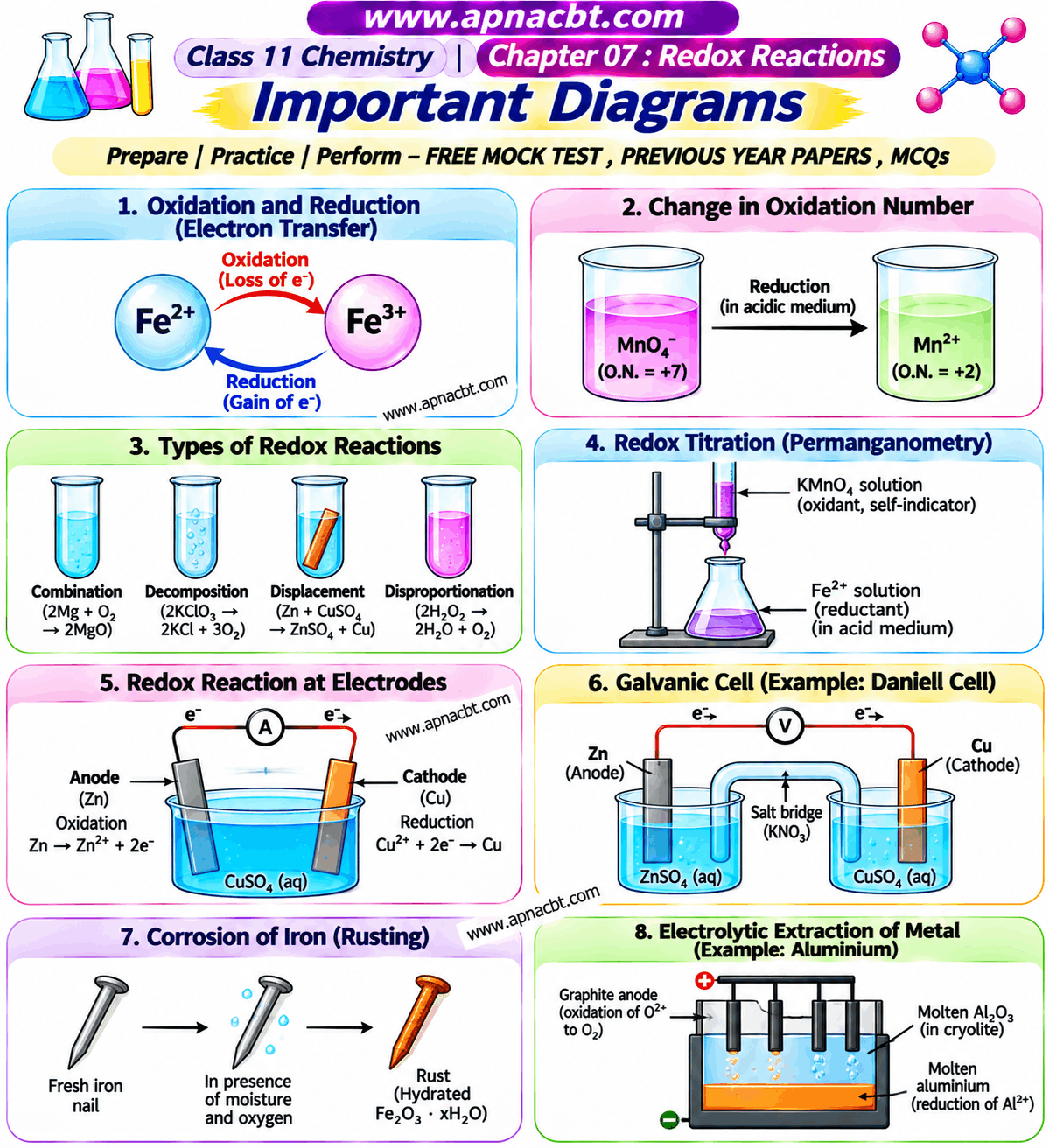
A Daniell cell consists of a zinc electrode in zinc sulphate solution and a copper electrode in copper sulphate solution, connected by an external wire and a salt bridge. Cell representation: Zn(s) | Zn2+(aq) || Cu2+(aq) | Cu(s) Anode (oxidation): Zn(s) → Zn2+(aq) + 2e− Cathode (reduction): Cu2+(aq) + 2e− → Cu(s) Overall reaction: Zn(s) + Cu2+(aq) → Zn2+(aq) + Cu(s)Functions of the Salt Bridge
- Completes the electrical circuit through ionic movement.
- Maintains electrical neutrality in the two half-cells.
- Reduces direct mixing of the two electrolyte solutions.
- Helps prevent charge build-up that would stop the cell reaction.
Electrode Potential
The potential developed at an electrode when it is in contact with a solution containing its ions is called electrode potential. A redox couple is commonly written as oxidised form/reduced form.Standard Electrode Potential
The standard electrode potential, E° , is measured under standard conditions: solution species at unit activity (often approximated as 1 mol L−1 in elementary problems), gases at standard pressure, pure solids and liquids in their standard states, and usually 298 K for the values tabulated in this chapter. The standard hydrogen electrode is assigned E° = 0.00 V by convention.Interpreting Standard Reduction Potentials
- A more positive standard reduction potential indicates a greater tendency for the reduction process as written.
- A stronger oxidising agent is associated with a more positive reduction potential.
- A more negative reduction potential generally indicates that the reduced form is a stronger reducing agent.
Using E° Values to Predict Feasibility
For a cell reaction: E°cell = E°cathode − E°anode using standard reduction potentials for both electrodes. A positive E°cell indicates that the reaction as written is thermodynamically feasible under standard conditions.Exam Focus
Understand the Daniell cell diagram, anode and cathode reactions, salt bridge functions, electron flow, cell notation and interpretation of standard reduction potentials.11. Short-Answer Questions – 30 Questions with Answers
Part A: Questions
- Define a redox reaction.
- Define oxidation and reduction in terms of electron transfer.
- What is an oxidising agent?
- What is a reducing agent?
- State the oxidation number of an element in its free state.
- What is the oxidation number of oxygen in most compounds?
- State the oxidation number of oxygen in a peroxide.
- What is the oxidation number of hydrogen in a metal hydride?
- What is the oxidation number of fluorine in its compounds?
- Calculate the oxidation number of sulphur in H2SO4.
- Calculate the oxidation number of chromium in Cr2O72−.
- Calculate the oxidation number of manganese in KMnO4.
- What is meant by a redox couple? Give one example.
- Identify the oxidising agent and reducing agent in Zn + Cu2+ → Zn2+ + Cu.
- What is a combination redox reaction?
- Give one example of a decomposition redox reaction.
- Why is every decomposition reaction not necessarily a redox reaction?
- Define a displacement reaction.
- What is a disproportionation reaction?
- Give one example of disproportionation of hydrogen peroxide.
- Arrange the halogens in decreasing oxidising power.
- What is Stock notation?
- What is the oxidation number of chlorine in ClO3−?
- What does a fractional oxidation number usually indicate?
- State the principle of the oxidation-number method of balancing redox equations.
- What is the purpose of adding H+ while balancing a redox reaction in acidic medium?
- How is a redox equation balanced in basic medium using the half-reaction method?
- What is a self-indicator? Give an example.
- What is the standard electrode potential of the standard hydrogen electrode?
- State the function of a salt bridge in a galvanic cell.
Part B: Answers
- A redox reaction is a chemical reaction in which oxidation and reduction occur simultaneously, involving changes in oxidation numbers.
- Oxidation is the loss of one or more electrons, while reduction is the gain of one or more electrons.
- An oxidising agent accepts electrons from another species and itself undergoes reduction.
- A reducing agent donates electrons to another species and itself undergoes oxidation.
- Zero. For example, the oxidation number of each atom in H2, O2 and Na is zero.
- −2, with exceptions such as peroxides, superoxides and oxygen-fluorine compounds.
- −1 per oxygen atom.
- −1.
- −1.
- Let S = x. 2(+1) + x + 4(−2) = 0; x = +6.
- Let Cr = x. 2x + 7(−2) = −2; x = +6.
- Let Mn = x. (+1) + x + 4(−2) = 0; x = +7.
- A redox couple consists of the oxidised and reduced forms of the same species, such as Cu2+/Cu.
- Zn is the reducing agent because it is oxidised to Zn2+. Cu2+ is the oxidising agent because it is reduced to Cu.
- A reaction in which substances combine to form one product and oxidation numbers change is a combination redox reaction. Example: 2Mg + O2 → 2MgO.
- 2H2O → 2H2 + O2.
- Some decomposition reactions involve no change in oxidation numbers. For example, CaCO3 → CaO + CO2.
- A reaction in which an atom or ion in a compound is replaced by another atom or ion is a displacement reaction.
- It is a redox reaction in which the same element in one oxidation state is simultaneously oxidised and reduced.
- 2H2O2 → 2H2O + O2. Oxygen changes from −1 to −2 and 0.
- F2 > Cl2 > Br2 > I2.
- Stock notation expresses the oxidation state of a metal using a Roman numeral in brackets, for example Fe(III) chloride.
- Let Cl = x. x + 3(−2) = −1; x = +5.
- It usually represents the average oxidation state of atoms that may occupy different whole-number oxidation states in the actual structure.
- The total increase in oxidation number must equal the total decrease in oxidation number.
- H+ is added to balance hydrogen atoms and, together with water, helps balance the equation in acidic solution.
- Balance the equation as in acidic medium, add OH− to both sides to neutralise H+, convert H+ and OH− into water, cancel excess water and verify atoms and charge.
- A self-indicator is a reactant that itself signals the end point by a colour change. Acidic permanganate ion is an example.
- 0.00 V by convention.
- A salt bridge completes the circuit, maintains electrical neutrality and allows ions to migrate between the half-cells while limiting direct mixing.
12. Long-Answer Questions – 15 Questions with Detailed Answers
Part A: Questions
- Explain the classical concepts of oxidation and reduction with suitable chemical equations.
- Explain oxidation and reduction in terms of electron transfer. Identify the oxidising and reducing agents in the formation of sodium chloride.
- State the important rules for assigning oxidation numbers. Illustrate the rules with examples.
- Calculate the oxidation numbers of the specified elements in H2SO4, Cr2O72−, KMnO4, H2O2 and NaH.
- Explain how oxidation numbers are used to identify oxidation, reduction, oxidising agents and reducing agents. Illustrate with CuO + H2 → Cu + H2O.
- Explain the four main types of redox reactions with suitable balanced examples.
- What is disproportionation? Explain the disproportionation of hydrogen peroxide and chlorine in alkaline medium. Why does fluorine not show the usual disproportionation behaviour?
- Explain the oxidation-number method for balancing redox equations and balance the dichromate-sulphite reaction in acidic medium.
- Explain the half-reaction method for balancing redox equations in acidic medium. Balance the reaction between Fe2+ and dichromate ions.
- Explain how a redox equation is balanced in basic medium by the ion-electron method. Give a balanced example involving permanganate and iodide ions.
- Explain the principle of redox titrations and describe the roles of permanganate, dichromate and iodine-starch indicator systems.
- Describe the construction and working of a Daniell cell. Explain the functions of its electrodes and salt bridge, and write the cell reaction.
- Define electrode potential and standard electrode potential. Explain the standard hydrogen electrode and the significance of positive and negative standard reduction potentials.
- Explain how standard electrode potentials can be used to predict the feasibility of a redox reaction. Write the expression for standard cell potential.
- Explain redox couples and competitive electron-transfer reactions using the Zn-Cu and Cu-Ag systems. Relate the observations to the relative reducing power of metals.
Part B: Detailed Answers
1. Classical Concepts of Oxidation and Reduction
Oxidation was first defined as the addition of oxygen to a substance. It was later extended to include addition of another electronegative element or removal of hydrogen or another electropositive element. Examples:- 2Mg + O2 → 2MgO: magnesium is oxidised by addition of oxygen.
- Mg + Cl2 → MgCl2: magnesium is oxidised by addition of chlorine.
- 2H2S + O2 → 2S + 2H2O: hydrogen is removed from H2S.
- 2HgO → 2Hg + O2: oxygen is removed from mercuric oxide.
- CH2=CH2 + H2 → CH3–CH3: hydrogen is added to ethene.
2. Electron-Transfer Concept and Agents
Oxidation is loss of electrons and reduction is gain of electrons. The species accepting electrons is the oxidising agent; the species donating electrons is the reducing agent. For sodium chloride formation: 2Na + Cl2 → 2NaCl Oxidation: 2Na → 2Na+ + 2e− Reduction: Cl2 + 2e− → 2Cl− Sodium loses electrons, so it is oxidised and acts as the reducing agent. Chlorine gains electrons, so it is reduced and acts as the oxidising agent. Adding the half-reactions gives the overall balanced equation.3. Rules for Assigning Oxidation Numbers
The oxidation number of a free element is zero; for a monoatomic ion it equals the ionic charge. Alkali metals are generally +1, alkaline earth metals +2 and aluminium +3. Oxygen is usually −2, but is −1 in peroxides and −1/2 on average in superoxides; oxygen is positive when bonded to fluorine. Hydrogen is +1 except in metal hydrides, where it is −1. Fluorine is −1 in its compounds. Other halogens are usually −1 in binary salts but can be positive in oxo-compounds. The sum of oxidation numbers is zero in a neutral compound and equals the charge in a polyatomic ion. For example, in H2SO4, sulphur is +6; in Cr2O72−, chromium is +6. In a peroxide such as H2O2, oxygen is −1. In NaH, hydrogen is −1. These rules provide a systematic way to identify redox changes.4. Oxidation-Number Calculations
(a) H2SO4: Let S = x. 2(+1) + x + 4(−2) = 0; x = +6. (b) Cr2O72−: Let Cr = x. 2x + 7(−2) = −2; x = +6. (c) KMnO4: (+1) + x + 4(−2) = 0; x = +7. (d) H2O2: 2(+1) + 2x = 0; x = −1 for oxygen. (e) NaH: (+1) + x = 0; x = −1 for hydrogen. The charge balance equation must include the overall ionic charge where the species is an ion.5. Identifying Redox Changes and Agents
In CuO + H2 → Cu + H2O, copper is +2 in CuO and zero in Cu. Its oxidation number decreases, so copper is reduced. Hydrogen is zero in H2 and +1 in water. Its oxidation number increases, so hydrogen is oxidised. CuO supplies the species that is reduced and therefore acts as the oxidising agent. H2 is oxidised and acts as the reducing agent. This method is useful even when no obvious electron transfer is shown in the molecular equation.6. Four Types of Redox Reactions
Combination: Two or more reactants form one product, with oxidation-state change. Example: 2Mg + O2 → 2MgO. Decomposition: One compound breaks into simpler products with oxidation-state change. Example: 2H2O → 2H2 + O2. Not all decomposition reactions are redox; CaCO3 → CaO + CO2 is not redox. Displacement: One element displaces another from a compound. Example: Zn + CuSO4 → ZnSO4 + Cu. Halogen displacement is another example: Cl2 + 2KBr → 2KCl + Br2. Disproportionation: The same element is oxidised and reduced. Example: 2H2O2 → 2H2O + O2.7. Disproportionation Reactions
In hydrogen peroxide, oxygen has oxidation number −1. During decomposition, some oxygen changes to −2 in water (reduction) and the rest changes to zero in oxygen gas (oxidation): 2H2O2 → 2H2O + O2. In alkaline medium, chlorine undergoes: Cl2 + 2OH− → ClO− + Cl− + H2O. Chlorine changes from zero to +1 in hypochlorite and −1 in chloride. Fluorine is the most electronegative element and does not exhibit positive oxidation states in its compounds; consequently, it does not show the usual halogen disproportionation pattern.8. Oxidation-Number Method: Dichromate and Sulphite
Start with: Cr2O72− + SO32− → Cr3+ + SO42−. Chromium changes from +6 to +3. Two Cr atoms gain 6 electrons in total. Sulphur changes from +4 to +6, losing 2 electrons per sulphur atom. Three sulphite ions therefore lose 6 electrons. After placing coefficients and balancing oxygen, hydrogen and charge in acidic solution, the balanced equation is: Cr2O72− + 3SO32− + 8H+ → 2Cr3+ + 3SO42− + 4H2O. The total charge on each side is +4. Chromium is reduced and the dichromate ion is the oxidising agent. Sulphite is oxidised and is the reducing agent.9. Half-Reaction Method in Acidic Medium
The ionic equation is Fe2+ + Cr2O72− → Fe3+ + Cr3+. Separate the half-reactions: Fe2+ → Fe3+ + e−. Cr2O72− → 2Cr3+. Balance oxygen and hydrogen in the reduction half: Cr2O72− + 14H+ + 6e− → 2Cr3+ + 7H2O. Multiply the iron half-reaction by six: 6Fe2+ → 6Fe3+ + 6e−. Add and cancel electrons: 6Fe2+ + Cr2O72− + 14H+ → 6Fe3+ + 2Cr3+ + 7H2O. Atoms and charges are balanced. Fe2+ is the reducing agent and dichromate is the oxidising agent.10. Half-Reaction Method in Basic Medium
For permanganate and iodide, the skeletal equation is: MnO4− + I− → MnO2 + I2. The oxidation half-reaction is: 2I− → I2 + 2e−. For the reduction half-reaction, balance oxygen with water and hydrogen with H+, then convert to basic medium: MnO4− + 2H2O + 3e− → MnO2 + 4OH−. Multiply the oxidation half by 3 and the reduction half by 2, then add: 2MnO4− + 6I− + 4H2O → 2MnO2 + 3I2 + 8OH−. There are 8 negative charges on each side, and all atoms are balanced.11. Redox Titrations and Indicators
Redox titration uses an oxidation-reduction reaction to determine the concentration of an oxidant or reductant. In permanganate titrations, the purple MnO4− ion can act as a self-indicator. In suitable acidic titrations, the first slight permanent pink colour indicates a small excess of permanganate after the reducing agent has been consumed. Dichromate is not a self-indicator; an indicator such as diphenylamine may be used in an appropriate procedure. Iodine forms an intense blue colour with starch. Thiosulphate removes iodine according to: I2 + 2S2O32− → 2I− + S4O62−. The disappearance of the blue starch-iodine colour signals that iodine has been consumed. Indicator selection depends on the redox system and experimental conditions.12. Daniell Cell: Construction and Working
A Daniell cell contains a zinc rod dipped in ZnSO4 solution and a copper rod dipped in CuSO4 solution. The two solutions are connected by a salt bridge, while the two metal electrodes are connected externally by a conducting wire. At the zinc anode, oxidation occurs: Zn(s) → Zn2+(aq) + 2e−. Electrons travel through the external wire to the copper cathode. At the copper cathode, reduction occurs: Cu2+(aq) + 2e− → Cu(s). The overall reaction is: Zn(s) + Cu2+(aq) → Zn2+(aq) + Cu(s). The salt bridge permits ion migration, maintains electrical neutrality and completes the internal circuit. In a galvanic Daniell cell, zinc is the negative anode and copper is the positive cathode. Electron flow in the external wire is from zinc to copper.13. Electrode Potential and Standard Hydrogen Electrode
Electrode potential is the potential difference developed between an electrode and the electrolyte containing its ions when the system reaches equilibrium. The standard electrode potential is measured under standard conditions, commonly reported at 298 K with species at standard states. The standard hydrogen electrode consists of a platinum electrode in contact with hydrogen gas at standard pressure and an aqueous solution with unit hydrogen-ion activity. Its standard potential is assigned zero volts by convention. Electrode potentials are tabulated as reduction potentials. A more positive value indicates a greater tendency for the reduction reaction to occur. A more negative reduction potential indicates that the reduced form is more readily oxidised and is generally a stronger reducing agent relative to the standard hydrogen electrode.14. Predicting Redox Feasibility with Standard Potentials
For a cell reaction, calculate: E°cell = E°cathode − E°anode where both values are standard reduction potentials. The half-reaction with the more positive reduction potential proceeds as reduction at the cathode; the other is reversed and proceeds as oxidation at the anode. If E°cell is positive, the reaction as written is thermodynamically feasible under standard conditions. If it is negative, the reverse reaction is favoured under standard conditions. A zero value indicates equilibrium under standard conditions. Do not multiply electrode potentials when multiplying half-reactions to balance electrons; potential is an intensive property.15. Redox Couples and Competitive Electron Transfer
In the reaction Zn(s) + Cu2+(aq) → Zn2+(aq) + Cu(s), zinc releases electrons to copper ions. The reaction shows that zinc has a greater tendency to lose electrons than copper. In the reaction Cu(s) + 2Ag+(aq) → Cu2+(aq) + 2Ag(s), copper transfers electrons to silver ions. These observations give the relative electron-releasing tendency: Zn > Cu > Ag. The redox couples are Zn2+/Zn, Cu2+/Cu and Ag+/Ag. Such comparisons form the basis for the activity series and electrochemical series. A metal higher in reducing power can generally displace a less active metal from a solution containing its ions.Redox Reactions Class 11 Chemistry – Chapter 7 Mind Map
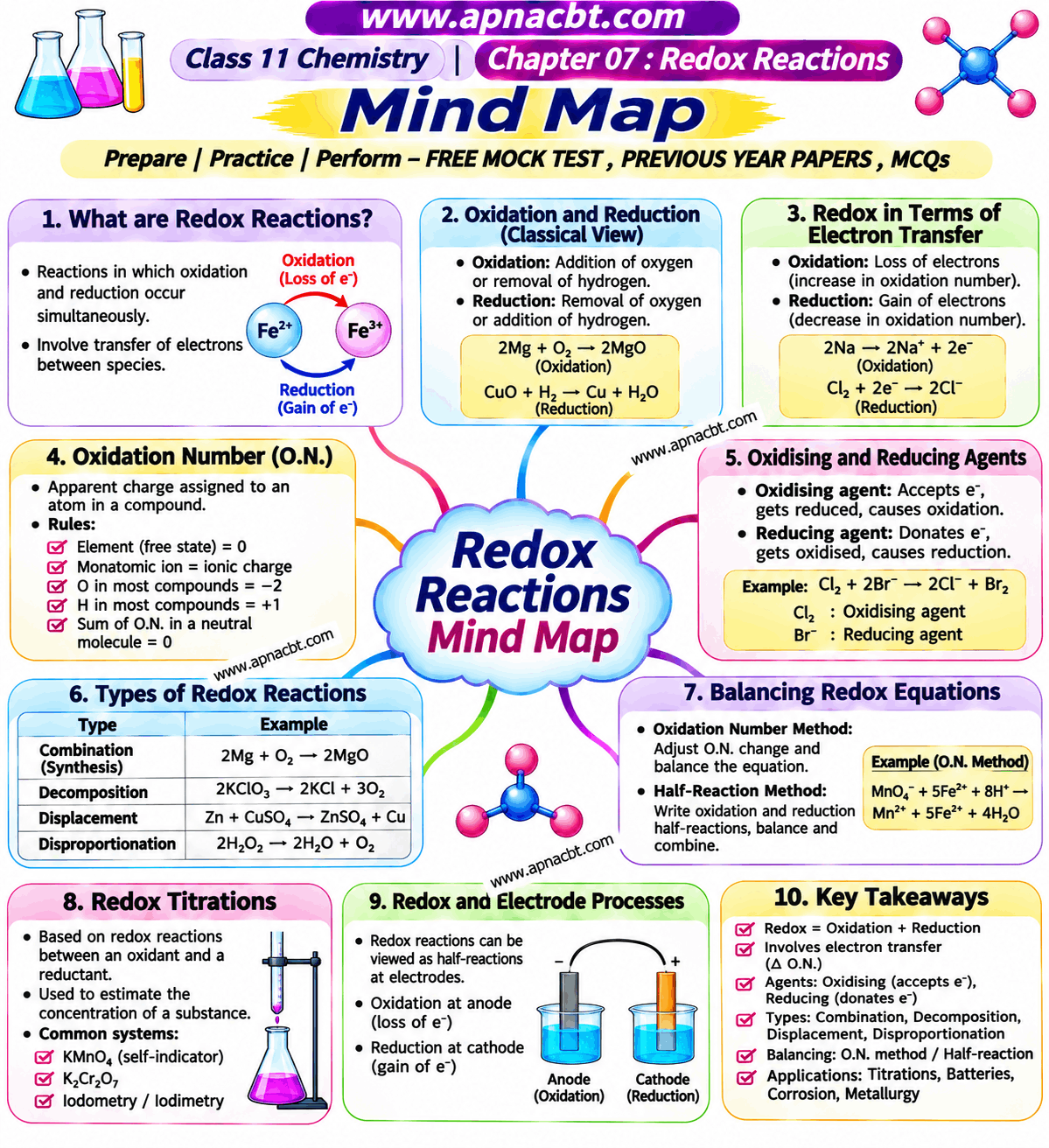
Redox Reactions Class 11 Chemistry – Important Diagrams
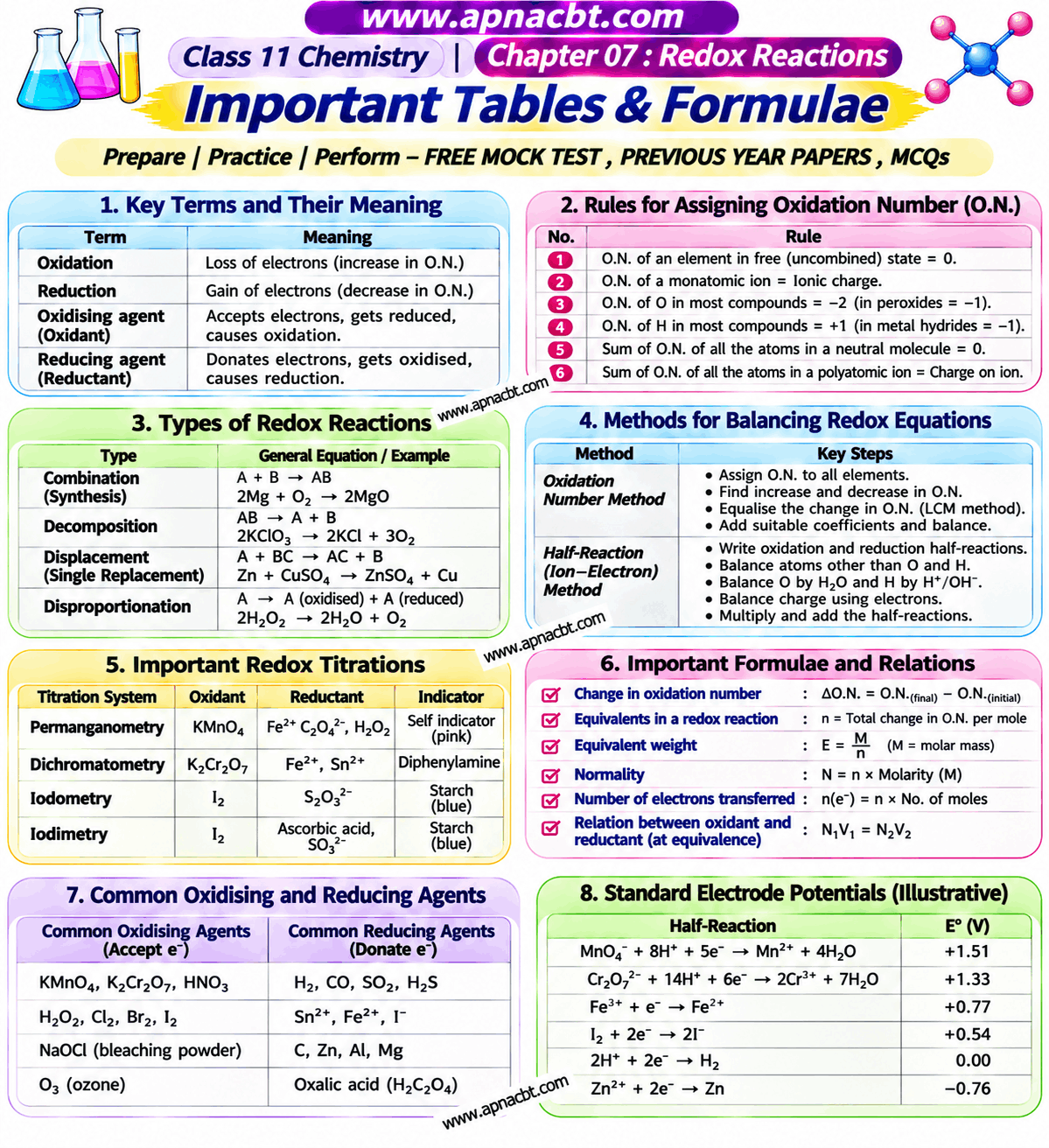
Redox Reactions Class 11 Chemistry – Important Tables and Formulae