1. Introduction, Scope and Basic Principles of Thermodynamics
Meaning and Scope
Thermodynamics is the branch of science concerned with different forms of energy, their interconversion and the quantitative relationships involved in physical and chemical processes. Chemical thermodynamics applies these principles to chemical reactions and changes of state.
- Zeroth law: provides the basis for temperature measurement.
- First law: expresses conservation of energy.
- Second law: determines the direction and spontaneity of a process.
- Third law: provides a reference for evaluating absolute entropy.
Thermodynamics predicts the feasibility and energy changes of a process. It does not predict the rate, detailed mechanism or molecular pathway of a reaction. These are studied through chemical kinetics and molecular-level theories.
System, Surroundings and Boundary
- System: the part of the universe selected for investigation.
- Surroundings: everything outside the system that can interact with it.
- Boundary: the real or imaginary surface separating system and surroundings.
- Universe: system + surroundings.
Types of Systems
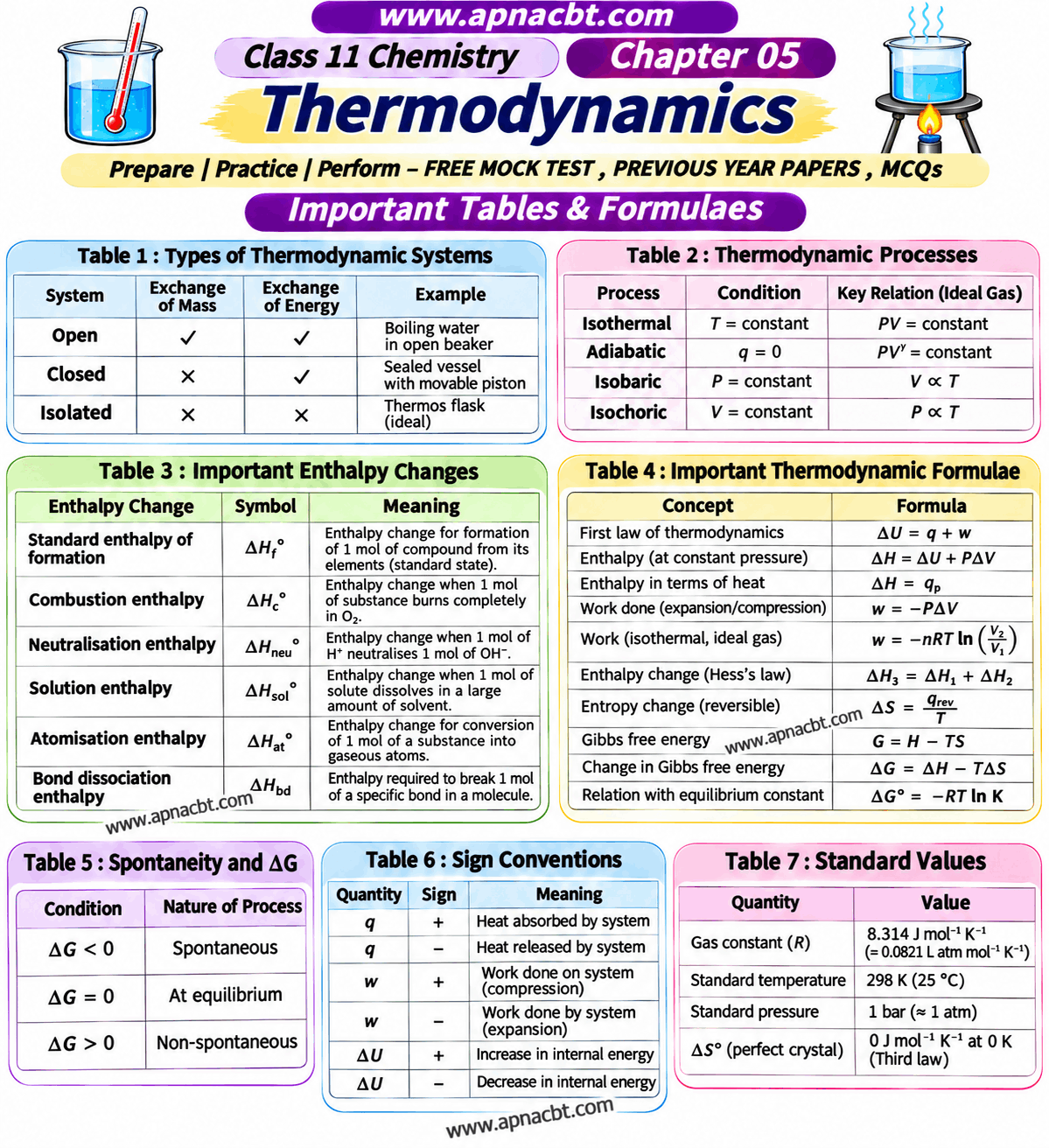
| System | Exchange of matter | Exchange of energy | Example |
|---|---|---|---|
| Open | Yes | Yes | Water boiling in an open beaker |
| Closed | No | Yes | Gas in a sealed cylinder that can be heated |
| Isolated | No | No | Ideal thermos flask |
Properties of a System
- Extensive properties: depend on the amount of matter; examples include mass, volume, internal energy, enthalpy, entropy and heat capacity.
- Intensive properties: independent of the amount of matter; examples include temperature, pressure, density, viscosity and refractive index.
Extensive properties are additive for non-interacting parts of a system. Specific and molar properties are generally intensive.
State Functions and Path Functions
A state function depends only on the initial and final states, not on the path followed. Examples: pressure, temperature, volume, internal energy (U), enthalpy (H), entropy (S) and Gibbs energy (G).
A path function depends on the path of the process. Heat (q) and work (w) are path functions. For a cyclic process, the net change in any state function is zero.
Thermodynamic Processes
| Process | Condition | Important relation |
|---|---|---|
| Isothermal | Temperature constant | ΔT = 0 |
| Adiabatic | No heat exchange | q = 0 |
| Isobaric | Pressure constant | ΔP = 0 |
| Isochoric | Volume constant | ΔV = 0; pressure-volume work = 0 |
| Cyclic | System returns to initial state | ΔU = ΔH = ΔS = ΔG = 0 |
Reversible and Irreversible Processes
A reversible process is an ideal process carried out through infinitesimal changes, with the system remaining in equilibrium at every stage. It can be reversed by an infinitesimal change in the driving force. A reversible expansion gives the maximum work in magnitude under the same specified conditions.
An irreversible process occurs at a finite driving force and cannot be exactly reversed so as to restore both system and surroundings to their original states. Real spontaneous processes are irreversible.
Exam Focus
- Distinguish open, closed and isolated systems.
- Classify extensive and intensive properties.
- Identify state functions and path functions.
- Remember that adiabatic means q = 0, not necessarily ΔT = 0.
2. Heat, Work, Internal Energy and Sign Conventions
Heat and Work
Heat (q) is energy transferred between a system and surroundings because of a temperature difference. Work (w) is energy transferred when a force acts through a displacement or when another organised interaction occurs.
Both heat and work are modes of energy transfer, not properties stored in a system. Their values depend on the path.
Chemical Thermodynamic Sign Convention
| Energy transfer | Sign | Meaning |
|---|---|---|
| Heat absorbed by system | q > 0 | Endothermic with respect to system |
| Heat released by system | q < 0 | Exothermic with respect to system |
| Work done on system | w > 0 | Energy enters system as work |
| Work done by system | w < 0 | Energy leaves system as work |
Pressure–Volume Work
For a small volume change against a constant external pressure:
w = −Pext ΔV
For expansion, ΔV is positive and w is negative. For compression, ΔV is negative and w is positive.
For a reversible change, the external pressure differs infinitesimally from the system pressure. For an ideal gas undergoing reversible isothermal expansion:
w = −nRT ln(V2/V1) = −2.303 nRT log(V2/V1)
Using P1V1 = P2V2, this can also be written as:
w = nRT ln(P2/P1)
For irreversible expansion against constant external pressure, w = −Pext(V2 − V1).
Other Forms of Work
Electrical work is important in electrochemical processes. When charge Q passes through a potential difference E, the magnitude of electrical work is Q × E; the sign depends on the direction of energy transfer under the adopted convention.
Internal Energy (U)
Internal energy is the total microscopic energy of a system, including molecular translational, rotational, vibrational, electronic and intermolecular contributions. Absolute internal energy is not usually measured; changes in internal energy are measurable.
ΔU = Ufinal − Uinitial
For an ideal gas, internal energy depends only on temperature. Thus, for an isothermal change of an ideal gas, ΔU = 0.
Units
- SI unit of heat, work and energy: joule (J).
- 1 J = 1 N m.
- 1 calorie ≈ 4.184 J.
- 1 L atm ≈ 101.3 J.
3. First Law of Thermodynamics and Enthalpy
First Law: Conservation of Energy
Energy can neither be created nor destroyed; it can only be converted from one form into another. For a system:
ΔU = q + w
The change in internal energy equals heat supplied to the system plus work done on the system.
- At constant volume, only pressure–volume work being possible: w = 0, therefore qv = ΔU.
- For an adiabatic process: q = 0, therefore ΔU = w.
- For an isolated system: q = 0 and w = 0, therefore ΔU = 0.
- For a cyclic process: ΔU = 0, so net q = − net w.
Enthalpy (H)
Enthalpy is a state function defined by:
H = U + PV
For a finite change:
ΔH = ΔU + Δ(PV)
At constant pressure, when only pressure–volume work occurs, the heat exchanged is:
qp = ΔH
At constant volume, qv = ΔU.
Relationship Between ΔH and ΔU for Gaseous Reactions
For ideal gases, PV = nRT. At a fixed temperature:
ΔH = ΔU + ΔngRT
where Δng = moles of gaseous products − moles of gaseous reactants. Count only gaseous species, using balanced stoichiometric coefficients.
If Δng = 0, then ΔH = ΔU. For reactions involving only solids and liquids, the PV contribution is often small and ΔH is approximately equal to ΔU.
Exothermic and Endothermic Changes
- Exothermic: heat is released; ΔH is negative.
- Endothermic: heat is absorbed; ΔH is positive.
The sign of ΔH describes the heat change at constant pressure; it does not by itself decide whether a reaction is spontaneous.
Heat Capacity and Specific Heat
Heat capacity is the heat required to raise the temperature of a system by one kelvin:
C = q/ΔT
Specific heat capacity is heat required to raise the temperature of unit mass by one kelvin. Molar heat capacity is heat required per mole per kelvin.
q = CΔT for a specified constant heat capacity.
For gases, Cp is the molar heat capacity at constant pressure and Cv at constant volume. For an ideal gas:
Cp − Cv = R (molar heat capacities).
Exam Focus
- Use the correct signs in ΔU = q + w.
- Do not confuse qv with qp.
- Calculate Δng from gaseous species only.
- Convert temperature differences and energy units consistently.
4. Calorimetry and Measurement of ΔU and ΔH
Calorimetry
Calorimetry measures heat exchanged during a physical or chemical process using a calorimeter. Heat lost by one part is gained by another, assuming negligible heat loss to the surroundings.
q = m c ΔT
where m is mass, c is specific heat capacity and ΔT = Tfinal − Tinitial.
For a calorimeter with calorimeter constant Ccal:
qcal = Ccal ΔT
Heat balance:
qreaction + qsolution + qcalorimeter = 0
Bomb Calorimeter – Constant Volume
A bomb calorimeter is a rigid, sealed vessel in which combustion occurs at constant volume. Since ΔV = 0, pressure–volume work is zero and the heat measured corresponds to ΔU for the reaction under the experimental conditions:
qv = ΔU
The calorimeter absorbs heat released by the reaction. For an exothermic reaction, qreaction is negative while qcal is positive.
Constant-Pressure Calorimetry
In a coffee-cup type calorimeter operating at constant pressure, the heat exchanged by the reaction is:
qp = ΔH
For a solution, qsolution = m c ΔT. The reaction heat is equal in magnitude and opposite in sign to the heat gained by the solution and calorimeter.
Temperature Dependence of Enthalpy
When heat capacity is approximately constant over a temperature range, q = nCmΔT for a molar heat capacity, or q = mcΔT for a specific heat capacity. Always identify whether the given heat capacity is per mole, per unit mass or for the whole calorimeter.
Problem-Solving Steps
- Identify whether the experiment is at constant volume or constant pressure.
- Calculate the temperature change with its sign.
- Calculate heat absorbed by the solution/calorimeter.
- Apply heat balance to obtain heat of reaction.
- Divide by the number of moles reacting if molar enthalpy or internal energy is required.
5. Thermochemical Equations and Standard Enthalpy of Reaction
Thermochemical Equation
A balanced chemical equation that specifies physical states and the enthalpy change is called a thermochemical equation. The enthalpy change belongs to the reaction as written.
- Reversing an equation changes the sign of ΔH.
- Multiplying an equation by a factor multiplies ΔH by the same factor.
- Adding equations adds their enthalpy changes.
- Physical states must be specified because enthalpy depends on state.
Standard State and Standard Enthalpy
The standard state is the reference state of a substance in its pure form at the specified standard pressure (commonly 1 bar) and a stated temperature, often 298 K. The superscript ° indicates standard conditions.
Standard enthalpy of reaction (ΔrH°) is the enthalpy change when the reaction occurs according to the balanced equation, with all substances in their standard states.
ΔrH° = Σν ΔfH°(products) − Σν ΔfH°(reactants)
Here ν represents the stoichiometric coefficient. The standard enthalpy of formation of an element in its most stable standard state is zero.
Hess’s Law of Constant Heat Summation
The total enthalpy change of a reaction is the same whether the reaction occurs in one step or several steps, provided the initial and final states are identical. This follows because enthalpy is a state function.
For a reaction obtained by adding several equations:
ΔHoverall = ΔH1 + ΔH2 + …
Applications of Hess’s Law
- Determination of enthalpy changes that cannot be measured directly.
- Calculation of enthalpy of formation, combustion and transition.
- Construction of Born–Haber cycles to estimate lattice enthalpy.
- Calculation of bond enthalpy using suitable reaction pathways.
Enthalpy from Bond Enthalpies
For a reaction in the gaseous phase, an approximate enthalpy change can be calculated as:
ΔH ≈ Σ(bond enthalpies of bonds broken) − Σ(bond enthalpies of bonds formed)
Breaking bonds requires energy (positive contribution); forming bonds releases energy (negative contribution). Average bond enthalpies are mean values and therefore give approximate results for many molecules.
6. Important Types of Enthalpy Changes
Enthalpy of Formation (ΔfH°)
The enthalpy change when one mole of a compound is formed from its constituent elements in their standard states. The standard enthalpy of formation of an element in its most stable standard state is zero.
Enthalpy of Combustion (ΔcH°)
The enthalpy change when one mole of a substance is completely burnt in oxygen under specified standard conditions. Combustion is generally exothermic, so ΔcH° is usually negative.
Enthalpy of Atomisation
The enthalpy change when one mole of gaseous atoms is formed from an element in its specified standard state. It is positive because energy is required to separate atoms.
Bond Dissociation Enthalpy and Bond Enthalpy
Bond dissociation enthalpy is the enthalpy required to break one mole of a specified covalent bond in gaseous molecules. Successive bond dissociation enthalpies in a polyatomic molecule may differ. Average bond enthalpy is the average energy needed to break a particular type of bond in gaseous molecules.
Lattice Enthalpy
Lattice enthalpy is associated with the formation of an ionic solid from gaseous ions or the separation of the solid into gaseous ions. Be careful: books may use opposite sign conventions depending on whether lattice formation or lattice dissociation is defined. State the convention before using its sign.
Enthalpy of Hydration
The enthalpy change when one mole of gaseous ions becomes hydrated by water molecules. Hydration is generally exothermic.
Enthalpy of Solution
The enthalpy change when one mole of a solute dissolves in a specified amount of solvent to form a solution. It depends on solute-solvent interactions and concentration.
Enthalpy of Neutralisation
The enthalpy change when an acid and a base react to form one mole of water in dilute aqueous solution. For a strong acid and strong base, the value is approximately −57.1 kJ mol−1, because the net ionic reaction is H+(aq) + OH−(aq) → H2O(l). Weak acids or bases require energy for ionisation, so the observed heat released is generally smaller in magnitude.
Enthalpy of Ionisation
The enthalpy change accompanying complete ionisation of one mole of a weak electrolyte into its ions. For weak acids/bases, ionisation is commonly endothermic.
Enthalpy of Phase Transitions
| Change | Definition | Usual sign |
|---|---|---|
| Fusion | Solid → liquid at melting point | Positive |
| Vaporisation | Liquid → gas at boiling point | Positive |
| Sublimation | Solid → gas | Positive |
| Reverse changes | Freezing, condensation, deposition | Negative |
For a substance undergoing sublimation through a liquid intermediate where applicable:
ΔHsublimation = ΔHfusion + ΔHvaporisation
Enthalpy of Allotropic Transformation
The enthalpy change when one mole of an element changes from one allotrope to another at a specified temperature and pressure, for example graphite converting to diamond.
Exam Focus
Learn the definition per mole, physical state, sign and representative equation for each enthalpy type. In numerical questions, first balance the equation and match the stated quantity to the reaction stoichiometry.
7. Spontaneity and Entropy
Spontaneous and Non-Spontaneous Processes
A spontaneous process proceeds in a particular direction under given conditions without continuous external assistance. It may be slow or fast. A non-spontaneous process does not proceed in that direction unless driven by external influence.
Examples include heat flowing from a hot body to a cold body, gas expanding into an available vacuum, and many combustion reactions after ignition. A spontaneous process is not necessarily rapid; thermodynamics does not determine reaction rate.
Entropy (S)
Entropy is a thermodynamic state function that measures the dispersal of energy and the number of accessible microscopic arrangements of a system. For a reversible process:
ΔS = qrev/T
For a finite reversible isothermal change, ΔS = qrev/T. SI unit: J K−1; molar entropy is J mol−1 K−1.
Qualitative Entropy Trends
- For the same substance under comparable conditions: S(gas) > S(liquid) > S(solid).
- Entropy generally increases when a solid melts or a liquid vaporises.
- Mixing and expansion of gases generally increase entropy.
- Increasing temperature usually increases entropy.
- Greater molecular complexity often gives higher molar entropy among comparable substances.
These are useful trends, but the actual entropy change must be evaluated for the specific process.
Entropy Change of the Universe
For a spontaneous process:
ΔSuniverse = ΔSsystem + ΔSsurroundings > 0
For a reversible process at equilibrium, ΔSuniverse = 0. A process with ΔSuniverse < 0 is non-spontaneous in the stated direction.
Entropy and Phase Changes
At a reversible phase transition temperature:
ΔStransition = ΔHtransition/Ttransition
For melting and vaporisation, entropy change is positive. For freezing and condensation, it is negative.
8. Second and Third Laws of Thermodynamics
Second Law of Thermodynamics
The second law gives the criterion for the direction of a process. In an isolated system, a spontaneous process proceeds in the direction of increasing entropy. At equilibrium, entropy of the isolated system is maximum and its infinitesimal change is zero.
Spontaneous: ΔSuniverse > 0
Reversible equilibrium: ΔSuniverse = 0
Non-spontaneous in the stated direction: ΔSuniverse < 0
Entropy of Surroundings
At constant temperature and pressure, when heat qsystem is exchanged reversibly with surroundings:
ΔSsurroundings = −ΔHsystem/T
This relation, combined with the system entropy change, leads to the Gibbs energy criterion.
Third Law of Thermodynamics
The entropy of a perfectly crystalline pure substance approaches zero as the temperature approaches absolute zero (0 K). This provides a reference point for determining absolute entropies.
For a perfect crystal at 0 K, S = 0. Real crystals with residual disorder may have residual entropy.
Absolute Entropy
Absolute entropy at a temperature can be obtained by integrating heat capacity over temperature from 0 K, including entropy contributions from any phase transitions. For a reversible phase transition, the entropy contribution is ΔHtransition/Ttransition.
Exam Focus
- Second law: direction and spontaneity.
- Third law: zero entropy reference for a perfect crystal at 0 K.
- Do not confuse entropy of the system with entropy of the universe.
9. Gibbs Free Energy and Criterion of Spontaneity
Gibbs Free Energy (G)
Gibbs free energy is a thermodynamic state function defined by:
G = H − TS
At constant temperature:
ΔG = ΔH − TΔS
This is the Gibbs–Helmholtz relation in the form used for evaluating spontaneity at constant temperature and pressure.
Criterion of Spontaneity at Constant T and P
| ΔG | Interpretation |
|---|---|
| ΔG < 0 | Spontaneous in forward direction |
| ΔG = 0 | System at equilibrium |
| ΔG > 0 | Non-spontaneous in forward direction; reverse direction is favoured |
A negative ΔG indicates thermodynamic favourability, not necessarily a fast reaction.
Effect of Enthalpy and Entropy
| ΔH | ΔS | Spontaneity |
|---|---|---|
| Negative | Positive | Spontaneous at all temperatures (under the stated assumptions) |
| Positive | Negative | Non-spontaneous at all temperatures |
| Negative | Negative | Favoured at low temperatures |
| Positive | Positive | Favoured at high temperatures |
At the temperature where ΔG = 0, the system is at the boundary between the spontaneous and non-spontaneous regions. If ΔH and ΔS are approximately temperature-independent, T = ΔH/ΔS at this boundary.
Standard Gibbs Energy and Equilibrium
For a reaction under non-standard conditions:
ΔG = ΔG° + RT ln Q
where Q is the reaction quotient. At equilibrium, ΔG = 0 and Q = K:
ΔG° = −RT ln K = −2.303 RT log K
Therefore, ΔG° < 0 corresponds to K > 1, ΔG° = 0 to K = 1, and ΔG° > 0 to K < 1 at the specified temperature.
Important Numerical Tips
- Use temperature in kelvin.
- Keep units consistent: if ΔH is in kJ mol−1, convert R to kJ mol−1 K−1.
- Convert entropy units before substituting into ΔG = ΔH − TΔS.
- Use natural logarithm in ΔG° = −RT ln K and common logarithm only with the 2.303 factor.
10. Formula Sheet, Concept Links and NEET Revision
Core Formulae
| Concept | Formula |
|---|---|
| First law | ΔU = q + w |
| PV work at constant external pressure | w = −PextΔV |
| Reversible isothermal ideal-gas work | w = −nRT ln(V2/V1) |
| Enthalpy | H = U + PV |
| Constant volume | qv = ΔU |
| Constant pressure | qp = ΔH |
| Gaseous reaction | ΔH = ΔU + ΔngRT |
| Heat absorbed | q = mcΔT |
| Ideal gas heat capacities | Cp − Cv = R |
| Reaction enthalpy from formation enthalpies | ΔrH° = ΣνΔfH°(products) − ΣνΔfH°(reactants) |
| Bond enthalpy estimate | Σ(bonds broken) − Σ(bonds formed) |
| Entropy change | ΔS = qrev/T |
| Phase transition entropy | ΔS = ΔHtransition/Ttransition |
| Gibbs energy | ΔG = ΔH − TΔS |
| Non-standard Gibbs energy | ΔG = ΔG° + RT ln Q |
| Equilibrium relation | ΔG° = −RT ln K |
High-Yield Concept Checks
- Heat and work are path functions; U, H, S and G are state functions.
- At constant volume, qv = ΔU; at constant pressure, qp = ΔH (when only PV work occurs).
- Expansion work is negative under the chemistry sign convention.
- Breaking bonds absorbs energy; forming bonds releases energy.
- Spontaneity depends on ΔG at constant T and P, not on ΔH alone.
- At equilibrium, ΔG = 0, but ΔG° need not be zero.
- Thermodynamic feasibility does not determine reaction speed.
Common Errors to Avoid
- Using total moles instead of gaseous mole change in Δng.
- Using Celsius instead of kelvin in thermodynamic equations.
- Forgetting to reverse the sign of ΔH when reversing a thermochemical equation.
- Mixing J and kJ in the same calculation.
- Assuming a negative ΔH always means spontaneous.
- Assuming a spontaneous reaction must be rapid.
11. Short-Answer Questions – 30 Questions
Questions
- Define thermodynamics and chemical thermodynamics.
- What are system, surroundings and boundary?
- Differentiate open, closed and isolated systems with one example each.
- Distinguish extensive and intensive properties with two examples each.
- What are state functions? Give four examples.
- Why are heat and work called path functions?
- Define isothermal, adiabatic, isobaric and isochoric processes.
- State the sign convention for heat and work in chemistry.
- Write the expression for pressure–volume work at constant external pressure.
- What is internal energy?
- State the first law of thermodynamics and write its mathematical expression.
- What is the relation between qv and ΔU?
- Define enthalpy and write its relation with internal energy.
- What is the relation between ΔH and ΔU for a gaseous reaction?
- When are ΔH and ΔU equal?
- Define heat capacity and specific heat capacity.
- What is calorimetry? Name the type of calorimeter used to measure ΔU of combustion.
- Why is a bomb calorimeter operated at constant volume?
- Define a thermochemical equation. What happens to ΔH when the equation is reversed?
- State Hess’s law of constant heat summation.
- Define standard enthalpy of formation. What is its value for an element in its standard state?
- Differentiate enthalpy of formation and enthalpy of combustion.
- What is bond dissociation enthalpy? Why is bond formation exothermic?
- Define enthalpy of neutralisation. State the approximate value for a strong acid–strong base reaction.
- What is enthalpy of atomisation?
- Define entropy and write its expression for a reversible process.
- State the entropy criterion for a spontaneous process.
- State the third law of thermodynamics.
- Write the Gibbs–Helmholtz equation and the spontaneity criterion at constant temperature and pressure.
- Write the relation between standard Gibbs energy change and equilibrium constant.
Answers
- Thermodynamics studies energy, heat, work and their interconversion. Chemical thermodynamics applies these principles to chemical reactions and physical changes.
- The system is the selected part under study; surroundings are everything outside it; the boundary separates them.
- An open system exchanges matter and energy (open beaker); a closed system exchanges energy but not matter (sealed heated vessel); an isolated system exchanges neither (ideal thermos flask).
- Extensive properties depend on amount, e.g. mass and volume. Intensive properties do not, e.g. temperature and pressure.
- A state function depends only on initial and final states. Examples: U, H, S and G.
- Heat and work depend on the path followed during a change, not only on the initial and final states.
- Isothermal: constant temperature; adiabatic: q = 0; isobaric: constant pressure; isochoric: constant volume.
- Heat absorbed by system is positive and heat released is negative. Work done on system is positive and work done by system is negative.
- w = −PextΔV.
- Internal energy is the total microscopic energy of a system. Its change is Ufinal − Uinitial.
- Energy is conserved. ΔU = q + w, where q is heat supplied to the system and w is work done on it.
- At constant volume, pressure–volume work is zero; therefore qv = ΔU if no other work is performed.
- Enthalpy is H = U + PV. For a change, ΔH = ΔU + Δ(PV).
- For an ideal-gas reaction at temperature T, ΔH = ΔU + ΔngRT.
- They are equal when Δ(PV) = 0; for an ideal-gas reaction this occurs when Δng = 0. They are also approximately equal for many condensed-phase reactions.
- Heat capacity is heat required to raise the temperature of a system by 1 K. Specific heat capacity is heat required to raise unit mass by 1 K.
- Calorimetry measures heat changes. A bomb calorimeter measures heat of combustion at constant volume and is used to obtain ΔU.
- Its rigid sealed vessel prevents volume change, so pressure–volume work is zero and qv = ΔU.
- It is a balanced equation with physical states and ΔH specified. Reversing the equation reverses the sign of ΔH.
- The enthalpy change of an overall reaction is independent of the route and equals the sum of enthalpy changes of the individual steps.
- It is the enthalpy change when one mole of compound forms from elements in their standard states. For an element in its most stable standard state, ΔfH° = 0.
- Formation produces one mole of a compound from elements; combustion completely burns one mole of a substance in oxygen.
- Bond dissociation enthalpy is the energy required to break one mole of a specified bond in gaseous molecules. Bond formation releases energy as attractive interactions form and the system reaches a lower-energy state.
- It is the enthalpy change when acid and base form one mole of water. For strong acid–strong base neutralisation in dilute solution it is about −57.1 kJ mol−1.
- It is the enthalpy change when one mole of gaseous atoms is formed from an element in its specified state.
- Entropy is a state function describing energy dispersal and accessible microscopic arrangements. For a reversible process, ΔS = qrev/T.
- For a spontaneous process, ΔSuniverse > 0; at reversible equilibrium it equals zero.
- The entropy of a perfect crystalline substance approaches zero as temperature approaches 0 K.
- ΔG = ΔH − TΔS. At constant T and P, ΔG < 0 is spontaneous, ΔG = 0 is equilibrium and ΔG > 0 is non-spontaneous in the forward direction.
- ΔG° = −RT ln K = −2.303RT log K.
12. Long-Answer Questions – 15 Questions
Questions
- Explain the basic terms of thermodynamics, types of systems, thermodynamic properties and different thermodynamic processes with examples.
- Explain heat, work and the chemistry sign convention. Derive the expression for pressure–volume work against constant external pressure.
- State and explain the first law of thermodynamics. Discuss its applications to constant-volume, adiabatic, isolated and cyclic processes.
- Define enthalpy and derive the relationship ΔH = ΔU + ΔngRT for an ideal-gas reaction.
- Explain calorimetry and describe the working principle of a bomb calorimeter. Show how heat of reaction is calculated.
- What is a thermochemical equation? Explain Hess’s law and describe how it is used to calculate unknown enthalpy changes.
- Define standard enthalpy of reaction and standard enthalpy of formation. Explain how reaction enthalpy is calculated from formation enthalpies.
- Explain the important types of enthalpy changes: formation, combustion, atomisation, bond dissociation, lattice, hydration, solution and neutralisation.
- Explain enthalpies of fusion, vaporisation, sublimation and allotropic transformation with suitable equations.
- Explain entropy, its physical significance, qualitative trends and the entropy criterion for spontaneity.
- State and explain the second law of thermodynamics. Discuss entropy changes of the system, surroundings and universe.
- State the third law of thermodynamics and explain its importance in determining absolute entropy.
- Define Gibbs free energy and derive the criterion of spontaneity at constant temperature and pressure.
- Discuss the effect of temperature on spontaneity for all four combinations of signs of ΔH and ΔS.
- Derive the relationship between standard Gibbs energy change and equilibrium constant. Explain the significance of the sign of ΔG°.
Detailed Answers
- Basic terms and processes: A thermodynamic system is the selected part of the universe; the surroundings are everything outside it and the boundary separates them. An open system exchanges matter and energy, a closed system exchanges energy but not matter, and an isolated system exchanges neither. Extensive properties depend on the quantity of matter (mass, volume, U, H and S); intensive properties do not (temperature, pressure and density). State functions depend only on end states, whereas heat and work are path functions. Isothermal processes occur at constant T, adiabatic processes have q = 0, isobaric processes occur at constant P, isochoric processes occur at constant V, and cyclic processes return to the initial state so every state-function change is zero.
- Heat, work and PV work: Heat is energy transferred because of a temperature difference. Work is energy transferred through an organised interaction such as expansion or compression. Under the chemistry convention, heat absorbed and work done on the system are positive; heat released and work done by the system are negative. For a small volume increase dV against constant external pressure Pext, the work done on the system is dw = −PextdV. Integrating between V1 and V2 gives w = −Pext(V2 − V1) = −PextΔV. Expansion gives negative work; compression gives positive work.
- First law: The first law is the law of conservation of energy. Energy cannot be created or destroyed, only transferred or converted. For a system, ΔU = q + w. At constant volume, ΔV = 0 and PV work is zero, so qv = ΔU. In an adiabatic process q = 0, hence ΔU = w. In an isolated system q = w = 0, hence ΔU = 0. In a cyclic process the system returns to its initial state and ΔU = 0, therefore net q = − net w.
- Enthalpy and ΔH–ΔU relation: Enthalpy is defined as H = U + PV. Thus ΔH = ΔU + Δ(PV). For an ideal-gas reaction at constant temperature, PV = ngRT. Therefore Δ(PV) = ΔngRT, where Δng is gaseous product moles minus gaseous reactant moles. Hence ΔH = ΔU + ΔngRT. Only gaseous species are included in Δng. If Δng is zero, ΔH = ΔU.
- Calorimetry and bomb calorimeter: Calorimetry measures heat exchanged in a process. A bomb calorimeter contains a known mass of sample in a strong sealed vessel immersed in a known quantity of water. The sample is ignited electrically in excess oxygen. The temperature rise of the water and calorimeter is measured. Heat gained is qcal = (m c + Ccal)ΔT, where Ccal is the calorimeter heat capacity. The reaction heat is qreaction = −qcal. Because the vessel is rigid, volume is constant and qv = ΔU. Divide by moles of sample to obtain molar internal-energy change.
- Thermochemical equations and Hess’s law: A thermochemical equation gives a balanced reaction, physical states and enthalpy change. Reversing the equation changes the sign of ΔH; multiplying coefficients multiplies ΔH by the same factor. Hess’s law states that total enthalpy change depends only on initial and final states, not the route. To calculate an unknown enthalpy, manipulate known equations so that their sum equals the target equation, reversing or scaling equations as needed, and add their adjusted ΔH values.
- Standard reaction and formation enthalpy: Standard reaction enthalpy is the enthalpy change for a reaction when all reactants and products are in their standard states at the stated temperature and standard pressure. Standard enthalpy of formation is the enthalpy change when one mole of a compound forms from its elements in their standard states. For an element in its most stable standard state, ΔfH° = 0. The reaction value is ΔrH° = ΣνΔfH°(products) − ΣνΔfH°(reactants).
- Important enthalpies: Formation refers to formation of one mole of compound from elements. Combustion is complete burning of one mole of substance in oxygen. Atomisation forms one mole of gaseous atoms. Bond dissociation breaks one mole of a specified gaseous bond. Lattice enthalpy describes formation of an ionic solid from gaseous ions or the reverse dissociation, so its sign depends on the stated convention. Hydration converts gaseous ions into hydrated ions. Enthalpy of solution accompanies dissolution of one mole of solute. Neutralisation forms one mole of water from acid and base; strong acid–strong base neutralisation is about −57.1 kJ mol−1 in dilute solution.
- Phase-transition enthalpies: Enthalpy of fusion is heat absorbed when one mole of solid becomes liquid at its melting point. Enthalpy of vaporisation is heat absorbed when one mole of liquid becomes gas at its boiling point. Enthalpy of sublimation is heat absorbed when one mole of solid changes directly to gas. These forward changes are endothermic; reverse changes release the same magnitude of heat with opposite sign. For a route through liquid, ΔHsublimation = ΔHfusion + ΔHvaporisation. Allotropic transformation is the enthalpy change when one mole of an element changes from one allotrope to another.
- Entropy and spontaneity: Entropy is a state function related to energy dispersal and the number of accessible microscopic arrangements. For a reversible process, ΔS = qrev/T. Entropy generally increases on melting, vaporisation, gas expansion and mixing. For comparable states, gas has greater entropy than liquid, which has greater entropy than solid. A process is spontaneous when the total entropy change of system plus surroundings is positive. At reversible equilibrium it is zero.
- Second law: The second law states that a spontaneous process increases the entropy of the universe. ΔSuniverse = ΔSsystem + ΔSsurroundings. If this sum is positive, the process is spontaneous; if zero, the system is at reversible equilibrium; if negative, the process is non-spontaneous in that direction. For heat exchange at constant temperature, ΔSsurroundings = −qsystem/T; at constant pressure where qsystem = ΔH, this becomes −ΔH/T.
- Third law: The third law states that the entropy of a perfect crystalline substance approaches zero at absolute zero. It establishes a reference point for absolute entropy measurements. Absolute entropy can be determined by integrating heat capacity divided by temperature from 0 K to the required temperature and adding entropy contributions from phase transitions. A crystal with residual disorder may possess residual entropy.
- Gibbs free energy: Gibbs energy is G = H − TS. At constant temperature, ΔG = ΔH − TΔS. At constant temperature and pressure, a negative ΔG indicates a spontaneous forward process, zero ΔG indicates equilibrium and positive ΔG indicates a non-spontaneous forward process. This criterion combines enthalpy and entropy contributions and is convenient because it does not require separate calculation of surroundings entropy.
- Temperature and spontaneity: If ΔH is negative and ΔS positive, both terms favour spontaneity and ΔG is negative at all temperatures. If ΔH is positive and ΔS negative, ΔG is positive at all temperatures. If both are negative, −TΔS is positive and the process is favoured at low temperature. If both are positive, the entropy term becomes increasingly favourable at high temperature and the process is favoured at sufficiently high T. The boundary occurs at ΔG = 0, approximately T = ΔH/ΔS when values are treated as temperature-independent.
- Gibbs energy and equilibrium constant: For a reaction under non-standard conditions, ΔG = ΔG° + RT ln Q. At equilibrium, ΔG = 0 and Q = K. Substitution gives 0 = ΔG° + RT ln K, so ΔG° = −RT ln K = −2.303RT log K. If ΔG° is negative, K is greater than one; if positive, K is less than one; if zero, K equals one. This describes the thermodynamic position of equilibrium, not the speed of reaching it.
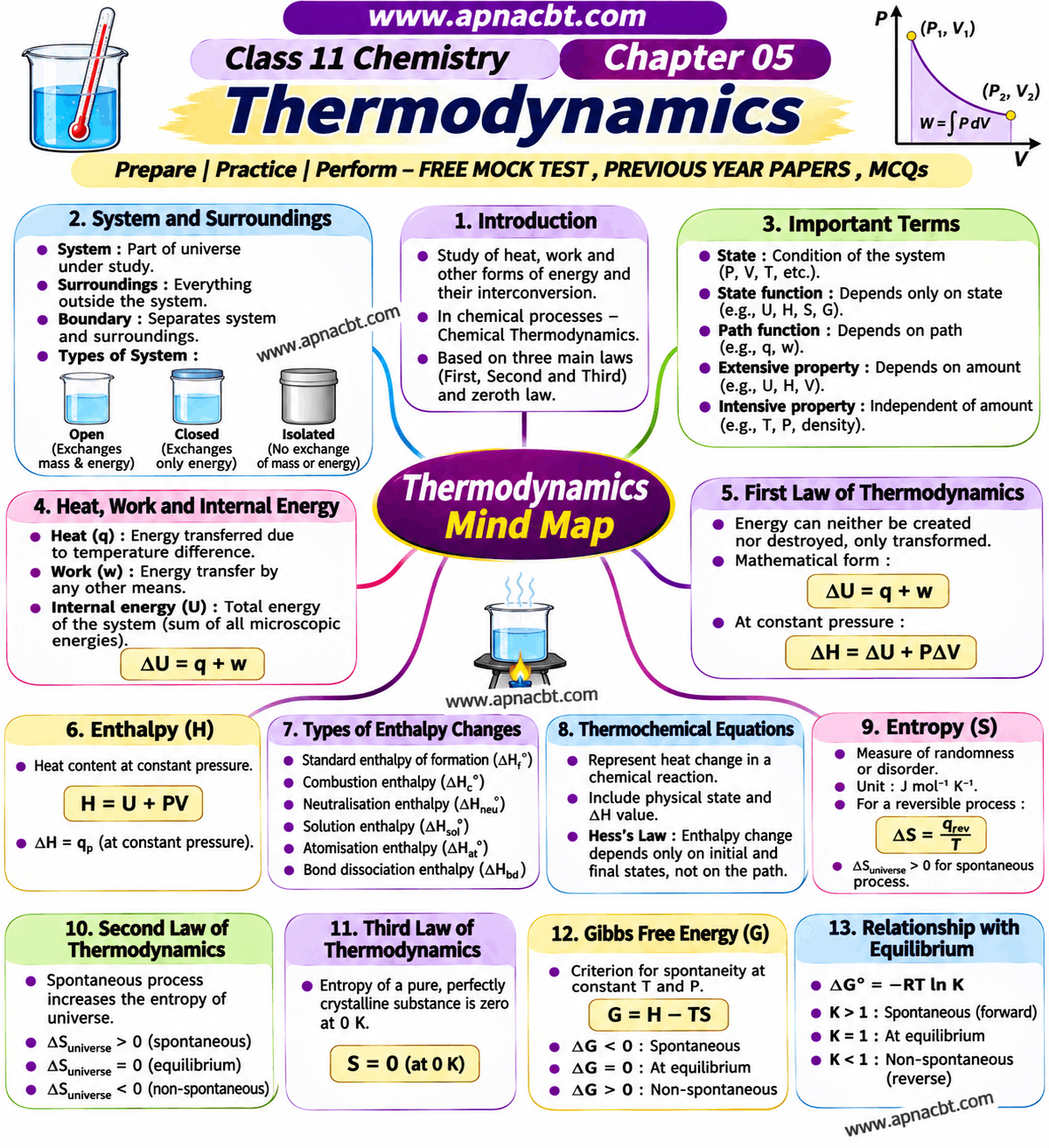
Thermodynamics Class 11 Chemistry – Chapter 05 Mind Map
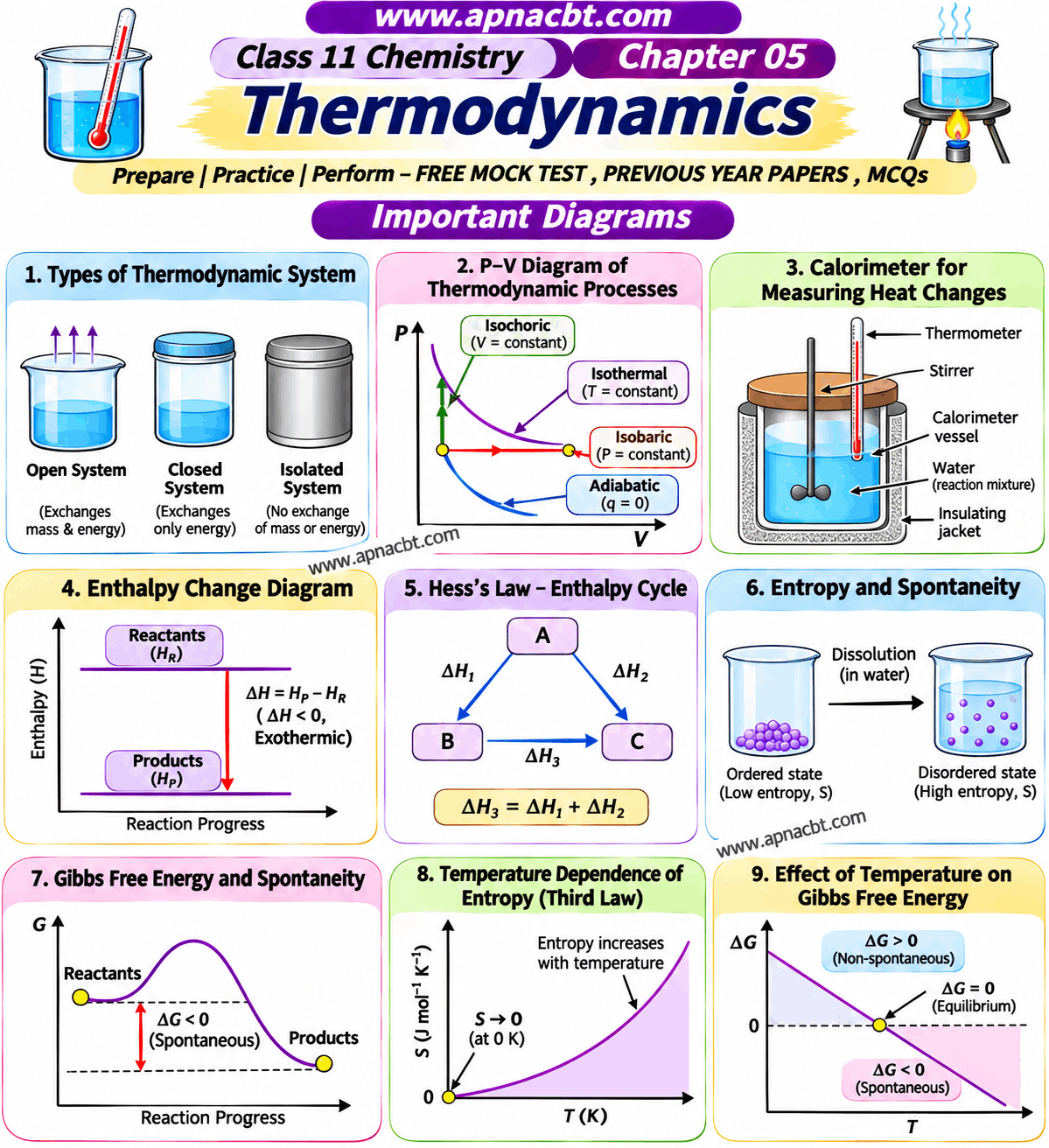
Thermodynamics Class 11 Chemistry – Important Diagrams
Thermodynamics Class 11 Chemistry – Important Tables and Formulae