1. Introduction to Chemical Bonding and the Kossel–Lewis Approach
Meaning and importance of a chemical bond
A chemical bond is the attractive force that holds atoms, ions or other particles together in a stable chemical species. Bond formation generally lowers the potential energy of the combining system and produces a more stable arrangement.
Atoms combine through transfer, sharing or donation of electron pairs. The valence electrons take part in bonding, while inner-shell electrons generally do not.
Kossel–Lewis electronic theory
- Noble gases possess stable outer electronic configurations: helium has a duplet and the other noble gases generally have an octet.
- Atoms tend to attain a stable configuration by losing, gaining or sharing valence electrons.
- Only valence electrons normally participate in chemical bond formation.
- Bond formation is associated with a decrease in energy and an increase in stability.
Octet rule and duplet rule
The octet rule states that atoms tend to achieve eight electrons in their valence shell by electron transfer or sharing. Hydrogen and some small atoms attain a stable duplet configuration similar to helium.
Limitations of the octet rule
- Incomplete octet: BeCl2 and BF3 have central atoms with fewer than eight electrons.
- Odd-electron molecules: NO and NO2 contain an odd number of valence electrons.
- Expanded octet: PF5 and SF6 are commonly represented with more than eight electrons around the central atom in the classical Lewis model.
- The rule does not explain molecular shapes, bond energies or the relative stability of all compounds.
Lewis symbols
Lewis symbols represent an element by its chemical symbol surrounded by dots corresponding to its valence electrons. For representative elements, the number of dots is related to the group and helps predict common valency.
2. Ionic Bond, Lattice Enthalpy and Properties of Ionic Compounds
An ionic or electrovalent bond is the electrostatic attraction between oppositely charged ions formed by transfer of one or more electrons. For example, sodium transfers one electron to chlorine to form Na+ and Cl−; their electrostatic attraction produces NaCl.
Conditions favouring ionic bond formation
- Low ionisation enthalpy of the atom forming the cation.
- Favourable electron gain enthalpy of the atom forming the anion.
- High lattice enthalpy of the resulting ionic solid.
- A substantial electronegativity difference between the combining atoms often favours ionic character.
Lattice enthalpy
Lattice enthalpy describes the energy change associated with formation of an ionic solid from gaseous ions (or the reverse process, depending on the sign convention used). A larger magnitude generally indicates stronger electrostatic attraction and greater lattice stability.
The magnitude of lattice enthalpy increases with increasing ionic charges and decreasing interionic distance. Thus, smaller ions with higher charges generally produce larger lattice enthalpy.
Properties of ionic compounds
- Usually crystalline, hard and brittle solids at room temperature.
- Generally have high melting and boiling points due to strong electrostatic attractions.
- Conduct electricity in molten state and aqueous solution because ions are mobile; they generally do not conduct in the solid state.
- Often dissolve in polar solvents such as water and are usually less soluble in non-polar solvents.
- Many ionic reactions in solution are rapid because they occur between mobile ions.
3. Covalent and Coordinate Bonds; Lewis Structures
Covalent bond
A covalent bond is formed when two atoms share one or more pairs of electrons. It is common between non-metal atoms. A single bond contains one shared pair, a double bond contains two shared pairs and a triple bond contains three shared pairs.
Examples: H–H, Cl–Cl, O=O and N≡N. Covalent bonds are generally directional because the shared electron density is concentrated in particular regions between nuclei.
Coordinate (dative) bond
A coordinate bond is a covalent bond in which both electrons of the shared pair are donated by the same atom. The donor has a lone pair and the acceptor has an available orbital or electron deficiency. It is represented by an arrow from donor to acceptor.
Example: NH3 donates its lone pair to electron-deficient BF3, forming H3N→BF3. The coordinate bond, once formed, behaves as a covalent bond.
Writing Lewis structures
- Count the total valence electrons, adding electrons for negative charge and subtracting electrons for positive charge.
- Choose a skeletal arrangement; the least electronegative suitable atom is usually central, while hydrogen is terminal.
- Connect atoms using single bonds and subtract two electrons for each bond.
- Complete the octets of terminal atoms, then place remaining electrons on the central atom.
- If the central atom lacks an octet, form multiple bonds where appropriate.
- For ions, enclose the structure in brackets and show the charge.
Lewis structures show bonding pairs and lone pairs but do not, by themselves, fully explain molecular geometry or magnetic behaviour.
4. Formal Charge, Resonance and Bond Parameters
Formal charge
Formal charge is the charge assigned to an atom in a Lewis structure by assuming that bonding electrons are shared equally.
Formal charge = V − N − ½B
Here V is the number of valence electrons in the free atom, N is the number of non-bonding electrons and B is the number of bonding electrons assigned to that atom.
Lewis structures with smaller formal charges and with negative formal charge on the more electronegative atom are often more favourable, subject to the correct total charge and valid bonding.
Resonance
When a single Lewis structure cannot adequately represent the observed bonding, two or more contributing structures are written. The actual molecule or ion is a resonance hybrid; it is not rapidly switching between the contributing structures.
Examples include O3, CO32−, NO3− and benzene. Resonance commonly leads to bond lengths intermediate between ideal single and double bonds and increases stability relative to an individual contributing structure.
Important bond parameters
- Bond length: Equilibrium distance between the nuclei of two bonded atoms. It is commonly expressed in pm or Å.
- Bond angle: Angle between two bonds having a common central atom.
- Bond enthalpy: Enthalpy required to break one mole of a specified bond in the gaseous state. Average bond enthalpies are used for many polyatomic molecules.
- Bond order: Number of bonds between two atoms in a simple Lewis description; in molecular orbital theory it is calculated from bonding and antibonding electrons.
- Dipole moment: Measure of charge separation in a bond or molecule. μ = q × r, where q is the magnitude of charge and r is the separation distance.
In general, for bonds between the same pair of atoms, higher bond order is associated with shorter and stronger bonds. Molecular dipole moment is the vector sum of individual bond dipoles, so molecular shape matters.
5. Polarity, Electronegativity and Ionic Character
A polar covalent bond forms when the shared electron pair is attracted unequally by the bonded atoms because of a difference in electronegativity. The more electronegative atom acquires a partial negative charge (δ−), while the other acquires a partial positive charge (δ+).
A non-polar covalent bond has equal or nearly equal sharing of the electron pair. A molecule containing polar bonds may still be non-polar if its geometry causes the bond dipoles to cancel.
Dipole moment
The dipole moment is a vector quantity: μ = q × r. Its SI unit is C m; it is also commonly expressed in Debye (D). The direction convention is from the positive to the negative end of the dipole.
- CO2 has polar C=O bonds but a linear, symmetrical structure; the bond dipoles cancel and the net dipole moment is zero.
- H2O has a bent shape; its O–H bond dipoles do not cancel, so the molecule is polar.
- BF3 is trigonal planar and symmetrical; its bond dipoles cancel.
Factors affecting ionic character
Ionic character generally increases with increasing electronegativity difference. Polarisation can give an ionic compound covalent character. A small, highly charged cation and a large, easily polarised anion tend to increase covalent character (Fajans’ rule).
6. VSEPR Theory and Prediction of Molecular Shapes
The Valence Shell Electron Pair Repulsion (VSEPR) theory predicts molecular shape by considering repulsions between electron domains around the central atom. Electron pairs arrange themselves as far apart as possible.
Order of repulsion
Lone pair–lone pair > lone pair–bond pair > bond pair–bond pair. Lone pairs occupy more space and generally compress adjacent bond angles.
Common geometries
| Type | Electron domains | Shape | Example |
|---|---|---|---|
| AX2 | 2 bond pairs | Linear, 180° | BeCl2, CO2 |
| AX3 | 3 bond pairs | Trigonal planar, 120° | BF3 |
| AX2E | 2 bond pairs, 1 lone pair | Bent | SO2 |
| AX4 | 4 bond pairs | Tetrahedral, 109.5° | CH4 |
| AX3E | 3 bond pairs, 1 lone pair | Trigonal pyramidal | NH3 |
| AX2E2 | 2 bond pairs, 2 lone pairs | Bent, about 104.5° | H2O |
| AX5 | 5 bond pairs | Trigonal bipyramidal | PCl5 |
| AX6 | 6 bond pairs | Octahedral | SF6 |
In trigonal bipyramidal arrangements, three equatorial positions are 120° apart and two axial positions are 90° from the equatorial plane. Lone pairs prefer equatorial positions because this reduces 90° repulsions.
Limitations
VSEPR is a useful qualitative model for predicting shapes, but it does not provide a complete quantum-mechanical explanation and is less reliable for some complex or transition-metal species.
7. Valence Bond Theory and Orbital Overlap
Valence Bond (VB) theory explains covalent bond formation through overlap of half-filled atomic orbitals containing electrons of opposite spins. As atoms approach, attractive and repulsive interactions operate. At the equilibrium separation, the system has minimum energy and maximum stability.
Conditions for effective overlap
- The orbitals should have suitable energies and appropriate orientation.
- The orbitals should overlap appreciably.
- The electrons forming the pair should have opposite spins.
- Greater effective overlap generally produces a stronger bond.
Types of overlap and covalent bonds
Sigma (σ) bond: Formed by head-on or end-to-end overlap along the internuclear axis. Examples include s–s, s–p and p–p head-on overlap.
Pi (π) bond: Formed by sideways overlap of parallel orbitals, commonly p orbitals. Electron density lies above and below the internuclear axis.
A single bond is generally one σ bond. A double bond consists of one σ and one π bond; a triple bond consists of one σ and two π bonds. A σ bond is usually stronger than a π bond because its overlap is more effective.
8. Hybridisation and Molecular Geometry
Hybridisation is the mixing of atomic orbitals of comparable energies on the same atom to form an equivalent set of hybrid orbitals with definite orientations. It is used in VB theory to explain molecular geometry and directional bonding.
| Hybridisation | Orbitals mixed | Geometry | Ideal angle | Examples |
|---|---|---|---|---|
| sp | 1 s + 1 p | Linear | 180° | BeCl2, CO2 (central atom model) |
| sp2 | 1 s + 2 p | Trigonal planar | 120° | BF3, C in C2H4 |
| sp3 | 1 s + 3 p | Tetrahedral electron arrangement | 109.5° | CH4 |
| sp3d | 1 s + 3 p + 1 d | Trigonal bipyramidal model | 90°, 120° | PCl5 |
| sp3d2 | 1 s + 3 p + 2 d | Octahedral model | 90° | SF6 |
Effect of lone pairs
In an sp3 electron-domain arrangement, CH4 is tetrahedral (109.5°), NH3 is trigonal pyramidal (about 107°) and H2O is bent (about 104.5°). The decrease in bond angle is due to stronger lone-pair repulsions.
Hybridisation is a bonding model. For modern descriptions of some hypervalent molecules, molecular orbital approaches provide a more complete account than simple d-orbital hybridisation pictures.
9. Molecular Orbital Theory – Formation and Electronic Configuration
Molecular Orbital Theory (MOT) treats electrons as occupying molecular orbitals spread over the molecule. Atomic orbitals combine to form molecular orbitals when they have suitable symmetry, comparable energies and effective overlap.
Bonding and antibonding molecular orbitals
- Bonding molecular orbital: Formed by constructive (in-phase) combination; it has lower energy than the combining atomic orbitals and stabilises the molecule.
- Antibonding molecular orbital: Formed by destructive (out-of-phase) combination; it has higher energy and is marked with an asterisk, such as σ* or π*.
- The number of molecular orbitals formed equals the number of atomic orbitals combined.
Rules for filling molecular orbitals
Electrons fill molecular orbitals in increasing energy order (Aufbau principle), obey the Pauli exclusion principle and follow Hund’s rule for degenerate orbitals.
Energy order for common second-period diatomic molecules
For B2, C2 and N2, the usual order is σ(2s), σ*(2s), π(2px) = π(2py), σ(2pz), π*(2p), σ*(2p). For O2 and F2, the σ(2p) orbital lies below the π(2p) orbitals.
Bond order
Bond order = ½ (Nb − Na), where Nb is the number of electrons in bonding molecular orbitals and Na is the number in antibonding molecular orbitals.
A positive bond order indicates net bonding in this simple model. Higher bond order generally means a stronger and shorter bond. If bond order is zero, the species is not expected to be stable in the simple MO model.
Magnetic behaviour
A species with one or more unpaired electrons is paramagnetic; one with all electrons paired is diamagnetic. O2 has two unpaired electrons in π* antibonding orbitals and is therefore paramagnetic, a result explained by MOT.
10. Molecular Orbital Theory – Important Diatomic Species
| Species | Bond order | Magnetic nature | Key point |
|---|---|---|---|
| H2 | 1 | Diamagnetic | Two electrons occupy σ1s. |
| He2 | 0 | Diamagnetic | Bonding and antibonding effects cancel. |
| Li2 | 1 | Diamagnetic | Two valence electrons occupy σ2s. |
| B2 | 1 | Paramagnetic | Two unpaired electrons occupy degenerate π2p orbitals. |
| C2 | 2 | Diamagnetic | All occupied MOs are paired. |
| N2 | 3 | Diamagnetic | High bond order and strong bond. |
| O2 | 2 | Paramagnetic | Two unpaired electrons in π*2p orbitals. |
| F2 | 1 | Diamagnetic | All electrons are paired. |
For ions, add electrons for negative charge and remove electrons for positive charge, filling or emptying the highest-energy occupied orbitals as appropriate. Recalculate bond order after adjusting the electron count.
11. Hydrogen Bonding and Its Applications
Hydrogen bonding is an attractive interaction involving a hydrogen atom covalently bonded to a highly electronegative atom (usually N, O or F) and another electronegative atom possessing a lone pair.
Types of hydrogen bonding
- Intermolecular hydrogen bonding: Occurs between different molecules. It can increase association and often raises boiling point. Examples include water and hydrogen fluoride.
- Intramolecular hydrogen bonding: Occurs within the same molecule when suitable donor and acceptor groups are positioned close to one another. It can influence molecular shape and physical properties.
Effects and importance
- Explains the unusually high boiling point of water compared with similar hydrides.
- Contributes to the open structure of ice and its lower density than liquid water.
- Influences solubility and association of molecules.
- Helps stabilise biological structures, including complementary base pairing in nucleic acids and parts of protein structure.
Hydrogen bonding is generally stronger than ordinary van der Waals attractions but weaker than a typical covalent bond. Its strength depends on the donor, acceptor and geometry.
12. Short-Answer Questions – 30 Questions with Answers
Questions
- Define a chemical bond.
- State the main idea of the Kossel–Lewis approach.
- What is the octet rule? Give one exception.
- What are Lewis symbols?
- Define an ionic bond with one example.
- What is lattice enthalpy?
- Write two properties of ionic compounds.
- Define a covalent bond and give one example.
- What is a coordinate bond? Identify donor and acceptor in NH3→BF3.
- What is a Lewis structure?
- Define formal charge and write its expression.
- What is resonance? Give one example.
- Define bond length.
- What is bond enthalpy?
- Define bond order.
- What is dipole moment? Write its formula.
- Why is CO2 non-polar although C=O bonds are polar?
- State the order of electron-pair repulsions in VSEPR theory.
- Predict the shape of BeCl2.
- Why is the H–O–H bond angle smaller than the H–C–H angle in methane?
- What is the shape of NH3?
- Define orbital overlap.
- Differentiate between σ and π bonds.
- What is hybridisation?
- State the hybridisation and shape of BF3.
- State the hybridisation and shape of CH4.
- What are bonding and antibonding molecular orbitals?
- Write the formula for bond order in MOT.
- Why is oxygen molecule paramagnetic?
- Distinguish between intermolecular and intramolecular hydrogen bonding.
Answers
- A chemical bond is the attractive force that holds atoms, ions or particles together in a stable chemical species.
- Atoms achieve greater stability by attaining noble-gas-like valence-shell configurations through transfer or sharing of valence electrons; bond formation lowers the energy of the system.
- The octet rule states that atoms tend to attain eight valence electrons. BF3 is an incomplete-octet example; NO is an odd-electron example.
- Lewis symbols are element symbols surrounded by dots representing valence electrons.
- An ionic bond is electrostatic attraction between oppositely charged ions, for example Na+ and Cl− in NaCl.
- Lattice enthalpy is the enthalpy change associated with forming an ionic crystal from gaseous ions, or the reverse process under the stated sign convention.
- They generally have high melting points and conduct electricity when molten or dissolved, but not when solid.
- A covalent bond forms by sharing electron pair(s), for example H–H in H2.
- A coordinate bond is a shared pair donated by one atom. In NH3→BF3, nitrogen in NH3 is the donor and boron in BF3 is the acceptor.
- A Lewis structure is an electron-dot representation showing valence electrons as bonding pairs and lone pairs.
- Formal charge is the charge assigned to an atom in a Lewis structure: FC = V − N − ½B.
- Resonance occurs when a species is represented by multiple contributing Lewis structures; the actual structure is a hybrid. O3 is an example.
- Bond length is the equilibrium distance between the nuclei of two bonded atoms.
- Bond enthalpy is the enthalpy required to break one mole of a specified bond in gaseous molecules.
- Bond order is the number of bonds between two atoms; in MOT, BO = ½(Nb − Na).
- Dipole moment measures charge separation: μ = q × r.
- CO2 is linear and symmetrical, so its two equal C=O bond dipoles act in opposite directions and cancel.
- LP–LP > LP–BP > BP–BP.
- BeCl2 is linear, with a bond angle of 180° in the simple VSEPR model.
- Water has two lone pairs on oxygen. Stronger lone-pair repulsions compress its bond angle to about 104.5°, compared with 109.5° in tetrahedral CH4.
- NH3 is trigonal pyramidal, with a bond angle of about 107°.
- Orbital overlap is the interpenetration of atomic orbitals as atoms approach, allowing electron density to be shared between nuclei.
- A σ bond forms by head-on overlap along the internuclear axis; a π bond forms by sideways overlap with electron density above and below that axis.
- Hybridisation is mixing of atomic orbitals of comparable energy on the same atom to form oriented hybrid orbitals.
- BF3 is sp2 hybridised and trigonal planar, with bond angles of about 120°.
- CH4 is sp3 hybridised and tetrahedral, with bond angles of 109.5°.
- Bonding MOs are lower-energy orbitals formed by constructive combination; antibonding MOs are higher-energy orbitals formed by destructive combination and are marked with an asterisk.
- Bond order = ½(number of bonding electrons − number of antibonding electrons).
- O2 has two unpaired electrons in its π* antibonding molecular orbitals, so it is paramagnetic.
- Intermolecular hydrogen bonding joins separate molecules; intramolecular hydrogen bonding occurs between groups within one molecule.
13. Long-Answer Questions – 15 Questions with Detailed Answers
Questions
- Explain the Kossel–Lewis approach and discuss the limitations of the octet rule.
- Explain the formation of NaCl by electron transfer and describe the important properties of ionic compounds.
- Describe covalent and coordinate bond formation with suitable examples. Explain the steps for writing Lewis structures.
- Explain formal charge and resonance. Illustrate their significance with suitable examples.
- Discuss the important bond parameters: bond length, bond angle, bond enthalpy, bond order and dipole moment.
- Explain polar and non-polar covalent bonds. Why can a molecule with polar bonds have zero dipole moment?
- State the postulates of VSEPR theory and explain the shapes of CH4, NH3 and H2O.
- Using VSEPR theory, explain the shapes of BF3, PCl5 and SF6.
- Explain valence bond theory using the formation of H2 and discuss the conditions for effective orbital overlap.
- Differentiate between sigma and pi bonds. Explain their formation and occurrence in single, double and triple bonds.
- Explain hybridisation and describe sp, sp2 and sp3 hybridisation with geometry and examples.
- Explain the basic principles of molecular orbital theory, including bonding and antibonding orbitals and the rules for filling them.
- Define bond order in MOT. Explain how bond order predicts stability, bond strength and bond length.
- Using molecular orbital theory, explain the paramagnetic nature of O2 and compare the bond order and magnetic nature of H2, He2, N2 and O2.
- Explain hydrogen bonding, its types and its effects on the physical and biological properties of substances.
Detailed answers
- Kossel–Lewis approach: Noble gases have stable valence shells, generally an octet, while helium has a duplet. Other atoms tend to attain stable configurations by losing, gaining or sharing valence electrons. Only valence electrons normally participate in bonding, and bond formation lowers the energy of the system. The octet rule is useful but not universal. BF3 and BeCl2 have incomplete octets; NO and NO2 have odd electron counts; PF5 and SF6 are commonly represented as expanded-octet species. The rule does not predict molecular shape, bond energies or magnetic properties.
- Formation of NaCl: Sodium has one valence electron and chlorine has seven. Sodium loses one electron to form Na+; chlorine gains that electron to form Cl−. Electrostatic attraction between the oppositely charged ions produces the ionic lattice of NaCl. Ionic compounds are generally crystalline, hard and brittle, have high melting and boiling points, conduct electricity when molten or in aqueous solution because ions can move, and are often soluble in polar solvents.
- Covalent and coordinate bonds: A covalent bond forms when atoms share electron pairs, as in H2, Cl2 or CH4. In a coordinate bond, both shared electrons are supplied by one donor atom; NH3 donates a lone pair to BF3 to form H3N→BF3. To write a Lewis structure, count total valence electrons, choose a skeletal arrangement, draw single bonds, complete terminal octets, place remaining electrons on the central atom, and introduce multiple bonds if required. For ions, adjust the electron count for charge and show brackets and the charge.
- Formal charge and resonance: Formal charge is calculated by FC = V − N − ½B. It helps compare alternative Lewis structures. Structures with smaller formal charges are often favoured, and negative charge is generally more favourable on a more electronegative atom. Resonance is used when no single Lewis structure represents the bonding adequately. O3, CO32− and NO3− have contributing structures. The real species is a resonance hybrid with delocalised electrons; it is not oscillating between separate structures. Resonance commonly equalises related bond lengths and increases stability.
- Bond parameters: Bond length is the equilibrium internuclear distance. Bond angle is the angle between two bonds at a central atom. Bond enthalpy is the energy required to break one mole of a specified gaseous bond. Bond order indicates the number of bonds, or in MOT is half the difference between bonding and antibonding electrons. Dipole moment is μ = q × r and measures charge separation. For comparable bonds, higher bond order usually corresponds to shorter bond length and greater bond strength. Molecular dipole moment is the vector sum of bond dipoles.
- Polarity: A covalent bond is polar when the bonded atoms have different electronegativities and the shared electron pair is unequally distributed. The more electronegative atom is δ−. Equal or nearly equal sharing gives a non-polar bond. Molecular polarity depends on both bond polarity and geometry. In linear CO2, the two equal C=O dipoles point in opposite directions and cancel. In bent H2O, the dipoles do not cancel, so the molecule has a net dipole moment.
- VSEPR theory: Electron domains around a central atom repel and arrange themselves as far apart as possible. Repulsion order is LP–LP > LP–BP > BP–BP. CH4 has four bond pairs and a tetrahedral shape with 109.5°. NH3 has three bond pairs and one lone pair; its electron arrangement is tetrahedral but molecular shape is trigonal pyramidal, about 107°. H2O has two bond pairs and two lone pairs; it is bent, about 104.5°. Increasing lone-pair repulsion compresses the bond angle.
- Shapes by VSEPR: BF3 has three bonding domains and no lone pair on boron, giving trigonal planar geometry and 120° angles. PCl5 has five bonding domains, giving trigonal bipyramidal geometry with three equatorial positions at 120° and two axial positions at 90° to the equatorial plane. SF6 has six bonding domains and octahedral geometry, with 90° angles between adjacent bonds.
- Valence bond theory and H2: VB theory describes a covalent bond as overlap of half-filled atomic orbitals containing electrons of opposite spins. As two hydrogen atoms approach, attractions between each electron and the other nucleus increase, while electron–electron and nucleus–nucleus repulsions also operate. At an optimum separation, the total energy is minimum; a stable H–H bond forms and energy is released. Effective overlap requires suitable orbital energy, symmetry and orientation, opposite-spin electrons and sufficient overlap.
- Sigma and pi bonds: A sigma bond forms by head-on overlap along the internuclear axis and has electron density concentrated around that axis. A pi bond forms by sideways overlap of parallel orbitals, with electron density above and below the axis. A single bond is one σ bond; a double bond contains one σ and one π bond; a triple bond contains one σ and two π bonds. Sigma overlap is generally stronger than pi overlap. Rotation around a double bond is restricted because it would disrupt sideways overlap.
- Hybridisation: Hybridisation mixes atomic orbitals of comparable energy on the same atom. sp uses one s and one p orbital to form two linear hybrids (180°), as in BeCl2. sp2 uses one s and two p orbitals to form three trigonal-planar hybrids (120°), as in BF3. sp3 uses one s and three p orbitals to form four tetrahedrally oriented hybrids (109.5°), as in CH4. Lone pairs can change the observed molecular shape and reduce bond angles, as in NH3 and H2O.
- Molecular orbital theory: Atomic orbitals of suitable energy and symmetry combine to form molecular orbitals extending over the molecule. Constructive combination forms a lower-energy bonding orbital; destructive combination forms a higher-energy antibonding orbital. The number of MOs equals the number of AOs combined. Electrons fill in increasing energy order, obey the Pauli exclusion principle and follow Hund’s rule in degenerate orbitals. Bonding orbitals stabilise the molecule, while antibonding orbitals oppose bonding.
- Bond order: BO = ½(Nb − Na). A positive bond order indicates net bonding; a higher value generally means a stronger, shorter bond. A zero bond order predicts no net bond in the simple MO model. Bond order allows comparison of related species and can be recalculated after adding or removing electrons to form ions.
- Oxygen paramagnetism: In the MO configuration of O2, two electrons occupy separate degenerate π*2p antibonding orbitals and remain unpaired, making O2 paramagnetic. H2 has bond order 1 and is diamagnetic; He2 has bond order 0 and is not stable in the simple model, and is diamagnetic; N2 has bond order 3 and is diamagnetic; O2 has bond order 2 and is paramagnetic.
- Hydrogen bonding: It is an attraction involving hydrogen covalently attached to N, O or F and a lone pair on another electronegative atom. Intermolecular hydrogen bonds form between molecules; intramolecular hydrogen bonds form within one molecule. Hydrogen bonding can raise boiling points, increase association, affect solubility, produce the open structure of ice and contribute to the stability of biological structures such as nucleic acids and proteins.
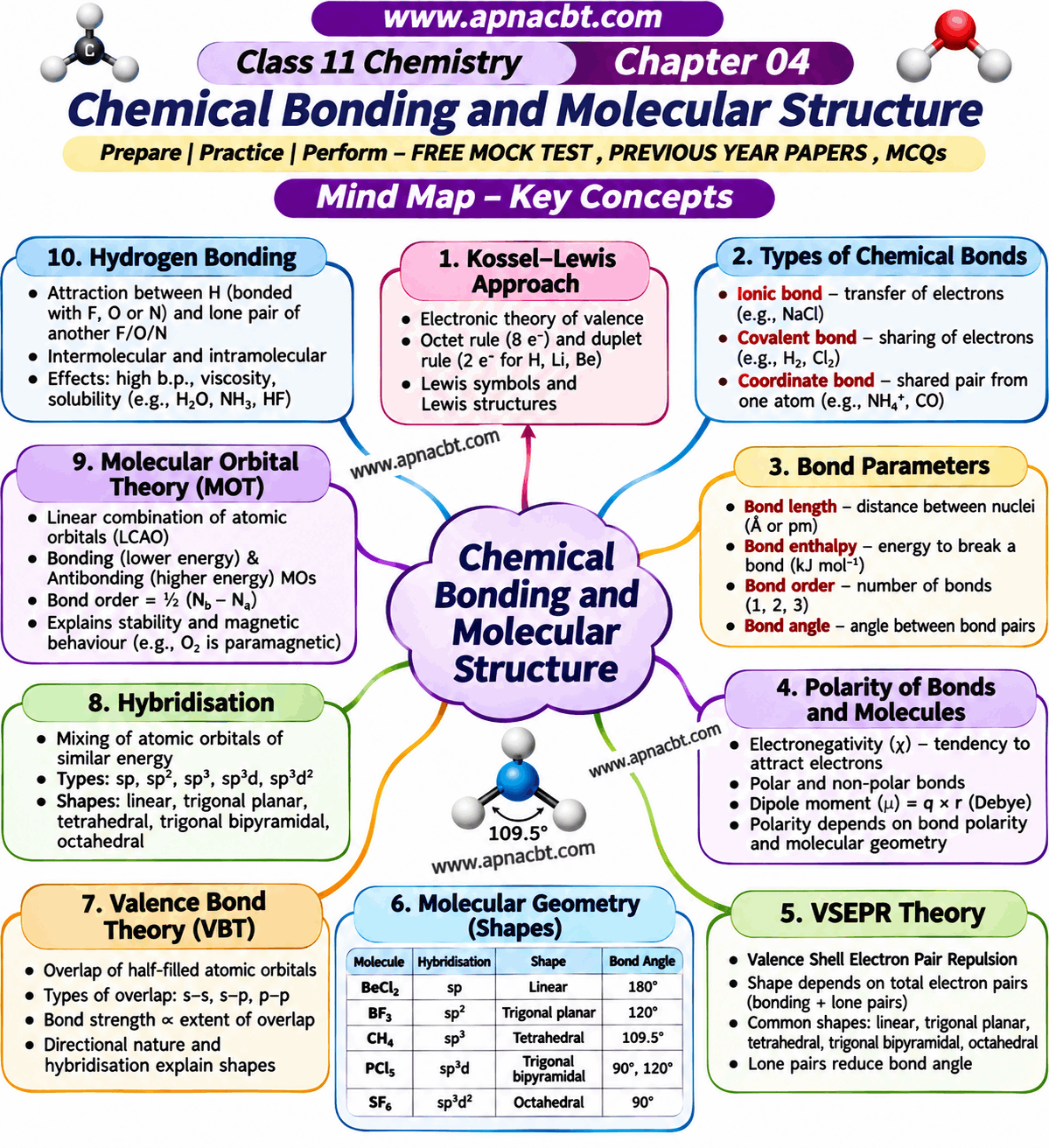
Chemical Bonding and Molecular Structure Class 11 Chemistry – Chapter 04 Mind Map
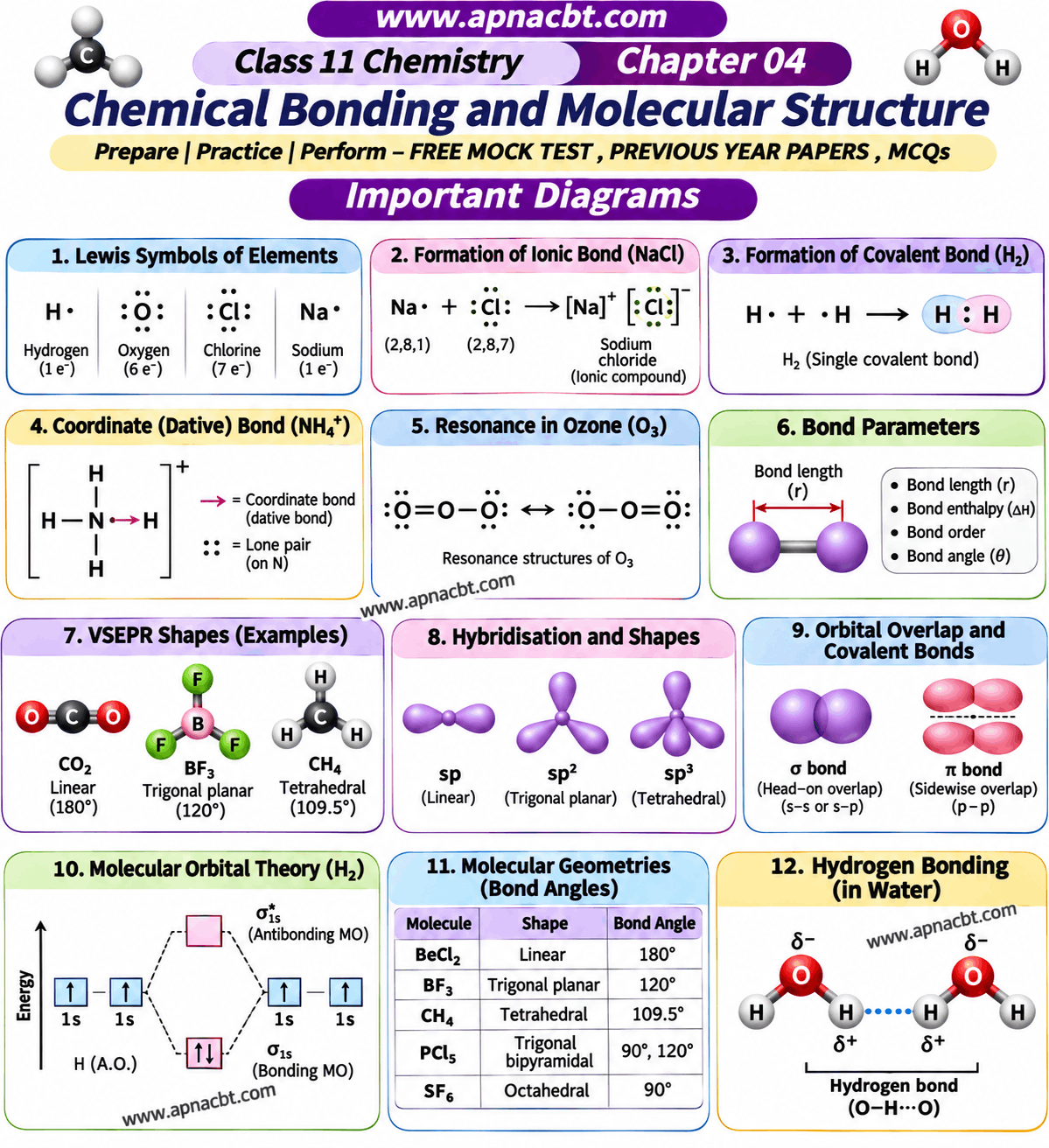
Chemical Bonding and Molecular Structure Class 11 Chemistry – Important Diagrams
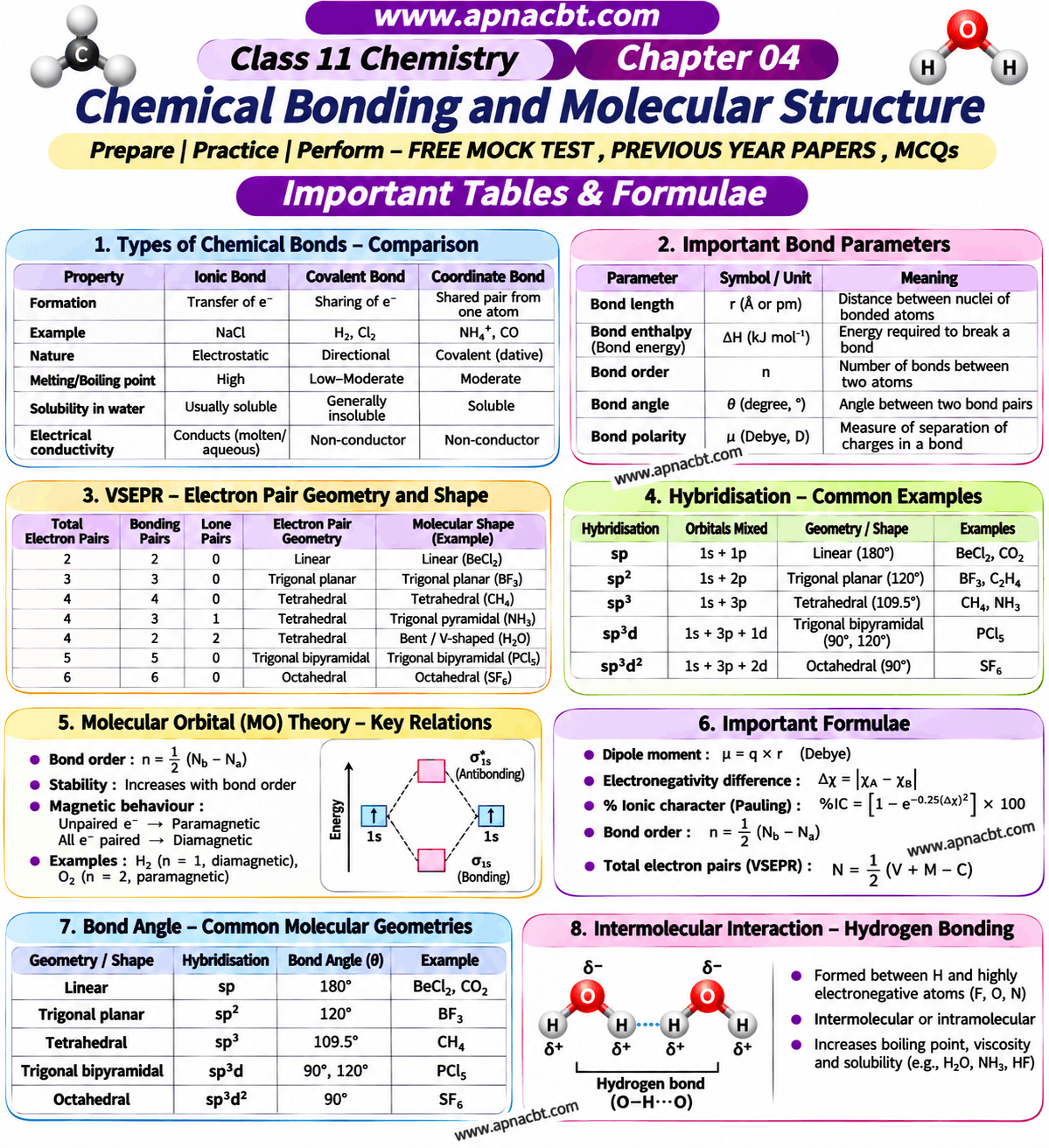
Chemical Bonding and Molecular Structure Class 11 Chemistry – Important Tables and Formulae