Chapter 02 – Structure of Atom explains the discovery of sub-atomic particles, the development of atomic models and the modern quantum mechanical description of electrons. These notes cover the important concepts, definitions, experiments, equations and numerical relationships required for CBSE Class 11 Chemistry and NEET-UG preparation.
Learning focus: Understand atomic structure, interpret atomic spectra, apply Bohr’s equations, use quantum numbers and write electronic configurations.
1. Dalton’s Atomic Theory and Its Limitations
Dalton’s atomic theory
John Dalton proposed the atomic theory of matter in 1808. It was based on the laws of conservation of mass and definite proportions, and it provided an explanation for the law of multiple proportions.
- All matter consists of extremely small particles called atoms.
- Atoms cannot be created or destroyed in a chemical reaction.
- Atoms of the same element were considered identical in mass and properties.
- Atoms of different elements have different masses and properties.
- Atoms combine in simple whole-number ratios to form compounds.
- A chemical reaction involves rearrangement of atoms.
Limitations and modifications
- Atoms are divisible and contain electrons, protons and neutrons.
- Isotopes show that atoms of the same element can have different masses.
- Isobars show that atoms of different elements can have the same mass number.
- Atoms of the same element may combine with one another, as in molecules such as O2.
- Allotropy and the existence of subatomic particles are not explained by the original theory.
2. Discovery and Properties of Subatomic Particles
Electron – cathode ray discharge tube
J. J. Thomson discovered the electron in 1897 through experiments on electrical discharge in gases at very low pressure. Cathode rays originate at the cathode and travel towards the anode.
- Cathode rays travel in straight lines and produce fluorescence.
- They produce heating and mechanical effects.
- They are deflected towards the positively charged plate, showing that they carry negative charge.
- The charge-to-mass ratio is independent of the gas and electrode material.
- Thomson measured the magnitude of e/m as approximately 1.7588 × 10¹¹ C kg−1.
Charge of electron – Millikan’s oil-drop experiment
R. A. Millikan measured the magnitude of the electron charge as approximately 1.6022 × 10⁻¹⁹ C. Combining this value with Thomson’s e/m value gives the electron mass.
Mass of electron: 9.109 × 10⁻³¹ kg.
Proton and canal rays
Canal rays (anode rays) are streams of positively charged particles formed in a discharge tube. Their properties depend on the gas present. The lightest positive ion, obtained from hydrogen, is the proton.
Proton: charge = +1.6022 × 10⁻¹⁹ C; mass ≈ 1.673 × 10⁻²⁷ kg.
Neutron
James Chadwick discovered the neutron in 1932 by bombarding beryllium with alpha particles. Neutrons have no electrical charge and a mass of approximately 1.675 × 10⁻²⁷ kg.
Fundamental particles
| Particle | Symbol | Relative charge | Approximate mass (u) |
|---|---|---|---|
| Electron | e− | −1 | 0.00055 |
| Proton | p+ | +1 | 1.0073 |
| Neutron | n | 0 | 1.0087 |
3. Radioactivity, Atomic Number, Mass Number and Isotopes
Radioactivity
Radioactivity is the spontaneous emission of radiations from certain unstable atomic nuclei. In an electric or magnetic field:
- Alpha (α) particles: positively charged; deflected towards the negative plate.
- Beta (β) particles: usually high-speed electrons; deflected towards the positive plate.
- Gamma (γ) rays: electrically neutral electromagnetic radiation; not deflected.
Atomic number (Z)
Atomic number is the number of protons in the nucleus. In a neutral atom, the number of electrons equals the number of protons.
Z = number of protons; for a neutral atom, Z = number of electrons.
Mass number (A)
Mass number is the total number of protons and neutrons in the nucleus.
A = Z + N, where N is the number of neutrons. Therefore, N = A − Z.
Representation of an atom
An atom is represented as AZX, where X is the element symbol, A is the mass number and Z is the atomic number.
Isotopes and isobars
- Isotopes: atoms of the same element having the same atomic number but different mass numbers. They have the same number of protons but different numbers of neutrons.
- Isobars: atoms of different elements having the same mass number but different atomic numbers.
4. Thomson’s and Rutherford’s Atomic Models
Thomson’s model
Thomson proposed that an atom is a sphere of positive charge in which electrons are embedded. It is commonly compared with plums in a pudding or raisins in a cake.
- Positive charge is distributed uniformly throughout the atom.
- Electrons are embedded in the positively charged sphere.
- The total positive and negative charges are equal, so the atom is electrically neutral.
Limitation: It could not explain the results of Rutherford’s alpha-particle scattering experiment.
Rutherford’s alpha-particle scattering experiment
Rutherford directed a beam of high-energy alpha particles at a very thin gold foil. A fluorescent zinc sulphide screen was used to detect scattered particles.
Observations
- Most alpha particles passed through the foil without deflection.
- Some particles were deflected through small angles.
- A very small number were deflected through large angles; a few nearly bounced back.
Conclusions and nuclear model
- Most of the volume of an atom is empty space.
- Almost all the mass and all the positive charge are concentrated in a tiny central nucleus.
- Electrons occupy the space around the nucleus.
- The nucleus is extremely small compared with the atom.
Approximate scale: atomic radius is of the order of 10−10 m, while nuclear radius is of the order of 10−15 m.
Limitations of Rutherford’s model
According to classical electromagnetic theory, a revolving electron is an accelerating charged particle and should continuously radiate energy. It would lose energy and spiral into the nucleus. The model therefore could not explain atomic stability or the discrete line spectrum of hydrogen.
5. Electromagnetic Radiation and Wave Parameters
Electromagnetic radiation consists of oscillating electric and magnetic fields perpendicular to each other and to the direction of propagation. It does not require a material medium.
| Parameter | Meaning | Symbol / unit |
|---|---|---|
| Wavelength | Distance between two successive crests or troughs | λ; metre (m) |
| Frequency | Number of wave cycles passing a point per second | ν; hertz (Hz) |
| Velocity | Distance travelled by the wave per second | c; m s−1 |
| Wavenumber | Number of wavelengths per unit length; reciprocal of wavelength | ṽ = 1/λ; m−1 |
| Amplitude | Maximum displacement of the wave field from its mean value | A |
Wave equation: c = νλ
For electromagnetic radiation in vacuum, c ≈ 3.00 × 10⁸ m s−1.
Electromagnetic spectrum
The electromagnetic spectrum includes radio waves, microwaves, infrared, visible light, ultraviolet, X-rays and gamma rays. In this order, frequency and energy increase, while wavelength decreases.
6. Planck’s Quantum Theory and Photoelectric Effect
Planck’s quantum theory
Max Planck proposed that radiant energy is emitted or absorbed discontinuously in small packets called quanta. For electromagnetic radiation, each packet is called a photon.
Energy of one quantum: E = hν = hc/λ
Here h = 6.626 × 10⁻³⁴ J s is Planck’s constant.
The energy of n quanta is E = nhν.
Photoelectric effect
The photoelectric effect is the emission of electrons from a metal surface when electromagnetic radiation of suitable frequency falls on it.
- Emission occurs only when the incident frequency is at least the threshold frequency (ν0).
- Increasing intensity at a frequency above threshold increases the number of emitted electrons.
- The maximum kinetic energy depends on the frequency, not the intensity, of incident radiation.
Einstein’s photoelectric equation: hν = hν0 + KEmax
Therefore, KEmax = h(ν − ν0).
The work function is the minimum energy needed to remove an electron from the metal surface: Φ = hν0.
7. Atomic Spectra and Hydrogen Spectrum
Emission and absorption spectra
An emission spectrum is produced when excited atoms release radiation as electrons move to lower energy levels. An absorption spectrum is produced when atoms absorb selected wavelengths from continuous radiation, producing dark lines.
A spectrum consisting of separate lines is called a line spectrum. Each element has a characteristic spectrum.
Hydrogen line spectrum
When an electric discharge passes through hydrogen gas at low pressure, hydrogen emits radiation at specific wavelengths. The lines arise from transitions between quantised energy levels.
Rydberg equation:
1/λ = RH(1/n12 − 1/n22), where n2 > n1.
RH ≈ 1.097 × 10⁷ m−1.
| Series | Final level (n1) | Spectral region |
|---|---|---|
| Lyman | 1 | Ultraviolet |
| Balmer | 2 | Visible / near ultraviolet |
| Paschen | 3 | Infrared |
| Brackett | 4 | Infrared |
| Pfund | 5 | Infrared |
For transitions from an initial level n to all possible lower levels, the maximum number of different spectral lines is n(n − 1)/2.
8. Bohr’s Model of the Hydrogen Atom
Niels Bohr proposed his model in 1913 by combining the nuclear model with Planck’s quantum theory.
Main postulates
- Electrons revolve around the nucleus only in certain permitted circular orbits called stationary states.
- An electron in a stationary orbit does not radiate energy.
- The angular momentum of an electron is quantised: mvr = nh/2π, where n = 1, 2, 3, …
- Energy is absorbed or emitted only when an electron moves from one allowed energy level to another.
Bohr frequency condition: |ΔE| = hν.
Radius of the nth orbit
For a hydrogen-like species (one-electron system): rn = a0n2/Z, where a0 = 0.529 Å and Z is the nuclear charge.
Energy of the nth level
En = −2.18 × 10⁻¹⁸(Z2/n2) J per atom.
Equivalently, En = −13.6(Z2/n2) eV.
For hydrogen, Z = 1. The ground state is n = 1. Higher values of n represent excited states. The energy approaches zero as n approaches infinity, which corresponds to ionisation.
Energy change during a transition
For a transition from ni to nf, ΔE = Ef − Ei. A transition to a higher level requires absorption; a transition to a lower level releases energy.
Successes and limitations
Bohr’s model explains the stability and line spectrum of hydrogen and hydrogen-like ions such as He+ and Li2+. It does not satisfactorily explain multi-electron atoms, fine spectral details or the effects of magnetic and electric fields, and it is inconsistent with the wave nature of electrons and the uncertainty principle.
9. Dual Behaviour of Matter and de Broglie Equation
In 1924, Louis de Broglie proposed that moving material particles have wave character. This is called the wave-particle duality of matter.
de Broglie wavelength: λ = h/p = h/mv.
Here p is momentum, m is mass and v is velocity. For a particle of charge q accelerated through a potential difference V, its kinetic energy is qV (for a particle starting from rest), so λ = h/√(2mqV).
The wave nature is significant for microscopic particles such as electrons. For everyday objects with large mass, the wavelength is extremely small and cannot normally be observed.
10. Heisenberg’s Uncertainty Principle
Werner Heisenberg stated that it is impossible to determine simultaneously and exactly both the position and momentum of a microscopic particle.
Mathematical expression: Δx × Δp ≥ h/4π.
Since p = mv for a non-relativistic particle, Δx × mΔv ≥ h/4π.
A related energy-time expression is ΔE × Δt ≥ h/4π.
- Greater precision in position produces greater uncertainty in momentum, and vice versa.
- The principle is important for microscopic particles such as electrons.
- It is not practically significant for macroscopic objects because Planck’s constant is extremely small.
The uncertainty principle means that an electron cannot be described as moving in a precise fixed circular path in the same sense as a planet orbiting the Sun.
11. Quantum Mechanical Model and Atomic Orbitals
The quantum mechanical model describes electrons using wave functions and probability. It is based on the wave nature of matter and the uncertainty principle.
Wave function and probability
The wave function is represented by ψ. The square of its magnitude, |ψ|2, gives the probability density of finding an electron at a point.
The Schrödinger wave equation for a stationary state is commonly written as Ĥψ = Eψ, where Ĥ is the Hamiltonian operator and E is the allowed energy.
Orbit and orbital
- Orbit: a definite path used in the Bohr model.
- Orbital: a three-dimensional region around the nucleus where the probability of finding an electron is high.
- An orbital can accommodate a maximum of two electrons with opposite spins.
Shapes of orbitals
- s orbitals: spherical; one orbital in each s subshell.
- p orbitals: dumbbell-shaped; three orientations (px, py, pz).
- d orbitals: generally four-lobed, with five orbitals in a d subshell; dz² has a different characteristic shape.
- f orbitals: seven orbitals with more complex shapes.
12. Quantum Numbers and Their Significance
Four quantum numbers describe the state of an electron in an atom.
| Quantum number | Symbol | Allowed values | Significance |
|---|---|---|---|
| Principal | n | 1, 2, 3, … | Main shell, size and approximate energy |
| Azimuthal | l | 0 to n − 1 | Subshell and orbital shape |
| Magnetic | ml | −l to +l, including 0 | Orientation of an orbital |
| Spin | ms | +½ or −½ | Electron spin orientation |
Subshell notation
l = 0, 1, 2 and 3 correspond to s, p, d and f subshells respectively.
Number of orbitals and electron capacity
- Number of orbitals in a subshell = 2l + 1.
- Maximum electrons in a subshell = 2(2l + 1).
- Number of orbitals in a shell = n2.
- Maximum electrons in a shell = 2n2.
| Subshell | Orbitals | Maximum electrons |
|---|---|---|
| s | 1 | 2 |
| p | 3 | 6 |
| d | 5 | 10 |
| f | 7 | 14 |
13. Electronic Configuration and Rules for Filling Orbitals
Aufbau principle
Electrons occupy orbitals in order of increasing energy. The (n + l) rule is used: the orbital with the lower value of n + l is filled first. If two orbitals have the same n + l value, the orbital with the lower n is filled first.
Common filling order: 1s, 2s, 2p, 3s, 3p, 4s, 3d, 4p, 5s, 4d, 5p, 6s, 4f, 5d, 6p, 7s, 5f, 6d, 7p.
Pauli exclusion principle
No two electrons in an atom can have the same set of all four quantum numbers. An orbital can therefore contain at most two electrons, and they must have opposite spins.
Hund’s rule of maximum multiplicity
In a set of degenerate orbitals, electrons occupy separate orbitals with parallel spins before pairing begins.
Electronic configuration examples
- H (Z = 1): 1s1
- He (Z = 2): 1s2
- C (Z = 6): 1s2 2s2 2p2
- O (Z = 8): 1s2 2s2 2p4
- Na (Z = 11): 1s2 2s2 2p6 3s1
- Cl (Z = 17): [Ne] 3s2 3p5
Some configurations show extra stability due to half-filled or completely filled subshells. For example, Cr is [Ar] 3d5 4s1 and Cu is [Ar] 3d10 4s1.
Writing configurations of ions
For cations, electrons are removed first from the shell with the highest principal quantum number. For transition-metal cations, 4s electrons are removed before 3d electrons. For example, Fe is [Ar] 3d6 4s2, while Fe2+ is [Ar] 3d6.
14. Important Formulae and Quick Revision
| Concept | Formula / fact |
|---|---|
| Atomic number | Z = number of protons |
| Mass number | A = Z + N |
| Neutrons | N = A − Z |
| Wave relation | c = νλ |
| Wavenumber | ṽ = 1/λ |
| Photon energy | E = hν = hc/λ |
| Photoelectric equation | KEmax = hν − hν0 |
| Rydberg equation | 1/λ = RH(1/n12 − 1/n22) |
| Bohr angular momentum | mvr = nh/2π |
| Bohr radius | rn = 0.529 n2/Z Å |
| Bohr energy | En = −13.6 Z2/n2 eV |
| de Broglie wavelength | λ = h/mv |
| Uncertainty principle | Δx Δp ≥ h/4π |
| Orbitals in a subshell | 2l + 1 |
| Maximum electrons in a shell | 2n2 |
| Maximum electrons in a subshell | 2(2l + 1) |
| Orbitals in a shell | n2 |
| Spectral lines from level n | n(n − 1)/2 |
Important constants
- Speed of light, c = 3.00 × 10⁸ m s−1.
- Planck’s constant, h = 6.626 × 10⁻³⁴ J s.
- Electron charge magnitude, e = 1.602 × 10⁻¹⁹ C.
- Electron mass, me = 9.109 × 10⁻³¹ kg.
- Rydberg constant, RH ≈ 1.097 × 10⁷ m−1.
- Bohr radius, a0 = 0.529 Å.
15. Short-Answer Questions – 30 Questions
Questions
- State any four postulates of Dalton’s atomic theory.
- Give two limitations of Dalton’s atomic theory.
- Who discovered the electron and in which year?
- What are cathode rays? Mention two of their properties.
- What is the charge-to-mass ratio of an electron?
- What are canal rays? Why do their properties depend on the gas used?
- Who discovered the neutron? State its charge.
- Define atomic number and mass number.
- Calculate the number of neutrons in ²³₁₁Na.
- Differentiate between isotopes and isobars with one example each.
- What are alpha, beta and gamma radiations? Which one is not deflected by an electric field?
- State the main feature of Thomson’s atomic model.
- Write two observations of Rutherford’s alpha-particle scattering experiment.
- What conclusions did Rutherford draw from the passage of most alpha particles through gold foil?
- Why could Rutherford’s model not explain atomic stability?
- Define wavelength, frequency and wavenumber.
- Write the relation between the velocity, wavelength and frequency of electromagnetic radiation.
- State Planck’s quantum theory and write the expression for photon energy.
- What is the photoelectric effect? Define threshold frequency.
- What is the difference between an emission spectrum and an absorption spectrum?
- Name the five principal series of the hydrogen spectrum and their spectral regions.
- State any three postulates of Bohr’s atomic model.
- Write the expression for the radius and energy of the nth Bohr orbit of a hydrogen-like species.
- What is the ground state? What is an excited state?
- State de Broglie’s hypothesis and write its equation.
- State Heisenberg’s uncertainty principle mathematically.
- What is an atomic orbital? How is it different from an orbit?
- What are the four quantum numbers? State the significance of the principal quantum number.
- State the Aufbau principle, Pauli exclusion principle and Hund’s rule.
- Write the electronic configurations of nitrogen (Z = 7) and calcium (Z = 20).
Answers
- All matter consists of atoms; atoms are rearranged in chemical reactions; atoms of different elements combine in simple whole-number ratios; and atoms of a given element were considered identical in Dalton’s original model.
- It could not explain subatomic particles and isotopes. It also could not account for isobars and allotropy.
- J. J. Thomson discovered the electron in 1897.
- Cathode rays are streams of electrons produced in a low-pressure discharge tube. They travel in straight lines and are deflected towards the positive plate.
- The magnitude is approximately 1.7588 × 10¹¹ C kg−1.
- Canal rays are positively charged particles moving through holes in the cathode. Their mass and charge depend on the positive ions formed from the gas present.
- James Chadwick discovered the neutron in 1932. Its charge is zero.
- Atomic number is the number of protons. Mass number is the total number of protons and neutrons.
- For ²³₁₁Na, N = A − Z = 23 − 11 = 12 neutrons.
- Isotopes have the same Z but different A, e.g. ¹H and ²H. Isobars have the same A but different Z, e.g. ⁴⁰Ar and ⁴⁰Ca.
- Alpha particles are positively charged, beta particles are negatively charged electrons (in beta-minus emission), and gamma rays are neutral electromagnetic radiation. Gamma rays are not deflected.
- Thomson described the atom as a positively charged sphere with electrons embedded in it, making the atom electrically neutral overall.
- Most alpha particles passed undeflected; a small fraction were deflected through small or large angles, and a very few nearly bounced back.
- Most of the atom is empty space, because most alpha particles passed through the foil without deflection.
- A revolving electron is an accelerating charged particle and, by classical theory, should radiate energy continuously and spiral into the nucleus.
- Wavelength is the distance between successive corresponding points of a wave; frequency is cycles per second; wavenumber is the reciprocal of wavelength.
- c = νλ.
- Energy is emitted or absorbed in discrete packets. The energy of one photon is E = hν = hc/λ.
- It is the emission of electrons from a surface under suitable incident radiation. Threshold frequency is the minimum frequency needed to cause emission.
- An emission spectrum has bright lines produced by emitted radiation; an absorption spectrum has dark lines where selected wavelengths have been absorbed.
- Lyman – ultraviolet; Balmer – visible/near ultraviolet; Paschen, Brackett and Pfund – infrared.
- Electrons occupy permitted stationary orbits; they do not radiate energy in these orbits; angular momentum is quantised; radiation is absorbed or emitted during transitions.
- rn = 0.529 n²/Z Å and En = −13.6 Z²/n² eV.
- The ground state is the lowest-energy state (n = 1 for hydrogen). An excited state is any higher allowed energy state.
- Moving particles have wave character. The wavelength is λ = h/mv = h/p.
- Δx × Δp ≥ h/4π.
- An orbital is a region of high electron probability. An orbit is a fixed path in the Bohr model; an orbital is not a definite path.
- The four are principal (n), azimuthal (l), magnetic (ml) and spin (ms). The principal quantum number identifies the shell and indicates the size and energy level.
- Aufbau: fill lower-energy orbitals first. Pauli: no two electrons have the same four quantum numbers. Hund: occupy degenerate orbitals singly with parallel spins before pairing.
- N: 1s² 2s² 2p³. Ca: 1s² 2s² 2p⁶ 3s² 3p⁶ 4s², or [Ar] 4s².
16. Long-Answer Questions – 15 Questions
Questions
- Explain Dalton’s atomic theory and discuss its important limitations in the light of modern discoveries.
- Describe the cathode ray discharge tube experiment. Explain the properties of cathode rays and the significance of Thomson’s e/m measurement.
- Explain the discovery of proton and neutron. Compare the mass, charge and location of the three fundamental subatomic particles.
- Describe Rutherford’s alpha-particle scattering experiment with its observations and conclusions. State the limitations of his atomic model.
- Explain the important characteristics of electromagnetic radiation and derive the relation c = νλ. Define wavenumber.
- Explain Planck’s quantum theory and the photoelectric effect. Write Einstein’s photoelectric equation and explain its terms.
- What are atomic spectra? Explain emission and absorption spectra and describe the series in the hydrogen spectrum using the Rydberg equation.
- State the postulates of Bohr’s model. Derive or present the expressions for the radius and energy of an electron in the nth orbit of a hydrogen-like atom.
- Explain how Bohr’s model accounts for the hydrogen line spectrum. Discuss its successes and limitations.
- Explain de Broglie’s concept of matter waves. Calculate the wavelength of an electron moving with a known momentum using the de Broglie equation.
- State and explain Heisenberg’s uncertainty principle. Why does it rule out a precise classical orbit for an electron?
- Explain the quantum mechanical model of the atom, the meaning of a wave function and the difference between an orbit and an orbital.
- Explain the four quantum numbers and show how they specify an electron in an atom. Calculate the number of orbitals and maximum electrons in a shell.
- Describe the shapes and orientations of s, p and d orbitals. State the number of orbitals and maximum electron capacity of s, p, d and f subshells.
- Explain the Aufbau principle, Pauli exclusion principle and Hund’s rule. Use them to write the electronic configurations of chromium, copper and iron, and explain the formation of Fe²⁺.
Detailed Answers
- Dalton’s theory: Matter consists of atoms; atoms are conserved in chemical reactions; atoms of different elements combine in simple whole-number ratios; and compounds have definite composition. The theory helped explain chemical combination laws. Its limitations became clear after the discovery of electrons, protons and neutrons. Isotopes showed that atoms of one element can have different masses, while isobars showed that different elements can have the same mass number. The existence of molecules containing atoms of the same element and allotropes also required refinement of the original postulates.
- Cathode ray experiment: A glass discharge tube containing two electrodes is partially evacuated. A high potential difference is applied at low gas pressure. Rays originate from the cathode and travel towards the anode. They travel in straight lines, cause fluorescence, heating and mechanical effects, and are deflected towards a positive plate. Thomson found the same e/m value with different gases and electrode materials, showing that electrons are universal constituents of matter. The magnitude of e/m is approximately 1.7588 × 10¹¹ C kg⁻¹.
- Proton and neutron: Positive canal rays led to the identification of the proton; the hydrogen nucleus is a proton. Chadwick discovered the neutron in 1932 by bombarding beryllium with alpha particles. Electron: charge −1.602 × 10⁻¹⁹ C, mass 9.109 × 10⁻³¹ kg, found outside the nucleus. Proton: charge +1.602 × 10⁻¹⁹ C, mass 1.673 × 10⁻²⁷ kg, located in the nucleus. Neutron: zero charge, mass 1.675 × 10⁻²⁷ kg, located in the nucleus.
- Rutherford experiment: Alpha particles were directed at a thin gold foil and their scattering was detected using a fluorescent screen. Most passed straight through, some were deflected slightly and a very small number were deflected strongly or returned. He concluded that the atom is mostly empty space and has a tiny, dense, positively charged nucleus containing nearly all its mass. Electrons occupy the surrounding region. The model could not explain atomic stability because orbiting electrons should radiate energy, lose energy and fall into the nucleus. It also could not explain the discrete hydrogen spectrum.
- Electromagnetic radiation: It consists of mutually perpendicular oscillating electric and magnetic fields, both perpendicular to the direction of travel. It can propagate through vacuum at approximately 3.00 × 10⁸ m s⁻¹. Wavelength (λ) is the distance between successive crests; frequency (ν) is the number of cycles per second. In one second, a wave of frequency ν completes ν cycles, each of length λ, so the distance travelled is νλ. Hence c = νλ. Wavenumber is the reciprocal of wavelength: ṽ = 1/λ.
- Planck and photoelectric effect: Planck proposed that energy exchange occurs in discrete quanta. A photon has energy E = hν. In the photoelectric effect, suitable radiation ejects electrons from a metal surface. Each electron must receive at least the work function Φ = hν₀. The remaining energy appears as maximum kinetic energy: hν = hν₀ + KEmax, or KEmax = h(ν − ν₀). Below the threshold frequency ν₀, emission does not occur regardless of intensity. Above threshold, intensity mainly affects the number of emitted electrons, while frequency determines their maximum kinetic energy.
- Atomic spectra: Excited atoms emit radiation at particular wavelengths when electrons move to lower energy levels, producing emission lines. Atoms absorb selected wavelengths from continuous radiation, producing dark absorption lines. Hydrogen gives a line spectrum described by 1/λ = RH(1/n₁² − 1/n₂²), with n₂ greater than n₁. The Lyman series ends at n₁ = 1 (ultraviolet), Balmer at n₁ = 2 (visible/near ultraviolet), Paschen at n₁ = 3, Brackett at n₁ = 4 and Pfund at n₁ = 5 (infrared).
- Bohr model: Electrons occupy certain stable circular orbits without radiating energy. Their angular momentum is restricted to mvr = nh/2π. Radiation is absorbed or emitted only during a transition, with |ΔE| = hν. For a hydrogen-like species, rₙ = 0.529 n²/Z Å and Eₙ = −13.6 Z²/n² eV. The negative energy indicates a bound electron; n = 1 is the ground state. The model successfully explains hydrogen and one-electron ions, but not multi-electron spectra or fine spectral effects.
- Hydrogen spectrum: An electron in an excited state can return to a lower level. The energy difference is emitted as a photon: hν = Ehigh − Elow. Since only particular energy levels are allowed, only particular photon energies and wavelengths are produced, giving discrete lines. Bohr’s quantised energy levels explain the hydrogen spectrum and the Rydberg relation. Its major successes are the hydrogen spectrum, hydrogen-like ions and atomic energy quantisation. Its limitations include multi-electron atoms, fine structure and field-induced splitting.
- de Broglie matter waves: de Broglie proposed that every moving particle has an associated wavelength λ = h/p = h/mv. For an electron with momentum p, substitute Planck’s constant h = 6.626 × 10⁻³⁴ J s and p in kg m s⁻¹ to obtain λ in metres. For example, if p = 1.00 × 10⁻²⁴ kg m s⁻¹, λ = 6.626 × 10⁻³⁴ / 1.00 × 10⁻²⁴ = 6.626 × 10⁻¹⁰ m. The wavelength is appreciable for microscopic particles but negligible for ordinary macroscopic bodies.
- Uncertainty principle: It is impossible to know simultaneously the exact position and momentum of an electron. The relation is ΔxΔp ≥ h/4π. Since momentum uncertainty is related to velocity uncertainty, improving the precision of position necessarily increases uncertainty in momentum. A classical orbit requires a precisely defined path and position at each instant. Such a path is incompatible with the uncertainty principle, so the modern model describes orbitals and probability distributions instead.
- Quantum mechanical model: Electrons are described by wave functions obtained from the Schrödinger equation. The wave function ψ contains information about the electron state, while |ψ|² represents probability density. An orbit is a definite path in the Bohr model; an orbital is a three-dimensional region where the probability of finding an electron is high. The quantum mechanical model does not assign an exact trajectory to an electron.
- Quantum numbers: The principal quantum number n specifies the shell and relates to orbital size and energy. The azimuthal quantum number l specifies the subshell and shape, with values 0 to n − 1. The magnetic quantum number ml specifies orientation, with values −l to +l. The spin quantum number ms is +½ or −½. For a shell n, the number of orbitals is n² and maximum electron capacity is 2n². For n = 3, there are 9 orbitals and a maximum of 18 electrons.
- Orbital shapes and capacities: An s orbital is spherical and has one orientation. A p subshell has three dumbbell-shaped orbitals oriented along three perpendicular axes. A d subshell has five orbitals, generally with more complex or four-lobed shapes. An f subshell has seven orbitals. Every orbital accommodates a maximum of two electrons. Thus s, p, d and f subshells hold 2, 6, 10 and 14 electrons respectively.
- Electronic configuration rules: Aufbau principle fills lower-energy orbitals first, using the (n + l) rule. Pauli exclusion principle allows at most two electrons per orbital with opposite spins. Hund’s rule places electrons singly with parallel spins in degenerate orbitals before pairing. Chromium is [Ar] 3d⁵ 4s¹ and copper is [Ar] 3d¹⁰ 4s¹ due to the additional stability of half-filled and fully filled d subshells. Iron is [Ar] 3d⁶ 4s². In forming Fe²⁺, the two 4s electrons are removed first, giving [Ar] 3d⁶.
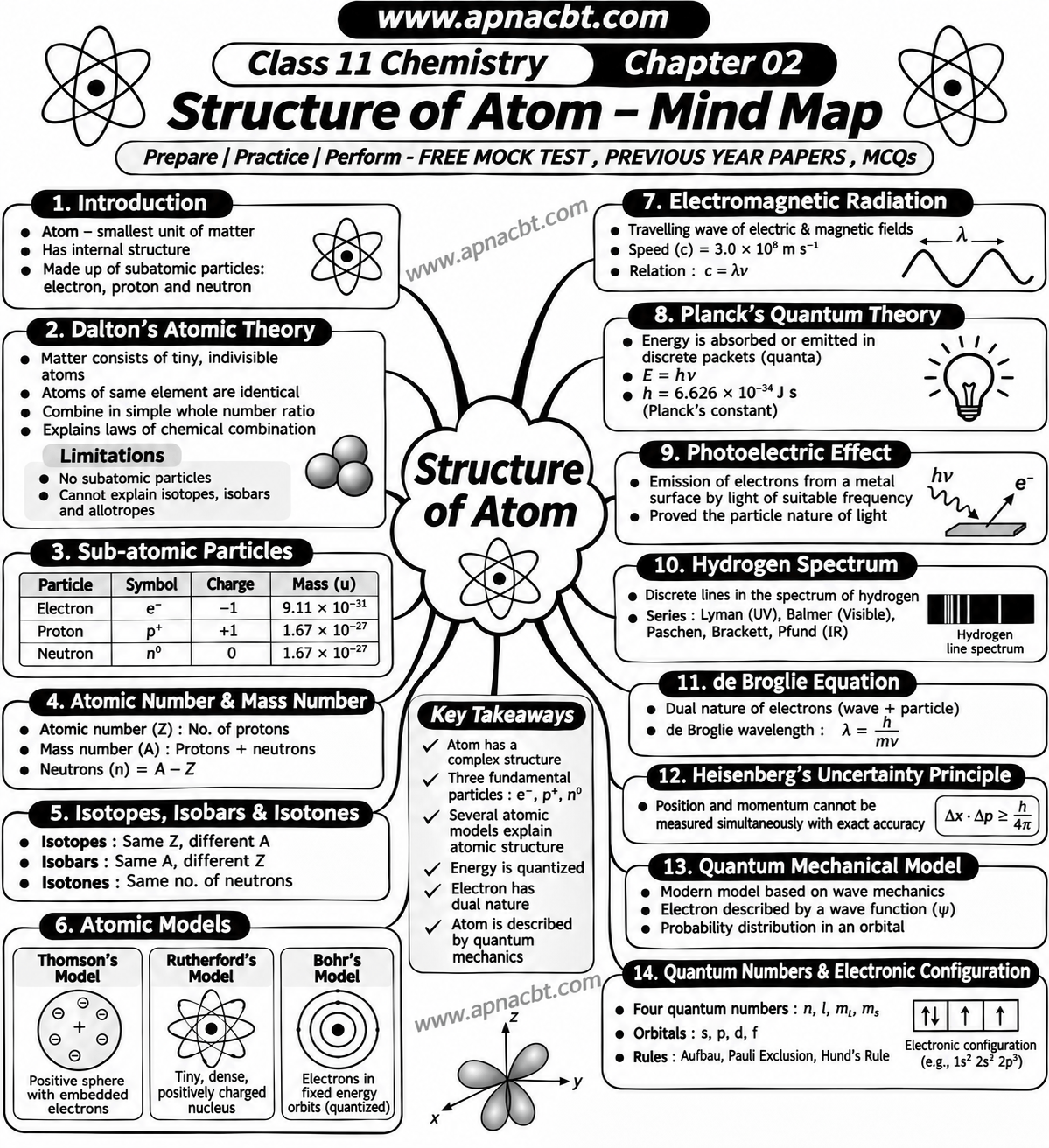
Structure of Atom Class 11 Chemistry – Chapter 02 Mind Map
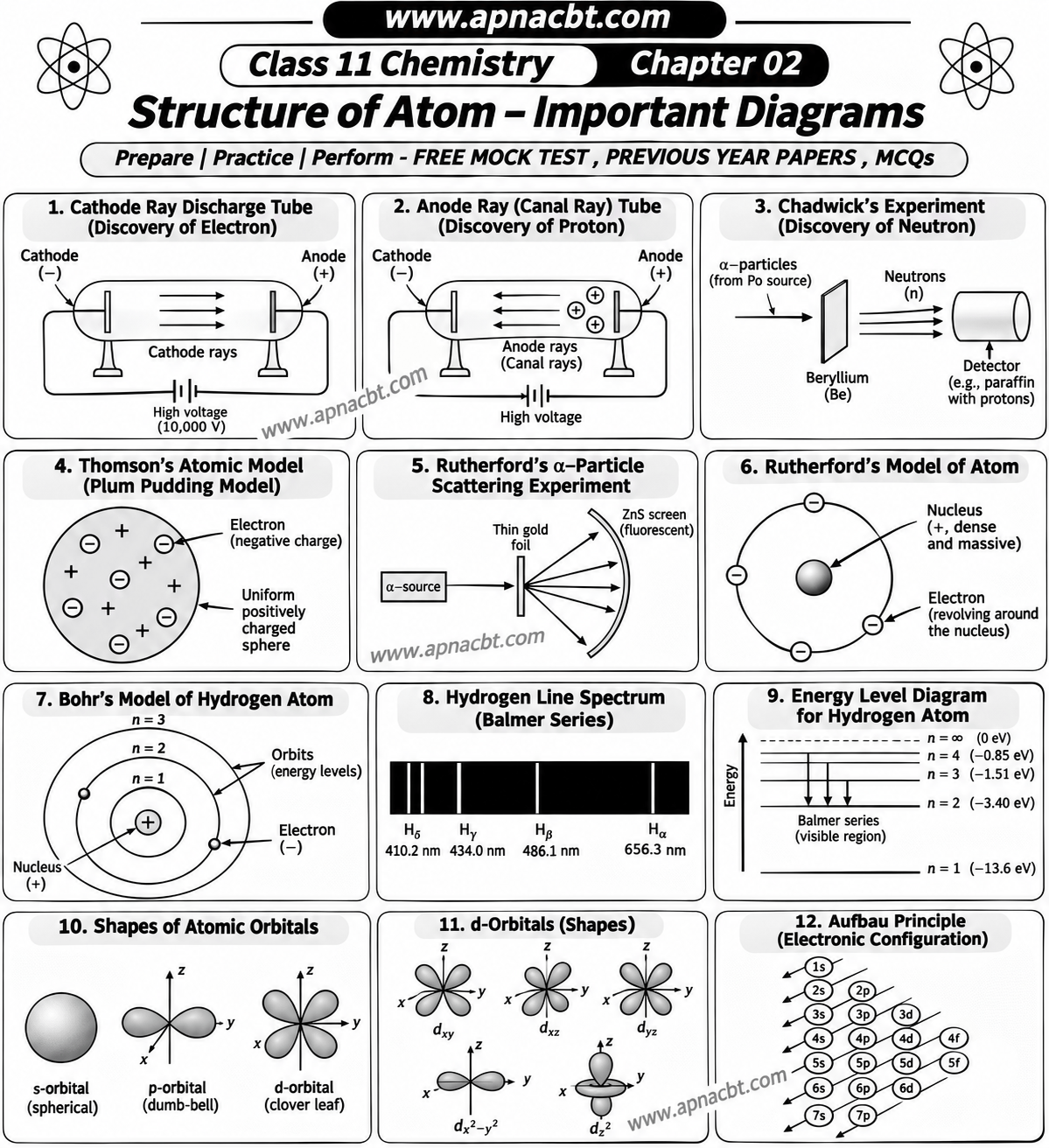
Structure of Atom Class 11 Chemistry – Important Diagrams
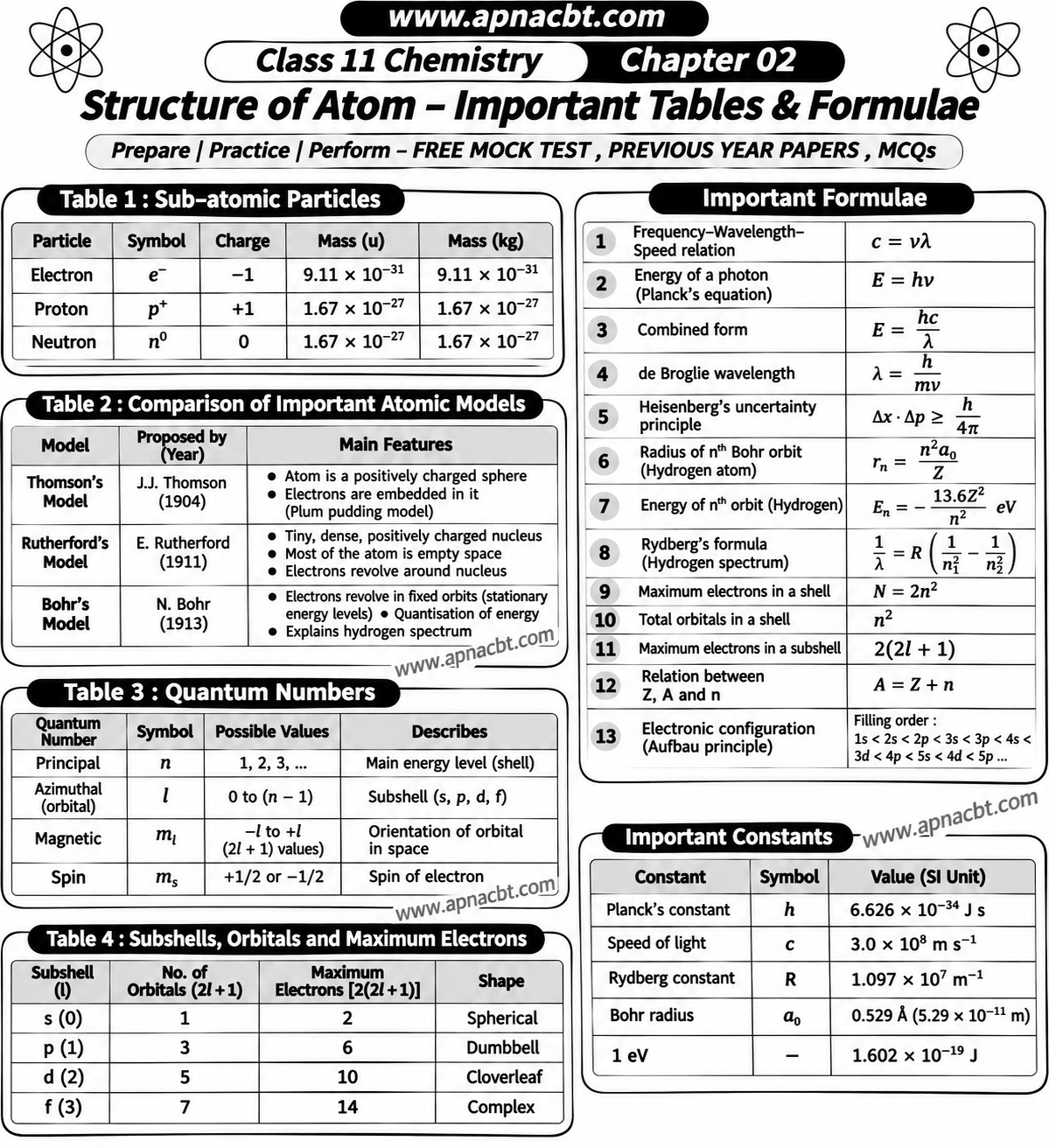
Structure of Atom Class 11 Chemistry – Important Tables and Formulae